Chapter I
A Cell Nobody Wanted
In 1763 the Royal Navy sheathed the hull of HMS Alarm in copper, to stop shipworm boring into the timber. It worked. When the ship was examined, the iron nails holding the copper on had largely dissolved, and the sheathing was in danger of falling off.
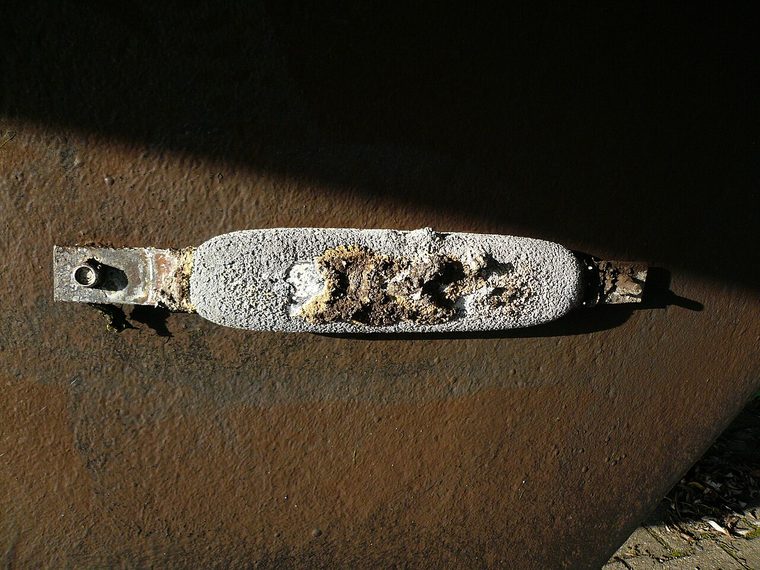
Sixty years later the Admiralty asked Humphry Davy what was happening. His answer was correct and is the foundation of the subject: copper and iron in contact in seawater constitute an electrical cell, and the iron, being the less noble metal, is the one that dissolves. The cure follows from the diagnosis. Attach to the copper a block of some metal still less noble — zinc, or iron itself — and that block will be consumed while the copper, and anything coupled to it, is protected.
Davy's remedy is used today on every ship, pipeline and harbour pile in the world. Its first trial was a failure of a kind worth recording. Protected copper no longer releases copper ions into the water, and it was the copper ions that had been poisoning the shipworm. The Navy got hulls that did not corrode and did foul, and went back to unprotected copper.
What made the subject quantitative was Ulick Evans's demonstration, a century later, that a single metal corroding behaves the same way. Put a drop of salt solution containing an indicator on a clean steel plate and watch: the centre of the drop, where oxygen cannot reach, turns blue as iron dissolves, the rim turns pink as oxygen is reduced, and rust forms in a ring between them. The metal has separated itself into anode and cathode millimetres apart, and the current flowing between them can be measured. Corrosion became electrochemistry rather than description, with a rate in amperes.
Chapter II
Eight Ways Metal Fails
Corrosion engineering classifies failures by form rather than by metal, because the form determines what will stop it. The conventional list is eight, and the distinctions are practical.
Uniform attack removes metal evenly. It is the least dangerous kind, because it can be measured, extrapolated and allowed for as a corrosion allowance in the wall thickness.
Galvanic corrosion is the two-metal couple Davy diagnosed, and its severity depends on the ratio of areas: a small anode joined to a large cathode concentrates all the dissolution into a small place. Steel bolts in a copper plate fail; copper bolts in a steel plate do not.
Pitting and crevice corrosion are the self-sustaining local attacks described above, the first starting at a flaw in a passive film and the second in any gap where solution stagnates — under a washer, a gasket, a barnacle.
Intergranular corrosion follows grain boundaries, and the classic case is a welded stainless steel in which chromium carbides have precipitated at the boundaries during cooling, leaving the adjacent metal depleted in chromium and so unable to passivate. The weld looks sound and falls apart along the lines beside it.
Selective leaching removes one component of an alloy — zinc from brass, leaving a porous copper skeleton with the original shape and almost no strength.
Erosion corrosion is mechanical removal of the protective film by flow, which is why a pipe fails at the elbows and a pump at the impeller tips.
Stress-corrosion cracking needs a tensile stress, a specific environment and a susceptible alloy together; given all three, cracks grow through the metal with almost no general corrosion and no warning. Stainless steel in hot chloride and brass in ammonia are the standard pairs.
Hydrogen embrittlement, often counted with it, is hydrogen generated by the cathodic reaction diffusing into the steel and making it brittle — which is how cathodic protection, applied too aggressively, can destroy the thing it protects.
The list's value is diagnostic. A failed component's appearance identifies the form, the form identifies the mechanism, and the mechanism dictates the remedy — change the alloy, break the couple, eliminate the crevice, relieve the stress, or reduce the flow.
Chapter III
A Closer Look: Why Aluminium Survives and Iron Does Not
Thermodynamics says aluminium should be destroyed. Its standard potential is V against iron's , so it is far more eager to oxidise — and aluminium window frames last decades in the rain while an iron equivalent would be gone. The explanation is not in the thermodynamics but in the oxide, and the decisive quantity can be calculated without any experiment.
Norman Pilling and Richard Bedworth's ratio is the volume of oxide formed divided by the volume of metal consumed:
where is the number of metal atoms in the oxide formula. Work through three metals.
Aluminium, forming : , , , , :
Magnesium, forming : , , , , :
Iron, forming : , , , , :
Now read the three numbers.
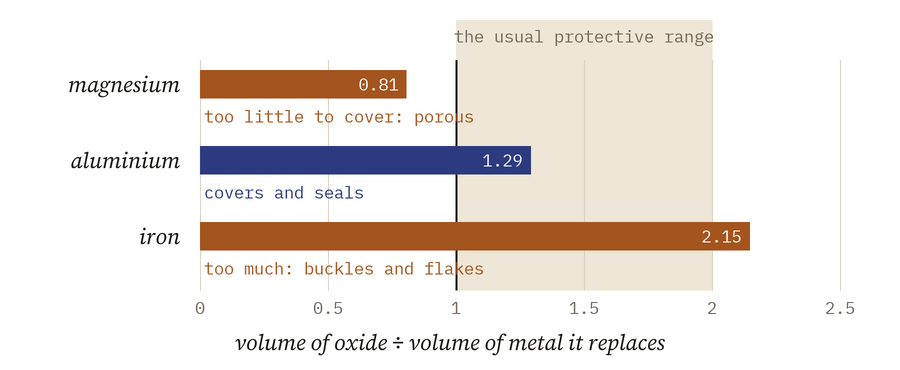
Aluminium's 1.29 is in the protective range. The oxide occupies slightly more space than the metal it replaced, so it covers the surface completely and sits in mild compression — enough to seal, not enough to buckle. The film is 2 to 4 nm thick, it forms within milliseconds of exposure to air, and if scratched it reforms instantly. Everything useful about aluminium follows from that one number being a little above one.
Magnesium's 0.81 is below one: there is not enough oxide to cover the metal. The film is porous by necessity, oxygen reaches the surface through it, and oxidation continues without limit. Magnesium alloys must be coated or they corrode steadily, and magnesium burns.
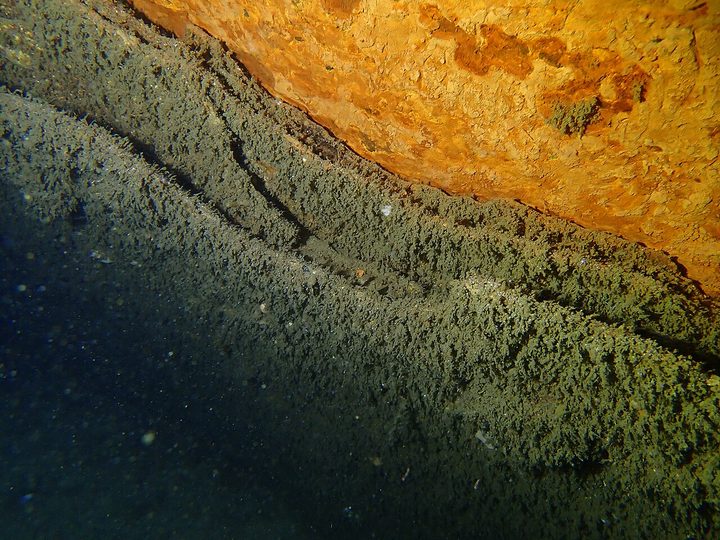
Iron's 2.15 is too large. The oxide occupies more than twice the volume of the metal consumed, so it grows in compression, buckles, cracks and flakes away, exposing fresh metal to repeat the process. Rust is not a protective film; it is a film that keeps failing, which is why iron corrodes to destruction while aluminium stops.
The ratio is a necessary condition and nothing like a sufficient one — it says nothing about whether the oxide conducts ions, adheres, or survives chloride — and it is the only predictive law in the subject that needs no measurement at all. Stainless steel is the ratio exploited deliberately: add more than about 12% chromium to iron and the film that forms is chromium-rich, with a ratio near 2.0 and, crucially, adherent, so the alloy passivates where the iron alone does not.
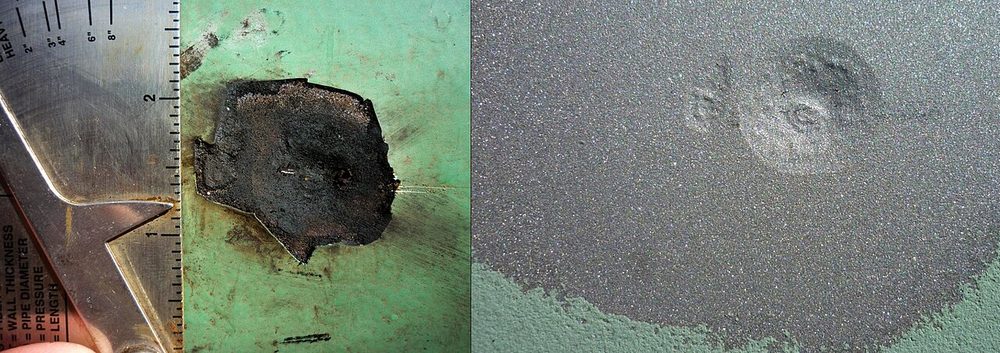
Where the calculation stops being useful. Everything above concerns uniform attack, and uniform attack is rarely what destroys a structure. Stainless steel in seawater does not rust generally; it pits. A chloride ion breaks the film at one point, the metal inside dissolves, the trapped solution becomes acidic by hydrolysis, and the acidity prevents the film from reforming — while the entire passive surface outside serves as the cathode feeding the reaction. A pit a tenth of a millimetre across, with square metres of cathode behind it, can bore through a plate in a year while the plate looks new. That asymmetry of areas, which Davy had identified in the iron nails, is what makes localised corrosion the hardest thing in the field to predict, and the open problem above.
Chapter IV
What It Costs
Two numbers give the scale. Corrosion's direct and indirect cost has been estimated at 3 to 4% of global GDP — of the order of two and a half trillion dollars a year — of which the large majority is not spectacular failure but replacement, inspection, coatings and metal used in excess of what strength requires.
And the longest prediction anyone has been asked for: a geological repository for high-level nuclear waste requires its canisters to resist corrosion for thousands of years, in groundwater whose chemistry will change over that period. No accelerated test can demonstrate it, since accelerating a corrosion test tends to change the mechanism. Only a mechanistic model could justify such a claim, and the mechanism of passive film breakdown — the thing that would have to be modelled — is exactly what remains unsettled.