Skip to content
Field Atlas

Atlas / Chemistry / The Synthesis Thread

Field · Emerged 1967 – 2022

Retrosynthetic Analysis

Given a molecule nobody has made, how is a route to it found — and can the search be done by machine?

4 chapters6 min read6 turning points1 open problem

Branched from
Total Synthesis
Branched into
Not yet surveyed past here
Figures
Elias James Corey, Todd Wipke, Robert Bruce Merrifield, James Hendrickson, Barry Trost, Roger Sheldon, Martin Burke, Lee Cronin, Marwin Segler, Mike Preuss, Mark Waller, Bartosz Grzybowski

In brief

Until the 1960s, planning a synthesis was a craft taught by apprenticeship. Elias James Corey gave it a logic. Work backwards: take the target, identify a bond whose formation corresponds to a reaction you trust, and break it on paper, leaving two simpler fragments. Repeat on each fragment until everything can be bought. The analysis is a tree, the breaks are called disconnections, and the fictitious fragments they leave are synthons, which must then be matched to real reagents.

Stated that way, route planning is a search problem, and Corey said so immediately — he and Todd Wipke had a program attempting it by 1969. The difficulty is the size of the tree. A molecule of moderate complexity offers tens of plausible disconnections, each leading to fragments offering tens more, so a ten-step plan sits somewhere in 101010^{10} to 101710^{17} possibilities, with no way to score a position as chess can. Fifty years of rule-based programs made little impression. Neural networks trained on the tens of millions of reactions in the literature, searching the tree by the method that had beaten human players at Go, did better: in 2018 chemists shown machine-generated routes and literature routes could not reliably tell them apart.

Key ideas

DisconnectionEnters 1967 – 1989

Breaking a bond in the target on paper, in the reverse direction of a reaction known to form it. The arrow is drawn backwards, from product to precursors, to mark that this is analysis and not a proposal about what happens in a flask.

SynthonEnters 1967 – 1989

An idealised fragment left by a disconnection — often a charged species that does not exist as such — which must then be matched to a real, available reagent that behaves equivalently.

Strategic bondEnters 1969 – 1985

Not all disconnections are equal. Breaking a bond that simplifies the ring system, or that sits between two halves of similar size, reduces the problem far more than breaking a peripheral one — which is why the analysis is guided by heuristics rather than enumerated.

Protecting groupEnters 1963 – 1990

A temporary modification that blocks a reactive site so a reagent attacks elsewhere, removed afterwards. Orthogonal sets can be removed independently, which is what allows several sites to be managed at once — at the price of two steps per group that build nothing.

Atom economyEnters 1975 – 1992

The fraction of the mass of all reactants that ends up in the product. It measures what conventional yield hides: a reaction can give 95% yield and discard most of the atoms it consumed.

Tree search with a learned policyEnters 2018 – 2022

Explore the retrosynthetic tree by sampling, using a network trained on known reactions to suggest which disconnections are worth trying and another to judge whether a fragment looks purchasable. It is the method that made machine route-finding work, and it came from game playing.

Draws on other domains

Chapter I

Working Backwards

Asked how to make a molecule, the natural impulse is to start from something available and build. Elias James Corey's insight, formalised in 1967, is that the search is far better conducted from the other end.

Take the target. Find a bond in it whose formation corresponds to a reaction you trust. Break that bond on paper — a disconnection, drawn with a special arrow to signal that this is analysis rather than a claim about what happens in a flask — and you are left with two simpler pieces. Repeat on each piece. Stop when everything in hand can be ordered from a catalogue. Reverse the whole thing and you have a plan.

Two features make this more than a change of direction. The fragments a disconnection leaves are often not real substances — one half may be a carbon atom bearing a negative charge — and Corey called these synthons, idealised pieces that must subsequently be matched to real reagents that behave equivalently. And not all disconnections are worth making: breaking a bond that dismantles a ring system, or that divides the molecule into halves of comparable size, simplifies the problem enormously, while breaking a peripheral bond barely helps. Corey's term for the first kind is a strategic bond, and recognising them is what the method teaches.

The result was a curriculum. Synthesis planning had been a tacit skill acquired by watching; after 1967 it could be set as an exercise, and that is most of why Corey's influence on the field exceeded even his own syntheses.

Chapter II

What a Metric Changed

Running alongside the planning problem is a measurement problem: what makes one route better than another?

Yield alone is a poor answer, because it says nothing about what was consumed. Barry Trost's atom economy — the fraction of the total mass of reactants that ends up in the product — exposes reactions that proceed in 95% yield while discarding four fifths of the atoms they used, which a great many classical reactions do. Roger Sheldon then defined the E-factor, kilograms of waste per kilogram of product, and published the figures that followed from it: around 1 for bulk chemicals, 5 to 50 for fine chemicals, and 25 to 100 for pharmaceuticals, most of it solvent.
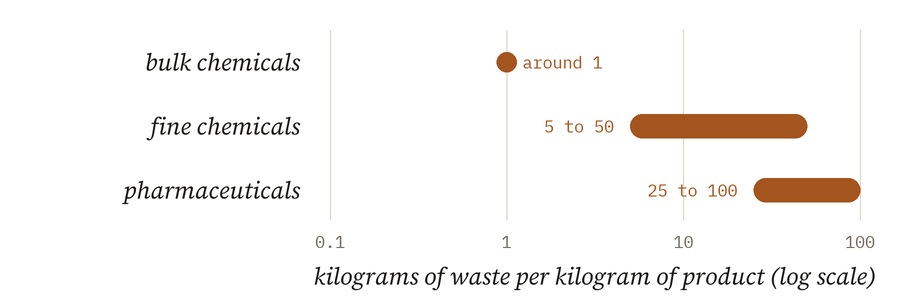
Waste per kilogram of product on a log scale, around 1 for bulk chemicals, 5 to 50 for fine chemicals and 25 to 100 for pharmaceuticals.
Sheldon's E-factors: kilograms of waste per kilogram of product. The smaller the volume of a product, the more waste each kilogram of it carries.Drawn for Field Atlas from the numbers above · Field Atlas original · Source

James Hendrickson had already defined the standard those numbers are measured against. In an ideal synthesis every step builds skeleton, nothing is protected and unprotected, nothing is purified between steps. Real routes fall short mainly through protecting groups — a third of the steps in a long synthesis may install and remove them, contributing nothing to the structure — which is the cost of using reagents less selective than enzymes, and the subject of the next field.

Publishing those numbers changed behaviour, which metrics in science do not always do. Process chemists now report E-factors, companies set targets for them, and the difference between a medicinal chemist's first route and the manufacturing route is routinely a halving of the step count.

Chapter III

A Closer Look: The Size of the Tree

Return to the planning problem itself. Corey saw at once that a procedure this explicit could be given to a computer, and by 1969 he and Todd Wipke had LHASA running. The programme of the next fifty years was to make it work. The obstacle is arithmetic.

Consider the branching. A molecule of moderate complexity offers somewhere between ten and a hundred disconnections that a chemist would take seriously. Each produces fragments that offer about as many again. For a route of depth dd with branching factor bb, the number of distinct routes is of order bdb^{d}:

Branching factorDepth 5Depth 10
1010510^{5}101010^{10}
503×1083\times10^{8}101710^{17}

For comparison, chess has a branching factor around 35 and games of about 80 moves; Go has around 250 and 150. Retrosynthesis sits between them in size — and lacks the one thing that makes game search tractable. In chess a position can be scored: count material, assess structure, and you have an estimate of how good it is. In retrosynthesis there is no reliable function that looks at a set of fragments and says how close they are to being purchasable, because the answer depends on the whole of chemical practice.
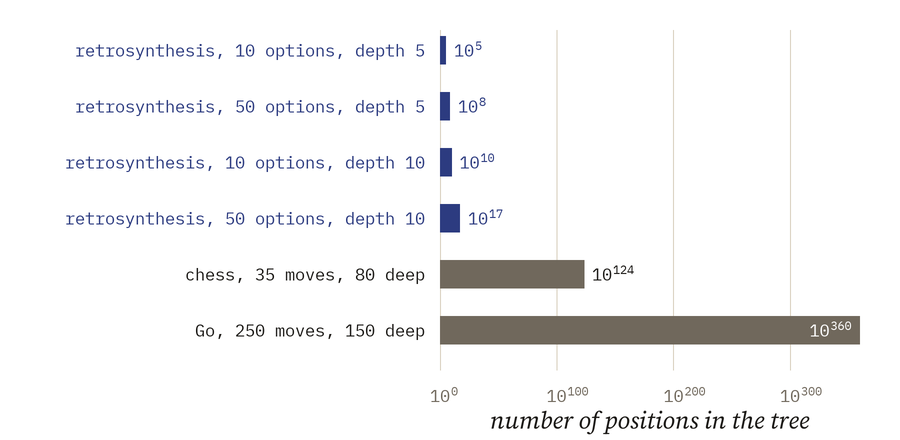
Bars on a scale of powers of ten, retrosynthesis trees from 10 to the 5 up to 10 to the 17, chess at 10 to the 124 and Go at 10 to the 360.
Tree sizes as powers of ten, counted as branching factor raised to the depth. A retrosynthesis tree is tiny next to chess or Go; what it lacks is a way to score a position.Drawn for Field Atlas from the numbers above · Field Atlas original · Source

Rule-based programs failed on exactly this. They could generate the tree — that was never the difficulty — and could not rank what they generated, so they handed the chemist thousands of suggestions, which is less useful than handing over none.

What changed is that both missing pieces were learned rather than written. Marwin Segler, Mike Preuss and Mark Waller trained one network on roughly 12 million published reactions to propose which disconnections are plausible for a given structure, a second to filter proposals that would not actually work, and a third to estimate whether a fragment is reachable. The tree is then explored by Monte Carlo tree search — sample a path to the end, use the outcome to update which branches are worth revisiting — which is the method that had just beaten human players at Go.

The result in 2018 was a system about thirty times faster than its rule-based predecessors, finding routes for molecules absent from its training set. The evaluation is the part worth noting: chemists were shown pairs of routes, one from the literature and one from the machine, without being told which was which, and rated them as equally plausible. In the same year Bartosz Grzybowski's group took eight computer-planned routes into the laboratory and executed all eight.

Chapter IV

Planning Is Not Making

The gap that remains is the one recorded in the open problem above, and it has widened as planning improved. Software proposes routes that chemists accept as reasonable. Turning such a route into material still requires a trained person to choose a solvent, a temperature, a concentration and a work-up, to recognise why a step produced tar, and to judge when a branch is not worth pursuing.

Part of the reason is in the data. The literature records what worked, in conditions chosen after unreported optimisation, with yields that are systematically optimistic. It almost never records what failed. A planner trained on that corpus learns what good chemistry looks like and has no training signal at all for the judgement a chemist uses most — recognising a route that will not survive contact with a flask.

The automated platforms attack the other half. Martin Burke's machine builds molecules from standardised blocks by one repeated coupling-and-deprotection cycle with a common purification, and Lee Cronin's executes published procedures from a machine-readable description. Both work, for the chemistry that fits their format, which is a small fraction of chemistry. The thing neither has is the thing the next field is about: reactions selective enough that most of the protecting and blocking could be dispensed with altogether.

Applications

Where it is used

  • Pharmaceutical process chemistry

    Choosing the route that can be run at a tonne

    A medicinal chemist's route makes milligrams; manufacturing needs tonnes, with constraints the first route ignores — no chromatography, no reagents that explode at scale, solvents that can be recovered, and an E-factor the regulator and the accountant will both accept. Process chemistry is retrosynthetic analysis performed again under those constraints, and it routinely cuts step counts by half or more.

    › Sources (1)
    • Caron, S. & Thomson, N. M. (2015). Pharmaceutical process chemistry: evolution of a contemporary data-rich laboratory environment. Journal of Organic Chemistry 80: 2943–2958.
  • Search algorithms↗ Mathematics · Computational Complexity

    A tree too large to enumerate

    Retrosynthesis is a search over a branching tree with no exact evaluation function, which is the shape of problem that defeated rule-based programs for fifty years and that Monte Carlo tree search with learned policies solved for board games. The transfer went in that direction — from game playing to chemistry — and it is among the clearest cases of an algorithm designed for one domain working in another because the two share a structure.

    › Sources (1)
    • Segler, M. H. S., Preuss, M. & Waller, M. P. (2018). Planning chemical syntheses with deep neural networks and symbolic AI. Nature 555: 604–610.
  • Green chemistry

    Counting the waste

    The E-factor made visible something yield conceals. Producing a kilogram of a pharmaceutical generates on the order of 25 to 100 kilograms of waste, most of it solvent, against about 1 to 5 for a fine chemical and under 1 for a bulk commodity. Reporting that number changed which routes companies chose, which is an unusually direct case of a metric altering practice.

    › Sources (1)
    • Sheldon, R. A. (2017). The E factor 25 years on. Green Chemistry 19: 18–43.

Open problems

Where the map runs out

Open

From a planned route to a working one

Open as of 2026; machine planning is useful and machine execution of an arbitrary plan is not.

Planning and doing have come apart. Software now proposes routes that chemists judge reasonable, and the step from a proposed route to material in a flask still requires a trained person: choosing solvents, temperatures, concentrations and work-ups, diagnosing why a step gave tar, and deciding when to abandon a branch. The literature the planners learn from records what worked and almost never what failed, so the models have no training signal for the most useful judgement of all.

Why it is hard

Reaction conditions are high-dimensional, interact, and are reported inconsistently; negative results are unpublished; and yields in the literature are optimistic and irreproducible often enough to matter. A planner trained on successes cannot learn to avoid failures it has never seen, and automated platforms handle only reaction classes that fit their hardware.

What resolving it unlocks

A molecule designed on a screen and delivered without a specialist would change the pace of drug and materials discovery, where synthesis is usually the slowest stage.

› Sources (2)
  • Coley, C. W. et al. (2019). A robotic platform for flow synthesis of organic compounds informed by AI planning. Science 365: eaax1566.
  • Strieth-Kalthoff, F., Sandfort, F., Segler, M. H. S. & Glorius, F. (2020). Machine learning the ropes: principles, applications and directions in synthetic chemistry. Chemical Society Reviews 49: 6154–6168.

Further reading

  1. Corey, E. J. & Cheng, X.-M. (1989). The Logic of Chemical Synthesis. Wiley.

    The method stated by its author, with a hundred worked analyses.

  2. Hoffmann, R. W. (2009). Elements of Synthesis Planning. Springer.

    Shorter and more candid about the trade-offs, including when to accept a longer route.

  3. Segler, M. H. S., Preuss, M. & Waller, M. P. (2018). Planning chemical syntheses with deep neural networks and symbolic AI. Nature 555: 604–610.

    The paper that made machine planning work, and clear about what it is and is not doing.