Skip to content
Field Atlas

Atlas / Chemistry / The Synthesis Thread

Field · Emerged 1856 – 1994

Total Synthesis

Can a complicated natural molecule be built from simple commercial starting materials, and what is proved by doing so?

4 chapters5 min read6 turning points1 open problem

Branched from
Stereochemistry
Branched into
Cross-Coupling and Bond Construction + Retrosynthetic Analysis
Figures
William Henry Perkin, Gustaf Komppa, Robert Woodward, William Doering, Albert Eschenmoser, Yoshito Kishi, K. C. Nicolaou, Robert Holton

In brief

A total synthesis is the construction of a naturally occurring molecule from materials bought in a bottle. It began as an industrial accident — William Perkin, trying to make quinine at eighteen, made a purple dye instead and founded an industry — and became, for most of the twentieth century, the discipline's demonstration of competence. Before spectroscopy could determine a structure, synthesis was the proof: make the substance by a route in which every step's outcome is known, and if the product is identical to the natural material, the structure was right.

Robert Woodward made it a form of design rather than a trial. His syntheses of quinine, cholesterol, strychnine, reserpine and finally vitamin B12 — the last with Albert Eschenmoser, a hundred collaborators and eleven years — were planned in advance, with the stereochemistry of each step controlled on purpose. The arithmetic is unforgiving, though. A linear route of forty steps, each running at a very respectable 90% yield, delivers one and a half per cent of the theoretical product, which is why strategy in this field is mostly about avoiding long linear sequences.

Key ideas

Total synthesisEnters 1856

Building a target molecule from simple, commercially available compounds, with no step relying on material isolated from a natural source. A partial or formal synthesis starts from an advanced natural product, which is a weaker claim.

Synthesis as structure proofEnters 1903 – 1907

Before spectroscopy, the best evidence for a proposed structure was to build that structure by unambiguous steps and compare the product with the natural substance. The logic runs the other way now, and the practice is still used to confirm contested assignments.

Overall yieldEnters 1951 – 1958

The product of every step's yield. Because it is a product rather than an average, long sequences are punished exponentially: forty steps at 90% give 1.5%, and at 80% give 0.013%.

Longest linear sequenceEnters 1960 – 1973

The length of the longest unbranched chain of steps in a route. Since only that chain multiplies through to the final yield, a convergent plan that joins two shorter branches late beats a linear plan of the same total length by orders of magnitude.

StereocontrolEnters 1989 – 1994

Arranging each step so that it produces one of the possible three-dimensional outcomes rather than a mixture. With nn centres there are 2n2^{n} possibilities, so control is not optional for anything complicated.

Chapter I

An Accident That Founded an Industry

In 1856 William Henry Perkin was eighteen, working at the Royal College of Chemistry under Hofmann, and spending his Easter holiday trying to make quinine in a laboratory at home. The attempt was hopeless in a way nobody could have known: quinine's composition was known, its structure was not, and Perkin's plan amounted to oxidising something of roughly the right formula and hoping. He got a black precipitate, and when he washed it with alcohol the liquid turned brilliant purple.

He recognised a dye, patented it, persuaded his father to finance a works, and had mauveine in commercial production within two years. The consequences were out of all proportion: a synthetic dye industry, the German chemical firms that grew to dominate it, and the demonstration that a laboratory could manufacture a substance better than nature supplied it.
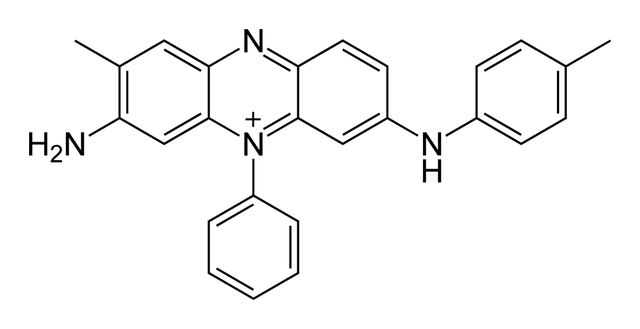
The skeletal structure of mauveine A, a central three-ring system bearing a phenyl group, an amino group and a tolyl-amino group.
Mauveine A, the main component of Perkin's dye. He was trying to make quinine; the dye came from impurities in his aniline.Benjah-bmm27 · Public domain · Source

The first deliberate synthesis of a complex natural product at scale came in 1903, and the motive was supply. Camphor was needed for celluloid and for smokeless powder, and came from a Taiwanese tree under monopoly control. Gustaf Komppa built it, establishing its structure in the process, and a Finnish plant was making it by 1907. Those two motives — prove a structure, escape a monopoly — have driven the field ever since.

Chapter II

Synthesis as Proof, and as Design

Before spectroscopy, a proposed structure could be confirmed in only one way that was fully convincing: build that structure by steps whose outcomes are individually known, and compare the product with the natural substance. Every degradation is ambiguous — fragments could have come from several arrangements — whereas a synthesis that arrives at the same substance from a known starting point leaves little room for argument. Structure determination and synthesis were therefore one activity.

Robert Woodward changed what the activity was. Between 1951 and 1958 his group completed cholesterol, cortisone, strychnine, lysergic acid, reserpine and chlorophyll, and the difference from earlier work was that the routes were planned. Each step was chosen because its stereochemical outcome could be predicted, using the conformational reasoning Barton had just introduced to decide which face of a ring a reagent would attack. Woodward reportedly worked out the reserpine route on paper before any of it was attempted.

The culmination was vitamin B12: a corrin ring, nine stereocentres, a cobalt atom, no useful symmetry. Woodward at Harvard and Albert Eschenmoser at Zurich ran it jointly with about a hundred collaborators over eleven years, building two halves separately and joining them. The project's most durable product was a by-product. A ring closure gave the wrong stereochemistry, reproducibly; thinking about why sent Woodward to Roald Hoffmann, and the answer was the orbital symmetry rules.
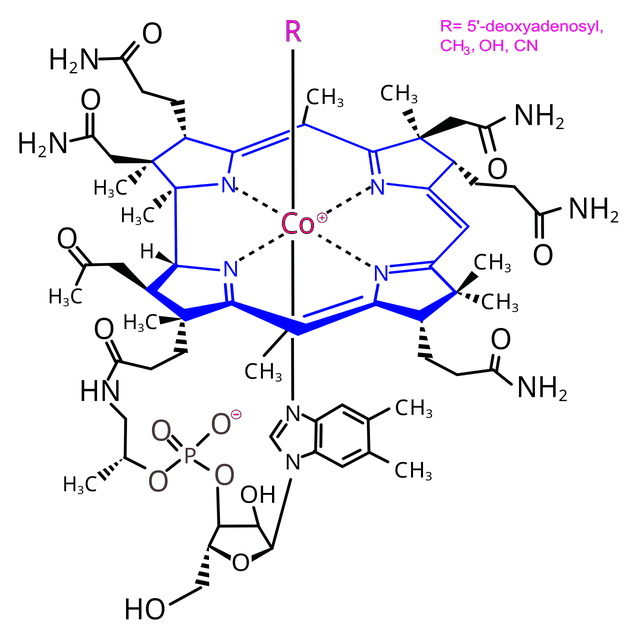
The skeletal structure of vitamin B12, a large corrin ring around a cobalt atom with amide side chains and a nucleotide loop below.
Vitamin B12: a corrin ring around a cobalt atom, with the bonds of the ring drawn in blue. Woodward and Eschenmoser's groups completed it in 1972.RicHard-59 · Public domain · Source

Chapter III

A Closer Look: Why Convergent Beats Linear

The arithmetic of a multi-step synthesis is harsher than intuition allows, because yields multiply.

A step that gives 90% of the theoretical product is a good step. Forty of them in sequence give

0.9040=e40ln⁡0.9=e−4.21=0.0148,0.90^{40} = e^{40\ln 0.9} = e^{-4.21} = 0.0148,

one and a half per cent. At 80% per step — still a publishable yield — forty steps give

0.8040=e−8.93=1.3×10−4,0.80^{40} = e^{-8.93} = 1.3\times10^{-4},

about one part in eight thousand. To finish with a gram of product requires nearly eight kilograms of the first intermediate, before accounting for the mass lost as the molecular weight changes.

Steps95% each90% each80% each
1060%35%11%
2036%12%1.2%
4013%1.5%0.013%

Now the strategic point. Only the longest linear sequence multiplies through to the final product. Suppose a target needs 40 bond-forming operations. Done as one chain at 90% per step, the yield is 1.5%. Done as two branches of 20 steps each, built separately and joined in a final coupling, the longest linear sequence is 21 steps, and

0.9021=e−2.21=0.109,0.90^{21} = e^{-2.21} = 0.109,

eleven per cent — a sevenfold improvement from rearranging the same chemistry. The gain is larger still in practice, because each branch can be made in quantity on its own schedule, and a failure late in one branch does not destroy material from the other. This is why convergent, fragment-coupling design has been the dominant strategy since the 1970s, and why a long linear route is read as a planning failure rather than as diligence.
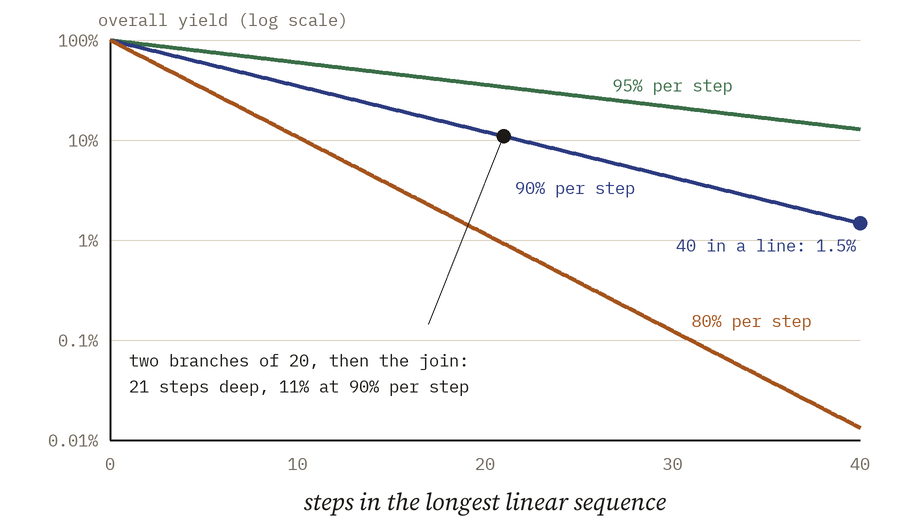
Three falling lines of overall yield against number of steps on a log scale, for 95, 90 and 80 per cent per step, with 40 steps at 90 per cent reaching 1.5 per cent and a 21-step convergent route at 11 per cent.
Overall yield against the length of the longest chain. At 90% a step, forty in a line leave 1.5%; the same forty split into two branches of twenty, then joined, leave 11%.Drawn for Field Atlas from the numbers above · Field Atlas original · Source

The second number worth stating is the stereochemical one. Yoshito Kishi's palytoxin has 64 stereocentres. The number of distinct stereoisomers is

264=1.8×1019,2^{64} = 1.8\times10^{19},

and the synthesis had to deliver one of them. Nothing about this is achievable by purification: the isomers are mostly diastereomers, separable in principle, and there are ten billion billion of them. Every centre has to be set correctly at the step that creates it. That is what stereocontrol means operationally, and why asymmetric catalysis and the methods of the next two fields mattered so much more than any individual target.

Chapter IV

What the Field Is For Now

The obstacles have moved. Complexity is no longer the barrier — palytoxin settled that — and structure determination has passed almost entirely to spectroscopy and crystallography. What remains is efficiency, and the comparison is with biology.

A plant builds a complex alkaloid in perhaps ten enzymatic steps from primary metabolites, in water, at ambient temperature, with no protecting groups and no purification between steps. The laboratory equivalent runs to twenty, forty, sixty steps, of which a large fraction install and remove protecting groups and so add no structure at all. The reason is selectivity: an enzyme acts on one site, while a laboratory reagent attacks everything of a given type, so everything else must be blocked first.

That gap is this field's open problem, and the two responses to it are the subjects that follow. One is to plan better, which is retrosynthetic analysis and now machine search. The other is to invent reactions selective enough that blocking becomes unnecessary, which is cross-coupling and the long pursuit of functionalising one carbon–hydrogen bond out of forty.

Applications

Where it is used

  • Medicine↗ Biology · Pharmacology

    Supplying a drug that a plant makes slowly

    Taxol was isolated from the bark of the Pacific yew at a yield that would have required felling tens of thousands of mature trees per year of treatment for a modest patient population. Total synthesis solved the structural question and semi-synthesis from a related compound in yew needles, then plant cell culture, solved the supply. Artemisinin followed a similar path, with a semi-synthetic route from engineered yeast providing a buffer against crop failure.

    › Sources (2)
    • Cragg, G. M. (1998). Paclitaxel (Taxol): a success story with valuable lessons for natural product drug discovery. Medicinal Research Reviews 18: 315–331.
    • Paddon, C. J. et al. (2013). High-level semi-synthetic production of the potent antimalarial artemisinin. Nature 496: 528–532.
  • Structure determination

    The proof of last resort

    Spectroscopy has replaced synthesis as the normal route to a structure, and synthesis remains the arbiter when spectroscopy is ambiguous. Several natural product structures assigned from spectroscopic data have been revised after a synthesis of the proposed structure gave a substance with different spectra — which is a strong argument, since the synthetic route's outcome is known step by step.

    › Sources (1)
    • Nicolaou, K. C. & Snyder, S. A. (2005). Chasing molecules that were never there: misassigned natural products. Angewandte Chemie International Edition 44: 1012–1044.
  • Training

    What the field was for

    For much of the twentieth century a total synthesis was how a research group demonstrated competence and how a graduate student was trained, which is why so many methodological advances — new reactions, new protecting groups, new ways of controlling stereochemistry — were reported as part of a campaign towards some natural product. The target was often less valuable than the methods invented on the way to it.

    › Sources (1)
    • Seeman, J. I. (2007). The Woodward–Doering/Rabe–Kindler total synthesis of quinine. Angewandte Chemie International Edition 46: 1378–1413.

Open problems

Where the map runs out

Open

Making a complex molecule in few steps

Open as of 2026; state-of-the-art routes to complex natural products still run to dozens of steps.

A plant assembles a complex alkaloid in perhaps ten enzymatic transformations from primary metabolites, in water, at ambient temperature, with no protecting groups and no purification between steps. The corresponding laboratory synthesis typically takes twenty to sixty steps, a third of which do nothing but attach and remove protecting groups, with an overall yield below a few per cent. The gap has narrowed since the 1970s and has not closed.

Why it is hard

Laboratory reagents are promiscuous where enzymes are selective, so the chemist blocks everything that must not react and unblocks it later — steps that add no structure. Selectivity between chemically similar sites, control of stereochemistry without a chiral environment built for the purpose, and the need to purify after each step all push the count up.

What resolving it unlocks

Step count determines whether a molecule can be made at the scale a medicine requires. Several effective natural-product drugs are supplied by fermentation or semi-synthesis because the total synthesis, though accomplished, is not economic.

› Sources (2)
  • Hendrickson, J. B. (1975). Systematic synthesis design. Journal of the American Chemical Society 97: 5784–5800.
  • Wender, P. A., Verma, V. A., Paxton, T. J. & Pillow, T. H. (2008). Function-oriented synthesis, step economy, and drug design. Accounts of Chemical Research 41: 40–49.

Further reading

  1. Nicolaou, K. C. & Sorensen, E. J. (1996). Classics in Total Synthesis. VCH.

    Thirty landmark syntheses worked through step by step, with the strategy explained.

  2. Seeman, J. I. (2007). The Woodward–Doering/Rabe–Kindler total synthesis of quinine. Angewandte Chemie International Edition 46: 1378–1413.

    A hundred pages on one disputed claim, and the best account of what "total" means.

  3. Hoffmann, R. W. (2009). Elements of Synthesis Planning. Springer.

    How routes are actually designed, including the arithmetic of yields and step counts.