Chapter I
A Crisis Made of Two Substances
Silver fulminate detonates when struck. Silver cyanate does not. Justus Liebig analysed the first and Friedrich Wöhler the second, and the compositions came out the same. Each suspected the other of carelessness; neither was careless. Berzelius, whose analytical authority was unquestioned, checked and accepted the result in 1830, naming the phenomenon isomerism.
This was a crisis rather than a curiosity, because composition was the whole of what chemistry could determine. If two substances can have identical composition, then composition does not identify a substance, and the thing that distinguishes them is something for which no notation and no concept existed.
The resolution took thirty years and arrived as a proposal about carbon. August Kekulé and Archibald Scott Couper argued in 1857–58 that carbon forms four bonds and — the decisive part — that carbon atoms bond to each other. A molecule is then a specific pattern of connections: a chain, a branched chain, a ring. Alexander Butlerov stated the principle in 1861: the properties of a compound are determined by its structure, and each compound has exactly one.
The claim is testable, and sharply so, because the number of distinct structures a formula permits is a matter of counting. allows two arrangements and two butanes were known; allows three and three pentanes were known; allows five. A theory of arrangement predicts isomer counts, and the counts came out right — which is why structure theory was accepted quickly, and also why chemistry became a source of problems for combinatorics.
Chapter II
Why That Ring Is So Stable
Benzene's isomer counts were explained. Its behaviour was not. A compound with three double bonds should be eager to add things across them; benzene prefers to have a hydrogen replaced and keep the ring intact, and its heat of hydrogenation is some 150 kJ/mol less than three separate double bonds would predict. Chemists called this aromaticity, after the smell of the compounds in which it was first met, and used benzene itself as the definition.
Erich Hückel supplied a criterion in 1931 using a drastically simplified molecular orbital calculation — the method described under quantum chemistry. For a flat ring of carbons sharing delocalised electrons, the orbital energies come out in a pattern such that the stable, closed-shell arrangements occur at electrons: 2, 6, 10, 14. Benzene has six and is exceptionally stable. Cyclobutadiene has four, falls in the case, and is so unstable it was not isolated until 1965 and only then trapped in frozen argon.
A property defined by resemblance had become a count. It has not become a measurement, though, which is the open problem recorded above: the stability criterion needs an imaginary reference molecule, the magnetic criterion measures a response, and the two disagree on a growing list of compounds.
Chapter III
A Closer Look: Finding a Position Without Seeing It
Return to the ring itself, because the way its isomers were told apart is a piece of reasoning rather than a measurement, and it needed no instrument at all.
Kekulé's ring explains the isomer counts immediately. There is one monosubstituted benzene, because all six positions are equivalent in a ring. There are three disubstituted ones, because the second substituent can be adjacent to the first, one position further round, or opposite — what chemists came to call ortho, meta and para. Three isomers were known, so the ring survived its first test.
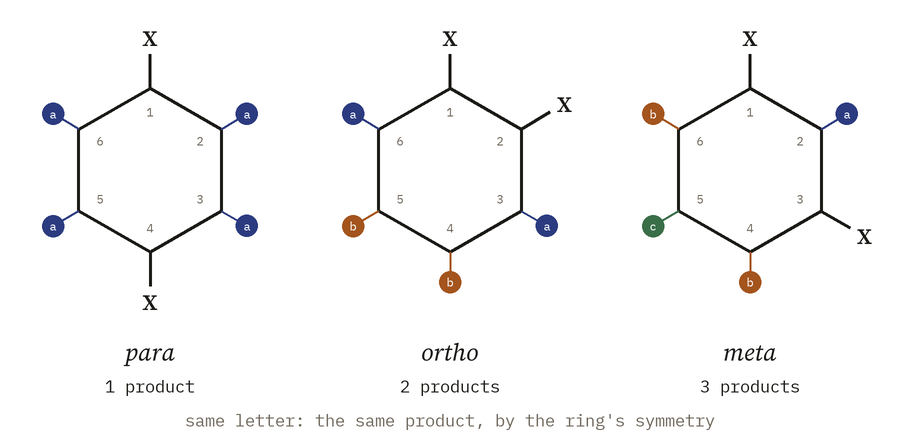
But which known isomer was which? Nothing in their chemistry distinguishes them, and no instrument in 1874 could look. Wilhelm Körner found the answer in a count. Take each disubstituted isomer, add a third identical substituent, and ask how many distinct trisubstituted products it can give.
Number the ring 1 to 6 and put the two substituents down:
| Starting isomer | Free positions | Distinct products |
|---|---|---|
| para, 1 and 4 | 2, 3, 5, 6 — all equivalent by symmetry | 1 |
| ortho, 1 and 2 | 3, 4, 5, 6 — equivalent in pairs (3≡6, 4≡5) | 2 |
| meta, 1 and 3 | 2, 4, 5, 6 — position 2 alone, 4≡6, 5 alone | 3 |
Work through the middle row to see how it goes. With substituents at 1 and 2, the mirror plane running between them maps position 3 onto 6 and 4 onto 5, so adding the third group at 3 gives the same substance as adding it at 6. Two distinct products, no more.
So the isomer that yields a single trisubstituted product is para; the one that yields two is ortho; the one that yields three is meta. Körner carried out the substitutions, counted the products and assigned all three. The positions of atoms in a molecule were established by pure combinatorics on a hexagon, from a theory that had been proposed nine years earlier, using no observation of the molecule at all.
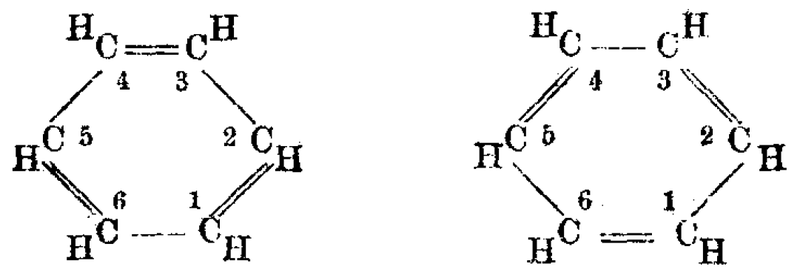
Two further notes make the episode more interesting, not less. Kekulé's alternating single and double bonds are wrong: all six bonds in benzene are identical, as the equivalence of the positions already hints and as Kathleen Lonsdale's X-ray work confirmed in 1929 when she showed the ring is flat with equal bond lengths — described under crystallography. And the famous story of the dream of a snake seizing its own tail was told by Kekulé twenty-five years after the fact, at a banquet in his honour, and historians treat it as reconstruction. Josef Loschmidt had meanwhile drawn ring diagrams in a privately printed pamphlet of 1861, which is one of chemistry's unresolved priority questions.
Chapter IV
Shape Without Changing Anything
The last layer took until 1950 and is easy to underestimate. A structural formula fixes connectivity and says nothing about the arrangement single bonds can rotate into. For a long time that rotation was assumed to be free and therefore unimportant.
Odd Hassel showed by electron diffraction that cyclohexane is not a flat hexagon but a puckered chair, in which six hydrogens stand roughly vertical and six roughly horizontal. Derek Barton then argued in 1950 that this matters enormously for reactivity: a group in the vertical position is hindered and reacts slowly, the same group in the horizontal position does not, and steroid chemistry — where the anomalies had been accumulating for years — becomes intelligible once each substituent's orientation is specified. Two compounds with identical structural formulas, differing only in which ring conformation they prefer, can react at rates differing by orders of magnitude.
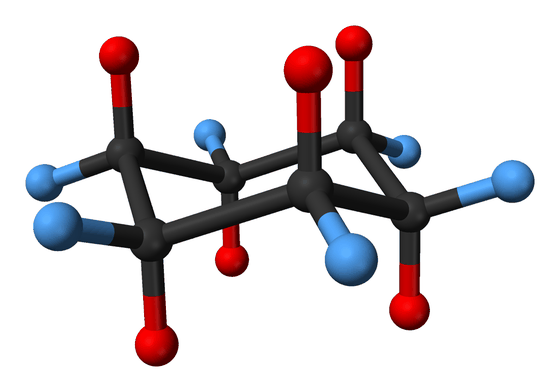
Connectivity, then, is not the end of the story. The next layer down is arrangement in three dimensions that cannot be interconverted by rotation — the difference between a left hand and a right — which is stereochemistry.