Chapter I
A Plastic Made Before Anyone Believed in Large Molecules
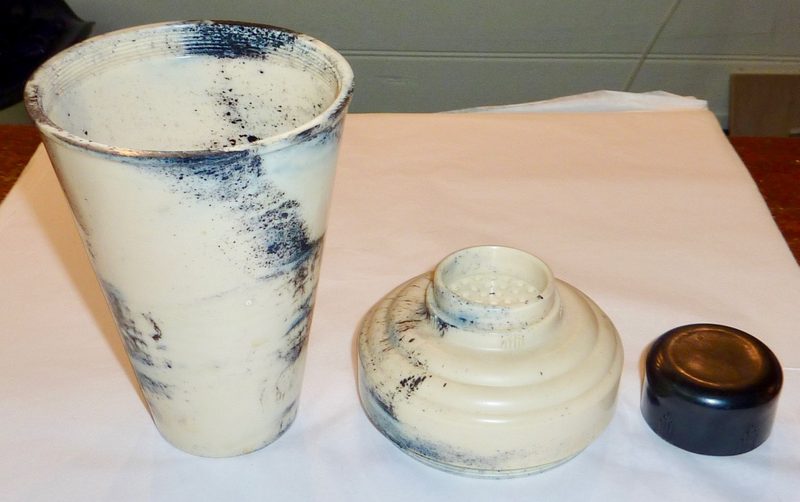
Leo Baekeland heated phenol with formaldehyde under pressure in 1907 and obtained a hard, infusible solid that could be moulded before it set and then held its shape permanently. Bakelite was the first entirely synthetic plastic, it insulated the electrical industry, and it arrived about twenty years before chemistry accepted that molecules of that size existed.
The material itself helps explain the delay. Bakelite is one covalent network running through the whole object: it cannot be dissolved, melted, distilled or given a molecular weight, so every method chemistry had for establishing what a substance is was inapplicable. The reasonable-sounding alternative view — that such materials are aggregates of ordinary small molecules held by some unusual attraction — was not easily refuted by anything Bakelite could be made to do. Hermann Staudinger's long argument for the macromolecule, described under soft matter, had to be won on other polymers.
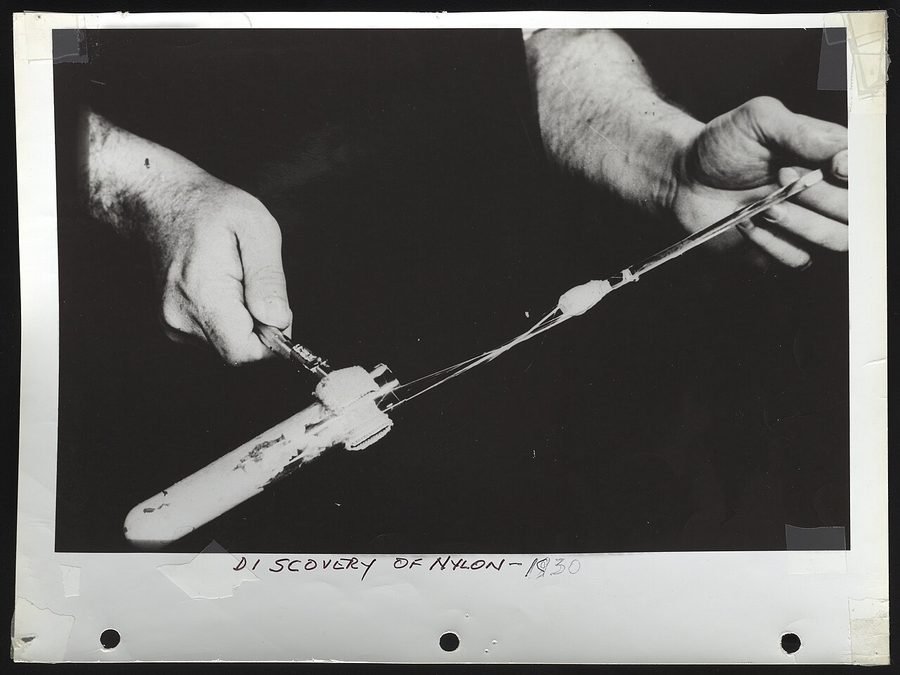
Wallace Carothers's approach at DuPont was to settle it constructively: build polymers from reactions whose chemistry was already known, so that the structure of the product followed from the structure of the reagents and no inference was required. Along the way he made neoprene and nylon. And in working out how to do it he found the arithmetic that constrains one half of the subject permanently.
Chapter II
Two Mechanisms With Opposite Requirements
Carothers's other contribution was a distinction that organises everything since.
In step-growth polymerisation any two molecules carrying the right groups can join: monomer to monomer, dimer to trimer, oligomer to oligomer. Chains grow slowly and in parallel, and long chains appear only when nearly every functional group has reacted. In chain-growth polymerisation there is a reactive end that adds monomer one at a time, so a chain goes from nothing to its full length in a fraction of a second, and increasing conversion produces more chains rather than longer ones.
The two therefore demand opposite things from the chemist, which the next section works out numerically. Step-growth needs extreme conversion and extreme stoichiometric precision. Chain-growth needs neither, and gives up control in exchange.
Paul Flory established just how much control is given up. The free-radical mechanism — a radical starts a chain, the chain adds monomer, and it dies when it meets another radical or hands its activity to a solvent molecule — has three features that no amount of care removes. Each chain lives under a second, so chains begun at different times grow under different conditions. Termination is a random encounter, so the length at which a chain stops is a random variable. And chain transfer puts branches in at a rate set by temperature. The product is a broad distribution: the polydispersity of an ideal radical polymerisation is 1.5 or 2.0 depending on how termination happens, and it is a property of the mechanism rather than of the operator.
That distribution is tolerable for a bag or a pipe and ruinous for anything that has to do two things at once. Which is what made the next result matter.
Chapter III
Controlling the Architecture
Michael Szwarc found in 1956 that if styrene is polymerised anionically in a scrupulously dry and oxygen-free solvent, the chain ends do not die. The solution stays coloured for days; add more monomer and the chains get longer. With no termination step, every chain grows throughout, all of them end up nearly the same length, and that length is simply the monomer-to-initiator ratio.
Three things follow immediately. The polydispersity collapses to about 1.01, so the chains are effectively identical. The length becomes a dial rather than an outcome. And — the consequence with the largest effect on the world — adding a second monomer after the first is consumed extends every chain with a block of the new one. A block copolymer cannot phase-separate, because the two incompatible runs are covalently joined, so it separates as far as it can and no further: into domains tens of nanometres across. A styrene–butadiene–styrene triblock is rubbery butadiene held together by hard glassy styrene domains that act as crosslinks but soften on heating, so the material behaves as vulcanised rubber in use and as a thermoplastic in a moulding machine. Most shoe soles and much road surfacing is this.
Two other kinds of control arrived around it. Stereochemical control — making every substituent along a chain point the same way, so the polymer crystallises — came from the catalysts described under catalysis, and the difference it makes is not marginal: regularly arranged polypropylene is a structural plastic and the randomly arranged polymer of identical composition is a soft grease. And Stephanie Kwolek obtained strength from shape in 1965, when a rigid-rod aromatic polyamide gave a cloudy, thin solution instead of a clear syrupy one. It was a liquid crystal, the rods already aligned; spun through a die, the alignment survived, and the fibre carries load along covalent bonds rather than across the weak forces between chains.
The last step made the control industrial. Living anionic polymerisation needs absolute dryness and tolerates no functional groups a carbanion would attack, which excludes most monomers of commercial interest. Krzysztof Matyjaszewski and Mitsuo Sawamoto independently found in 1995 that a metal complex can hold a growing radical reversibly dormant, so that only a minute fraction is active at any instant and chains almost never meet to terminate; Ezio Rizzardo, Graeme Moad and San Thang achieved the same by reversible transfer through a dithioester. Block copolymers and controlled lengths became available in water, in air, with ordinary monomers.
Chapter IV
A Closer Look: Why Nylon Needs a Salt
Take a step-growth polymerisation in which two kinds of group, present in equal numbers, react pairwise. Let be the fraction of groups that have reacted. Carothers's result is that the number-average degree of polymerisation is
The derivation is a count: start with monomer units, and each reaction joins two molecules into one, so after reactions there are ... more directly, the number of molecules remaining is while the number of units is unchanged, so the average molecule contains units.
Put numbers in it:
| Conversion | What it is | |
|---|---|---|
| 0.50 | 2 | a dimer |
| 0.90 | 10 | a brittle powder |
| 0.99 | 100 | a usable fibre |
| 0.999 | 1,000 | a good fibre |
| 0.9999 | 10,000 | high-performance |
This is the tyranny of the mechanism. At 90% conversion — which in most of organic chemistry is a good yield — there is no polymer, only an oligomer that crumbles. Useful properties start around , which requires 99%, and every further factor of ten in chain length costs another decimal place of conversion. There is no clever reagent that shortens this; it is arithmetic.
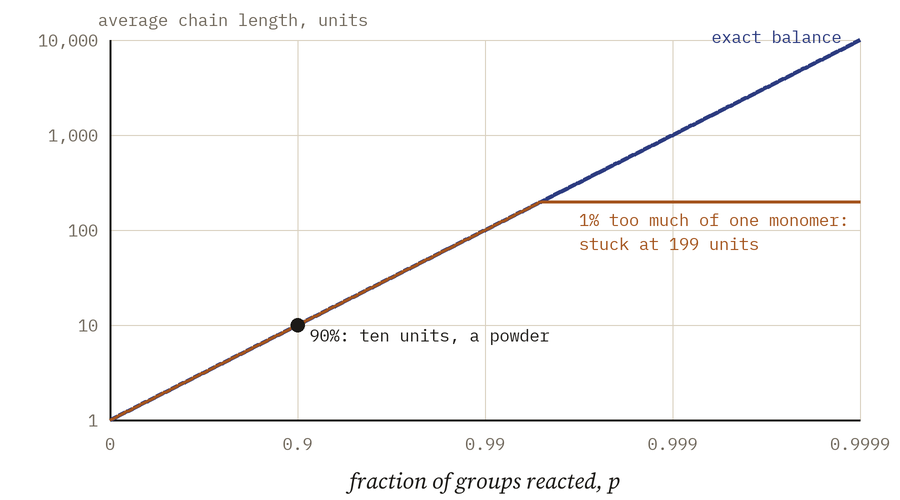
There is a second and sharper constraint that follows from the same algebra. Suppose the two monomers are not present in exactly equal amounts, with a ratio . Once the minority monomer is exhausted, every chain end is of the majority kind and cannot react with another, so growth stops at
| Excess of one monomer | ||
|---|---|---|
| 10% | 0.909 | 21 |
| 1% | 0.990 | 199 |
| 0.1% | 0.999 | 1,999 |
A one per cent weighing error caps the chain length at 199 forever, no matter how long the reaction is run or how pure the reagents are. To reach a thousand units the two monomers must be matched to better than one part in a thousand.
Weighing two substances to that accuracy at industrial scale, with both of them hygroscopic and one volatile, is not realistic. So nylon is not made by weighing. Adipic acid and hexamethylenediamine are first combined in solution, where they form a crystalline 1:1 salt — nylon salt — which is filtered off and recrystallised. The crystal lattice enforces the stoichiometry: there is no composition of that solid other than exactly one to one. The salt is then heated and polymerises. A purification step is being used to solve an arithmetic problem, and that is why the industrial process has a step that looks, chemically, entirely unnecessary.
Now compare the chain-growth case, to see how different the two mechanisms are. In a radical polymerisation a chain reaches within a second of initiation, at whatever overall conversion happens to prevail — even 2%. Conversion determines how many chains exist, not how long they are, so there is no conversion requirement at all and no stoichiometric requirement, since there is only one monomer. What is given up is uniformity: the polydispersity is 1.5 to 2.
And a living polymerisation gets both. With no termination, chain lengths follow a Poisson distribution, for which
so at the polydispersity is 1.01. Chains within one per cent of one another, at a length chosen by the amount of monomer added. That is the precision a block copolymer needs, because the size of the domains it self-assembles into depends on the length of each block — and it is the precision that sets the limit of the field's ambition, since the one thing still missing, recorded above as an open problem, is control over the order of the monomers rather than their number.
Chapter V
What Is Not Controlled
Length, breadth of distribution, branching, tacticity and block architecture are all now controllable. Two things are not, and both are visible from a long way off.
The first is sequence. A protein's function comes almost entirely from the exact order of its residues, and a synthetic copolymer's order is statistical — biased by the relative reactivities of the monomers, never specified. Exact sequences can be built one unit at a time, as peptides are, at milligram scale and with yields that fall geometrically with length. The properties a specified sequence would give — folding to one structure, binding one target, catalysing one reaction — are wanted in materials that are cheap and durable, which proteins are not.
The second is the end of the object's life. Production is around 400 million tonnes a year, and on careful accounting less than a tenth of all the plastic ever made has been recycled. Mechanical recycling shortens the chains and mixes polymers that will not blend, so the product is worth less than the feed. Chemical recycling back to monomer works where the backbone contains a bond that can be cut — the ester links of a polyester hydrolyse — and hardly at all for the polyolefins that are the largest fraction, whose backbone is nothing but carbon–carbon single bonds. The inertness that makes polyethylene useful is the same property that makes it permanent, which is an uncomfortably exact statement of the problem, and it is taken up from the environmental side in atmospheric chemistry and its thread.