Skip to content
Field Atlas

Atlas / Chemistry / The Reaction Thread

Field · Emerged 1835 – 2001

Catalysis

How can a substance accelerate a reaction enormously, by factors of millions, without being consumed and without shifting the equilibrium at all?

4 chapters7 min read6 turning points1 open problem

Branched from
Chemical Kinetics
Branched into
Cross-Coupling and Bond Construction + Polymer Synthesis + Porous Frameworks + Surface and Imaging Analysis
Figures
Jöns Jacob Berzelius, Wilhelm Ostwald, Fritz Haber, Carl Bosch, Alwin Mittasch, Paul Sabatier, Karl Ziegler, Giulio Natta, William Knowles, Ryōji Noyori, Barry Sharpless

In brief

A catalyst does not make an impossible reaction possible. Wilhelm Ostwald was explicit about this when he defined the term in 1894: a catalyst alters the rate and cannot alter the equilibrium, because if it could it would be a perpetual motion machine of the second kind. What it does is provide a different route — one with a lower barrier — and since the barrier sits in an exponential, a modest reduction buys an enormous factor in rate.

The quantitative payoff is easiest to see in the reaction that matters most. Nitrogen in the air is held by the strongest bond in ordinary chemistry, 941 kJ/mol, and the uncatalysed dissociation of N2\mathrm{N_2} at 700 K would occur about once in 107010^{70} collisions. An iron surface does not lower that barrier; it replaces the step entirely, binding both nitrogen atoms to the metal so that the molecule comes apart with almost no barrier at all. Fritz Haber found conditions under which this works, Carl Bosch and Alwin Mittasch built a plant around it after testing some twenty thousand catalyst formulations, and the resulting fertiliser now supports roughly half the nitrogen in the human population — at the cost of about one per cent of the world's energy, and with the same chemistry having supplied explosives for two world wars.

Key ideas

CatalysisEnters 1812 – 1835

Acceleration of a reaction by a substance that is regenerated, so that a small amount processes an unlimited quantity. The catalyst appears in the rate law and not in the balanced equation.

Equilibrium is untouchedEnters 1894 – 1901

A catalyst speeds the forward and reverse reactions by exactly the same factor, so the position of equilibrium is unchanged. Anything that moved it could be used to build a perpetual motion machine.

An alternative pathEnters 1909 – 1913

The catalyst does not lower the barrier of the original route; it supplies a different route with its own, lower barrier — usually by binding fragments so that bonds can be broken one at a time instead of all at once.

Sabatier principleEnters 1913 – 1960

The best catalyst binds the reacting species neither too weakly, in which case nothing sticks, nor too strongly, in which case the surface is poisoned by its own products. Plotting activity against binding strength gives a volcano, and the summit is the design target.

Turnover number and frequencyEnters 1894 – 1901

How many molecules one catalytic site converts, and how fast. These, rather than yield, are what make catalysts comparable: an enzyme may turn over a thousand times a second, an industrial heterogeneous site a few times.

Stereospecific catalysisEnters 1968 – 2001

A catalyst that controls not only whether a bond forms but the three-dimensional arrangement produced, so that one of two mirror-image products is made almost exclusively.

Draws on other domains

  • ↙ Biology

    Biochemistry

    The catalysts everything else is compared against

  • ↙ Biology

    Pharmacology

    A regulatory requirement that created a field

Chapter I

A Name Before an Explanation

Three unrelated observations in the 1810s and 1820s had the same shape. Dilute acid turns starch into sugar and is still there afterwards. A platinum wire makes hydrogen and oxygen combine, glowing, while remaining platinum. Berzelius gathered them in 1835, called the phenomenon catalysis, and ascribed it to a catalytic force — which is a name for the puzzle rather than a solution.
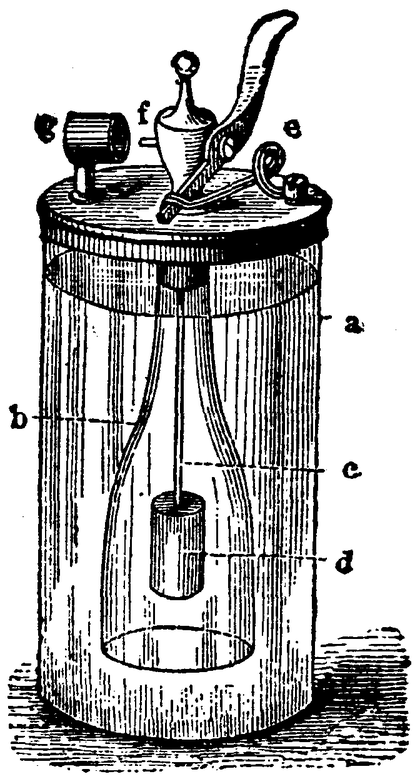
An engraving of a glass jar holding an inner bell over a lump of zinc, with a tap and nozzle on top aimed at a small holder of platinum.
Döbereiner's lamp of the 1820s. Zinc in acid makes hydrogen; opening the tap lets it out onto a pinch of platinum sponge, which sets it alight while remaining unchanged.Engraving, unknown artist · Public domain · Source

For sixty years the subject was faintly disreputable, because it looked like getting something for nothing. Wilhelm Ostwald made it respectable in 1894 with a definition and a prohibition. A catalyst changes the rate and does not appear in the products; and it cannot change the position of equilibrium, because a substance that favoured one direction over the other could be used to run a cycle indefinitely without work, which the second law forbids. Catalysis is therefore entirely kinetic. It cannot make an unfavourable reaction go; it can only make a favourable one go sooner.

That constraint is worth keeping in view, because it is routinely forgotten. A catalyst in an ammonia plant does not improve the yield that thermodynamics allows at a given temperature — it allows a lower temperature, where the allowed yield is better.

Chapter II

Three Kinds of Catalyst

Catalysts divide into three classes that share a principle and little else, and the differences decide what each is used for.

A homogeneous catalyst is dissolved in the reaction mixture, usually a metal complex with organic ligands. Every molecule of it is accessible, so activity per atom is high; the ligands can be modified one at a time, which makes the structure-activity relationship legible and is why asymmetric catalysis is almost entirely homogeneous; and the catalyst must be separated from the product afterwards, which for a pharmaceutical means removing a toxic metal to parts per million. Turnover frequencies are typically one to a thousand per second.

A heterogeneous catalyst is a solid that the reactants flow over. Separation is free — the catalyst stays in the reactor — which is why essentially all bulk chemistry is heterogeneous, and the price is that only the surface atoms work. For a 15-nanometre particle that is about a tenth of them; dispersed as 2-nanometre particles, three quarters. The sites are also not identical: a surface has terraces, steps and corners that bind differently, so measured activity is an average over a population, and the most active sites may be a per cent of the total.

An enzyme is a protein with a pocket built around one reaction. Rate enhancements reach 101710^{17} over the uncatalysed reaction, selectivity is essentially complete, and the conditions are water at ambient temperature — against which both other classes compare badly. The costs are fragility, a narrow range of tolerable conditions, and that each enzyme does one thing.

The numbers worth holding together are these. An industrial iron ammonia catalyst turns over a few times per second per site and lasts years. A homogeneous hydrogenation catalyst turns over hundreds of times per second and is discarded after one batch. Carbonic anhydrase turns over a million times per second. The spread is nine orders of magnitude, and the design trade-off running through it is between activity, selectivity and the ease of getting the catalyst back.

Chapter III

A Closer Look: The Strongest Bond in the Air

Four fifths of the atmosphere is nitrogen, and almost nothing can use it. The reason is one number: the N≡N\mathrm{N{\equiv}N} bond energy is 941 kJ/mol, the strongest bond in common chemistry.

Ask what that implies for an uncatalysed reaction. At 700 K the fraction of collisions carrying enough energy to break the bond is

e−941000/(8.314×700)=e−161.7=10−70.2.e^{-941000/(8.314 \times 700)} = e^{-161.7} = 10^{-70.2}.

With collision frequencies of order 101010^{10} per second, a given molecule reacts about once every 106010^{60} seconds. The age of the universe is 4×10174\times10^{17} seconds. Heating is not a solution: to get the exponent down to something workable the temperature would have to be thousands of degrees, at which ammonia is unstable anyway.

The catalyst does not help with this barrier. It removes the step. On an iron surface, a nitrogen molecule adsorbs, and each nitrogen atom forms bonds to several iron atoms; the energy released on forming those metal–nitrogen bonds pays for most of the cost of pulling the molecule apart, so the dissociation barrier on the surface is of the order of tens of kJ/mol rather than 941. The atoms are then hydrogenated one step at a time, each step with a modest barrier of its own, and ammonia leaves. Six small barriers in place of one impossible one.

Paul Sabatier's principle says why only a few metals do this. The surface must bind nitrogen strongly enough to dissociate it and weakly enough to let the product go. Bind too weakly — silver, gold — and nothing adsorbs. Bind too strongly — tungsten, molybdenum — and the surface fills with nitrogen atoms that will not react on. Plot activity against binding energy and the result is a volcano, with iron and ruthenium near the summit. That curve, now computed from first principles rather than measured, is the modern form of catalyst design.

What it cost and what it bought. Haber's bench demonstration gave a few per cent conversion per pass. Carl Bosch had to build vessels that would hold 200 atmospheres of hydrogen at 500 °C without embrittling, and Alwin Mittasch ran some twenty thousand catalyst tests to replace osmium, which was unobtainable in quantity, finally arriving at iron promoted with alumina and potassium. The modern plant still uses that catalyst, at 400–500 °C and 150–300 bar, and the process consumes on the order of one to two per cent of the world's primary energy — most of it not for the ammonia reaction itself but for making hydrogen from methane.
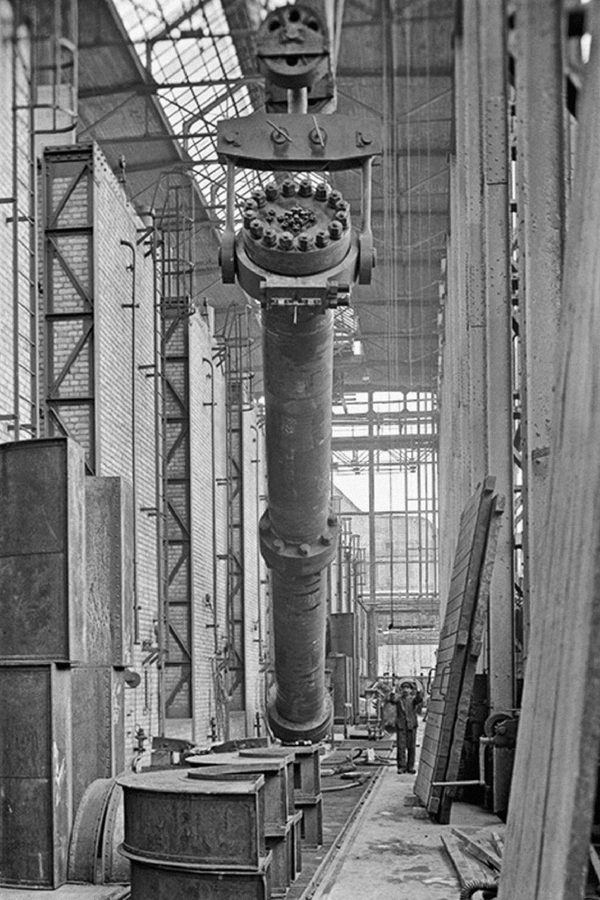
A tall cylindrical steel reactor hanging from a crane inside a factory hall.
BASF's first full-scale ammonia reactor, built for 9,000 tonnes a year, during assembly at Oppau in 1913.BASF Corporate History · CC BY-SA 3.0 · Source

The return is the largest single intervention of chemistry in human life. Isotopic evidence indicates that about half the nitrogen atoms in a person alive today were fixed in such a plant. The same nitrates, in the same years, made the munitions of two world wars, and Haber personally directed the first chlorine gas attack at Ypres in 1915. The Nobel committee honoured him in 1918 and was protested for it.

Meanwhile a soil bacterium does the identical conversion at 20 °C and one atmosphere, using an iron–molybdenum cluster, and nobody can reproduce that. The gap between 500 °C and room temperature is the field's standing reproach to itself, recorded above as its open problem.
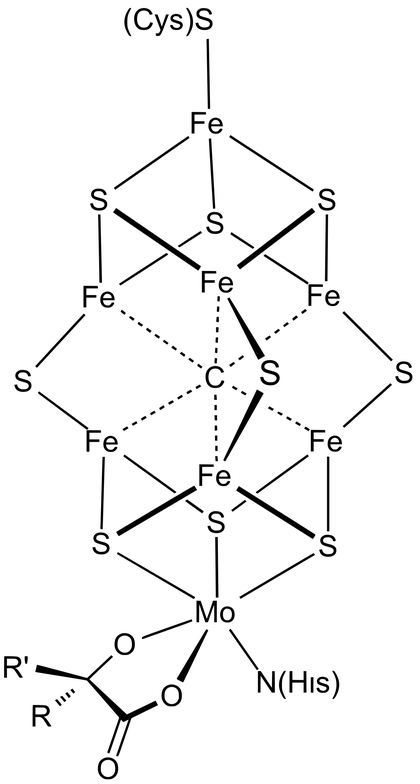
A structural formula of a cage of seven iron atoms and nine sulfur atoms around a central carbon, capped by a molybdenum atom.
The iron–molybdenum cofactor of nitrogenase, the cluster with which soil bacteria break nitrogen's triple bond at room temperature: seven iron atoms, nine sulfur, one molybdenum, and a carbon at the centre.Smokefoot · Public domain · Source

Chapter IV

Controlling More Than the Rate

The second half of the subject's history is catalysts that control which product forms, not just how fast.

Karl Ziegler found in 1953 that titanium chloride with an aluminium alkyl polymerises ethylene at ordinary pressure — the existing process needed a thousand atmospheres — and produces unbranched chains that pack and crystallise. Giulio Natta then showed that the same catalyst class polymerises propylene with every methyl group on the same side of the chain. The regularity matters enormously: isotactic polypropylene crystallises and is a structural plastic, while the randomly arranged polymer is a soft grease. The catalyst is imposing a stereochemical choice at every one of thousands of successive additions, which is the behaviour described under soft matter as the reason polymer properties depend on architecture rather than composition.

The logical end point is asymmetric catalysis. Many molecules exist as two non-superimposable mirror images, and in a biological setting the two can differ entirely in effect. William Knowles hydrogenated a prochiral alkene in 1968 using rhodium with a chiral phosphine ligand, got an excess of one hand, and developed it into the industrial route to L-DOPA. Ryōji Noyori's BINAP catalysts and Barry Sharpless's oxidations pushed the selectivity above 99%, with the catalyst present at a fraction of a mole per cent. One chiral molecule, recycled, transmits its handedness to tonnes of product — and why handedness is worth that trouble is a question about stereochemistry and about what a receptor can tell apart.

Applications

Where it is used

  • Agriculture↗ Biology · Ecosystem Ecology

    Half the nitrogen in a human body

    Synthetic fertiliser supplies the nitrogen for a large share of world food production, and isotopic analysis indicates that roughly half the nitrogen atoms in an average person today passed through a Haber–Bosch plant. The same flux is the dominant human perturbation of the nitrogen cycle, driving the nutrient loading that produces algal blooms and oxygen-depleted coastal water.

    › Sources (1)
    • Erisman, J. W., Sutton, M. A., Galloway, J., Klimont, Z. & Winiwarter, W. (2008). How a century of ammonia synthesis changed the world. Nature Geoscience 1: 636–639.
  • Energy and transport

    Converting most of the world's oil

    Catalytic cracking over zeolites breaks heavy petroleum fractions into the molecules that make petrol, and reforming, hydrotreating and the three-way catalytic converter handle the rest of the chain to the exhaust pipe. Something like nine tenths of industrial chemical production passes over a catalyst at some stage, and the converter alone — platinum, palladium and rhodium on a ceramic honeycomb — removes most of the carbon monoxide and nitrogen oxides from a car's exhaust.

    › Sources (1)
    • Vogt, E. T. C. & Weckhuysen, B. M. (2015). Fluid catalytic cracking: recent developments. Chemical Society Reviews 44: 7342–7370.
  • Pharmaceuticals↗ Biology · Pharmacology

    Why handedness is regulated

    Two mirror-image forms of a drug can differ completely in effect, and regulators therefore require single enantiomers for most new molecules. Asymmetric catalysis is how that is achieved at scale: a chiral catalyst at a fraction of a mole per cent converts an achiral starting material into one hand of the product, which is cheaper and cleaner than making both and throwing half away.

    › Sources (1)
    • Blaser, H.-U. & Schmidt, E. (eds) (2004). Asymmetric Catalysis on Industrial Scale. Wiley-VCH.

Open problems

Where the map runs out

Open

Fixing nitrogen the way a bacterium does

Open as of 2026; no synthetic system approaches nitrogenase's conditions at useful rate.

Haber–Bosch runs at 400 to 500 °C and 150 to 300 atmospheres and consumes something like one to two per cent of the world's primary energy, most of it to make hydrogen from methane. The enzyme nitrogenase performs the same conversion in soil bacteria at 20 °C and one atmosphere. Dozens of molecular catalysts and electrochemical routes reproduce the reaction at ambient conditions, and none does so at a rate, selectivity and durability that would replace a plant — the competing reduction of water to hydrogen usually wins.

Why it is hard

The nitrogen triple bond must be broken while six electrons and six protons are delivered in sequence, and every intermediate is more reactive than the starting material. Nitrogenase does it with an iron–molybdenum cluster whose mechanism, after fifty years and a crystal structure, is still not agreed — including what the central carbon atom found in 2011 is for.

What resolving it unlocks

Ammonia is the second most produced industrial chemical and the basis of the fertiliser that roughly half the world's food depends on. An ambient-condition route would decouple it from natural gas, and the same chemistry is wanted for ammonia as a carbon-free fuel.

› Sources (2)
  • Smil, V. (2001). Enriching the Earth. MIT Press.
  • Hoffman, B. M., Lukoyanov, D., Yang, Z.-Y., Dean, D. R. & Seefeldt, L. C. (2014). Mechanism of nitrogen fixation by nitrogenase. Chemical Reviews 114: 4041–4062.

Further reading

  1. Smil, V. (2001). Enriching the Earth. MIT Press.

    What ammonia synthesis did to the world, counted carefully, including the parts that are not good.

  2. Chorkendorff, I. & Niemantsverdriet, J. W. (2017). Concepts of Modern Catalysis and Kinetics, 3rd edition. Wiley-VCH.

    The standard modern text; works through the Sabatier analysis and surface kinetics quantitatively.

  3. Nørskov, J. K. et al. (2009). Towards the computational design of solid catalysts. Nature Chemistry 1: 37–46.

    How volcano plots are now computed rather than measured, and what that has and has not achieved.