Skip to content
Field Atlas

Atlas / Chemistry / The Reaction Thread

Field · Emerged 1850 – 1949

Chemical Kinetics

How fast does a reaction go, what does the rate depend on, and what does that reveal about the steps it passes through?

4 chapters7 min read6 turning points1 open problem

Branched from
Chemical Thermodynamics
Branched into
Atmospheric Chemistry + Catalysis + Transition State Theory
Figures
Ludwig Wilhelmy, Augustus Vernon Harcourt, William Esson, Svante Arrhenius, Max Bodenstein, Nikolai Semenov, Cyril Hinshelwood, Frederick Lindemann, Rudolph Marcus, Ronald Norrish, George Porter

In brief

Thermodynamics says where a reaction will end up and is silent about whether it will take a microsecond or an age. Diamond is unstable with respect to graphite at room temperature, and the conversion has a half-life far longer than the universe has existed. Kinetics is the study of that gap, and it turned out to be the only route to the one thing thermodynamics cannot supply: the mechanism, the sequence of elementary steps a reaction actually passes through.

The connection between the two is indirect and had to be learned. A rate law — the dependence of rate on each concentration — is measured, not derived from the equation, and the exponents in it need bear no relation to the stoichiometric coefficients. That mismatch is the evidence: an observed rate law is consistent with some mechanisms and not others, so kinetics works by elimination. Svante Arrhenius then found in 1889 that rate constants depend on temperature through an exponential containing an energy, which gave the subject its central quantity, an activation barrier, and the first hint that a reaction is not simply a matter of molecules meeting.

Key ideas

Rate lawEnters 1850

The measured dependence of rate on concentrations, with its own exponents — the orders. They are determined experimentally and frequently differ from the coefficients in the balanced equation, which is the first sign that the equation is not the mechanism.

Elementary stepEnters 1865 – 1867

A single molecular event: one bond made or broken, one collision. For an elementary step, and only then, the rate law can be read off the equation. A reaction's mechanism is a proposed sequence of them.

Activation energyEnters 1889

The energy a collision must supply before it can lead to reaction. It appears in an exponential, so modest changes in it alter rates by orders of magnitude, and modest changes in temperature do the same.

Rate-determining stepEnters 1913 – 1934

The slowest step in a sequence, which governs the overall rate the way the narrowest section of a pipe governs the flow. Identifying it is what allows a complicated reaction to be improved by changing one thing.

Chain reactionEnters 1913 – 1934

A sequence in which a reactive intermediate is regenerated, so one initiation event produces many product molecules. If each step produces more than one carrier, the chain branches and the rate runs away — which is combustion, and explosion.

Steady-state approximationEnters 1922 – 1952

Assume a reactive intermediate is consumed as fast as it forms, so its concentration stays small and constant. The assumption turns an insoluble set of differential equations into algebra, and it is how almost every mechanism is tested against a rate law.

Chapter I

Thermodynamics Does Not Say When

Graphite is the stable form of carbon at room temperature and pressure. Diamond is not, and the conversion has never been observed, because the rate is unmeasurably small. Any account of chemistry built only on free energies would predict that every diamond in the world is on its way to becoming pencil lead, which is true and useless.

The study of rates began in 1850 with a measurement of unusual elegance. Cane sugar, inverted by acid, changes the direction in which it rotates polarised light; Ludwig Wilhelmy simply watched the rotation drift as the reaction proceeded, so the reaction was never disturbed and no samples were taken. He found that the rate at any instant is proportional to the sugar remaining, wrote the differential equation, and published in a physics journal where chemists did not read it for thirty years.

Augustus Vernon Harcourt established the practice in the 1860s, with the mathematician William Esson doing the integration. Their method is still the method: measure concentration against time, fit an integrated rate law, extract the order and the rate constant.

And the orders turned out not to match the balanced equations. A reaction written with two molecules of one reactant may be first order in it, or half order, or of an order that changes with concentration. This mismatch is the most useful fact in the subject, because it means the rate law carries information the equation does not: it constrains the sequence of steps. Kinetics cannot prove a mechanism — several mechanisms may predict the same rate law — but it can rule one out, and that is how every mechanism in chemistry has been established.

Chapter II

How a Rate Law Is Measured

A rate law is not derived; it is determined, and the methods are worth stating because the field's conclusions are only as good as they are.

The direct approach is to follow a concentration against time and fit. Which quantity is followed matters more than it seems: an analysis that requires sampling disturbs the reaction, so the preferred observables are ones that can be read continuously from outside — the rotation of polarised light, as Wilhelmy used, or an absorbance, a pressure, a conductivity, a volume of gas. The resulting curve is then fitted to the integrated form for each candidate order: a first-order reaction gives a straight line when the logarithm of concentration is plotted against time, a second-order one when the reciprocal is.

The difficulty is that several orders fit a single run almost equally well over the first half-life, so the determination is made by varying conditions instead. The method of initial rates measures the slope at the very start for several starting concentrations, which gives each order independently without the complication of products accumulating. The isolation method floods the mixture with all reactants but one, so their concentrations barely change and the reaction appears to depend only on the remaining one — the pseudo-first-order trick that makes most biochemical kinetics tractable.

Two diagnostics then test a proposed mechanism. The half-life of a first-order reaction is independent of the starting concentration and nothing else behaves that way, which identifies the order at a glance. And where a mechanism involves a reactive intermediate, the steady-state approximation — assuming the intermediate is consumed as fast as it is made — converts the differential equations into algebra and predicts a specific, often unusual, rate law: an order of one and a half, or an order that falls from two to one as pressure rises. Such predictions are the strongest kinetic evidence available, because they are peculiar enough that a wrong mechanism rarely reproduces them.

Chapter III

A Closer Look: What the Exponential Does

Svante Arrhenius's equation is

k=A e−Ea/RT,k = A\,e^{-E_a/RT},

and almost everything distinctive about chemical rates follows from the fact that the temperature sits in an exponent.
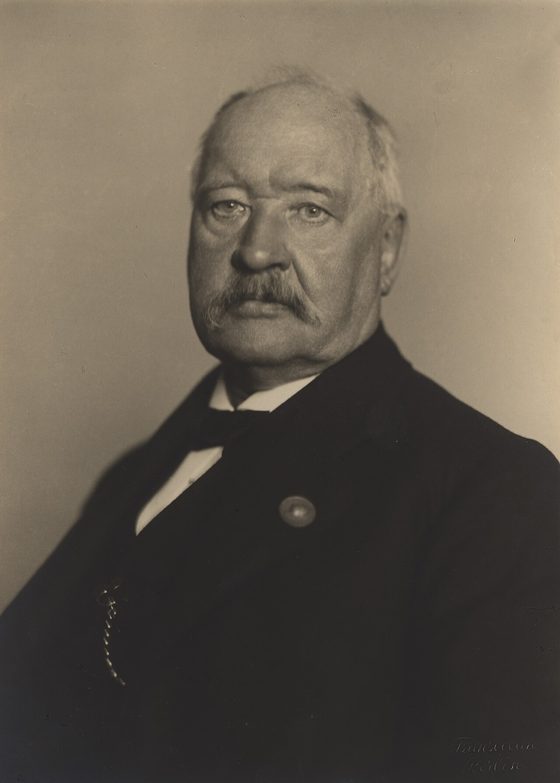
Photograph of Svante Arrhenius in later life, heavy-set, with a moustache, in a dark suit.
Svante Arrhenius, whose 1889 equation put temperature in an exponent.Transocean, Berlin; Smithsonian Institution Libraries · Public domain · Source

The ten-degree rule. Chemists learn that a rate roughly doubles for every 10 °C. That is not a rule of nature but a consequence of a typical barrier. With Ea=50E_a = 50 kJ/mol, the ratio of rate constants between 298 K and 308 K is

k308k298=exp⁡ ⁣[EaR(1298−1308)]=exp⁡ ⁣[6014×1.089×10−4]=e0.655=1.93.\frac{k_{308}}{k_{298}} = \exp\!\left[\frac{E_a}{R}\left(\frac{1}{298} - \frac{1}{308}\right)\right] = \exp\!\left[6014 \times 1.089\times10^{-4}\right] = e^{0.655} = 1.93.

A factor of 1.9, for the most ordinary barrier there is. Double the barrier to 100 kJ/mol and the same ten degrees gives a factor of 3.7.
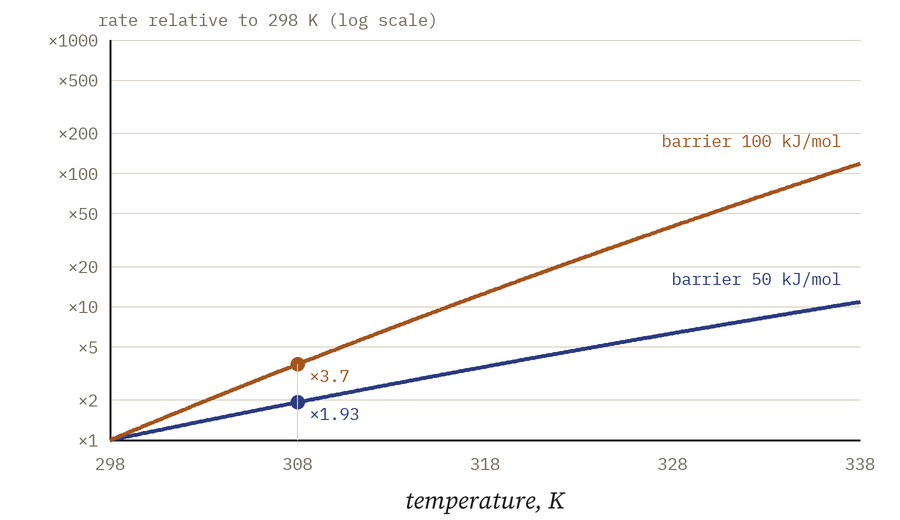
Two rising lines of rate against temperature from 298 to 338 K on a logarithmic scale, the 50 kJ/mol barrier reaching 1.93 at 308 K and the 100 kJ/mol barrier reaching 3.7.
The ten-degree rule from the Arrhenius equation. Ten degrees nearly doubles the rate over a 50 kJ/mol barrier and multiplies it by 3.7 over a 100 kJ/mol one; the higher the barrier, the more the temperature matters.Drawn for Field Atlas from the numbers above · Field Atlas original · Source

Why some reactions never go. In solution a molecule collides with its neighbours of order 101010^{10} times a second. With RT=2478RT = 2478 J/mol at 298 K, the fraction of collisions carrying 100 kJ/mol is

e−100000/2478=e−40.4=2.9×10−18.e^{-100000/2478} = e^{-40.4} = 2.9\times10^{-18}.

Multiply: productive events occur at about 1010×2.9×10−18=2.9×10−810^{10} \times 2.9\times10^{-18} = 2.9\times10^{-8} per second, which is one reaction per molecule per year. The mixture is, for practical purposes, inert — and the free energy change may be enormously favourable. Raise the temperature to 500 K and the same barrier gives e−24.1=3.4×10⁻¹¹e^{-24.1} = 3.4\times10^{-11}, a rate up by a factor of 10710^{7}: one event every few seconds. This is why heating works, and why it is so often the only available lever.

Why a catalyst is worth so much. Lower the barrier and the gain is exponential. At 298 K, removing 30 kJ/mol multiplies the rate by

e30000/2478=e12.1=1.8×105,e^{30000/2478} = e^{12.1} = 1.8\times10^{5},

and removing 60 kJ/mol — a realistic figure for an enzyme against the uncatalysed reaction — multiplies it by 3×10103\times10^{10}. A factor of thirty billion, from changing a path rather than a temperature. That is the entire economic case for catalysis, and it is why industrial chemistry spends so much more effort on catalysts than on reactors.

What AA is. The prefactor is roughly the frequency with which the molecules attempt the reaction — collision frequency for a bimolecular step, a vibrational frequency for a unimolecular one — modified by how many of those attempts have the right geometry. For reactions between small molecules in the gas phase, collision theory predicts AA within an order of magnitude. For anything with structure it does not, because most collisions with enough energy still fail on orientation, and accounting for that properly requires knowing the shape of the barrier rather than just its height — which is transition state theory.

Chapter IV

Chains, Explosions and Intermediates

Two discoveries showed that a rate law can conceal something qualitatively more interesting than a sequence of steps.

Max Bodenstein was puzzled that a single flash of light shone into a mixture of hydrogen and chlorine produces a million molecules of hydrogen chloride per photon absorbed. The resolution is that the reaction regenerates its own reactive intermediate: a chlorine atom attacks hydrogen, producing a hydrogen atom, which attacks chlorine, producing a chlorine atom, and so on until a termination event stops the chain. One initiation, many products.

Nikolai Semenov and Cyril Hinshelwood then identified the dangerous case. If a step produces two carriers where one was consumed, the number of chains grows geometrically and the rate accelerates without limit. That is an explosion, and it explains something that had looked arbitrary: combustible mixtures have explosion limits, regions of pressure and temperature inside which they detonate and outside which they quietly do nothing, because termination at the vessel walls competes with branching in the gas.

The last step was to stop inferring intermediates and look at them. Ronald Norrish and George Porter's flash photolysis, in 1949, fires a flash bright enough to make radicals in bulk and takes their spectrum microseconds later with a second flash. Species that had existed only as entries in a proposed mechanism acquired spectra and measured lifetimes. The method's time resolution has improved by nine orders of magnitude since, and the pump-and-probe principle has not changed.

Applications

Where it is used

  • Shelf life and storage

    Dating by rate constant

    The expiry date on a medicine, the storage temperature of a vaccine and the recommended cellar for a wine are kinetics in commercial form. Accelerated stability testing runs the degradation hot, fits the Arrhenius equation and extrapolates down — which works when the mechanism does not change with temperature, and fails spectacularly when it does, so the extrapolation has to be checked against real time.

    › Sources (1)
    • Waterman, K. C. & Adami, R. C. (2005). Accelerated aging: prediction of chemical stability of pharmaceuticals. International Journal of Pharmaceutics 293: 101–125.
  • Enzymology↗ Biology · Biochemistry

    The same equations inside a cell

    Michaelis and Menten's treatment of enzyme kinetics is this field's steady-state approximation applied to a catalyst that can be saturated: the enzyme binds substrate reversibly, the complex turns over at a fixed rate, and the resulting hyperbolic dependence on concentration gives two measurable constants. Nearly all quantitative biochemistry is built on that analysis.

    › Sources (1)
    • Michaelis, L. & Menten, M. L. (1913). Die Kinetik der Invertinwirkung. Biochemische Zeitschrift 49: 333–369.
  • Differential equations↗ Mathematics · Differential Equations

    Stiff systems, and the methods built for them

    A mechanism with intermediates that live for nanoseconds alongside species that survive for hours produces equations whose timescales differ by ten orders of magnitude. Integrating them with an explicit method requires steps set by the fastest process and runs for the duration of the slowest, which is impossible; the implicit methods now standard for stiff systems were developed largely in response to chemical kinetics and to circuit simulation.

    › Sources (2)
    • Gear, C. W. (1971). Numerical Initial Value Problems in Ordinary Differential Equations. Prentice-Hall.
    • Hairer, E. & Wanner, G. (1996). Solving Ordinary Differential Equations II: Stiff and Differential-Algebraic Problems. Springer.

Open problems

Where the map runs out

Open

Predicting what a network of reactions will do

Open as of 2026; combustion and atmospheric mechanisms contain thousands of steps with uncertain constants.

Real systems are not single reactions. A detailed mechanism for burning a hydrocarbon contains hundreds of species and thousands of elementary steps; atmospheric chemistry and the chemistry of a flow battery are similar. Most of the individual rate constants have never been measured, and are estimated from analogy or calculation to within a factor of two to ten — which, through the exponential, can be a factor of a hundred in a predicted ignition delay.

Why it is hard

The output depends on a few steps among thousands, and which few changes with temperature and pressure, so the mechanism cannot be reduced once and for all. Measuring a single elementary rate constant in isolation is a project; measuring thousands is not feasible; and uncertainty propagates nonlinearly through a stiff system of differential equations.

What resolving it unlocks

Engine and burner design, predictions of air quality and of the atmospheric lifetime of a pollutant, the safety case for a battery, and the yield of any industrial process with side reactions.

› Sources (2)
  • Tomlin, A. S. (2013). The role of sensitivity and uncertainty analysis in combustion modelling. Proceedings of the Combustion Institute 34: 159–176.
  • Green, W. H. (2019). Automatic generation of reaction mechanisms. In Computer Aided Chemical Engineering 45: 259–294.

Further reading

  1. Laidler, K. J. (1993). The World of Physical Chemistry. Oxford University Press.

    A historian who was also a kineticist; the chapters on rates and mechanism are definitive.

  2. Houston, P. L. (2001). Chemical Kinetics and Reaction Dynamics. McGraw-Hill.

    Modern treatment that carries kinetics through to the dynamics of single collisions.

  3. Semenov, N. N. (1935). Chemical Kinetics and Chain Reactions. Clarendon Press.

    The founding account of branching chains, by the person who worked out why mixtures explode.