Skip to content
Field Atlas

Atlas / Chemistry / The Reaction Thread

Field · Emerged 1840 – 1923

Chemical Thermodynamics

Which way will a reaction go, how far, and what can be done to move it?

4 chapters7 min read6 turning points1 open problem

Branched from
Chemical Composition
Branched into
Chemical Kinetics + Ions in Solution + Solid-State Chemistry
Figures
Germain Hess, Julius Thomsen, Marcellin Berthelot, Cato Guldberg, Peter Waage, Josiah Willard Gibbs, Wilhelm Ostwald, Jacobus Henricus van 't Hoff, Henry Le Chatelier, Gilbert Lewis, Merle Randall

In brief

A reaction that is possible on paper may not happen, and one that happens may stop half way. For most of the nineteenth century the rule of thumb was that reactions proceed in the direction that releases the most heat — a principle associated with Julius Thomsen and Marcellin Berthelot, and plainly false, since ammonium nitrate dissolves spontaneously while getting cold enough to frost the beaker.

The correct criterion came from Josiah Willard Gibbs, in a paper of 1876–78 published in the transactions of a Connecticut academy and read by almost nobody for fifteen years. The quantity that decides direction is not the heat but the heat minus the temperature times the entropy change; a reaction proceeds while that combination falls, and stops when it reaches a minimum, which is equilibrium rather than exhaustion. Gibbs also introduced chemical potential and the phase rule, which between them govern every distillation, alloy and mineral assemblage. Wilhelm Ostwald translated the paper into German in 1892; Jacobus van 't Hoff and Henry Le Chatelier had meanwhile worked out how equilibrium responds to temperature and pressure, which is the knowledge an industrial chemist actually uses.

Key ideas

Thermochemical additivityEnters 1840

The heat of a reaction is the same whatever route it takes, so heats of reaction can be added and subtracted like any other state function. It is Hess's law, and it means a heat that cannot be measured directly can be assembled from ones that can.

Equilibrium constantEnters 1864 – 1879

At equilibrium the concentrations of products and reactants stand in a fixed ratio, each raised to the power of its coefficient. The reaction has not stopped; it is proceeding equally fast in both directions.

Chemical potentialEnters 1876 – 1892

The change in a system's free energy when one more particle of a given species is added. Matter flows from high chemical potential to low, which is what drives diffusion, dissolution, osmosis and every phase change.

Free energyEnters 1876 – 1892

ΔG=ΔH−TΔS\Delta G = \Delta H - T\Delta S. The combination that decides direction: negative and the reaction proceeds, zero and it is at equilibrium. Heat alone is the wrong criterion because it ignores the second term.

Le Chatelier's principleEnters 1884 – 1888

Disturb a system at equilibrium and it shifts so as to oppose the disturbance. Qualitative, occasionally misleading, and the most used piece of reasoning in industrial chemistry.

ActivityEnters 1901 – 1923

The effective concentration of a species, which in anything but a dilute ideal solution differs from the actual one. Replacing concentrations by activities is what lets the thermodynamics of ideal systems be applied to real ones.

Draws on other domains

Chapter I

The Wrong Criterion

By 1860 chemists could balance an equation and measure the heat a reaction gives out. The natural guess, made independently by Julius Thomsen and Marcellin Berthelot, was that the heat is the driving force: among the reactions available to a mixture, the one that occurs is the one releasing most heat.

The guess is wrong, and the counterexample is on any laboratory shelf. Dissolve ammonium nitrate in water and it absorbs heat — enough to drop the beaker's temperature by twenty degrees and frost its outside — and it dissolves anyway, completely, without being pushed. Ice melting in a warm room does the same thing. Whatever decides direction, it is not the heat alone.

Josiah Willard Gibbs had the answer in print by 1878, in a paper of 300 pages that essentially nobody read. The quantity that must decrease is not the heat released but

ΔG=ΔH−TΔS,\Delta G = \Delta H - T\Delta S,

the enthalpy change less the temperature times the entropy change. A reaction proceeds while ΔG\Delta G is negative and stops when it reaches zero — which is equilibrium, not exhaustion. Gibbs also introduced the chemical potential, the quantity whose differences drive matter from one place or phase to another, and the phase rule relating the number of coexisting phases to the number of components. The paper covered heterogeneous equilibria, surfaces and electrochemical cells, and it was published in the Transactions of the Connecticut Academy of Arts and Sciences in a notation of such austerity that Wilhelm Ostwald, who translated it into German in 1892, said it was like reading a book written in a language one had to invent first.

Chapter II

Heat Before Free Energy

Thermochemistry preceded thermodynamics, and for a while it was the whole of the quantitative subject. Lavoisier and Laplace had built an ice calorimeter in 1783 — a jacket of packed ice around a reaction vessel, with the mass of meltwater measuring the heat released — and the heats of combustion, neutralisation and solution were being tabulated long before anyone could say what they implied.
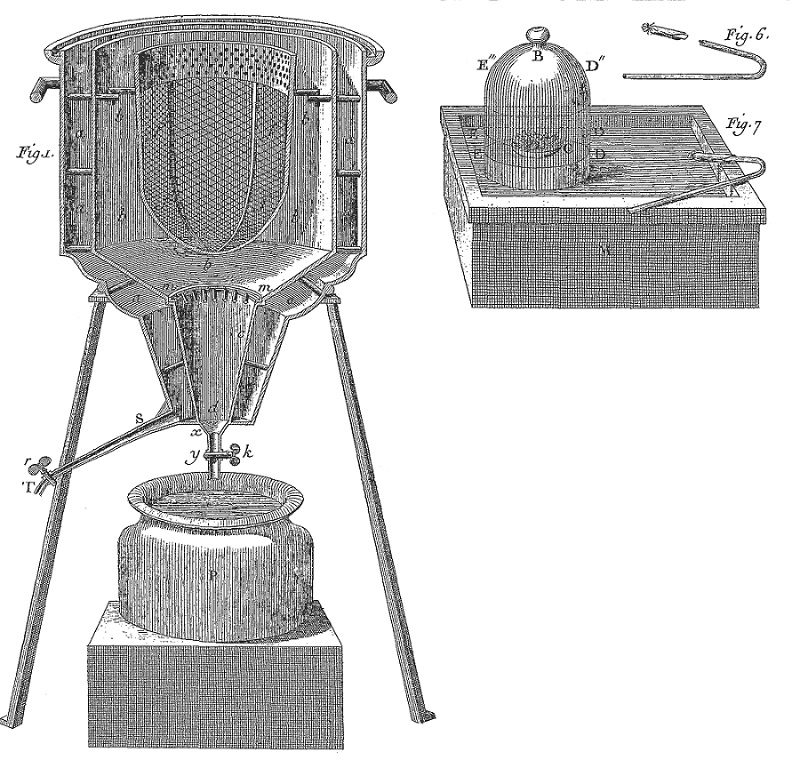
An engraving of a tall metal vessel on three legs, with a wire basket inside nested jackets and a tap at the bottom, beside a smaller bell jar apparatus.
Lavoisier and Laplace's ice calorimeter. The reaction sits in the inner basket, packed round with ice; the heat it gives out is measured by the weight of meltwater that runs from the tap.Antoine Lavoisier, Histoire de l'Académie royale des sciences · Public domain · Source

Germain Hess supplied the rule that makes a table of such numbers more useful than the sum of its entries. The heat of a reaction depends only on its start and end points, not on the path, so reactions can be added and subtracted and their heats added and subtracted with them. The consequence is practical: a heat that cannot be measured directly, because the reaction will not go cleanly or at all, can be assembled from ones that can. The heat of formation of carbon monoxide is impossible to measure, since burning carbon in limited oxygen always gives a mixture — and it follows immediately from the heats of combustion of carbon and of carbon monoxide, which are both straightforward.

The same construction run over bond-breaking steps gives average bond enthalpies, from which the heat of an unmeasured reaction can be estimated to within ten or twenty kilojoules by counting bonds broken and formed. That is poor accuracy by thermodynamic standards and often enough to decide whether a proposed reaction is worth attempting.

What the heats could not do was predict direction, and this is where the subject stalled for thirty years. Reactions that absorb heat happen; reactions that release it sometimes do not. The missing term was entropy, and the reason it took so long to find is that entropy is not a heat and cannot be measured by a calorimeter directly — it has to be assembled from heat capacities measured down towards absolute zero, which is a twentieth-century capability.

Chapter III

A Closer Look: Why Heat Release Is the Wrong Criterion

Take the counterexample and do the arithmetic. Ammonium nitrate dissolving in water:

NH4NO3(s)⟶NH4+(aq)+NO3−(aq)\mathrm{NH_4NO_3(s)} \longrightarrow \mathrm{NH_4^+(aq)} + \mathrm{NO_3^-(aq)}

with ΔH=+25.7\Delta H = +25.7 kJ/mol — it absorbs heat — and ΔS=+108\Delta S = +108 J/K/mol, because an ordered crystal becomes two freely moving ions. At 298 K,

TΔS=298×0.108=32.2 kJ/mol,T\Delta S = 298 \times 0.108 = 32.2 \text{ kJ/mol}, ΔG=25.7−32.2=−6.5 kJ/mol.\Delta G = 25.7 - 32.2 = -6.5 \text{ kJ/mol}.

Negative, so it dissolves, and the entropy term is what pays for the heat absorbed. Thomsen and Berthelot's rule predicts the opposite because it leaves the second term out.

The same number fixes how far a reaction goes, through

ΔG∘=−RTln⁡K.\Delta G^{\circ} = -RT\ln K.

With RT=8.314×298=2478RT = 8.314 \times 298 = 2478 J/mol,

K=exp⁡ ⁣(65002478)=e2.62=13.7,K = \exp\!\left(\frac{6500}{2478}\right) = e^{2.62} = 13.7,

so at equilibrium the dissolved form is favoured about fourteen to one. Note the sensitivity: because KK is exponential in ΔG\Delta G, a change of RTln⁡10=5.7RT\ln 10 = 5.7 kJ/mol moves the equilibrium constant by a factor of ten. That is less than the strength of a single hydrogen bond, which is why small structural changes make large differences to a yield.

Now the industrially decisive case, which also shows the trade-off that creates the need for a catalyst. Ammonia synthesis:

N2+3 H2⇌2 NH3,ΔH=−92.2 kJ/mol,ΔS=−198 J/K/mol.\mathrm{N_2} + 3\,\mathrm{H_2} \rightleftharpoons 2\,\mathrm{NH_3}, \qquad \Delta H = -92.2 \text{ kJ/mol}, \quad \Delta S = -198 \text{ J/K/mol}.

The entropy change is strongly negative because four molecules of gas become two. At room temperature,

ΔG=−92.2+(298)(0.198)=−92.2+59.0=−33.2 kJ/mol,\Delta G = -92.2 + (298)(0.198) = -92.2 + 59.0 = -33.2 \text{ kJ/mol},

which is comfortably favourable: K≈7×10⁵K \approx 7 \times 10^{5}. But at room temperature the reaction does not happen at any measurable rate, so it must be heated. At 700 K,

ΔG=−92.2+(700)(0.198)=−92.2+138.6=+46.4 kJ/mol,\Delta G = -92.2 + (700)(0.198) = -92.2 + 138.6 = +46.4 \text{ kJ/mol}, K=exp⁡ ⁣(−464008.314×700)=e−7.97=3.5×10−4.K = \exp\!\left(-\frac{46400}{8.314 \times 700}\right) = e^{-7.97} = 3.5 \times 10^{-4}.

Heating the reaction to make it go destroys the yield — a factor of 10910^{9} in the equilibrium constant between 298 K and 700 K. This is Le Chatelier's principle as a number: the reaction is exothermic, so heat pushes it backwards.
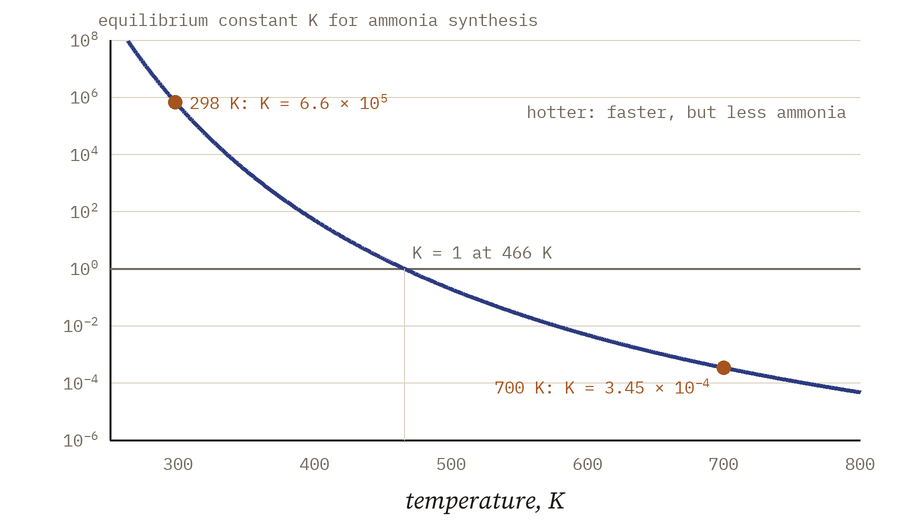
A falling curve of ammonia's equilibrium constant on a logarithmic scale against temperature, from about 6.6 times 10 to the 5 at 298 K, through 1 at 466 K, to 3.45 times 10 to the minus 4 at 700 K.
Ammonia's equilibrium constant from ΔG=ΔH−TΔS\Delta G = \Delta H - T\Delta S with the values above. It passes 1 at 466 K and has fallen by a factor of a billion by 700 K, the temperature needed for the reaction to go at a useful rate.Drawn for Field Atlas from the numbers above · Field Atlas original · Source

Two escapes exist, and both are used. Pressure, because the forward reaction consumes gas molecules: at 200 atmospheres the equilibrium shifts far enough to be worth having. And a catalyst, which does not touch the equilibrium at all — Ostwald was explicit that a catalyst cannot — but allows a usable rate at a lower temperature, where the equilibrium is better. The whole design of the Haber–Bosch process is contained in the two calculations above, and it is taken up under catalysis.

Chapter IV

Equilibrium Is Not Stasis

Cato Guldberg and Peter Waage supplied the other half of the picture in 1864, and it is easy to underrate because it now looks obvious. A reaction that has stopped changing has not stopped. It is proceeding in both directions at equal rates, and the ratio of concentrations that results — each raised to the power of its coefficient — is a constant at a given temperature.

That reframing explains things the older picture could not: why a reaction leaves reactants behind, why adding product reverses it, why a sealed flask reaches a steady state rather than running to completion. Van 't Hoff then connected the constant to temperature, showing that its logarithm shifts in proportion to the heat of reaction — the same relation that appears in the calculation above — and, in a separate stroke, that dilute solutions obey a law formally identical to the gas law, with osmotic pressure in the role of pressure.
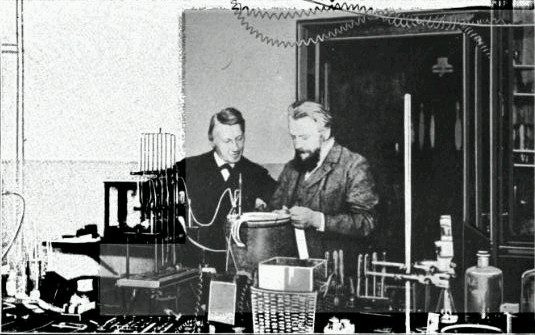
Two bearded men in dark suits at a laboratory bench crowded with glassware.
Wilhelm Ostwald and Jacobus van 't Hoff in the laboratory. Van 't Hoff tied the equilibrium constant to temperature; Ostwald defined what a catalyst can and cannot change.Benjamin Harrow, Eminent Chemists of Our Time · Public domain · Source

The last piece was making all of it apply to anything real. The equations above hold exactly for ideal gases and dilute solutions, and a concentrated brine is neither. Gilbert Lewis's solution was definitional: introduce activity, an effective concentration chosen so that the ideal equations remain exactly true, and put all the deviation from reality into an activity coefficient to be measured. It works, and it leaves the field with the awkwardness recorded above as its open problem — those coefficients can be predicted from first principles only when the solution is dilute enough not to matter.

Applications

Where it is used

  • Industry

    Choosing the conditions

    Whether to run a reaction hot or cold, at high pressure or low, concentrated or dilute, is decided by the sign and size of the enthalpy and entropy changes. Ammonia synthesis is run under pressure because it consumes gas molecules and as cool as the catalyst allows because it is exothermic; steam reforming is run hot for the opposite reason. The same arithmetic sets the limits of what no amount of engineering can achieve.

    › Sources (1)
    • Smith, J. M., Van Ness, H. C. & Abbott, M. M. (2005). Introduction to Chemical Engineering Thermodynamics, 7th edition. McGraw-Hill.
  • Geology

    Which minerals can coexist

    Gibbs's phase rule says how many phases can be in equilibrium given the number of components and the constraints, which turns a rock into a record: the assemblage of minerals present fixes the pressure and temperature at which it last equilibrated, so a thin section can be read as a depth and a temperature in the Earth's crust. Geology is not one of the domains this atlas surveys, so the use is recorded here and lands nowhere.

    › Sources (1)
    • Spear, F. S. (1993). Metamorphic Phase Equilibria and Pressure–Temperature–Time Paths. Mineralogical Society of America.
  • Biochemistry↗ Biology · Biochemistry

    Coupling a reaction that will not go

    Many reactions a cell needs have positive free energy and cannot proceed alone. They are driven by being coupled to the hydrolysis of ATP, which supplies about 50 kJ/mol under cellular conditions, so that the sum of the two has negative free energy. Metabolism is therefore an exercise in thermodynamic bookkeeping, and the standard free energies of its intermediates are tabulated for exactly that purpose.

    › Sources (2)
    • Alberty, R. A. (2003). Thermodynamics of Biochemical Reactions. Wiley.
    • Nicholls, D. G. & Ferguson, S. J. (2013). Bioenergetics, 4th edition. Academic Press.

Open problems

Where the map runs out

Open

Thermodynamics of concentrated electrolyte solutions

Open as of 2026; models are fitted to data rather than derived, and extrapolate badly.

Debye–Hückel theory predicts activity coefficients in dilute ionic solutions from first principles, and fails above roughly 0.01 molar. Above that — which includes seawater, blood, battery electrolytes, geothermal brines and most industrial streams — practice relies on fitted expressions such as Pitzer's equations, with dozens of empirical parameters per system, no reliable route from molecular structure, and poor behaviour outside the range of the data they were fitted to.

Why it is hard

In a concentrated solution the ions are close enough that their interactions are not pairwise additive, the solvent cannot be treated as a structureless dielectric because ions reorganise the water around them, and specific effects of ion identity dominate — which is why sodium and potassium salts of the same anion behave differently in ways the theory does not capture.

What resolving it unlocks

Battery and electrolyser design, desalination, carbon capture by amine solutions, geochemical modelling of ore deposits and the predictions of nuclear waste chemistry all require activities in concentrated solution.

› Sources (2)
  • Pitzer, K. S. (1973). Thermodynamics of electrolytes I. Journal of Physical Chemistry 77: 268–277.
  • Kontogeorgis, G. M., Maribo-Mogensen, B. & Thomsen, K. (2018). The Debye–Hückel theory and its importance in modeling electrolyte solutions. Fluid Phase Equilibria 462: 130–152.

Further reading

  1. Atkins, P. & de Paula, J. (2014). Physical Chemistry, 10th edition. Oxford University Press.

    The standard text; the chapters on free energy and equilibrium are the clearest short route in.

  2. Rukeyser, M. (1942). Willard Gibbs. Doubleday.

    A biography by a poet, and still the best account of why Gibbs went unread for fifteen years.

  3. Lewis, G. N. & Randall, M. (1923). Thermodynamics and the Free Energy of Chemical Substances. McGraw-Hill.

    The book that taught chemists to use thermodynamics; readable, and historically decisive.