Skip to content
Field Atlas

Atlas / Chemistry / The Materials Thread

Field · Emerged 1903 – 2020

Solid-State Chemistry

How do you make a solid with a composition and a structure you chose, when the atoms cannot move?

5 chapters9 min read7 turning points2 open problems

Branched from
Chemical Thermodynamics + The Periodic System
Branched into
Defect Chemistry + Nanomaterials Chemistry + Porous Frameworks
Figures
Gustav Tammann, Linus Pauling, Victor Goldschmidt, Robert Shannon, Eduard Zintl, Arthur von Hippel, Eugene Wainer, Boris Vul, Takeshi Ogawa, Robert Coble, Walter Rüdorff, Karl Fredenhagen

In brief

Most of chemistry happens in solution, where molecules meet by diffusing. Two solids in contact do not diffuse: the atoms are fixed in a lattice and the reaction can only proceed at the interface, as fast as atoms can hop through a crystal. Gustav Tammann established the consequence around 1910 — a solid reacts at a useful rate only above roughly two-thirds of its melting temperature — and it is why solid-state synthesis is still largely a matter of grinding powders together and holding them at 1,000 °C for a day.

That constraint sets what the field can and cannot do. Because the reaction must pass through every intermediate the thermodynamics allows, what comes out of the furnace is the stable product, not the interesting one. And because the product is an extended structure rather than a molecule, there is no equivalent of a functional group: the unit of design is a structure type, and the variable is which element sits on which site.

Which turns out to be enough. The perovskite structure accommodates most of the periodic table on its two cation sites, and the resulting compounds are ferroelectric, piezoelectric, catalytic, superconducting, magnetoresistive or photovoltaic according to what was put in. Victor Goldschmidt's radius ratios and Linus Pauling's rules say which substitutions will fit, from numbers tabulated once. The outstanding difficulty is the reverse of organic chemistry's: hundreds of thousands of stable compounds have been predicted by computation and nobody can say which of them can be made, because there is no retrosynthesis for a solid.

Key ideas

Tammann temperatureEnters 1903 – 1925

Roughly two-thirds of a solid's melting point in kelvin, the temperature at which lattice diffusion becomes fast enough for a reaction between solids to proceed. It is why solid-state synthesis means a furnace, and why the method delivers whichever phase is thermodynamically stable there.

Radius ratioEnters 1926 – 1929

The ratio of cation to anion radius, which fixes how many anions can pack around a cation: below 0.414 four, between 0.414 and 0.732 six, above that eight. The first of Pauling's rules, and the reason the common structure types are as few as they are.

Tolerance factorEnters 1941 – 1955

Goldschmidt's one-number test of whether three ions will form a perovskite and in what symmetry. Near 1.0 gives the cubic structure; below it the octahedra tilt; above it the small cation sits off-centre, which is what makes a ferroelectric.

Zintl conceptEnters 1929 – 1939

In a compound of a very electropositive metal with a semi-metal, treat the electrons as fully transferred and the structure of the remaining anion framework follows from ordinary bonding rules. It gives intermetallic compounds — which have no molecules and no obvious valences — a structural logic.

SinteringEnters 1949 – 1962

Consolidating a powder into a dense solid below its melting point, driven by the reduction of surface area. Controlling it is what turns a chemical composition into an object, and control of the last fraction of a per cent of porosity is the difference between an opaque ceramic and a transparent one.

Topotactic reactionEnters 1926 – 1976

A reaction in which ions enter or leave a solid while its framework stays intact, so the host is changed in composition but not rebuilt. It is the only general way to make a solid at low temperature that the furnace would never give, and it is how a battery electrode works.

Chapter I

Chemistry Without a Solvent

Nearly all chemical reactions are run in solution, because a solvent lets molecules find each other. Two solids in contact cannot do that. Each atom is in a lattice site, the reaction can only happen where the two crystals touch, and the first thing the reaction produces is a layer of product that separates the reagents from one another.

Gustav Tammann established the consequences in the years around 1910. The rate of a solid-state reaction is set by how fast atoms can diffuse through the growing product layer, which means it falls as the reaction proceeds, and it means nothing happens at all until atoms can move. The threshold is roughly two-thirds of the absolute melting temperature — the Tammann temperature — which for a typical oxide puts the furnace somewhere between 800 and 1,400 °C.

This explains the characteristic method of the field, essentially unchanged in a century: grind the oxides or carbonates together as finely as possible, press them, hold them at temperature for hours or days, regrind, repeat. Intimate mixing matters more than any choice of reagent, because the only variable under real control is the diffusion distance.

It also sets a hard limit on what can be made. A reaction that must crawl through every accessible intermediate will arrive at whichever phase is thermodynamically stable at the temperature used. The furnace delivers the stable compound, and the interesting ones are very often metastable — which is why the two routes out of this constraint, topotactic reactions at low temperature and the framework syntheses of porous frameworks, matter out of proportion to their apparent modesty.

Chapter II

Rules for Where the Atoms Go

A molecule has functional groups; an extended solid does not. What it has instead is a structure type — rock salt, spinel, perovskite, fluorite — and a set of sites within it. The design variable is which element goes on which site, and the question is which substitutions will fit.

Victor Goldschmidt supplied the raw material in 1926 by extracting a consistent set of ionic radii from the crystal structures that Bragg's diffraction methods, described under crystallography, were then producing in quantity. Pauling turned radii into rules in 1929. The first and most used of them is simply geometric: the number of anions that can pack around a cation is fixed by the ratio of their radii, four below 0.414, six between 0.414 and 0.732, eight above. The others concern charge balance and the observation that coordination polyhedra prefer to share corners rather than edges, and edges rather than faces, because sharing a face brings two cations uncomfortably close.

Eduard Zintl added a different kind of rule for a class the radius arguments cannot touch. Compounds between a very electropositive metal and a semi-metal — NaTl, for instance — are neither salts nor alloys and have no obvious valences. Zintl's move was to hand the electron over completely on paper: thallium with one extra electron has four valence electrons, like carbon, and sure enough the thallium atoms in NaTl form a diamond-like network with the sodium in the gaps. One electron count turns a structure that looked arbitrary into one that follows the ordinary rules of bonding, and the idea generalises across a large region between the salts and the metals.

Chapter III

One Structure, a Thousand Compositions

The perovskite structure is the clearest demonstration of what a structure type buys. It is a framework of corner-sharing octahedra with a large cation in the cavities, formula ABO₃, and it accepts most of the periodic table.
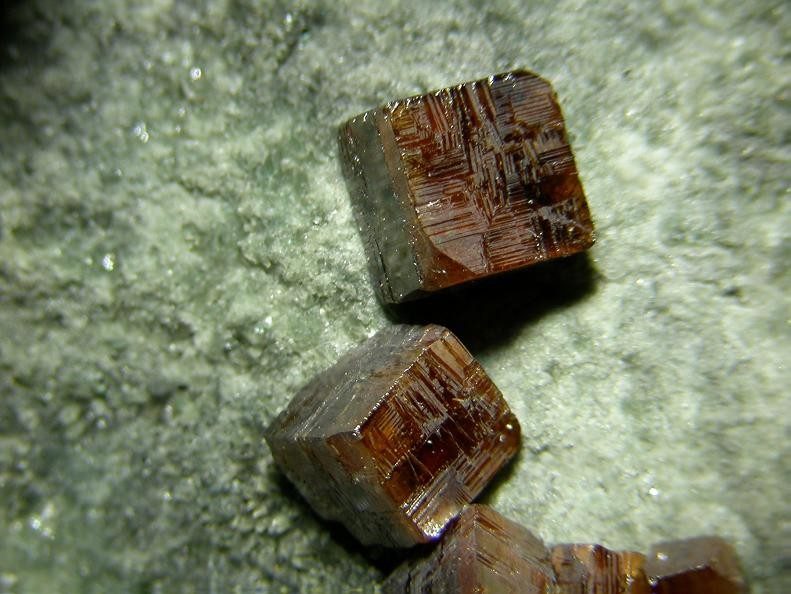
Two small dark brown cube-shaped crystals on a pale green rock.
Perovskite, calcium titanate, as the mineral from the Susa Valley in Piedmont; the field of view is 7 mm. Its name now covers every compound with the same structure.Leon Hupperichs · CC BY-SA 3.0 · Source

It came to attention through a wartime secret. Barium titanate was found independently in the United States, the Soviet Union and Japan, in work none of the three could publish, to have a dielectric constant more than a hundred times anything a capacitor then used. Arthur von Hippel showed in 1946 what was going on: the titanium ion is not at the centre of its octahedron but displaced to one side, giving every unit cell a permanent dipole that an applied field can switch. A ferroelectric.

Once the structure was understood as a family, the property became selectable. Substitute lead and zirconium and the material is strongly piezoelectric, which is the sonar transducer and the ultrasound probe. Substitute lanthanum and manganese and it is magnetoresistive. Substitute copper on a related layered perovskite and it is the high-temperature superconductor of superconductivity. Substitute lead and iodide and it is the photovoltaic absorber that went from 3% to over 25% efficiency in a decade. The chemistry in each case is a substitution on a known framework.

Two methods widen what can be reached. Robert Coble showed in the late 1950s how to control sintering well enough to eliminate almost all porosity, producing alumina transparent enough to contain sodium vapour at 1,200 °C and so making the high-pressure sodium lamp possible — a property won by controlling microstructure rather than composition. And Walter Rüdorff and others established that ions can be put into a layered solid, and taken out again, at room temperature, leaving the host framework intact. Such topotactic reactions reach compositions no furnace can, because they do not require the product to be the stable phase; they are how a battery electrode works, and they are the main escape from the Tammann constraint.

Chapter IV

A Closer Look: Predicting a Structure From Two Radii

The field's oldest predictive tool is a ratio of two tabulated numbers, and it is worth seeing both how well it works and where it stops.

Which structure type? Pauling's first rule says the coordination number follows from r+/r−r_+/r_-. Taking Shannon's radii:

Compoundr+r_+ (Å)r−r_- (Å)RatioPredicted CNObserved structure
ZnS0.601.840.3264zinc blende, CN 4
NaCl1.021.810.5636rock salt, CN 6
CsCl1.701.810.9398caesium chloride, CN 8

Three for three, and these are the three archetypes every chemist learns. It is worth being honest about the rule's reach, though: tested systematically across the binary compounds, the radius-ratio prediction is right about two thirds of the time. It is a guide with a known failure rate, not a law, and part of its apparent success is circular — the radii were themselves fitted to structures.

Which symmetry, within a structure type? Goldschmidt's tolerance factor is a sharper test, because it predicts not whether a perovskite forms but which distortion it adopts:

t=rA+rO2 (rB+rO).t = \frac{r_A + r_O}{\sqrt{2}\,(r_B + r_O)}.

Take three titanates that differ only in the large cation. With rTi4+=0.605r_{\mathrm{Ti}^{4+}} = 0.605 Å and rO2−=1.40r_{\mathrm{O}^{2-}} = 1.40 Å, the denominator is 2×2.005=2.835\sqrt{2} \times 2.005 = 2.835 Å in all three cases:

CompoundrAr_A (Å)ttWhat tt impliesObserved at 20 °C
CaTiO₃1.340.966A too small: octahedra tiltorthorhombic
SrTiO₃1.441.002fits exactlycubic
BaTiO₃1.611.062A too big: B rattles off-centretetragonal, ferroelectric

Three compounds of the same formula type, three different symmetries, each one predicted by a number computed from a table in under a minute. And the third line is the commercially decisive one. Because barium is slightly too large for the cavity, the titanium has room to sit about 0.1 Å off-centre; every unit cell is then a dipole, the dipoles align in domains, and the dielectric constant at the transition reaches several thousand against about 5 for a typical glass. That single consequence of t>1t > 1 is why barium titanate is in essentially every electronic device made.
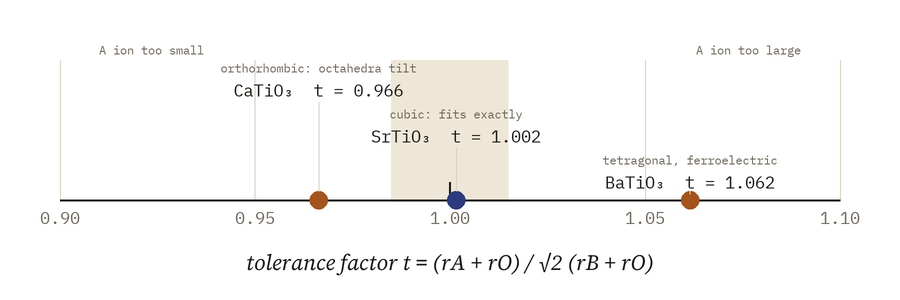
Three points on a tolerance-factor scale, calcium titanate at 0.966, strontium titanate at 1.002 and barium titanate at 1.062, each labelled with the symmetry it adopts.
Goldschmidt's tolerance factor for the three titanates in the table. Below 1 the octahedra tilt, at 1 the cell stays cubic, above 1 the titanium rattles off-centre and the crystal becomes ferroelectric.Drawn for Field Atlas from the table above · Field Atlas original · Source

The arithmetic also shows where composition becomes a dial rather than a choice. Replacing a fraction xx of the barium with calcium moves tt smoothly between 1.062 and 0.966, so the transition temperature can be placed where a specification requires it. Capacitor grades differ in exactly this way: the formulation is chosen so that the dielectric peak sits outside the operating range, giving a high and flat permittivity rather than a high and sharp one. A tolerance factor is being used as a design parameter, three quarters of a century after it was proposed to classify minerals.

Chapter V

Predicted, But Can It Be Made?

The field now has a peculiar problem. Electronic-structure calculation applied systematically to the structural catalogues has produced lists of hundreds of thousands of compositions that should be thermodynamically stable, of which a small minority have ever been prepared. Knowing what might exist is no longer the constraint.

Making it is. There is no retrosynthesis for a solid: nothing takes a target composition and returns the precursors, the temperature, the atmosphere and the sequence. The reason is the one this field began with. A solid-state reaction proceeds through whichever intermediates its particles happen to make accessible, and those depend on grain size, heating rate and local composition — none of which appear in a thermodynamic calculation. Worse, many of the desirable targets are metastable, so the furnace cannot reach them in principle, and the low-temperature routes that could are the least systematised part of the subject.

Three of them are developed further in this thread. Defect chemistry takes up what happens when the composition is deliberately not stoichiometric, which turns out to be where ionic conduction and most useful electronic behaviour live. Porous frameworks builds solids out of units that assemble in solution, evading the diffusion problem entirely. And nanomaterials chemistry exploits the fact that at small enough sizes the surface is most of the material, so a property can be changed by changing a dimension rather than a composition.

Applications

Where it is used

  • Electronics

    A trillion capacitors a year, all the same structure

    Multilayer ceramic capacitors are built from barium titanate with its composition adjusted by partial substitution — some of the barium replaced by calcium, some of the titanium by zirconium — to move the ferroelectric transition and flatten the temperature dependence. They are made in the region of a trillion units a year, which makes this probably the most-manufactured designed inorganic material other than cement, and the whole product line is one structure type with the composition used as a dial.

    › Sources (1)
    • Pan, M.-J. & Randall, C. A. (2010). A brief introduction to ceramic capacitors. IEEE Electrical Insulation Magazine 26: 44–50.
  • Lighting

    The orange street light needs a transparent ceramic

    A high-pressure sodium lamp runs sodium vapour at over 1,200 °C, which attacks glass and quartz. Coble's translucent alumina withstands it, and the lamp — about twice as efficient as the mercury lamps it replaced — became the standard street light for decades. The enabling step was not a new compound but the removal of the last tenth of a per cent of porosity from a familiar one.

    › Sources (1)
    • Wei, G. C. (2009). Transparent ceramics for lighting. Journal of the European Ceramic Society 29: 237–244.
  • Planetary interiors↗ Physics

    Most of the Earth is one structure type

    Magnesium silicate adopts the perovskite structure above about 24 gigapascals, and that phase makes up a large majority of the lower mantle by volume — the most abundant mineral in the planet, named bridgmanite only in 2014 because a natural sample had never been held. Its stability field, its viscosity and the further transition near the core boundary set how heat leaves the Earth, and they are read from the same radius-ratio reasoning used to design a capacitor.

    › Sources (1)
    • Tschauner, O. et al. (2014). Discovery of bridgmanite, the most abundant mineral in Earth. Science 346: 1100–1102.

Open problems

Where the map runs out

Open

A retrosynthesis for solids

Open as of 2026; machine-learned synthesis prediction is being attempted and is not yet reliable for new structure types.

Organic chemistry can take a target molecule and work backwards to available starting materials, as described in retrosynthetic analysis. Inorganic chemistry cannot. Given a predicted compound, there is no procedure that outputs the precursors, the temperature, the atmosphere and the order of steps, and the great majority of computationally stable compositions have no published route. Which of the predicted set in chemical composition are reachable is therefore unknown.

Why it is hard

A solid-state reaction passes through whatever intermediate phases are accessible, and which ones form depends on the precursors' particle size, the heating rate and the local composition — none of which appear in a thermodynamic calculation. The target is often metastable, so the furnace route cannot reach it at all, and the kinetic barriers that would decide a low-temperature route are not computed.

What resolving it unlocks

The limiting step in materials discovery for batteries, catalysts, thermoelectrics and magnets is currently synthesis rather than design. A reliable route-finder would make the computed catalogues usable rather than suggestive.

› Sources (2)
  • Kovnir, K. (2021). Predictive synthesis. Chemistry of Materials 33: 4835–4841.
  • Szymanski, N. J. et al. (2021). Toward autonomous design and synthesis of novel inorganic materials. Materials Horizons 8: 2169–2198.

Open

What the composition is at a grain boundary

Open as of 2026; individual boundaries are now imaged atom by atom, general predictive rules are not available.

A polycrystalline solid is mostly grains and partly the few atomic layers between them, and those layers have their own composition: impurities segregate there, the structure is disordered, and the local stoichiometry differs from the bulk. Conduction, fracture, corrosion and degradation are frequently controlled by this small fraction of the material, and predicting what will segregate where, and what it will do, remains case by case.

Why it is hard

A boundary is a two-dimensional defect whose structure depends on the relative orientation of the two grains, so there is no single boundary to compute — there is a continuum of them. The segregating species are present at a fraction of a monolayer, which is at the edge of what analysis can quantify spatially, and the structure changes during the measurement.

What resolving it unlocks

Solid electrolytes fail at grain boundaries, ceramics fracture along them, and a battery's lifetime is largely a boundary problem. Deliberate boundary engineering would change the durability of most functional ceramics.

› Sources (2)
  • Chiang, Y.-M., Birnie, D. P. & Kingery, W. D. (1997). Physical Ceramics. Wiley.
  • Dillon, S. J. et al. (2007). Complexion transitions in ceramics. Acta Materialia 55: 6208–6218.

Further reading

  1. West, A. R. (2014). Solid State Chemistry and Its Applications, 2nd edition. Wiley.

    The standard course: structure types, defects, synthesis and properties in one volume.

  2. Chiang, Y.-M., Birnie, D. P. & Kingery, W. D. (1997). Physical Ceramics. Wiley.

    Where the microstructure is treated as the subject rather than as an impurity on the chemistry.

  3. Schmalzried, H. (1981). Solid State Reactions, 2nd edition. Verlag Chemie.

    What actually happens at the interface between two reacting solids, worked out properly.