Chapter I
A Perfect Crystal Is Not the Lowest Free Energy
Crystals are introduced as perfect repetition, and the picture is a good first approximation that happens to be thermodynamically impossible.
Yakov Frenkel made the argument in 1926. Removing an atom from its site costs energy — call it per defect. But a crystal with vacancies distributed among sites can be arranged in an enormous number of ways, and that configurational entropy lowers the free energy. The first few vacancies are almost free, entropically speaking, because there are so many places to put them; the cost grows only logarithmically. So the free energy has a minimum at some finite , and the perfect crystal is not it.
Walter Schottky and Carl Wagner worked out the statistics and identified the two neutral combinations an ionic crystal can use: a vacancy paired with the displaced ion in an interstitial position, or vacancies on the cation and anion sublattices together. A crystal in equilibrium therefore contains a definite, calculable number of defects, and the number rises steeply with temperature.
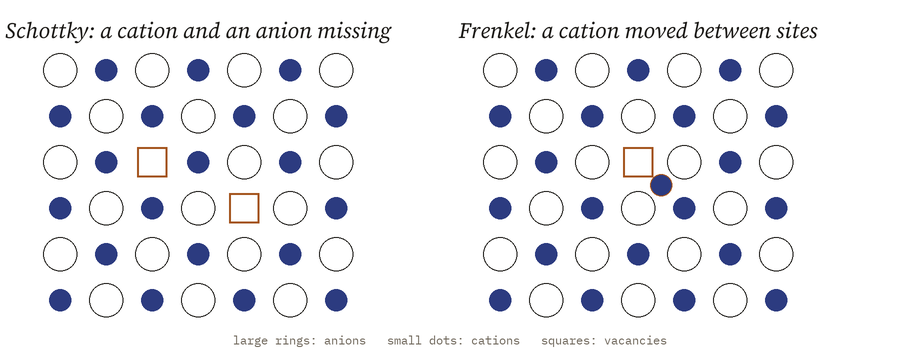
That reframes the subject. Defects stop being damage to be minimised and become a property to be computed — and then, once the chemistry is understood, a property to be set.
Chapter II
Composition Need Not Be Fixed
The chemical consequence is stranger than the thermodynamic one, and it cuts against something chemistry had treated as definitional.
A compound, since Proust won his argument with Berthollet in 1811, has a fixed composition; that is what distinguishes a compound from a mixture, and the whole of the atomic theory in chemical composition rests on it. Wagner and Schottky showed that for a large class of solids it is false. If a lattice can carry cation vacancies, and if the cation has a second accessible oxidation state, then some cations can simply be missing provided others are oxidised to compensate. The structure is unchanged; the formula is not.
Iron(II) oxide is the standard case. Prepared in equilibrium with metallic iron it is about Fe₀.₉₅O, and raising the oxygen pressure drives it to Fe₀.₈₄O — a continuous range, with one in six iron sites empty at the extreme and a third of the remaining iron present as Fe³⁺. Titanium oxides, tungsten oxides, cerium oxide, the uranium oxides and most of the transition-metal sulphides behave similarly. The composition is a function of the surrounding gas pressure, which means it is a variable rather than a fact about the compound.
Ferdinand Kröger and Hendrik Vink then made this calculable in 1956 by the simple device of writing defects as chemical species. A vacancy has a site, a charge relative to the perfect lattice, and a concentration; defect formation can be written as a balanced equation; and mass action then gives concentrations as functions of temperature, doping and gas pressure. Plot the logarithm of each defect's concentration against the logarithm of oxygen pressure and the result is a diagram of straight lines whose slopes identify which defect is in charge in which regime. This is the point at which the subject became chemistry rather than physics with impurities.
Wagner used the same thinking in 1933 on a problem with immediate industrial weight. A metal oxidising in air is separated from the air by its own oxide, so the rate is set by how fast ions and electrons can cross that layer — which is a defect-transport question, answerable from independently measured diffusion data. The theory predicts the parabolic growth law and says which oxides protect, giving a mechanism to sit underneath the geometric criterion in corrosion.
Chapter III
Defects You Put There on Purpose
The step from calculating defects to installing them is where the field earns its place.
Robert Pohl's group at Göttingen found through the 1930s that pure alkali halides, colourless as grown, acquire strong absorption bands after X-irradiation or exposure to alkali vapour, and that the colour belongs to the crystal and not to any impurity. Frederick Seitz, with Nevill Mott and Ronald Gurney, identified the absorber: an electron trapped where an anion is missing, with energy levels inside the gap. Colour centres were the first defects to be seen one species at a time, and they are the reason most blue topaz on sale was colourless when it came out of the ground.
The general tool is aliovalent doping: substitute an ion of the wrong charge and the lattice is forced to make a compensating defect. Put calcium on a sodium site and one sodium vacancy must appear. Put yttrium on a zirconium site and one oxygen vacancy appears for every two yttriums. Because the dopant level is set when the material is made, the defect concentration becomes a composition rather than a temperature — and, as the next section shows, that is worth a great many orders of magnitude.
Arne Magnéli found the limit of the picture. Reduced titanium and tungsten oxides do not scatter their missing oxygens at random; they remove entire planes of them and shear the structure across the gap, giving a series of distinct, closely spaced phases. At the concentrations that matter in practice, defects see each other, cluster and order. The dilute thermodynamics that makes the field calculable is an approximation that fails exactly where the useful materials are, which is the second open problem recorded above.
Chapter IV
A Closer Look: Why Doping Beats Heating
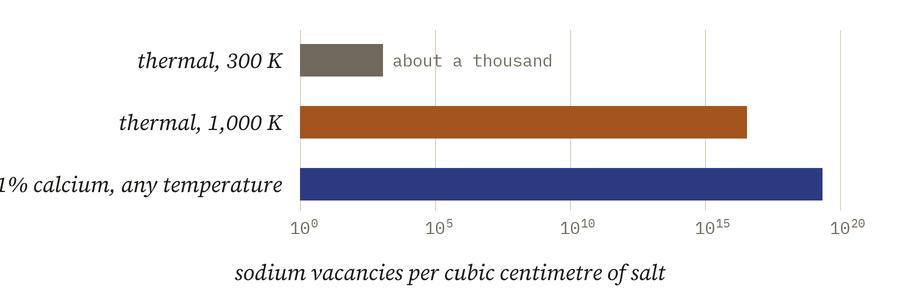
Take sodium chloride, where the Schottky pair formation enthalpy is about 2.3 eV. The equilibrium fraction of sites vacant is
the factor of two because one pair creates two vacancies. At room temperature, eV:
Sodium chloride contains about ion pairs per cubic centimetre, so that is roughly one thousand vacancies per cubic centimetre. Effectively none.
Now heat it to 1,000 K, close to melting, where eV:
or about per cubic centimetre. Heating by 700 degrees has multiplied the defect population by thirteen orders of magnitude — which is the sensitivity that makes the exponential the dominant fact about the subject.
Now do it chemically instead. Add calcium chloride at 0.1 mole per cent. Each Ca²⁺ sits on a Na⁺ site carrying one extra positive charge, and the lattice must create one sodium vacancy for each to stay neutral. The vacancy fraction is then simply the dopant fraction:
Compare the three figures:
| Route | Vacancies per cm³ |
|---|---|
| Thermal, 300 K | ~10³ |
| Thermal, 1,000 K | |
| 0.1% Ca²⁺ doping, any temperature |
One part in a thousand of an impurity beats heating to near the melting point by a factor of six hundred, and it does so at room temperature — and, crucially, the concentration no longer depends on temperature at all, because it is fixed by charge balance rather than by an equilibrium. The defect population has become a composition. That is the whole method of the field in one line.
Push it further and the consequence is a solid electrolyte. Zirconia doped with 8 mole per cent yttria has roughly 15% of its cation sites occupied by yttrium, which forces about 3.7% of all oxygen sites to be vacant. With that many empty sites to hop into, oxide ions migrate freely: at 1,000 °C the conductivity is about 0.1 S cm⁻¹, which is the conductivity of a molar solution of potassium chloride at room temperature. A dense, hard, chemically inert ceramic conducts ions as well as brine does.
Two things follow that the arithmetic does not. First, the conductivity does not keep rising with doping; it peaks near 8% and falls thereafter, because the vacancies begin to associate with the dopants that created them and stop moving. The dilute theory predicts no such maximum, and no theory predicts where it will fall for a new composition. Second, this ceramic is the reason modern car exhausts are clean — not as a catalyst but as a sensor, generating a voltage from the oxygen difference across it and so letting the engine hold its air-to-fuel ratio within the one per cent window the catalyst requires.
Chapter V
Where the Properties Live
Taken together the field makes a claim that is easy to state and was slow to accept: for a non-metallic solid, the interesting properties belong to the defects rather than to the lattice.
Ionic conduction needs vacancies. Electronic conduction in an oxide is usually carried by the mixed valence that non-stoichiometry produces. Colour in a nominally colourless crystal is a trapped charge. Semiconductor devices are built on impurities at one atom in a million, held to nanometre tolerances, with unwanted impurities excluded at parts per billion — the most demanding purity requirement in industry, in service of a defect specification. The catalytic activity of ceria in a converter comes from how readily it gives up oxygen and takes it back, which is non-stoichiometry doing work. And the lithium electrode of batteries is a host whose composition is deliberately varied over a wide range while its framework survives.
What the field cannot yet do is predict these populations from first principles, because a concentration that depends exponentially on an energy demands an accuracy that computation does not reach, and because at useful concentrations the defects stop being independent. Both limits are recorded above. They are the reason materials screening of the kind described in solid-state chemistry stops at thermodynamic stability and does not go on to say whether the compound will conduct.