Skip to content
Field Atlas

Atlas / Chemistry / The Electrochemistry Thread

Field · Emerged 1859 – 2019

Batteries and Electrolysers

How much energy can be stored in a chemical reaction run through wires, and what limits how fast it goes in and out?

4 chapters7 min read6 turning points1 open problem

Branched from
Electrode Potentials
Branched into
Not yet surveyed past here
Figures
Gaston Planté, Georges Leclanché, Carl Gassner, Francis Thomas Bacon, Stanley Whittingham, John Goodenough, Akira Yoshino

In brief

A battery is a reaction kept from happening, with its electrons routed through a circuit. The constraints on one are therefore chemical: the voltage is fixed by the couple, the charge by how many electrons per kilogram the materials can supply, and Faraday's law converts the two into a specific energy that no engineering improves. Gaston Planté's lead–acid cell of 1859 stores about 35 watt-hours per kilogram and is still made in the hundreds of millions, because it is cheap and delivers enormous current.

The modern cell works differently and the difference is the reason it exists. Rather than consuming the electrodes, lithium ions move back and forth between two host structures that accommodate them without dissolving — intercalation, found by Stanley Whittingham in the 1970s, given a usable cathode by John Goodenough in 1980 and a safe anode by Akira Yoshino in 1985. Nothing is destroyed, so the cell can be cycled a thousand times. The arithmetic still does not reach petrol: a good cell holds a fiftieth as much energy per kilogram as fuel, and after accounting for engine and motor efficiency the gap is about fourteenfold. That is the number electrification has to work around rather than overcome.

Key ideas

Specific energyEnters 1859

Energy stored per kilogram. It follows from the cell voltage and the charge the materials can hold: one mole of electrons is 26.8 ampere-hours, so the mass of material per ampere-hour is fixed by chemistry.

IntercalationEnters 1972 – 1980

Inserting ions reversibly into the gaps of a host crystal structure, which expands slightly and is otherwise unchanged. Because nothing dissolves or is plated, the process can be reversed hundreds or thousands of times.

Rocking-chair cellEnters 1985 – 1991

A cell in which the same ion shuttles between two intercalation hosts and no metal is ever plated. It is what makes a lithium-ion battery safe enough to sell, at the cost of some capacity.

Solid electrolyte interphaseEnters 1985 – 1991

A thin film that forms on the negative electrode during the first charge, as the electrolyte decomposes. It is unavoidable, it consumes some lithium permanently, and if it is stable the cell lasts for years while if it is not the cell dies.

Round-trip efficiencyEnters 1927 – 2022

The fraction of energy put in that comes back out, lost mainly to overpotential. Lithium cells reach above 90%; water electrolysis followed by a fuel cell returns around 35 to 40%, which is why hydrogen is a poor battery and a reasonable fuel.

Power against energyEnters 1932 – 1969

How fast charge can be moved is a separate design problem from how much is stored, and the two conflict: thick electrodes hold more and conduct worse. A cell is built for one or the other.

Chapter I

A Reaction Held Apart

Every battery is the same trick. Take a reaction that would release energy if the reactants met, separate them so that they cannot, and provide the electrons with a longer route through a circuit. The voltage is then set by the free energy of the reaction and the capacity by how much reactant is present.

Gaston Planté's lead–acid cell of 1859 was the first that could be refilled by reversing the current. Lead and lead dioxide in sulfuric acid give slightly over two volts — the highest of any aqueous chemistry, since beyond about that the water itself decomposes — and the materials are cheap and conduct superbly, so the cell can deliver hundreds of amperes for the few seconds needed to turn an engine. It is still manufactured in enormous numbers for that one job, and its specific energy, about 35 watt-hours per kilogram, has barely improved in 160 years.
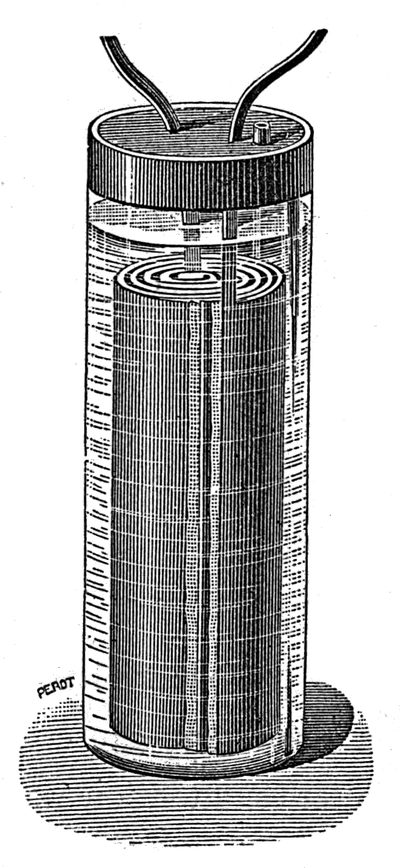
An engraving of a tall glass jar holding a spiral roll of lead sheets, with two wires leading out of the lid.
Planté's lead–acid cell: two lead sheets rolled together into a spiral, kept apart, and stood in dilute sulfuric acid.Gaston Planté, The Storage of Electrical Energy · Public domain · Source

The Leclanché cell and Gassner's sealed paste version made electricity portable, which mattered more at the time than anything about efficiency: a dry cell works in any orientation, does not spill acid, and is still essentially the alkaline cell sold today.
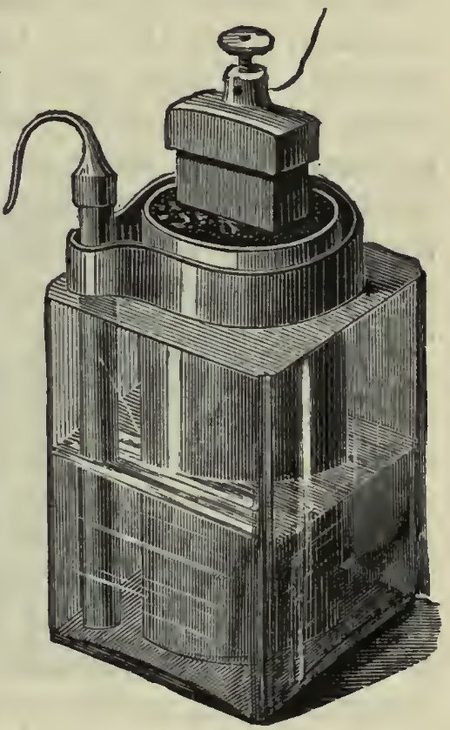
An engraving of a square glass jar holding a porous pot with a carbon plate and a zinc rod, with terminals on top.
A Leclanché cell: a zinc rod in sal ammoniac solution, and a carbon plate packed round with manganese dioxide inside a porous pot.William Edward Ayrton, Practical Electricity · Public domain · Source

What neither could do was be recharged many times without destroying itself, because in both the electrodes dissolve and are rebuilt, and material does not return to where it came from.

Chapter II

What a Cell Has to Survive

A battery's specific energy is chemistry, and almost everything else about it is degradation. A cell that stores a great deal and fails after fifty cycles is a laboratory result, not a product.

The first thing that happens to a lithium cell is that its electrolyte decomposes. The graphite electrode, holding lithium, sits outside the voltage window within which the electrolyte is stable, so on the first charge a film forms on its surface from the decomposition products — the solid electrolyte interphase. This is not a defect but the thing that makes the cell possible: the film conducts lithium ions and blocks electrons, so the decomposition stops once the surface is covered. It consumes a few per cent of the cell's lithium permanently, which is why the first cycle has a lower efficiency than every subsequent one, and if it is unstable — cracking as the electrode expands and contracting, reforming, consuming more lithium each time — the cell fades.

Capacity loss therefore has two clocks. Cycle ageing tracks how many times the electrodes have swelled and shrunk, which cracks particles and thickens films. Calendar ageing proceeds while the cell sits unused, faster when it is hot and when it is held at a high state of charge, because both raise the rate of the side reactions. A cell kept at full charge in a warm place loses capacity measurably in a year while doing nothing, which is why a laptop left plugged in ages faster than one that is cycled.

The failure that matters most is thermal. Above about 80 °C the interphase begins to break down; the exposed electrode then reacts with the electrolyte, which releases more heat, which accelerates the breakdown. Past the tipping point the cell vents and burns, and because the cathode supplies its own oxygen the fire does not need air. Preventing that is why commercial cells contain a pressure vent, a separator that melts shut to stop ion flow, and a management circuit that refuses to charge outside a narrow window — engineering around an energy source that is, by design, a long way from equilibrium.

Chapter III

A Closer Look: The Arithmetic of a Battery

Three calculations fix what batteries can and cannot do.

How much lithium is in a car. One mole of electrons carries 96,485 coulombs, which is

96,4853600=26.8 ampere-hours.\frac{96{,}485}{3600} = 26.8 \text{ ampere-hours}.

A 60 kWh pack at an average 3.7 V holds

60,0003.7=16,200 Ah=16,20026.8=605 mol of electrons.\frac{60{,}000}{3.7} = 16{,}200 \text{ Ah} = \frac{16{,}200}{26.8} = 605 \text{ mol of electrons}.

Since each lithium ion carries one charge, 605 moles of lithium must shuttle back and forth, which at 6.94 g/mol is

605×6.94=4.2 kg of lithium.605 \times 6.94 = 4.2 \text{ kg of lithium}.

Four kilograms, in a pack weighing 400. The lithium is a small part of the mass; most of it is the hosts that hold the ion, the electrolyte, the current collectors and the casing. That is why improving a battery is mostly about the materials the lithium sits in rather than the lithium itself, and why the metal's share of the cell's cost is modest.

Why petrol still wins on weight. Petrol stores about 46 MJ/kg. A good lithium-ion cell stores 250 Wh/kg, which is

250×3600=9.0×10⁵ J/kg=0.9 MJ/kg,250 \times 3600 = 9.0\times10^{5} \text{ J/kg} = 0.9 \text{ MJ/kg},

a factor of 51 less. The comparison is unfair, because an internal combustion engine wastes about three quarters of what it burns while an electric drivetrain delivers around 90%. Correcting for that:

46×0.250.9×0.90=11.50.81=14.\frac{46 \times 0.25}{0.9 \times 0.90} = \frac{11.5}{0.81} = 14.

A fourteenfold gap in useful energy per kilogram, not fifty. That number explains the pattern of electrification precisely. A car can carry a 400 kg pack, because wheels bear the weight and braking returns some energy; the gap costs range and is tolerable. An airliner cannot, because weight must be lifted continuously and fuel is nearly half its take-off mass — so a fourteenfold penalty is not a range problem but an impossibility, and aviation is arguing about fuels rather than batteries.
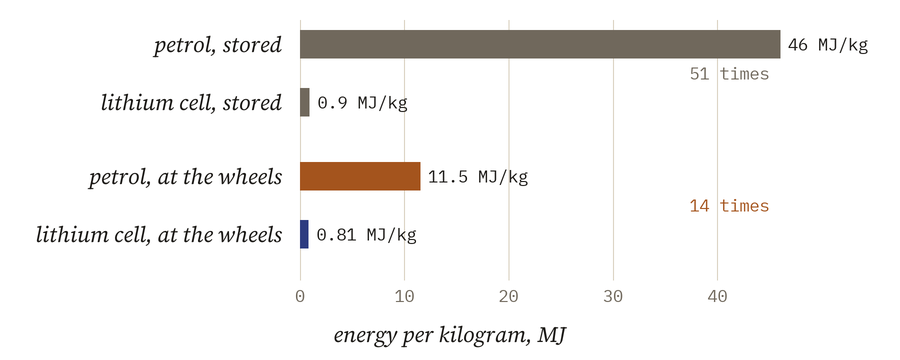
Bars of energy per kilogram, petrol 46 MJ against a lithium cell's 0.9 MJ stored, and 11.5 against 0.81 MJ at the wheels.
Petrol against a lithium cell. Stored, the gap is a factor of 51; after the engine's and the motor's losses, a factor of 14.Drawn for Field Atlas from the numbers above · Field Atlas original · Source

Why hydrogen is not a battery. Splitting water requires 1.23 V thermodynamically; a working electrolyser needs 1.8 to 2.0 V because of the overpotentials described under electrode potentials. So about a third of the electricity is lost on the way in. Running the hydrogen back through a fuel cell loses a comparable fraction again, giving a round trip of roughly

0.65×0.55≈0.36,0.65 \times 0.55 \approx 0.36,

against above 90% for a lithium cell. Storing electricity as hydrogen therefore throws away nearly two thirds of it. Hydrogen is a reasonable fuel — it has excellent energy per kilogram and terrible energy per litre — and a poor battery, and the arithmetic, not the engineering, is why.

Chapter IV

Nothing Dissolves

The change that made the rechargeable cell of modern life possible was to stop consuming the electrodes.

Stanley Whittingham, working at Exxon in the 1970s on the assumption that oil would run short, found that lithium ions slide reversibly between the layers of titanium disulfide. The host expands by a few per cent and is otherwise unaltered; no material dissolves, nothing is plated, and the process can be run backwards indefinitely. His cell paired it with lithium metal and caught fire.

John Goodenough supplied the cathode that made it worth doing. Lithium cobalt oxide intercalates lithium at about 4 V rather than 2, and since energy is charge times voltage, that nearly doubles what a given amount of charge is worth. He was 57, and published the work in a materials bulletin after the battery industry showed no interest.

Akira Yoshino removed the fire. Replace the lithium metal anode with a carbon that also intercalates lithium, and the cell contains no lithium metal at any stage of its life: the ion simply rocks between two hosts. Capacity is lower than metal would give, and the cell does not burn down. Sony sold the first in 1991, and the three shared the Nobel Prize in Chemistry in 2019, nearly forty years after the key papers.

The remaining prize is to put the metal back. Lithium metal holds nearly ten times the charge per gram of graphite, and a cell using it would gain half again in specific energy — the difference between a 300-mile car and a 450-mile one, or between an electric aircraft being impossible and merely difficult. What stands in the way is that lithium does not plate smoothly: a bump concentrates the electric field and grows faster than its surroundings, so deposition runs away into filaments that pierce the separator. Solid electrolytes were expected to block them mechanically and do not, because the filaments find grain boundaries. That is the open problem above, and it is the interface problem of this whole thread in its most expensive form.

Applications

Where it is used

  • Transport

    Why electrification happened in cars before aircraft

    A car can accept a heavy battery because it carries the weight on wheels and recovers energy when braking; an aircraft cannot, because weight must be lifted and the fuel fraction of a long-range airliner approaches half its take-off mass. The specific-energy gap between a cell and kerosene is therefore decisive for one application and merely inconvenient for the other, which is why road transport is electrifying and aviation is arguing about fuels.

    › Sources (1)
    • Schäfer, A. W. et al. (2019). Technological, economic and environmental prospects of all-electric aircraft. Nature Energy 4: 160–166.
  • Grid operation

    Storage measured in hours, not kilograms

    For a battery that never moves, specific energy hardly matters and cost per kilowatt-hour, cycle life and the availability of materials matter enormously — which is why grid storage is drifting towards chemistries with worse energy density and better economics, including sodium and iron-based cells. The requirement is also different in kind: smoothing hours of solar output is a different problem from carrying a vehicle, and seasonal storage is a different problem again.

    › Sources (1)
    • Albertus, P., Manser, J. S. & Litzelman, S. (2020). Long-duration electricity storage applications, economics, and technologies. Joule 4: 21–32.
  • Materials physics↗ Physics · Solid-State Physics

    A working device at the edge of stability

    A charged lithium cobalt oxide electrode is thermodynamically unstable with respect to releasing oxygen, and a graphite electrode holding lithium is outside the electrolyte's stability window entirely. Both work because kinetics are slow and a passivating film forms, which makes a commercial battery a sustained metastable state — and makes its failure modes a solid-state chemistry problem rather than an engineering one.

    › Sources (1)
    • Goodenough, J. B. & Park, K.-S. (2013). The Li-ion rechargeable battery: a perspective. Journal of the American Chemical Society 135: 1167–1176.

Open problems

Where the map runs out

Open

Making the lithium-metal anode safe

Open as of 2026; dendrites remain the obstacle to the highest-energy chemistry available.

Lithium metal holds nearly ten times the charge per gram of the graphite that replaced it, and a cell using it would gain perhaps 50 to 70% in specific energy. On charging, though, lithium does not plate evenly: it grows filaments that penetrate the separator, short the cell and, in a flammable electrolyte, start a fire. Solid electrolytes were expected to stop them mechanically and do not — dendrites propagate through ceramics along grain boundaries and cracks.

Why it is hard

Deposition is unstable for the same reason frost grows as crystals: a protrusion concentrates the field and grows faster. Suppressing it requires controlling what happens in a nanometres-thick interphase that forms in the first charge, is buried between a metal and an electrolyte, and reforms after every cycle — the interface problem of electrochemistry in its most consequential form.

What resolving it unlocks

Electric aircraft, longer-range vehicles with smaller packs, and grid storage with less material per kilowatt-hour. It is the single change that would most alter what batteries can be used for.

› Sources (2)
  • Lin, D., Liu, Y. & Cui, Y. (2017). Reviving the lithium metal anode for high-energy batteries. Nature Nanotechnology 12: 194–206.
  • Albertus, P., Babinec, S., Litzelman, S. & Newman, A. (2018). Status and challenges in enabling the lithium metal electrode for high-energy batteries. Nature Energy 3: 16–21.

Further reading

  1. Goodenough, J. B. & Park, K.-S. (2013). The Li-ion rechargeable battery: a perspective. Journal of the American Chemical Society 135: 1167–1176.

    Short, authoritative, and candid about what limits the cell and what does not.

  2. Linden, D. & Reddy, T. B. (2002). Handbook of Batteries, 3rd edition. McGraw-Hill.

    The reference for what every chemistry actually achieves, with the numbers rather than the claims.

  3. Fletcher, S. (2011). Bottled Lightning. Hill & Wang.

    A readable history of the lithium battery, including the industrial politics.