Skip to content
Field Atlas

Atlas / Chemistry / The Electrochemistry Thread

Field · Emerged 1800 – 1886

Electrochemistry

What is the exact relation between a quantity of electricity and a quantity of chemical change?

4 chapters5 min read6 turning points1 open problem

Branched from
Chemical Composition
Branched into
Ions in Solution
Figures
Alessandro Volta, Luigi Galvani, Humphry Davy, Michael Faraday, William Whewell, John Frederic Daniell, William Robert Grove, Charles Martin Hall, Paul Héroult

In brief

Volta's pile of 1800 gave chemistry its first steady source of electric current, and within weeks it had been used to decompose water. Humphry Davy saw the implication and ran it hard: pass a current through a molten salt and the elements separate at the electrodes. Within two years he had isolated potassium, sodium, calcium, barium, strontium and magnesium — six elements that Lavoisier's list had carried as undecomposable substances, taken apart by a battery.

Michael Faraday then found the law. The mass of a substance liberated at an electrode is proportional to the charge passed, and for a given charge the masses of different substances are proportional to their equivalent weights. That is a quantitative bridge between electricity and matter, and it carries a consequence Faraday did not draw: if a fixed charge liberates a fixed number of atoms, electricity itself must come in units. Helmholtz said so in 1881; dividing Faraday's constant by Avogadro's number gives the charge on the electron, from measurements made sixty years before anyone knew there was one.

Key ideas

ElectrolysisEnters 1807 – 1808

Driving a chemical change by passing current: oxidation at one electrode, reduction at the other, with ions carrying the charge between them. It decomposes compounds that no reagent will touch, which is how the most reactive metals were first obtained.

Faraday's lawsEnters 1832 – 1834

The amount of substance transformed is proportional to the charge passed, and for the same charge the amounts of different substances are proportional to their equivalent weights. One mole of electrons is 96,485 coulombs, the Faraday constant.

Electrode, ion, anode, cathodeEnters 1832 – 1834

Faraday's vocabulary, devised with William Whewell's help, for a process whose mechanism was unknown — deliberately chosen to describe what is observed, so that it would not commit the user to a theory of what travels.

Half-cellEnters 1836

Separating the two electrode reactions into compartments, each with its own electrolyte, joined so that ions but not reactants can pass. It is what makes a cell reproducible and what every battery since has been built from.

Electrochemical equivalentEnters 1886

The mass of a substance deposited per coulomb. It converts a current and a time into a yield, which is why electrochemical industry can be costed from an electricity bill.

Chapter I

A Current That Does Not Stop

Static electricity could be stored in a Leyden jar and released in a spark. What nobody had before 1800 was a current that flowed steadily for hours, and Alessandro Volta produced one by stacking discs of two different metals separated by brine-soaked card. His purpose was polemical — he was arguing against Galvani's claim that frog legs twitch because of an electricity peculiar to animals, and wanted to show that dissimilar metals in contact with moisture suffice.
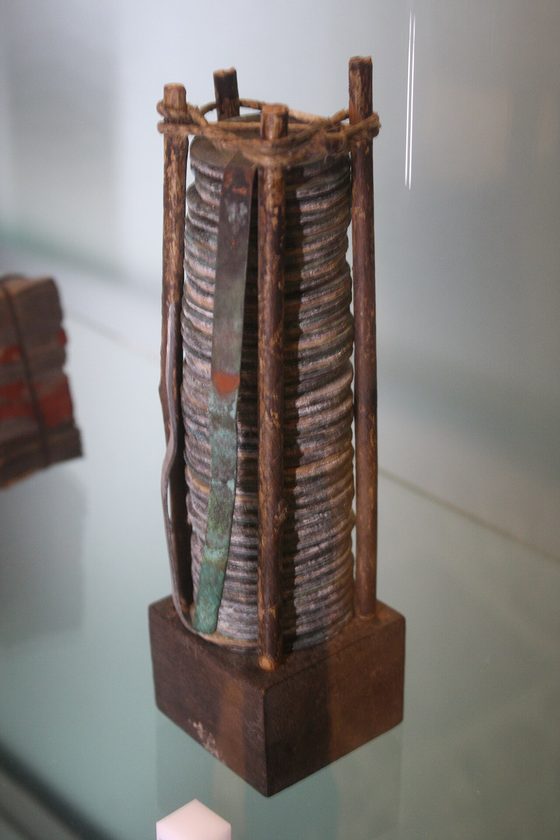
A column of stacked metal discs held between wooden rods on a wooden base, in a museum case.
A voltaic pile at the Tempio Voltiano in Como: discs of two different metals stacked alternately, each pair separated by brine-soaked card.Dario Crespi · CC BY-SA 4.0 · Source

The chemical consequences arrived within weeks. Nicholson and Carlisle connected a pile to two wires in water and collected hydrogen at one and oxygen at the other. Humphry Davy then saw what the tool was for. If current decomposes water, it should decompose anything, and the Royal Institution had the largest battery in the world. In 1807 he electrolysed moist potash and obtained globules of a metal so reactive it skims across water while burning: potassium. Sodium followed in days, then calcium, barium, strontium and magnesium.
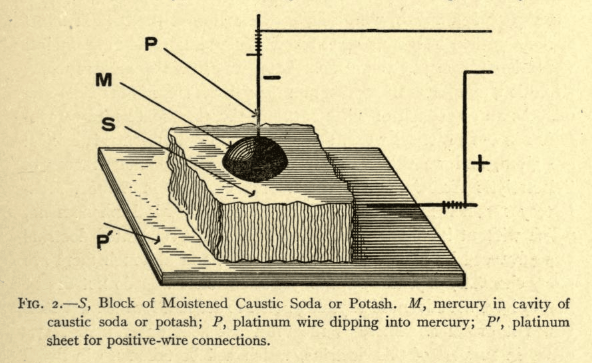
An engraving of a block of caustic potash resting on a metal sheet, with a wire dipping into a small pool of mercury in a hollow on its top.
A setup for repeating Davy's 1807 experiment: a block of moist caustic potash on a platinum sheet, with current led in through mercury held in a hollow on top. Potassium collects at the negative side.Nevil Monroe Hopkins, Experimental Electrochemistry (1905) · Public domain · Source

Lavoisier's table of simple substances had listed potash and soda. Davy showed they were compounds, using a method that reaches further than any reagent, because the oxidising or reducing power of an electrode can be turned up simply by raising the voltage.

Chapter II

The Law, and What It Contained

Michael Faraday made the relation exact between 1832 and 1834. The quantity of chemical change at an electrode is proportional to the quantity of electricity passed — not to the current, nor the time, nor the electrode material, nor the concentration, but to the product of current and time. And for the same charge, different substances are liberated in amounts proportional to their equivalent weights.

He also built the vocabulary, with the philosopher William Whewell supplying the Greek: electrode, electrolyte, anode, cathode, ion. The choice was deliberate and is worth noticing. Faraday did not know what carried the charge through the solution and framed words that describe the observations without committing to a mechanism — ion, from the Greek for "going", says that something travels and not what.

The law's deeper content went unremarked for fifty years. If a fixed quantity of charge always liberates a fixed number of atoms, then charge comes in units as surely as matter does. Helmholtz drew the conclusion in a lecture of 1881: electricity must be composed of elementary portions that behave like atoms of electricity. The electron was identified in 1897. Its charge had been sitting in Faraday's data since 1834, waiting only for Avogadro's number to divide by.

Chapter III

A Closer Look: What Faraday's Constant Costs

The practical content of Faraday's law is that electricity is a reagent you buy by the coulomb. One mole of electrons is

F=96,485 C=26.8 ampere-hours,F = 96{,}485 \text{ C} = 26.8 \text{ ampere-hours},

and that one number turns an industrial process into an arithmetic problem.

The electron's charge, from chemistry. Dividing by Avogadro's number:

e=96,4856.022×1023=1.602×10⁻¹⁹ C.e = \frac{96{,}485}{6.022\times10^{23}} = 1.602\times10^{-19} \text{ C}.

That is the modern value to four figures, obtainable from an electrolysis experiment and a count of molecules, with no reference to particles at all.

What it costs to make aluminium. Each aluminium ion needs three electrons, and aluminium's atomic mass is 26.98, so one tonne requires

10626.98=3.71×10⁴ mol of Al,×3=1.11×10⁵ mol of electrons,\frac{10^{6}}{26.98} = 3.71\times10^{4} \text{ mol of Al}, \qquad \times 3 = 1.11\times10^{5} \text{ mol of electrons},

which is

1.11×105×96,485=1.07×10¹⁰ C.1.11\times10^{5} \times 96{,}485 = 1.07\times10^{10} \text{ C}.

A commercial cell runs at about 4.5 volts — of which only around 1.2 is the thermodynamic requirement and the rest is overpotential and resistance — so the energy is

E=1.07×1010×4.5=4.8×10¹⁰ J=13,400 kWh per tonne.E = 1.07\times10^{10} \times 4.5 = 4.8\times10^{10} \text{ J} = 13{,}400 \text{ kWh per tonne}.

Real smelters consume 13,000 to 15,000 kWh per tonne. The estimate is a one-line calculation from a constant Faraday measured in 1834, and it is why aluminium plants are sited next to hydroelectric dams, why the metal is sometimes called solid electricity, and why recycling it — which needs about 5% of that energy — is so overwhelmingly worthwhile.
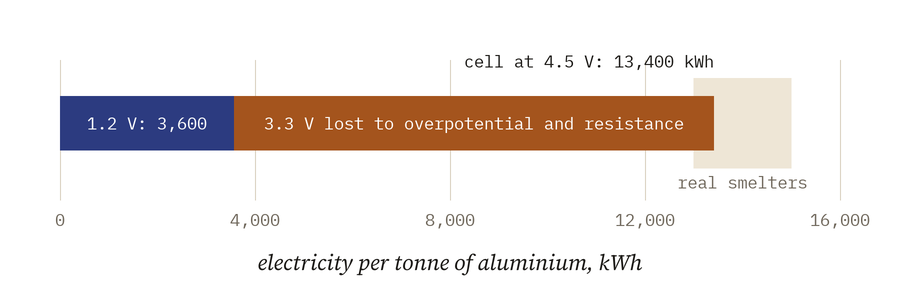
A horizontal bar of electricity per tonne of aluminium, 3,600 kWh for the 1.2 volts thermodynamics requires and the rest up to 13,400 kWh lost to overpotential and resistance, beside a shaded band for real smelters at 13,000 to 15,000.
Faraday's arithmetic for a tonne of aluminium. At the 1.2 volts the reaction itself needs it would take about 3,600 kWh; at a real cell's 4.5 volts it takes 13,400, inside the 13,000 to 15,000 that smelters actually use.Drawn for Field Atlas from the numbers above · Field Atlas original · Source

Run the same arithmetic for any electrochemical process and it gives the floor on its energy cost. The gap between that floor and what a real cell uses is the overpotential, and reducing it is what electrocatalysis is about.

Chapter IV

Cells That Keep Working

Volta's pile had a defect that limited every early experiment: within minutes the current collapsed. The cause is polarisation — hydrogen accumulates on one electrode and blocks it — and the fix, found by John Frederic Daniell in 1836, is to give each electrode its own solution. Zinc in zinc sulfate, copper in copper sulfate, separated by a porous pot that passes ions and not reactants. Each electrode then has an unlimited supply of what it consumes, and the cell holds 1.1 volts for hours.
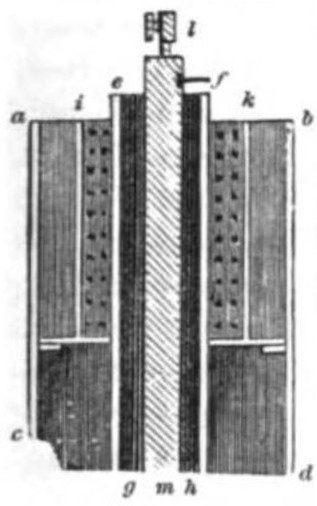
A cross-section engraving of a cylindrical cell with an outer vessel, an inner porous pot and a central rod.
Daniell's cell in cross-section, from his 1839 textbook: copper and zinc each in its own solution, the two kept apart by a porous pot.John Frederic Daniell, An Introduction to the Study of Chemical Philosophy (1839) · Public domain · Source

That architecture — two half-cells, each with its own chemistry, joined by something that conducts ions but keeps the reactants apart — is what a battery is. It powered the electric telegraph, and it is the ancestor of the lithium cell described under batteries and electrolysers.

William Robert Grove then ran the process backwards in 1839, which is a more radical idea than it looks. Having used electricity to split water, he supplied hydrogen to one platinum electrode and oxygen to the other and drew a current: chemical energy converted directly into electrical work, with no flame, no steam and no Carnot limit on the efficiency. His gas battery produced very little power, because the reaction happens only along the line where gas, liquid and metal meet, and the problem of giving that reaction enough area took most of the following century to solve.

Applications

Where it is used

  • Metal production

    Elements that exist only because of electricity

    Aluminium, magnesium, sodium, lithium, chlorine and fluorine are made by electrolysis, because no chemical reducing agent is strong enough or the product is too reactive to survive the conditions. Aluminium smelting alone accounts for something near one per cent of world electricity consumption, which is why smelters are built beside hydroelectric dams rather than beside mines.

    › Sources (1)
    • Grjotheim, K. & Kvande, H. (1993). Introduction to Aluminium Electrolysis. Aluminium-Verlag.
  • Physics↗ Physics · Old Quantum Theory

    The charge on the electron, measured in 1834

    Faraday's constant is the charge per mole of electrons. Once Avogadro's number was known, dividing one by the other gives the charge on a single electron — which Helmholtz pointed out in 1881, and which means electrolysis had measured a property of a particle that would not be identified for another sixteen years. The quantisation of charge was in chemical data all along.

    › Sources (1)
    • Helmholtz, H. von (1881). On the modern development of Faraday's conception of electricity. Journal of the Chemical Society 39: 277–304.
  • Manufacturing

    Plating, anodising and machining with current

    Electroplating puts a controlled thickness of one metal on another — Faraday's law converts a current and a time directly into a coating thickness — and anodising grows a protective oxide on aluminium to a specified depth. Electrochemical machining removes metal by the reverse process, in shapes a cutting tool cannot reach, and the printed circuit board is an electrochemical artefact throughout.

    › Sources (1)
    • Schlesinger, M. & Paunovic, M. (eds) (2010). Modern Electroplating, 5th edition. Wiley.

Open problems

Where the map runs out

Open

What the electrode–electrolyte interface looks like

Open as of 2026; models from the 1910s remain in use for want of better.

Everything electrochemical happens in a layer a few nanometres thick where metal meets solution, across which the potential drops by a volt or so — a field of order 10910^{9} V/m. What the structure of that layer is, how the water is oriented, where the ions sit, and how it rearranges when the potential changes, are described in practice by the Gouy–Chapman–Stern picture of 1910–1924, which treats water as a dielectric continuum and ions as point charges.

Why it is hard

The region is buried between a metal and a liquid, so most surface techniques cannot reach it; it is only nanometres thick, so bulk measurements average over it; and it responds on picoseconds, so it rearranges faster than most probes resolve. Simulations must treat metal, water, ions and an applied potential consistently, which is exactly the regime where the available methods are least reliable.

What resolving it unlocks

Battery lifetime is set by what forms at that interface, electrocatalytic rates by what sits on it, and corrosion by whether it protects. Most of the field's practical problems are interface problems described by a hundred-year-old approximation.

› Sources (2)
  • Magnussen, O. M. & Groß, A. (2019). Toward an atomic-scale understanding of electrochemical interface structure and dynamics. Journal of the American Chemical Society 141: 4777–4790.
  • Bockris, J. O'M. & Reddy, A. K. N. (1998). Modern Electrochemistry, 2nd edition. Plenum.

Further reading

  1. Bockris, J. O'M. & Reddy, A. K. N. (1998). Modern Electrochemistry, 2nd edition. Plenum.

    The standard treatment, unusually discursive about what the interface models assume.

  2. Williams, L. P. (1965). Michael Faraday: A Biography. Chapman & Hall.

    How Faraday's experimental programme was organised, including the invention of the vocabulary.

  3. Pancaldi, G. (2003). Volta: Science and Culture in the Age of Enlightenment. Princeton University Press.

    The pile, the dispute with Galvani, and what each of them thought they were demonstrating.