Skip to content
Field Atlas

Atlas / Chemistry / The Substance Thread

Field · Emerged 1661 – 1811

Chemical Composition

What is a substance made of, and what is conserved when one substance turns into another?

4 chapters6 min read6 turning points1 open problem

Branched from
Root of the thread
Branched into
Atomic Theory and Stoichiometry + Quantitative Analysis + Chemical Thermodynamics + Electrochemistry
Figures
Robert Boyle, Joseph Black, Joseph Priestley, Carl Wilhelm Scheele, Antoine Lavoisier, Marie-Anne Paulze Lavoisier, Louis-Bernard Guyton de Morveau, Antoine-François de Fourcroy, Claude-Louis Berthollet, Joseph Proust

In brief

Chemistry became quantitative when it started weighing gases. For as long as the products of a reaction could escape into the air unmeasured, there was no way to tell whether anything was conserved, and the leading theory held that burning releases a substance called phlogiston. The decisive objection is arithmetical: metals gain weight when they burn, by amounts that can be measured to a fraction of a per cent, and nothing that is leaving can account for that.

Antoine Lavoisier's contribution was less a discovery than an accounting discipline. Work in closed vessels, weigh everything including the air, and insist that the books balance. Done consistently, this killed phlogiston, identified combustion as combination with one component of the atmosphere, and produced a list of substances that could not be decomposed any further — the first table of elements in the modern sense. With Louis-Bernard Guyton de Morveau, Claude-Louis Berthollet and Antoine-François de Fourcroy he then reformed the language, so that a name stated a composition instead of commemorating an alchemist. Finally Joseph Proust established that a compound's composition is fixed, against Berthollet's argument that it should vary — a dispute in which the loser turned out to be right about something else.

Key ideas

ElementEnters 1661

A substance that no operation available to the chemist will decompose. The definition is deliberately operational — it says what has not been achieved, not what the substance is — which is why Lavoisier's table included light and heat, and why the list kept changing.

Conservation of massEnters 1772 – 1789

In a closed vessel, the total weight before a reaction equals the total weight after. It sounds like bookkeeping and it functions as a constraint: any proposed account of a reaction must balance, and most eighteenth-century accounts did not.

Pneumatic chemistryEnters 1754 – 1756

Treating a gas as a chemical substance with a definite identity and weight, rather than as air in some condition. Collecting gases over water made them weighable, and the balance did the rest.

Systematic nomenclatureEnters 1787

A name built from the composition — sulfuric acid, copper sulfate — rather than from a discoverer, a source or an appearance. Reforming the language was itself a scientific act, because it made a claim about composition every time a substance was mentioned.

Law of definite proportionsEnters 1799 – 1811

A given compound always contains the same elements in the same proportions by mass, however it was prepared. Without this there is nothing for an atomic theory to explain.

Draws on other domains

Chapter I

An Operational Definition

Before anything could be said about what substances are made of, there had to be a test for a substance that is made of nothing else. Robert Boyle supplied one in 1661, and its merit is that it refuses to answer the metaphysical question. Aristotle's four elements and the alchemists' three principles both fail, he argued, for the same reason: nobody can produce them. So define an element as whatever resists decomposition by any means available.
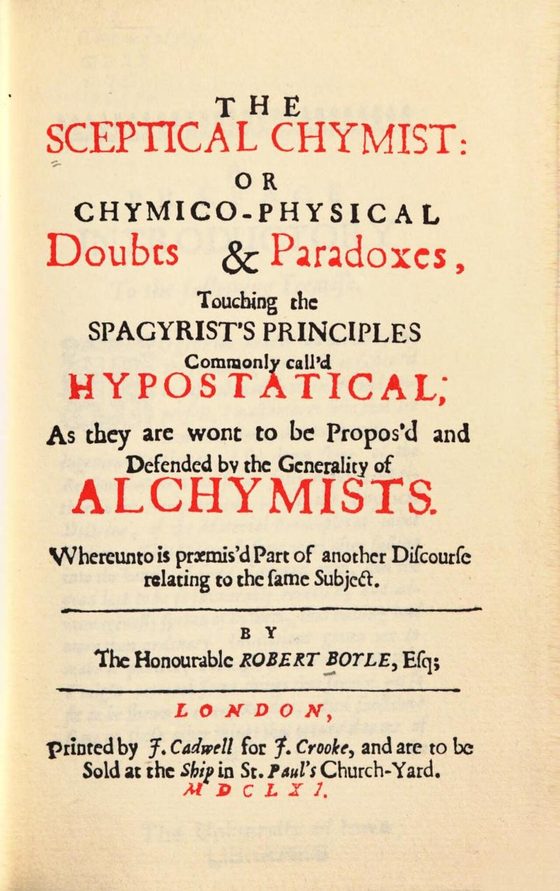
The title page of The Sceptical Chymist, printed in red and black, London, 1661.
The title page of Boyle's Sceptical Chymist (1661), the book in which an element became whatever could not yet be split into anything simpler.Robert Boyle, 1661 · Public domain · Source

This is a definition that moves. Lime was an element until Davy decomposed it; light and caloric appear in Lavoisier's own table of simple substances and are not elements at all. Boyle's test tells you what has not yet been done, which sounds like a weakness and is the reason the definition survived three subsequent revolutions in what matter was thought to be.

The obstacle to applying it was that a great many reactions involve a gas, and gases escaped. Joseph Black removed the obstacle in 1756 by weighing one. Heating magnesia alba drives off something and leaves a caustic residue that weighs less; treat the residue appropriately and the weight comes back, with the original substance restored. The thing driven off is a definite chemical substance — carbon dioxide — with a weight that can be entered in a ledger. After Black, a gas was a reagent rather than a condition of the air.

Chapter II

The Books Must Balance

The prevailing account of combustion held that burning substances release phlogiston. It explained a great deal: why flames go out in a closed vessel, why metals can be recovered from their ores by heating with charcoal, why some substances burn and others do not. And it had a quantitative problem that its defenders knew about and could not fix. When a metal is calcined it gets heavier. Lead, tin, mercury all gain weight on burning, reproducibly, by amounts that are not small.

Antoine Lavoisier's method was to work in sealed vessels and weigh everything, including the air. Done that way, the gain in the product is matched by a loss from the air, and about a fifth of the air is consumed before combustion stops. The remaining four-fifths will not support burning or breathing. Combustion is therefore combination with one component of the atmosphere, not the release of anything — and that component was the gas Joseph Priestley had prepared in 1774 and Carl Wilhelm Scheele probably before him, which Lavoisier named oxygen.
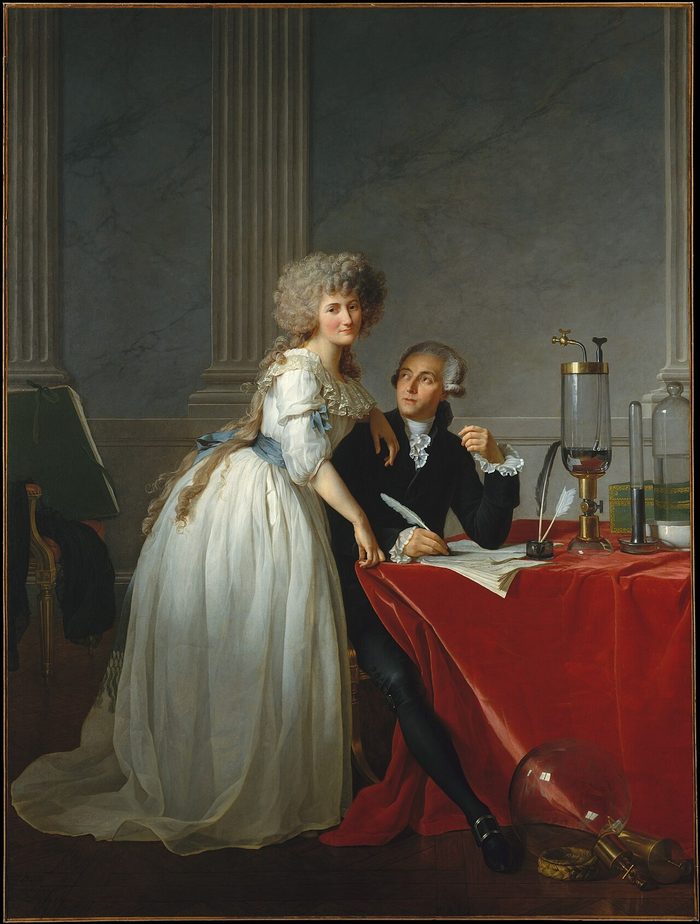
Painting of Marie-Anne Lavoisier standing and leaning on the shoulder of Antoine Lavoisier, who sits writing at a table covered with red cloth and glass apparatus.
Antoine and Marie-Anne Lavoisier, painted by Jacques-Louis David in 1788. The glassware on the table and floor is the new chemistry's apparatus for collecting and weighing gases.Jacques-Louis David, Metropolitan Museum of Art · CC0 · Source

Marie-Anne Paulze Lavoisier translated the English phlogistic literature for him — including Richard Kirwan's defence, published with her husband's rebuttals attached — kept the laboratory records, and drew the plates of the apparatus in the Traité. The instruments she drew are the argument: sealed, graduated, and designed so that nothing enters or leaves unweighed.
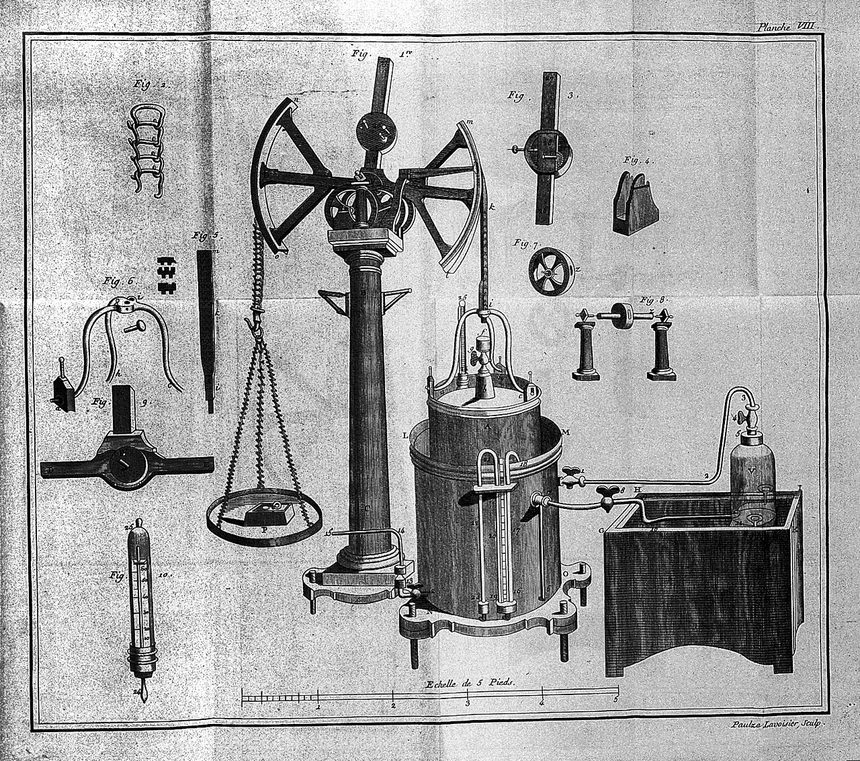
An engraved plate showing a large balance-beam gasometer with a counterweighted bell over a water tank, and smaller details of its parts.
Lavoisier's large gasometer, a plate from the Traité élémentaire de chimie, engraved and signed by Marie-Anne Paulze Lavoisier. The balance measured how much gas went in or out, so the gas could be weighed with everything else.Wellcome Collection · CC BY 4.0 · Source

The 1789 Traité élémentaire de chimie states conservation of mass as a principle and writes reactions as balanced equations. Two years earlier the same group had reformed the language, replacing oil of vitriol and flowers of zinc with sulfuric acid and zinc oxide. That reform was fought over harder than the chemistry, because adopting the names meant conceding the composition.

Chapter III

A Closer Look: Why Weighing Magnesium Settles It

Take the reaction phlogiston could not survive, and do the arithmetic with modern atomic masses.

2 Mg+O2⟶2 MgO2\,\mathrm{Mg} + \mathrm{O_2} \longrightarrow 2\,\mathrm{MgO}

Magnesium's atomic mass is 24.31, oxygen's 16.00. So 48.61 g of magnesium combines with 32.00 g of oxygen to give 80.61 g of magnesium oxide, and the weight gain is

32.0048.61=65.8%.\frac{32.00}{48.61} = 65.8\%.

Burning a gram of magnesium ribbon leaves 1.66 g of white ash. Under phlogiston theory, burning releases a substance, so the residue should weigh less than the metal. It weighs two-thirds more, and the discrepancy is not a measurement artefact — it is larger than the quantity being weighed.

The eighteenth-century rescue was to give phlogiston negative weight, or to suppose that air rushes in to fill the space it vacates. Both are available; neither is testable without weighing the air. So follow the oxygen instead. One gram of magnesium requires

32.0048.61=0.658 g of O2,0.65832.00=0.0206 mol,\frac{32.00}{48.61} = 0.658 \text{ g of } \mathrm{O_2}, \qquad \frac{0.658}{32.00} = 0.0206 \text{ mol},

which at standard conditions occupies 0.0206×22.41=0.4610.0206 \times 22.41 = 0.461 litres. Air is 20.9% oxygen by volume, so the gram of magnesium strips the oxygen from

0.4610.209=2.21 litres of air.\frac{0.461}{0.209} = 2.21 \text{ litres of air}.

That is the number a closed vessel makes visible. Burn the magnesium in a sealed flask of two and a bit litres of air and the flame goes out with the metal unconsumed, the pressure has dropped by about a fifth, and the weight of the sealed flask has not changed at all. Open it and the balance records the gain.

The lesson is about the apparatus rather than the chemistry. Every term in the equation above is a weight, and the only one that is hard to obtain is the gas. Phlogiston theory was not defeated by a better idea; it was defeated by vessels that would not let the gases leave, and by the discipline of refusing to publish an account that did not balance. Lavoisier's laboratory notebooks are full of sums that did not close, abandoned.

Chapter IV

What a Compound Is

One question remained, and it had to be settled before anything atomic could be built. Is a compound's composition fixed?

Joseph Proust said yes, on the evidence of years of analyses: copper carbonate prepared by any route gives the same proportions of copper, carbon and oxygen; tin has two oxides and nothing in between. Claude-Louis Berthollet said no, and had good reasons. Chemical affinity, he argued, depends on the quantities present — a view that is correct and became the law of mass action — and he pointed at solutions, alloys and glasses, whose composition plainly varies continuously.

Proust won, and the law of definite proportions is what gave Dalton's atoms something to explain, as atomic theory describes. Berthollet's examples did not go away, though. Many solids — iron oxides, titanium sulfides, the lithium cobalt oxide in a rechargeable battery — have compositions that vary over a range, because they are held together by a lattice rather than assembled from identical molecules. They are called non-stoichiometric compounds, and sometimes berthollides, which is as close as chemistry comes to an apology.

Applications

Where it is used

  • Physiology↗ Biology · Biochemistry

    Respiration is slow combustion

    Having established that burning is combination with oxygen, Lavoisier turned the apparatus on a living subject. With Armand Séguin he measured the oxygen a man consumes at rest, during digestion and while lifting a weight, and found that respiration consumes oxygen and produces fixed air and water in the proportions of a combustion. Animal heat therefore has a chemical source, and the measurement of metabolic rate by gas exchange has not changed in principle since.

    › Sources (2)
    • Lavoisier, A. L. & Séguin, A. (1789). Premier mémoire sur la respiration des animaux. Mémoires de l'Académie Royale des Sciences: 185–194.
    • Holmes, F. L. (1985). Lavoisier and the Chemistry of Life. University of Wisconsin Press.
  • Metrology↗ Physics · Crystallography

    The mole, and fixing Avogadro's number

    Chemistry needs a unit that counts particles while weighing substances, and since 2019 the mole is defined by fixing the Avogadro constant at exactly 6.02214076×10236.02214076 \times 10^{23}. The value was not chosen arbitrarily: it was measured by counting atoms in a sphere of silicon, using X-ray interferometry to get the lattice spacing and interferometry to get the volume, so a definition in the International System rests on a crystal lattice measured to nine significant figures.

    › Sources (2)
    • Fujii, K. et al. (2016). Realization of the kilogram by the XRCD method. Metrologia 53: A19–A45.
    • Bureau International des Poids et Mesures (2019). The International System of Units, 9th edition.
  • Industry

    Assay, and knowing what you have bought

    Gravimetric and volumetric analysis — precipitate, dry, weigh; or titrate to an endpoint — made it possible to state the metal content of an ore, the purity of a reagent and the strength of an acid as numbers. Mining, metallurgy, agriculture and pharmacy were all reorganised around that capability during the nineteenth century, and the techniques are still the reference methods against which instruments are calibrated.

    › Sources (1)
    • Szabadváry, F. (1966). History of Analytical Chemistry. Pergamon.

Open problems

Where the map runs out

Open

Which compositions are stable

Open as of 2026; computational screening has proposed far more stable compounds than have been made.

Given a set of elements, which compounds will form, in what proportions, and which of them are stable rather than merely metastable? About 250,000 inorganic compounds have been characterised experimentally, against a combinatorial space of compositions that is larger by many orders of magnitude. Databases of calculated energies now propose hundreds of thousands of candidate compounds below the known stability surface, and only a small fraction have been synthesised.

Why it is hard

Stability is a comparison against every competing combination of the same atoms, so it requires the energy of all the alternatives and not just the candidate. Calculated energies are accurate to a few tens of millielectronvolts per atom, which is the same size as the differences being decided. And a compound that is thermodynamically stable may have no accessible route to it, while many useful materials are metastable and persist indefinitely.

What resolving it unlocks

Battery electrodes, catalysts, superconductors and thermoelectrics are all searches through composition space, currently conducted by informed guesswork at a few compounds per laboratory-year.

› Sources (2)
  • Jain, A. et al. (2013). Commentary: The Materials Project. APL Materials 1: 011002.
  • Sun, W. et al. (2016). The thermodynamic scale of inorganic crystalline metastability. Science Advances 2: e1600225.

Further reading

  1. Donovan, A. (1993). Antoine Lavoisier: Science, Administration and Revolution. Cambridge University Press.

    What Lavoisier actually changed, and how much of it was method rather than discovery.

  2. Holmes, F. L. (1985). Lavoisier and the Chemistry of Life. University of Wisconsin Press.

    Follows the respiration work in detail, from the laboratory notebooks.

  3. Brock, W. H. (1992). The Fontana History of Chemistry. Fontana.

    The standard one-volume history; good on why the nomenclature reform was so contentious.