Chapter I
Whole Numbers Where None Were Expected
By 1800 chemistry had the law of definite proportions: a compound's composition is fixed. John Dalton noticed something sharper. Where two elements form more than one compound, the proportions are related by small whole numbers. Carbon forms two oxides, and the oxygen combining with a fixed weight of carbon in one is exactly twice that in the other. Nitrogen forms several, and the ratios are 1 : 2 : 3 : 4 : 5.
Continuous matter has no reason to behave like that. Indivisible units do: a molecule contains one oxygen atom or two, never one and a half. Dalton drew the conclusion, and then drew out its consequence — if atoms have characteristic weights, an analysis can be inverted to find them.
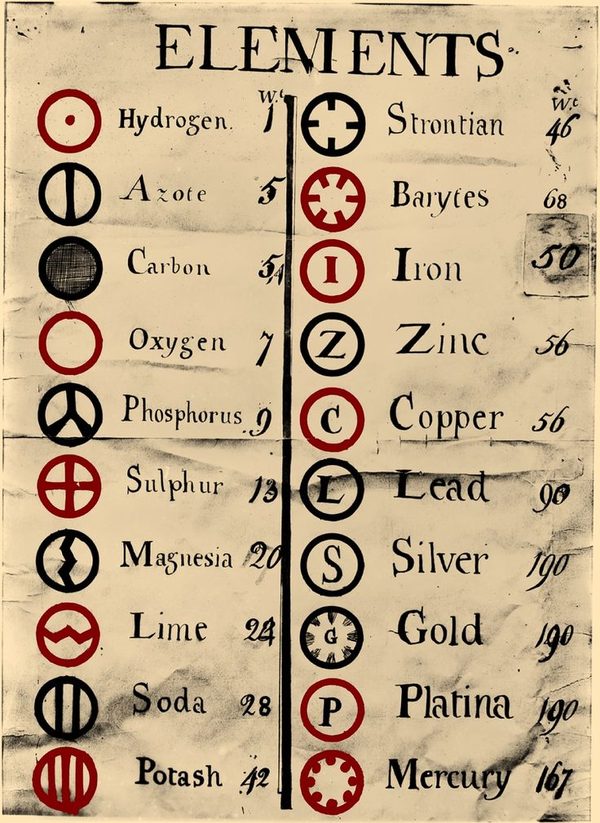
His 1808 table is the first attempt, and it is wrong almost throughout. The reason is a gap in the method rather than in the measurements. Analysis gives the proportion by mass; converting it to an atomic weight requires knowing the formula, and nothing in the analysis supplies one. Dalton adopted a rule of greatest simplicity: water, having one known composition, should be one atom of each. Water is 11.2% hydrogen by mass, so on that assumption oxygen weighs about eight times hydrogen. The true figure is sixteen, and every weight derived through a wrong formula inherited the error.
Chapter II
The Information Was Already There
The missing information arrived the same year, from Joseph Louis Gay-Lussac, and was rejected. Gases, he found, combine in volume ratios of small whole numbers, and the product's volume joins the pattern:
Volumes are counts of particles if equal volumes hold equal numbers, so this is a formula written in the laboratory. Dalton would not have it. On his picture the particles in a volume of oxygen are single atoms, so making two volumes of product from one of oxygen requires each oxygen atom to be split between two particles of water — which contradicts indivisibility. Faced with a measurement that broke his theory, he doubted the measurement.
Amedeo Avogadro resolved it in 1811 with two propositions that have to be taken together. Equal volumes of any gas contain equal numbers of molecules; and the molecules of an elementary gas may contain more than one atom. If oxygen gas is , one volume of it supplies two oxygen atoms, no atom is divided, water is , and oxygen weighs sixteen. The paper was noticed and set aside as metaphysics, partly because Avogadro's terminology was obscure, partly because Berzelius's rival electrochemical theory of combination had better empirical credit, and partly because the hypothesis cannot be tested except through the atomic weights it produces.
So chemistry proceeded for fifty years with two systems of weights, the choice between them a matter of school and nationality. The same compound had different formulas in different journals.
Chapter III
A Closer Look: How Cannizzaro Broke the Circle
Stanislao Cannizzaro's 1858 pamphlet is a procedure, and its merit is that it is self-checking. Two steps.
Step one: molecular weights from vapour densities. Measure the density of a vapour relative to hydrogen gas by Dumas's method. Equal volumes hold equal numbers of molecules, so the density ratio is the ratio of molecular weights. Setting hydrogen gas at 2 — because it is — gives the molecular weight directly as twice the relative density.
Step two: atomic weights from the smallest share. Analyse each compound for its percentage of an element. Multiplying by the molecular weight gives the mass of that element present in one molecule. Then take the atomic weight to be the smallest such mass found in any compound, because no molecule can contain less than one atom.
Carry it out for carbon:
| Compound | Molecular weight | Carbon by mass | Carbon per molecule |
|---|---|---|---|
| Carbon dioxide | 44.0 | 27.3% | 12.0 |
| Carbon monoxide | 28.0 | 42.9% | 12.0 |
| Methane | 16.0 | 74.9% | 12.0 |
| Ethane | 30.1 | 79.9% | 24.0 |
| Ethanol | 46.1 | 52.1% | 24.0 |
The column on the right contains 12.0 and 24.0 and nothing between them. The atomic weight of carbon is therefore 12, and ethane and ethanol contain two atoms of it. Do the same for oxygen and the smallest share is 16, never 8; for hydrogen, 1.
Check one entry by hand. Carbon dioxide's molecular weight is 44.0, and carbon is of it, so the carbon in one molecule weighs . For ethanol, , molecular weight 46.07 and carbon , giving — two atoms.
The power of the procedure is in its redundancy. Any one compound leaves the formula ambiguous; a dozen compounds of the same element cannot all be consistent with the wrong atomic weight. And the method exposes its own failures: sulfur's vapour density gives a molecular weight near 256 at low temperature and near 64 at high, which under Avogadro means dissociating to . Dumas had taken the same anomaly as evidence against the hypothesis. Read through the hypothesis, it is a measurement of molecular structure.
At the Karlsruhe congress in September 1860 — the first international meeting of chemists, convened precisely because the atomic weights were in disarray — no resolution was passed. Copies of Cannizzaro's pamphlet were handed out as the delegates left. Lothar Meyer later wrote that reading it on the journey home felt as though the scales fell from his eyes, and within a few years he and Mendeleev had a consistent set of weights to arrange — which is where the periodic system begins.
Chapter IV
Relative Until Physics Arrived
One feature of this whole episode deserves a note, because it is easy to miss from the modern side. Every weight in Cannizzaro's table is relative. Chemistry ranked and compared the masses of particles for a century without the least idea how many particles were in a gram, and it did not need one: a balanced equation only ever uses ratios.
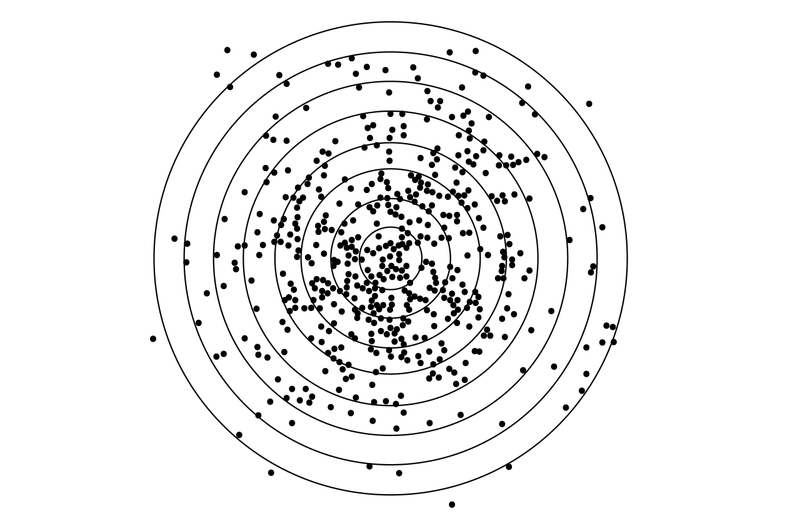
The absolute number came from outside. Jean Perrin's measurements of Brownian particles — how they settle in a column, how far they wander — gave Avogadro's constant to within a few per cent and were widely taken as the end of the argument about whether atoms are real or a useful fiction, as kinetic theory describes. Chemistry had been doing exact arithmetic on objects whose existence was still in dispute, which is a reasonable summary of how the subject got to 1900.
The inheritance is the mole, and a last twist. An atomic weight is an average over isotopes, and that average depends on where the sample was dug up. Since 2009, the standard atomic weights of fourteen elements have been published not as values but as intervals — sulfur lies somewhere between 32.059 and 32.076 — because for those elements there is no universal constant to be measured, only a range that provenance selects from.