Skip to content
Field Atlas

Atlas / Chemistry / The Substance Thread

Field · Emerged 1864 – 1945

The Periodic System

Why do the elements, arranged by weight, fall into repeating families — and can the pattern be trusted to predict elements nobody has seen?

4 chapters7 min read6 turning points1 open problem

Branched from
Atomic Theory and Stoichiometry
Branched into
Chemical Bonding + Geochemistry + Main-Group Chemistry + Solid-State Chemistry
Figures
John Newlands, Dmitri Mendeleev, Lothar Meyer, Paul-Émile Lecoq de Boisbaudran, Clemens Winkler, Lars Fredrik Nilson, Lord Rayleigh, William Ramsay, Henry Moseley, Glenn Seaborg

In brief

Once there was one agreed set of atomic weights, a question that had been unanswerable became urgent: is the order meaningful? Several people noticed that listing the elements by increasing weight brings chemically similar ones round at regular intervals, and at least five published versions of the idea in the 1860s. What distinguishes Dmitri Mendeleev's table of 1869 is not the arrangement but what he was willing to do with it. He left gaps where the pattern demanded an element that was not known, predicted the properties of three of them in detail, and corrected measured atomic weights that disagreed with the position he thought an element should hold.

Within fifteen years gallium, scandium and germanium had been isolated and matched the predictions closely enough to settle the matter. The pattern was then nearly broken by a group the table had no room for — the noble gases, discovered from 1894 — and finally explained by something outside chemistry: Henry Moseley's demonstration in 1913 that the ordering principle is not weight but nuclear charge, a whole number that says exactly how many elements can exist between hydrogen and uranium, and how many of them were still missing.

Key ideas

PeriodicityEnters 1864 – 1866

Arrange the elements in order and chemical similarity recurs at intervals — the halogens together, the alkali metals together — so the list is better drawn as a table, with families in columns.

Predictive gapEnters 1871 – 1886

A blank left in the table on the grounds that the pattern requires an element there. It converts a classification into a theory, because the blank carries predicted properties and can be wrong.

Group and periodEnters 1869 – 1871

A column of chemically similar elements and a row across which properties change steadily. Position in both fixes an element's expected valency, oxide formula, density and volatility closely enough to interpolate.

Atomic numberEnters 1913

The count of positive charges in the nucleus, which Moseley showed can be read off an element's X-ray spectrum. It orders the elements without exception, where weight has three inversions, and it is an integer, so the number of elements in a range is fixed.

Inner transition seriesEnters 1944 – 1945

A block in which an inner shell fills while the outer one does not, so the elements are chemically almost indistinguishable — the lanthanides, and, once Seaborg moved them, the actinides.

Draws on other domains

Chapter I

The Pattern Several People Saw

Karlsruhe left chemistry with one agreed table of atomic weights, and within a decade at least five people had noticed the same thing about it. List the elements by increasing weight and chemical character returns periodically: lithium, sodium and potassium at intervals; fluorine, chlorine and bromine likewise.

John Newlands published a version in 1865 and called it the law of octaves, by analogy with music. When he presented it to the Chemical Society the following year, a Fellow asked whether he had considered arranging the elements alphabetically, and the Society declined to publish the paper. Alexandre Béguyer de Chancourtois had drawn the elements on a spiral round a cylinder in 1862; William Odling's 1864 table is close to the one now in every classroom.

Dmitri Mendeleev came to it in 1869 through a textbook — he needed an order in which to present the elements to students — and his table was not notably better than Odling's. What he did with it was different in kind. He left gaps, asserting that elements must exist to fill them. He put tellurium before iodine although tellurium weighs more, because their chemistry demanded it. And he revised published atomic weights that conflicted with the position he thought an element should occupy: beryllium from 13.5 to 9, indium, uranium from 120 to 240. Those were measurements made by competent people, overruled by a pattern.
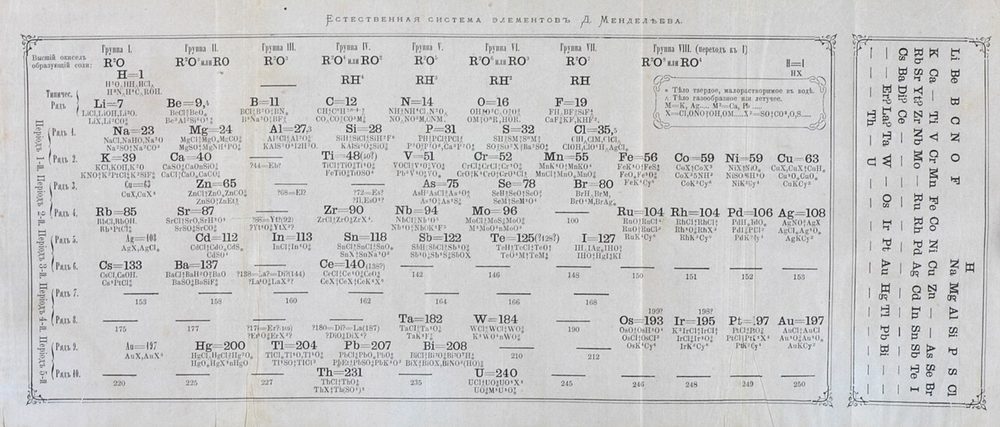
A printed table in Russian of the elements with their atomic weights, arranged in rows and columns by group.
Mendeleev's periodic table as printed in his textbook Osnovy khimii (Principles of Chemistry), 1869–71.Dmitri Mendeleev, Science History Institute · Public domain · Source

Lothar Meyer had the same arrangement independently, and published a graph of atomic volume against weight in 1864 that shows the periodicity more vividly than any table. The two later argued about priority. The conventional verdict — Meyer found it, Mendeleev bet on it — is roughly right and flatters both of them, since the arrangement was in the air.

Chapter II

A Family With No Column

The table's sternest test came from an element nobody had looked for, and it was found because of a discrepancy in the fourth decimal place.

Lord Rayleigh had been measuring gas densities carefully for years when he noticed that nitrogen prepared from the air was consistently denser than nitrogen prepared from ammonia — by about half a per cent, reproducibly, well beyond his errors. With William Ramsay he set about removing everything known from a sample of air, burning away the oxygen and absorbing the nitrogen with hot magnesium, and found a residue of about one per cent of the original volume that would react with nothing at all. They named it argon, from the Greek for idle.

A glass discharge tube bent into the letters Ar, glowing violet-pink against black.
Argon glowing in a discharge tube shaped into its symbol. It reacts with nothing, which is how Rayleigh and Ramsay found it: it was what remained of air after everything known had been removed.Pslawinski · CC BY-SA 2.5 · Source

An element that forms no compounds is awkward in a system built on valency, and the table had no column for it. Mendeleev initially doubted that it was an element, suggesting it might be a triatomic form of nitrogen. Within four years Ramsay had found helium in a uranium mineral, and then neon, krypton and xenon by fractionating liquid air — a whole family, all unreactive, with atomic weights that placed them between the halogens and the alkali metals.

The outcome is the strongest evidence the periodic law received. Inserting an entire new group between two existing ones left the rest of the arrangement untouched: every other element kept its place, every other family stayed intact, and the period lengths went from 8 to 8 with a new member each. A classification that can absorb eight unforeseen elements without rearrangement is describing something real. It also sharpened the question the table could not answer — why periods are the length they are — because the noble gases sit exactly where a shell closes, which is a fact about electrons that nothing in 1898 could have supplied.

Chapter III

A Closer Look: Predicting Germanium Fifteen Years Early

Mendeleev's 1871 paper describes three missing elements. Take the one under silicon, which he called eka-silicon.

The interpolation. Its neighbours in the table are known: gallium at 69.72 and arsenic at 74.92 on the same row, silicon at 28.09 and tin at 118.71 in the same column. The simplest estimate of its weight is the mean of its horizontal neighbours:

69.72+74.922=72.32.\frac{69.72 + 74.92}{2} = 72.32.

Germanium's atomic weight is 72.63. A mean of two numbers, taken before the element existed, lands within half a per cent.

Density is harder, because density does not interpolate linearly — but atomic volume, the atomic weight divided by the density, varies smoothly across the table, and that was Meyer's observation. Mendeleev predicted an atomic volume of 13, hence a density of 72/13=5.572/13 = 5.5 g/cm³.

The result. Clemens Winkler isolated the element from argyrodite in 1886 and named it germanium:

PropertyPredicted, 1871Found, 1886
Atomic weight7272.3
Density5.5 g/cm³5.47 g/cm³
Atomic volume1313.2
OxideEsO2\mathrm{EsO_2}, density 4.7GeO2\mathrm{GeO_2}, density 4.70
Chlorideboils below 100 °C, density 1.9GeCl4\mathrm{GeCl_4} boils at 86 °C, density 1.89

Every entry agrees to within about a per cent. Check the consistency: 72.3/5.47=13.272.3 / 5.47 = 13.2, which is the atomic volume, exactly as the interpolation required.
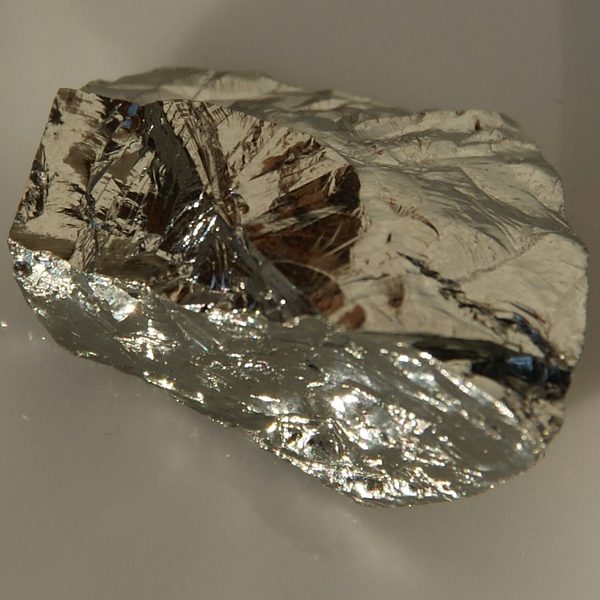
A shiny, silver-grey chunk of germanium with sharp, faceted surfaces.
Twelve grams of germanium, the element Mendeleev described as eka-silicon fifteen years before Winkler isolated it.Hi-Res Images of Chemical Elements · CC BY 3.0 · Source

This is not what a classification does. A classification sorts what is already in hand; this made five quantitative statements about a substance nobody possessed, any one of which could have failed. Gallium in 1875 came close to failing: Lecoq de Boisbaudran measured its density as 4.7 against a prediction of 5.9, and Mendeleev wrote to tell him his sample was contaminated. On repurification it came out at 5.9.

What the predictions cost. It is worth recording the failures too, because the atlas's business is what a method can and cannot do. Mendeleev predicted elements lighter than hydrogen — coronium, and an "element zero" filling the role of the ether — which do not exist. He initially refused to accept argon, suggesting it was a triatomic form of nitrogen, because it fitted nowhere. And the pattern he was predicting from had no explanation at all: nothing in the table said why periods should be eight long, or why the length should change further down. A method can be reliable and unexplained at the same time, and for forty-four years this one was.

Chapter IV

What It Was Really Ordered By

The explanation came from physics, and it arrived in two parts.

The first was a correction to the ordering itself. Henry Moseley bombarded element after element with electrons and measured the frequency of the characteristic X-rays each emitted. Plotting the square root of frequency against position gave a straight line with equal steps, one per element, and the step corresponds to one unit of positive nuclear charge. So the ordering principle is an integer — the atomic number — and not the weight. All three of the inversions that had embarrassed the table disappear, because tellurium has a lower atomic number than iodine while weighing more. The integer also did something the weights could not: it said how many elements can lie between two known ones, so the remaining gaps could be counted rather than guessed. Seven were outstanding between hydrogen and uranium; all seven were eventually found or made.
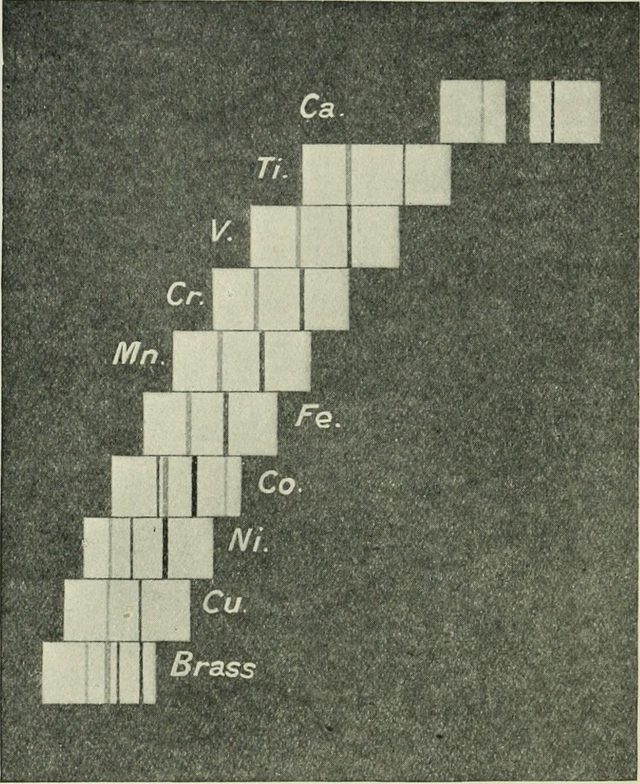
Photographic X-ray spectra stacked in a staircase, one strip per element from calcium at the top through titanium, vanadium, chromium, manganese, iron, cobalt, nickel and copper to brass.
Moseley's X-ray spectra, calcium to copper, as reproduced by the Braggs in 1915. The lines step along evenly, one step per element, and cobalt comes before nickel although it is the heavier. Brass shows the lines of copper and of zinc.Henry Moseley, in W. H. and W. L. Bragg, X Rays and Crystal Structure (1915) · Public domain · Source

The second part was the shell structure of the atom, which says why periods have the lengths they do — and that belongs to old quantum theory and to chemical bonding.

The table has been altered since, most consequentially by Glenn Seaborg in 1944. Thorium and uranium sat among the transition metals, and the new transuranic elements made in the Manhattan Project behaved wrongly there. Seaborg proposed that a second inner series starts at actinium, parallel to the lanthanides — a rearrangement that predicted the oxidation states of the next several elements and told their makers what chemistry to use to separate them. At the bottom of that block the periodic law now runs into its own limit: in elements that exist a few atoms at a time, inner electrons move fast enough for relativity to reorder the orbitals, and whether an element's chemistry still follows its column is the open question above.

Applications

Where it is used

  • Materials discovery

    Where to look for a substitute

    When a material depends on a scarce or toxic element, the table says what to try instead: neighbours in a group share valency and ionic radius closely enough that substitution often works. Replacing lead in solders and piezoelectrics, cobalt in battery cathodes, and iridium in electrolyser catalysts are all searches conducted first along columns and rows, before any calculation.

    › Sources (1)
    • Scerri, E. R. (2007). The Periodic Table: Its Story and Its Significance. Oxford University Press.
  • Astrophysics↗ Physics · Astronomical Spectroscopy

    Reading the table in starlight

    Each element's spectrum is a fingerprint, and the table organises which fingerprints to expect together: the alkali metals ionise easily and show in cool stars, the noble gases need violent excitation. Helium was found in the Sun in 1868, before it was found on Earth, and the relative abundances of the elements in stellar spectra are read against the table's groups to work out what the star has been fusing.

    › Sources (1)
    • Lockyer, J. N. (1869). Spectroscopic observations of the Sun. Philosophical Transactions of the Royal Society 159: 425–444.
  • Biology↗ Biology · Biochemistry

    Which elements life uses, and which it cannot

    Life is built from a small selection — about thirty of the ninety-odd natural elements — and the table explains much of the selection: the second-row non-metals form strong multiple bonds, so carbon and not silicon makes stable chains; magnesium and calcium are abundant divalent ions of the right size; the trace metals used in enzymes sit in a band where redox potentials are useful. The toxicity of several heavy elements follows from their sitting under an element the body already transports.

    › Sources (1)
    • Williams, R. J. P. & Fraústo da Silva, J. J. R. (2006). The Chemistry of Evolution. Elsevier.

Open problems

Where the map runs out

Open

Whether periodicity survives at the bottom of the table

Open as of 2026; the heaviest elements are made a few atoms at a time, and their chemistry is largely predicted rather than measured.

In the heaviest elements the inner electrons move at a substantial fraction of the speed of light, which contracts some orbitals and expands others and can detach an element's chemistry from its group. Calculations suggest flerovium, under lead, may behave as a volatile metal or almost as a noble gas; that oganesson, under radon, may be a solid with no closed-shell inertness; and that the periodic trends in group 1 reverse somewhere beyond francium.

Why it is hard

These elements exist a few atoms at a time, for seconds or less, so their chemistry must be inferred from how single atoms adsorb on a surface during the moment before they decay. Relativistic calculations are the main evidence, and the experiments that could check them require making enough atoms to count — which for elements beyond 118 nobody has yet managed at all.

What resolving it unlocks

Whether the periodic law is a universal statement about matter or an approximation that holds for the first hundred or so elements, and where its limit lies.

› Sources (2)
  • Türler, A. & Pershina, V. (2013). Advances in the production and chemistry of the heaviest elements. Chemical Reviews 113: 1237–1312.
  • Giuliani, S. A. et al. (2019). Colloquium: Superheavy elements — Oganesson and beyond. Reviews of Modern Physics 91: 011001.

Further reading

  1. Scerri, E. R. (2007). The Periodic Table: Its Story and Its Significance. Oxford University Press.

    The careful account, fair to the five or six people who found the pattern before Mendeleev published.

  2. Gordin, M. D. (2004). A Well-Ordered Thing. Basic Books.

    Mendeleev as he was — textbook writer, bureaucrat, balloonist — rather than as a legend.

  3. Heilbron, J. L. (1974). H. G. J. Moseley. University of California Press.

    The short life of the man who found what the table was actually ordered by.