Chapter I
Compounds the Octet Rule Forbids
The shared electron pair explains a great deal, which is why the places it fails are worth attention. Three kinds of failure were catalogued in the first half of the twentieth century, and all three turned out to be doors rather than walls.
Alfred Stock found the first by trying to make the boron equivalents of the hydrocarbons. They existed, they were volatile, and they were destroyed instantly by air, water and the stopcock grease of ordinary glassware. Stock's response was to rebuild the apparatus: a greaseless vacuum line with mercury valves, in which a compound could be distilled, weighed and analysed without ever meeting the atmosphere. Between 1912 and the early 1930s he isolated and characterised B₂H₆, B₄H₁₀, B₅H₉, B₅H₁₁, B₆H₁₀ and B₁₀H₁₄.
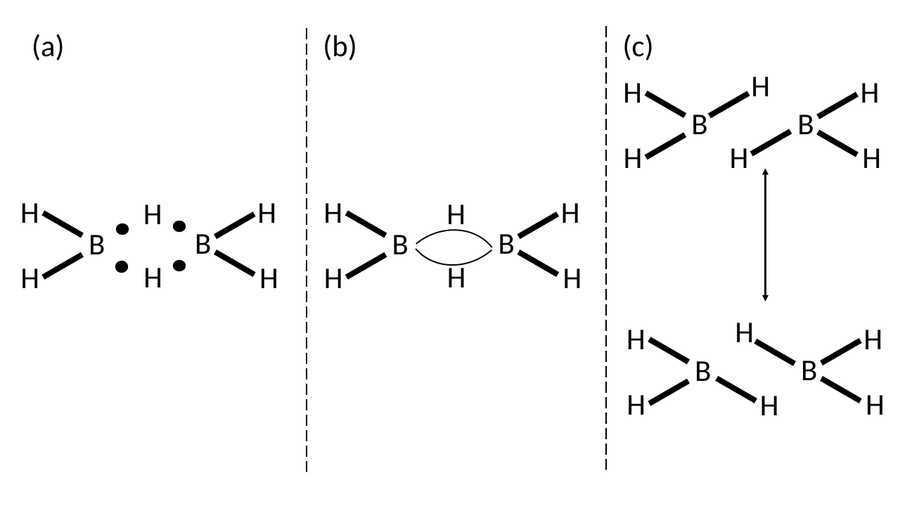
Not one of them could be drawn. Diborane, the simplest, is the clearest case: ethane's analogue should be B₂H₆ with seven ordinary bonds, and seven bonds require fourteen electrons, while boron and hydrogen between them supply only twelve. The compound is two electrons short of its own structure. For forty years this was known as the boron hydride problem, and proposals included an ethane-like structure that the evidence steadily refused.
Stock paid for the work. Decades of mercury vapour in a poorly ventilated laboratory cost him his hearing and much of his health, and he spent his later career establishing the handling rules that would have protected him.
Chapter II
The Inert Gases Are Not
The second failure was a failure of the rule's successes. Group 18 was the textbook demonstration that a filled octet means no chemistry, and for sixty years it was treated as settled; Pauling had suggested in 1933 that xenon fluorides should exist, and nobody tried.
Neil Bartlett was working with platinum hexafluoride in 1962 and noticed it would oxidise molecular oxygen — removing an electron from O₂, which requires 12.1 electronvolts. Xenon's first ionisation energy is 12.1 electronvolts as well. The inference took an afternoon to test, and gave a yellow-orange solid at room temperature.
Within a year XeF₂, XeF₄ and XeF₆ had been made, and the chemistry of the group was open. The lesson is not that the octet rule is wrong but that "unreactive" had been read as "incapable": the ionisation energy of xenon is lower than that of oxygen or of fluorine, and the only question was whether a reagent oxidising enough existed.
Chapter III
Too Many Electrons, and Bonds That Should Not Form
The third failure runs the other way. Sulphur hexafluoride has twelve electrons around the sulphur; phosphorus pentachloride has ten around the phosphorus. Jeremy Musher named these hypervalent in 1969, and the explanation in every textbook was that the central atom promotes electrons into its empty 3d orbitals, making ten or twelve bonding electrons available.
Calculations through the 1980s established that this is not what happens. The d-orbital population in SF₆ is a fraction of an electron, far too small to support six bonds. The better description combines three-centre four-electron bonding with a large ionic contribution: the sulphur carries a substantial positive charge and the fluorines share the negative. The d-orbital story survived in teaching for decades after it was refuted, which is worth noting as a fact about textbooks rather than about sulphur.
The last barrier to fall was the double bond rule: that elements of the third row and below do not form multiple bonds to themselves. Silicon is directly below carbon, and every attempt to make the silicon analogue of an alkene gave a polymer instead. Robert West succeeded in 1981 by changing the strategy — not by making the bond stronger but by making it unreachable, loading each silicon with two very bulky aryl groups so that nothing could get close enough to attack. Masaaki Yoshifuji did the equivalent for phosphorus in the same year.
The compound that resulted shows why the rule had held. In an alkene the C=C bond is 1.34 Å against 1.54 Å for a single bond, a 13% contraction, and the whole unit is flat. West's disilene has Si=Si at 2.16 Å against 2.34 Å for a single bond — only 7.7% — and it is not planar: the substituents bend out of the plane, because silicon would rather keep its lone pair in an s orbital than hybridise fully. The bond is real and it is poor, which is precisely the prediction one would make from the periodic trends rather than from a rule.
Kinetic protection then became a general method, and it changed the inventory of chemistry. Anthony Arduengo applied it in 1991 to the carbene — a carbon with two bonds and a lone pair, the standard example of a species too reactive to see — by flanking the carbon with two nitrogens that donate into its empty orbital and two bulky groups that keep reagents away. The product is a colourless crystalline solid that can be weighed out on a bench. Within a decade these N-heterocyclic carbenes were, alongside the phosphines of organometallic chemistry, the most important ligands in homogeneous catalysis.
Chapter IV
A Closer Look: Counting Electrons in a Cage
Boron's structures cannot be drawn with ordinary bonds, and yet they are entirely predictable from arithmetic. Two counts show how.
Diborane's shortfall. Count the valence electrons: two borons at three each, six hydrogens at one each, total 12, which is 6 pairs. Compare ethane: two carbons at four, six hydrogens at one, total 14, which is 7 pairs for 7 bonds — exactly enough. Diborane is one pair short.
The structure resolves it. Four hydrogens sit in ordinary terminal B–H bonds, using 4 pairs and leaving 2. Those two pairs hold the remaining two hydrogens in bridges, each pair binding a B, an H and the other B — one pair, three atoms. William Lipscomb's three-centre two-electron bond. The molecule is not electron-deficient at all once you stop insisting that a bond must join exactly two atoms.
Wade's rules. Kenneth Wade noticed in 1971 that the shape of a boron cage follows from counting the pairs available to the skeleton. A BH unit brings 3 electrons from boron and 1 from hydrogen, spends 2 on its own B–H bond, and contributes 2 to the skeleton. Every extra hydrogen contributes 1, and the charge is added. Then:
- skeletal pairs → a closo cage: a closed deltahedron with vertices
- pairs → nido: that deltahedron with one vertex removed
- pairs → arachno: with two removed
Check it on three compounds:
| Compound | Skeletal electrons | Pairs | Rule | Predicted shape | Found |
|---|---|---|---|---|---|
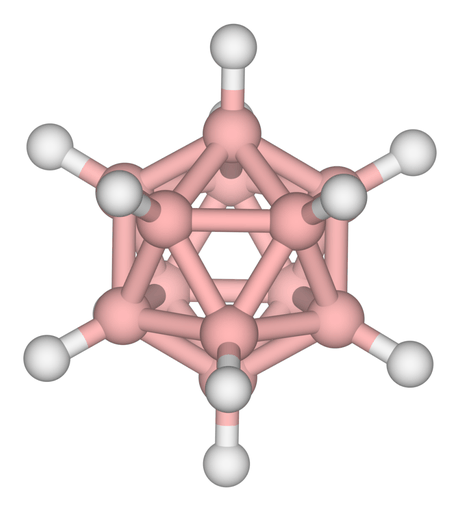
| [B₁₂H₁₂]²⁻ | 12 × 2 + 2 = 26 | 13 | = 13 | closo icosahedron | icosahedron |
| B₅H₉ | 5 × 2 + 4 = 14 | 7 | = 7 | nido: octahedron less a vertex | square pyramid |
| B₄H₁₀ | 4 × 2 + 6 = 14 | 7 | = 7 | arachno: octahedron less two | butterfly |
Three compounds, three correct shapes, from counting. And the icosahedral case is worth dwelling on: [B₁₂H₁₂]²⁻ and its carbon-substituted relative C₂B₁₀H₁₂ are among the most robust molecular species known — the carborane survives above 400 °C, resists concentrated acid, and is thermally more stable than benzene. A structure with no classical bonding description at all turns out to be more durable than the archetype of stability. Wade's rules were later extended to clusters of main-group and transition metals alike, so the count outgrew the compounds it was invented for.
The arithmetic also does something the octet rule cannot. It predicts a three-dimensional shape for a species where the number of bonds is not even well defined, using only the number of electrons — which is the same move Werner made with isomer counts in coordination chemistry, and the same move the eighteen-electron rule makes for metals.
Chapter V
The Bottom of the Table
Two trends run down the main group, and they pull against each other.
One is the weakening of multiple bonding, visible already in West's disilene and more so further down: silicon's triple bond is bent by some 40 degrees at each end, germanium's more, and no lead analogue has been isolated. The reason is that the heavier atoms prefer to keep a lone pair in an s orbital rather than hybridise, which is the same effect that makes lead prefer the +2 oxidation state over +4. For the heaviest elements this becomes relativistic: the inner electrons move fast enough that the s orbitals contract, an effect that also makes gold yellow and mercury liquid, and that puts the regularities of the periodic system under strain near the bottom.
The other is capability. The modern main group does things that were once the exclusive business of transition metals — activating hydrogen, binding small molecules reversibly, and in a growing number of cases completing a catalytic cycle. Whether that can be made general, with abundant elements replacing the platinum group, is the first open problem recorded above, and it is the same shortage of cheap catalysts that organometallic chemistry runs into from the other side.
What the field has already supplied to the rest of chemistry is mostly reagents and ligands: boron compounds stable enough to be weighed in air and reactive enough to transfer a carbon to palladium, carbenes that hold a metal more tightly than any phosphine, fluorides that fluorinate, and silanes clean enough to grow a semiconductor from. The elements that broke the octet rule turned out to be the useful ones.