Chapter I
More Ammonia Than the Valence Allows
Cobalt chloride is CoCl₃. Cobalt has used three combining capacities, the chlorines have used one each, and the books balance. Add ammonia and an orange crystalline solid comes out whose composition is CoCl₃·6NH₃ — stable, pure, reproducible, and impossible to write a structure for, because nothing in the compound has a spare valence to hold the ammonia on.
This was not an isolated curiosity. By the 1880s the shelves held dozens of such compounds, and their colours were so characteristic that they served as names: luteo for the yellow CoCl₃·6NH₃, purpureo for the purple CoCl₃·5NH₃, praseo for the green and violeo for the violet forms of CoCl₃·4NH₃. Two compounds with the same formula and different colours — that is isomerism, the problem that had already forced organic structure theory into existence. Here it was happening in compounds with no carbon in them at all.
The explanation on offer came from Christian Wilhelm Blomstrand and was developed by Sophus Mads Jørgensen: ammonia molecules link into chains, as carbon atoms do, with the chain attached to the metal through one ordinary valence. It was a reasonable transfer of the one structural principle chemistry had that worked. Jørgensen spent sixteen years making the compounds the theory called for, and his preparations and analyses were the best in the field — which is why, when the chain theory lost, it lost on the evidence of its own supporter's experiments.
Chapter II
Two Kinds of Valence
Alfred Werner was twenty-six when he proposed, in 1893, that the trouble was the assumption of a single kind of valence. A metal atom has two. The first balances ionic charge and can be satisfied by an ion anywhere in the solution. The second is a fixed number of positions, arranged in a definite geometry in contact with the metal, which can be occupied by whole neutral molecules.
For cobalt(III) that number is six, and it is six regardless of the charge. This makes the whole luteo–purpureo–praseo series one pattern:
| Compound | Werner's formula | Positions occupied |
|---|---|---|
| CoCl₃·6NH₃ | [Co(NH₃)₆]Cl₃ | six ammonias |
| CoCl₃·5NH₃ | [Co(NH₃)₅Cl]Cl₂ | five ammonias, one chloride |
| CoCl₃·4NH₃ | [Co(NH₃)₄Cl₂]Cl | four ammonias, two chlorides |
| CoCl₃·3NH₃ | [Co(NH₃)₃Cl₃] | three ammonias, three chlorides |
Ammonia leaves, chloride takes its place, and the total never changes. The square brackets are doing real work: a chloride inside them is bonded to the cobalt and is not an ion, while a chloride outside is an ion and nothing else. Nevil Sidgwick supplied the electronic reason thirty years later — the ligand donates a lone pair into an empty metal orbital, which is why molecules with lone pairs are the ligands and molecules without are not — but Werner's structural claim stood on its own, and it stood because it could be tested two ways at once.
Chapter III
A Handed Molecule With No Carbon In It
The isomer and ion counts, set out below, left one alternative standing in principle. Werner closed it with an experiment that was also a demonstration about chemistry in general.
Since Pasteur, optical activity had been tied to the asymmetric carbon atom — and, in the hands of those who wanted it to be, to the chemistry of living things. If a complex is octahedral, then one with three identical two-point ligands exists in two mirror-image forms, with nothing organic required. Werner and Victor King resolved such a cobalt complex into its enantiomers in 1911.
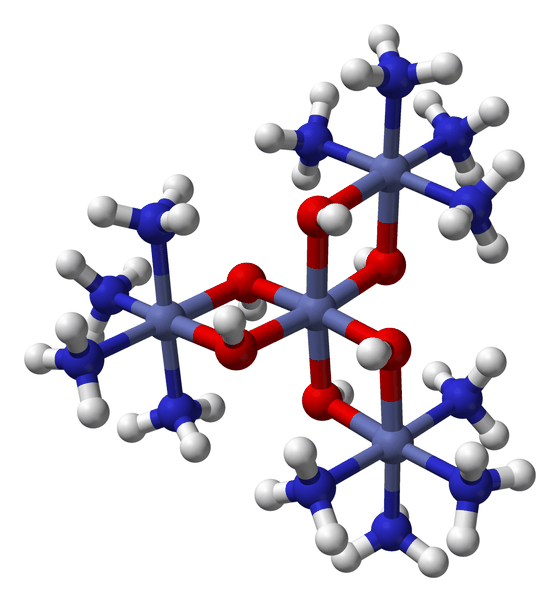
Then in 1914 he did it with the hexol: a central cobalt bridged by pairs of hydroxide groups to three more cobalts, each carrying four ammonias. Four cobalt atoms, twelve ammonias, six hydroxides, six bromides as counter-ions, and not one carbon atom. The two forms rotate the plane of polarised light in opposite directions by equal amounts. Handedness, it turned out, is a property of arrangement in space and is available to any element that has a shape — the point taken up in stereochemistry from the organic side.
Chapter IV
A Closer Look: Deciding Between Three Geometries by Counting
Werner's claim had two parts: that the number of positions is six, and that they lie at the corners of an octahedron. Each part was settled by a count, and the counts are worth doing because they show a structural question being answered with no structural method available — there would be no X-ray crystallography for another twenty years.
First count: how many ions? Arturo Miolati measured molar conductivities, which rise with the number of ions a formula unit releases. Silver nitrate gave an independent check, since it precipitates free chloride at once and coordinated chloride not at all. Werner's formulae predict both:
| Compound | Ions predicted | Cl⁻ precipitated at once |
|---|---|---|
| [Co(NH₃)₆]Cl₃ | 4 | 3 of 3 |
| [Co(NH₃)₅Cl]Cl₂ | 3 | 2 of 3 |
| [Co(NH₃)₄Cl₂]Cl | 2 | 1 of 3 |
| [Co(NH₃)₃Cl₃] | 0 | 0 of 3 |
Both staircases were found. The last entry is the striking one: a compound built from an ionic salt and a gas that conducts no better than sugar water. The platinum series does something better still. Running down PtCl₄·6NH₃ to PtCl₄·2NH₃ the conductivity falls to that of a non-electrolyte — and then rises again for K[PtCl₅(NH₃)] and K₂[PtCl₆], because the coordination sphere is now full of chloride and the potassium ions are outside it. A curve with a minimum is a prediction of the theory. The chain picture gives no reason to expect one.
Second count: what shape? Six positions can be arranged in three ways a chemist of 1893 would consider: a flat hexagon, a trigonal prism, or an octahedron. They are distinguished by how many isomers they permit. For a complex with four of one ligand and two of another, MA₄B₂:
| Arrangement | Isomers of MA₄B₂ | Isomers of MA₃B₃ |
|---|---|---|
| Planar hexagon | 3 (1,2 and 1,3 and 1,4) | 3 |
| Trigonal prism | 3 | 3 |
| Octahedron | 2 (cis, trans) | 2 (facial, meridional) |
The octahedron is the only one of the three that predicts two. And two was what existed: praseo-green and violeo-violet CoCl₃·4NH₃, with every search for a third — including Jørgensen's, conducted in the hope of refuting Werner — failing. The argument is of a particular kind, and worth naming: it is not that the octahedron explains the two known isomers, but that its rivals require a third compound which repeated, motivated, competent searching could not find.
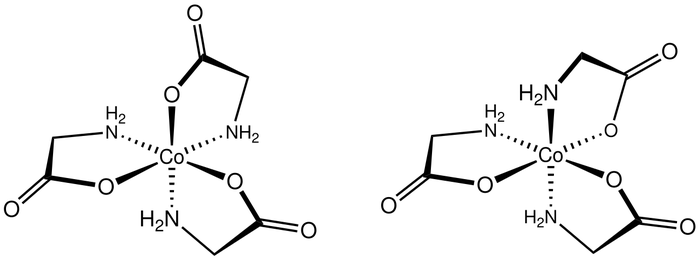
The hexol finishes it. Of the three arrangements, only the octahedron is chiral when three two-point ligands are fitted to it; the hexagon and the prism both have a mirror plane in that case and cannot give optical isomers. So a resolution into enantiomers excludes the other two outright. Three counts — ions, geometric isomers, optical isomers — none of them requiring any apparatus beyond a conductivity bridge, a balance and a polarimeter, and the structure of a class of thousands of compounds was fixed.
Chapter V
Numbers for How Tightly a Metal Is Held
Werner's theory says what a complex is. It does not say how strongly the ligands are held, which is the question every practical use turns on.
Gilbert Morgan and Harry Drew named the key structural trick in 1920: a chelate, a ligand that grips the metal at two or more positions and closes a ring. Chelates are bound far more tightly than the equivalent separate ligands, and the reason is mostly bookkeeping of a kind that belongs to chemical thermodynamics. Replacing six waters with six ammonias exchanges six molecules for six: no change in the number of free particles. Replacing six waters with three two-point ligands exchanges six for three, releasing three molecules into solution. The entropy gain is worth a factor of roughly a hundred to a thousand in the equilibrium constant, for no change in the bonds formed.
Jannik Bjerrum showed in 1941 how to measure such constants one step at a time, turning binding into a table. Gerold Schwarzenbach then built ligands to exploit the effect — EDTA grips at six positions at once, with constants so large and so general that one reagent titrates most of the metals in the periodic table, as described in chemical analysis. The same property, pointed the other way, pulls lead out of a poisoned child.
Two directions lead out of this field. The colours that gave the compounds their names are not incidental: they encode how the metal's d electrons are split by the ligands around them, which is the subject of ligand field theory. And Werner's positions need not be filled by ammonia or chloride. Fill one with a carbon atom and the result belongs to organometallic chemistry, where the coordination number and Sidgwick's electron count become the working rules of a catalytic cycle.