Skip to content
Field Atlas

Atlas / Chemistry / The Coordination Thread

Field · Emerged 1869 – 2011

Bioinorganic Chemistry

Which metals does life use, held in what coordination, and what can a metal do that an amino acid cannot?

5 chapters9 min read7 turning points2 open problems

Branched from
Coordination Chemistry + Ligand Field Theory
Branched into
Not yet surveyed past here
Figures
Jules Raulin, Max Perutz, Christian Bohr, David Keilin, Thaddeus Mann, Anders Liljas, Harry Gray, Barnett Rosenberg, Pierre Joliot, Bessel Kok, Yasufumi Umena, Keisuke Kawakami, Jian-Ren Shen, Nobuo Kamiya

In brief

About a third of all known proteins contain a metal, and the metals are not incidental passengers. Oxygen is carried by iron, respiration runs on iron and copper changing oxidation state, carbon dioxide is hydrated by zinc, nitrogen is fixed at an iron–molybdenum cluster, and water is split by four manganese atoms and a calcium. Strip the metal out and the protein does nothing.

The reason is that the twenty amino acids are chemically narrow. None of them changes oxidation state usefully, none is a strong Lewis acid, none binds molecular oxygen. A metal ion supplies all three, and the protein's contribution is to put it in a particular coordination environment — often a strained one the metal would never adopt on its own — and so to tune what it does. The same iron atom carries oxygen reversibly in one protein and inserts it into an unactivated hydrocarbon in another, and the difference is the ligands.

Reading that back the other way gives the field its programme. If the environment sets the function, then measuring the environment — by spectroscopy, by the colours and magnetism that ligand field theory interprets, and eventually by crystallography — tells you what a site is for. It also makes failure diagnosable: half the inherited diseases of metabolism, and a long list of poisonings, are a metal in the wrong place.

Key ideas

MetalloenzymeEnters 1925

An enzyme whose activity requires a metal ion held at the active site. Roughly a third of characterised proteins qualify, and the metal is doing one of a small number of jobs: changing oxidation state, acting as a Lewis acid, binding a small molecule, or holding a structure rigid.

Redox-active and redox-inert metalsEnters 1939 – 1972

Iron, copper, manganese and cobalt move between oxidation states and are used where electrons must be moved. Zinc and magnesium do not, and are used where a positive charge is wanted without any risk of radical chemistry — which is why zinc, not iron, sits in the enzymes that handle DNA.

Entatic stateEnters 1962 – 1992

A metal site held by the protein in a geometry the free ion would not adopt, so that it is already part of the way towards the transition state. Blue copper proteins are the classic case: the distorted site makes the copper exchange electrons far faster than a relaxed one would.

Long-range electron tunnellingEnters 1962 – 1992

Electrons move between metal centres fifteen or twenty ångströms apart through the intervening protein, with the rate falling off exponentially with distance. It is what lets a respiratory chain be built out of separated redox centres rather than requiring them to touch.

The oxygen problemEnters 1904 – 1970

Molecular oxygen has two unpaired electrons, so its reaction with an ordinary paired-electron molecule is spin-forbidden and slow — which is why we are not already burnt. A transition metal, with unpaired electrons of its own, is the catalyst that lets life use oxygen at all, and the one that makes it dangerous.

Metal homeostasisEnters 1869 – 1957

The cellular machinery that gets the right metal to the right site despite the binding preferences running the wrong way: copper and zinc bind more tightly than iron or manganese almost everywhere. Free copper in a cell is kept below one atom per cell, and delivery is by dedicated carrier proteins.

Chapter I

What a Metal Does That an Amino Acid Cannot

A protein is built from twenty amino acids, and chemically they are a narrow set. They offer acids, bases, hydrogen bond donors and acceptors, and a range of greasiness. What they do not offer is a usable change of oxidation state, a strong Lewis acid, or anything that binds molecular oxygen.

Life needs all three, so it borrows metals. About a third of characterised proteins contain one, and the division of labour is clean enough to tabulate:

MetalWhat it is used forExample
Ironcarrying O₂; moving electrons; activating O₂haemoglobin, cytochromes
Coppermoving electrons; reducing O₂ to waterplastocyanin, cytochrome oxidase
ZincLewis acid; structuralcarbonic anhydrase, zinc-finger proteins
Magnesiumcharge neutralisation; phosphate chemistryevery ATP-using enzyme
Manganeseaccumulating oxidising equivalentsphotosystem II
Molybdenumtwo-electron oxygen atom transfernitrogenase, nitrate reductase
Cobaltthe one biological metal–carbon bondcoenzyme B₁₂

The split in the middle of that table is the organising distinction of the field. Iron, copper and manganese change oxidation state, so they go where electrons must move — and they bring with them the risk of radical chemistry. Zinc and magnesium do not change oxidation state at all, so they go where a positive charge is wanted and radicals would be a catastrophe. This is why the enzymes that cut, join and copy DNA use zinc and magnesium: an iron atom next to a nucleic acid would eventually destroy it.

David Keilin established in 1925 that respiration is organised this way, using a hand spectroscope and the flight muscle of a botfly. Watching four absorption bands come and go as the insect consumed oxygen, he concluded that oxidation proceeds along a chain of iron-containing pigments passing electrons from one to the next, and found the same bands in yeast and in plants. The whole result was obtained optically.

Chapter II

The Protein Decides What the Metal Does

An iron atom in a haem ring carries oxygen reversibly in haemoglobin, reduces oxygen to water in cytochrome oxidase, destroys hydrogen peroxide in catalase, and inserts an oxygen atom into an unreactive C–H bond in cytochrome P450. Same metal, same ring. The difference is what else is coordinated and what surrounds it.

Two numbers from haemoglobin show how little it takes. Christian Bohr found in 1904 that the oxygen binding curve is sigmoid: the Hill coefficient is about 2.8, where an independent binding site would give 1.0, so the four subunits are communicating. Max Perutz's structures said what the signal is. Deoxygenated iron(II) is high-spin, five-coordinate, and sits about half an ångström out of the plane of its ring. On binding oxygen it becomes low-spin, smaller, and pulls into the plane — a spin-state change of exactly the kind ligand field theory describes — dragging the attached histidine with it and setting off a rearrangement of the whole assembly. A motion of half an ångström at one atom, amplified into a change of affinity at three others fifteen ångströms away.
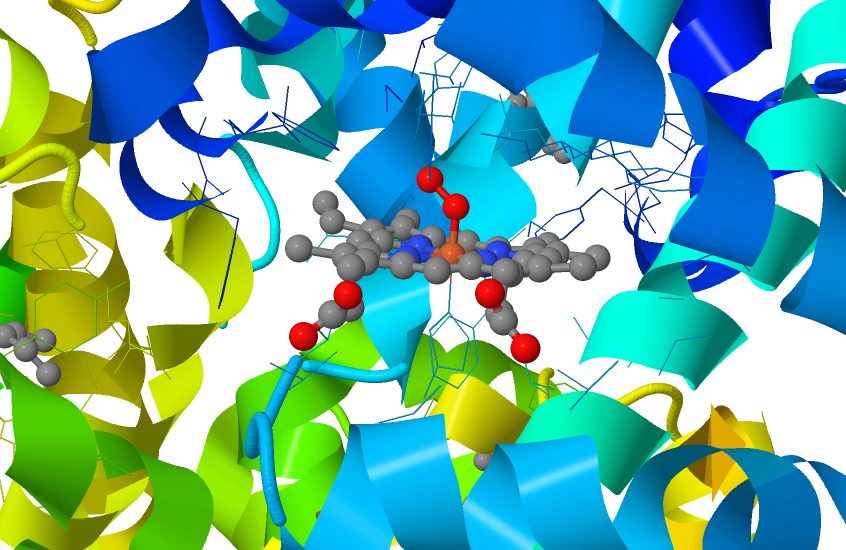
A ribbon model of protein helices surrounding a flat haem group shown as balls and sticks.
A haem group nested in the helices of human haemoglobin, from the 1.25 Å crystal structure. The iron at its centre is what carries the oxygen.Protein Data Bank entry 2DN1 · CC0 · Source

The blue copper proteins make the point in the opposite direction, by showing the protein imposing a geometry on the metal. Their colour is roughly a thousand times more intense than an ordinary copper complex's, because it is a charge transfer from a coordinated sulphur rather than a forbidden d-to-d transition. Crystallography showed the copper held in a distorted site it would never adopt in solution. That distortion is the point: the site is already partway to the geometry the oxidised form wants, so almost no reorganisation is needed when the electron leaves, and the transfer is fast — the entatic state, a metal kept uncomfortable on purpose. The rate theory this draws on is Marcus's, set out under transition state theory.

Harry Gray then settled how electrons get between sites that do not touch. By attaching a redox partner at chosen positions on a protein and measuring the rates, he showed they fall off exponentially with distance, with transfers remaining fast over fifteen to twenty ångströms. The protein is a tunnelling medium, which is what makes a respiratory chain of separated centres possible at all.

Chapter III

The Hardest Reactions in Biology

Two reactions stand out for how much they demand, and both are performed by metal clusters rather than single ions.

Nitrogen fixation breaks the 941 kJ mol⁻¹ triple bond of N₂ at an iron–molybdenum–sulphur cluster, at ambient temperature and pressure, where the industrial process described in catalysis needs 400 °C and 200 atmospheres. That gap is catalysis's standing open problem, and it is a bioinorganic problem in its details.

Water oxidation is the other. Pierre Joliot and Bessel Kok established the arithmetic in 1970 by giving plants single flashes of light and watching the oxygen come off: the yield oscillates with a period of four, so the catalyst accumulates four oxidising equivalents and then releases O₂ in one event. What the catalyst was took another forty years, until Yasufumi Umena, Keisuke Kawakami, Jian-Ren Shen and Nobuo Kamiya resolved it at 1.9 ångströms in 2011: four manganese atoms, one calcium, five bridging oxygens. It is the most thermodynamically demanding reaction life performs, it happens in every leaf, and the reaction damages the protein that performs it badly enough that photosystem II is disassembled and rebuilt roughly every half hour. Durability was not available, so the organism bought repair instead — which is a design decision no synthetic catalyst has yet been allowed to make.

Chapter IV

A Closer Look: How Zinc Buys a Factor of Ten Million

Those clusters are the extreme. The commonest thing a metal does in a protein needs only one ion and no redox chemistry at all, and it is worth seeing how much that buys.

Zinc cannot change oxidation state. Whatever it is doing in an enzyme is not electron chemistry, and carbonic anhydrase shows what the alternative is.

The reaction is the hydration of carbon dioxide, CO₂ + H₂O → HCO₃⁻ + H⁺, and it is needed because a red blood cell has to load the carbon dioxide from a whole tissue's metabolism during its passage through a capillary. Uncatalysed, the rate constant at 25 °C is about 0.04 s⁻¹. A red cell's transit takes roughly 0.75 s, so the fraction of dissolved CO₂ that would react in the time available is

1−e−0.04×0.75=3%.1 - e^{-0.04 \times 0.75} = 3\%.

That is not a workable physiology. The enzyme's turnover number is about 10⁶ s⁻¹ — one of the fastest known — giving an acceleration of some 2.7×1072.7 \times 10^7.

The whole of it comes from one water molecule. The reaction's difficulty is that CO₂ is attacked by hydroxide, not by water, and at pH 7 there is very little hydroxide about. Water's pKa\mathrm{p}K_a is 15.7, so the fraction of water molecules ionised at pH 7 is

107−15.7=2×10−9.10^{7 - 15.7} = 2 \times 10^{-9}.

Coordinate that water to a zinc ion held by three histidines, and the metal's positive charge pulls electron density from the oxygen and makes the O–H bond far easier to break. The measured pKa\mathrm{p}K_a of the zinc-bound water in carbonic anhydrase is about 7.0. So at physiological pH half of the enzyme molecules carry a hydroxide, against two in a billion for free water: an increase in the concentration of the actual nucleophile of roughly
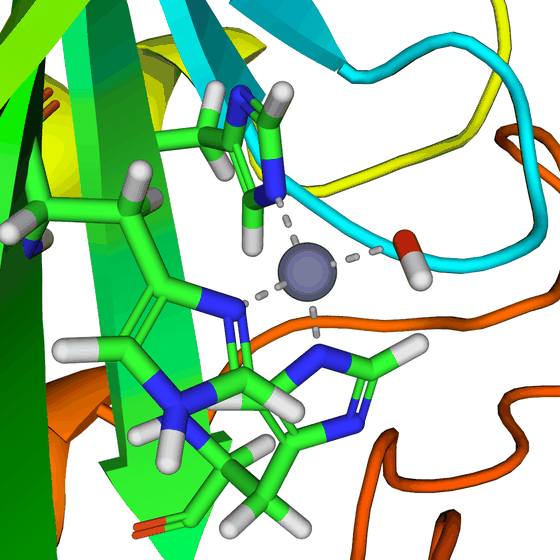
A close-up of a protein active site with a grey zinc atom held by three histidine side chains and a hydroxide.
The active site of human carbonic anhydrase II: a zinc ion held by three histidines, with the fourth position taken by the water-derived hydroxide that attacks carbon dioxide.Wikimedia Commons user, from PDB entry 1CA2 · Public domain · Source
0.52×10⁻⁹≈2×10⁸.\frac{0.5}{2 \times 10^{-9}} \approx 2 \times 10^{8}.

In energy terms, shifting a pKa\mathrm{p}K_a by 8.7 units is worth

2.303 RT×8.7=5.71×8.7=50 kJ mol−1,2.303\,RT \times 8.7 = 5.71 \times 8.7 = 50\ \text{kJ mol}^{-1},

about half a typical activation barrier, delivered by putting a water molecule next to a divalent cation. The rest of the protein's contribution is logistics: a hydrophobic pocket that holds the CO₂ in position, and a histidine that shuttles the released proton out to the solvent, which is needed because without it the proton transfer becomes the slow step.

Two conclusions follow. First, the choice of zinc is not arbitrary. A metal is wanted that is a strong Lewis acid, binds water with a pKa\mathrm{p}K_a near neutral, exchanges ligands quickly, and cannot do redox chemistry next to a membrane full of oxidisable lipid. Zinc satisfies all four; iron would satisfy the first three and fail the fourth. Second, the enzyme is operating within a factor of a few of the diffusion limit, with kcat/KMk_{\mathrm{cat}}/K_{\mathrm{M}} around 10810^8 M⁻¹ s⁻¹. There is nothing left to optimise; the protein has run out of room to improve, and what remains is the rate at which CO₂ arrives.

Chapter V

Metals Out of Place

Because the metal is the function, a metal in the wrong place is a disease or a drug, and both show up here.

Barnett Rosenberg found the drug by accident in 1965. Looking for an effect of electric fields on cell division, he saw bacteria elongate without dividing, and traced it to platinum dissolving from his electrodes. The active compound was cis-diamminedichloroplatinum; the trans isomer does nothing. The reason is geometric — the cis arrangement can bind two adjacent guanines on one DNA strand and kink it, the trans arrangement reaches two sites that are too far apart to matter — and the only reason the pure cis isomer can be made at all is Chernyaev's trans effect from coordination chemistry. Approved in 1978, it turned metastatic testicular cancer from a disease that killed almost everyone into one that is usually cured.
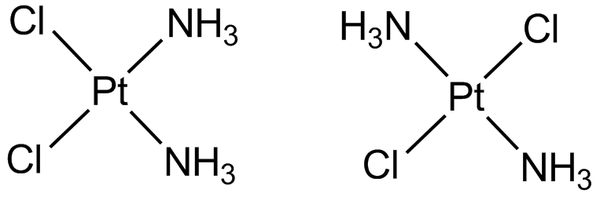
Two square-planar platinum structures, one with the two chlorides side by side and one with them opposite.
Cisplatin (left) and its trans isomer. Only the cis form is an anticancer drug: its two chlorides, side by side, leave two adjacent sites free to bind DNA.Puppy8800 · Public domain · Source

The failures run the other way. Wilson's disease is copper accumulating because the protein that exports it is defective; Menkes' disease is copper never arriving. Both are treated with the chelating ligands of coordination chemistry, chosen by stability constant. And the commonest nutritional deficiency in the world is not a shortage of iron in the diet but iron bound up by phytate in cereal grains tightly enough that it is never absorbed — a public health problem whose decisive quantity is an equilibrium constant.

Which returns the field to the question it started from. The cell's difficulty, recorded above as an open problem, is that the metals it must distribute have affinities in almost the same order for every ligand set, with copper and zinc at the top. A site that needs manganese should fill with copper and does not. The answer is not thermodynamics but control: free copper is held below one atom per cell, and every metal is handed over by a carrier that will not let go to the wrong recipient. Having spent a century learning what a metal site does, the field is now mostly asking how one gets built.

Applications

Where it is used

  • Oncology↗ Biology · Cancer Biology

    A coordination compound that cures a cancer

    Cisplatin and its successors are given to a large fraction of all patients receiving chemotherapy, and for testicular cancer the cure rate exceeds ninety per cent. The mechanism is coordination chemistry: the two chlorides are slowly replaced by water inside the cell, and the resulting electrophilic platinum binds two adjacent guanine bases, bending the DNA so that repair and replication fail. The geometry is the drug — the trans isomer makes the same bonds to separate sites and does nothing.

    › Sources (1)
    • Kelland, L. (2007). The resurgence of platinum-based cancer chemotherapy. Nature Reviews Cancer 7: 573–584.
  • Public health↗ Biology · Epidemiology

    The commonest nutritional deficiency is a stability-constant problem

    Iron deficiency affects over a billion people, and in cereal-based diets the cause is not a shortage of iron but its sequestration: phytate, the storage form of phosphate in grain, binds iron and zinc with constants large enough that the metal passes through unabsorbed. Vitamin C competes for the iron and increases uptake several-fold; tea and coffee polyphenols compete the other way. Fortification programmes therefore have to choose a chemical form of iron, not merely a quantity.

    › Sources (1)
    • Hurrell, R. & Egli, I. (2010). Iron bioavailability and dietary reference values. American Journal of Clinical Nutrition 91: 1461S–1467S.
  • Energy

    Copying a cluster that destroys itself twice an hour

    The manganese–calcium cluster of photosystem II splits water using visible light, at a rate and overpotential no synthetic catalyst matches. Attempts to copy it have produced manganese and cobalt oxide catalysts that work, and that share with the natural system a tendency to fall apart — which the leaf solves by continuous repair rather than by durability. The overpotential that limits every such catalyst is the open problem of electrode potentials.

    › Sources (1)
    • Kanan, M. W. & Nocera, D. G. (2008). In situ formation of an oxygen-evolving catalyst. Science 321: 1072–1075.

Open problems

Where the map runs out

Open

Building a metal site that performs like a natural one

Open as of 2026; designed metalloproteins reach useful activity for simple reactions and fall short by orders of magnitude for hard ones.

Natural metal sites achieve rates and selectivities that synthetic catalysts do not approach, using the same metals. Designing one from scratch — choosing the ligands, the second coordination shell, the channels that admit substrate and expel product — now succeeds for hydrolysis and simple oxidations, and fails for the reactions that matter most. The hardest case is nitrogen fixation, recorded as an open problem of its own in catalysis.

Why it is hard

The metal is only part of the site. Much of the catalytic power comes from a precisely placed second shell of residues that position the substrate, shuttle protons and tune the metal's potential, and these contributions are individually small and collectively decisive. Computing them requires accuracy in spin-state and redox energies that is not currently available.

What resolving it unlocks

Catalysts for oxidation with air, for carbon dioxide reduction and for water splitting that work at ambient conditions on abundant metals. It would also test whether the natural sites are optimal or merely the ones evolution happened to find.

› Sources (2)
  • Lu, Y., Yeung, N., Sieracki, N. & Marshall, N. M. (2009). Design of functional metalloproteins. Nature 460: 855–862.
  • Schwizer, F. et al. (2018). Artificial metalloenzymes: reaction scope and optimization strategies. Chemical Reviews 118: 142–231.

Open

How a cell gets the right metal to the right site

Open as of 2026; carrier proteins identified for copper and some others, the general logic not established.

The affinities of divalent metals for almost any ligand set follow the same order, with copper and zinc at the top and manganese and iron below. A protein that needs manganese would therefore be expected to fill with copper. It does not. Cells maintain free copper below one atom per cell, deliver metals by dedicated chaperones, and discriminate by kinetics and compartment rather than by thermodynamics — but how the specificity is achieved in general, and how a newly folded protein is matched to its metal, is not settled.

Why it is hard

The quantity that matters is the free concentration of each metal in each compartment, and those concentrations are far too low to measure directly; they are inferred from sensor proteins whose own affinities must be calibrated. Metals also exchange during the extraction of a protein, so the metal found in a purified sample need not be the one that was there.

What resolving it unlocks

Metal misdistribution underlies Wilson's and Menkes' diseases, contributes to neurodegeneration, and is a route by which pathogens are starved of iron by their hosts and fight back. It also sets whether a metal supplement or a chelating drug will reach its target.

› Sources (2)
  • Rae, T. D. et al. (1999). Undetectable intracellular free copper. Science 284: 805–808.
  • Foster, A. W., Osman, D. & Robinson, N. J. (2014). Metal preferences and metallation. Journal of Biological Chemistry 289: 28095–28103.

Further reading

  1. Lippard, S. J. & Berg, J. M. (1994). Principles of Bioinorganic Chemistry. University Science Books.

    The book that defined the subject as a subject; short, and organised by what metals do.

  2. Bertini, I., Gray, H. B., Stiefel, E. I. & Valentine, J. S. (2007). Biological Inorganic Chemistry. University Science Books.

    The comprehensive modern treatment, with the spectroscopy worked through.

  3. Keilin, D. (1966). The History of Cell Respiration and Cytochrome. Cambridge University Press.

    Written by the discoverer; a model of how an optical observation becomes a mechanism.