Skip to content
Field Atlas

Atlas / Chemistry / The Coordination Thread

Field · Emerged 1827 – 1977

Organometallic Chemistry

What happens when one of a metal's coordination positions is filled by a carbon atom, and why does that make a catalyst?

5 chapters8 min read7 turning points2 open problems

Branched from
Coordination Chemistry
Branched into
Not yet surveyed past here
Figures
Justus Liebig, William Christopher Zeise, Ludwig Mond, Robert Woodward, Thomas Kealy, Peter Pauson, Samuel Miller, Geoffrey Wilkinson, Myron Rosenblum, Mark Whiting, Ernst Otto Fischer, Michael Dewar, Joseph Chatt, L. A. Duncanson, Lauri Vaska, Richard Schrock, Chadwick Tolman

In brief

In 1827 William Zeise boiled platinum chloride in ethanol and isolated a crystalline salt that contained ethylene bonded to platinum. Nobody could say how. A double bond has no lone pair to donate, so by every account of bonding available for the next hundred and twenty-five years the compound should not exist. It sat in the literature as a curiosity, joined in 1890 by Ludwig Mond's nickel carbonyl — a metal that boils at 43 °C — and by little else.

Two things changed in the early 1950s. Ferrocene was made by accident and turned out to be a sandwich: an iron atom between two flat five-membered rings, stable in air, stable to 400 °C, and unlike any structure in the existing vocabulary. And Michael Dewar, Joseph Chatt and L. A. Duncanson explained the bonding, with a mechanism that runs both ways — the ligand donates electrons from a π bond to the metal, and the metal donates electrons back into the ligand's empty antibonding orbital. Once that two-way flow is admitted, ethylene, carbon monoxide and the metal–carbon bond all become ordinary.

What the field then produced was not mainly compounds but a vocabulary. Oxidative addition, migratory insertion, β-hydride elimination, reductive elimination: a small set of elementary steps that combine into cycles, with an electron count that says which species can be isolated and which will react. Almost every homogeneous catalyst in industrial use is described in those terms.

Key ideas

HapticityEnters 1951 – 1952

How many contiguous atoms of a ligand are bonded to the metal, written ηn\eta^n. Ethylene binds through both carbons of its double bond (η2\eta^2) and a cyclopentadienyl ring through all five (η5\eta^5). The concept was needed because a ligand can bind through a bond rather than through an atom, which Werner's positions did not anticipate.

Back-bondingEnters 1951 – 1953

Electron density flowing from a filled metal d orbital into an empty antibonding orbital of the ligand, in the opposite direction to the ordinary donation. It strengthens the metal–ligand bond while weakening the bond inside the ligand, and it is measurable: the carbon–oxygen stretching frequency of bound CO falls by up to 300 cm⁻¹.

Eighteen-electron ruleEnters 1970 – 1977

Complexes of the transition metals are most often stable when the metal's d electrons plus those donated by the ligands total eighteen, the configuration of the next noble gas. Sixteen-electron species are the reactive ones, because they have a vacancy — which is why most catalytic cycles alternate between the two counts.

Oxidative addition and reductive eliminationEnters 1961 – 1968

A metal inserts itself into a bond, taking both fragments onto itself and rising two in oxidation state and electron count; the reverse step joins two fragments and releases them. Together they let a metal pick up two pieces, hold them next to each other, and put them out joined.

Migratory insertionEnters 1961 – 1968

A ligand already bonded to the metal migrates onto a neighbouring ligand, forming a carbon–carbon or carbon–hydrogen bond and opening a coordination site. Repeated, it is how a polymer chain grows; used once, it is how an aldehyde is made from an alkene.

Cone angleEnters 1970 – 1977

Tolman's measure of how much room a ligand takes up at the metal, in degrees. Together with his electronic parameter it reduced ligand choice to two coordinates, so that a catalyst could be tuned by moving on a map rather than by trying compounds at random.

Chapter I

A Compound Nobody Could Explain for 125 Years

William Christopher Zeise boiled platinum chloride with ethanol in 1827 and got yellow crystals. The analysis said the salt contained a whole ethylene molecule bonded to the platinum, which was not a thing a molecule could do. A carbon–carbon double bond has no lone pair; there is nothing for it to donate. Justus von Liebig, who was in a position to make his doubts count, argued for two decades that the formula must be wrong.
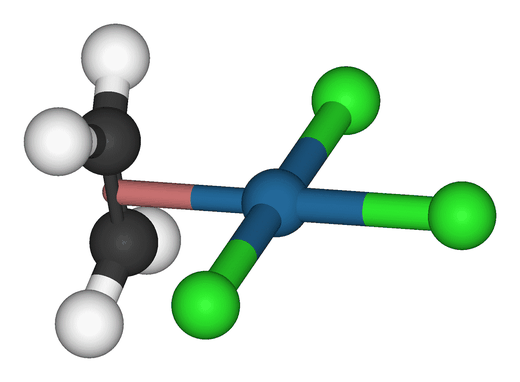
A ball-and-stick model of a platinum atom with three chlorines and an ethylene molecule bound side-on.
The anion of Zeise's salt, [PtCl₃(C₂H₄)]⁻: an ethylene molecule bound side-on to platinum by its double bond, the arrangement nobody could explain for more than a century.Wikimedia Commons · Public domain · Source

It was not wrong. But it was also not explicable, and so it remained for a remarkably long time: the structure was not determined by diffraction until 1954, and the bonding not accounted for until the early 1950s.

Zeise's salt acquired a companion in 1890 by way of an industrial nuisance. Ludwig Mond was trying to find out why carbon monoxide was eating the nickel valves in his alkali works. The answer was that nickel and carbon monoxide combine to give Ni(CO)₄, a colourless liquid boiling at 43 °C that decomposes back to pure metal when warmed — so a metal can be distilled. Mond built a refinery on it. Here again was a neutral molecule, carbon monoxide, held firmly by a metal in its zero oxidation state, with no account of why.

Meanwhile the useful organometallic chemistry of the period was reagent chemistry: Grignard's magnesium compounds from 1900, described in cross-coupling, which were made, used and destroyed in the same flask. The idea that the metal–carbon bond was a structural principle in its own right had nothing to stand on.

Chapter II

The Sandwich

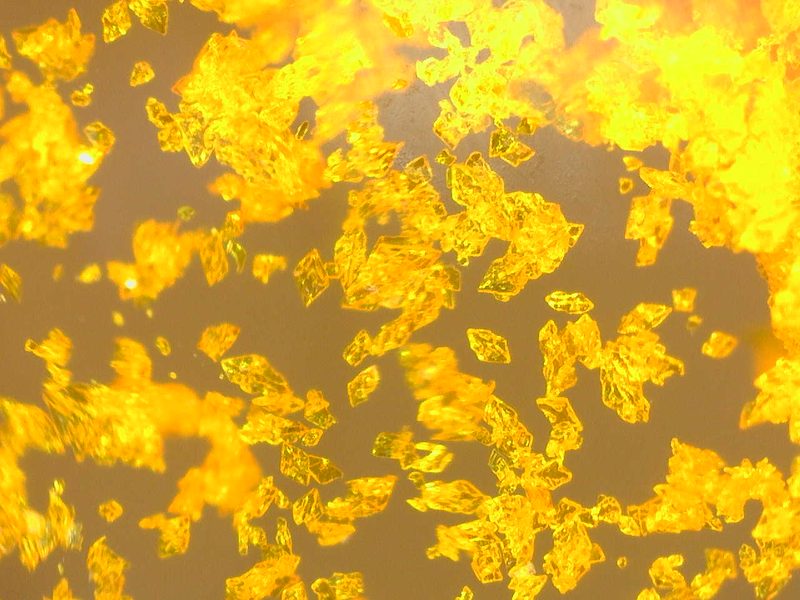
In 1951 Thomas Kealy and Peter Pauson were trying to make a different compound and obtained an orange solid, Fe(C₅H₅)₂, with properties that did not fit. It melted at 173 °C, sublimed, was indifferent to air and water, and survived above 400 °C. Organometallic compounds were supposed to be unstable. Samuel Miller's group had made the same substance independently by passing cyclopentadiene over hot iron, and had not recognised what they had.
A mass of shiny orange crystal flakes.
Ferrocene, grown as orange crystals by undergraduates at University College London.Andrea Sella · CC BY 4.0 · Source

The structure Kealy and Pauson proposed, with the iron bonded to one carbon of each ring, was wrong, and the error mattered because the right answer was new. Geoffrey Wilkinson, Myron Rosenblum, Mark Whiting and Robert Woodward, with Ernst Otto Fischer arriving at it independently, showed that the iron sits between two parallel rings, bonded to all five carbons of each.

No existing notion of a bond described that. The ring is not donating a lone pair from one atom; it is donating from a delocalised π system across five atoms at once. The vocabulary had to be extended, and the extension is hapticity — a count of how many contiguous ligand atoms are involved, written η5\eta^5 for a cyclopentadienyl ring and η2\eta^2 for Zeise's ethylene. Werner's coordination positions had been places for atoms with lone pairs; now a position could be filled by a bond, or by a face of a ring.

Wilkinson and Fischer shared the 1973 Nobel Prize for this chemistry, and the field dates itself from the compound rather than from Zeise.

Chapter III

Why a Neutral Molecule Binds a Metal at All

Michael Dewar, and then Joseph Chatt and L. A. Duncanson, supplied the missing bonding picture, and it has two halves going in opposite directions.

The ligand donates electron density from its filled π orbital into an empty orbital of the metal. That much is ordinary donation, as in coordination chemistry. The new part is that a filled d orbital of the metal donates density back into the ligand's empty antibonding π* orbital. Both flows strengthen the metal–ligand bond. But the second one weakens the bond inside the ligand, because it is putting electrons into an antibonding orbital — and that is what makes the model testable rather than merely plausible.

Free carbon monoxide stretches at 2143 cm⁻¹. Bound to nickel in Ni(CO)₄ it stretches at 2057. The bond has been weakened by the metal, by an amount that can be read off an infrared spectrum in a minute, and the amount tracks how electron-rich the metal is. This is also the reason carbon monoxide produces the largest ligand field splitting of any common ligand despite being neutral: it is not a strong electrostatic ligand, it is a strong π acceptor.

Lauri Vaska then found the steps. His iridium complex binds oxygen reversibly — which was interesting to biochemists — and inserts itself into the bond of hydrogen, of hydrogen chloride, of methyl iodide, taking both fragments onto the metal and rising two in oxidation state. Reverse the step and the two fragments leave joined together. Add the move in which one bound ligand migrates onto another, and a metal can pick up two molecules, hold them adjacent, rearrange them and put out a product, returning to where it started. That is a catalytic cycle, written as a sequence of named steps instead of described as a black box.

Chapter IV

A Closer Look: Counting to Eighteen

The bookkeeping rule of the field is that stable complexes usually have eighteen electrons around the metal — the d electrons plus two for each pair donated. The rule is not exact, but it sorts compounds into isolable and reactive with surprising reliability, and the arithmetic takes seconds.

ComplexMetal d electronsLigand donationTotal
Ni(CO)₄Ni(0): 104 × 218
Fe(C₅H₅)₂Fe(II): 62 × 618
Cr(CO)₆Cr(0): 66 × 218
[PtCl₃(C₂H₄)]⁻Pt(II): 83 × 2 + 216
IrCl(CO)(PPh₃)₂Ir(I): 82 + 2 + 2 × 216

The three eighteen-electron compounds are the ones you can buy in a bottle. Ferrocene survives 400 °C; nickel carbonyl is unpleasant but perfectly stable as a liquid. The two sixteen-electron compounds are the ones that react: Zeise's anion exchanges its ethylene readily, and Vaska's complex is a catalyst precursor precisely because it has a vacancy. Add H₂ to Vaska's complex by oxidative addition and the count goes to eighteen, the iridium goes from (I) to (III), and the product is isolable — then reductive elimination returns it to sixteen. A cycle is a loop between the two counts.

Now the back-bonding, quantitatively. Take three carbonyl complexes that all have eighteen electrons and all have six CO ligands in an octahedron, and differ only in charge:

ComplexMetalν(CO), cm⁻¹
[Mn(CO)₆]⁺Mn(I)2,090
Cr(CO)₆Cr(0)2,000
[V(CO)₆]⁻V(−I)1,860
free CO—2,143

A span of 230 cm⁻¹ across the three, produced by nothing but the charge on the metal. The more electron-rich the metal, the more density it pushes into the π* orbital, the weaker the C–O bond, the lower the frequency. Every one of the three is below free CO, so every one of them is back-bonding; the vanadium complex has weakened the C–O bond by 283 cm⁻¹, roughly 13% in frequency.
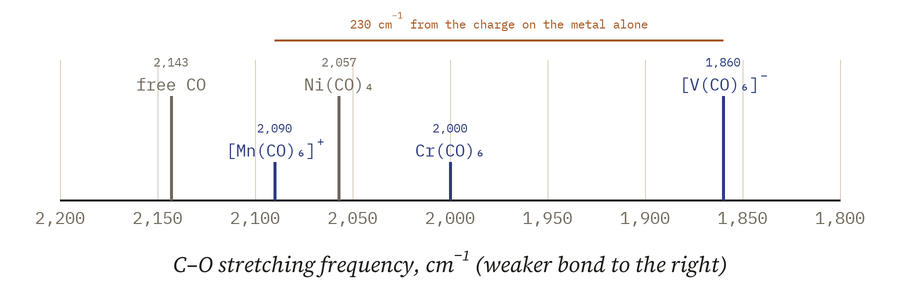
Lines on a wavenumber axis for free CO at 2,143, manganese hexacarbonyl cation at 2,090, nickel tetracarbonyl at 2,057, chromium hexacarbonyl at 2,000 and the vanadium hexacarbonyl anion at 1,860.
The carbonyl stretches from the tables. The richer the metal in electrons, the more it pushes back into CO and the lower the frequency: 230 cm⁻¹ between the manganese cation and the vanadium anion.Drawn for Field Atlas from the numbers above · Field Atlas original · Source

Chadwick Tolman turned this into a measuring instrument. Make Ni(CO)₃L for a long list of ligands L and record the CO stretch: the frequency is a number for how electron-donating L is. For phosphines it runs from 2056.1 cm⁻¹ for tri-tert-butylphosphine, a strong donor, to 2110.8 cm⁻¹ for trifluorophosphine, a poor one. Then he built space-filling models and measured the cone angle each ligand sweeps out: 118° for trimethylphosphine, 145° for triphenylphosphine, 182° for tri-tert-butylphosphine, 194° for tri(o-tolyl)phosphine.

Two numbers per ligand, and ligand selection becomes navigation on a map. This is not a small thing. The reason the rhodium hydroformylation process makes the straight-chain aldehyde rather than the branched one is that a bulky phosphine — high cone angle — makes the metal's remaining sites crowded, so the alkene inserts in the less hindered orientation. Selectivity worth hundreds of millions of tonnes of product follows from a number measured off a plastic model.

Chapter V

A Vocabulary of Steps

What organometallic chemistry contributed was less a class of compounds than a way of writing down what a catalyst does. Oxidative addition, migratory insertion, β-hydride elimination, reductive elimination, ligand substitution: a handful of steps, each with a known effect on the electron count and the oxidation state, which combine into cycles that can be checked for consistency before being tested in a flask.

The consequences are elsewhere in the atlas. The palladium cycles of cross-coupling are built from these steps, and so is the chain growth in the Ziegler–Natta polymerisation described under catalysis — one migratory insertion per monomer, thousands of times over, with the stereochemistry set at each one. Fischer's and Schrock's metal–carbon double bonds became the catalysts that swap the ends of alkenes.

Two things the field has not done are recorded above as its open problems, and they are of different kinds. One is epistemic: in a working catalytic reaction it is often unknown which of the species present is doing the catalysis, and reactions long believed homogeneous have turned out to run on nanoparticles formed in the flask. The other is a resource problem with a chemical cause. The metals that make these cycles clean — palladium, rhodium, iridium, platinum — are among the rarest in the crust, and the abundant metals directly above them in the periodic table do not substitute, because they prefer one-electron steps and have several spin states available. That is the same difficulty that ligand field theory cannot yet compute, arriving from the other direction.

Applications

Where it is used

  • Biochemistry↗ Biology · Biochemistry

    The one place life makes a metal–carbon bond

    Coenzyme B₁₂ contains a cobalt–carbon bond, and it is the only well-established organometallic chemistry in biology. The bond is weak enough to break homolytically on demand, generating a radical that the enzyme uses to move a hydrogen atom between adjacent carbons — a rearrangement with no ordinary route. The same chemistry has an unwanted side: bacteria methylate mercury by a related pathway, which is how an industrial discharge of inorganic mercury becomes the methylmercury that accumulates in fish.

    › Sources (2)
    • Banerjee, R. & Ragsdale, S. W. (2003). The many faces of vitamin B12. Annual Review of Biochemistry 72: 209–247.
    • Parks, J. M. et al. (2013). The genetic basis for bacterial mercury methylation. Science 339: 1332–1335.
  • Industrial chemistry

    Aldehydes from alkenes, by the million tonnes

    Hydroformylation adds carbon monoxide and hydrogen across a double bond to make an aldehyde, and it is written as a textbook cycle: oxidative addition, migratory insertion of the alkene, insertion of CO, then reductive elimination. Otto Roelen found it over a cobalt catalyst in 1938; the switch to rhodium with bulky phosphines let the process run near atmospheric pressure and choose the linear product over the branched one. It is among the largest-volume homogeneous catalytic processes in existence, and the selectivity is set by Tolman's two parameters.

    › Sources (1)
    • Franke, R., Selent, D. & Börner, A. (2012). Applied hydroformylation. Chemical Reviews 112: 5675–5732.
  • Semiconductor manufacture

    Growing a crystal from a volatile metal compound

    Metalorganic vapour-phase epitaxy builds semiconductor layers atom by atom by passing volatile compounds — trimethylgallium, trimethylindium — over a hot substrate where they decompose and deposit. The method exists because organometallic compounds can be made volatile and clean-decomposing by choice of ligand, and it is how blue light-emitting diodes, laser diodes and high-efficiency solar cells are manufactured. The precursor chemistry is the limiting factor in layer purity.

    › Sources (1)
    • Stringfellow, G. B. (1999). Organometallic Vapor-Phase Epitaxy, 2nd edition. Academic Press.

Open problems

Where the map runs out

Open

Knowing which species in the flask is the catalyst

Open as of 2026; a general case-by-case problem rather than one awaiting a single result.

A catalytic reaction contains the precatalyst that was added, the species that accumulate because they are stable, and the species that actually turns over — which may be present at a fraction of a per cent and may not be the one the mechanism was drawn around. Reactions believed to be homogeneous have repeatedly turned out to be catalysed by metal nanoparticles formed in situ, and the opposite has happened too. Kinetics constrain the active species without identifying it.

Why it is hard

The active species is by definition the one with the shortest lifetime and the lowest concentration, which is the hardest combination to observe. Removing it for study changes the conditions that produced it, and the usual tests for heterogeneity — filtration, mercury poisoning, kinetic hysteresis — give answers that can be argued either way.

What resolving it unlocks

Optimisation currently proceeds by varying conditions on a mechanism that may be wrong. Knowing the resting and active states would make ligand design rational, and would settle how much precious metal a process actually needs, which is often far less than is added.

› Sources (2)
  • Crabtree, R. H. (2012). Resolving heterogeneity problems and impurity artifacts in homogeneous catalysis. Chemical Reviews 112: 1536–1554.
  • Blackmond, D. G. (2005). Reaction progress kinetic analysis. Angewandte Chemie International Edition 44: 4302–4320.

Open

Doing with iron what is done with palladium

Open as of 2026; individual successes exist for most reaction classes, general replacements for none.

The homogeneous catalysts of industry are built on palladium, platinum, rhodium, iridium and ruthenium, which are among the rarest elements in the crust and are mined in a handful of places. Iron, cobalt, nickel and manganese sit directly above or beside them and are thousands of times more abundant, but they do not behave the same way: they change oxidation state in single-electron steps, they have several accessible spin states, and they form radicals where the heavier metals form two-electron intermediates.

Why it is hard

The clean two-electron cycles that make the precious metals predictable depend on a large gap between oxidation states and a single accessible spin state. First-row metals have neither, so the same ligand set gives different and often uncontrolled chemistry — and predicting which spin surface a reaction will follow runs into the spin-state energy problem recorded in ligand field theory.

What resolving it unlocks

Platinum-group metals are a standing cost and a supply risk in pharmaceutical manufacture, fuel cells and emissions control, and residual metal limits in drug substances are strict. Replacing them with iron would change the economics of a large part of chemical manufacture.

› Sources (2)
  • Chirik, P. J. (2015). Iron- and cobalt-catalyzed alkene hydrogenation. Accounts of Chemical Research 48: 1687–1695.
  • Fürstner, A. (2016). Iron catalysis in organic synthesis: a critical assessment. ACS Central Science 2: 778–789.

Further reading

  1. Crabtree, R. H. (2019). The Organometallic Chemistry of the Transition Metals, 7th edition. Wiley.

    The standard course, organised around the elementary steps rather than around the elements.

  2. Tolman, C. A. (1977). Steric effects of phosphorus ligands in organometallic chemistry and homogeneous catalysis. Chemical Reviews 77: 313–348.

    The review that reduced ligand choice to a two-dimensional map; still consulted as a data source.

  3. Seyferth, D. (2002). Bis(benzene)chromium and the beginnings of a field. Organometallics 21: 1520–1530.

    How the 1950s sandwich compounds were made and argued over, by someone who was there.