Skip to content
Field Atlas

Atlas / Chemistry / The Synthesis Thread

Field · Emerged 1900 – 2022

Cross-Coupling and Bond Construction

How can two specified carbon atoms be joined, reliably and in the presence of everything else a complicated molecule contains?

4 chapters6 min read6 turning points1 open problem

Branched from
Total Synthesis + Catalysis
Branched into
Not yet surveyed past here
Figures
Victor Grignard, Otto Diels, Kurt Alder, Richard Heck, Ei-ichi Negishi, Akira Suzuki, Norio Miyaura, Yves Chauvin, Richard Schrock, Robert Grubbs, Barry Sharpless, Morten Meldal, Carolyn Bertozzi, Robert Bergman, John Hartwig, Alexander Shilov

In brief

Carbon–carbon bonds are what organic molecules are made of, and for most of chemistry's history they were the hardest thing to make on purpose. Victor Grignard's organomagnesium reagents of 1900 gave the first general method, and they are so reactive that they attack almost anything — which is a reason a long synthesis spends a third of its steps protecting sites that must be left alone.

The modern answer is catalysis. A palladium atom will take two different partners, each stable and unreactive on its own, bring them together in its coordination sphere, join them, and release the product unchanged — millions of times over. The reactions named after Heck, Suzuki and Negishi are now among the most used in the pharmaceutical industry, because they tolerate the esters, amines, alcohols and heterocycles that a drug molecule carries and the Grignard reagent would destroy. Olefin metathesis does the same for carbon–carbon double bonds, exchanging the ends of two alkenes as though swapping dance partners. The remaining frontier is the bond that is not reactive at all: a molecule with forty carbon–hydrogen bonds, and the problem of functionalising one chosen one.

Key ideas

Organometallic reagentEnters 1900 – 1912

A compound with a carbon–metal bond, in which the carbon is electron-rich and attacks electron-poor centres. Grignard reagents made carbon–carbon bond formation general and are indiscriminate, which is both their utility and their cost.

CycloadditionEnters 1928 – 1950

Two molecules joining to form a ring in one step, with all the bonds made simultaneously. The Diels–Alder reaction builds a six-membered ring and controls up to four stereocentres at once, with no reagent and no catalyst.

Catalytic cycleEnters 1968 – 1979

The sequence a catalyst passes through and returns from: take up one partner, take up the other, join them, release the product. The metal's oxidation state changes and comes back, so a few hundredths of a mole per cent can convert a tonne.

Functional group toleranceEnters 1968 – 1979

Whether a reaction leaves alone the other groups a complicated molecule carries. It is the property that decides whether a method is usable late in a synthesis, and it is what distinguishes catalytic coupling from classical organometallic chemistry.

BioorthogonalityEnters 2001 – 2022

A reaction that proceeds in water, at body temperature, between two partners that ignore every functional group biology contains. It allows a molecule to be joined to another inside a living cell without disturbing the cell.

C–H activationEnters 1982 – 2018

Making a carbon–hydrogen bond react deliberately. Since such bonds are everywhere in an organic molecule and nearly identical in strength, the problem is almost entirely one of choosing between them.

Chapter I

Reactive Enough to Be a Nuisance

Victor Grignard found in 1900 that magnesium turnings and an organic halide in dry ether give a solution that will attack almost any carbon bearing an oxygen: aldehydes, ketones, esters, nitriles. A new carbon–carbon bond forms in each case. It was the first general method for the operation organic synthesis most needs, it requires no special equipment, and it won a Nobel Prize twelve years later.

Its defect is the same sentence read differently: almost any carbon bearing an oxygen. A Grignard reagent cannot be used on a molecule that already contains an ester you wish to keep, or an alcohol, or an amine with a free hydrogen. So the other sites are blocked first and unblocked afterwards, which is where a long synthesis spends a third of its steps and most of its material.

Otto Diels and Kurt Alder found in 1928 a reaction of the opposite character. A diene and an alkene simply combine, with no reagent and no catalyst, to give a six-membered ring — and because all the bonds form at once in a single ordered encounter, up to four stereocentres are set simultaneously with their relative arrangement fixed by the geometry of the approach. Nothing is discarded; the atom economy is 100%. It is probably the most used ring-forming reaction in synthesis, and why it works when it works is exactly what the orbital symmetry rules explain.

Chapter II

A Metal That Holds Both Partners

The modern solution to selectivity is to let a metal do the joining. The cycle, in outline, is the same for all the named reactions: palladium takes up the first partner, usually by inserting into a carbon–halogen bond; the second partner, carried on boron, zinc or tin, transfers its organic group to the metal; the two groups, now adjacent on the same atom, join and leave; and the metal returns to its starting state ready to do it again.
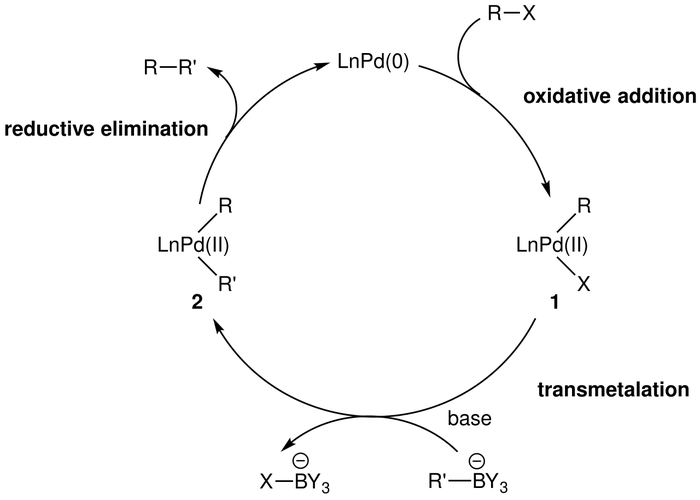
A circular diagram of a palladium catalyst passing through oxidative addition of R–X, transmetalation with a boron reagent, and reductive elimination of R–R′.
The Suzuki cycle. Palladium inserts into the carbon–halogen bond, takes the second carbon from boron, then releases the two carbons joined and returns to the start.LibreTexts · CC BY 4.0 · Source

Two consequences follow, and they are what made the chemistry so widely used. First, turnover: the metal is regenerated, so catalyst loadings of a few hundredths of a mole per cent suffice, and a few grams of palladium can convert a tonne of material. Second, and more important, tolerance. Neither partner is reactive on its own — an aryl boronic acid is a stable solid you can weigh out in air — so the reagents ignore the esters, amides, alcohols and heterocycles that a drug molecule carries. A Grignard reagent cannot be let near those; a Suzuki coupling can.

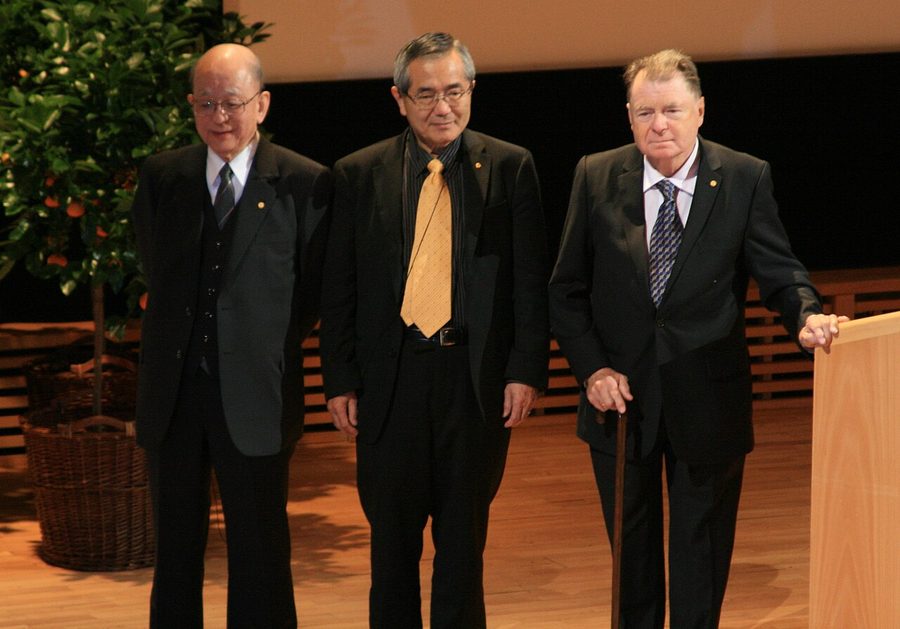
Richard Heck, Ei-ichi Negishi and Akira Suzuki developed the variants that bear their names between 1968 and 1979 and shared the 2010 Nobel Prize. The boron version spread furthest, for unglamorous reasons: boronic acids are stable, cheap, available by the thousand, and their by-products are harmless. Surveys of how marketed drugs are actually manufactured find these couplings among the most used carbon–carbon bond-forming steps in the industry.
Three elderly men in dark suits standing together on a stage.
Akira Suzuki, Ei-ichi Negishi and Richard Heck, who shared the 2010 Nobel Prize in Chemistry for palladium-catalysed cross-coupling.BloodIce · CC BY-SA 4.0 · Source

Yves Chauvin, Richard Schrock and Robert Grubbs did the equivalent for double bonds. In olefin metathesis two alkenes exchange their ends — the mechanism is a metal–carbon double bond that adds across the alkene and comes apart the other way — so a chain with alkenes at both ends can be closed into a large ring, an operation that is otherwise extremely difficult. Grubbs's ruthenium catalysts tolerate air, water and most functional groups, which took the reaction from a curiosity of industrial polymer chemistry to a standard step in total synthesis.

Chapter III

A Closer Look: Choosing One Bond Out of Forty

The frontier is the bond that is not reactive at all. A carbon–hydrogen bond is strong, unpolarised and present everywhere: a drug-sized molecule has thirty to fifty of them. Making one react is now possible; making the right one react is the problem, and its difficulty can be stated exactly.

Selectivity between two competing sites is a ratio of rates, and rates depend exponentially on free energy, so the selectivity follows from the difference in activation free energy between the two pathways:

k1k2=exp⁡ ⁣(ΔΔG‡RT).\frac{k_1}{k_2} = \exp\!\left(\frac{\Delta\Delta G^{\ddagger}}{RT}\right).

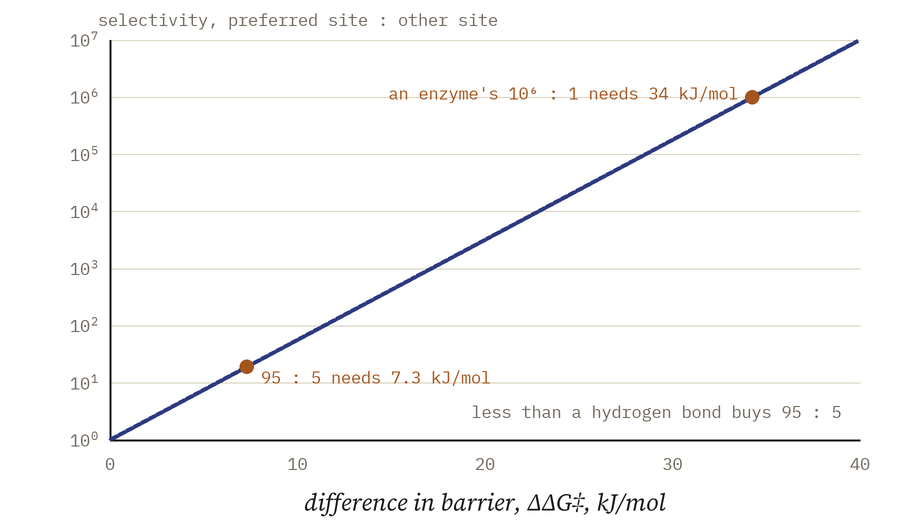
With RT=2.48RT = 2.48 kJ/mol at 298 K, a useful 95:5 preference — a ratio of 19 — needs only

ΔΔG‡=RTln⁡19=2.48×2.94=7.3 kJ/mol.\Delta\Delta G^{\ddagger} = RT\ln 19 = 2.48 \times 2.94 = 7.3 \text{ kJ/mol}.

Seven kilojoules. That is less than a hydrogen bond, about a tenth of a typical reaction barrier, and well inside the error of a routine quantum chemical calculation.
A straight rising line of selectivity on a log scale against the difference in barrier from 0 to 40 kJ/mol, marking 95 to 5 at 7.3 kJ/mol and a million to one at 34 kJ/mol.
Selectivity between two sites against the difference in their barriers. A 95 : 5 preference needs only 7.3 kJ/mol; an enzyme's million to one needs 34.Drawn for Field Atlas from the numbers above · Field Atlas original · Source

This cuts both ways, and that is the point. On the optimistic side, controlling selectivity does not require a large energetic difference — a modest steric preference or a weak attraction between catalyst and substrate suffices, which is why enzymes can be so selective using nothing but shape. On the pessimistic side, differences that small are produced by almost anything: a change of solvent, a nearby substituent, a slight distortion of the catalyst. So selectivity achieved on one substrate frequently vanishes on the next, and a method that works on toluene fails on a molecule with four other aromatic rings.

The arithmetic also explains why the available strategies look as they do. One is to attach a directing group that coordinates the metal and holds it next to the intended bond, converting an energetic problem into a geometric one — effective, and it costs two steps, which is what the method was meant to save. Another is to exploit the small intrinsic differences that do exist: bonds adjacent to nitrogen are weaker by 15 to 25 kJ/mol, which is worth a factor of several hundred and is enough. The third, and the one that would generalise, is to build a catalyst that holds the whole substrate in a fixed orientation, as an enzyme does — which requires a new catalyst for each substrate, and is where the field is.

For comparison, the same calculation run on an enzyme shows what is being competed against. A selectivity of 10610^{6}, routine for a hydroxylase choosing among the C–H bonds of a steroid, corresponds to

ΔΔG‡=2.48×ln⁡(106)=34 kJ/mol,\Delta\Delta G^{\ddagger} = 2.48 \times \ln(10^{6}) = 34 \text{ kJ/mol},

achieved not by activating one bond but by presenting only one bond to the catalytic centre.

Chapter IV

Reactions That Ignore an Entire Cell

The most extreme form of the selectivity problem has an unexpectedly clean solution. Suppose you want to join two molecules inside a living organism, where there are thousands of amines, alcohols, thiols and carboxylic acids, all more reactive than anything you would ordinarily choose, and where the only acceptable conditions are water at 37 °C.

Barry Sharpless and Morten Meldal found in 2001 that copper makes an azide and a terminal alkyne combine rapidly and almost quantitatively under exactly those conditions, and that neither partner reacts with anything biological. Carolyn Bertozzi then removed the copper, which is toxic to cells, by building the strain into the alkyne so that no catalyst is needed.

The result is a pair of groups that see only each other. Feed a cell a sugar carrying an azide, let it be incorporated into the molecules on the cell's surface, then add a fluorescent alkyne, and the label attaches to that sugar and nowhere else — in a living animal. The approach is now the standard way to attach a probe, a drug or a tag to a biomolecule in place, and it is discussed from the other side under cell biology. Selectivity, in the end, was achieved not by discriminating between similar bonds but by introducing two groups that chemistry had no other use for.

Applications

Where it is used

  • Pharmaceutical manufacture

    The reactions a drug is actually made with

    Surveys of process routes to marketed drugs find palladium-catalysed couplings among the most used carbon–carbon bond-forming steps, with the boron variant dominant because the reagents are stable and the by-products are innocuous. The reason is tolerance rather than elegance: these reactions survive the amines, amides, alcohols and heterocycles that a drug molecule is largely made of, and can therefore be used on the complicated fragment rather than on a simplified stand-in.

    › Sources (1)
    • Magano, J. & Dunetz, J. R. (2011). Large-scale applications of transition metal-catalyzed couplings for the synthesis of pharmaceuticals. Chemical Reviews 111: 2177–2250.
  • Cell biology↗ Biology · Cell Biology

    Labelling a molecule inside a living cell

    A bioorthogonal pair — an azide and a strained alkyne, say — reacts with each other and with nothing a cell contains, so a sugar fed to an organism can be tagged with a fluorophore afterwards and watched. The technique made it possible to image where particular glycans are made and trafficked in a living animal, and it is now the standard way to attach a label, a drug or a probe to a biomolecule in place.

    › Sources (2)
    • Prescher, J. A. & Bertozzi, C. R. (2005). Chemistry in living systems. Nature Chemical Biology 1: 13–21.
    • Agard, N. J., Prescher, J. A. & Bertozzi, C. R. (2004). A strain-promoted [3+2] azide–alkyne cycloaddition for covalent modification of biomolecules in living systems. Journal of the American Chemical Society 126: 15046–15047.
  • Materials↗ Physics · Soft Matter

    Conjugated polymers and the screens made from them

    Light-emitting and semiconducting polymers are made by repeating a cross-coupling along a chain, so the same palladium chemistry that joins two fragments of a drug assembles a conducting backbone hundreds of units long. Control of the coupling's regiochemistry determines whether the resulting polymer conducts, which is why the display and organic photovoltaic industries depend on these reactions.

    › Sources (1)
    • Yokozawa, T. & Ohta, Y. (2016). Transformation of step-growth polymerization into chain-growth polymerization. Chemical Reviews 116: 1950–1988.

Open problems

Where the map runs out

Open

Choosing one C–H bond out of forty

Open as of 2026; general site-selective functionalisation of a complex molecule has not been achieved.

A typical drug-sized molecule contains thirty to fifty carbon–hydrogen bonds whose strengths lie within about 20 kJ/mol of one another. Functionalising a chosen one, without a directing group attached nearby for the purpose, requires discriminating between sites on the basis of differences smaller than a hydrogen bond. Enzymes do it routinely, by holding the substrate in a fixed orientation; synthetic catalysts mostly cannot.

Why it is hard

Rate ratios depend exponentially on free energy differences, so a 95:5 preference between two sites needs only 7.3 kJ/mol of differentiation at room temperature — which sounds achievable and means the selectivity is decided by effects of a size that no current catalyst controls reliably across different substrates. Approaches that work by holding the substrate, as enzymes do, must be redesigned for every new molecule.

What resolving it unlocks

Late-stage functionalisation: taking a finished drug molecule and installing a fluorine, a hydroxyl or a label at a chosen position, instead of rebuilding the molecule from the start. It would shorten medicinal chemistry's iteration cycle from weeks to days.

› Sources (2)
  • Hartwig, J. F. & Larsen, M. A. (2016). Undirected, homogeneous C–H bond functionalization: challenges and opportunities. ACS Central Science 2: 281–292.
  • Cernak, T., Dykstra, K. D., Tyagarajan, S., Vachal, P. & Krska, S. W. (2016). The medicinal chemist's toolbox for late stage functionalization. Chemical Society Reviews 45: 546–576.

Further reading

  1. Hartwig, J. F. (2010). Organotransition Metal Chemistry: From Bonding to Catalysis. University Science Books.

    The standard treatment of how these catalytic cycles work, mechanism by mechanism.

  2. Magano, J. & Dunetz, J. R. (2011). Large-scale applications of transition metal-catalyzed couplings. Chemical Reviews 111: 2177–2250.

    What is used industrially rather than what is published, with the reasons.

  3. Sletten, E. M. & Bertozzi, C. R. (2009). Bioorthogonal chemistry. Angewandte Chemie International Edition 48: 6974–6998.

    How a reaction is designed to ignore an entire cell's worth of chemistry.