Chapter I
A Difference With Almost No Signature
Tartaric acid, crystallised from wine lees, rotates the plane of polarised light to the right. Racemic acid, found in the same casks, is identical by every analysis and rotates light not at all. In 1848 a 25-year-old Louis Pasteur looked at crystals of the sodium ammonium salt of the second under a lens and saw that they came in two shapes — each the mirror image of the other, distinguished by small facets on opposite sides.
He separated them with tweezers into two piles, dissolved each, and put both in a polarimeter. One solution rotated light to the right by the amount tartaric acid does; the other rotated it to the left by exactly as much; an equal mixture did nothing. So racemic acid is a one-to-one mixture of two substances that are mirror images, and the handedness survives dissolution — which means it belongs to the molecules and not to the crystal.
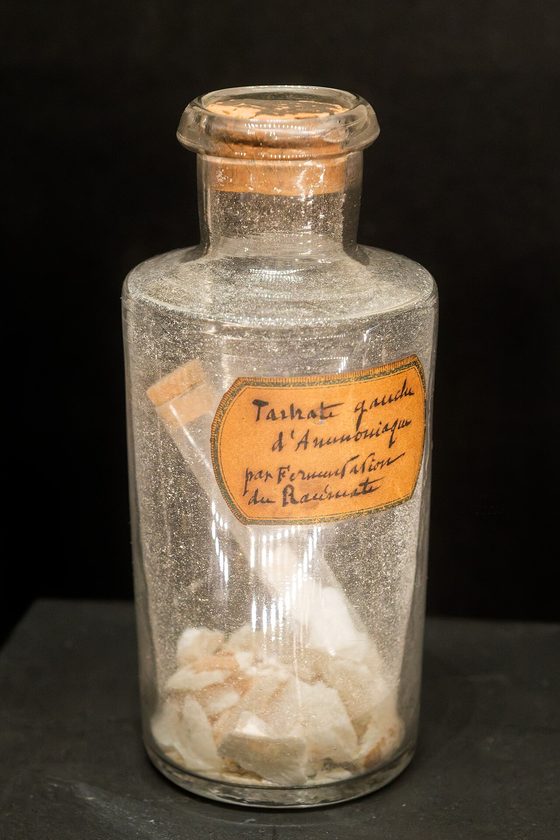
This is an inference about molecular architecture made in 1848, drawn from the shape of crystals and the rotation of light, with no theory of structure in existence. Pasteur then did something that mattered even more for biology: he found that a mould fed on the mixture consumed one hand and left the other untouched.
Chapter II
Four Bonds to the Corners of a Tetrahedron
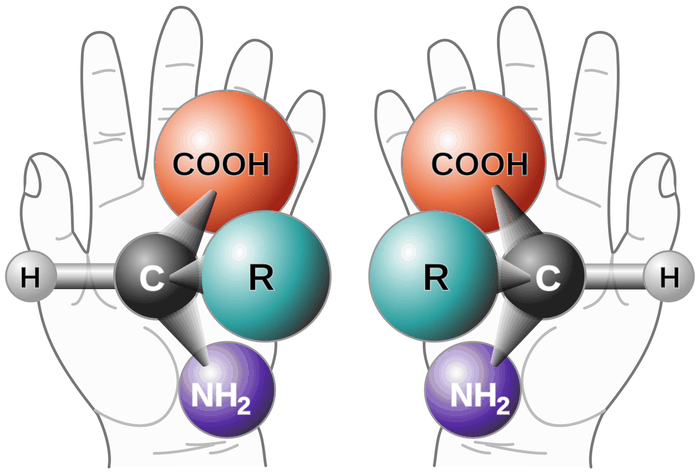
The explanation waited until 1874 and arrived twice in the same year. Jacobus Henricus van 't Hoff, aged 22, and Joseph Le Bel independently proposed that carbon's four bonds are not drawn in a plane, as the structural formulas of the day implied, but point towards the corners of a tetrahedron.
Everything follows. A carbon carrying four different groups can be assembled in two ways related as object and mirror image, and no rotation brings one onto the other — exactly like a pair of hands. A molecule with one such centre is optically active and comes in two forms; a molecule with independent centres has up to stereoisomers. Glucose has four, so sixteen are possible, and all sixteen exist.
Hermann Kolbe's review of the proposal is worth quoting as a reminder of what a correct idea can sound like to a competent contemporary: he complained of a Dr J. H. van 't Hoff, employed at a veterinary college, who had no taste for exact chemical research and had mounted his Pegasus to proclaim how, on the chemical Parnassus, atoms appeared to him arranged in space.
Emil Fischer then did the work that made the theory usable. Starting in 1888, he established which of the sixteen possible glucose stereoisomers each known sugar was, by a long campaign of degradations and interconversions in which two different sugars giving the same product constrains both. It took six years. He could determine configurations only relative to one another, so he fixed the reference arbitrarily, stating plainly that it was a choice — and it was fifty-seven years before anyone could check whether he had guessed right.
Chapter III
A Closer Look: Counting Stereoisomers, and the One Fact That Settles Which Is Which
Two pieces of arithmetic make this subject concrete.
How many isomers. With chiral centres there are at most stereoisomers, falling into mirror-image pairs. For glucose, . The isomers divide into two classes with completely different behaviour:
- Enantiomers — full mirror images, differing at every centre. They have identical melting points, boiling points, solubilities, spectra and densities. In an unhanded environment nothing distinguishes them but the sign of their optical rotation.
- Diastereomers — differing at some centres and not others. They are not mirror images, so they differ in everything: melting point, solubility, chromatographic retention, reaction rate.
That distinction is the basis of every separation. Enantiomers cannot be separated by distillation or crystallisation, because the relevant properties are equal. Attach a handed group to both, though, and the pair becomes diastereomers, which can be separated by ordinary means; remove the group afterwards and the enantiomers are resolved. Pasteur's mould did the same thing biologically — a chiral enzyme consuming one hand — and Pasteur's tweezers worked only because this particular salt happens to crystallise into separate handed crystals, which is rare.
Relative versus absolute. Chemistry can establish that two compounds have the same arrangement, by converting one into the other without disturbing the centre. It cannot say which arrangement that is. Mirror images are identical in energy, so no thermodynamic measurement distinguishes them, and a crystal and its mirror image diffract X-rays identically — a result known as Friedel's law.
Johannes Bijvoet found the loophole in 1951. If the crystal contains an atom heavy enough to absorb the X-rays being used, that atom re-emits them slightly out of phase, and the small shift breaks the symmetry between a reflection and its opposite. Measuring the two carefully enough distinguishes the structure from its mirror image absolutely. Applied to a rubidium tartrate, it showed that Fischer's arbitrary assignment of 1891 had been right — a coin flip, recorded as such, that held up for sixty years.
Vladimir Prelog, with Cahn and Ingold, then removed the need for reference compounds entirely. Rank the four groups attached to a centre by atomic number; look along the bond from the centre with the lowest-ranked group pointing away; read the remaining three in order. Clockwise is R, anticlockwise is S. The rule is an algorithm, applies to arbitrarily complicated molecules, and turns a configuration into something a name can carry.
Chapter IV
Why It Matters Outside Chemistry
An enantiomer pair differs in no property measurable in an unhanded environment. A living organism is not an unhanded environment. Proteins are built from L-amino acids only, so every enzyme and every receptor is itself chiral, and binds the two hands of anything else differently — often by factors of thousands.
The consequences are ordinary and occasionally terrible. The two enantiomers of carvone smell of spearmint and of caraway, which anyone can check with two bottles. One enantiomer of a beta-blocker does the work and the other contributes side effects. And thalidomide, marketed from 1957 as a sedative safe in pregnancy and sold as a mixture of both hands, left around ten thousand children with severe limb malformations before withdrawal in 1961. One hand is the sedative; the other is the teratogen.
The case is usually told as an argument for marketing single enantiomers, and the real lesson is less comfortable: thalidomide's two forms interconvert in the body within hours, so administering the pure beneficial enantiomer would not have prevented the harm. What the episode did establish is regulatory. Stereochemistry is now something a drug application must specify, and the demand for single-enantiomer synthesis is what made asymmetric catalysis an industrial priority rather than an academic one.
Which leaves the question the subject has not answered. Ordinary chemistry makes both hands in equal amounts; life uses one. Why, and how the imbalance was amplified to completeness, is the open problem above, and it is the one place where a question about molecular handedness turns into a question about the origin of life.