Chapter I
A Number Before a Mechanism
Berzelius had an account of why atoms combine: they carry opposite electrical charges and attract. It explained salts well, and it could not explain , or , in which the two partners are identical and so cannot differ in charge. That difficulty sat unresolved for most of the nineteenth century, during which chemistry made enormous progress by not asking.
What it used instead was Edward Frankland's observation of 1852. Study enough compounds of an element and its partners always add up the same way: nitrogen is satisfied by three attachments or five, oxygen by two, carbon by four, whatever the partners are. Frankland called it combining power; the word valence came later. The concept says nothing about what an attachment is, and within a decade chemists were drawing it as a dash between letters, counting the dashes to check a formula, and building the whole of structural organic chemistry on it.
This is worth pausing on, because it is a pattern the atlas meets repeatedly: a formal rule with no mechanism can carry a field for decades, provided it is quantitative enough to be wrong.
Chapter II
The Dash Acquires a Content
Gilbert Lewis filled it in 1916, and the key move was to stop thinking about transfer. A bond, he proposed, is a pair of electrons shared between two atoms, counted by both. Two chlorine atoms can hold a pair jointly without either becoming charged, which disposes of the difficulty Berzelius left. Lewis drew the electrons as dots at the corners of a cube around each atom, and noted that eight is the stable number — the octet rule. Irving Langmuir publicised the idea energetically enough that it was known for some years as the Lewis–Langmuir theory.

Lewis's 1923 monograph went further and redefined acids and bases in terms of the same pair: an acid accepts one, a base donates one. That definition is broader than the proton-transfer account and is the one still used for most of inorganic and organometallic chemistry.
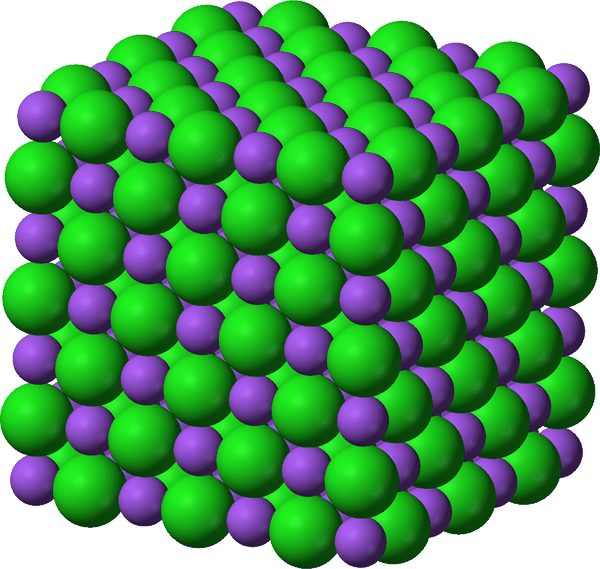
Meanwhile Walther Kossel had developed the other half of the picture in 1916. In a salt, the electron really is transferred, leaving ions of opposite charge held by plain electrostatics. For a while these looked like rival theories of the bond. They are two limits of one continuum, and settling that required making the ionic case quantitative.
Chapter III
A Closer Look: Two Routes to the Energy of a Crystal
The energy holding a crystal of common salt together cannot be measured directly — there is no experiment that pulls a lattice apart into gaseous ions. It can be reached two completely different ways, and the agreement between them is the evidence that the ionic picture is right.
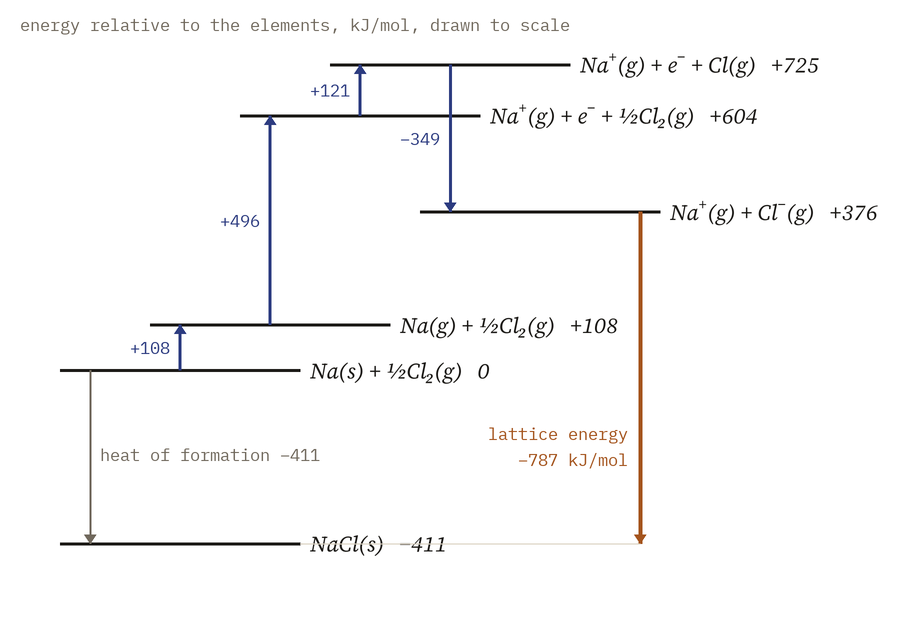
Route one: a thermodynamic cycle. Max Born and Fritz Haber's construction uses the fact that energy is a state function, so a sum round a closed path must vanish. To go from sodium metal and chlorine gas to a crystal of salt, either react them directly, or take the long way: vaporise the sodium, ionise it, split the chlorine, add the electron, and let the gaseous ions collapse into a lattice. All the steps but the last are measurable:
| Step | Energy (kJ/mol) |
|---|---|
| Sublimation of sodium | +108 |
| Ionisation of Na(g) | +496 |
| Dissociation of ½ Cl₂ | +121 |
| Electron attachment to Cl(g) | −349 |
| Sum of the measurable steps | +376 |
| Heat of formation of NaCl(s) | −411 |
The lattice energy is whatever closes the cycle:
Route two: adding up the charges. Now compute it from electrostatics alone, with no thermochemistry. Each ion attracts its six nearest neighbours of opposite charge, is repelled by twelve at times the distance, attracted by eight at , and so on. That infinite sum converges to a constant for a given lattice type — the Madelung constant, 1.7476 for rock salt. Allowing for the short-range repulsion that stops the ions collapsing, with Born exponent :
With m, the Coulomb term for one mole of ion pairs is
so
Two routes, nothing in common but the substance: −787 from calorimetry, −753 from a lattice sum and a measured interionic distance. They agree to 4%.
That margin is the interesting part. The agreement is close enough to establish that salt is held together by nothing but charges — no sharing, no directed bonds, just a sum over an infinite array. And the 4% discrepancy is real: it is the part of the cohesion that the point-charge model misses, chiefly the van der Waals attraction and the zero-point vibrational energy. Run the same comparison on silver chloride and the gap widens to about 8%, because silver's electrons are polarisable and the bonding has acquired covalent character. The size of the disagreement therefore measures how ionic a compound actually is.
Pauling put a number on the same thing from the other direction. His electronegativity scale, derived from bond energies, gives each element a value: caesium 0.79, sodium 0.93, hydrogen 2.20, chlorine 3.16, fluorine 3.98. The difference across a bond predicts its character — 2.23 for Na–Cl, substantially ionic; 0.96 for H–Cl, polar covalent; zero for Cl–Cl. There is no boundary in the scale, because there is no boundary in nature.
Chapter IV
Shape, and the Limits of Counting
The last piece is geometry. A formula says what is attached; it does not say where. Nevil Sidgwick and Herbert Powell noticed in 1940 that shape follows from the number of electron pairs round the central atom, and Ronald Gillespie and Ronald Nyholm made it a recipe: count the bonding pairs and the lone pairs, push them as far apart as possible, read off the arrangement. Four pairs give a tetrahedron, three a flat triangle, five a curious see-saw. A lone pair, being held by one nucleus rather than two, spreads wider and squeezes the others — which is why methane's angles are 109.5° and water's are 104.5°.
It is a remarkable piece of prediction for something done on the back of an envelope, and it is not a theory of bonding. Neither, quite, is any of the above: Lewis's pairs, Pauling's hybrids and Gillespie's repulsions are all ways of talking about a system whose actual description is a many-electron wavefunction. Pauling's localised-pair approach and the rival molecular-orbital picture of Hund and Mulliken — electrons spread over the whole molecule — compete precisely because neither is the truth, and the argument about which is primary was fierce for decades. Solving the underlying equations, and discovering how much had to be approximated to do it, is quantum chemistry.