Chapter I
Ions Before the Current
Faraday had named the travelling species and left its nature open. The consensus that followed held that the current itself splits the molecules as it passes — that ions are produced by electrolysis rather than present beforehand — which seemed necessary, since charged particles in water ought to attract each other and recombine.
Friedrich Kohlrausch supplied the first decisive evidence, and it came from improving a measurement. Conductivity had been measured with direct current, which electrolyses the solution under test and so changes it; Kohlrausch used alternating current and a telephone earpiece as a null detector, and got results good to a fraction of a per cent. The data showed something unexpected: each ion contributes a fixed amount to the conductivity, independent of its partner. Sodium contributes the same whether it arrives as the chloride, the nitrate or the sulfate. Conductivities could be predicted by adding two numbers from a table.
That is hard to explain if the ions are produced in pairs by the current, and easy if they are moving independently and were already there. Svante Arrhenius argued exactly that in his 1884 thesis, adding that the fraction dissociated increases with dilution, which accounted for the longstanding puzzle that dilute solutions depress a freezing point as though they contained more particles than formula units. The Uppsala examiners gave the thesis the lowest passing grade. Ostwald read it, travelled to meet him, and the theory became the foundation of solution chemistry; Arrhenius took the 1903 Nobel Prize for it.
Chapter II
Why the Theory Only Works When Dilute
Arrhenius's picture predicts that a dissolved salt behaves ideally, each ion independent. Measurements disagree measurably at a thousandth of a mole per litre, which is very dilute indeed.
Peter Debye and Erich Hückel explained the deviation in 1923 by treating the problem statistically. An ion is not in a uniform medium: it attracts opposite charges and repels like ones, so it sits at the centre of a diffuse atmosphere carrying a slight net charge of the opposite sign. That atmosphere screens the ion, lowering its effective concentration — its activity — and it drags on the ion when it moves, lowering its conductivity.
Solving for the potential gives a characteristic screening distance, the Debye length, which shrinks as the square root of concentration, and hence the limiting law
for water at 25 °C, with the ionic strength. For 0.01 molar sodium chloride this gives , so : ions behave as though eleven per cent of them were absent. At 0.1 molar the prediction is and the measured value is about 0.78, so the theory has gone wrong by the second figure. At one molar it is useless.
The result is therefore exact in a limit nothing of interest occupies, which is the frustration recorded under chemical thermodynamics as an open problem. Its compensation is unexpected generality: the same screening argument, with electrons or ions as the mobile charges, gives the Debye length of a plasma, the depletion width of a semiconductor junction and the range of the forces that keep a colloid from flocculating.
Chapter III
A Closer Look: The Ion That Moves Too Fast
One entry in Kohlrausch's tables took nearly a century to explain, and the anomaly is visible at a glance. Limiting molar conductivities in water at 25 °C, in S cm² mol⁻¹:
| Cation | Conductivity | Anion | Conductivity |
|---|---|---|---|
| H⁺ | 349.8 | OH⁻ | 198.0 |
| Li⁺ | 38.7 | F⁻ | 55.4 |
| Na⁺ | 50.1 | Cl⁻ | 76.3 |
| K⁺ | 73.5 | Br⁻ | 78.1 |
| Cs⁺ | 77.3 | NO₃⁻ | 71.4 |
The ordinary cations behave sensibly. Lithium, the smallest, is the slowest, because a small ion holds its shell of water molecules tightly and must drag them along; caesium, large and weakly hydrated, moves fastest. The trend is explicable by Stokes' law applied to a hydrated sphere.
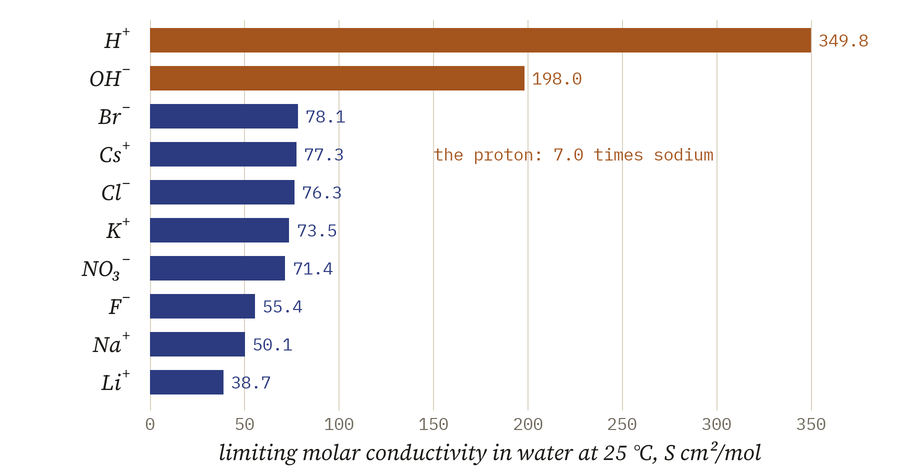
Then there is the hydrogen ion, five to seven times faster than any of them. A bare proton does not exist in water — it is bound to a water molecule as , which is about the size of a sodium ion with its shell and ought to move like one. Hydroxide is anomalous in the same way, by a factor of about three.
A quick estimate shows how large the discrepancy is. Taking sodium's 50.1 as the expected value for a comparable hydrated species, the proton's 349.8 is a factor of 7.0 too high. In terms of the diffusion coefficient, the proton would have to be about seven times smaller than a water molecule to move that fast while pushing through water, which is impossible.
Theodor Grotthuss had the resolution in 1806, before anything else in this chapter existed. The charge moves without the atoms moving far. Picture a chain of water molecules linked by hydrogen bonds: the molecule at one end gives up a proton to its neighbour, which gives up one of its own to the next, and so on. Each atom shifts by a fraction of an ångström while the charge travels the length of the chain. Nothing has to be dragged through the liquid.
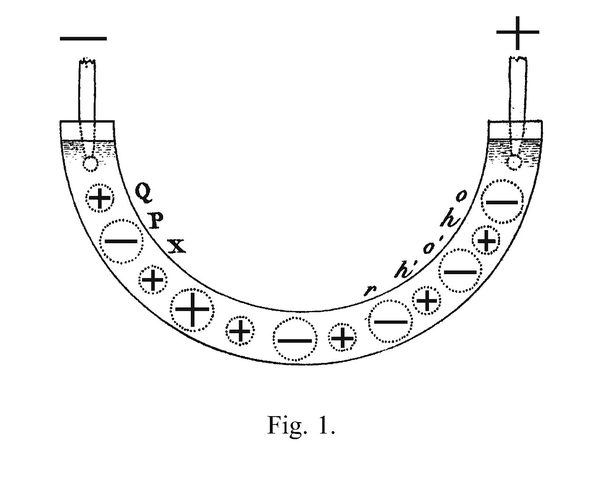
Simulations in the 1990s by Dominik Marx and Michele Parrinello showed the mechanism in detail, and also why the question of what exactly hops has stayed open. The excess proton is sometimes centred on one molecule with three neighbours attached, sometimes shared equally between two, and the structures interconvert within picoseconds — so the species is a continuum rather than one of the two canonical ions that textbooks name. The hopping is agreed; the hopper is not.
The same mechanism is why a pH electrode responds in seconds, why acid-catalysed reactions proceed as fast as they do, and why proton transport in a fuel-cell membrane can approach that in water. It is also a case where an 1806 hypothesis, abandoned as unfounded, turned out to be the right picture.
Chapter IV
Acidity as a Relation
One conceptual tidying belongs here. Arrhenius's definition — an acid releases hydrogen ions in water — makes acidity a property a substance has, and works only in water. Johannes Brønsted and Thomas Lowry, independently in 1923, redefined it as a transfer: an acid donates a proton to a base. Acidity becomes a relation between a pair, every acid has a conjugate base, and the same substance can act as either depending on what it meets — water being the standard example, since it both donates and accepts.
The practical scale, meanwhile, had already been fixed by Søren Sørensen in 1909, working on enzymes at the Carlsberg brewery's laboratory and needing to record hydrogen ion concentrations spanning fourteen orders of magnitude. He defined the logarithmic exponent that became pH, and defined it operationally — as what a particular electrochemical measurement yields. That caution was better judged than he can have known: the quantity pH purports to report, the activity of a single ionic species, turns out not to be thermodynamically measurable at all, which is the open problem above.