Skip to content
Field Atlas

Atlas / Chemistry / The Environment Thread

Field · Emerged 1957 – 2020

Aquatic Chemistry

What fixes the composition of natural water, and why does the ocean's acidity barely move when the atmosphere's carbon dioxide rises — until it does?

5 chapters9 min read6 turning points2 open problems

Branched from
Ions in Solution + Geochemistry
Branched into
Not yet surveyed past here
Figures
Hans Suess, Roger Revelle, Lars Gunnar Sillén, Werner Stumm, James Morgan, Philip Froelich, John Martin, Ken Caldeira, Michael Wickett, Richard Feely

In brief

Seawater is not simply salty water. It is a buffered solution whose acidity is held within about a tenth of a pH unit over the whole ocean, and the thing holding it is the carbonate system: dissolved carbon dioxide, bicarbonate and carbonate in equilibrium with each other and with the calcium carbonate of shells and sediments. Roger Revelle and Hans Suess asked in 1957 how much of the carbon dioxide being added to the atmosphere this system would take up, and the answer turned out to be the most consequential number in the field.

The buffer makes the ocean absorb about twenty times more carbon dioxide than plain dissolution would. It also stops well short of absorbing all of it, because the reaction consumes carbonate ion and there is a limited supply — so a one per cent increase in the ocean's total carbon requires a ten per cent increase in the pressure of carbon dioxide above it. That factor of ten is why carbon dioxide accumulates in the air rather than vanishing into the sea, and it is the reason the Keeling curve exists to be measured.

The same reaction says what the cost is. Carbon dioxide is taken up by converting carbonate into bicarbonate — which means the ocean absorbs the gas by spending the ion that shells are built from. Surface ocean pH has fallen by about 0.1 units since the industrial revolution, a 26 per cent rise in hydrogen ion concentration, and the carbonate ion concentration has fallen by roughly a sixth. Both numbers follow from one equation, and the second is the one that matters to anything with a shell.

Key ideas

Total alkalinityEnters 1970 – 1981

The charge balance of the weak-acid anions in a water sample, which is unchanged by adding or removing carbon dioxide. Because it is conserved under the reaction of interest, it is the right master variable: fix alkalinity and any one other carbonate quantity, and the whole system is determined.

Revelle factorEnters 1957

The fractional change in the partial pressure of carbon dioxide produced by a given fractional change in the water's total dissolved carbon. About ten in modern surface water, and rising as carbon accumulates, so the ocean becomes a less efficient sink the more it absorbs.

Saturation stateEnters 1999 – 2015

The product of the calcium and carbonate ion concentrations divided by the solubility product of the mineral, written Ω\Omega. Above one a shell is stable, below one it dissolves, and the depth at which the transition occurs moves upward as carbon dioxide is absorbed.

Redox ladderEnters 1979 – 1990

The sequence in which oxidants are consumed as organic matter is respired: oxygen, then nitrate, then manganese and iron oxides, then sulphate, then carbon dioxide. The order is the order of free energy yield, and it appears as visible layers in a sediment core.

Surface complexationEnters 1970 – 1981

Binding of a dissolved ion to the hydroxyl groups on a particle's surface, treated as a chemical equilibrium with its own constant. It is why most of a trace metal in a river is on the suspended solids rather than in solution, and why a change of pH releases it.

Limitation by a trace metalEnters 1988 – 2004

A nutrient present at parts per trillion can limit productivity as effectively as one present at parts per million. Iron is insoluble in oxygenated seawater, arrives mostly as windblown dust, and leaves large regions of the ocean with unused nitrate and phosphate.

Chapter I

Why the Ocean Is Not Just Salty Water

The pH of the open ocean lies between about 7.8 and 8.3 everywhere, at every depth, in every basin. That is a remarkably narrow range for a body of water receiving rivers, rain, volcanic gas, decaying organic matter and dissolving rock, and it is not an accident of mixing. It is a buffer.

The buffer is the carbonate system: dissolved carbon dioxide, bicarbonate ion and carbonate ion, interconverting, and in contact with solid calcium carbonate in shells and sediments. In surface seawater the proportions are lopsided in a way that matters:

SpeciesConcentration (µmol/kg)Share of total carbon
Bicarbonate, HCO₃⁻~1,87089%
Carbonate, CO₃²⁻~22010%
Dissolved CO₂~100.5%

The dissolved gas is half a per cent of the carbon present. Almost all of the ocean's carbon is in ionic forms, which is why the sea holds roughly fifty times as much carbon as the atmosphere, and why the question of how much more it will hold is not a solubility calculation.

Lars Gunnar Sillén proposed in 1961 that seawater's whole composition should be calculated, as the equilibrium state of water in contact with the minerals of its own sediments. The strong form of the claim was wrong — silicate reactions are too slow and biology moves too much material — but the move mattered more than its accuracy, because it turned the composition of the ocean from a table of measurements into something that required explanation.

Werner Stumm and James Morgan supplied the working apparatus in 1970, and its central device is a choice of variable. Adding carbon dioxide to seawater changes the pH, the carbonate, the bicarbonate and the total carbon all at once, which makes bookkeeping awkward. Total alkalinity — the charge balance of the weak-acid anions — does not change at all, because carbon dioxide is electrically neutral and the protons it releases are taken up by the anions it creates. So alkalinity is conserved under the reaction of interest, and fixing it plus any one other carbonate quantity determines the entire system. Almost all practical work in the field runs on that fact.

Chapter II

The Thermodynamic Ladder

The second organising idea concerns not acidity but electrons, and it is visible to the eye.

Philip Froelich and colleagues analysed the water held between the grains of a sediment core in 1979, centimetre by centimetre, and found the oxidants being consumed in a strict order. Oxygen disappears first, within millimetres of the surface where organic matter is plentiful. Then nitrate. Then manganese oxides, then iron oxides, then sulphate — and finally, when all of those are gone, carbon dioxide itself, reduced to methane.

The order is the order of free energy released per electron transferred. An organism that respires with oxygen gets more energy than one using nitrate, which gets more than one using sulphate, so each oxidant is used until it runs out before the next is touched. A thermodynamic table, several pages of standard potentials from electrode potentials, appears in nature as a stack of coloured bands a few centimetres thick, with a distinct microbial community living in each.

The consequence is that redox potential is a second master variable alongside pH, and the pair of them determines what dissolved form an element takes — which is Pourbaix's diagram applied to mud. It is why iron is mobile in a waterlogged soil and immobile in a drained one, why arsenic is released from aquifer sediments when the oxygen is used up, and why phosphate stored in lake sediments returns to the water when the lake bottom goes anoxic.

Chapter III

Iron at Parts Per Trillion

Large tracts of the Southern Ocean, the equatorial Pacific and the subarctic Pacific carry nitrate and phosphate that the plankton never use. On any ordinary account of nutrient limitation that should not happen.

John Martin applied the contamination-free methods that Patterson had developed for lead, described in geochemistry, and found the reason. Dissolved iron in those regions is present at a fraction of a nanomole per litre — parts per trillion. Iron(III) is almost insoluble in oxygenated water at seawater pH, the open ocean is far from any source of dust, and so the plankton are starved of a metal while swimming in nitrate.

The hypothesis was testable in an unusually direct way, and was tested: patches of open ocean several kilometres across were fertilised with iron sulphate, with a tracer added to follow the patch, and the plankton bloomed. These are among the very few controlled experiments ever performed on an ocean. What they did not show is the thing the experiments were widely expected to settle — whether the carbon fixed is exported to the deep sea and stays there. The export measured was small, variable and extremely hard to quantify, which is why the question of iron fertilisation as a carbon removal method remains contested in exactly the way the blooms themselves do not.

Martin's finding also sharpened a problem that remains open. If free iron(III) is insoluble, the iron that is in solution must be held by something, and it is: over ninety-nine per cent of dissolved iron in seawater is bound to organic ligands. Their binding strengths can be titrated. What they actually are is mostly unknown.

Chapter IV

A Closer Look: The Buffer That Spends the Shells

Roger Revelle and Hans Suess asked in 1957 how much of the carbon dioxide being emitted the ocean would absorb. The arithmetic has three steps and each one says something different.

Step one: the buffer multiplies the uptake. Without any chemistry, carbon dioxide would simply dissolve according to Henry's law. Surface seawater holds about 10 µmol/kg of dissolved CO₂ at present; double the pressure above it and that becomes 20, an increase of 10 µmol/kg.

But the dissolved gas does not stay as gas. It reacts with the carbonate already present:

CO2+H2O+CO32−⟶2 HCO3−.\mathrm{CO_2} + \mathrm{H_2O} + \mathrm{CO_3^{2-}} \longrightarrow 2\,\mathrm{HCO_3^{-}}.

Each carbon dioxide molecule that enters is converted into bicarbonate, which clears the way for another. The Revelle factor measures how efficiently: it is the fractional change in CO₂ pressure per fractional change in total dissolved carbon, and it is about 10 in modern surface water. So doubling the pressure above the water requires the total carbon to rise by

ΔDIC=DICR=2,10010=210 μmol/kg.\Delta \mathrm{DIC} = \frac{\mathrm{DIC}}{R} = \frac{2{,}100}{10} = 210\ \mathrm{\mu mol/kg}.

Twenty-one times what plain dissolution would give. This is why the ocean holds most of the carbon — it has absorbed roughly a quarter of all fossil carbon dioxide emitted, and without the carbonate reaction it would have taken up almost nothing.
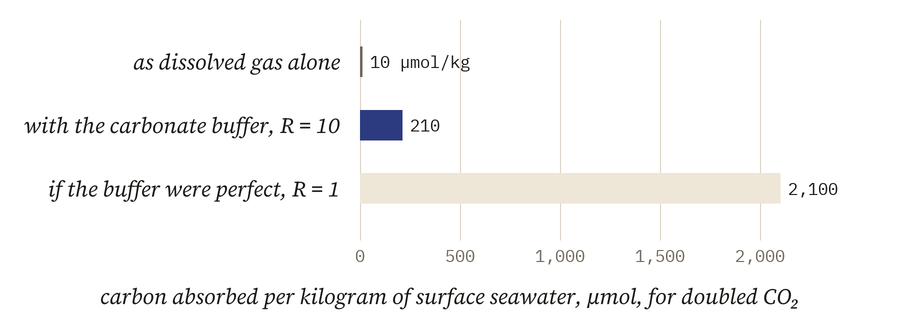
Three bars of carbon absorbed per kilogram of seawater for doubled CO2, 10 as dissolved gas alone, 210 with the carbonate buffer and 2,100 if the buffer were perfect.
Step one and step two of the Revelle arithmetic. The carbonate buffer lets seawater take up twenty-one times what dissolution alone would, and a tenth of what a perfect buffer could.Drawn for Field Atlas from the numbers above · Field Atlas original · Source

Step two: the buffer is not free, and it weakens. If the buffer were perfect — every added molecule converted, R=1R = 1 — the ocean would absorb 2,100 µmol/kg for a doubling instead of 210. The factor of ten is the shortfall, and it exists because the reaction consumes carbonate ion, of which there is only 220 µmol/kg. The supply is the constraint.

And it gets tighter. As carbon accumulates, carbonate is consumed, so the next increment is buffered less well and RR rises — from about 8 in pre-industrial surface water to around 10 now, heading to 15 and beyond. The ocean becomes a worse sink the more it absorbs, which is a positive feedback with no threshold and no drama, just a slowly worsening exchange rate.

Step three: the same equation is the damage. Look again at what the reaction consumes. The ocean absorbs carbon dioxide by spending carbonate ion, and carbonate ion is what shells are made of. The two are not separate phenomena to be weighed against each other; they are one equation read twice.
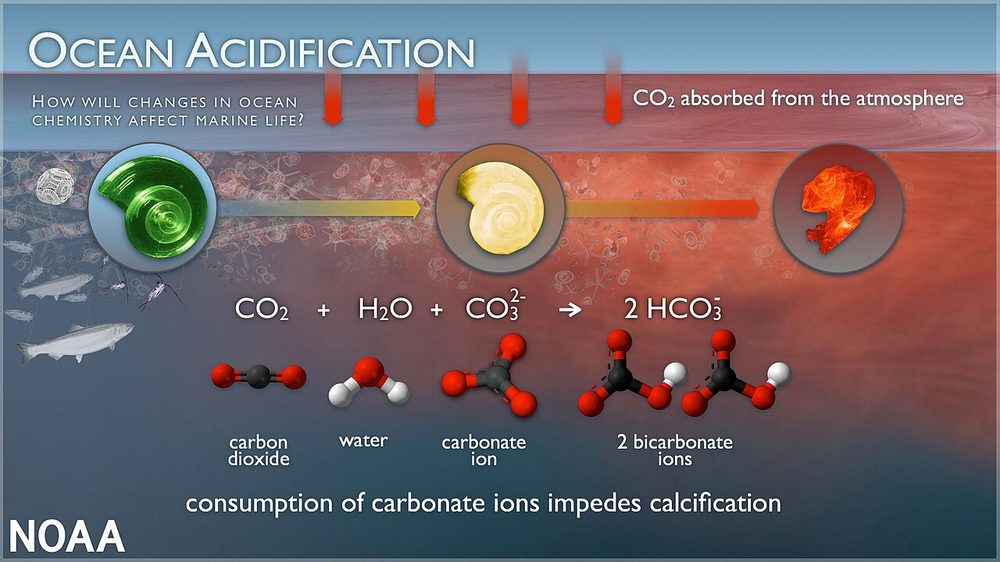
An illustration of the reaction of carbon dioxide, water and carbonate ion to two bicarbonate ions, with shelled sea creatures above it.
The reaction that buffers the ocean is the one that takes carbonate away from shell-builders: CO₂ + H₂O + CO₃²⁻ → 2 HCO₃⁻.NOAA · Public domain · Source

The numbers, since 1750:

QuantityChange
Surface pH8.2 → 8.1
Hydrogen ion concentration+26%
Carbonate ion concentrationabout −16%
Aragonite saturation state Ω\Omega~3.5 → ~2.9

The pH figure looks small and the hydrogen ion figure does not, and they are the same measurement: a drop of 0.1 in a logarithm is a factor of 100.1=1.2610^{0.1} = 1.26.

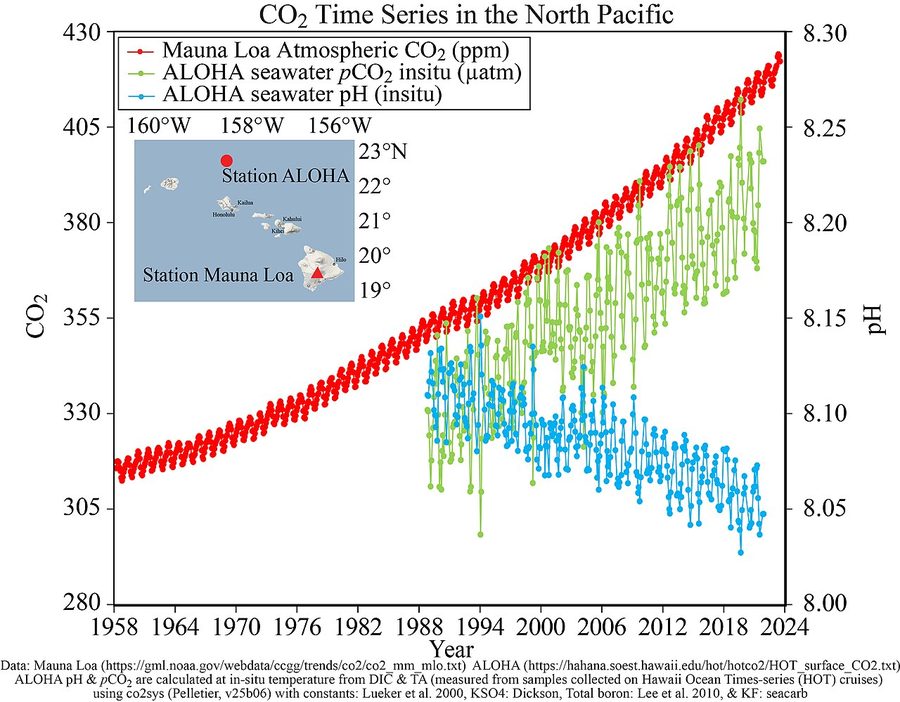
A chart from 1958 to 2024 of rising atmospheric CO2 at Mauna Loa, rising seawater CO2 at station ALOHA, and falling seawater pH.
Carbon dioxide in the air at Mauna Loa and in the sea at station ALOHA off Hawaii, rising together, while the seawater pH falls.NOAA Pacific Marine Environmental Laboratory · Public domain · Source

The quantity that decides whether a shell survives is the saturation state,

Ω=[Ca2+][CO32−]Ksp,\Omega = \frac{[\mathrm{Ca^{2+}}][\mathrm{CO_3^{2-}}]}{K_{\mathrm{sp}}},

which is above one where carbonate is stable and below one where it dissolves. Calcium does not change; carbonate does. Ω\Omega for aragonite — the form corals and pteropods use, more soluble than calcite — has already fallen from about 3.5 to about 2.9 in surface water, and because carbonate solubility increases with pressure and with the carbon dioxide released by respiration, there is a depth below which Ω<1\Omega < 1 everywhere. That horizon has risen by tens to over a hundred metres in parts of the ocean. In cold polar surface water, where carbon dioxide is more soluble to begin with, Ω\Omega is projected to fall below one this century on high-emissions trajectories — surface water in which an aragonite shell is thermodynamically unstable.

The practical form of this reached shellfish hatcheries on the Pacific coast of North America from 2007, when larval oysters began failing in water upwelled from depth with low saturation. The hatcheries now monitor the carbonate chemistry of their intake and buffer it, which is this calculation run as a production control.

Chapter V

Water as the Reservoir That Records

The thread's three atmospheric fields deal with a reservoir that turns over in days to centuries. The ocean turns over in a thousand years and the sediments in millions, so water is where the record accumulates — which makes aquatic chemistry both the slowest-responding part of the system and the part that remembers.

It is also where the thread's arguments converge. The weathering thermostat of geochemistry delivers its alkalinity here. The carbon dioxide whose atmospheric lifetime atmospheric chemistry cannot assign a single number to is removed, over ten thousand years, by the reactions in this field. And the one quantity that would say how fast — the alkalinity budget — does not currently balance, by a margin comparable to the size of the interventions now proposed to accelerate it. A field whose central number was computed in 1957 is still unable to close its own accounts.

Applications

Where it is used

  • Drinking water

    Whether the pipe dissolves is a chemistry decision

    A lead service pipe is tolerable only because its interior carries a scale of insoluble lead compounds, and whether that scale stays put depends on the water's pH, alkalinity, chloride-to-sulphate ratio and added orthophosphate. Change the source water without adjusting the treatment and the scale dissolves, which is what happened in Flint, Michigan in 2014. The underlying chemistry is the passive film of corrosion applied to a pipe carrying something people drink, and the control variable is a calculated saturation index rather than a measurement of lead.

    › Sources (1)
    • Pieper, K. J., Tang, M. & Edwards, M. A. (2017). Flint water crisis caused by interrupted corrosion control. Environmental Science and Technology 51: 2007–2014.
  • Fisheries and conservation↗ Biology · Conservation Biology

    The shell is made of the ion the ocean is spending

    Oysters, corals, pteropods and coccolithophores build structures from calcium carbonate, and the saturation state that determines whether those structures are stable falls as carbon dioxide is absorbed. Hatcheries on the Pacific coast of North America recorded larval oyster failures from 2007 traceable to upwelled water of low saturation, and now monitor the chemistry and buffer their intake. The ecological consequences are the subject of conservation biology.

    › Sources (1)
    • Barton, A. et al. (2012). The Pacific oyster, Crassostrea gigas, shows negative correlation to naturally elevated carbon dioxide levels. Limnology and Oceanography 57: 698–710.
  • Carbon accounting

    A quarter of the emissions, and where they went

    The ocean has absorbed roughly a quarter of all carbon dioxide emitted from fossil fuels, and the amount is known not from models alone but from measurement: the anthropogenic component can be separated from the natural background using the carbonate system together with tracers of how long the water has been out of contact with the air. Repeating the global survey of ocean carbon every decade is how the sink is audited, and it is the largest sustained analytical chemistry programme in existence.

    › Sources (1)
    • Gruber, N. et al. (2019). The oceanic sink for anthropogenic CO₂ from 1994 to 2007. Science 363: 1193–1199.

Open problems

Where the map runs out

Open

The alkalinity budget does not close

Open as of 2026; river, sediment and carbonate-production terms disagree, and the discrepancy is of the same size as proposed interventions.

Alkalinity enters the ocean from weathering delivered by rivers and leaves when carbonate is buried, and the two are supposed to balance over tens of thousands of years. The measured terms do not balance: the production and dissolution of carbonate in the upper ocean, the contribution of dissolution above the saturation horizon, and the alkalinity released from sediments are each uncertain by a large fraction. This now matters practically, because the proposal to remove carbon dioxide by adding alkali to the sea requires measuring an addition smaller than the existing uncertainty.

Why it is hard

Alkalinity must be measured to a few parts in ten thousand to see a signal against a background of 2,300 microequivalents per kilogram, over an ocean that mixes on century timescales. The carbonate produced by organisms is partly dissolved again within the water column by processes that leave no distinctive trace, so the gross fluxes cannot be separated from the net.

What resolving it unlocks

Whether ocean alkalinity enhancement can be verified well enough to be paid for, how fast the ocean will neutralise the carbon dioxide already emitted, and the interpretation of past carbon cycle events recorded in sediments.

› Sources (2)
  • Middelburg, J. J., Soetaert, K. & Hagens, M. (2020). Ocean alkalinity, buffering and biogeochemical processes. Reviews of Geophysics 58: e2019RG000681.
  • Ho, D. T. et al. (2023). Monitoring, reporting and verification for ocean alkalinity enhancement. State of the Planet 2-oae2023.

Open

What the organic ligands binding the metals are

Open as of 2026; binding strengths are measured routinely, the molecules responsible are identified only in part.

More than 99 per cent of the dissolved iron in seawater, and most of the copper, is bound to organic ligands rather than present as free ion — which is why any iron is in solution at all, since the free ion would precipitate. The binding strengths are measurable by titration. The identities of the ligands are mostly not known: some are bacterial siderophores, some are breakdown products of cells, and the rest are inferred from their constants alone. Bioavailability depends on which, so productivity cannot be predicted from a total concentration.

Why it is hard

The ligands are present at sub-nanomolar concentrations in a matrix of 35 grams per litre of salt, which defeats most separations, and the operationally defined classes from titration need not correspond to single compounds. This is the marine case of the speciation problem recorded under coordination chemistry.

What resolving it unlocks

How much iron the ocean can hold, how dust deposition translates into productivity, and whether a fertilisation or a changing dust supply will have the effect calculated from total iron. Copper speciation similarly decides whether the metal is a nutrient or a toxin.

› Sources (2)
  • Gledhill, M. & Buck, K. N. (2012). The organic complexation of iron in the marine environment. Frontiers in Microbiology 3: 69.
  • Boiteau, R. M. et al. (2016). Siderophore-based microbial adaptations to iron scarcity. PNAS 113: 14237–14242.

Further reading

  1. Stumm, W. & Morgan, J. J. (1996). Aquatic Chemistry, 3rd edition. Wiley.

    The book that made the field a field; every calculation is set out so it can be redone.

  2. Zeebe, R. E. & Wolf-Gladrow, D. (2001). CO₂ in Seawater: Equilibrium, Kinetics, Isotopes. Elsevier.

    The carbonate system in full, including the kinetics usually assumed away.

  3. Sarmiento, J. L. & Gruber, N. (2006). Ocean Biogeochemical Dynamics. Princeton University Press.

    Where the chemistry is joined to the circulation, which is what turns a local equilibrium into a global sink.