Chapter I
Most of the Atoms Are on the Outside
Michael Faraday reduced a gold salt with phosphorus in 1857 and got a clear ruby-red fluid. He established that the gold in it was metallic and finely divided rather than chemically combined, noted that adding salt turned the liquid blue and that gelatin reversed the change, and kept the samples. They are still at the Royal Institution and they are still red.
Nothing about the gold was different. The pieces were small, and smallness turned out to be sufficient to change the colour of a metal.

The reason is a ratio that behaves badly. Divide a solid finer and the surface grows relative to the volume as the inverse of the diameter — gently while the pieces are large, and then not gently at all. For gold, where neighbouring atoms are 0.288 nm apart:
| Particle diameter | Fraction of atoms at the surface |
|---|---|
| 100 nm | 1.7% |
| 10 nm | 16% |
| 5 nm | 31% |
| 3 nm | 47% |
| 2 nm | 64% |
Below ten nanometres the surface stops being a correction to a bulk solid and becomes most of the material. And since surface atoms have fewer neighbours, higher energy and different reactivity, every quantity a chemist is accustomed to treating as a property of a substance becomes a function of a dimension instead. Philippe Buffat and Jean-Pierre Borel measured the extreme case in 1976: gold, which melts at 1,064 °C in a crucible, melts below 400 °C at two and a half nanometres.
So a nanomaterial is not a small piece of a known substance. It is closer to a very large molecule, whose properties depend on how many atoms it has.
Chapter II
Carbon Found Three New Forms
The element with the largest literature acquired two new allotropes in six years, both by looking at soot properly.
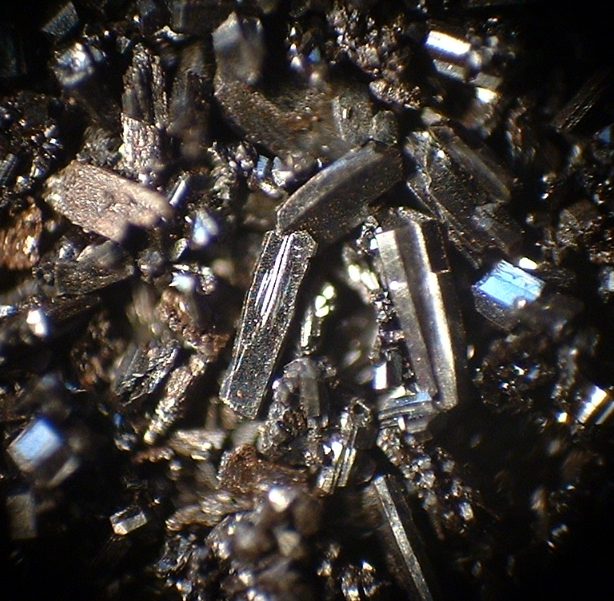
Harold Kroto, Richard Smalley, Robert Curl, James Heath and Sean O'Brien were vaporising graphite with a laser in 1985 to study carbon chains in interstellar space, and found an unexpectedly intense mass-spectral peak at exactly sixty carbon atoms. Their proposal — a closed cage of twelve pentagons and twenty hexagons, the pattern of a football — was an inference from one number, and it was disputed for five years because a mass spectrum does not show a structure. The argument ended when Wolfgang Krätschmer and Donald Huffman found that an ordinary carbon arc makes the stuff by the gram, at which point it could be crystallised and settled.
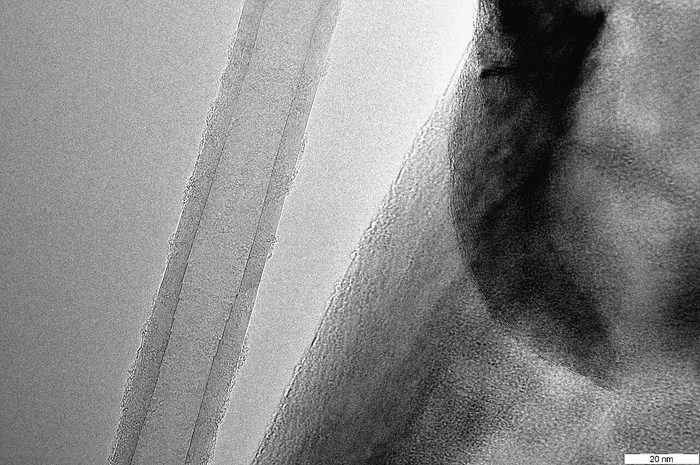
Sumio Iijima looked at arc soot by electron microscopy in 1991 and found concentric cylinders of graphitic carbon, nanometres across and micrometres long. Carbon nanotubes have the highest measured tensile strength of any material, above a hundred gigapascals, and they conduct along their length as either a metal or a semiconductor — determined not by composition, which is pure carbon, but by the angle at which the sheet is notionally rolled up. Electronic character following from geometry is the same point the two-dimensional case makes in topological matter.
Chapter III
Colour by Size, and Shape by Ligand
The semiconductor case is where the field's chemistry became exact.
Alexei Ekimov noticed in 1981 that semiconductor crystallites grown inside a glass absorbed at wavelengths depending on their size, and Louis Brus found the same in solution. The cause is confinement: in a crystal smaller than the natural separation of an electron and its hole, the carriers are squeezed into a smaller box and their energies rise, so the band gap widens as the particle shrinks.
Turning that into a usable material was a synthetic problem, because a mixture of sizes gives a mixture of colours. Moungi Bawendi's group solved it in 1993 with a method whose logic is worth stating plainly: inject the precursors rapidly into a hot coordinating solvent, so that the concentration spikes above the nucleation threshold, collapses as nuclei form, and then stays in the range where existing particles grow but new ones cannot start. All the particles are born within the same instant and grow for the same time, so they end up the same size. Separating nucleation from growth in time is the whole technique, and Ekimov, Brus and Bawendi shared the 2023 Nobel Prize for the work.
Once size was controlled, shape followed, and the lever was the ligand shell. A molecule bound to the growing crystal binds some faces more strongly than others and slows their growth, so the particle elongates, flattens or facets. Xiaogang Peng and others showed that rods, plates, cubes and branched forms come from the same reagents with a different surfactant. This is a genuinely chemical kind of control — a coordination preference, of the sort set out in coordination chemistry, deciding a crystal's morphology.
The same solution-processing instinct produced an unexpected photovoltaic. Akihiro Kojima and Tsutomu Miyasaka used a lead halide perovskite as a light absorber in 2009 and got 3.8% efficiency; replacing the liquid electrolyte with a solid hole conductor in 2012 took it past 10%; certified efficiencies passed 25% within a decade. Nothing else has improved that fast. The material is spun on from solution a hundred degrees below silicon's processing temperature, which should fill it with the defects that would destroy a conventional semiconductor — and it works anyway, because its defect levels fall outside the gap rather than inside it. A material that tolerates being made badly, which is a design criterion the defect chemistry of silicon never permitted.
Chapter IV
A Closer Look: What Changes at Three Nanometres
Take a gold sphere three nanometres across and count what is in it. Gold is face-centred cubic with a lattice parameter of 0.408 nm and four atoms per cell, so each atom occupies
The sphere's volume is nm³, so it contains
Of those, the fraction within one atomic layer of the surface is with nm, which gives 47% — about 390 surface atoms out of 830. Half the material is interface. There is no meaningful bulk to speak of, and a quantity like melting point, which is defined by a competition between bulk and surface free energy, has no reason to keep its bulk value. It does not: the measured melting point falls from 1,337 K to under 700 K by two and a half nanometres.
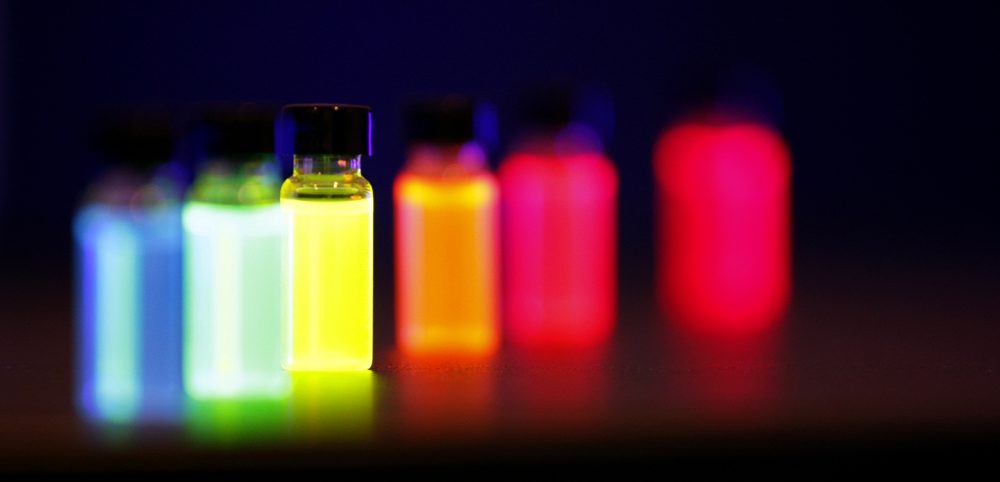
Now the semiconductor case, where the effect is used rather than merely observed. Cadmium selenide has a bulk band gap of 1.74 eV, corresponding to 713 nm — just past the red end of the visible. Confining it raises the gap, and because the confinement energy of a particle in a box scales as , halving the diameter quadruples the shift. Measured emission wavelengths:
| Diameter | Emission | Colour |
|---|---|---|
| 2.1 nm | 510 nm | green |
| 3.0 nm | 545 nm | yellow-green |
| 4.0 nm | 590 nm | orange |
| 5.5 nm | 620 nm | red |
| 6.5 nm | 645 nm | deep red |
| bulk | 713 nm | invisible |
One compound, one crystal structure, the entire visible spectrum covered by changing a diameter by a factor of three. It is worth noting honestly that the simple effective-mass formula gets this trend right and the magnitude wrong — it over-predicts the shift badly below about three nanometres, because a particle of 800 atoms is not well described by treating the electron as a free carrier in a dielectric continuum.
The third number explains why the synthesis has the form it does. Differentiating the confinement term, a relative spread in radius produces a relative spread in confinement energy of about . A display needs an emission linewidth of roughly 30 nm at 550 nm, which is 5% in wavelength; the confinement term is most of the photon energy's variable part, so the particles must be uniform to within a few per cent in diameter — which for an 830-atom particle means within about a single atomic layer.
That is an extraordinary requirement to place on a precipitation from solution, and it is why the procedure is an injection into a hot flask rather than a mixing of two reagents. It is also exactly why the field's scale-up problem, recorded above, is severe. The method depends on the mixture becoming homogeneous faster than nuclei form. In ten millilitres that takes well under a second and the condition holds; in ten litres it does not, so nucleation continues while the first particles are already growing, the distribution broadens, and nothing downstream can narrow it again, because a nucleus cannot be unmade. The gap between a flask and a factory is, in this field, a mixing time.
Chapter V
Small, and Then What?
The chemistry of making these materials is in good order. Size is controlled to an atomic layer, shape to a facet, composition to a shell-by-shell structure. What is not in good order is everything on either side of the synthesis.
On the inward side, the surface is largely uncharacterised. For a three-nanometre particle the ligand shell is a substantial share of the mass and effectively all of the chemistry — it sets solubility, stability, electronic passivation and catalytic behaviour — and how many ligands there are, what they bind and how fast they come and go is established for a few model systems and assumed for the rest. The electronic losses that keep quantum-dot devices below their limits are surface recombination, so this is not a question of tidiness.
On the outward side is scale, and the mixing argument above is most of the reason. The applications that have arrived are the ones that need grams and tolerate variation: the red line of a rapid diagnostic test, which is Faraday's colloid read by eye; the few grams of platinum in a catalytic converter, dispersed so finely that almost every atom is working surface; the conversion film in a quantum-dot display. The ones that have not arrived mostly need tonnes.
Which leaves the thread's recurring difficulty in a new form. Solid-state chemistry cannot predict a route to a compound it can compute; porous frameworks cannot predict which framework a recipe will give; and here a recipe that works cannot be relied on to work at a different volume. In each case the obstacle is that the product is selected during nucleation, in a few nanometres and a few milliseconds, which is the part of the process nobody can see.