Skip to content
Field Atlas

Atlas / Chemistry / The Reaction Thread

Field · Emerged 1955 – 2021

Reaction Dynamics

What happens during a single collision between two molecules, and can a reaction be watched as it occurs rather than inferred from what is left?

4 chapters7 min read6 turning points1 open problem

Branched from
Transition State Theory
Branched into
Not yet surveyed past here
Figures
Edward Taylor, Sheldon Datz, Dudley Herschbach, Yuan Tseh Lee, John Polanyi, Daniel Neumark, Ahmed Zewail, F. Fleming Crim, Richard Zare

In brief

Everything in classical kinetics is an average. A rate constant describes 102010^{20} molecules in a flask at a distribution of speeds, orientations and internal energies, colliding at random. Reaction dynamics asks the question underneath: what happens in one encounter, between molecules in known quantum states, approaching at a known speed and angle.

Answering it required two inventions. Crossed molecular beams, developed from the 1950s, let two thin streams of molecules intersect in a vacuum so that each product is formed in a single collision and can be detected by the direction and speed with which it flies off. The result is a picture of the mechanism no rate law could give: whether the reagents rebound or pass through each other, how the released energy is divided between recoil and vibration, which collisions work and which bounce. Then, in the late 1980s, Ahmed Zewail realised that laser pulses had become shorter than the time a bond takes to break — a hundred femtoseconds — so a reaction could be started with one pulse and photographed with a second. The transition state that transition state theory had treated as an inference became something to take a spectrum of.

Key ideas

Single-collision conditionsEnters 1955 – 1972

In crossed beams at low enough density, a product molecule has been formed by exactly one collision and has not collided again before detection. Everything measured therefore refers to one event, not to an average over a thermal distribution.

Angular distributionEnters 1955 – 1972

Where the products go. Forward scattering means the reagents passed through each other in a glancing encounter; backward scattering means they rebounded. The pattern distinguishes a direct collision from one that forms a complex living long enough to forget which way it came in.

Energy disposalEnters 1958 – 1972

How the energy released by a reaction is divided between translation, vibration and rotation of the products. It is far from statistical, and it is a direct readout of the shape of the potential energy surface near the exit.

Femtosecond timescaleEnters 1987 – 1999

10−1510^{-15} s. A bond vibrates with a period of 10 to 50 fs and separating fragments clear each other in about 100 fs, so a pulse shorter than that can resolve the act of breaking.

Mode-selective chemistryEnters 1990 – 2004

Putting energy into a specific vibration rather than heating the molecule, and finding that the reaction outcome depends on which vibration — so the energy has not had time to redistribute, and a bond can be chosen.

Reactive resonanceEnters 1988 – 2018

A transient quantum state, trapped for a few vibrational periods near the transition state, which makes the reaction probability spike at particular collision energies. It is the clearest evidence that a reaction is a wave phenomenon rather than a trajectory.

Chapter I

One Collision at a Time

A rate constant is an average over everything. In a flask the molecules have a spread of speeds, every possible mutual orientation, a distribution of vibrational and rotational states, and they collide repeatedly. Whatever the mechanism does in detail is washed out before the measurement is made.

The way to see underneath it is to arrange for exactly one collision. Two beams of molecules, each a few centimetres wide, are crossed in a chamber evacuated so hard that a molecule's mean free path is metres; where the beams intersect, collisions occur; and the products fly off and are detected before they can hit anything else. Edward Taylor and Sheldon Datz did it first in 1955 with potassium and hydrogen bromide, detecting the product on a hot wire. Dudley Herschbach spent the 1960s turning it into a method, and Yuan Tseh Lee replaced the alkali-specific detector with a mass spectrometer, which freed the technique from the handful of reactions a hot wire can see.

What the measurement gives is the direction and speed of the products, and that turns out to be unexpectedly eloquent. If the products emerge mostly backwards relative to the incoming reagent, the collision was a rebound: the two met head-on, exchanged an atom and recoiled. If they emerge forwards, the reagent passed through in a glancing stripping encounter. And if they emerge equally in all directions, the two stuck together long enough to lose all memory of how they met — a complex, living for many rotations. Three mechanisms, distinguished by where the products go.

John Polanyi measured the complementary quantity: not where the energy went in space but which motion it went into. Fresh product molecules glow in the infrared, and the spectrum of that glow says how the released energy is divided between vibration, rotation and recoil. The division is nothing like thermal. Hydrogen and chlorine put most of the energy into vibration of the new bond; other reactions put it into flinging the fragments apart. The pattern maps directly onto the shape of the potential energy surface — whether the barrier comes early in the approach or late — and the fact that it produced more excited molecules than unexcited ones is a population inversion, which is to say a laser.

Chapter II

A Spectrum of the Saddle Point

The transition state is defined by being unstable, which seems to rule out observing it: a species that survives for less than one vibration cannot be put in a cell and have a spectrum taken. Two methods get at it anyway, from opposite directions.

Daniel Neumark's approach starts from a stable species with the right shape. Many neutral transition states resemble the equilibrium geometry of a corresponding negative ion — the arrangement [F⋯H⋯H]−\mathrm{[F \cdots H \cdots H]^{-}}, for instance, is a bound anion and also approximately the saddle point for fluorine attacking hydrogen. Remove the extra electron with a photon of known energy and measure the kinetic energy of the electron that leaves: the difference reports the energy of the neutral system at the geometry it was created in, which is the transition state. The resulting spectrum shows vibrational structure in a species with no bound vibrations along the reaction coordinate, and in several cases shows sharp features that are not vibrations at all.

Those features are reactive resonances: states in which the system is held near the saddle point for a few vibrational periods, long enough for the wavefunction to interfere with itself, before committing to products. Theory had predicted them for decades. Observing them required beams monochromatic enough that the collision energy is defined to a fraction of a kilojoule, and they appear as a spike in the reaction probability at one particular energy — reported for fluorine with hydrogen deuteride in 2000 and for chlorine with the same partner in 2018, with lifetimes of tens of femtoseconds.

Resonances matter beyond their novelty. A trajectory picture of a reaction — a ball rolling over a pass — cannot produce them, and they are therefore direct evidence that a chemical reaction is a wave phenomenon in which amplitude can be trapped and interfere. They also mean that a rate constant is not always a smooth function of energy, which no form of transition state theory anticipates.

Chapter III

A Closer Look: Why a Hundred Femtoseconds Is the Right Shutter Speed

Watching a bond break requires knowing how long it takes. Two estimates, which agree.

From the vibration. A bond's stretching frequency, expressed as a wavenumber, is typically 1000 to 3000 cm⁻¹. Converting, a vibration at 1000 cm⁻¹ has frequency

ν=1000×2.998×1010=3.0×10¹³ Hz,\nu = 1000 \times 2.998\times10^{10} = 3.0\times10^{13}\ \mathrm{Hz},

so its period is 1/ν=331/\nu = 33 fs. A C–H stretch at 2900 cm⁻¹ has a period of 11 fs. Any process that involves a bond extending must therefore be resolved on a timescale of tens of femtoseconds or it is simply blurred.

From the separation. Suppose a bond breaks and the two fragments fly apart with 50 kJ/mol of relative translational energy — a typical figure. For a fragment of mass 20 atomic units, the energy per molecule is

500006.022×1023=8.3×10⁻²⁰ J,m=20×1.66×10−27=3.3×10⁻²⁶ kg,\frac{50000}{6.022\times10^{23}} = 8.3\times10^{-20}\ \mathrm{J}, \qquad m = 20 \times 1.66\times10^{-27} = 3.3\times10^{-26}\ \mathrm{kg},

giving a speed of

v=2Em=2(8.3×10⁻²⁰)3.3×10−26=2.2×10³ m/s.v = \sqrt{\frac{2E}{m}} = \sqrt{\frac{2(8.3\times10^{-20})}{3.3\times10^{-26}}} = 2.2\times10^{3}\ \mathrm{m/s}.

The fragments must separate by about 2 Å before the bond can be called broken, which takes

t=2×10−102.2×103=9×10⁻¹⁴ s=90 fs.t = \frac{2\times10^{-10}}{2.2\times10^{3}} = 9\times10^{-14}\ \mathrm{s} = 90\ \mathrm{fs}.

Bond breaking takes roughly a hundred femtoseconds. To photograph it, the flash must be shorter than that.
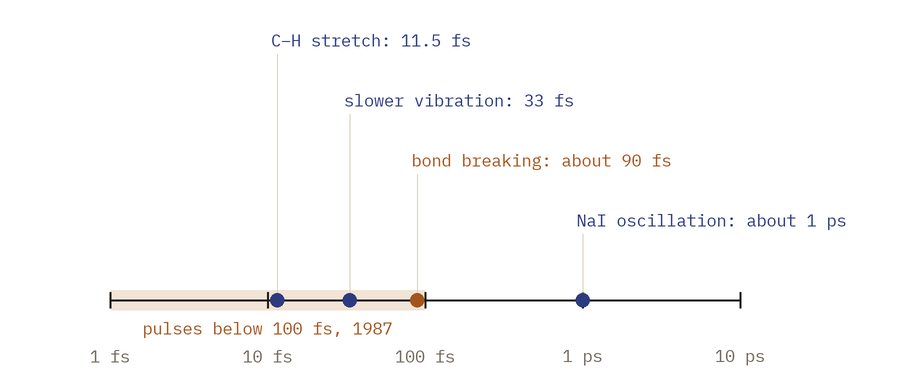
A logarithmic time axis from 1 femtosecond to 10 picoseconds, marking a C–H stretch at 11.5 fs, a slower vibration at 33 fs, bond breaking at about 90 fs and the sodium iodide oscillation at about 1 ps, with the range below 100 fs shaded.
The timescales of the chemistry on one axis. Pulses shorter than 100 fs, available by 1987, are fast enough to catch a bond breaking.Drawn for Field Atlas from the numbers above · Field Atlas original · Source

In 1987 such pulses existed, for the reasons set out under lasers and photonics — mode-locked lasers and chirped pulse amplification had brought durations below 100 fs. Ahmed Zewail put the two facts together: start the reaction with one pulse, probe it with a second at a controlled delay, and vary the delay to assemble the reaction frame by frame. The delay is set by path length, and 100 fs of delay is 30 µm of extra travel, so the clock is a translation stage.
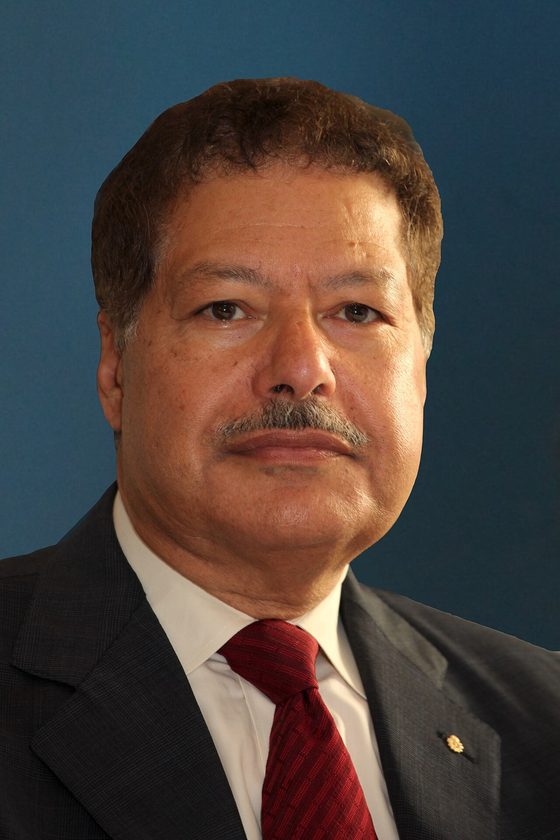
Photograph of Ahmed Zewail in a suit and red tie.
Ahmed Zewail in 2010. He used femtosecond laser pulses to watch bonds break, and won the 1999 Nobel Prize in Chemistry for it.Simon Fraser University · CC BY 2.0 · Source

The results included one that no inference would have produced. In sodium iodide, the excited pair of atoms does not simply fly apart: it separates, is pulled back, separates again, oscillating with a period of about 1 ps and leaking a fraction of its population to dissociation on each outward swing. The reaction was watched hesitating. Daniel Neumark reached the same region a different way, by photodetaching an electron from a stable negative ion whose shape resembles the transition state and recording what the neutral system does at the instant it is created.

So the configuration that transition state theory treats as a thermodynamic abstraction has been given a spectrum, a lifetime and, in several reactions, interference structure — resonances in which the system is briefly trapped near the saddle point, making the reaction probability spike at particular collision energies. A reaction is a wave phenomenon, and at this resolution it looks like one.

Chapter IV

Choosing the Bond, and the Cold Frontier

Two further results have changed what seemed possible.

The textbook assumption was that energy put into a polyatomic molecule spreads among all its vibrations within a picosecond, far faster than the molecule reacts, so only the total energy can matter and selectivity is impossible. F. Fleming Crim and Richard Zare showed that in favourable cases this is false. Excite one particular O–H stretch in a water molecule, and a colliding hydrogen atom attacks that bond rather than the other one, by a large factor. The energy had not had time to redistribute, and the choice of vibration chose the chemistry.

The opposite extreme has opened more recently. Molecules cooled to a few hundred nanokelvin, by the methods of quantum optics, collide so slowly that only a single quantum state is involved and the interaction time is microseconds rather than picoseconds. In 2019 and 2020 the intermediate complex of a four-atom reaction was detected directly in such a system — a species that in an ordinary flask exists for a fraction of a picosecond, held together long enough to be observed. At those temperatures, reaction rates are governed by quantum statistics and can be tuned with a magnetic field, which is about as far from a flask of warm liquid as chemistry has got.

Applications

Where it is used

  • Astrochemistry↗ Physics · Galactic Astronomy

    Reactions that only happen in space

    Interstellar clouds are at 10 K and a few thousand molecules per cubic centimetre, where a collision is a once-in-a-century event and three-body collisions never occur. Beam and trap experiments supply the rate constants for those conditions directly, which is how the chemistry producing the two hundred-odd known interstellar molecules is modelled — and why the discovery that some reactions speed up as the temperature falls mattered.

    › Sources (1)
    • Smith, I. W. M. (2011). Laboratory astrochemistry: gas-phase processes. Annual Review of Astronomy and Astrophysics 49: 29–66.
  • Lasers↗ Physics · Lasers and Photonics

    The chemical laser

    Polanyi's measurements showed that some reactions deposit most of their energy in a single vibration of the product, leaving more molecules in an excited state than in the ground state. That is a population inversion produced by chemistry rather than by pumping, and it is the basis of the hydrogen fluoride and chemical oxygen–iodine lasers, which reach megawatt powers without any electrical supply.

    › Sources (1)
    • Polanyi, J. C. (1961). Proposal for an infrared maser dependent on vibrational excitation. Journal of Chemical Physics 34: 347–348.
  • Combustion and atmosphere

    The rate constants nobody can measure in a flask

    Models of flames and of the atmosphere need rate constants for radical reactions at temperatures and pressures where the species cannot be kept long enough to titrate. Beam and laser methods supply them one elementary step at a time, and the resulting database is what makes a detailed combustion mechanism possible at all — which is where this field feeds back into the networks problem of chemical kinetics.

    › Sources (1)
    • Baulch, D. L. et al. (2005). Evaluated kinetic data for combustion modeling: supplement II. Journal of Physical and Chemical Reference Data 34: 757–1397.

Open problems

Where the map runs out

Open

Exact dynamics for a molecule worth reacting

Open as of 2026; exact quantum treatment is routine for three or four atoms and infeasible beyond about six.

The reactions whose dynamics are understood exactly contain three or four atoms. Solving the quantum dynamics scales exponentially with the number of degrees of freedom, so systems of ten atoms — a small organic molecule — are beyond reach, and the reactions chemists care about have dozens. Mixed approaches treat most degrees of freedom classically, which loses exactly the quantum effects resonance experiments have shown to matter.

Why it is hard

The same dimensional problem that limits electronic structure recurs for nuclear motion, and here there is no analogue of density functional theory to collapse it. A full treatment also needs a potential energy surface over all those coordinates, which must itself be computed point by point or fitted, and the fitting error propagates into the dynamics unpredictably.

What resolving it unlocks

Rate constants and product distributions predicted for reactions nobody has run, including the ones in flames, in the atmosphere and in interstellar clouds, where the conditions cannot be reproduced in a laboratory.

› Sources (2)
  • Guo, H. (2012). Quantum dynamics of complex-forming bimolecular reactions. International Reviews in Physical Chemistry 31: 1–68.
  • Bowman, J. M., Czakó, G. & Fu, B. (2011). High-dimensional ab initio potential energy surfaces for reaction dynamics calculations. Physical Chemistry Chemical Physics 13: 8094–8111.

Further reading

  1. Levine, R. D. (2005). Molecular Reaction Dynamics. Cambridge University Press.

    The standard graduate text, built around what a single collision can be made to reveal.

  2. Zewail, A. H. (2000). Femtochemistry. Journal of Physical Chemistry A 104: 5660–5694.

    A long Nobel review; the best account of how the pulses and the chemistry were matched.

  3. Herschbach, D. R. (1987). Molecular dynamics of elementary chemical reactions. Angewandte Chemie International Edition 26: 1221–1243.

    Crossed beams explained by the person who made them a method.