Swimming
Same problem as the javelin. Opposite decision. The records stand.
- Official
- Aquatics
- Game category
- Performance
- Adjudication
- Measured
- Standing
- Never off
- rule changes
- 5
- comparability break
- 1
- Olympic editions
- 31
- Governing body
- World Aquatics
- Founded
- Fédération Internationale de Natation founded 1908; renamed World Aquatics in 2023.
- Olympic status
- 31 editions
- on the 2028 programme
- Also contested at
- Asian Games
The reference case for this whole site. Polyurethane suits were banned with effect from 2010, and the records set in them were allowed to stand — which is why several are still unbeaten more than fifteen years later. Athletics faced the same situation with the javelin in 1986 and reset the record book. Two governing bodies, the same facts, opposite rulings, and both are visible here on the same page.
The gamewhat it is now · sections 1 to 5
01How it is played
Swim a set distance faster than everyone else. The complication, and the source of nearly every rule, is that three of the four strokes are defined by regulation rather than by physics: a breaststroke swimmer is doing breaststroke because the rulebook says what breaststroke is, and the sport's history is a history of swimmers finding faster motions the definition did not quite exclude.
These figures were entered from the edition named above but have not been checked against its text line by line. Treat them as this site’s reading of the laws, not as a substitute for them.
The object of the race
Reach the finish wall first, having covered the distance in a stroke that satisfies the definition of the event. Freestyle is the exception and is a category rather than a technique — it means any style, which is why the front crawl is universal in it without ever being required.
The pool
A long course pool is 50 m; short course is 25 m, and the two keep separate record lists because a 25 m pool gives twice as many turns and turns are faster than swimming. Backstroke flags hang across the lanes to warn a swimmer on their back that the wall is coming.
- Long course length
- 50 m
- Short course length
- 25 m
- Lanes
- 8 or 10
- Lane width
- 2.5 m
- Backstroke flags
- 5 m from each wall
World Aquatics Competition Rules, swimming (SW) section · FR 2 (facilities) · article not confirmed
Swimwear
Suits must be made of textile, may not cover the neck, and may not extend past the shoulders or the ankles; men's suits may not go above the waist. This specification exists because for a decade there was none, and polyurethane construction produced a run of records that the sport then chose to leave standing.
- Material
- Textile only
- Men's coverage
- Waist to knee
- Women's coverage
- Shoulder to knee
This clause reads this way because of
World Aquatics Competition Rules, swimming (SW) section · BL 8 (swimwear)
Swimmers and officials
One swimmer per lane; relays are four swimmers in sequence. A referee runs the meet, stroke judges walk the deck watching for illegal technique, turn judges stand at each end, and underwater cameras are now used at major meets — which changed what could actually be enforced, and in one case changed the rule instead.
This clause reads this way because of
Format
Heats, then semi-finals for shorter events, then a final of eight. Qualification is on time alone, so a swimmer can win a heat and go out. There is no clock limit and no format decision left to organisers — the distance is the format.
Timing
Touchpads at each end are triggered by the swimmer's own hand, and times are recorded to one hundredth of a second. Where two swimmers register the same hundredth the result is a dead heat, and both are awarded the place — swimming does not break ties by going to a thousandth, on the stated grounds that lane construction cannot be guaranteed accurate to that precision.
- Timing precision
- 0.01 s
- Ties
- Dead heat
Starts and turns
Freestyle, breaststroke and butterfly start from the blocks; backstroke starts in the water. After the start and every turn a swimmer may travel submerged for a limited distance before the head must break the surface — a limit that exists because underwater dolphin kick is faster than any of the surface strokes, and without it the events tend towards being swum underwater.
- Underwater limit after start and turns
- 15 m
- Backstroke start
- In the water
- False starts allowed
- None
This clause reads this way because of
World Aquatics Competition Rules, swimming (SW) section · SW 6 (backstroke) · article not confirmed
Disqualifications
Breaking the stroke definition is the main one: an illegal kick in breaststroke, a non-simultaneous arm recovery in butterfly, rolling past vertical in backstroke other than as part of a turn. Beyond the stroke: a false start, pushing off the bottom, pulling on the lane rope, surfacing beyond the underwater limit, or an early takeover in a relay.
Breaststroke is the exception that proves the rule about enforcement. Swimmers were adding a downward dolphin kick off the walls, underwater video showed it was near universal, and surface officials could not see it. In 2015 the rule was changed to allow one, rather than continuing to disqualify only the swimmers who happened to be caught.
This clause reads this way because of
Deciding the winner
The first legal touch. Records are ratified separately and, unlike athletics with the javelin, marks set under superseded equipment rules were kept — which is why several world records in this sport were set in 2009 in suits that have been illegal since 2010.
This clause reads this way because of
Everything above is current law. Everything below is how Swimming got here.
02Disciplines and events
Swimming is one discipline of aquatics, which is the clearest illustration on this site of why the IOC's three-level vocabulary is worth using. Aquatics is the sport; swimming, diving, water polo, artistic swimming and open water are its disciplines; the 100 m freestyle is an event.
- Disciplines
- 2
- Olympic medal events
- 37
- Men’s and women’s counted separately.
- Contested elsewhere
- 1
- world championship.
- Listed for context
- 1
- Not counted as this sport.
Swimming, pool events35
Four strokes at a range of distances, plus medley and relays. Each is contested by men and by women, and the mixed medley relay is contested by both at once.
- Freestyle — 50, 100, 200, 400, 800, 1500 mA category, not a technique: any style is legal.
- Backstroke — 100, 200 m
- Breaststroke — 100, 200 m
- Butterfly — 100, 200 mSplit off from breaststroke as its own event in 1952.
- Individual medley — 200, 400 m
- Freestyle and medley relays
- Mixed medley relayTwo men and two women in one team.
Open water2
- 10 km marathon swim
Other disciplines of aquatics4
Governed by the same federation under the same rulebook's other sections. They are not swimming, and this site does not cover their rules.
- Diving
- Water polo
- Artistic swimming
- High divingWorld championship
03Officiating and technology
Swimming is the most instrumented sport here and the least dependent on officials for its result. Touchpads are triggered by the swimmer's own hand, so the finish is recorded without a human in the loop at all, to one hundredth of a second.
Where the sport stops trusting its instruments is instructive. Two swimmers on the same hundredth are declared a dead heat and both awarded the place. Swimming could resolve them by going to a thousandth, and it declines to — on the stated grounds that a lane cannot be built accurately enough for a thousandth of a second to mean anything. That is a governing body publicly setting the limit of its own precision, which is rare enough to be worth recording.
Officials still decide everything the touchpad cannot. Stroke judges walk the deck watching for illegal technique, turn judges stand at each end, and the starter controls the start. Their subject is the stroke definitions, which are rules rather than facts, so this is the one part of swimming that is judged rather than measured.
Underwater cameras changed that part of the sport, and in one case changed the rule instead of the enforcement. Breaststroke swimmers were adding a downward dolphin kick off the walls; the cameras showed it was near universal; surface officials could not see it. In 2015 the federation legalised a single kick rather than continue disqualifying the swimmers it happened to catch.
That is the honest response to a rule that technology reveals to be unenforceable — and it is the opposite of what most federations do, which is to add more surveillance and keep the rule.
04Where it is played
Swimming's map is a map of pools, and pools are a map of money and climate. This is the most infrastructure-determined sport on the site after gymnastics, and unlike gymnastics the barrier applies at the very first step: a person cannot learn the sport at all without access to water and instruction.
Elite competition is concentrated in the United States, Australia, western Europe, Japan and China. What those have in common is not a swimming culture in any romantic sense; it is a density of 50-metre pools, a school or club system that teaches children to swim as a matter of course, and enough coaching to convert that into competition.
The consequence is a participation funnel unlike any other sport here. In football the barrier is that everyone plays. In swimming the barrier is that most of the world's population never gets the chance to, so the competitive pool — the phrase is unavoidable — is small, well resourced and stable.
This intersects with the rules in one direct way. When polyurethane suits were permitted between 2000 and 2009, a swimmer's equipment depended on their national federation's supplier contract, and swimmers tied to a slower manufacturer were competing on unequal terms through no choice of their own. That was part of the federation's stated case for the 2010 ban: an equipment arms race in a sport whose access is already unequal made the inequality visible at the elite level, where it had previously only operated at the entry level.
05Learning curve
The only sport here whose entry barrier is a survival skill. Nobody can begin swimming competitively without first learning not to drown, which makes this the one sport on the site where access to the facility determines access to the sport, permanently and by geography.
Editorial — the site’s reading, not a sourced claim
Barrier to entry
How hard is it to get to a real game?
Learning to swim is the barrier. After that, the sport starts immediately.
Once a person can swim, competitive swimming needs almost nothing — a costume, goggles, a lane. There is no opponent to arrange, no equipment to buy, no team to join, and the first race is available within weeks.
But the prerequisite is unusual. Swimming is the only sport on this site that a person cannot begin without months of prior instruction in something that is not the sport, and the instruction requires a pool. Pools are expensive, unevenly distributed, and in much of the world simply absent, so the barrier is not skill or money in the individual sense but where a person happens to live.
The three regulated strokes add a second layer. Breaststroke, backstroke and butterfly are defined by rule rather than by what is fastest, so a swimmer must learn a legal technique rather than an effective one.
Evidence
- Kit to startCostume and gogglesobserved
- Facility neededA poolobservedThe whole barrier
- PrerequisiteBeing able to swimobserved
- Strokes defined by rule3observedFreestyle is a category
- Time to a first raceWeeksestimate
Barrier to the top
How hard is it to be good at?
A closed environment, hundredths of a second, and several records still standing from a banned suit.
Elite swimming is a technical sport that looks like an endurance one. The water returns nothing, so almost all improvement comes from reducing drag rather than adding power, and the difference between a national and a world swimmer is largely invisible from the side of the pool.
Volume is the other half: elite programmes train at a distance and frequency that require the sport to be organised around them from adolescence.
And there is a barrier unique to this sport. Because the records set in polyurethane suits in 2008 and 2009 were allowed to stand, several of the marks a swimmer is measured against were set under equipment rules that no longer exist. In one event nobody has beaten the 2009 time in the entire textile era.
Evidence
- Records set in banned suitsStill standingruleThe men's 200 m freestyle record has not been beaten since July 2009. The empty half of that chart is a mastery barrier written into the record book.2010 — the rule this rests on
- Underwater limit15 mruleCaps the fastest part of a race, so a swimmer cannot simply be better at it.1991 — the rule this rests on
- Legal breaststroke kickOne dolphin kick permittedrule2015 — the rule this rests on
- Timing precision0.01 sobserved
- Typical peak age22–26estimate
Why the two differ
Swimming's gap is created by the pool at one end and the record book at the other, and both are structural rather than personal.
Set it against athletics, the other measured sport here. Both judge mastery against a published number, but they made opposite decisions about whether an unreachable number should stay in the book. Athletics redesigned the javelin and annulled the list; swimming banned the suits and kept the marks. A young swimmer in one event is therefore chasing a time that the sport itself has said cannot be set again under current rules, and a young thrower is not.
The historyhow it got here · sections 6 to 10
06Origin and invention
Competitive swimming as a governed sport dates from the National Swimming Society in London in the 1830s and the Amateur Swimming Association in 1869; FINA was founded in 1908 to run it internationally. Almost everything interesting about its rules comes from one structural fact: the strokes are themselves rules.
Freestyle is a category, not a technique — it means any style, and the crawl won because it is fastest. But breaststroke, backstroke and butterfly are defined by regulation. A breaststroke swimmer is doing breaststroke because the rulebook says what breaststroke is, and the entire history of those events is a history of swimmers finding faster motions that the definition did not quite exclude, and the federation deciding whether to exclude them.
Butterfly exists because of exactly this. It began in the 1930s as breaststroke swum with an over-water recovery, which the breaststroke rules did not forbid. Rather than ban it, FINA split it off into its own event in 1952. That is the generous version of the move; the underwater breaststroke ban of 1957 and the backstroke fifteen-metre limit are the restrictive version. Same mechanism, different answer.
07Rule timeline
The sport’s own lane, expanded. Every entry carries a cause from the closed vocabulary and a citation, and says so where the citation is incomplete.
- 1957Safetyalso broadcast and pacingadopted 1956
Swimming the breaststroke underwater was prohibited; part of the head must break the surface during each complete cycle. Competitors at the 1956 Games had covered large portions of the race submerged, which is faster than swimming on the surface.
Trigger and citationIncomplete — no confirmed article
Trigger
Swimmers holding their breath for extended underwater sections risked shallow-water blackout, and several were reported to have surfaced in distress. A secondary concern was that the event had become largely invisible to spectators.
Competition Rules · FINA Rules, 1957
- 1991Disputedadopted 1988
The distance a backstroke swimmer may remain submerged after the start and each turn was limited — first to ten metres, then settled at fifteen — after which the head must break the surface. Underwater dolphin kicking is faster than surface backstroke, and without a limit the event tends towards being swum underwater.
Trigger and citationIncomplete — no confirmed article
Trigger
At the 1988 Games David Berkoff swam roughly the first third of the 100 m backstroke submerged. The stated concern was the same hypoxia risk that had ended underwater breaststroke thirty years earlier.
It is at least as widely held that the federation acted because a backstroke race in which the swimmers are not visible is unusable as a spectator and broadcast event. The sources do not separate the two, so the cause is recorded as disputed.
Competition Rules · FINA Rules, 1991
- 2000Equipment and technologyadopted 1999
Swimwear covering the torso and limbs was permitted, ending the previous restriction of suits to the trunk. The decision opened roughly a decade in which suit construction, rather than swimming, became the fastest-moving variable in the sport.
Trigger and citationIncomplete — no confirmed article
Trigger
Manufacturers had developed low-drag full-body fabrics and sought approval; the federation permitted them rather than writing a construction specification.
Competition Rules · FINA Rules, 2000
- 2010-01-01Equipment and technologyalso fairness and eligibilityadopted 2009-07
Swimsuits must be made of textile, may not cover the neck or extend past the shoulders or ankles, and men's suits may not extend above the waist. Polyurethane and other non-textile constructions were prohibited outright. Every world record set in the banned suits was allowed to stand.
Comparability break · Rule changed, marks retained
Non-textile suits were prohibited from 1 January 2010 and the records set in them were allowed to stand. The rule changed; the record book did not. The two segments are not comparable — the left one was swum in equipment that is now illegal — but unlike the javelin, the left one is still the record to beat. Fifteen years passed before anyone did. See the series
Trigger and citation
Trigger
Forty-three world records fell at the 2009 World Championships in Rome alone. The federation's stated position was that the suits had made the sport a contest between manufacturers, and that swimmers on teams tied to a slower supplier were competing on unequal terms.
On the decision to let the records stand, the federation's position was that the marks were set legally under the rules in force. Critics argued that this left a set of records effectively unreachable under the new rules — which is what happened, and is visible in the charts on this page.
Competition Rules · FINA Rules, 2010, swimwear provisions · article BL 8
- 2015Integrityadopted 2014
A single downward dolphin kick was explicitly permitted at any point during the first arm pull after the start and each turn, having previously been permitted only as part of the pull-out and been a disqualification otherwise.
Trigger and citation
Trigger
Underwater video had made it clear that the kick was being performed routinely and was not being detected by officials at the surface. The federation legalised a rule it could not enforce rather than continue to disqualify the swimmers it happened to catch.
Competition Rules · FINA Rules, 2015 · article SW 7.1
08Equipment evolution
For most of the twentieth century swimming had no equipment worth regulating. Goggles arrived in the 1970s, caps were a convenience, and the suit covered the trunk because the rules said so and nobody had a reason to want otherwise.
Then in 2000 FINA permitted full-body swimwear, and did it by removing a restriction rather than by writing a specification. That distinction is the whole story. Athletics, when it faced the javelin, wrote a tight construction specification and then had to keep amending it. Swimming wrote nothing, and for a decade the suit was the fastest-moving variable in the sport.
The end state was polyurethane: panels that compressed the body, trapped air, and raised the swimmer in the water so that less of them was in it. At the 2009 World Championships in Rome, forty-three world records fell in eight days. Paul Biedermann beat Michael Phelps over 200 m freestyle by nearly a second and said afterwards that the suit was worth about two seconds. Nobody in the sport seriously argued that the swimming had improved.
The 2010 rule is a construction specification arriving nine years late: textile only, no coverage of the neck, nothing past the shoulders or ankles, men's suits below the waist. It has held. What it did not do was touch the record book, and the charts on this page are what that decision looks like fifteen years on.
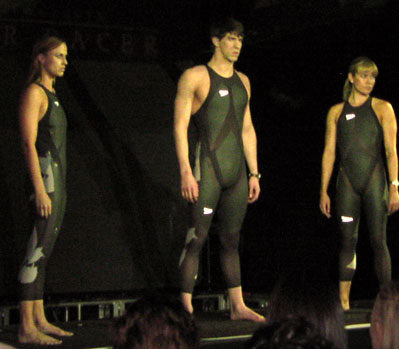
The LZR Racer, unveiled in New York in February 2008.
The suit itself, photographed at its launch. This is the generation of swimwear that was banned from 1 January 2010; the records set in it were allowed to stand.
Kathy Barnstorff · Public domain · Wikimedia Commons
09Governing body politics
FINA — World Aquatics since 2023 — governs six aquatic disciplines through one body, which gives it an unusual internal politics: swimming's commercial weight subsidises the rest, and swimming's rule decisions are taken by a congress in which the other disciplines vote.
The suit episode is the federation's largest modern governance failure and its largest modern correction, and it is worth separating the two decisions taken in Rome in July 2009. The first — ban the suits — was close to unanimous and is not controversial. The second — let the records stand — was a separate judgement, and it is the one this site exists to record.
The reasoning given was that the marks were set legally under the rules then in force, and that retroactively annulling legal performances would punish athletes for a failure of governance. It is a defensible position and it is the opposite of the one World Athletics took over the javelin in 1986, where marks set legally under the rules then in force were annulled precisely because the governance had failed.
Both federations were right by their own lights. The difference is what each thought a record was for: a ranking of legal performances, or a comparable series. Swimming chose the first. Athletics chose the second.
10Controversies that forced rule changes
Rome, July 2009. Forty-three world records in eight days, in an event that normally produces a handful a year. The suits were banned within days by a congress sitting at the same championships. The records stayed.
Fifteen years later the consequence is still on the page. The men's 200 m freestyle record set by Paul Biedermann in Rome has not been beaten. The post-2010 half of that chart is empty, and this site draws it empty rather than extending the axis or joining the segments, because an empty panel is what actually happened.
The 100 m freestyle is the more hopeful version of the same story: César Cielo's 46.91 from Rome stood until Pan Zhanle finally went under it in 2024. It took fifteen years for swimming to get back to where its equipment had briefly taken it.
Seoul, 1988. David Berkoff swam roughly the first third of the 100 m backstroke underwater, because underwater dolphin kick is faster than backstroke and the rules did not say how far you could go. FINA imposed a limit — ten metres, later fifteen — citing the hypoxia risk that had ended underwater breaststroke in 1957. It is also true that a backstroke race with no visible swimmers is unusable on television. The sources do not separate the two motives, so this site records the cause as disputed rather than choosing the flattering one.
The dolphin kick nobody could see. Breaststroke swimmers were performing an extra downward kick off the walls, underwater cameras showed it was near universal, and surface officials could not detect it. In 2015 FINA legalised it. A rule that cannot be enforced is enforced arbitrarily, and this is one of the few cases where a federation said so by acting.
Where it standsthe record, and what is still open · sections 11 to 12
11Series
Men's 100 m freestyle world record
Seconds — lower is better. Broken at 2010 (rule changed, marks retained).
2010–2026 Fifteen years with no ratified improvement, then two in one season.
- 1976–2010
- 46.91 → 49.99
- spans 3.08 s
- 2010–2026
- 46.40
- spans 0.00 s
2010 Rule changed, marks retained. Non-textile suits were prohibited from 1 January 2010 and the records set in them were allowed to stand. The rule changed; the record book did not. The two segments are not comparable — the left one was swum in equipment that is now illegal — but unlike the javelin, the left one is still the record to beat. Fifteen years passed before anyone did.
Men's 200 m freestyle world record
Seconds — lower is better. Broken at 2010 (rule changed, marks retained).
- 1976–2010
- 1:42.00 → 1:50.29
- spans 8.29 s
- 2010–2026
- no marks
- the panel is empty on purpose
2010 Rule changed, marks retained. The same 2010 rule, and the same decision to retain the marks. Here the consequence is still visible as an empty half of the chart: the record set in Rome in July 2009 has not been beaten since.
12What is contested now
Recorded as unsettled.
The 2009 records. The single largest open question in the sport, and it has been open for over fifteen years. Several world records were set in polyurethane suits that have been illegal since 2010, and the federation chose to let them stand. Periodic proposals to annul them, or to keep two lists, have gone nowhere. The argument for annulment is that a record nobody can reach under current rules is not a target but a wall; the argument against is that the marks were legal when set, and that punishing athletes for a governance failure is worse than living with the anomaly.
This site takes no position and notes only that World Athletics faced the same choice with the javelin in 1986 and decided the other way. Both federations are still living with their decision.
Underwater distance. Fifteen metres is an arbitrary number that caps the fastest part of a race. Swimmers who are exceptional underwater are limited by rule rather than by physiology, and proposals to extend, shorten or remove the limit recur. Extending it would advantage a different body type; removing it would return the sport to something closer to what the 1988 backstroke rule was written to prevent.
Short course and long course. The sport maintains two record lists for the same events because a 25-metre pool gives twice as many turns. It is a comparability break that the sport handled correctly and in advance, by never merging the series — which makes it the counter-example to almost everything else on this site.