Water polo
A team ball game played in deep water, where seven swimmers a side pass the ball by hand and throw it into a goal, and nobody may touch the bottom.
- Official
- Aquatics
- Game category
- Invasion
- Adjudication
- Decided by score
- Standing
- Never off
- players a side in the water
- 7
- to take a shot
- 28 s
- between the goal lines
- 25 m
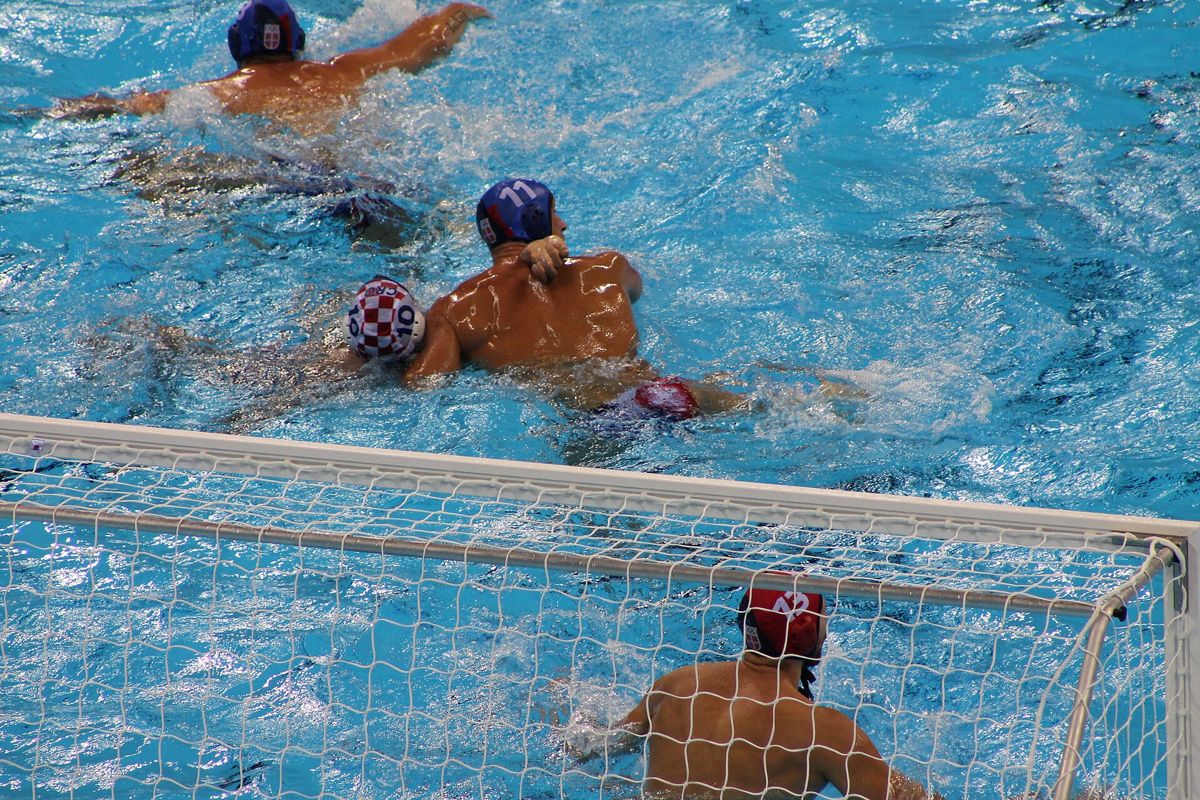
A centre forward wrestling for position with a defender in front of goal · Carlos Antonio Azevedo · CC BY-SA 4.0
- Governing body
- World Aquatics
- Founded
- Devised as "aquatic football" in Scotland in 1877; governed internationally by FINA from 1908, renamed World Aquatics in 2023.
- Olympic status
- 30 editions
- on the 2028 programme
- Also contested at
- No other programme here
Water polo is played in a pool at least two metres deep, so every player swims or treads water for the whole match. Seven players a side, one of them usually a goalkeeper, pass the ball and throw it at a goal three metres wide. A team has 28 seconds to shoot. Contact is allowed and never stops, and a player who holds, sinks or pulls back an opponent without the ball is sent out for 18 seconds, which leaves the other team a player up. Much of the struggle for position happens under the surface, where it is hard to see.
The gamewhat it is now · sections 1 to 6
01How it is played
Score more goals than the other team, in water deep enough that nobody can stand. Everything else is a clock: a possession clock, an exclusion clock, and a game clock that stops on every whistle. Those three numbers are the rules the federation changes most often.
One attack, from the swim-off to the goal
A match is four periods of eight minutes, and each period is a string of attacks like this one.
The swim-off
The teams line up at their own ends. The referee drops the ball at halfway, and the fastest swimmer from each team races for it. The team that gets there first has the ball.
Twenty-eight seconds
The team with the ball has 28 seconds to shoot. The players pass the ball while they swim or tread water. Nobody may touch the bottom or hold the side, and a tackled player may not take the ball under the water.
An ordinary foul
Contact is allowed, and fouls are frequent. An ordinary foul gives the other team a free throw from where the ball is. The game hardly stops.
A major foul
Holding, sinking or pulling back a player who does not have the ball is a major foul. The offender goes to the re-entry area for 18 seconds, or until their team wins the ball back. The attack now has one player more, and its clock is reset to 18 seconds. A foul that stops a likely goal inside six metres is a penalty, thrown from five metres.
The shot
A goal may be thrown from anywhere, and counts one point. If the shot misses and the attack keeps the rebound, or wins a corner, it gets 18 more seconds. If the clock runs out, the ball goes to the other team.
The match
The clock stops on every whistle. The team with more goals after four periods wins. When a drawn match needs a winner there is no extra time: five players from each team take penalties.
That is the game. What follows is the same game clause by clause, with the measurements.
The object of the game
Throw the ball into the opponents' goal. A team must shoot before its possession clock runs out, may not touch the bottom or hold the side, and may not take the ball underwater when tackled. Contact is allowed and constant; the fouls are about holding, sinking and pulling back a player who does not have the ball.
The field of play
A rectangle marked out in a pool by floating lines, the same size for men and women since 2025. The water must be at least two metres deep everywhere, so no one can push off the floor.
- Length
- 25 m between the goal lines
- Width
- 20 m
- Six-metre line
- 6 m from each goal line
- Depth
- 2 m minimum
- Goal
- 3 m wide, crossbar 0.9 m above the water
- Water temperature
- 25–27 °C
The playing area
A field marked on the water
- within 6 m of goal
- 5 m line
- goal, 3 m wide
Floating lines mark the field in a pool at least two metres deep. The shaded water is within six metres of a goal. A foul there that stops a likely goal is a penalty, thrown from the five-metre line. A free throw given outside the six-metre line may be shot straight at goal.
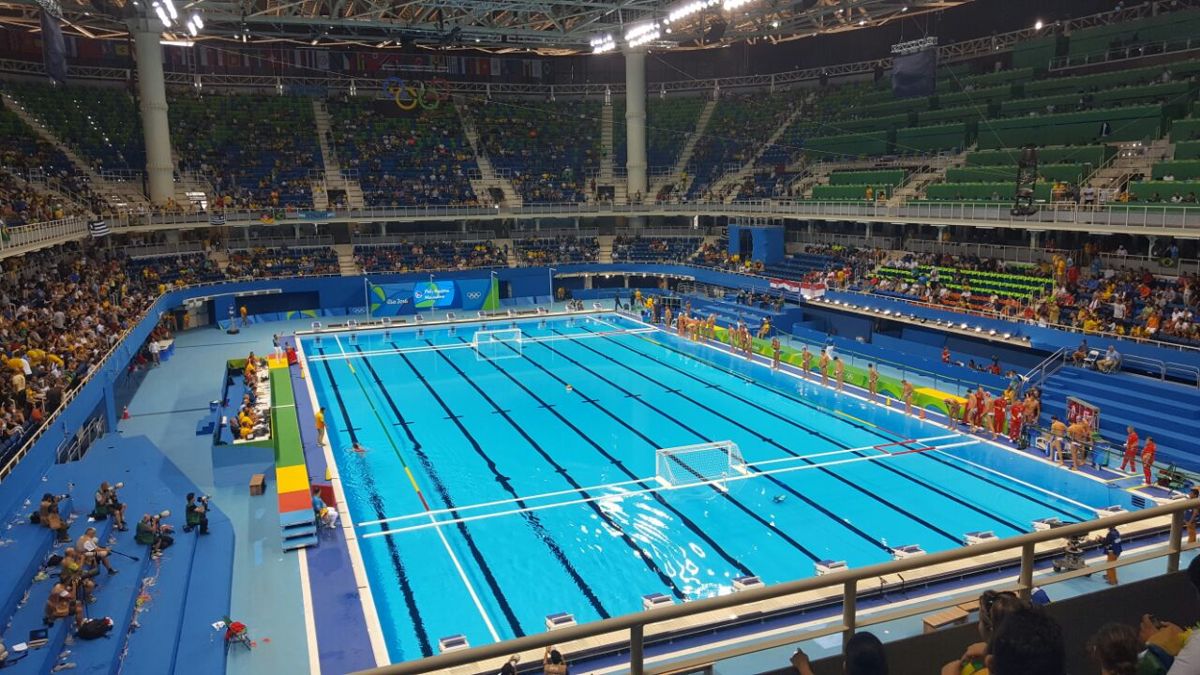
An Olympic water polo pitch marked with floating lines in a full arena
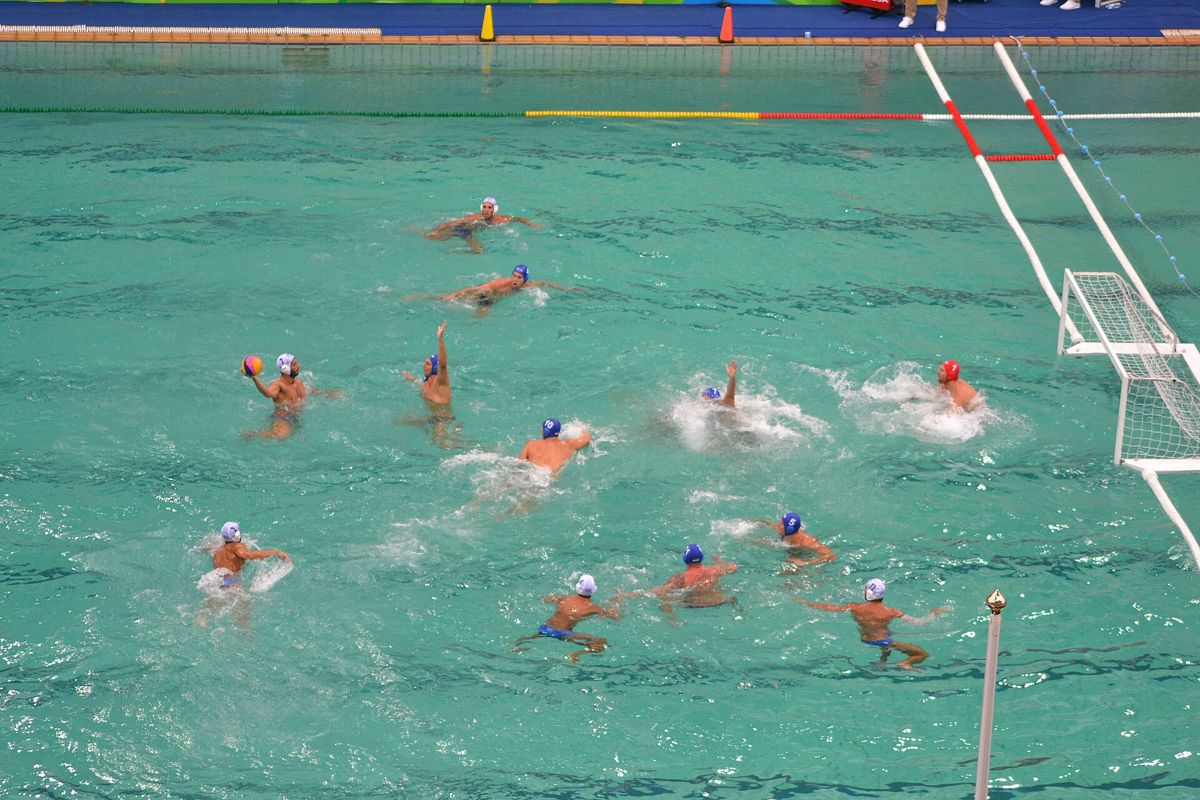
The pitch at the Rio 2016 Olympic Aquatics Stadium, the field marked out by floating lines.
Henriquemarra01 · CC BY-SA 4.0 · Wikimedia Commons
This clause reads this way because of
World Aquatics Competition Regulations, Part Six — Water Polo Rules (February 2026) · CR 20.2, CR 21.6
The ball and caps
The women's ball is slightly smaller and softer than the men's. Caps carry malleable ear protectors in the cap's colour, which the rules require, and a number for the officials to call.
- Ball weight
- 400–450 g
- Men's ball
- 0.68–0.71 m round, 7.5–8.5 psi
- Women's ball
- 0.65–0.67 m round, 6.5–7.5 psi
- Caps
- White or blue, goalkeeper red, with ear guards
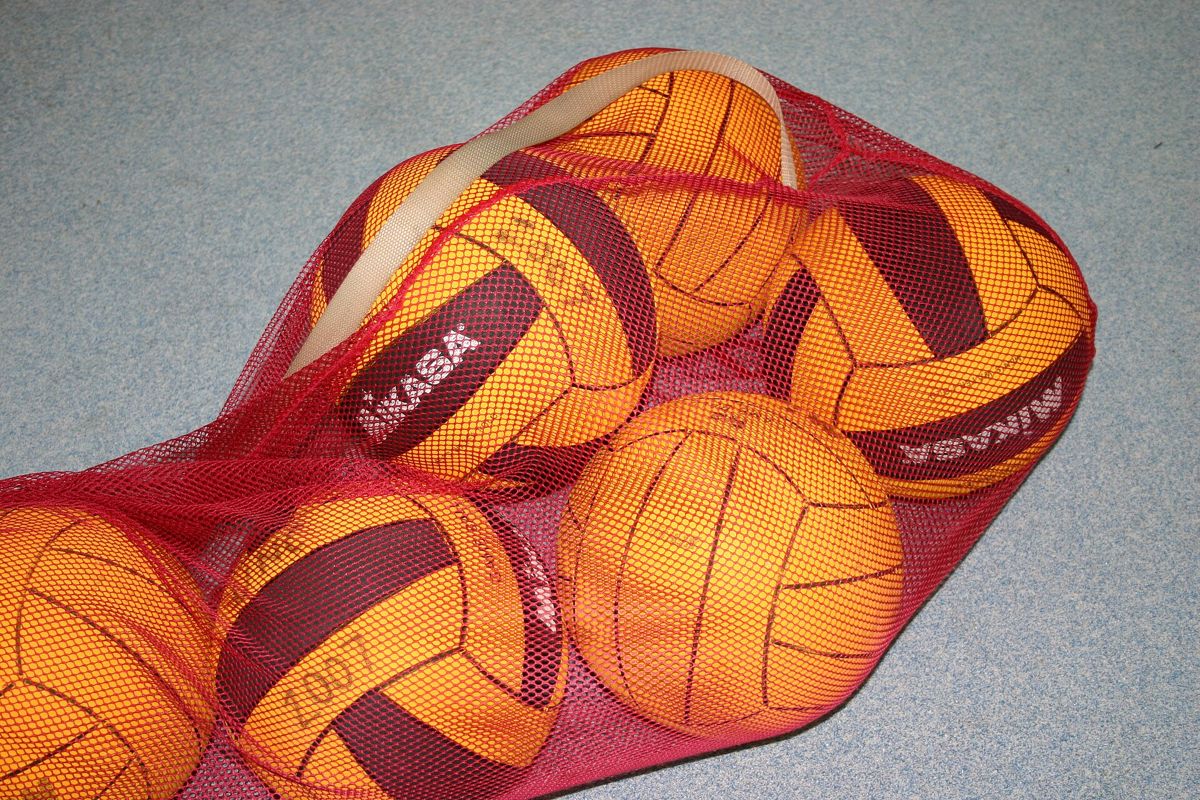
A mesh bag full of yellow and maroon water polo balls
Water polo balls: the men's and women's balls differ slightly in size and pressure.
Russell Harrison · CC BY-SA 2.0 · Wikimedia Commons
World Aquatics Competition Regulations, Part Six — Water Polo Rules (February 2026) · CR 21.2, CR 21.4
Teams
Seven in the water, one of them normally a goalkeeper — though since 2025 a team may replace its goalkeeper with a seventh field player. A match squad is up to fourteen, with two goalkeepers, and substitutes swap in from a re-entry area at the team's own end.
- In the water
- 7
- Match squad
- 14, including 2 goalkeepers
- Olympic squad
- 13
This clause reads this way because of
World Aquatics Competition Regulations, Part Six — Water Polo Rules (February 2026) · CR 2.2.2, Appendix 7
Time
Four periods of eight minutes of actual play — the clock stops on every whistle, so a match takes well over an hour. Each team has two time-outs.
- Periods
- 4 × 8 min, stopped clock
- Breaks
- 2 min, and 5 min at half-time
- Time-outs
- 2 per team
This clause reads this way because of
World Aquatics Competition Regulations, Part Six — Water Polo Rules (February 2026) · CR 4.1, CR 4.3
Possession and scoring
A team has 28 seconds to shoot. The clock resets to 18 after a corner, after the attack keeps a rebound, and after an exclusion — the number that was 20 until 2024, 15 for six months, and 18 since. A goal is one point, from anywhere, and may be scored directly from a corner or from a free throw awarded outside six metres.
- Possession
- 28 s
- Reset
- 18 s
- Goal
- 1 point
This clause reads this way because of
World Aquatics Competition Regulations, Part Six — Water Polo Rules (February 2026) · CR 9.1, CR 9.8–9.10
Swim-off and restarts
Each period starts with a swim-off: the ball is dropped at halfway and the two fastest players race for it. Ordinary fouls give a free throw taken where the ball is, which keeps the game moving rather than stopping it.
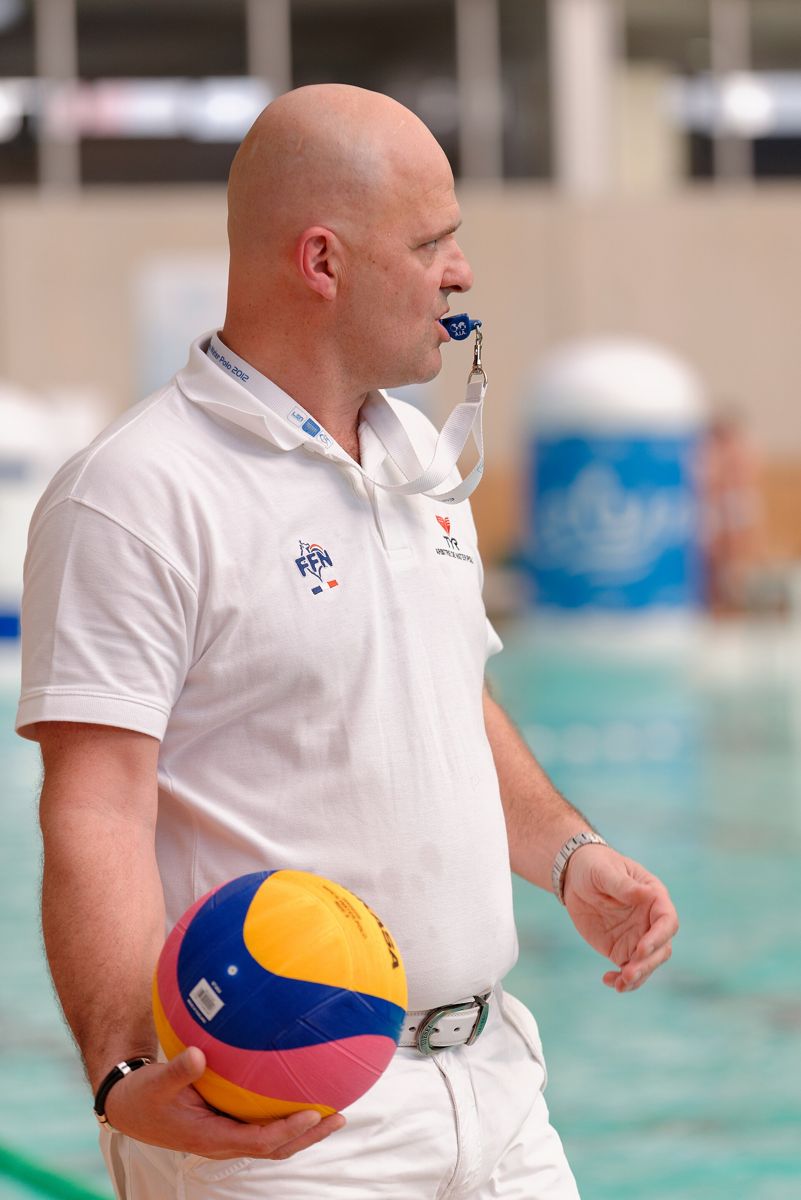
A referee holding the ball at halfway before the swim-off
A referee about to release the ball for the swim-off at a French league cup match, 2014.
Marie-Lan Nguyen · CC BY 3.0 · Wikimedia Commons
This clause reads this way because of
Fouls and exclusions
Ordinary fouls cost a free throw. Major fouls — holding, sinking or pulling back a player away from the ball — send the offender to the re-entry area for 18 seconds, or until his team wins the ball back. A foul that stops a likely goal inside six metres is a penalty from five metres. Three personal fouls and a player is out of the match; violent action is a four-minute exclusion.
- Exclusion
- 18 s
- Personal fouls to foul out
- 3
- Penalty
- From 5 m
- Violent action
- 4 min exclusion
This clause reads this way because of
World Aquatics Competition Regulations, Part Six — Water Polo Rules (February 2026) · CR 10.5, CR 10.8, CR 16.2, CR 17.3
Deciding the winner
More goals. Where a winner is needed after a draw, the match goes straight to a penalty shootout of five shooters each, with no extra time.
World Aquatics Competition Regulations, Part Six — Water Polo Rules (February 2026) · CR 4.4.2, Appendix 3
Everything above is current law. Everything below is how Water polo got here.
02Disciplines and events
Two Olympic tournaments, men's since 1900 and women's since 2000. From 2028 they are the same size for the first time.
- Disciplines
- 1
- Olympic medal events
- 2
- Men’s and women’s counted separately.
- Contested elsewhere
- 2
- asian games, world championship, federation only.
- Listed for context
- 1
- Not counted as this sport.
Tournaments2
The men's tournament has been held at every Games since 1900; the women's joined in 2000.
- Men's tournament12 teams at the Games.
- Women's tournamentTen teams in 2024, twelve from 2028.
Contested away from the Games2
- Water Polo World CupFederation only
- Water polo 4sFederation onlyA short four-a-side format in an appendix of the rules.
03The words of the game
- Cap
- The numbered cap each player wears, with guards over the ears. One team wears white, the other blue, and goalkeepers wear red.
- In the laws: The ball and caps
- Centre forward
- The attacker who takes position in front of the opponents' goal, with a defender on their back.
- Corner
- A throw awarded to the attacking team from the corner of the field. A goal may be scored from it directly.
- In the laws: Possession and scoring
- Eggbeater
- The kick players use to tread water upright with both hands free.
- Exclusion
- Sending a player out of the game for 18 seconds after a major foul. The player waits in the re-entry area and returns when the time is up or when their team wins the ball.
- In the laws: Fouls and exclusions
- Free throw
- The restart after an ordinary foul. The fouled team puts the ball back into play from where it is.
- In the laws: Swim-off and restarts
- Major foul
- A serious foul, such as holding, sinking or pulling back a player who does not have the ball. It is punished with an exclusion.
- In the laws: Fouls and exclusions
- Penalty
- A free shot at goal from five metres, with only the goalkeeper to beat. It is given for a foul that stops a likely goal inside six metres.
- In the laws: Fouls and exclusions
- Penalty shootout
- The way a drawn match is decided when a winner is needed. Five players from each team take a penalty in turn.
- In the laws: Deciding the winner
- Personal foul
- A major foul counted against the player who made it. A player with three is out for the rest of the match.
- In the laws: Fouls and exclusions
- Possession clock
- The clock that limits an attack. A team must shoot within 28 seconds of getting the ball, or the ball goes to the other team.
- In the laws: Possession and scoring
- Power play
- The time one team has a player more because an opponent is excluded. It is the likeliest time to score.
- In the laws: Fouls and exclusions
- Re-entry area
- The corner at a team's own end where excluded players wait and substitutes come in.
- In the laws: Teams
- Reset
- Putting the possession clock back to 18 seconds. It happens after a corner, after the attack keeps a rebound, and after an exclusion.
- In the laws: Possession and scoring
- Swim-off
- The start of each period. The ball is dropped at halfway and one player from each team races to reach it first.
- In the laws: Swim-off and restarts
04Refereeing from above the water
Two referees walk the sides of the pool, one near each end of the play. Goal judges help them, and a table of timekeepers and secretaries runs the clocks. Each player wears a numbered cap so that the officials can name a player from the deck. What they are watching happens mostly below the surface.
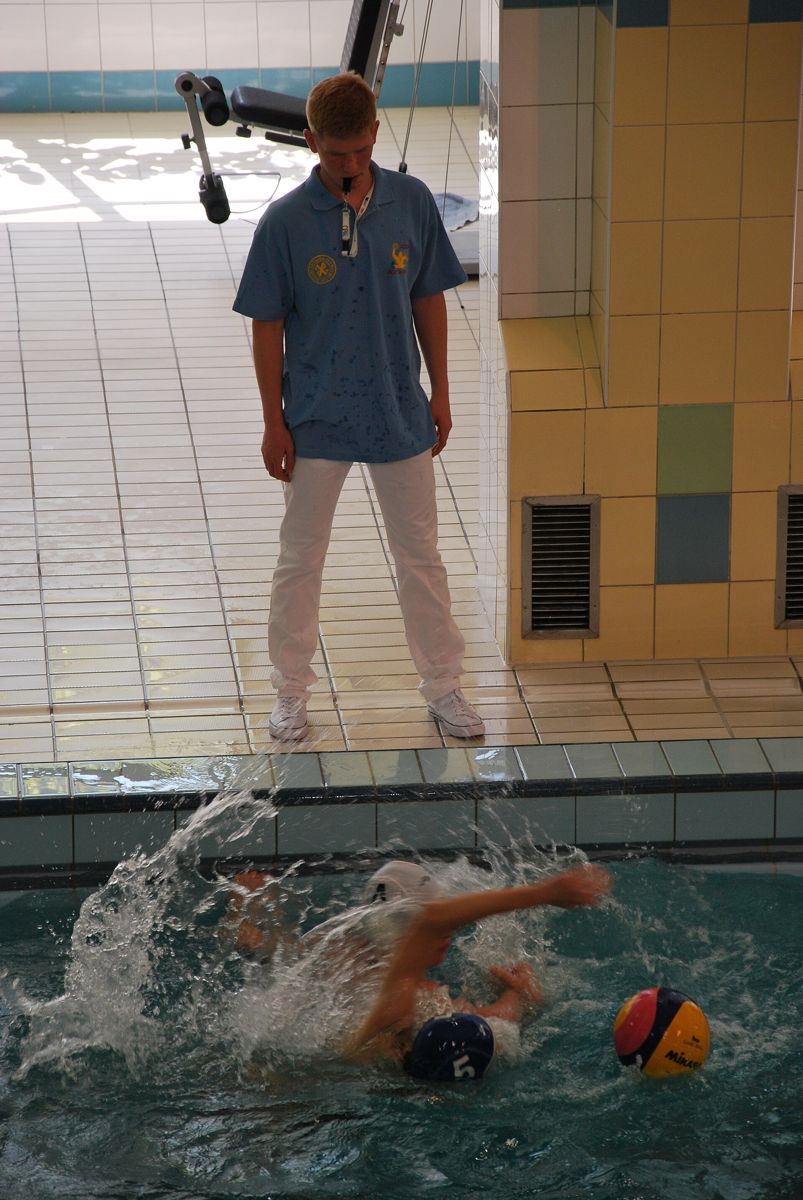
A referee watching from the poolside above a player swimming with the ball
A referee walking the side of the pool, 2012. The view from above is the only one the officials have.
Zorro2212 · CC BY-SA 3.0 · Wikimedia Commons
Ordinary or major
The call that matters most is the line between an ordinary foul and a major foul. An ordinary foul costs a free throw. A major foul costs an exclusion. Holding an opponent who has the ball is ordinary. Holding, sinking or pulling back an opponent who does not have it is major. Often the difference is which arm was where, under broken water, seen from above.
An exclusion usually leads to a goal, so players work hard to win one. A centre forward who can make a defender's hold look illegal is worth as much as one who can shoot.
Video
Video came late. The 2019 rules allowed a review of whether a goal had been scored, and of violent action the referees had missed. The 2024 package gave each coach one challenge per match. The committee said it would "reduce the human factor in certain calls". In 2025 each review was limited to two minutes.
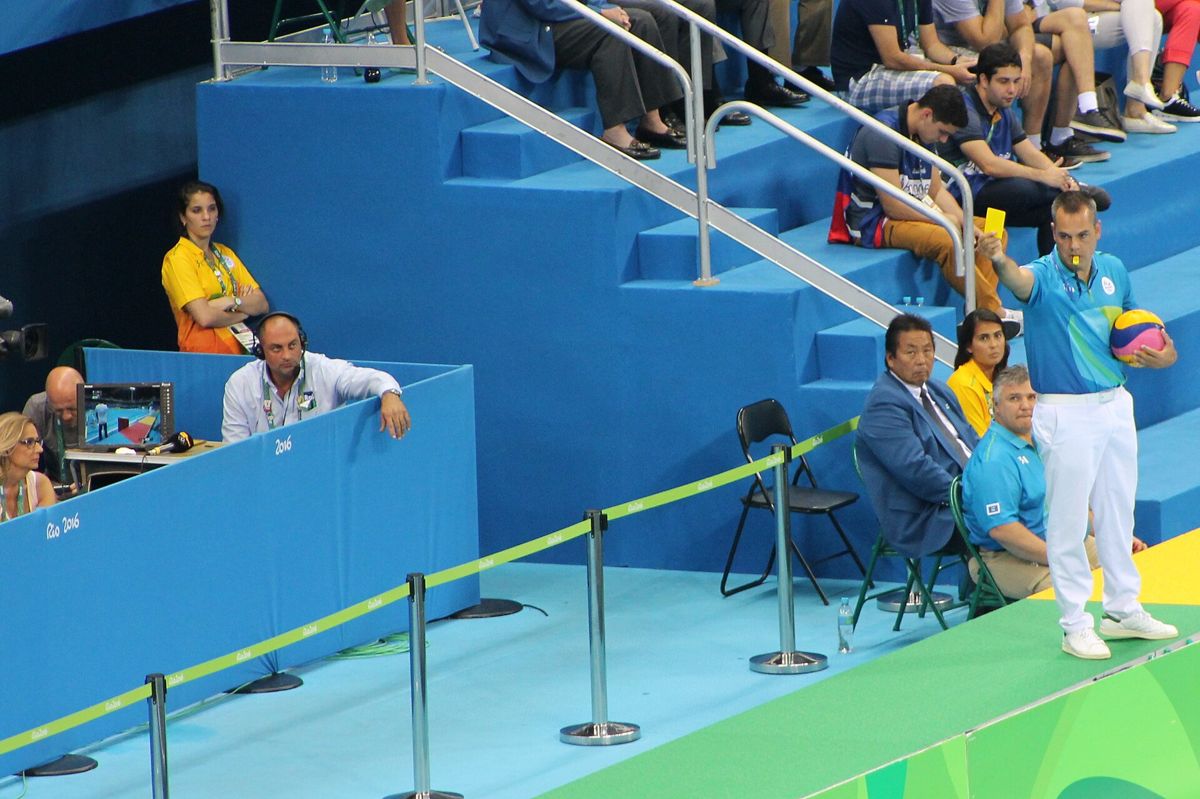
A referee showing a yellow card towards the bench
A referee cautioning a coach during the men's final at Rio 2016.
Carlos Antonio Azevedo · CC BY-SA 4.0 · Wikimedia Commons
A camera above the pool still cannot see under the water. The challenge has made the disputes fewer. It has not ended them.
05Where it is played
Water polo is strongest in central and southern Europe, and above all in Hungary. Hungarian men have won nine Olympic gold medals, the first in 1932 and the ninth in 2008. They won a medal at every Games from 1928 to 1980. The sport is part of national life there in a way it is almost nowhere else.
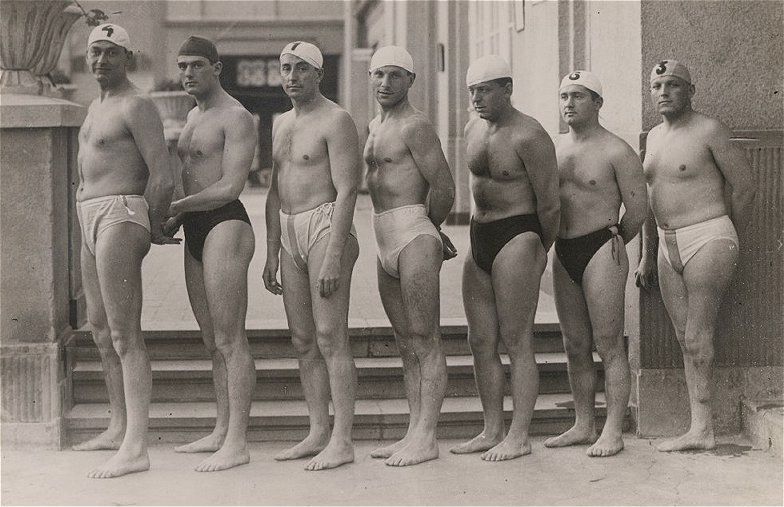
Seven Hungarian players in caps and trunks lined up on the poolside
Hungary's Olympic champions of 1932 in Los Angeles, the first of nine men's titles.
Unknown authorUnknown author · Public domain · Wikimedia Commons
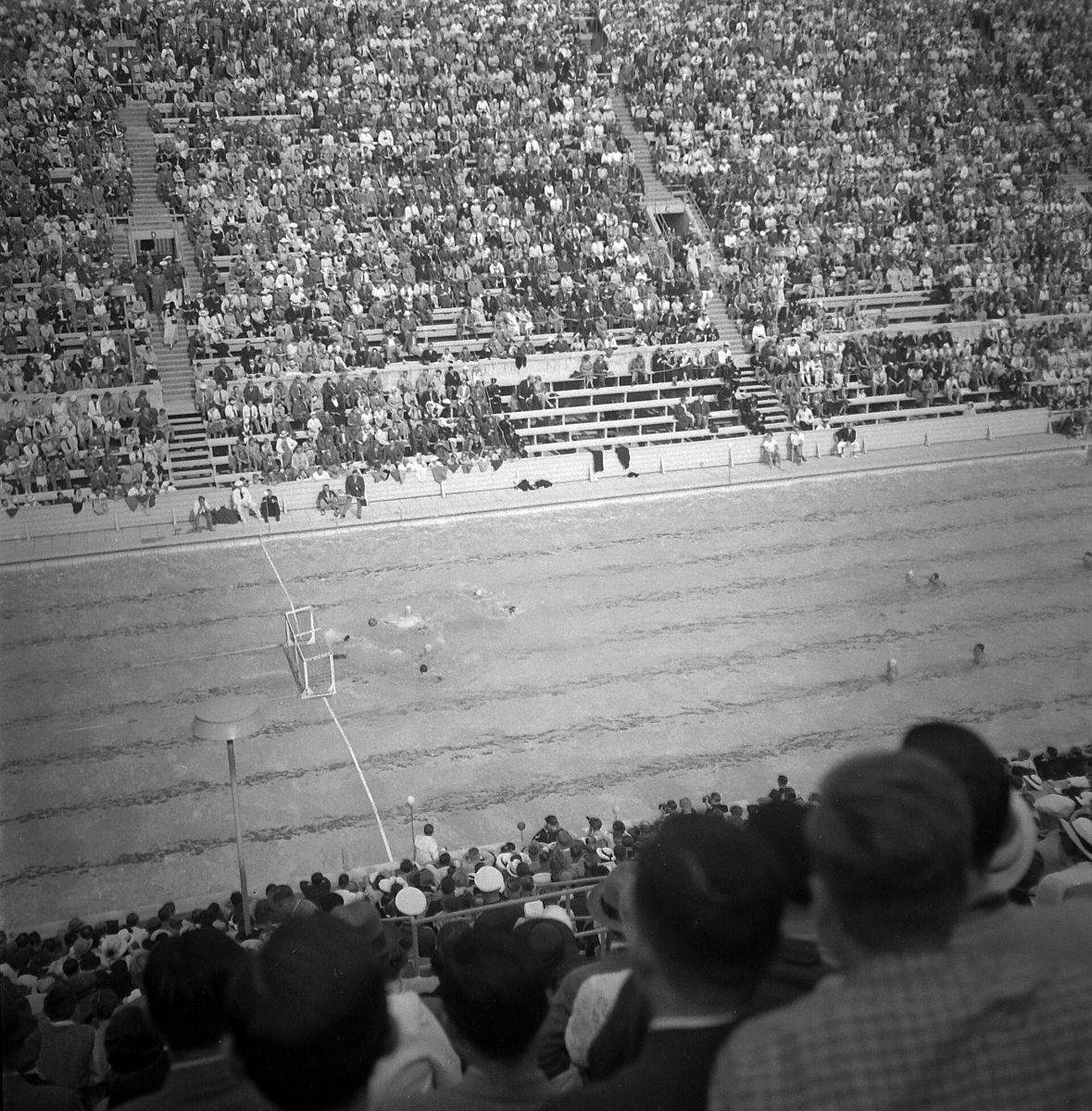
A crowded Olympic stadium looking down on a water polo pitch marked out in a long pool
The water polo tournament at the Berlin Olympic swimming stadium in 1936, which Hungary won.
Fortepan · CC BY-SA 3.0 · Wikimedia Commons
The Balkans are the second centre. Yugoslavia won three Olympic titles, and the countries that followed it have kept the strength. Serbia won the men's gold in 2016, 2020 and 2024. Croatia and Montenegro are contenders every time. Italy and Spain complete the European core.
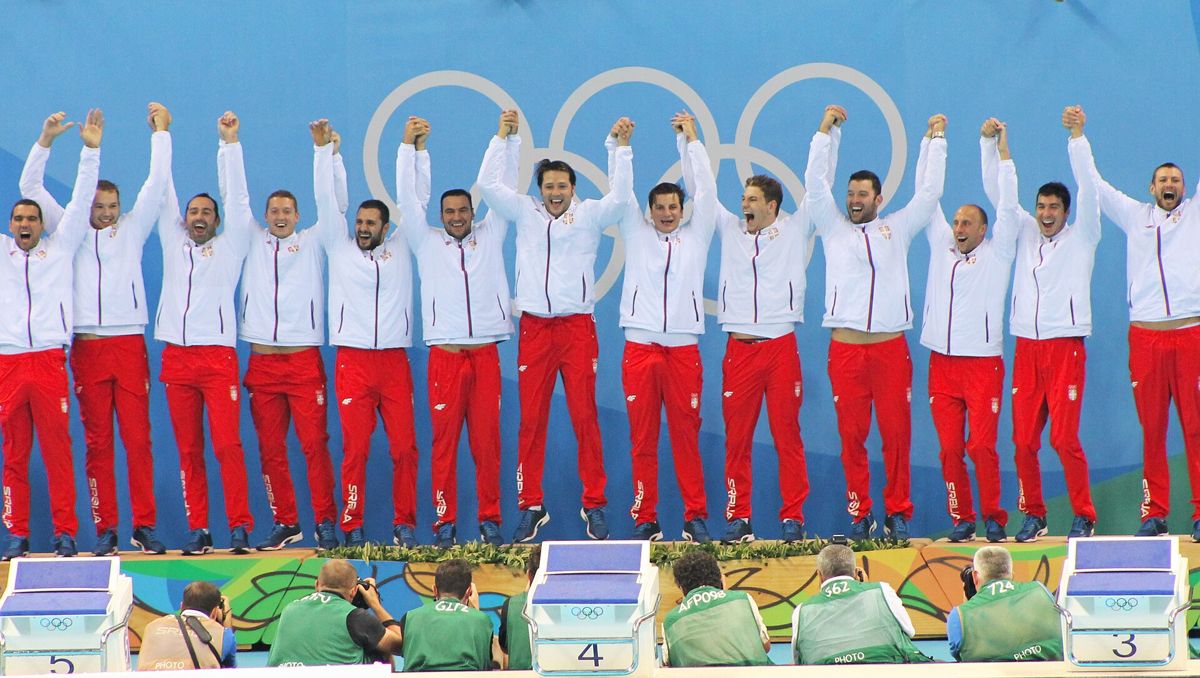
A team in white and red jumping with arms raised on the Olympic podium
Serbia, Olympic champions at Rio 2016, the first of three successive titles.
Carlos Antonio Azevedo · CC BY-SA 4.0 · Wikimedia Commons
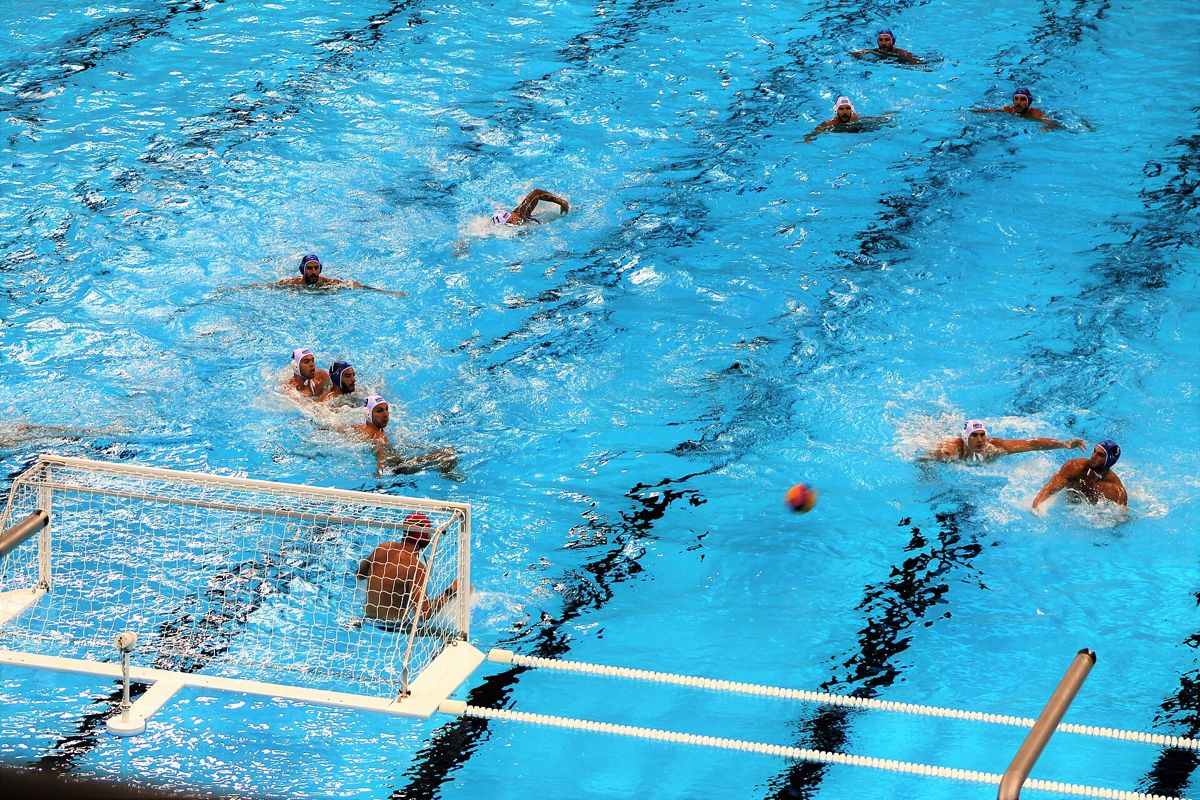
An attacker shooting at goal from the edge of the area, seen from above
A shot in the men's final at Rio 2016.
Carlos Antonio Azevedo · CC BY-SA 4.0 · Wikimedia Commons
The United States
The American men's only Olympic title dates from 1904. The American women have led the women's game, with gold in 2012, 2016 and 2020. Australia won the first women's title in 2000, the Netherlands won in 2008 and Spain in 2024.
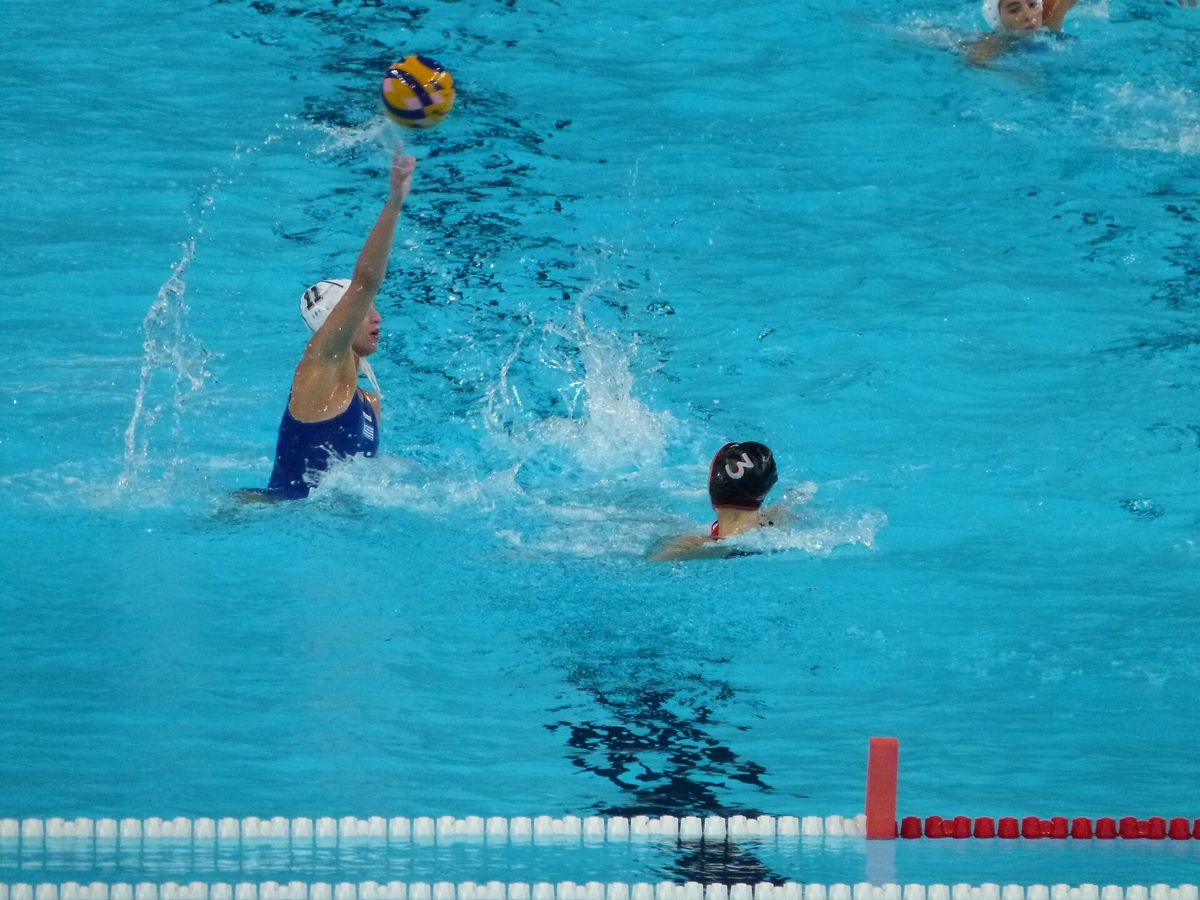
A player rising high out of the water to shoot, a defender behind
Greece against Canada in the women's tournament at Paris 2024.
Daieuxetdailleurs · CC BY 4.0 · Wikimedia Commons
Why so few countries
Water polo needs a deep pool that is given over to it for hours at a time. That limits it to places with many pools. It also grows through clubs, and a club system takes decades to build. Where those clubs exist the sport is professional and deep. Elsewhere it is a minor sport for swimmers, who must already be strong in the water before they can begin.
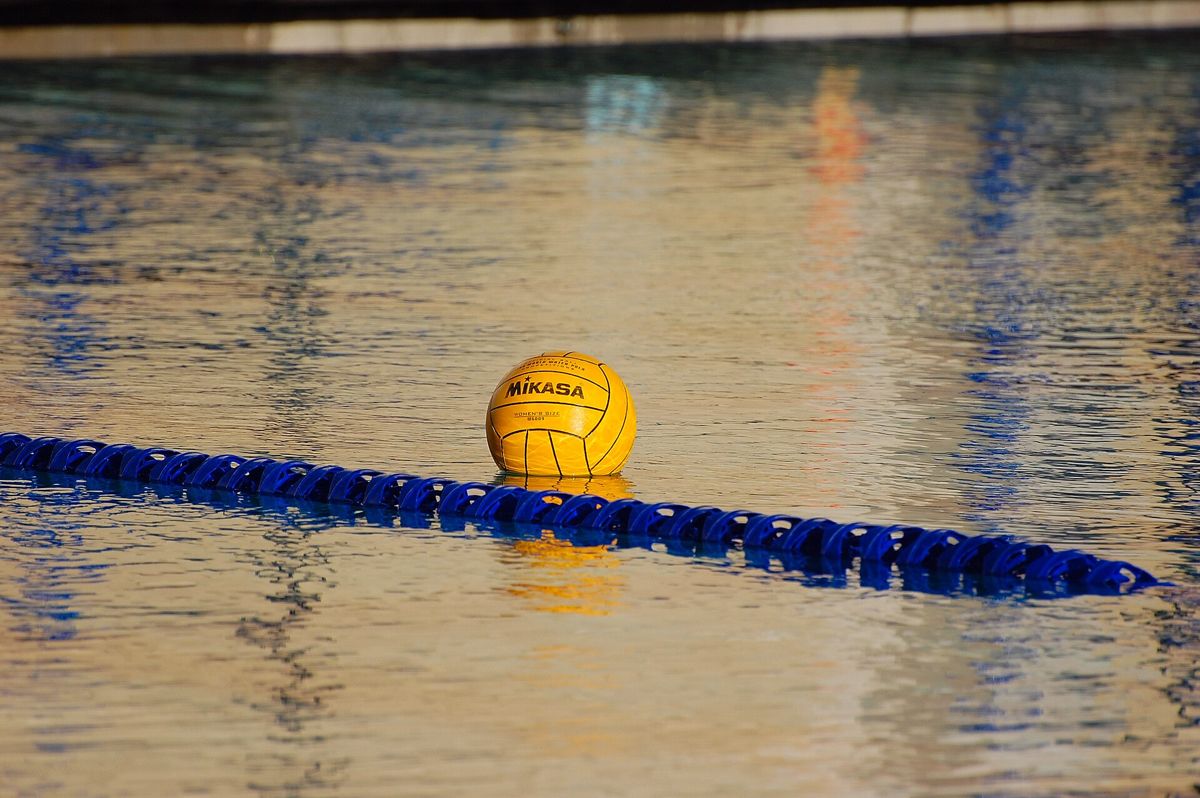
A yellow ball floating beside a lane rope
A ball on the water at a women's team practice, 2008.
Sean Fornelli · CC BY-SA 2.0 · Wikimedia Commons
06Learning curve
A team sport whose first requirement is something no other team sport asks: staying up, for an hour, without touching anything, while someone holds you under.
Editorial — the site’s reading, not a sourced claim
Barrier to entry
How hard is it to get to a real game?
You have to be a strong swimmer before you can be a beginner.
The rules are learned quickly, and the kit is a cap and a costume. The barrier is the water. A player must tread water upright for long periods with the hands free — the "eggbeater" kick — swim hard in short repeats, and be comfortable being grabbed and pushed under, all in a pool deeper than they can stand in.
That puts the sport behind swimming itself in the queue: a newcomer is usually a competitive swimmer already, and the pool time is shared with every other aquatic discipline.
Evidence
- Kit to startCap, costume, ballobserved
- Water depth2 m minimumrule2025 — the rule this rests on
- PrerequisiteStrong swimming and treading waterestimate
Barrier to the top
How hard is it to be good at?
Physical contact you cannot see, under a clock that keeps changing.
Elite water polo is a contact sport fought mostly below the surface, where the referee's view is worst and the advantage goes to whoever holds and pushes most cleverly without being seen. Learning to do that, and to draw exclusions from opponents, takes years.
The tactical layer moves under the players' feet. The possession and exclusion times — the numbers that set the length of every power play — have changed three times since 2018.
Evidence
- Possession clock28 srule2025 — the rule this rests on
- Power-play length18 srule2025 — the rule this rests on
- Changes to the reset since 2018Threerule2019 — the rule this rests on
Why the two differ
The gap is set by the pool, not the rulebook. Entry is hard because the water is unforgiving; mastery is hard because the sport's decisive contact is invisible, so it rewards a kind of experience that cannot be watched and copied. The recorded rule changes have tried to make more of the game visible and faster, and have not touched either of those.
The historyhow it got here · sections 7 to 10
07Football in the water
Water polo began as a show for a swimming gala. In 1877 the Bon-Accord club of Aberdeen asked William Wilson, a swimming-club official from Glasgow, to invent a game that would liven up its gala. He drew up rules for what he called aquatic football. The first match was played in open water on the River Dee, from one bank to the other. A revised version was played in Paisley Baths that October.

A colourful circus poster of swimmers, divers and water games at Coney Island
A Barnum & Bailey poster for the Coney Island water carnival, 1898: water games and stunts as popular entertainment in the decades water polo was becoming a sport.
Strobridge Lithograph Co. · Public domain · Wikimedia Commons
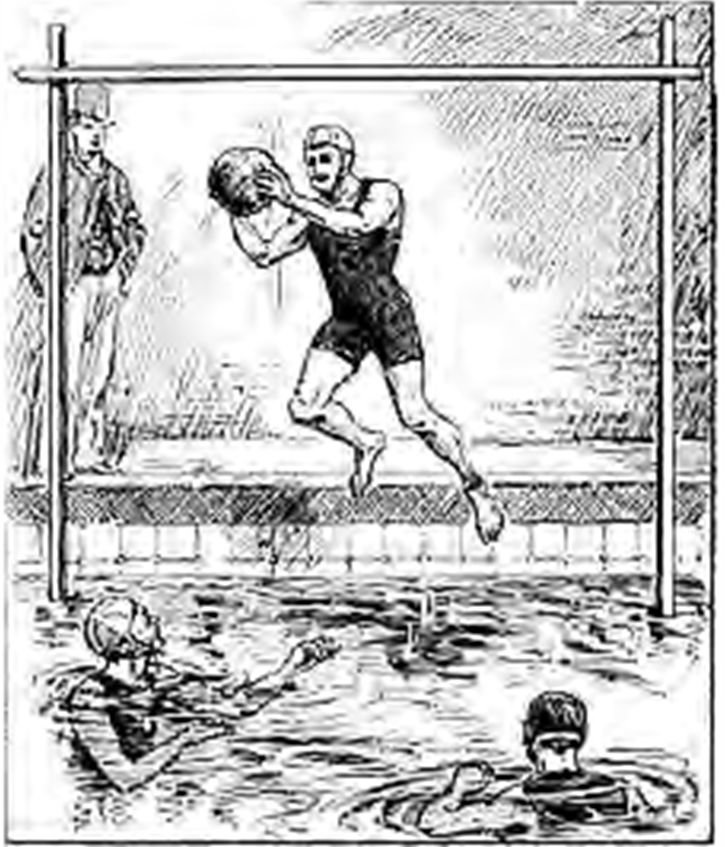
A drawing of a goalkeeper in the water catching a ball between tall rugby-style posts
An early water polo goalkeeper defending tall posts, in an illustration of the 1880s game.
Unknown authorUnknown author · Public domain · Wikimedia Commons
The pool gives it a shape
Indoor baths gave the game fixed ends, fixed goals and a set area. By 1885 the Swimming Association of Great Britain had sent round an agreed set of rules, and the game spread across Europe in that form. A rougher American version was played at the St Louis Olympics in 1904. The European game outlasted it.
Even so, matches went on being played in rivers for years, with floating goals and a field marked out on the current.
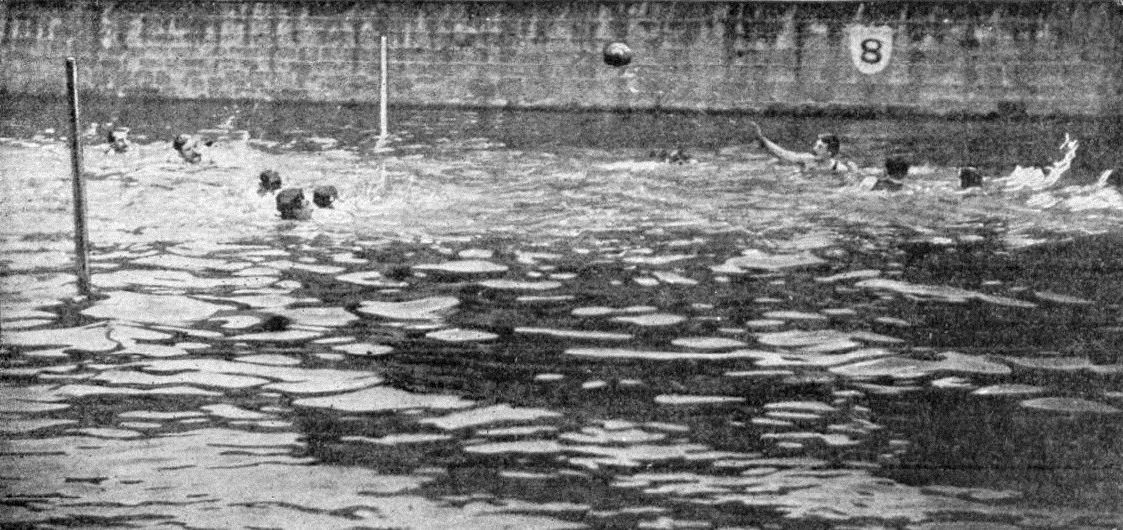
Swimmers chasing a ball in open water beside a stone quay, 1900
Water polo at the Paris Olympics in 1900, played in the Seine.
La Vie au Grand Air · Public domain · Wikimedia Commons
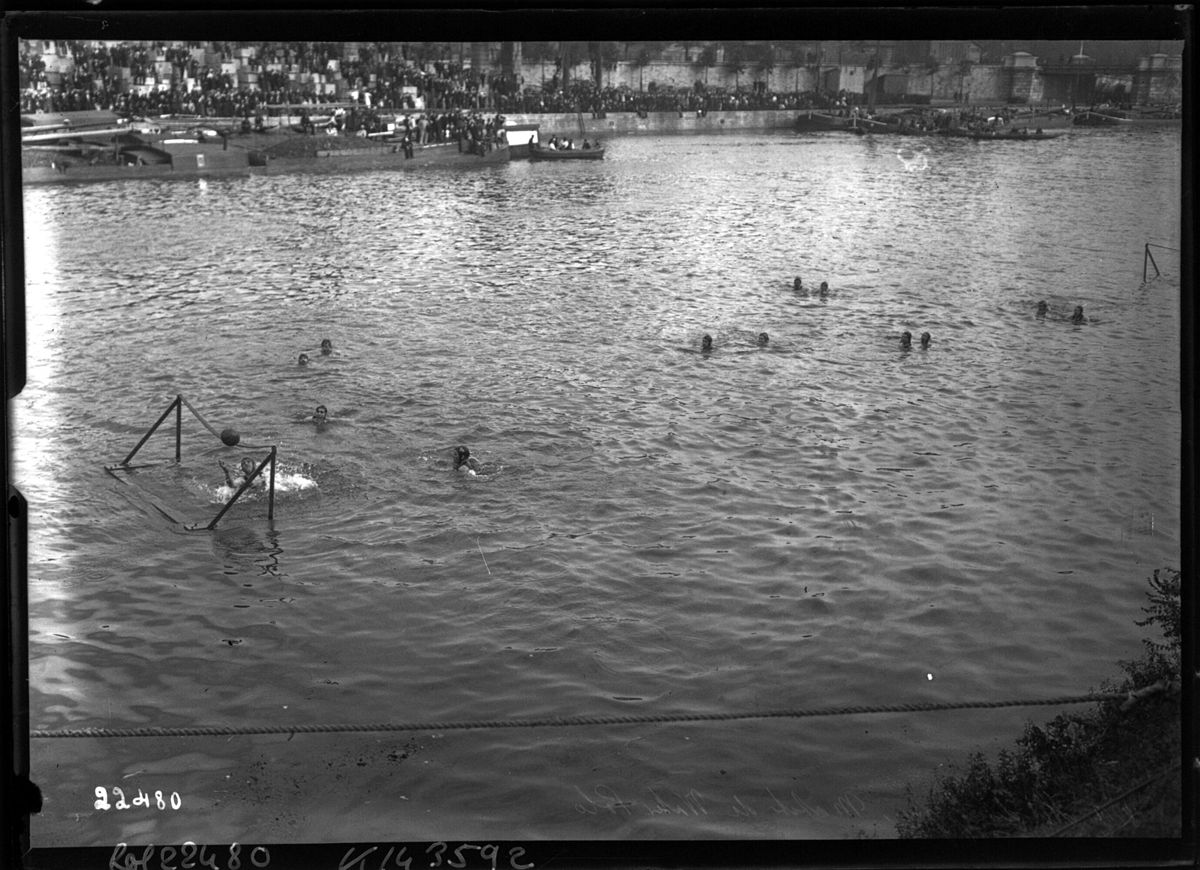
Players in a river with floating goals, spectators on the bank, 1912
A water polo match at the Île des Cygnes on the Seine in 1912, with floating goals: before pools, the field was marked out in a river.
Agence Rol · Public domain · Wikimedia Commons
At every Olympics since 1900
Water polo has been at every Olympic Games since 1900, the longest unbroken run of any team sport. Great Britain won four of the first five tournaments. After that the strength of the game moved east, and Germany beat Hungary 5–2 in the 1928 final in Amsterdam.
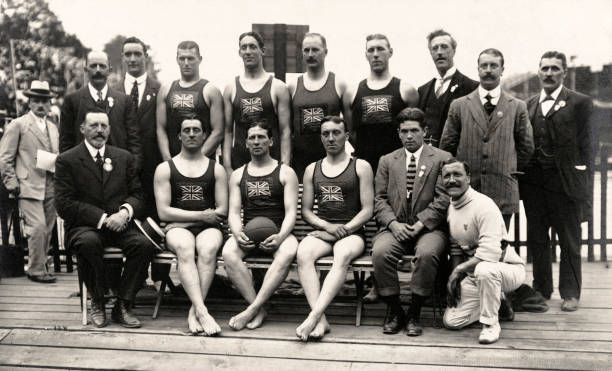
A British water polo team in costumes posed with officials on a jetty, 1912
Great Britain's team at the Stockholm Olympics in 1912. Britain won four of the first five Olympic tournaments.
Unknown authorUnknown author · Public domain · Wikimedia Commons
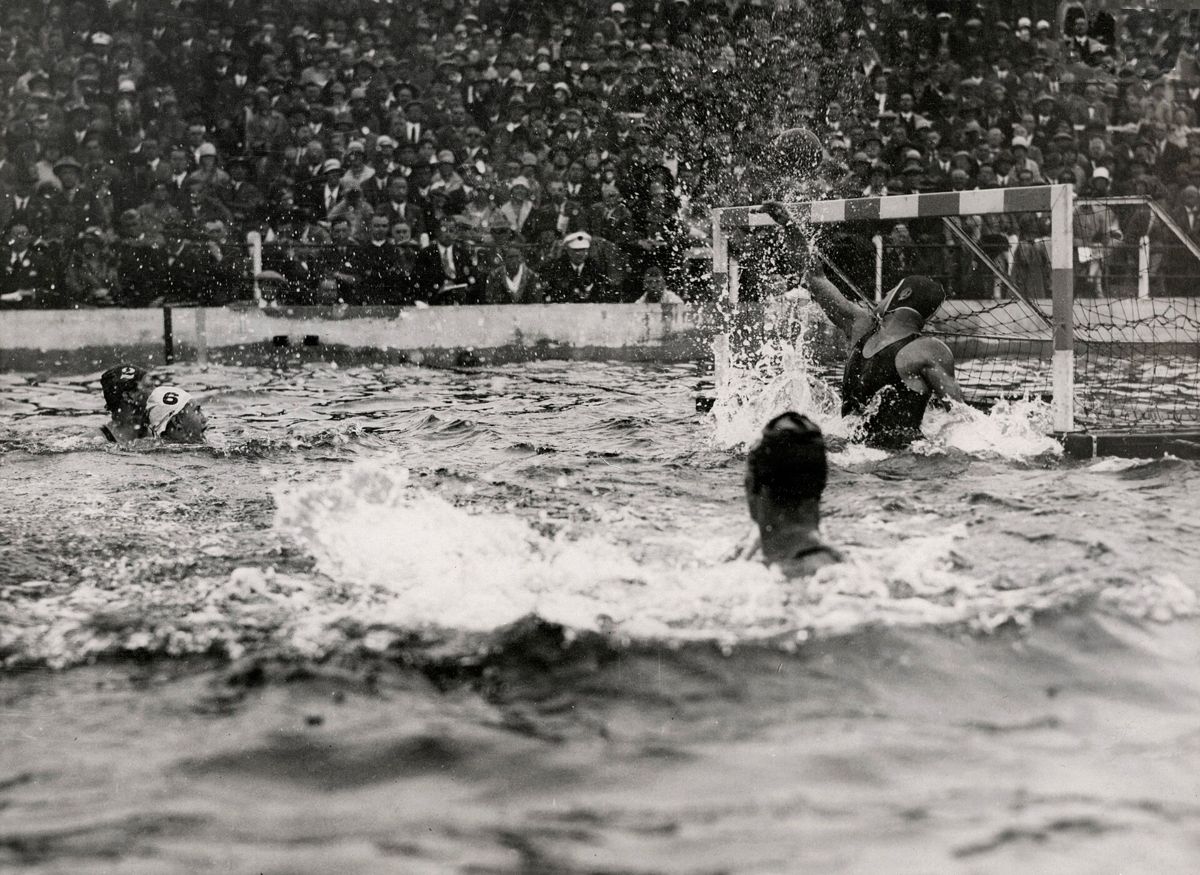
A goalkeeper rising out of the water as a shot comes in, crowds behind
The 1928 Olympic final in Amsterdam, which Germany won 5–2 against Hungary.
Unknown authorUnknown author · Public domain · Wikimedia Commons
One thing has stayed the same from the start. The water is too deep to stand in, so every player treads water the whole time. The struggle for position goes on below the surface, where spectators and referees cannot see it clearly. Most of the sport's arguments since have come from that.
08Rule timeline
The sport’s own lane, expanded. Every entry carries a cause from the closed vocabulary and a citation, and says so where the citation is incomplete.
- 2005Broadcast and pacingadopted 2005
A package from the 2005 FINA congress: possession time cut from 35 to 30 seconds, periods lengthened from seven to eight minutes of actual play, and a direct shot allowed from a free throw awarded outside five metres. The penalty throw moved out from four metres to five in the same period.
Trigger and citationIncomplete — no confirmed article
Trigger
No statement of reasons from the federation has been obtained. The academic literature on the change reads it as one of a series meant to make the game faster and more attractive to watch, because so much of it is fought below the surface and out of view; a study of the 2005 rules found shots and goals both up by about eighteen per cent.
Competition Rules · FINA Water Polo Rules, 2005
- 2019Broadcast and pacingadopted 2018-12-10
After a corner throw, a rebound kept by the attack, or an exclusion, the possession clock resets to 20 seconds rather than 30, unless more remains. The same package let a corner be shot directly, extended the direct-shot free throw to anywhere outside six metres, gave each team two time-outs, let the goalkeeper cross halfway, and introduced video review of goals and violent action.
Trigger and citation
Trigger
Adopted at an extraordinary congress in Hangzhou by 161 votes to 2. The committee's own note on the reset is that a team "is not to lose time as a result of the exclusion, nor is the offending team to benefit". USA Water Polo, announcing the rules, reported that trials at youth and World Cup events had produced a 25 per cent rise in goals and a 24 per cent fall in fouls called per game.
New rules approved during the FINA Extraordinary Technical Water Polo Congress, Hangzhou, 10 December 2018 (with clarifications) · Hangzhou rules, 10 December 2018 · article WP 20.15
- 2025Disputedadopted 2024-11-08
The men's field shortened from 30 to 25 metres, matching the women's. Men's possession cut from 30 to 25 seconds, and the exclusion and second-possession time cut from 20 to 15 seconds for both. A Coach's Challenge on video was introduced, and a team was allowed to replace its goalkeeper with a seventh field player.
Trigger and citationIncomplete — no confirmed article
Trigger
The committee's stated purpose for the Challenge was to "reduce the human factor in certain calls" and "help to protect the game". The rest of the package was reported as meant to raise the pace of play.
The changes were first presented as trials for the 2025 World Cup and then adopted outright by a Bureau postal vote without a congress. Former Serbia coach Dejan Savić called the process "devastating" and the Challenge "a farce". Whether the package was a considered reform or an untested one is the dispute; both accounts are recorded.
Water Polo Rules changes, modification and housekeeping (TWPC summary, December 2024) · TWPC summary, December 2024
- 2025Broadcast and pacingalso safetyadopted 2025-05-09
Possession time set at 28 seconds for men and women, and the second-possession and exclusion time at 18 seconds: a partial reversal, six months later, of the 25 and 15 adopted in November 2024. Half-time went from three minutes to five.
Trigger and citation
Trigger
The federation's letter to national federations says the changes "seek to improve the overall speed and efficiency of the sport, while also enhancing the player safety and overall fairness at all levels of competition". It followed the 2025 World Cup, played under the November rules.
Coaches remain divided. Ratko Rudić said the game had "lost much of the tactical component"; Tom Hoad called it "more television appropriate now".
Competition Regulations, Part Six — Water Polo Rules (in force from February 2026) · CR Part Six, February 2026 · article CR 9.1, CR 10.5.2
- 2028Participation and accessadopted 2025-04-09
The women's Olympic tournament enlarged to twelve teams from 2028, the same as the men's. Women's water polo entered the Games in 2000 with six teams and had been held at eight and then ten.
Trigger and citationIncomplete — no confirmed article
Trigger
Endorsed by the IOC Executive Board on 9 April 2025, giving the two tournaments the same size for the first time.
IOC Executive Board endorses twelve-team women's water polo tournament for LA28 · World Aquatics release, April 2025
09One rule package, made two ways
Water polo is run by World Aquatics, a federation whose main business is swimming. In six years it changed the rules of water polo by two very different routes.
Hangzhou, 2018
The first route was slow. A set of changes was proposed at a water polo congress in Budapest in April 2018. It was tried at youth and World Cup events. USA Water Polo reported that the trials produced 25 per cent more goals and 24 per cent fewer fouls called per game. In December 2018 an extraordinary congress in Hangzhou adopted the package by 161 votes to 2.
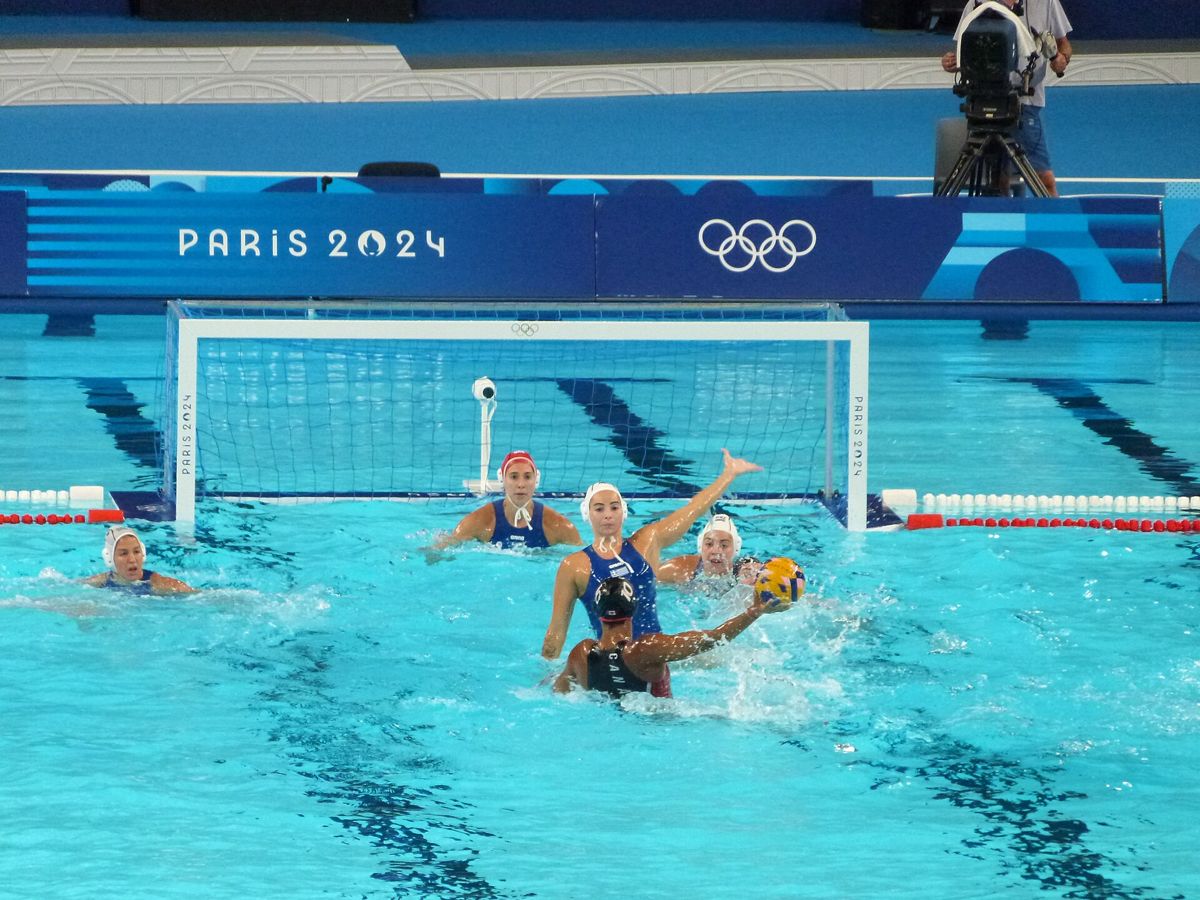
An attacker shooting at goal as the goalkeeper in red reaches across
An attack on goal in the same match at Paris 2024, La Défense Arena.
Daieuxetdailleurs · CC BY 4.0 · Wikimedia Commons
A postal vote, 2024
The second route was fast. In October 2024 the technical committee recommended a new package. The men's field would shrink from 30 metres to 25, the size the women already used. The possession clock would drop to 25 seconds and the exclusion to 15. Coaches would get a video challenge. The package had been presented as a set of trials for the 2025 World Cup. In November the federation's Bureau adopted it outright by postal vote, with no congress and before any trial.
Leading coaches objected, and more to the method than to the content. Dejan Savić, the former coach of Serbia, called the process "devastating" and the challenge "a farce".
Six months later
The 2025 World Cup was played under the new rules. In May 2025 the federation went halfway back: 28 seconds to shoot, and 18 for an exclusion. Its letter to the national federations said the changes "seek to improve the overall speed and efficiency of the sport, while also enhancing the player safety and overall fairness at all levels of competition".
Coaches are still divided about the game that came out of it. Ratko Rudić said it had "lost much of the tactical component". Tom Hoad called it "more television appropriate now".
The shorter field stayed. The same seven players now cover a sixth less water, and every attack starts closer to goal. Water polo keeps no records that a shorter pool could spoil. What changed was the shape of the game.
Twelve women's teams
Women's water polo was played at world championships from 1986 and entered the Olympics in 2000 with six teams. In April 2025 the International Olympic Committee agreed a twelve-team women's tournament for 2028. It will be the same size as the men's for the first time.
10Blood in the water, and the fight nobody sees
Melbourne, 6 December 1956
Hungary met the Soviet Union in the Olympic pool, a few weeks after the Soviet army had crushed the Hungarian uprising. Hungary led 4–0 when the referees stopped the match. Ervin Zádor of Hungary climbed out of the pool with a cut head, and the photograph of him became the image of those Games. The match is remembered as Blood in the Water.
Hungary went on to win the gold medal, and many Hungarian athletes did not go home afterwards. The match changed no rule. It is still the one thing most people know about water polo, and it shows how much of the game is a fight.
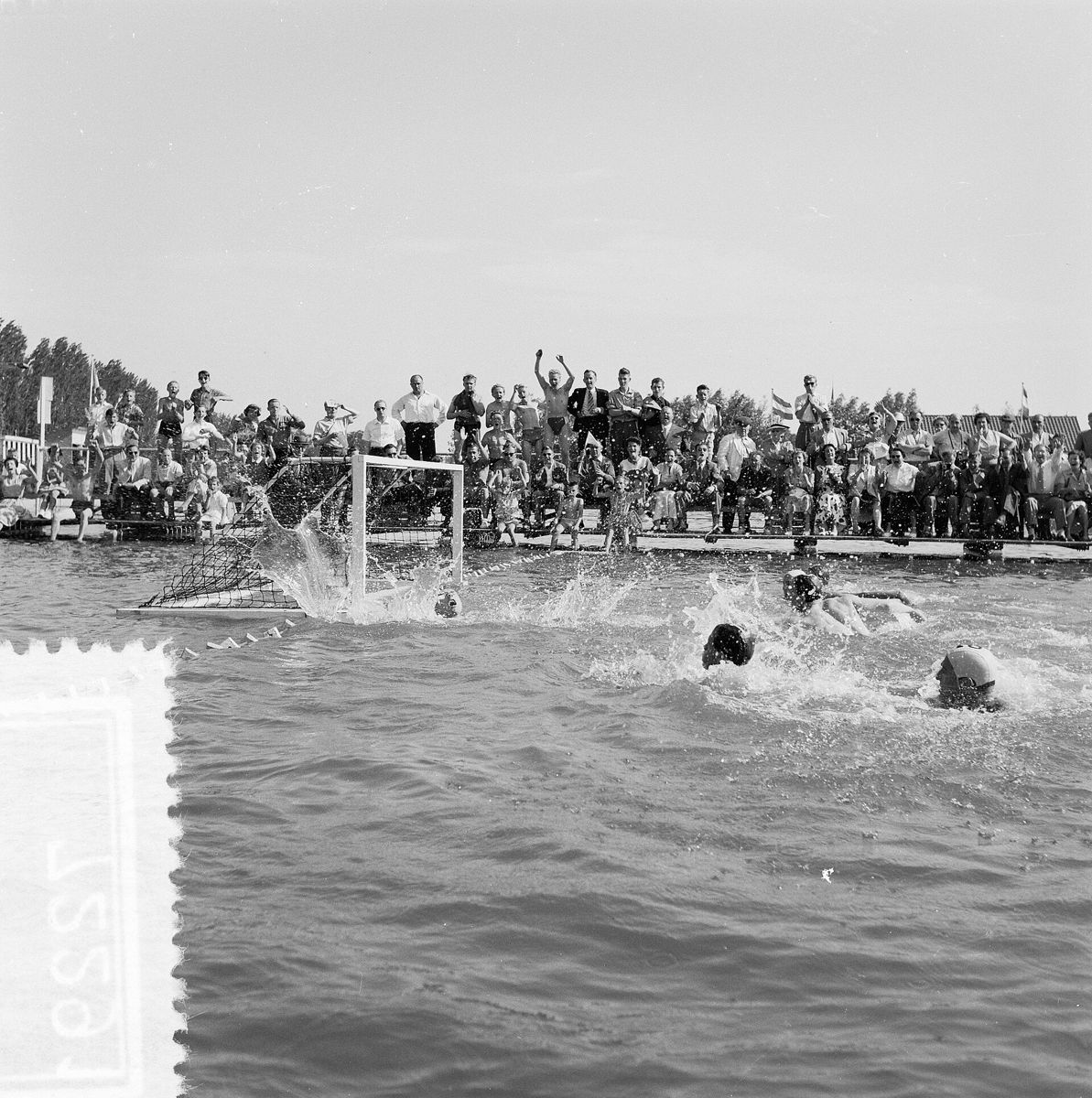
Players splashing in front of a goal in an outdoor pool with spectators behind
The Netherlands against Belgium in 1955.
Herbert Behrens / Anefo · CC0 · Wikimedia Commons
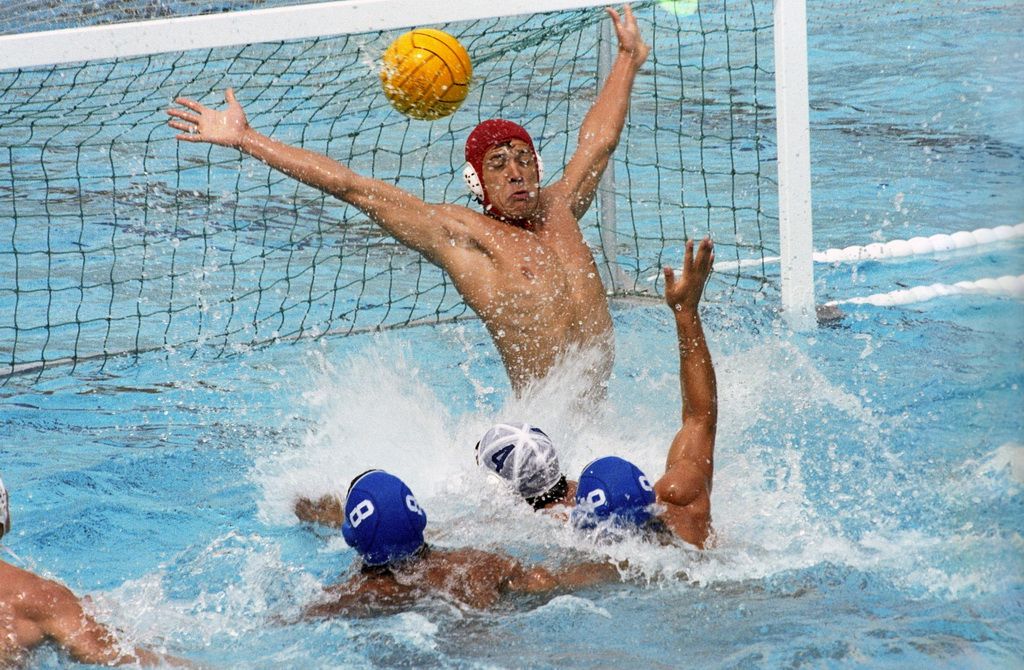
A goalkeeper in a red cap leaping to block a shot as attackers close in
Hungary against the Netherlands at the Moscow Olympics in 1980.
Vladimir Vyatkin / RIA Novosti · CC BY-SA 3.0 · Wikimedia Commons
The game under the surface
The lasting trouble in water polo is quieter. Holding, sinking and pulling back happen under the water, out of the referee's sight. For most of the sport's history the advantage went to the team that fouled best without being seen.
A centre forward wrestling for position with a defender in front of goal
The fight for the centre position in the men's final at Rio 2016, Serbia against Croatia: the contest the referees most need to see, much of it under the water.
Carlos Antonio Azevedo · CC BY-SA 4.0 · Wikimedia Commons
Players crowding the goalmouth in a scramble for the ball
A scramble in front of goal at Rio 2016.
Jorge Mello · CC BY-SA 4.0 · Wikimedia Commons
Wave after wave of rule changes has tried to open the game up. Players were allowed to keep moving after the whistle in 1949. Timed exclusions came in 1971. The clocks were shortened in 2005 and again in 2019. Researchers who have studied these changes read them as attempts to make the sport better to watch. One study of the 2005 rules found shots and goals both up by about eighteen per cent. The federation's own reasons for the older changes are not on record.
The exclusion clock
Since 1971 a major foul has sent the offender out of the water for a set time. That time has been cut again and again: sixty seconds at first, then forty-five, thirty-five and twenty. For six months it was fifteen, and since 2025 it has been eighteen.
The number matters because a power play is the likeliest way to score. Each change to the exclusion clock changes how every team attacks and defends.
Where it standsthe record, and what is still open · sections 11 to 12
11Series
No series has been assembled for this sport.
12What is still argued about
How rules get made. One package was tried out and voted on at a congress. The next was adopted by postal vote and partly reversed six months later. The federation has set up a group to revise the rules. Whether future changes go back to trials and a congress is the question under all the others.
The 25-metre men's field. Supporters say it brings more shots, less dead time and a game better suited to television. Opponents say it removes tactics and produces lopsided scores. Both views come from people who have coached at the highest level.
The clocks. Twenty-eight seconds to shoot and eighteen for an exclusion are compromises between the old 30 and 20 and the short-lived 25 and 15. Nothing suggests they are the final numbers.
Seeing the game. Video review and the coach's challenge have helped with goals and with violence. They cannot see under the water. Which hold was legal is still judged from above.