Air sports
Its federation ratifies aviation and spaceflight records, and decided where space begins.
- Official
- Air sports
- Game category
- Outside this taxonomy
- Adjudication
- Measured
- Standing
- Never Olympic
- rule changes
- 3
- comparability break
- 1
- Olympic editions
- 0
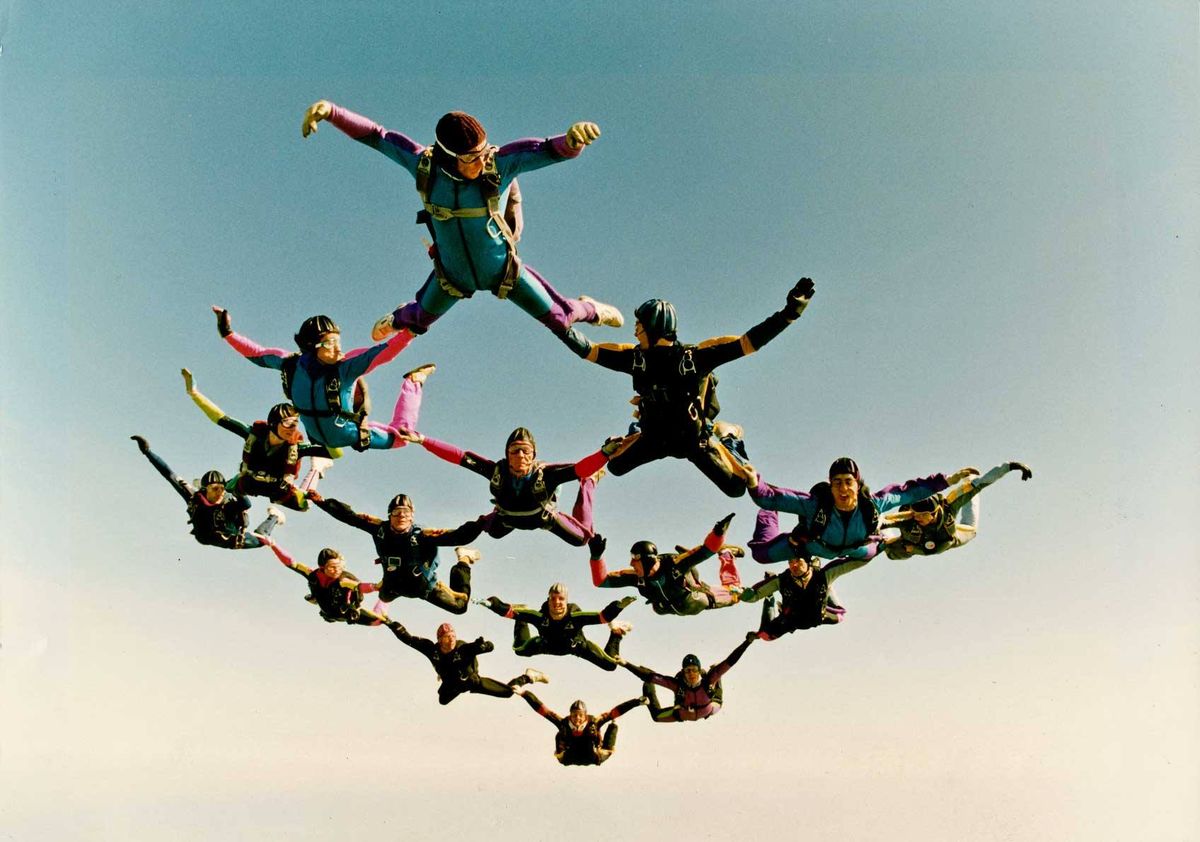
A sixteen-way skydiving formation over Peterborough, 2014 · Alistair Christie · CC BY-SA 4.0
- Governing body
- Fédération Aéronautique Internationale
- Founded
- The Fédération Aéronautique Internationale was founded in 1905 to certify aeronautical records — before the aeroplane was a practical machine, and before most of the sports on this site had international federations.
- Olympic status
- Not on the Olympic programme
- Also contested at
- World Games
A federation older than most of the sports it sits beside, governing gliding, ballooning, parachuting, paragliding, hang gliding, aerobatics, aeromodelling and drone racing. Its competitors range from a pilot at four thousand metres to a person standing in a field with a controller. And because it was founded to certify records rather than to run competitions, it ratifies aviation and spaceflight performance generally — which is how a sports body came to define the boundary of space.
The gamewhat it is now · sections 1 to 5
01How it is played
One federation, many disciplines, and no single set of rules. Gliding scores tasks set on the day. Parachuting measures a landing to the centimetre. Aerobatics is judged. Drone racing is a stadium race flown by a pilot standing on the ground.
These figures were entered from the edition named above but have not been checked against its text line by line. Treat them as this site’s reading of the laws, not as a substitute for them.
The object of the game
It depends entirely on the discipline, and that is the honest answer.
Gliding flies a task — a course round turning points — for speed or distance. Parachuting hits a target, or performs formations against the clock, or flies a canopy through a course. Aerobatics performs a sequence and is judged. Ballooning navigates to markers. Drone racing goes round a course of gates fastest.
What unites them is the medium and the federation, not the contest.
- Disciplines
- Gliding, ballooning, parachuting, paragliding, hang gliding, aerobatics, aeromodelling, drones
The air
The field of play is the atmosphere, and it is the least standardised playing surface of any sport covered here — by a distance that is not close.
A glider stays up by finding rising air: thermals over heated ground, ridge lift on a hillside, mountain wave downwind of a range. None of that is available on demand, none is visible, and the day's weather determines what is possible. A task set on Tuesday cannot be flown on Wednesday.
Drone racing is the exception: a stadium course of illuminated gates, indoors or out, which is why it is the discipline the federation can actually present to an audience.
- Playing surface
- The atmosphere
- Standardised
- Only in drone racing
- Gliding lift
- Thermal, ridge and mountain wave
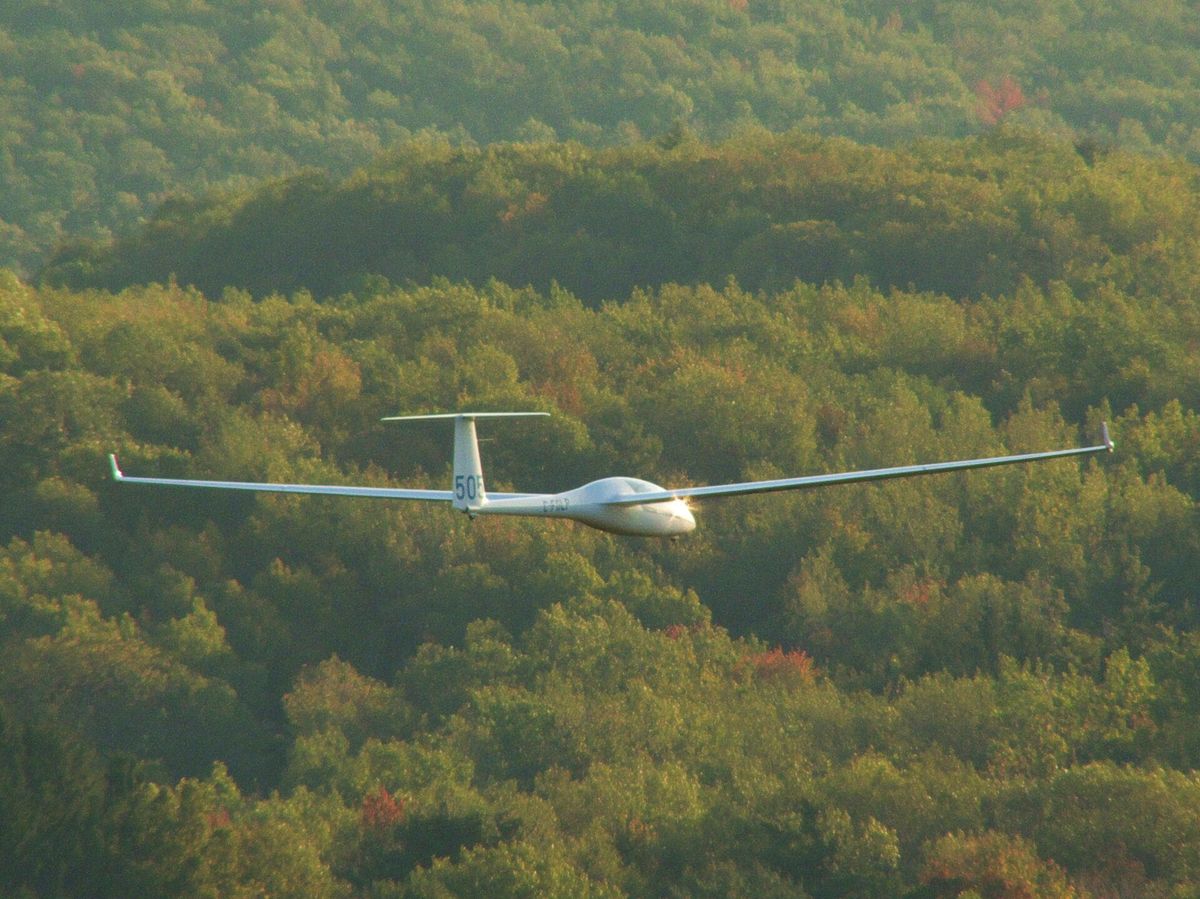
A DG-505 two-seater ridge soaring in Pennsylvania, 2007.
The field of play made visible. Wind meeting the ridge is forced upward, and the glider holds itself in that band of rising air just above the trees — lift that exists only while the wind blows from the right direction.
Dhaluza · CC BY-SA 4.0 · Wikimedia Commons
Aircraft
The aircraft is the equipment and it varies from a fifteen-metre-span composite sailplane to a paraglider that packs into a rucksack to a racing drone that fits in a hand.
Gliding manages equipment inequality by class: competitors fly within defined classes limited by wingspan or by a standard specification, so a contest is between pilots rather than between budgets. That is the same instrument sailing uses, and for the same reason.
Parachuting, paragliding and hang gliding all certify equipment for airworthiness, which is a category of regulation almost nothing else on this site needs: the equipment failing is not a competitive disadvantage.
- Gliding
- Classes by wingspan or standard specification
- Certification
- Airworthiness, not just fairness
Competitors and officials
A pilot, sometimes a crew, and in two disciplines a competitor who never leaves the ground: aeromodelling and drone racing are flown by someone standing in a field or a stadium.
That range is unmatched here. The same federation governs a person at four thousand metres in a sailplane and a person on the ground watching through goggles.
- In the air
- Most disciplines
- On the ground
- Aeromodelling and drone racing
This clause reads this way because of
Time
A gliding task can take five hours or be abandoned when the weather collapses. A drone race lasts a minute. A parachuting accuracy jump is decided in the last second of a descent.
The federation's disciplines have less in common in duration than in anything else.
- Gliding task
- Hours, weather permitting
- Drone race
- About a minute
Scoring
Gliding scores tasks relative to the field: points depend on what the other competitors achieved in the same air on the same day, because a fixed standard would measure the weather.
Parachuting accuracy measures the distance from the centre of a target to the first point of contact, electronically, to the centimetre.
Aerobatics is judged by a panel against a declared sequence, with deductions for deviation from the figure's geometry.
Drone racing is elapsed time.
One federation running a relative-scoring sport, a measured sport, a judged sport and a timed sport is a broader spread than any other body on this site attempts.
This clause reads this way because of
Launch
Gliders launch by aerotow or winch. Paragliders and hang gliders launch on foot from a slope. Balloons inflate and lift. Parachutists exit an aircraft. Drones start from a grid.
In several disciplines the launch is not part of the competition and is simply how you get to the start, which is unusual: for most sports the start is the contest's first moment.
Infringements
Airspace violations, which carry consequences outside the sport entirely. Missing a turning point or flying below a defined minimum height. Equipment outside the class or certification. In aerobatics, breaking the boundaries of the display box, which is penalised progressively.
Safety rules here are aviation regulations rather than sporting ones, and a competitor who breaks them may answer to a national aviation authority rather than to a federation.
Deciding the winner
Highest points, closest landing, best judged sequence, or fastest lap — by discipline. Championship gliding accumulates points over many contest days, so a title reflects consistency across whatever weather the week supplied.
Everything above is current law. Everything below is how Air sports got here.
02Disciplines and events
No Olympic events. Air sports are contested at the World Games in the disciplines that can be staged for an audience, and the federation runs world championships across a far wider range — as well as ratifying aviation records that have nothing to do with sport.
- Disciplines
- 1
- Olympic medal events
- 0
- Men’s and women’s counted separately.
- Contested elsewhere
- 12
- world games, world championship, federation only.
- Listed for context
- 2
- Not counted as this sport.
Contested at the World Games7
The disciplines that can be held in a venue with spectators.
- Paragliding accuracyWorld GamesWorld championship
- Canopy pilotingWorld GamesWorld championshipFlying a parachute through a course at speed, close to the water.
- Drone racingWorld GamesWorld championshipFirst world championship in 2018.
- Glider aerobaticsWorld GamesWorld championship
Contested in the air, away from spectators6
The federation's larger disciplines, held over open country and difficult to present to an audience.
- GlidingWorld championshipTasks scored relative to what the field achieved in the same weather.
- BallooningWorld championship
- Hang gliding and paragliding cross-countryWorld championship
- Skydiving formation and freefall disciplinesWorld championship
- Powered aerobatics and air racingWorld championship
- AeromodellingWorld championshipFlown by a competitor standing on the ground.
What else the federation does2
The FAI was founded in 1905 to certify records, and it still ratifies absolute aeronautical performance — including flights that are in no sense sporting.
- Absolute aviation recordsFederation onlyAltitude, speed and distance for aircraft, ratified regardless of whether the flight was a competition.
- Astronautic recordsFederation onlyThe federation's definitions extend above the atmosphere, which is how a sports body came to fix the accepted boundary of space at 100 km.
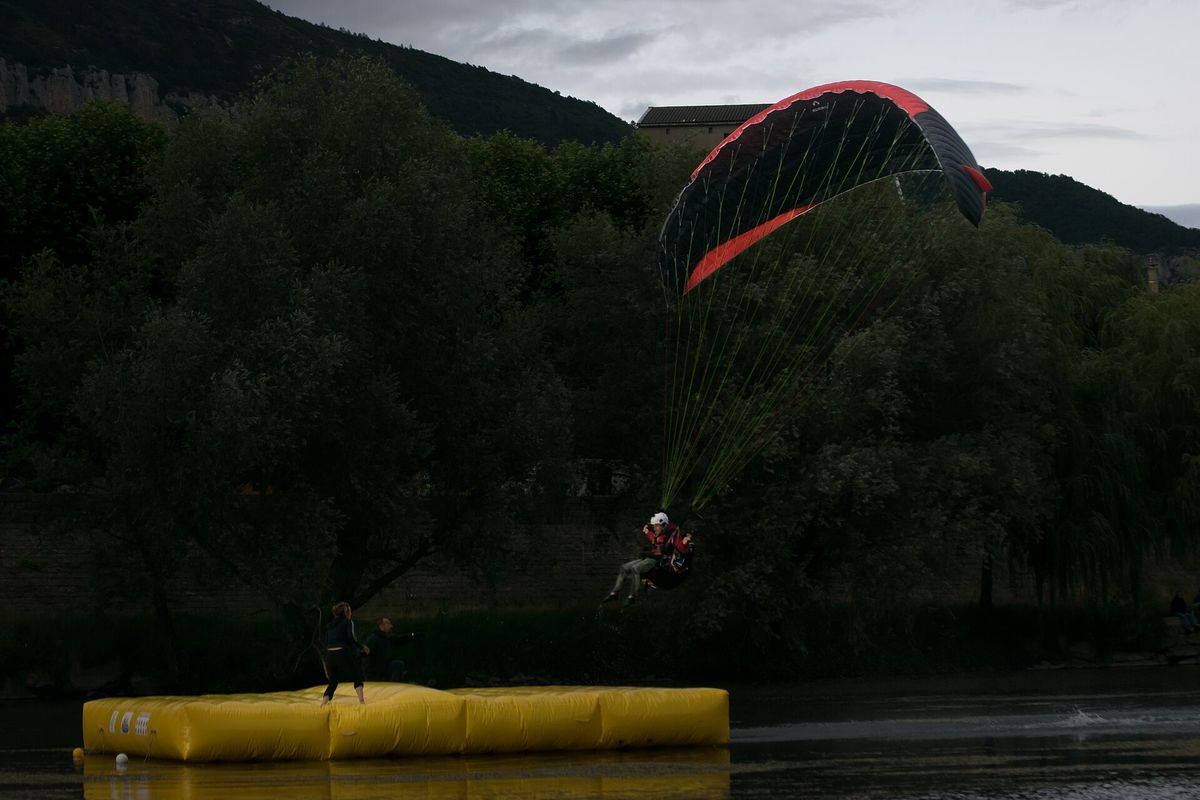
Paragliding accuracy at the Natural Games, Millau, 2017.
The pilot is aiming for the target on a floating pad, the whole contest in view of the riverbank. It can be staged in front of an audience, which is why it is one of the disciplines the World Games carries.
Antoine Lamielle · CC BY-SA 4.0 · Wikimedia Commons
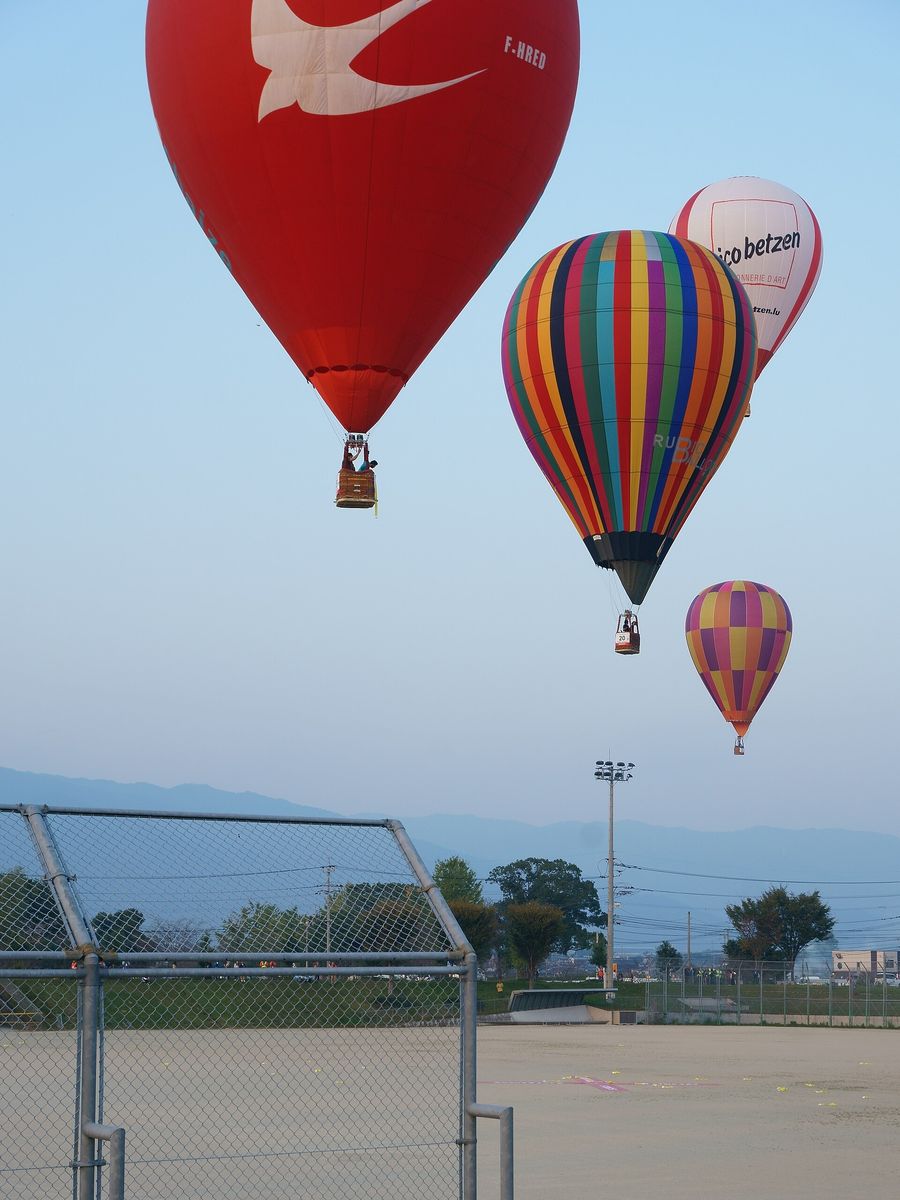
A pilot drops a marker at the 22nd FAI World Hot Air Balloon Championship, 2016.
A judge-declared-goal task: the pilot navigates to a cross laid out on the ground and drops a marker, the yellow ribbon, as close to it as they can. Ballooning, too, ends in a measurement.
Pekachu · CC BY-SA 4.0 · Wikimedia Commons
A sixteen-way skydiving formation over Peterborough, 2014.
Captioned by its uploader as a competition jump. The only view of it is the camera flyer's: a formation built at terminal velocity, thousands of metres above anybody who might watch.
Alistair Christie · CC BY-SA 4.0 · Wikimedia Commons
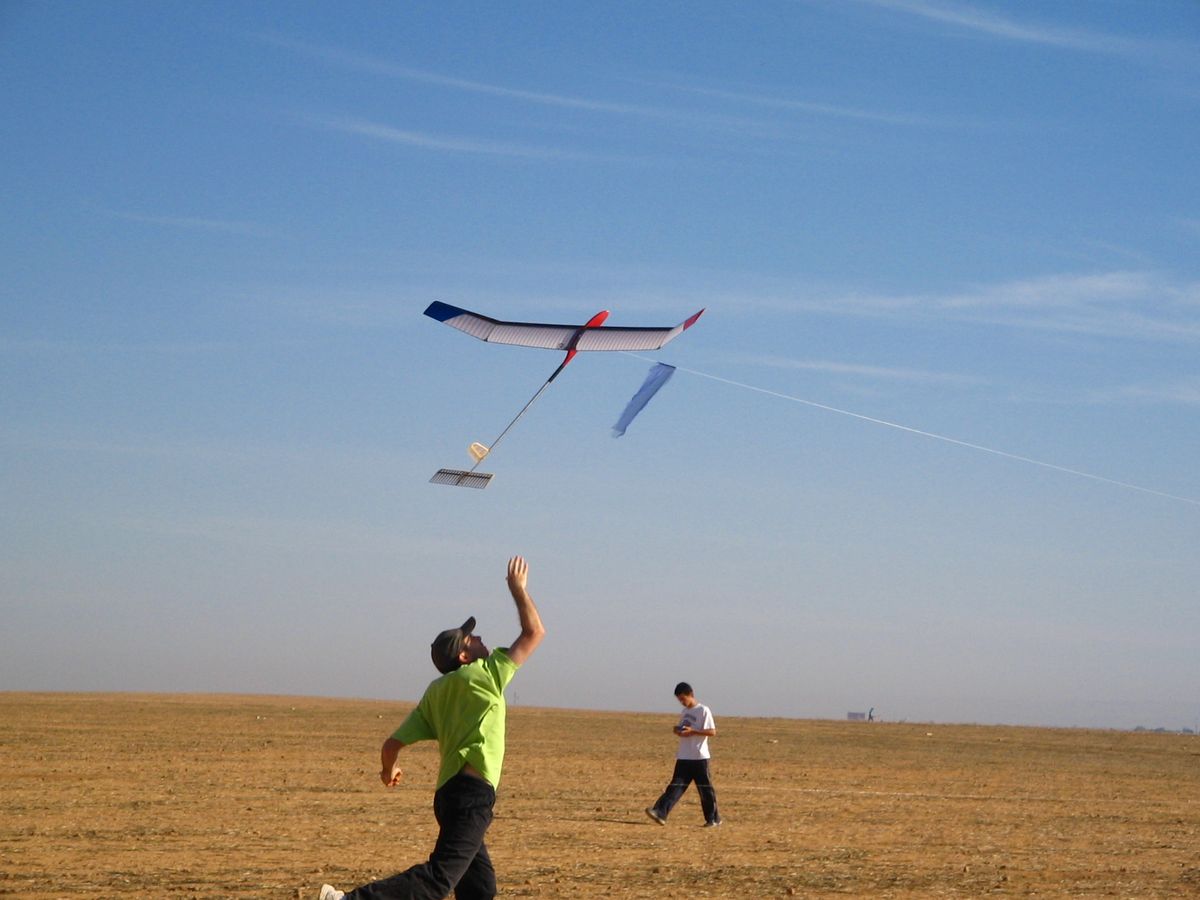
An F1A free-flight glider coming off its towline, 2005.
Aeromodelling's competitors stay on the ground. This class is towed up on a line and released to find lift on its own, and nothing steers it once it is off the line.
Liav he · CC BY-SA 4.0 · Wikimedia Commons
03Officiating
Almost everything here is verified after the fact, because there is nobody present to see it.
Evidence, not observation. A gliding task is flown out of sight over hundreds of kilometres. The proof is a secure recording flight logger carrying a GPS trace, checked afterwards against the declared task — did the pilot round each turning point, did they stay above the minimum height, did they start when they said. This is the same structure orienteering uses: an electronic record replacing an official who cannot be there.
Before loggers, the evidence was a camera and a barograph, and the sport's officiating history is largely the history of what counted as proof.
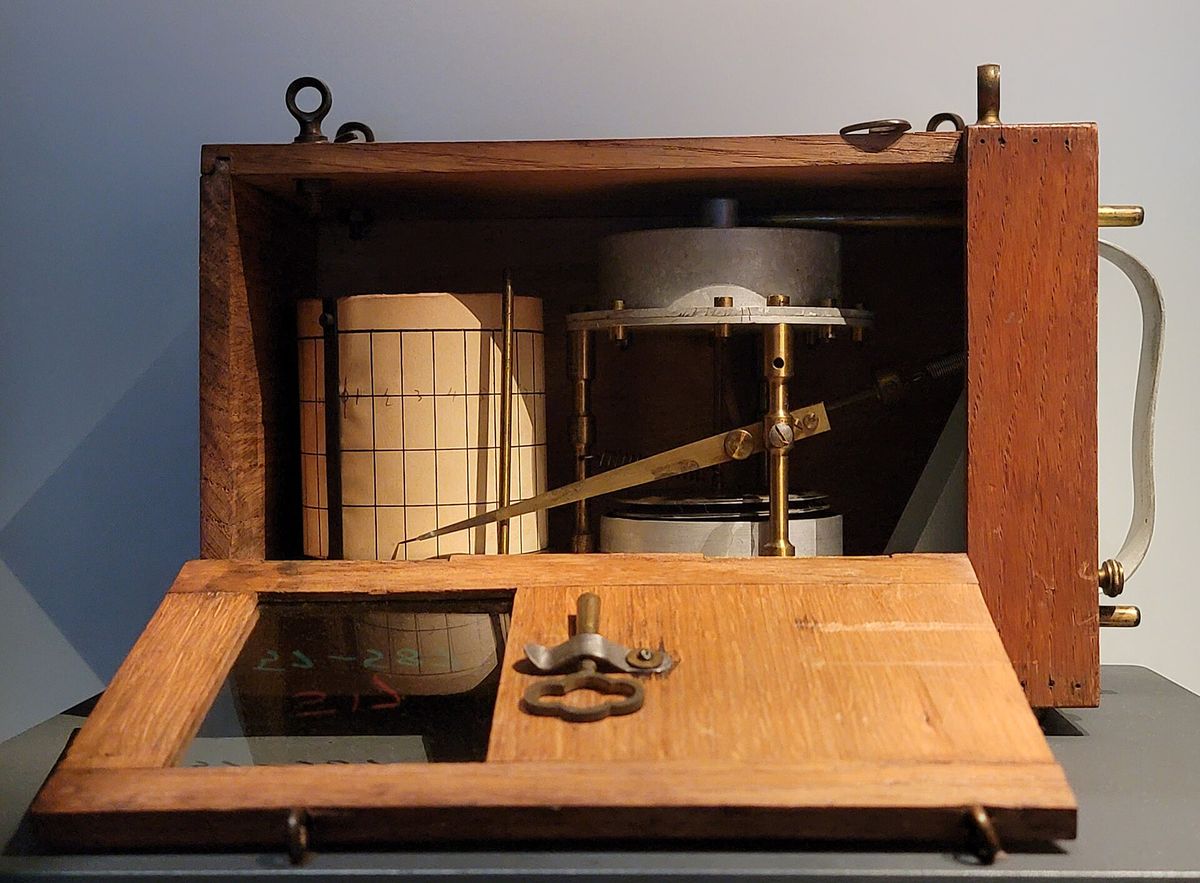
A French barograph of 1930, in the National Air and Space Museum.
A clockwork drum turning under a pen moved by air pressure, so the trace it leaves is height against time. Instruments of this kind were how a pilot proved a climb, or that they had not landed on the way, before the GPS logger replaced them.
Votpuske · CC BY 4.0 · Wikimedia Commons
Measured disciplines. Parachuting accuracy uses an electronic pad measuring the distance from the target's centre to the first point of contact, to the centimetre. Canopy piloting is timed and measured through a course. These are the least disputable results in the federation.
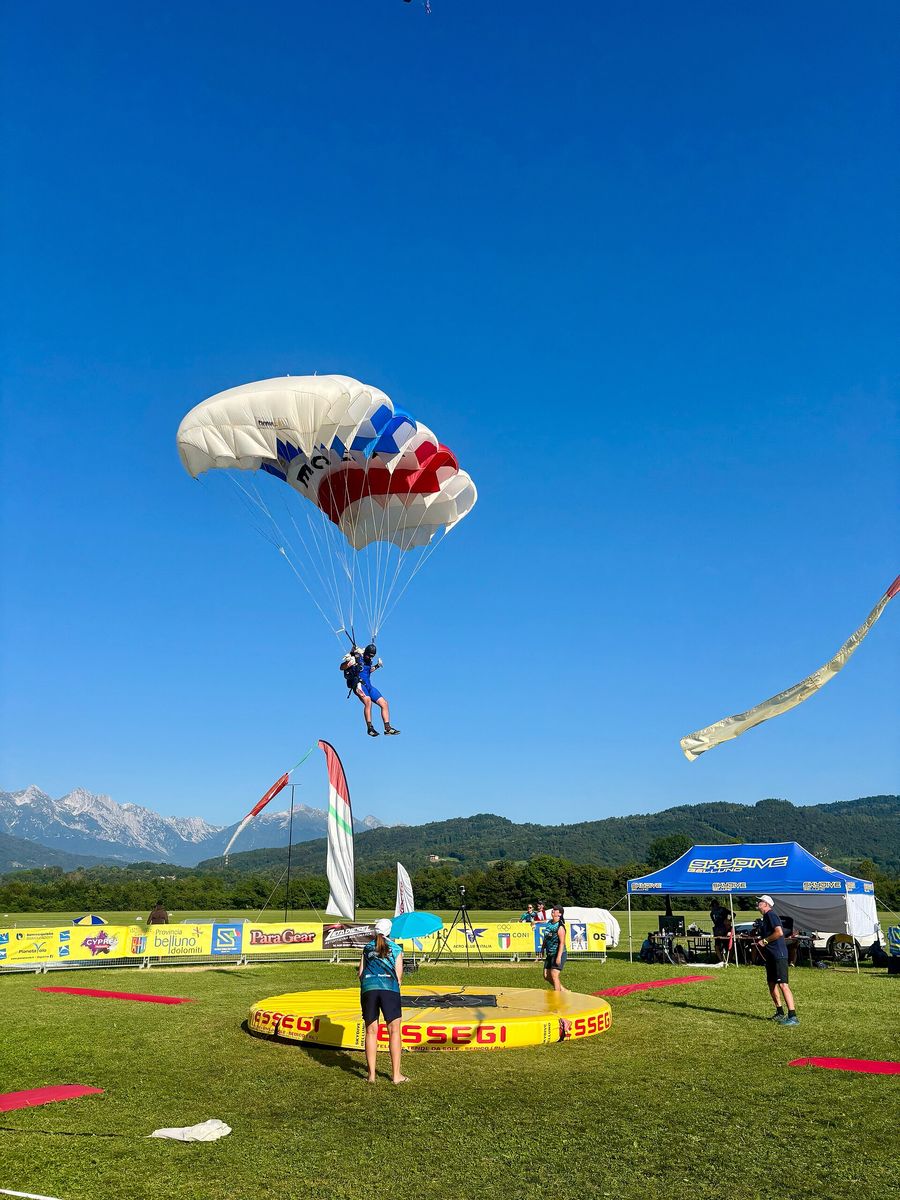
Accuracy landing at the Skydive World Cup Series, Belluno, 2025.
A competitor on final approach to the target pad in the middle of the field. The first point of contact is measured electronically from its centre, which is why this is among the least disputable results the federation produces.
kallerna · CC BY-SA 4.0 · Wikimedia Commons
Judged disciplines. Aerobatics is marked by a panel against a declared sequence, with deductions for deviation from each figure's geometry and penalties for leaving the display box. The pilot is the one person who cannot see the shape being drawn, which is a difficulty no other judged sport here imposes.
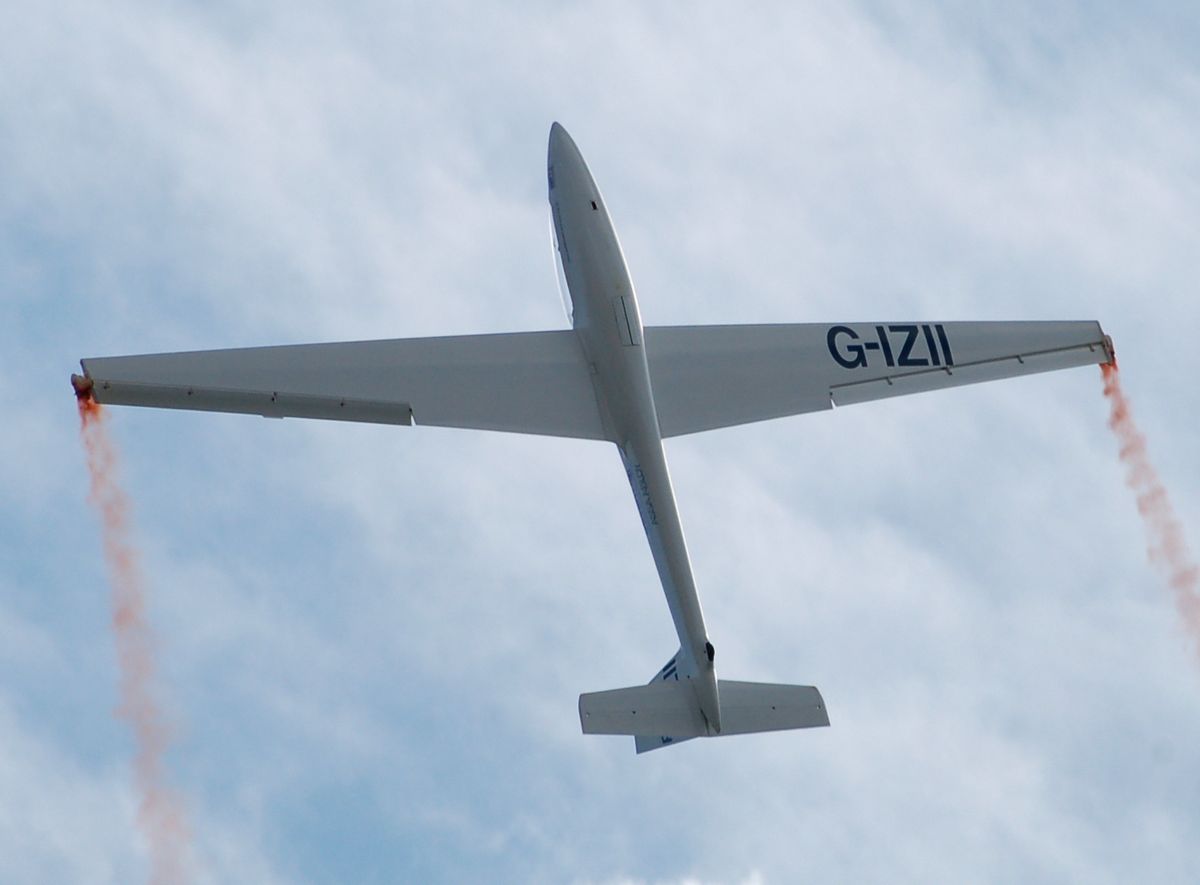
A Swift S-1 aerobatic glider trailing smoke at Kemble, 2009.
A display, not a judged flight. The smoke is for the crowd: it draws the figure being flown, which is the one thing the pilot cannot see, and the shape a judging panel would be marking against the declared sequence.
Adrian Pingstone · Public domain · Wikimedia Commons
Record ratification is the federation's oldest officiating function and its most consequential. A record claim is a dossier — instrument traces, witness statements, calibration certificates — assessed by people who were not present, which is exactly what the body was created in 1905 to do.
04Where it is played
Air sports go where the air is good and the money is available, which is a narrower intersection than it sounds.
Gliding is concentrated in Germany, Poland, the Czech Republic, France, Britain, Australia, New Zealand, South Africa and the United States. Germany is the historic centre — soaring flight developed there in the 1920s and 1930s, partly because the Treaty of Versailles restricted powered aviation — and it still has the deepest club structure and the largest manufacturers.
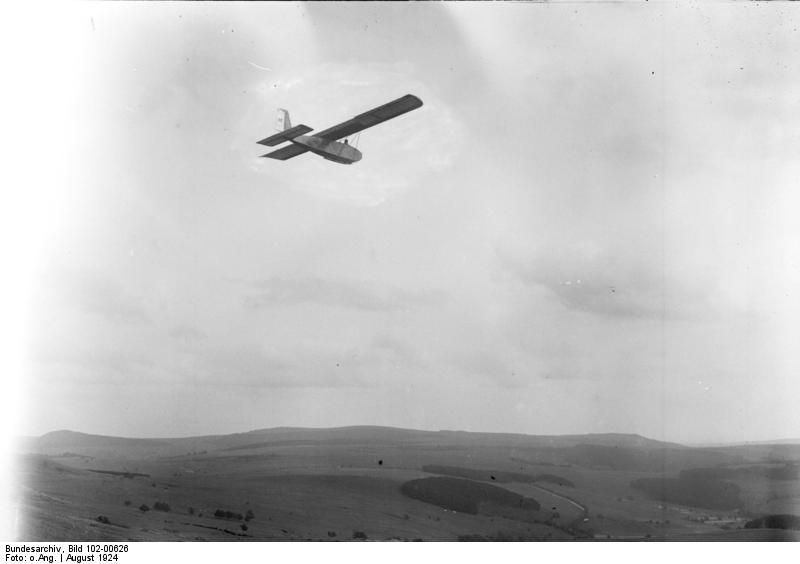
A glider fifty metres above the Rhön, August 1924.
From the same competition; the archive's caption names the pilot as Henzen. The Wasserkuppe was the centre of German gliding in these years, when the Treaty of Versailles restricted powered flying and gliding was one of the few ways left to fly.
Bundesarchiv, Bild 102-00626 (photographer unknown) · CC BY-SA 3.0 de · Wikimedia Commons
Records follow the weather rather than the clubs. The great distance flights are made where mountain wave conditions are reliable: the Andes above all, along with New Zealand's Southern Alps and a few comparable ranges. A record book is therefore partly a map of orography.
Paragliding and hang gliding concentrate around suitable terrain — the Alps, the Pyrenees, Turkey, Nepal, Colombia, Brazil — and are the most globally distributed of the air disciplines because the equipment travels in a car.
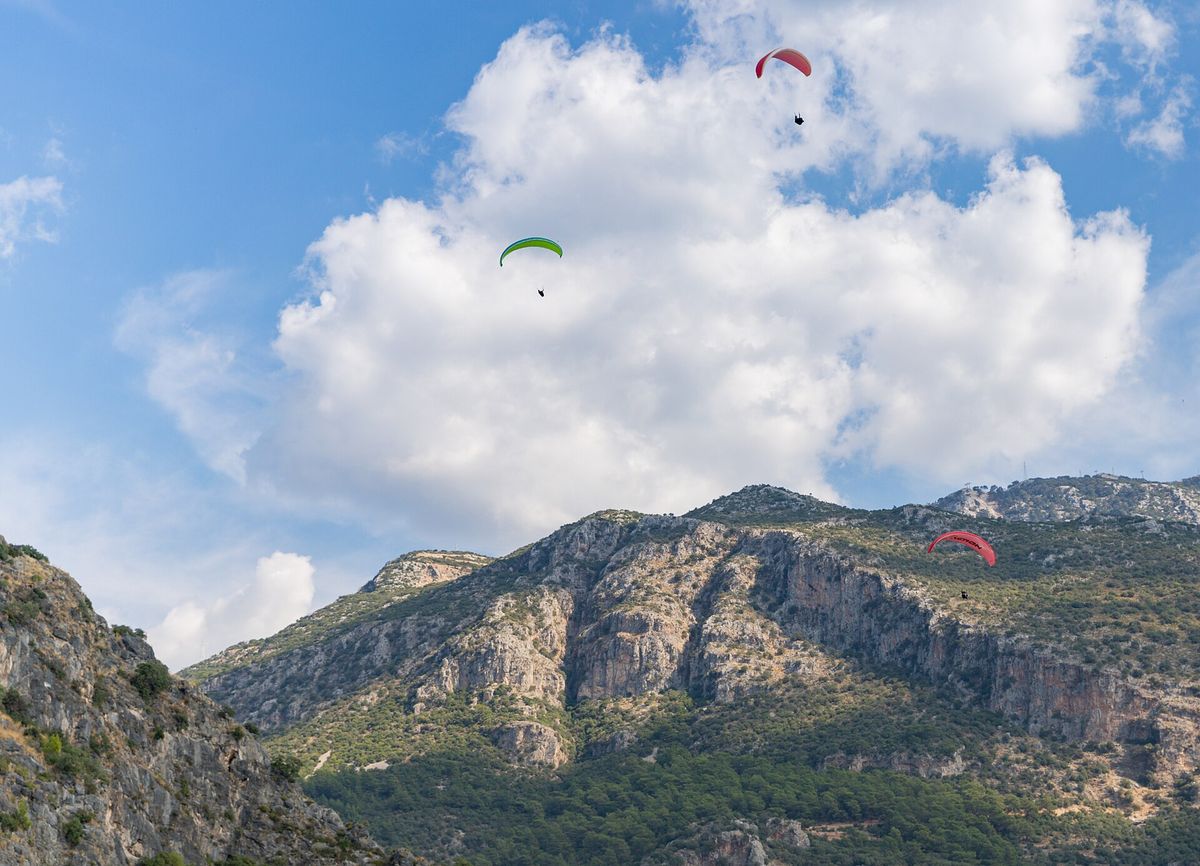
Paragliders over Ölüdeniz, Turkey, launched from Babadağ, 2019.
One of the terrain sites the sport concentrates around: a mountain close enough to the sea that a pilot can launch near the summit and land on the beach. Nothing in the frame needed an airfield.
dronepicr · CC BY 2.0 · Wikimedia Commons
Drone racing has no geography at all in the traditional sense. It grew online, its strongest pilots are young, and national representation reflects where communities formed rather than where facilities exist. It is the only discipline here that a country can be good at without owning an airfield.
The unifying constraint is that most air sports need airspace, and airspace is allocated by states for reasons that have nothing to do with sport. A country with excellent weather and restrictive airspace has no gliding.
05Learning curve
The highest entry barrier of any sport on this site for most of its disciplines — you need an aircraft, a licence and an airfield — and one discipline you can start this week with a two-hundred-pound drone.
Editorial — the site’s reading, not a sourced claim
Barrier to entry
How hard is it to get to a real game?
An aircraft, a licence, an airfield and a club. Except in drone racing, where it is a controller and a field.
For most of the federation's disciplines the barrier is aviation itself. Gliding requires a club with launch equipment, an instructor, a licence earned over months, and an airfield. Ballooning requires a balloon and a crew. Parachuting requires an aircraft and a drop zone. None of that is cheap and none of it is available near most people.
Paragliding and hang gliding are the cheapest routes into the air — equipment that fits in a car, launched on foot from a hill — and they still need instruction, a licence in most jurisdictions, and suitable terrain.
Drone racing is the exception and it is a large one. A racing drone, a controller and goggles cost less than a set of golf clubs, the sport can be practised in a field or a car park, and a beginner is flying on the first day. It is the only discipline here that a person can take up alone.
Evidence
- Most disciplinesAircraftestimate
- GlidingMonths of instruction to fly soloestimate
- Drone racingEquipment costs less than a bicyclerule2018 — the rule this rests on
- Foot-launchedParagliding and hang gliding are the cheapest way into the airobserved
- Time to a first competitionYearsestimate
Barrier to the top
How hard is it to be good at?
Reading air you cannot see, for hours, with the weather deciding what is possible.
Championship gliding is the clearest case. A pilot must find rising air that is invisible, work it efficiently, choose a route across country that will still have lift when they get there, and decide when to leave a thermal — all while flying a task set that morning against pilots in the same air. The decisions compound over five hours, and a wrong one puts you in a field.
That skill is closest, on this site, to orienteering: reading an environment nobody standardised, at speed, where the mistake is a decision rather than a physical failure.
Aerobatics is a judged discipline flown under g-loading, where the geometry of a figure must be exact and the pilot is the only person who cannot see the shape they are drawing.
Parachuting accuracy asks for a landing measured to the centimetre after a descent through air that is moving.
And drone racing, the accessible one, has a very high ceiling of its own: flying at speed through gates, seen through a camera, with reaction times that select hard for young pilots.
Evidence
- Tasks scored relative to the fieldSince 1937ruleA fixed standard would measure the weather rather than the pilot.1937 — the rule this rests on
- The lift is invisibleThermal, ridge and waveobservedThe central skill is reading an environment that cannot be seen.
- Records certified since 1905By the same bodyruleThe federation was created to arbitrate performance, not to run contests.1905 — the rule this rests on
- Typical peak age30–50 in gliding; under 25 in drone racingestimate
Why the two differ
High to very high, and it is the only sport on this site whose entry barrier is set by aviation law rather than by anything sporting.
You cannot begin most of these disciplines without a licence, an aircraft and a facility, and no rule change by any federation can alter that. Where every other sport here can lower its barrier by simplifying its equipment — as pétanque did in 1907 and flag football did by removing the tackle — air sports cannot, because the aircraft is not negotiable.
Drone racing is the exception that proves it. The moment the aircraft became cheap, disposable and legal to fly in a field, the barrier collapsed to almost nothing, and the discipline grew outside the federation entirely before being brought inside in 2018.
The historyhow it got here · sections 6 to 10
06Origin and invention
The Fédération Aéronautique Internationale was founded in 1905, which is two years after the first powered flight and earlier than the governing body of almost every sport on this site.
It was not founded to run competitions. It was founded to certify records — to decide what counted as a flight, what evidence a claim required, and who had the standing to ratify it. Aero clubs across Europe were watching performance claims multiply with no agreed way to check them, and the federation was the answer.
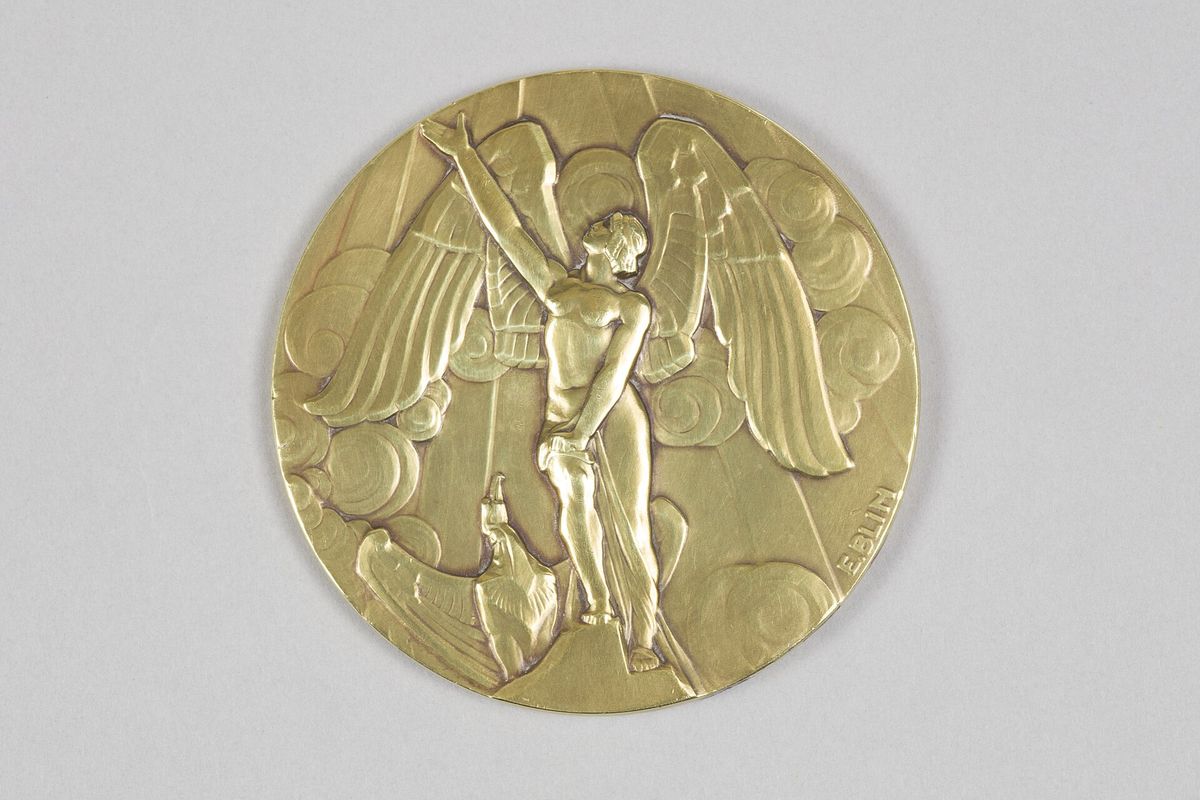
The FAI gold medal presented to Charles Lindbergh, awarded on 5 January 1928.
An award rather than a ratified record, so it is evidence of the federation's standing and not of its certifying work: twenty-three years after its founding, its recognition was something to present after the first solo crossing of the Atlantic. Lindbergh gave the medal to the Missouri Historical Society in 1933.
Missouri Historical Society (medal by Le Médaillier) · No known copyright restrictions · Wikimedia Commons
That founding purpose has never gone away, and it explains almost everything odd about air sports as a governed activity. The FAI ratifies absolute aeronautical records — altitude, speed, distance — whether or not the flight was sporting in any sense. Its definitions were used to settle the early history of aviation, and they extend upward: the widely accepted boundary of space at one hundred kilometres is a sporting federation's definition, adopted so that it could decide which records were aeronautical and which were astronautic.
Competition came later. The first world gliding championships were held in 1937, and gliding brought a problem with it that shaped how the federation scores things: a soaring flight depends entirely on the day's weather, so a fixed standard would measure the sky rather than the pilot. The answer was to set a task each morning and score competitors relative to what the rest of the field achieved in the same air.
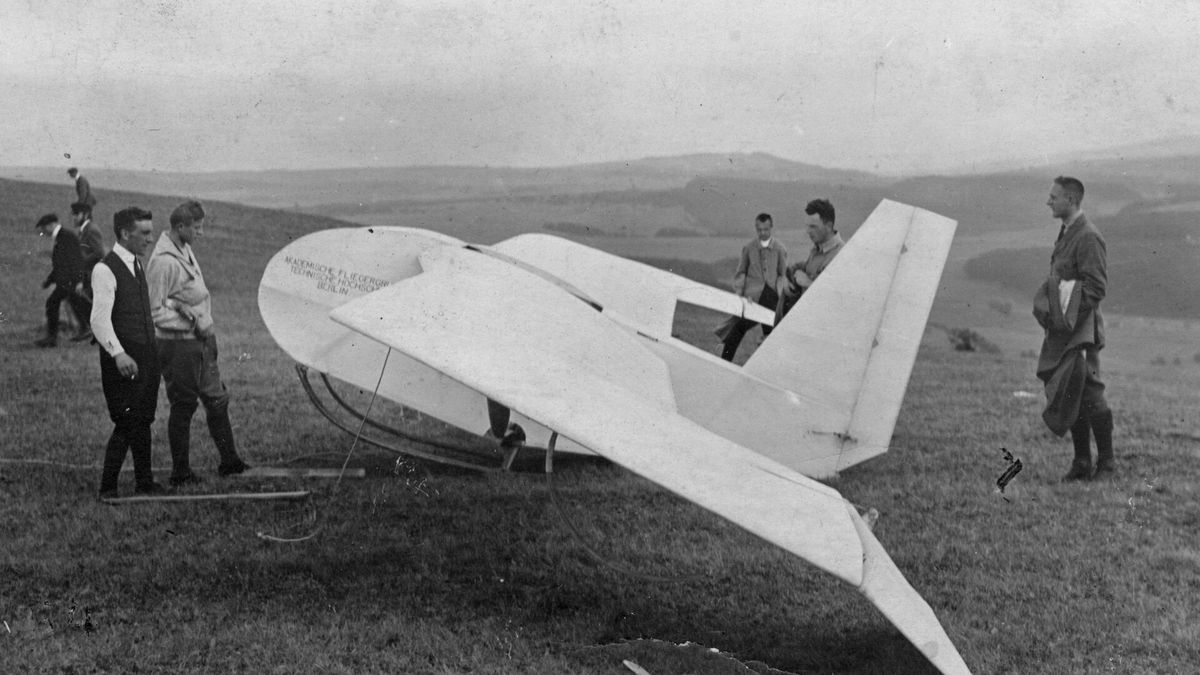
Akaflieg Berlin's glider Charlotte at the Rhön competition on the Wasserkuppe, August 1922.
A student club's aircraft at one of the Wasserkuppe contests, fifteen years before the federation's first world gliding championships. The launch point is a hillside and the ground crew is whoever is standing nearby: competition existed before anybody governed it.
Members of Akaflieg Berlin · Public domain · Wikimedia Commons
The federation has since accumulated disciplines — ballooning, parachuting, hang gliding, paragliding, aerobatics, aeromodelling and, from 2018, drone racing — that share a medium and very little else.
07Rule timeline
The sport’s own lane, expanded. Every entry carries a cause from the closed vocabulary and a citation, and says so where the citation is incomplete.
- 1905Fairness and eligibilityadopted 1905
The FAI was founded to certify aeronautical records: to define what a record was, what evidence was required, and who could ratify it. That is an unusual founding purpose. Almost every federation on this site was created to organise competition and acquired record-keeping as a consequence. The FAI was created to be the arbiter first, and the competitions came later. The consequence is that its remit reaches far outside sport. The FAI ratifies absolute performance records for aircraft — altitude, speed, distance — regardless of whether the flight was a sporting one, and its definitions have been used to settle questions that have nothing to do with competition.
Comparability break · Scoped to one competition
Records are certified by class, discipline and category, and the federation's remit extends to flights that were never sport. See the series
Trigger and citationIncomplete — no confirmed article
Trigger
Powered flight was two years old, claims of performance were being made without agreed measurement standards, and aero clubs across Europe needed a body that could say whether a record had been set.
FAI Sporting Code · FAI Sporting Code, general section
- 1937Fairness and eligibilityadopted 1937
The first world gliding championships were held, turning the federation from a record-certifying body into one that also runs competitions. Gliding competition required an invention: since a glider's performance depends entirely on the day's weather, the sport scores tasks set on the morning of each contest day, with points calculated relative to what the field achieved. A competitor is scored against the other pilots flying the same air, rather than against a fixed standard.
Trigger and citationIncomplete — no confirmed article
Trigger
Soaring flight had developed rapidly in Germany in the 1920s and 1930s and national contests existed, with no international competition and no agreed way to score a sport whose conditions change hourly.
FAI Sporting Code · FAI Sporting Code, Section 3 — Gliding
- 2018Commercialalso participation and accessadopted 2018
The FAI held its first world drone racing championship, formalising a discipline in which the competitor stands on the ground wearing goggles and the aircraft flies a course by itself — piloted remotely, seen through its own camera. The federation had governed aeromodelling for decades, so a pilot who never leaves the ground was not new. What drone racing added was a discipline where the aircraft is disposable, the course is a set of gates in a stadium, and the sport is watchable — which none of the federation's other disciplines had managed.
Trigger and citationIncomplete — no confirmed article
Trigger
First-person-view drone racing had grown rapidly outside any federation, organised by commercial leagues and online communities, and the FAI moved to bring it inside the international system.
FAI Sporting Code · FAI Sporting Code, Section 4 — Aeromodelling and drones
08Equipment evolution
In every other sport on this site the equipment serves the athlete. Here the equipment is an aircraft, and the athlete serves it.
Gliders went from wood and fabric to composite construction, and the performance metric that matters — glide ratio, the distance travelled per unit of height lost — improved by a factor that would be scandalous in any sport with records. A modern open-class sailplane glides more than sixty to one.
The federation's answer to that is the one sailing uses: classes. Standard, 15-metre, 18-metre, open and club classes limit span or specify a standard design, so a championship is a contest between pilots rather than between budgets. Without classes, gliding would be an equipment competition and everybody involved knows it.
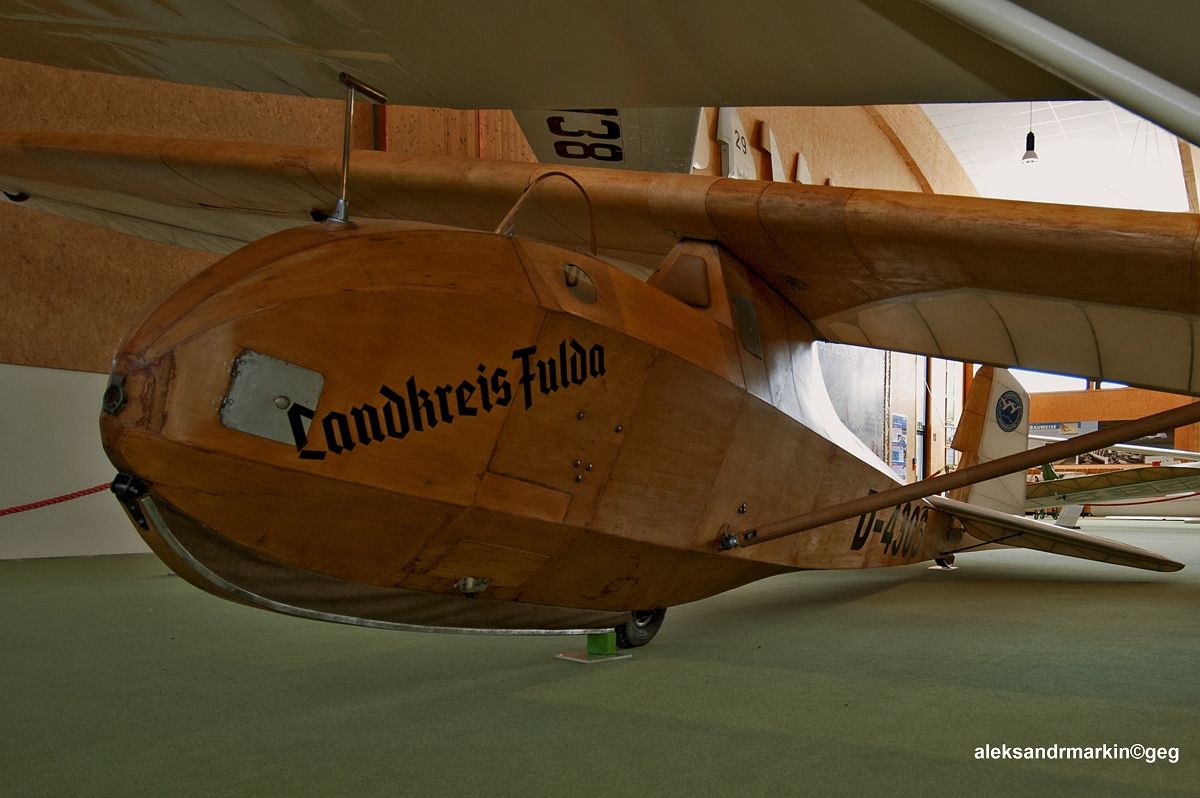
A Grunau Baby III in the German Gliding Museum on the Wasserkuppe.
Wood, with the grain showing. The Grunau Baby was a common club glider of its era, and the museum dates this one 1943/52. Set beside the eta, it is the distance gliding equipment travelled in a lifetime.
Aleksandr Markin · CC BY-SA 2.0 · Wikimedia Commons
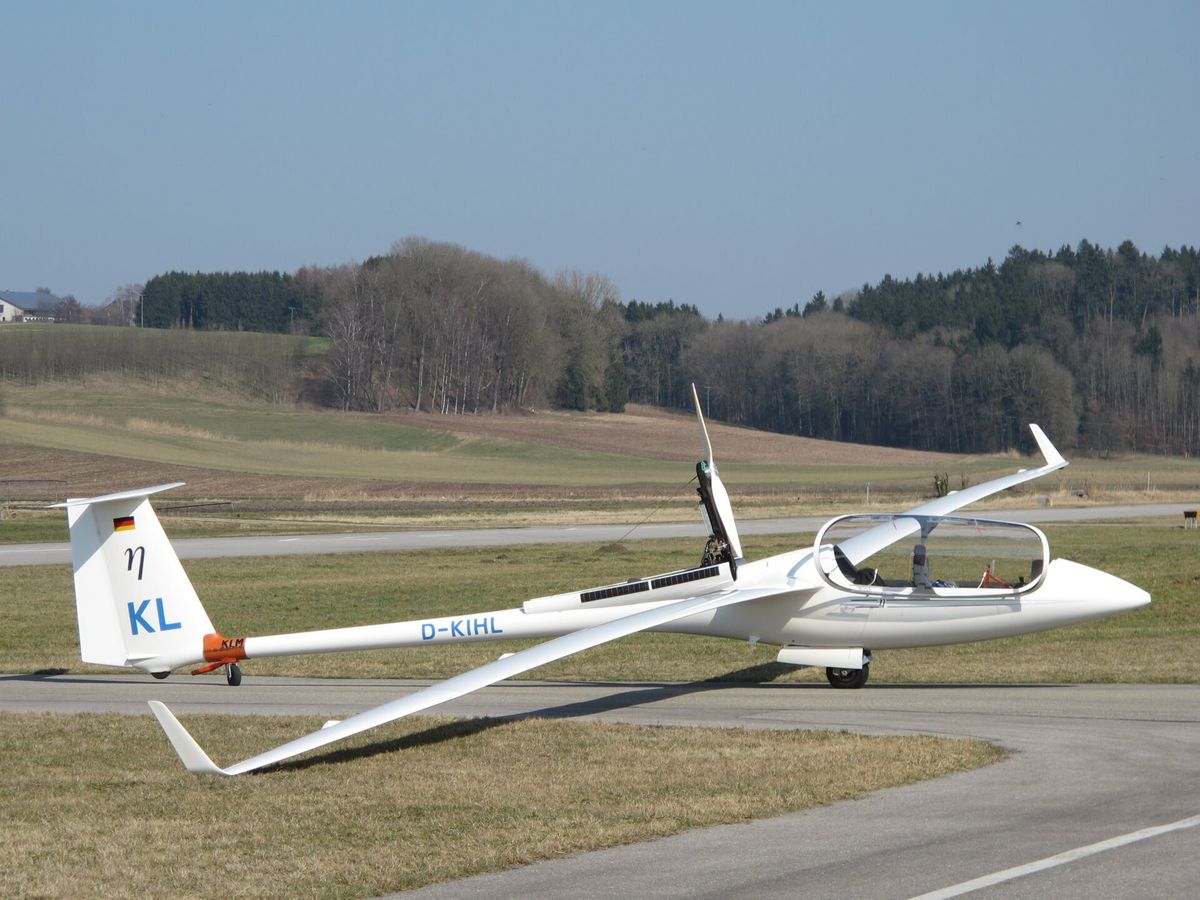
The eta, an open-class two-seat sailplane, taxiing in 2012.
Composite construction and a span of almost thirty-one metres, the largest sailplane built. Open class sets no limit on span, which is the only reason an aircraft like this has a class to compete in.
Eta-fliegen · CC BY-SA 3.0 · Wikimedia Commons
Paragliders and hang gliders made the opposite journey — towards equipment that packs into a rucksack and launches on foot — and they are the reason anybody can get into the air without an airfield.
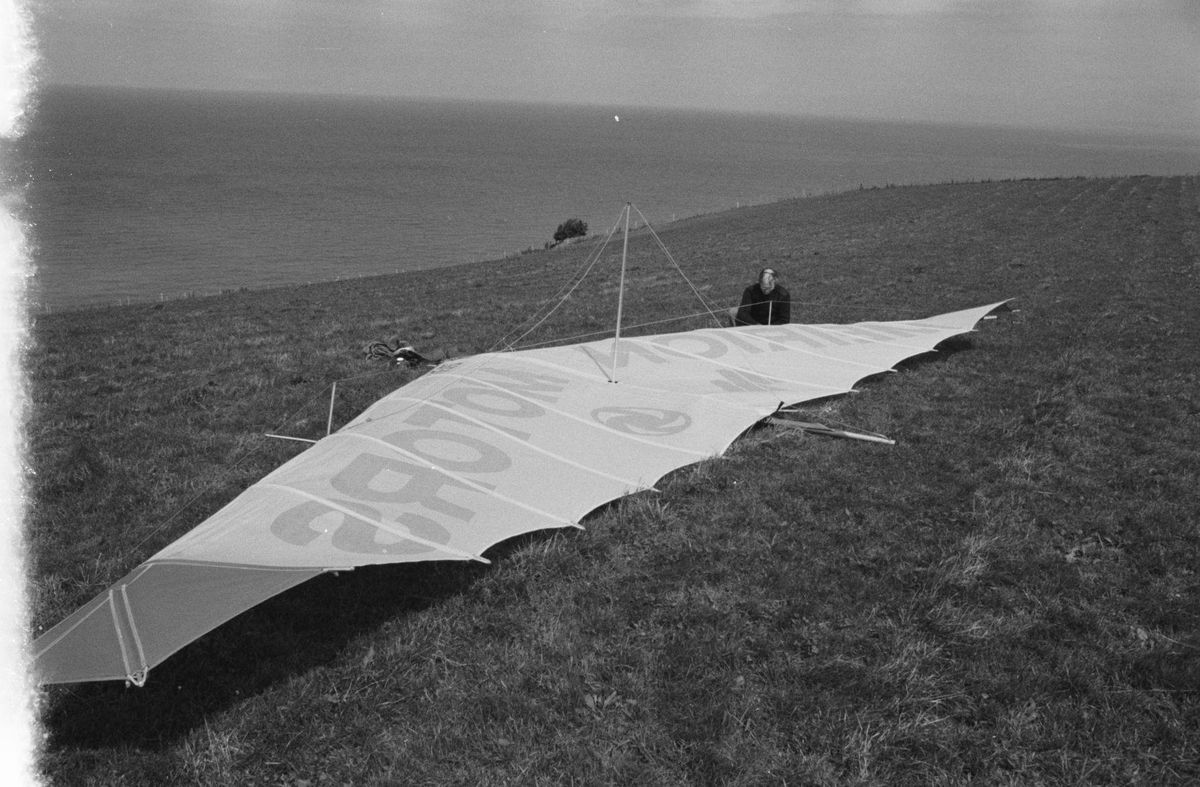
Jay Long with a hang glider on a hillside, September 1982.
From Geoff Charles's archive at the National Library of Wales. A wing that is carried up the slope and launched from the pilot's feet: no tow, no runway, no airfield.
Geoff Charles · CC BY-SA 4.0 · Wikimedia Commons
Parachutes became steerable ram-air canopies, which turned a descent into a flight and created the disciplines built on flying a canopy rather than surviving one.
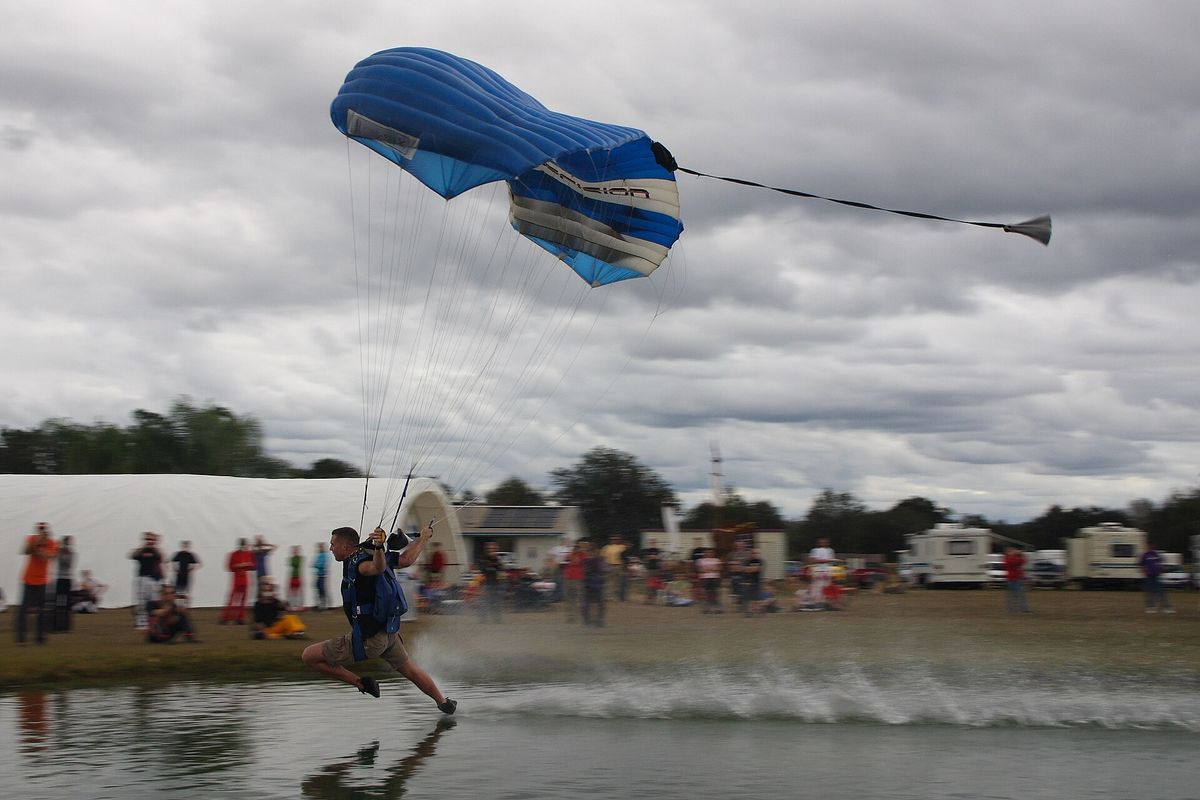
A canopy pilot skimming a pond, January 2008.
A ram-air canopy is a wing, and this is what that makes possible: a descent turned into a fast, flat pass over water, which is canopy piloting in miniature. The spectators on the far bank are the reason it is one of the disciplines the World Games carries.
Oskari Kettunen · CC BY 2.0 · Wikimedia Commons
Racing drones are the newest and the most disruptive. They cost very little, they are assembled and repaired by the pilot, and they are expected to crash. No other aircraft in this federation is disposable, and that single property is why drone racing's entry barrier is a small fraction of every other discipline's.
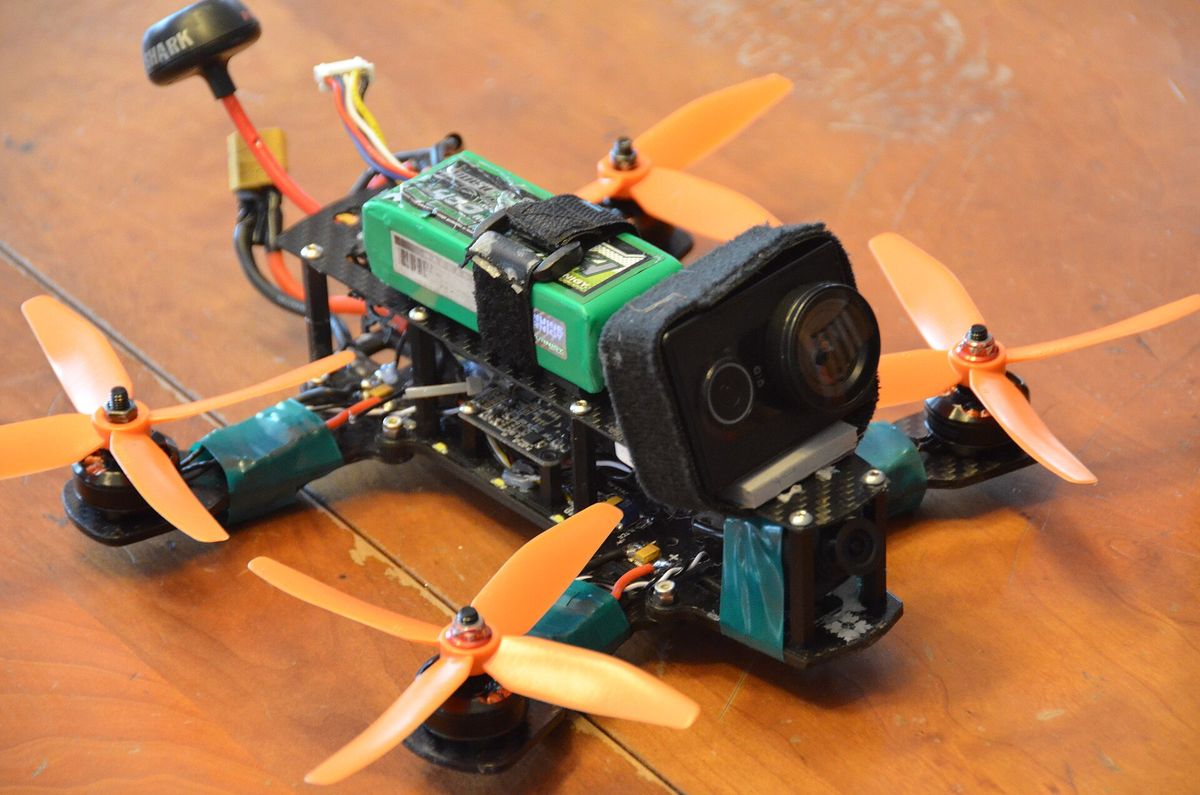
A 220-size racing quadcopter, 2016.
Frame, motors, camera and battery, held together partly with tape. Built by the pilot, repaired by the pilot, and expected to crash — the only aircraft in the federation that is disposable.
Commanderbryce · CC BY-SA 4.0 · Wikimedia Commons
Airworthiness certification runs through all of it — a category of regulation almost nothing else here needs, because in other sports equipment failure costs you the contest rather than more than that.
09Governing body politics
The FAI's problem is that it governs something magnificent that nobody can watch.
Its disciplines are among the most spectacular activities humans do, and almost all of them happen out of sight. A championship gliding task covers hundreds of kilometres of open country over five hours; the spectator experience is an empty airfield and, eventually, some aircraft coming back. Ballooning and cross-country hang gliding have the same problem. Skydiving formation work happens at terminal velocity, thousands of metres up.
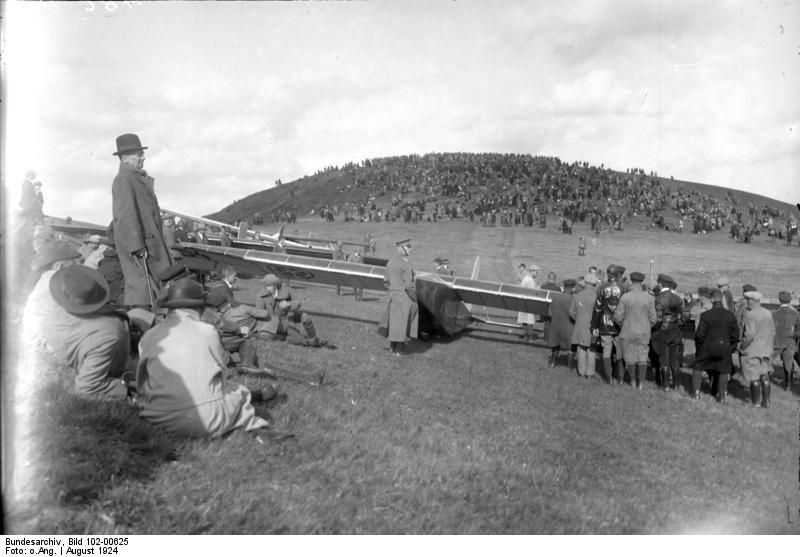
The launch site at the Rhön gliding competition, August 1924.
The archive's original caption remarks on the colossal crowd. In 1924 gliders were launched off the hill in front of it; once pilots learned to soar away across country, the contest left its audience behind.
Bundesarchiv, Bild 102-00625 (photographer unknown) · CC BY-SA 3.0 de · Wikimedia Commons
Everything the federation has done competitively in recent decades follows from this. The disciplines it takes to the World Games — paragliding accuracy, canopy piloting, glider aerobatics, drone racing — are precisely the ones that can be staged in a venue with an audience and a finish line.
Drone racing is the sharpest example. It grew entirely outside the federation, organised by commercial leagues and online communities, and it is the first discipline the FAI has that is natively watchable: a stadium, lit gates, a race lasting a minute, and a camera feed the audience sees exactly as the pilot does. The federation brought it inside in 2018.
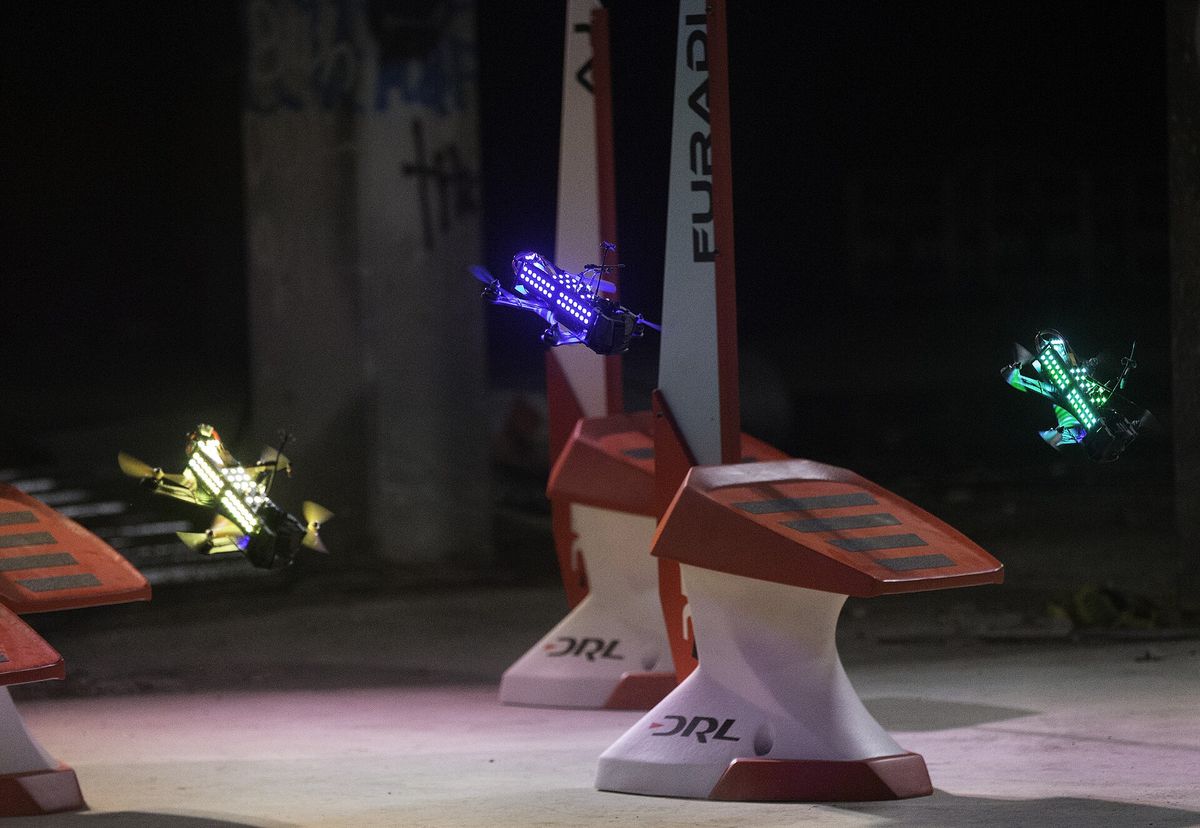
Drone Racing League aircraft leaving the start, Hawthorne, California, 2016.
A commercial league's race, two years before the federation held its first drone racing world championship. The discipline grew up like this — indoors, lit, filmed — and was brought inside the FAI afterwards.
Melanie Wallner · CC BY-SA 4.0 · Wikimedia Commons
The other half of FAI politics is not sport at all. As the ratifier of absolute aeronautical records it deals with manufacturers, air forces and space programmes, and its definitions carry weight outside its own membership. A body whose competition arm is a niche pursuit is simultaneously the accepted authority on where space begins.
There is no Olympic prospect and, unusually, very little sign the federation wants one.
10Controversies that forced rule changes
Scoring a sport the weather controls. Gliding's founding problem. A soaring flight depends on conditions nobody can produce on demand, so a fixed standard would measure the sky. The answer — set a task each morning and score competitors relative to what the field achieved in the same air — is one of the more elegant solutions on this site, and it means a gliding score is meaningless outside the day that produced it.
Equipment inequality. Glider performance varies enormously with money, and the federation contains it with classes limited by span or by standard design. It works, and it concedes that without it the sport would be decided by purchasing.
Where records can be set. The great distance records require mountain wave conditions that occur reliably in a handful of places, so the record book is partly a map of geography. The federation certifies them anyway, because certifying performance is what it was founded to do.
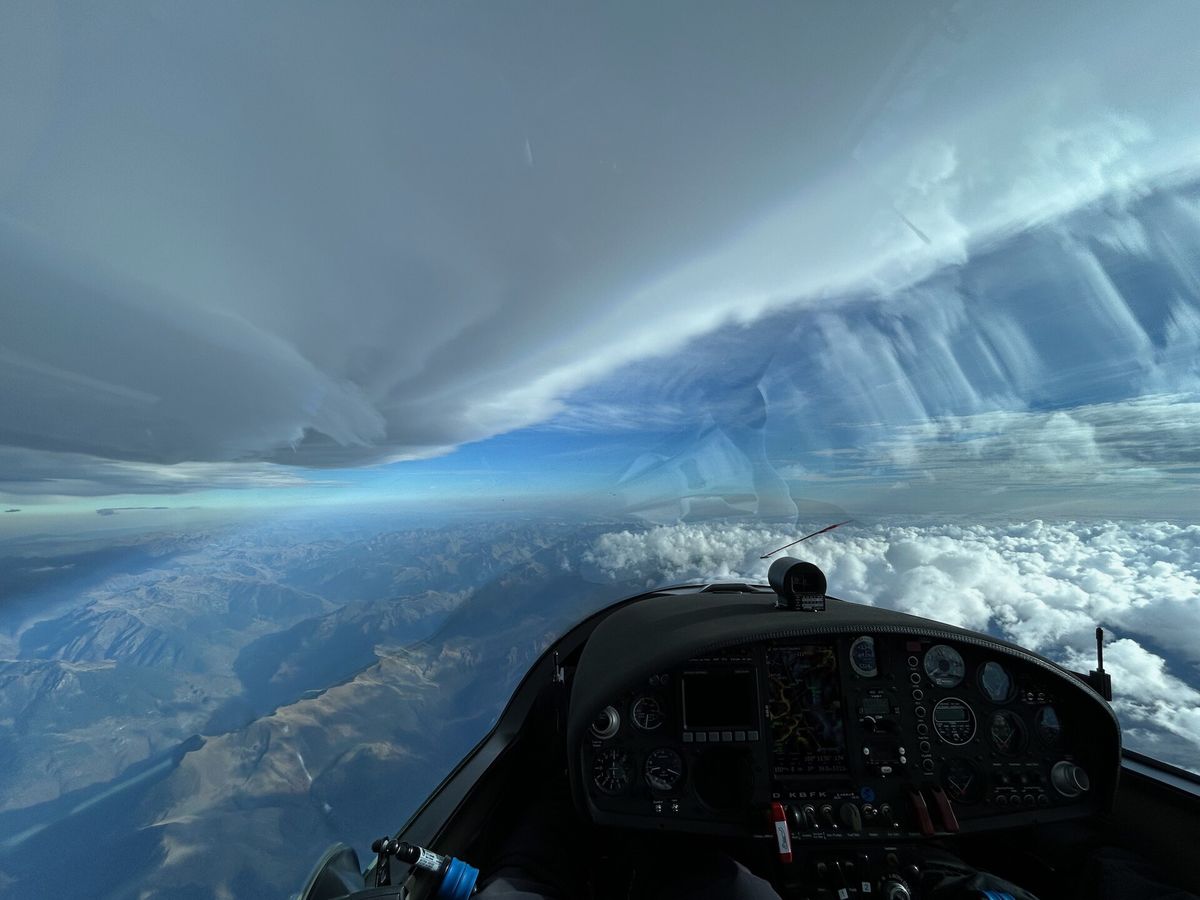
Mountain wave cloud over the Pyrenees, photographed from a glider at 5,320 m.
Wind crossing a range sets up standing waves in the air downwind, and a glider that finds one can climb far above the peaks and run along it. This is the Pyrenees, not the Andes where the great distance records are flown, but it is the same air — and the reason the record book follows the mountains.
Robert Prat · CC BY-SA 4.0 · Wikimedia Commons
Safety as external regulation. Air sports' safety rules are aviation law, enforced by national authorities, not by the federation. A competitor who violates airspace answers to a regulator. That makes air sports the only activity on this site whose most serious rules are written by people with no interest in the sport.
Drone racing's arrival. A discipline that grew outside the federation, in commercial leagues, and was brought inside in 2018. Whether an aviation body founded in 1905 is the natural governor of a stadium esport-adjacent activity is argued, mostly by people in drone racing.
Where it standsthe record, and what is still open · sections 11 to 12
11Series
No series can exist
Record progressions
The FAI ratifies more records than any other body on this site, and none of them belongs on a single line. The weather sets the ceiling. A gliding distance record requires a specific meteorological phenomenon — mountain wave downwind of a range, usually — that occurs reliably in a small number of places on earth. The great distance records are set in the Andes and in a handful of comparable ranges, and they measure the availability of a weather system as much as the skill of a pilot. Competitive gliding acknowledges this openly by scoring tasks relative to what the rest of the field achieved in the same air. The classes multiply. Records are held by aircraft class, by discipline, by category of flight, and by whether the aircraft was launched under its own power. A record is a fact about a category rather than about the sport. The remit exceeds the sport. The federation certifies absolute aeronautical performance — altitude, speed, distance — for flights that were never competitions, and its definitions extend beyond the atmosphere altogether. That is why the accepted boundary of space at 100 kilometres is a sporting body's definition, adopted for the purpose of deciding which records were aeronautical and which were astronautic. A chart cannot hold that. What this space records instead is the oddest fact about this federation: it was founded in 1905 to arbitrate performance rather than to run contests, and it has been arbitrating things far outside sport ever since.
1905Scoped to one competitionRecords are certified by class, discipline and category, and the federation's remit extends to flights that were never sport.
12What is contested now
Recorded as unsettled.
Whether the sport can be watched. The federation's largest disciplines happen out of sight over open country, and its competitive future depends on the handful that can be staged in a venue. That is a hard constraint, not a presentation problem.
Drone racing's place. It arrived from outside, it is the federation's only natively watchable discipline, and its constituency has little in common with the gliding and ballooning communities that built the FAI. How much weight it should carry is genuinely disputed.
Equipment classes. Gliding's classes keep competition between pilots rather than budgets, and every class boundary is an argument about which aircraft belong together.
Records and geography. The best distance records need weather systems available in a few places. Whether a record book that partly maps mountain ranges is measuring the sport is a question the federation has answered by certifying anyway.
Airspace. The binding constraint on air sports everywhere, decided by national regulators balancing commercial aviation, security and defence. Recreational flying loses those arguments steadily, and no sporting body has much leverage in them.
Being the arbiter of things that are not sport. The FAI ratifies absolute aviation and astronautic records and fixed the accepted boundary of space at 100 kilometres. Whether a sporting federation should hold that role, in an era of commercial spaceflight with a commercial interest in the answer, is a question being asked from outside the sport rather than within it.
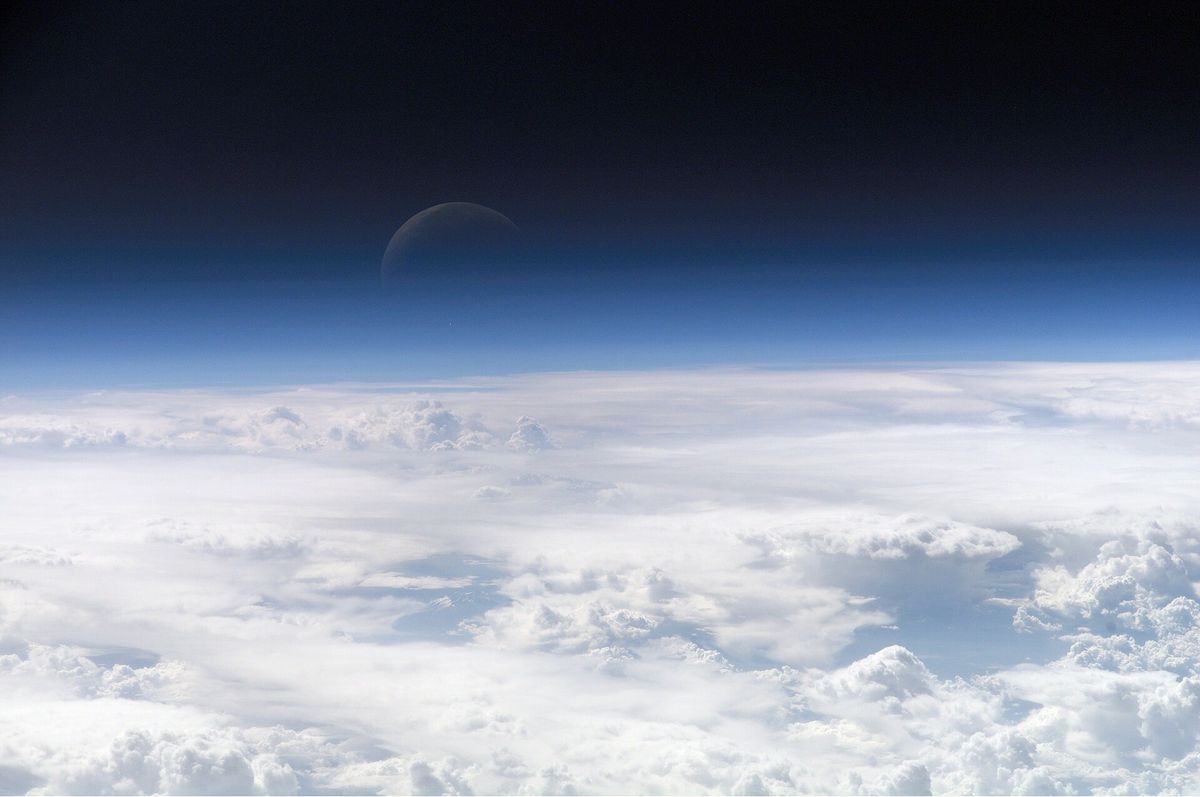
The top of the atmosphere, photographed from the International Space Station in 2006.
The station orbits far above the 100-kilometre line, and nothing in the picture marks where that line falls: the atmosphere thins out rather than ending. That is why a boundary had to be defined at all, and why defining it fell to the body that certifies records on either side of it.
NASA Earth Observatory · Public domain · Wikimedia Commons