Archery
Replaced the score with the scoreline in 2011, and made its own results incomparable overnight.
- Official
- Archery
- Game category
- Target
- Adjudication
- Measured
- Standing
- Removed, restored
- rule changes
- 5
- comparability break
- 1
- Olympic editions
- 19
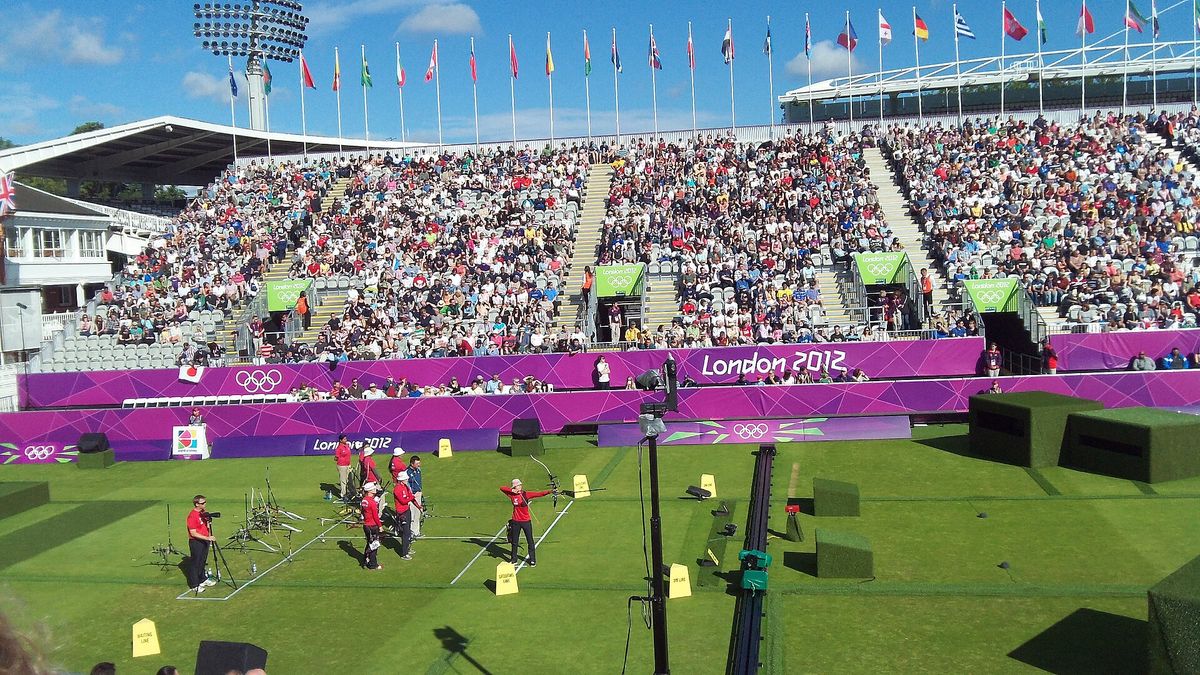
Olympic archery at Lord's Cricket Ground, 29 July 2012 · Mark Hillary · CC BY 2.0
- Governing body
- World Archery Federation
- Founded
- Fédération Internationale de Tir à l'Arc founded 1931; renamed World Archery Federation in 2011.
- Olympic status
- 19 editions
- on the 2028 programme
- Also contested at
- Asian Games, World Games
Archery is the purest measured sport on this site: a number produced by where an arrow landed, with no judgement and no opponent involved. Which makes what it did in 2011 remarkable. It stopped adding the numbers up. Head-to-head matches are now scored in sets, so the winner is not necessarily the archer who shot better — and every match score before that date is measured in a unit the sport no longer uses.
The gamewhat it is now · sections 1 to 5
01How it is played
Shoot arrows at a target 70 metres away and score more than your opponent — except that since 2011 "more" has not meant more points. Archery is the sport on this site with the least ambiguity in its measurement and, since it stopped simply adding that measurement up, one of the most contested relationships between what an athlete does and whether they win.
These figures were entered from the edition named above but have not been checked against its text line by line. Treat them as this site’s reading of the laws, not as a substitute for them.
The object of the competition
Put arrows as close to the centre of the target as possible. The target is divided into ten scoring rings, and an arrow's value is decided by where the shaft touches — with the higher value awarded if it touches a dividing line at all, which is why shaft diameter had to be limited.
There is no opponent interaction of any kind. Two archers shoot at separate targets, and nothing either does affects the other's arrow.
The field
An outdoor range with targets at a fixed distance, shot in the weather that happens to be there. Wind is not controlled for, not measured, and not compensated — which makes archery the one measured sport here that does not attempt to standardise its conditions.
- Olympic distance
- 70 m
- Target face
- 122 cm
- Ten ring
- 12.2 cm
- Inner ten
- 6.1 cm
- Used to break ties.
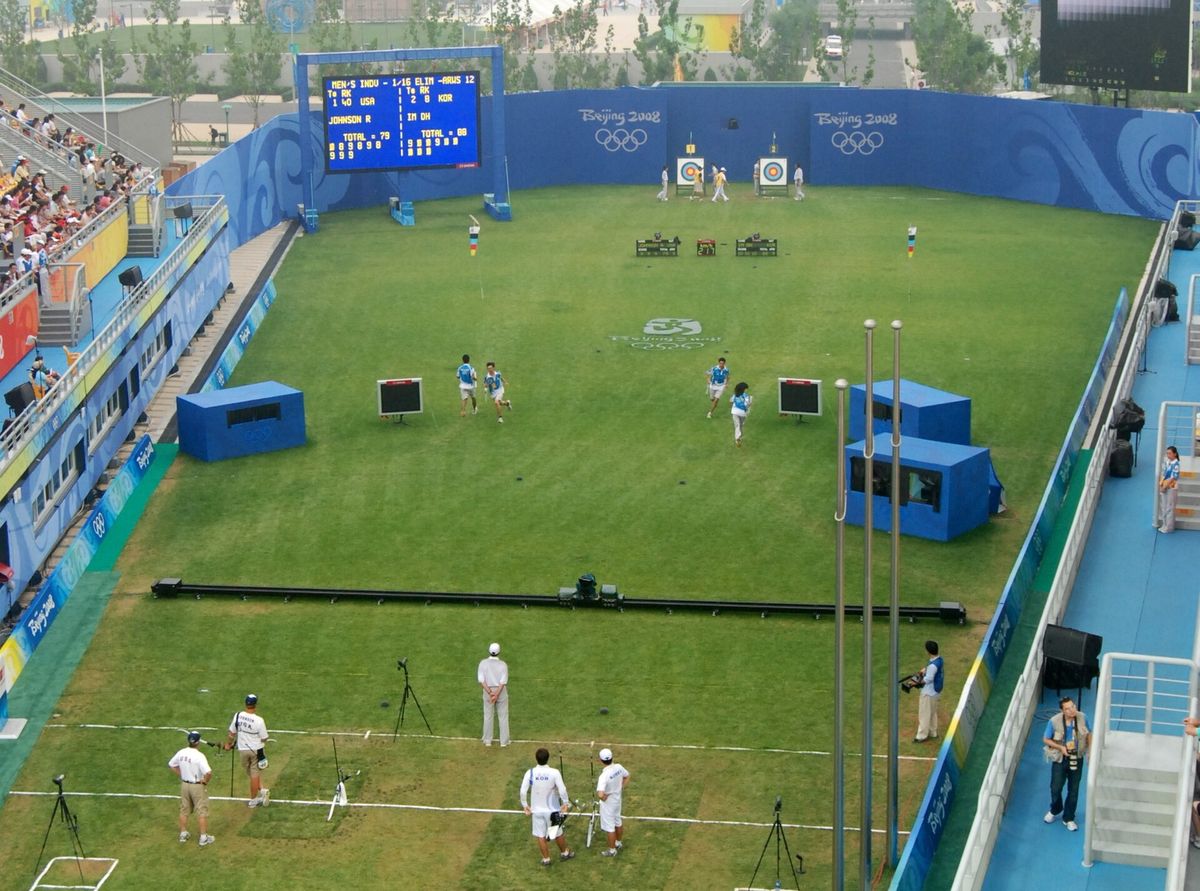
The Olympic Green Archery Field during the men's individual event, Beijing 2008.
The field from behind the shooting line: archers in the foreground, the targets at the far end, the scoreboard above them. It is flat, open and exposed to whatever wind there is, which the sport chooses not to regulate.
Shizhao · CC BY-SA 3.0 · Wikimedia Commons
World Archery Rulebook, Book 3 · Book 3 · article not confirmed
Bow and arrow
The Olympic discipline uses the recurve bow, which may carry a sight, a stabiliser and a clicker but no magnifying optics and no release aid. The compound bow, which has both, is a separate discipline and is not on the Olympic programme.
Arrows are limited to 9.3 mm in shaft diameter for outdoor target archery. A fatter shaft touches a higher ring more often, so without the limit an archer could buy points rather than shoot them.
- Olympic bow
- Recurve
- Magnifying sights
- Not permitted
- Release aid
- Not permitted
- Arrow shaft
- 9.3 mm max
This clause reads this way because of
Archers and officials
Individual, team of three, and mixed team of two. Judges call arrow values where an arrow touches a line, operate the timing, and inspect equipment. There is very little for an official to interpret, which is unusual on this site: the arrow is either touching the line or it is not.
Format
A ranking round of 72 arrows seeds the bracket, then head-to-head elimination. That structure dates from 1992 and replaced a format in which everyone shot a large number of arrows and the highest total won — a competition with no moment of victory and nobody to point a camera at.
- Ranking round
- 72 arrows
- Time per arrow
- 20 s
- In alternating match play.
- Match format
- First to 6 set points
Scoring
In the ranking round, arrows are added up, and that number means exactly what it says. In a recurve match they are not. Each set of three arrows is won, drawn or lost, worth two points, one or none, and the match goes to the first archer to six set points.
The consequence is the most argued fact in the sport: an archer can shoot more total points than their opponent across a match and lose it. A cumulative score and a set score are different quantities, and every match result before 2011 is recorded in the first while every result since is recorded in the second.
The mixed team event, added in 2021, still uses cumulative scoring — so the sport runs both systems at the same Games.
- Ring values
- 10 down to 1
- Set win
- 2 points
- Set draw
- 1 point
- Match to
- 6 set points
- Mixed team
- Cumulative
This clause reads this way because of
World Archery Rulebook, Book 3 · Book 3, match play · article not confirmed
Shooting order
Match play alternates: one archer shoots, then the other, twenty seconds each. A drawn match goes to a single-arrow shoot-off decided on value and, if still level, on which arrow is physically closer to the centre — measured, not judged.
This clause reads this way because of
Infringements
Shooting outside the time limit forfeits the highest-scoring arrow of that end. Equipment outside specification is not permitted onto the shooting line. Beyond that there is almost nothing to forbid, because there is almost nothing an archer can do to an opponent — which makes this the shortest prohibitions section on the site, and that brevity is itself the characteristic of a target sport.
Deciding the winner
Six set points, or the closer arrow in a shoot-off. Not, since 2011, the higher score.
This clause reads this way because of
Everything above is current law. Everything below is how Archery got here.
02Disciplines and events
Five Olympic events, all recurve, all at 70 metres. The compound bow — which has magnifying sights, a release aid and a mechanical draw — is a full World Archery discipline with world championships and is not on the Olympic programme, which is why the Olympic events all use a bow design that is essentially a refined version of a very old one.
- Disciplines
- 1
- Olympic medal events
- 5
- Men’s and women’s counted separately.
- Contested elsewhere
- 4
- paralympic, world games, world championship.
- Listed for context
- 1
- Not counted as this sport.
Recurve, outdoor target5
The Olympic discipline. Sights and stabilisers permitted, optics and release aids not.
- Men's individual
- Women's individual
- Men's team
- Women's team
- Mixed teamAdded 2021, and scored cumulatively rather than in sets.
Contested away from the Games4
- CompoundWorld championshipWorld GamesMagnifying sights and a release aid. World championship discipline; repeatedly proposed for the Games.
- Indoor targetWorld championship18 m, and scored cumulatively.
- Field archeryWorld championshipWorld GamesVarying distances over terrain.
- Para archeryParalympic
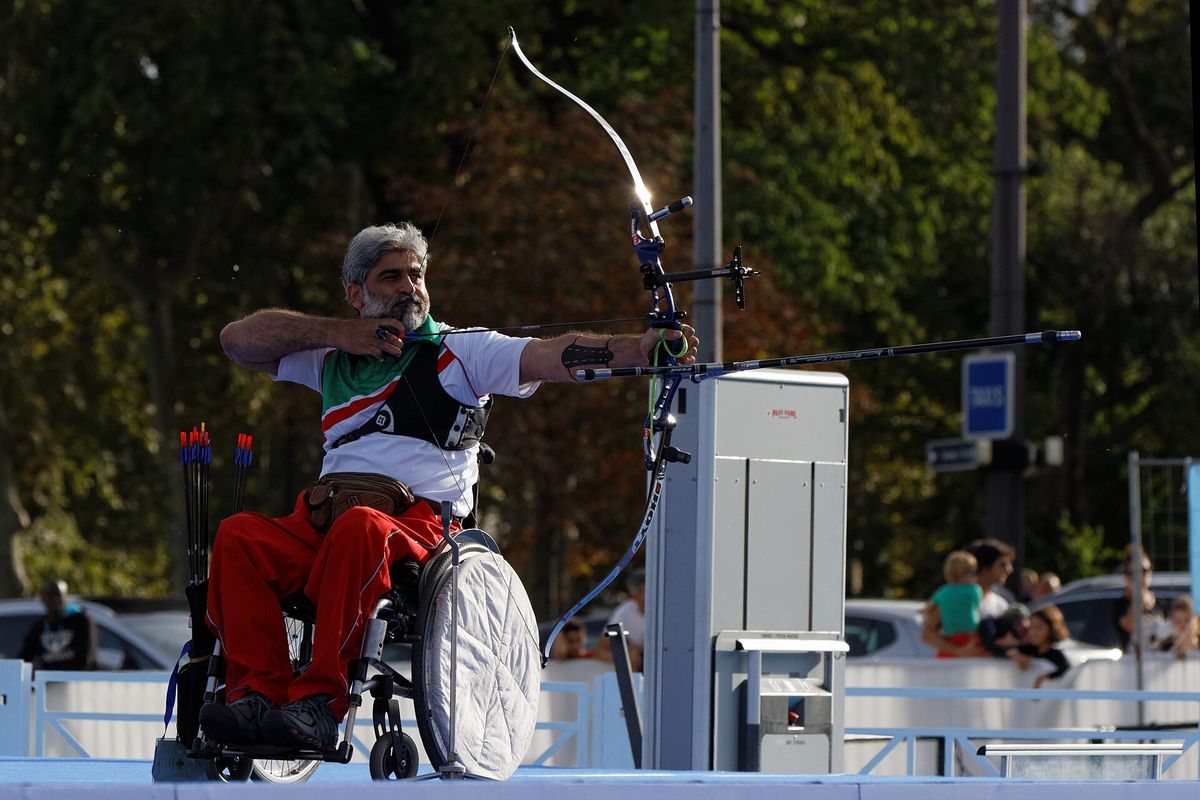
Ebrahim Ranjbar Kivaj shooting in the para-archery match at the 2013 Archery World Cup final, Paris.
Para archery is on the Paralympic programme. This match was shot at a federation World Cup event alongside the able-bodied finals, on the same range.
Pierre-Yves Beaudouin · CC BY-SA 3.0 · Wikimedia Commons
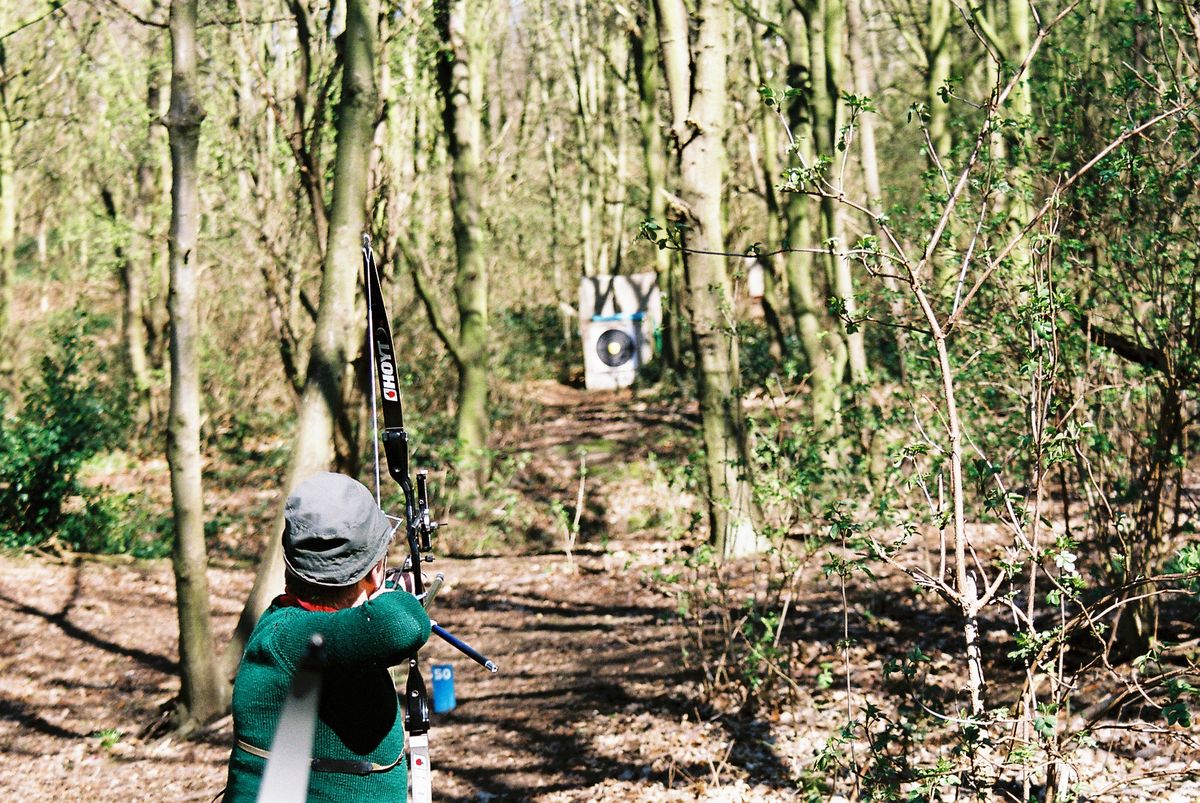
A field archer at the Yorkshire Field Archery Championships, 2008.
The target is in woodland, at a distance the archer has to judge. Field archery keeps the ring and the arrow but drops the flat, measured range that the Olympic discipline is built on.
Mr Barndoor · CC BY 3.0 · Wikimedia Commons
03Officiating and technology
Archery is the easiest sport on this site to officiate correctly, and it has almost no officiating controversies as a result. An arrow is either in a ring or touching a line, which is a question of fact with a physical answer that can be inspected at leisure by two people standing at the target.
Where technology has gone is scoring speed and broadcast. Electronic scoring systems read arrow position optically and produce a score before the archers have walked to the target, which serves the audience more than the result. Cameras behind the target and on the bow have made the sport far more legible than it was.
The genuinely difficult call is the line-cutter — an arrow whose shaft touches the boundary between two rings — and the sport's answer is characteristic: it did not improve the judgement, it removed the incentive. Limiting shaft diameter to 9.3 mm in 2014 reduced how often the question arises and how much is gained by engineering for it.
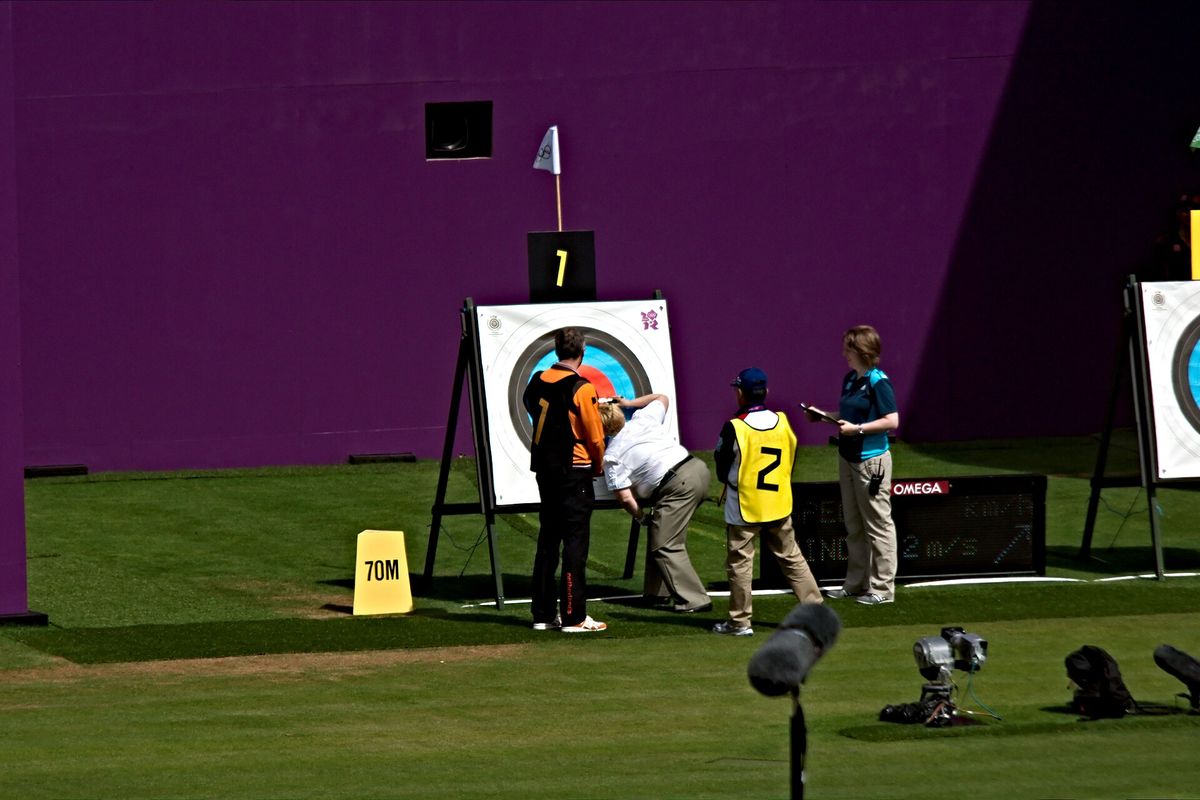
Officials checking line cutters at a 70-metre target, London 2012.
The photographer titled it "Scoring line cutters". The one hard call in the sport is settled like this: people walk up to the target and look at the arrow where it landed.
Andy Rogers · CC BY-SA 2.0 · Wikimedia Commons
Timing is the other officiated thing, and it is mechanical: twenty seconds, alternating, with lights. An arrow shot after the clock forfeits the highest-scoring arrow of that end, which is a penalty that requires no interpretation at all.
What archery shows, set against gymnastics at the other extreme, is what a sport's officiating looks like when its central question has a correct answer. There is no panel, no review protocol, no statistical monitoring of judges, and no equivalent of the handball law. The whole apparatus that gymnastics and football have built exists to manage judgement, and archery has almost none to manage.
04Where it is played
Archery has the most concentrated elite dominance of any sport on this site except table tennis, and it belongs to one country: South Korea.
Korean women in particular have won the team event at every Games since it was introduced in 1988, a run without parallel in any Olympic event anywhere. The usual explanations are a school and corporate club system that identifies archers young, a domestic selection process harder than the Olympic competition, and deliberate training against pressure — Korean squads are reported to practise in crowded stadiums with noise piped in.
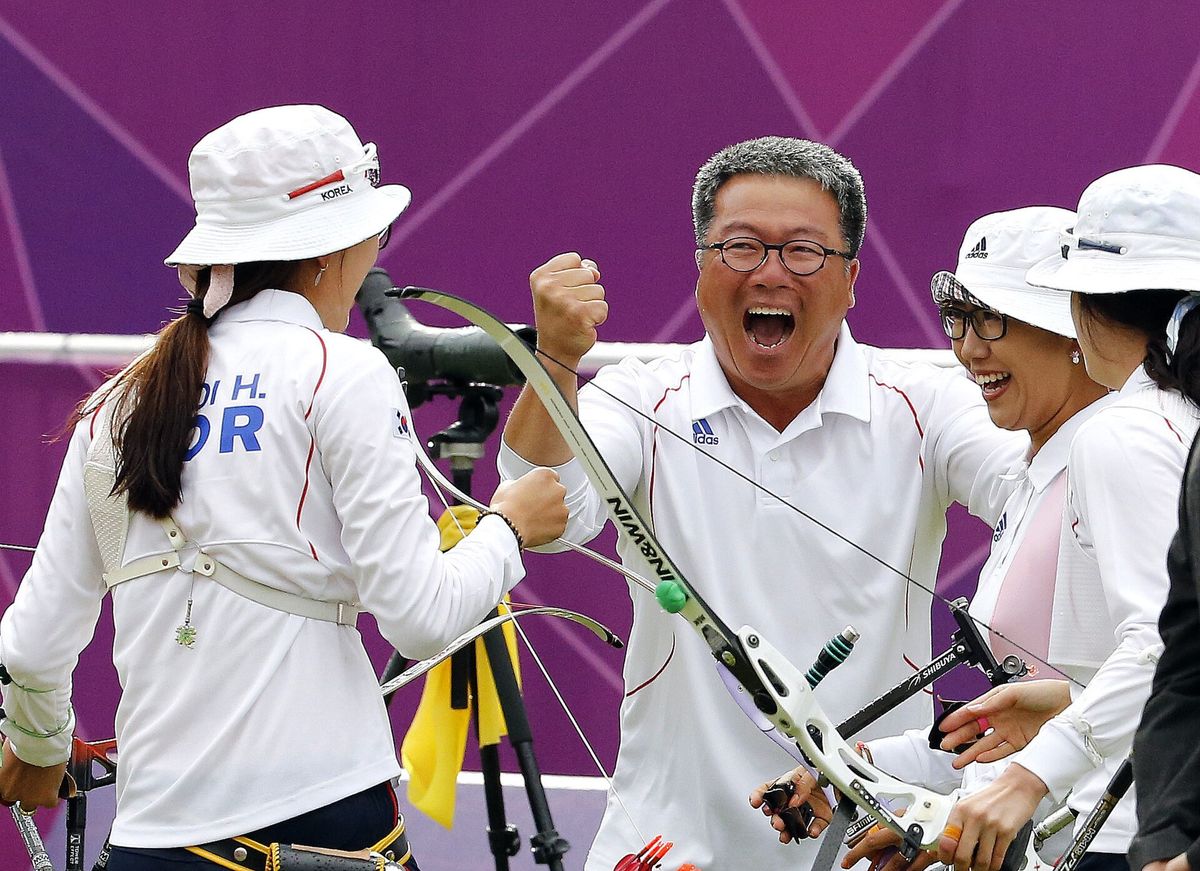
South Korea's women's team celebrate Olympic gold, London 2012.
Their seventh team title in seven Games since the event was introduced in 1988. The run continued at every Games after this one.
Korean Olympic Committee, via Korea.net · CC BY-SA 2.0 · Wikimedia Commons
That last detail matters for what this sport's rules have become. If the elite technical margin is nearly nil and the difference is psychological, then a programme that trains psychology systematically will dominate, and every rule change that raises pressure — the shot clock, alternating shooting, the set system — arguably widens rather than narrows that advantage. This site records that as a reading rather than a finding, because the federation has never addressed it.
Beyond Korea the sport is broadly distributed: the United States, Italy, France, Turkey, India, China and Mexico all produce international recurve archers, and the compound discipline has a different and more European map again.
The entry barrier keeps archery a club sport almost everywhere. It needs a supervised range, which is a facility, and that puts it closer to gymnastics than to basketball in how it recruits.
05Learning curve
The narrowest gap on this site. Archery is moderately hard to start and extremely hard to master, but the distance between a competent club archer and an Olympian is smaller in raw score than in any other sport here — and that closeness is exactly what makes the top so brutal.
Editorial — the site’s reading, not a sourced claim
Barrier to entry
How hard is it to get to a real game?
A club, a coach and a bow you cannot safely improvise.
Archery cannot be picked up informally. A bow is a weapon, the range needs to be laid out safely, and a beginner needs supervision from the first arrow — so entry runs through a club in a way that badminton or basketball does not.
Once inside, the sport is unusually welcoming. Clubs lend equipment, beginners hit the target within a session, and the scoring is immediately legible: you can see how you did without knowing anything about the sport. There is also no opponent and no physical contact, so age and body type exclude almost nobody.
Evidence
- Facility neededA supervised rangeobserved
- Coach neededYes, initiallyestimateSafety rather than technique.
- Kit to startClub loan equipmentobserved
- Olympic distance70 mobserved
- Time to first scoring arrowsOne sessionestimate
Barrier to the top
How hard is it to be good at?
Everyone at the top shoots nearly the same score, so the margin is entirely psychological.
At elite level the technical problem is close to solved. Top recurve archers group arrows inside the ten ring with a consistency that leaves very little room between them, which means the difference between a world champion and someone who does not make the bracket is a handful of arrows across a season.
When the margin is that thin, the contest moves to what happens under pressure — and archery has arranged its own rules to maximise that pressure. Alternating shots, twenty seconds each, a single arrow to settle a drawn match, and since 2011 a set system that keeps every match alive to the end and can hand victory to the archer who shot worse.
The wind is the other thing. Archery is the only measured sport here that does not control its conditions: there is no wind limit, no rerun and no adjustment, so an elite archer must read weather they cannot influence while shooting at a target the size of a grapefruit.
Evidence
- Set systemSince 2011ruleAn archer can out-shoot an opponent and lose, so the pressure never resolves.2011 — the rule this rests on
- Time per arrow20 sruleAlternating, with the opponent watching.2014 — the rule this rests on
- Arrow shaft limit9.3 mmruleClosed off the one route to points that was not shooting.2014 — the rule this rests on
- Ten ring12.2 cm at 70 mobserved
- Typical peak age22–32estimateOne of the widest peak windows here.
Why the two differ
Archery inverts the usual shape. In badminton or table tennis the gap is enormous because the elite version of the skill is unrecognisable from the beginner's. In archery the actions are the same and the scores are much closer — a good club archer might shoot within ten per cent of an Olympian's ranking round, which is unthinkable in any other sport on this board.
The barrier is that the last ten per cent is almost entirely psychological, and the sport has deliberately made it harder. Every rule change here since 1992 has increased pressure rather than reduced it: elimination brackets instead of cumulative totals, a short clock, alternating shots, and a set system that can take a match away from the archer who shot better. A federation optimising for broadcast has, as a side effect, built the most psychologically demanding competition format on this site.
The historyhow it got here · sections 6 to 10
06Origin and invention
Archery is by an enormous margin the oldest activity on this site — a weapon technology in continuous use for tens of thousands of years — and by a reasonable margin one of the youngest sports. The gap between the two is the interesting part.
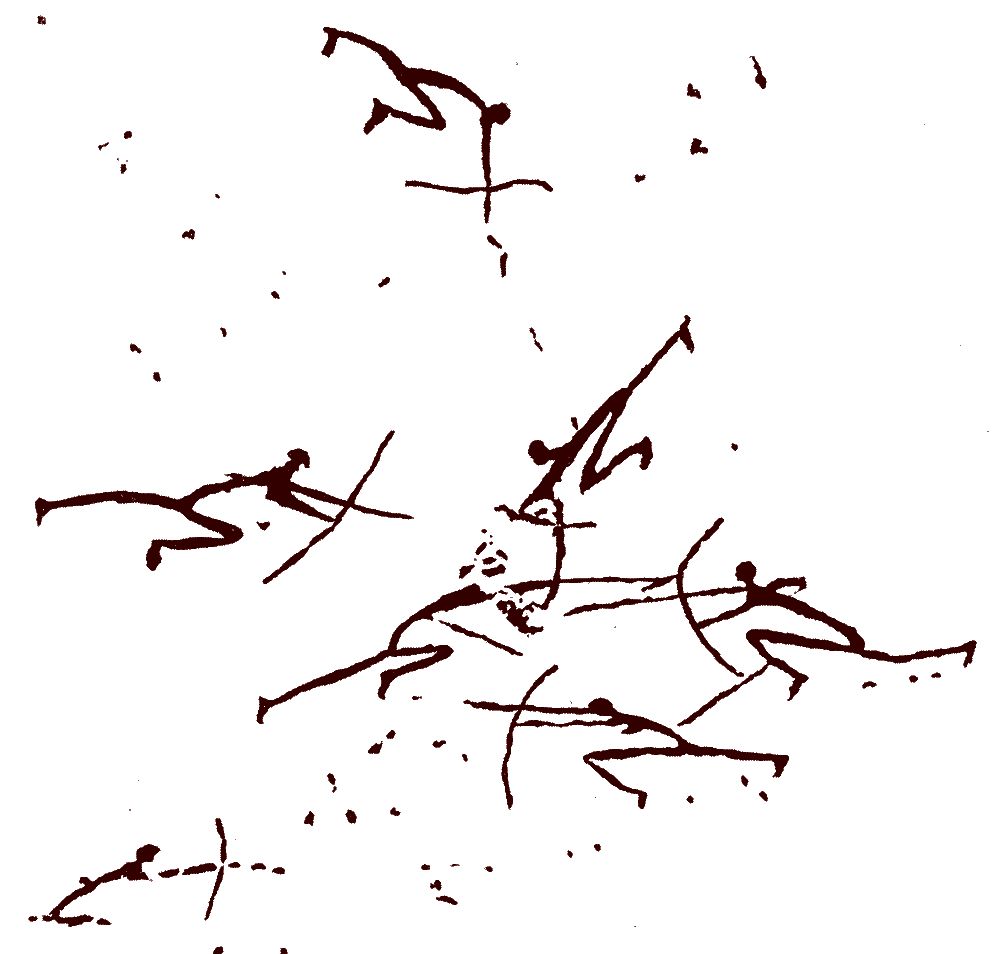
Archers in combat, from a Mesolithic rock painting at the Cova del Roure, Morella la Vella, Spain.
A 1924 tracing by Eduardo Hernández Pacheco of a painting dated to the late Mesolithic. It is evidence of the bow as a weapon, thousands of years before anyone shot one at a scoring target, which is the gap the section is about.
Eduardo Hernández Pacheco · Public domain · Wikimedia Commons
Target shooting as a formal pastime survived the bow's military obsolescence in England as a gentry recreation, and the societies that kept it going through the eighteenth and nineteenth centuries produced the first codified rounds: fixed distances, a fixed number of arrows, a scoring target. The Grand National Archery Society dates from 1861.
Olympic archery in its early appearances was chaos. It was contested in 1900, 1904, 1908 and 1920 under rules that differed by host country to the point where events had almost nothing in common, and it was dropped afterwards — partly for exactly that reason. There was no international body to standardise it. FITA was founded in 1931 to be that body, and archery returned to the Games in 1972 after a fifty-two-year absence, the longest of any returning sport except golf and cricket.
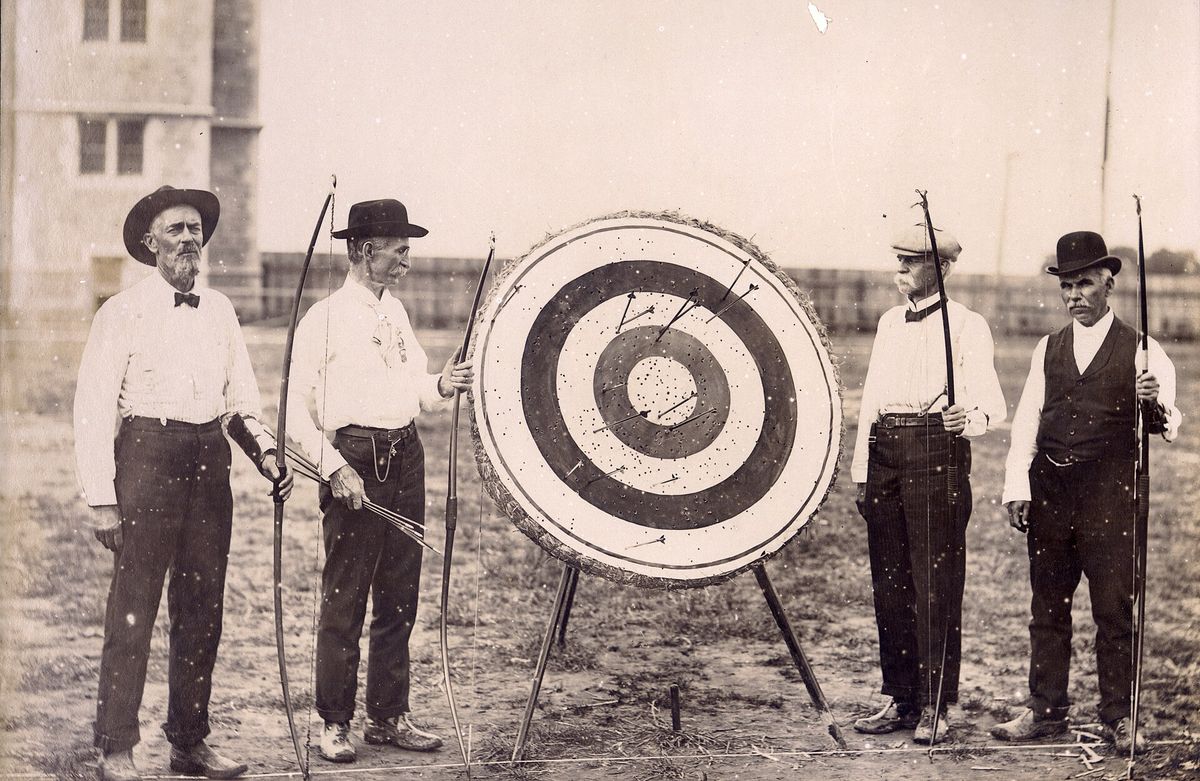
The team competition at the St. Louis Games, 1904.
Every archer at the 1904 Games was American, and the tournament doubled as the American national championship. It is one of the four early Olympic tournaments that had almost nothing in common with each other.
Jessie Tarbox Beals (attributed) · Public domain · Wikimedia Commons
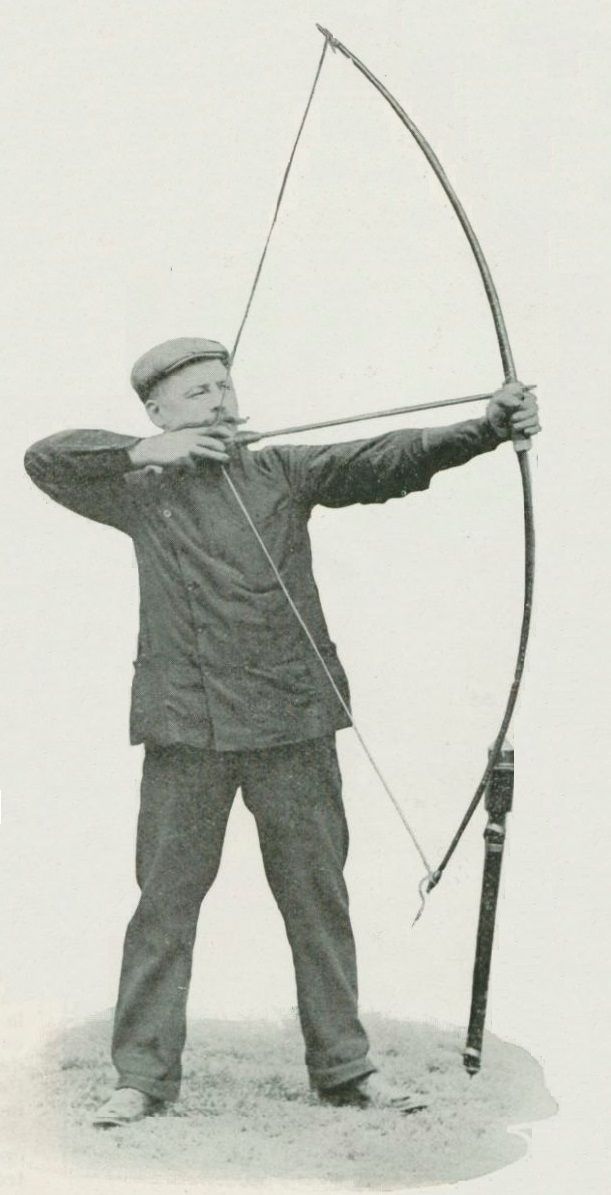
Eugène Grisot, winner of the continental-style event at London 1908.
From La Vie au Grand Air. London held a separate event shot in the French and Belgian style beside its British rounds, so the host country's rules decided what the Olympic contest even was. Grisot won it with 263 points from 62 hits.
La Vie au Grand Air · Public domain · Wikimedia Commons
So archery's competitive rules are a twentieth-century invention laid over a prehistoric skill, and the sport has been unusually willing to rewrite them — because unlike football or judo, there is no ancient tradition of how the competition should work to defend.
07Rule timeline
The sport’s own lane, expanded. Every entry carries a cause from the closed vocabulary and a citation, and says so where the citation is incomplete.
- 1992Broadcast and pacingalso commercialadopted 1991
Olympic competition moved to head-to-head elimination matches after a ranking round, replacing a format in which archers shot a large number of arrows and the highest cumulative total won. Archery stopped being a contest against a scorecard and became a bracket.
Trigger and citationIncomplete — no confirmed article
Trigger
A cumulative-score format produces no moment of victory and no opponent to point a camera at. The federation's stated aim was a competition with a visible winner at a known time.
World Archery Rulebook · FITA Constitution and Rules, 1992
- 2011Broadcast and pacingalso commercialadopted 2010
Recurve matches were rescored in sets. Each set of three arrows is won, lost or drawn, awarding two points, none, or one, and the match goes to the first archer to six set points. The cumulative arrow total no longer decides anything. An archer can therefore shoot more points than the opponent across a match and lose it, which had been impossible in the sport's entire history.
Comparability break · Measurement scale changed
A match score stopped being a sum of arrows and became a count of sets won. The two are different quantities, and no mapping exists between them — the same shooting can produce either result depending on how the arrows were distributed across the sets. See the series
Trigger and citationIncomplete — no confirmed article
Trigger
Under cumulative scoring a match was frequently decided long before it ended, because a two-point lead over three ends is close to insurmountable at elite accuracy. The set system keeps every set live and guarantees the match runs near its full length.
Archers objected that a system in which the better shooting can lose is a worse measure of archery, and that the change subordinated the sport's one unambiguous virtue — an objective score — to the needs of a broadcast. The federation has not disputed the description, only the priority.
World Archery Rulebook · World Archery Rulebook, Book 3, 2011
- 2014Broadcast and pacingadopted 2013
Shot timing was tightened to twenty seconds per arrow in alternating match play, and a drawn match is settled by a single-arrow shoot-off decided on score and, if still level, on proximity to the centre.
Trigger and citationIncomplete — no confirmed article
Trigger
Alternating shooting with a short clock produces a rhythm a camera can follow and a match of predictable length. The single-arrow shoot-off guarantees a conclusion that can be shown.
World Archery Rulebook · World Archery Rulebook, Book 3, 2014
- 2014Equipment and technologyalso fairness and eligibilityadopted 2013
A maximum arrow shaft diameter of 9.3 mm was set for outdoor target archery. A fatter shaft is more likely to touch a higher scoring ring, so diameter had become a way of buying points that the archer had not shot.
Trigger and citationIncomplete — no confirmed article
Trigger
Line-cutting arrows were producing measurable score inflation and an arms race in shaft manufacture that had nothing to do with shooting.
World Archery Rulebook · World Archery Rulebook, Book 3, equipment
- 2021Participation and accessalso broadcast and pacingadopted 2018
A mixed team event of one man and one woman per nation was added to the Olympic programme, scored cumulatively rather than in sets — so the sport now runs two incompatible scoring systems side by side at the same Games.
Trigger and citationIncomplete — no confirmed article
Trigger
Part of a programme-wide push for gender-balanced and mixed events. That it kept cumulative scoring while the individual event uses sets is recorded here because it means the sport did not consider the set system universally correct, only correct for the format it was designed around.
World Archery Rulebook · World Archery Rulebook, Book 3, 2021
08Equipment evolution
Archery's equipment question is settled by a decision most sports never have to make explicitly: the Olympic discipline uses a deliberately restricted bow, and the unrestricted one exists as a separate sport.
The recurve bow may have a sight, long stabilisers and a clicker. It may not have magnifying optics or a mechanical release aid, and the archer holds the full draw weight at full draw. The compound bow has cams that reduce the holding weight at full draw by most of its value, a magnifying scope and a trigger release, and it is substantially more accurate. It is a full World Archery discipline with its own world championships and it is not on the Olympic programme.
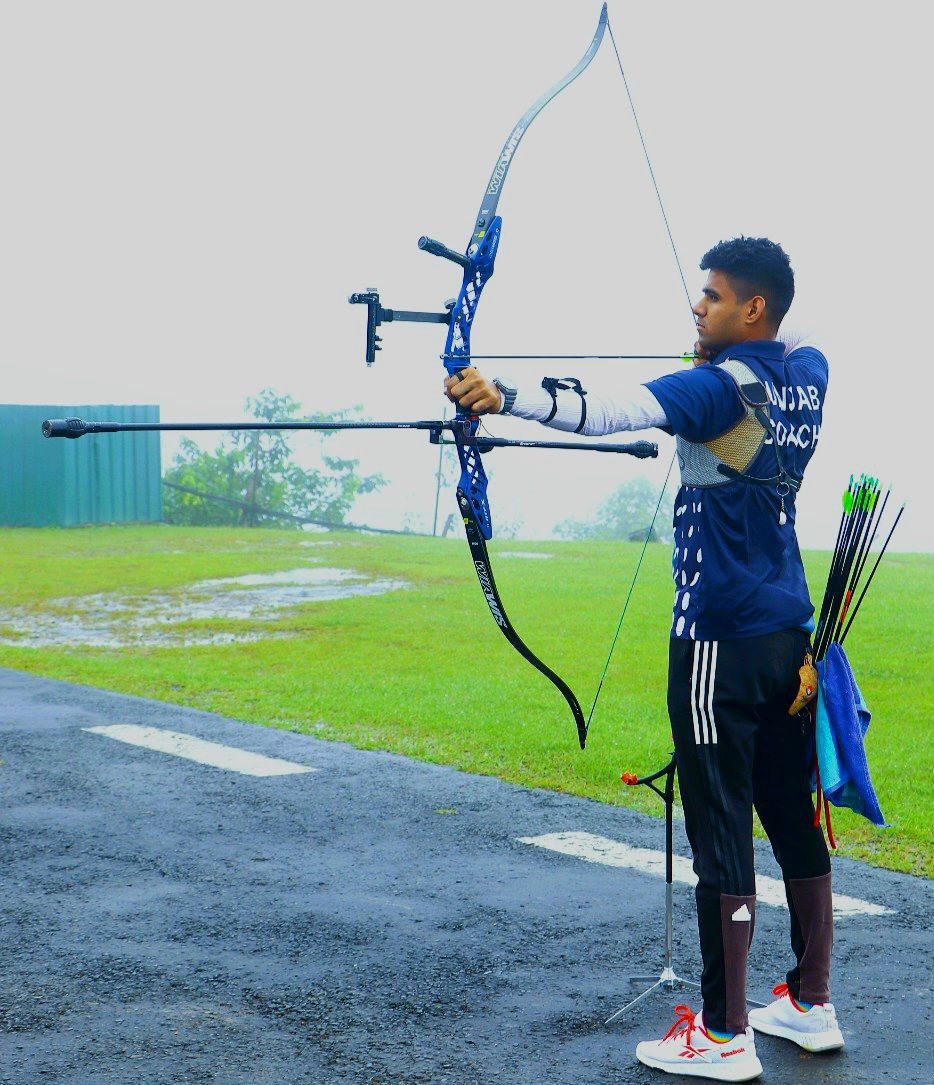
An archer with a modern recurve bow, 2025.
The Olympic bow: a sight out in front, a long stabiliser, and no magnification and no release aid. The archer's fingers hold the full draw weight.
Hemant23071999 · CC0 · Wikimedia Commons
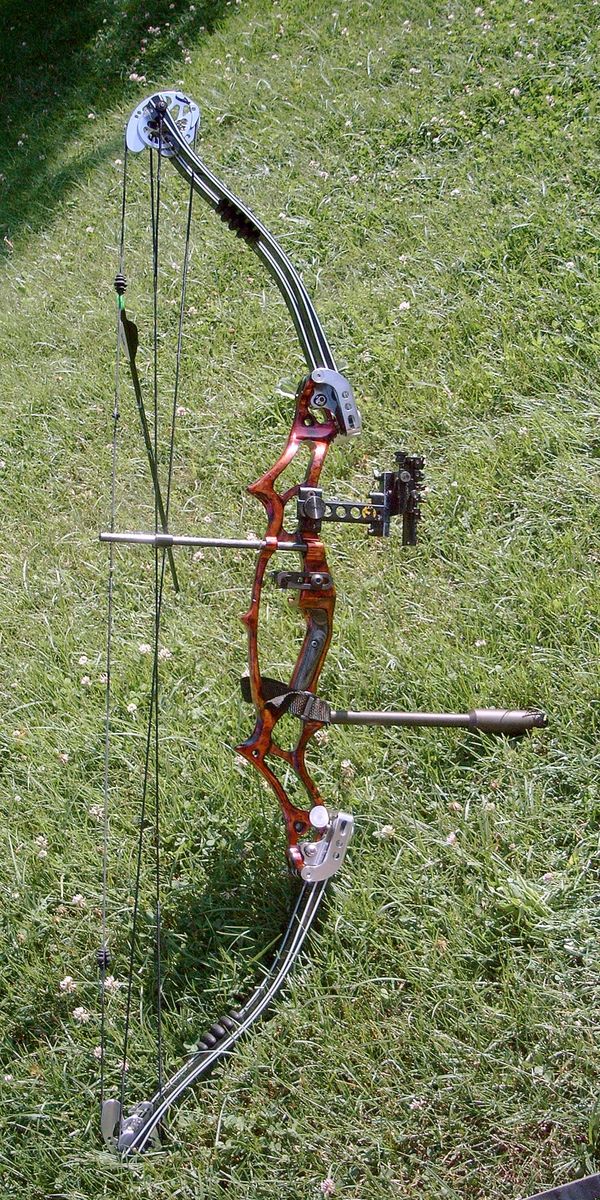
A Hoyt compound bow with twin cams, 2007.
The cams at each end of the limbs are what take most of the holding weight off at full draw. Archery did not ban this bow. It gave it a competition of its own, which is not on the Olympic programme.
StromBer · CC BY-SA 3.0 · Wikimedia Commons
That split is unusual and worth noticing. Athletics banned the aerodynamic javelin outright. Cycling banned the Superman position. Swimming banned the polyurethane suit. Archery did not ban the compound bow; it put it in a different competition and let both exist. Two of the sports on this site have handled a technology fork this way, and the other is cycling's brief attempt at two hour records — which it abandoned.
The one equipment rule that changed the numbers is small and precise. Arrow shafts are limited to 9.3 mm for outdoor target archery, because a fatter shaft touches a higher scoring ring more often. Without the limit, an archer could buy points that they had not shot, and the manufacture of ever-fatter shafts had become a measurable route to a better score.
09Governing body politics
World Archery's defining problem for forty years has been that its sport is genuinely difficult to broadcast, and almost every governance decision it has made follows from trying to solve that.
A cumulative-score competition has no moment of victory. Everyone shoots, the numbers are added, and somebody has the highest total — which is an excellent way to determine the best archer and an impossible way to make television. The federation's response has been a thirty-year sequence: elimination brackets from 1992, a short shot clock, alternating shooting, single-arrow shoot-offs, and in 2011 the set system.
Olympic archery at Lord's Cricket Ground, 29 July 2012.
A full grandstand for the first archery Games after the set system came in. The venues are chosen for the picture as much as the range, and this is what forty years of format changes were for.
Mark Hillary · CC BY 2.0 · Wikimedia Commons
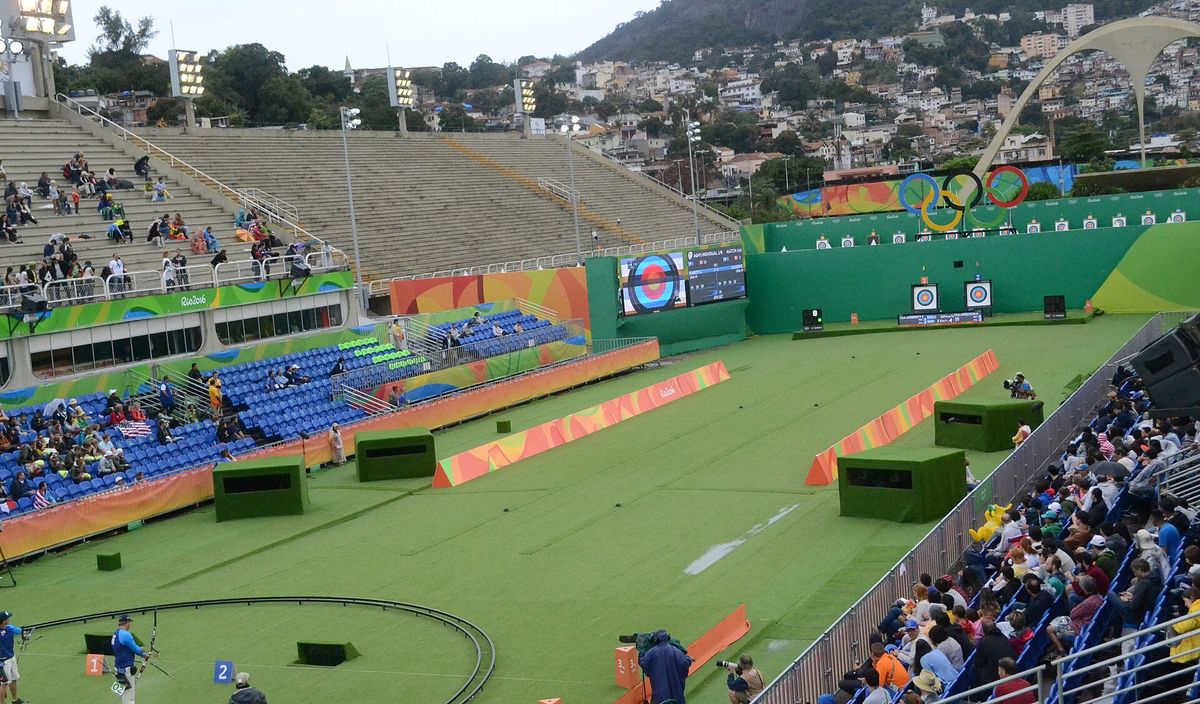
The archery range in the Sambódromo, Rio de Janeiro, August 2016.
Four years later the range went into Rio's carnival parade ground. Two Games in a row, the sport was staged in a landmark built for crowds and cameras rather than on an archery field.
Jorge mello ej · CC BY-SA 4.0 · Wikimedia Commons
Every one of those changes increased the drama and reduced the extent to which the result measures accuracy. The set system is the point at which that trade became explicit, because it made it possible to shoot better and lose. The federation has not disputed that description; it has argued that a sport nobody watches has a worse problem.
The other long-running question is the compound bow, which is more popular in several countries than the recurve and has been proposed for the Olympic programme repeatedly. Admitting it would mean either replacing the recurve events or expanding the programme, and the IOC's fixed quota makes the second difficult. The politics here is entirely about the size of the Games.
The federation renamed itself from FITA to World Archery in 2011, in the same year it changed how matches are scored.
10Controversies that forced rule changes
The unwatchable format. Not an incident, a structural problem. Through the 1970s and 1980s Olympic archery was a cumulative-score competition that took days and had no visible conclusion, and it was under real pressure as a result. The 1992 shift to head-to-head elimination was a rescue.
The 2011 set system, and the archers. This is the sport's live controversy and the reason it is on this site. Under cumulative match scoring an elite archer who got two points ahead over three ends had effectively won, so matches were decided early and the remaining arrows were formalities. The set system fixed that by making each set a separate contest.
It also made it possible to lose a match while shooting better arrows than your opponent, and archers said so loudly. The objection was not that the format was unexciting; it was that archery's one unambiguous virtue was an objective score and the federation had just made the score stop deciding things.
Both positions are recorded in the entry. What is not in dispute is the consequence for this site: match results before and after 2011 are measured in different quantities, and the sport's own record cannot be read across that line.
Fat arrows. A quieter one. Because an arrow scores the higher value if the shaft touches the line at all, shaft diameter was worth points, and manufacturers obliged. The 9.3 mm limit in 2014 closed a route to a better score that involved no better shooting.
The wind. Archery does not regulate its conditions and has faced periodic proposals to do so. It has declined every time, which is worth recording as the one place this sport has resisted the logic that governs athletics and swimming.
Where it standsthe record, and what is still open · sections 11 to 12
11Series
No series can exist
Match results across the set system
There is no chart here, and this is not the badminton case. Before 2011 a recurve match produced a number: the sum of the arrows, out of a known maximum, and the higher number won. After 2011 a match produces a scoreline in set points, six-four or six-two, which is not a measurement of anything the archer did with a bow. The quantity was not rescaled. It was replaced by a different kind of object, in the way gymnastics replaced its score in 2006. The severity is easiest to see in the fact that makes archers angriest: an archer can now out-shoot an opponent across a match and lose it. Any series running across 2011 would be joining a measure of accuracy to a measure of who won more sets, and those are not two values of one quantity. What could exist, and does not here, is a series of ranking-round totals — those are still cumulative and still comparable, subject to the 2014 arrow diameter limit. That would be a real chart. It has not been assembled from a cited source.
2011Measurement scale changedA match score stopped being a sum of arrows and became a count of sets won. The two are different quantities, and no mapping exists between them — the same shooting can produce either result depending on how the arrows were distributed across the sets.
12What is contested now
Recorded as unsettled.
The set system. Fifteen years on, archers still argue that a format in which the better shooting can lose is the wrong way to decide an archery match. The federation's position is that the alternative was a sport nobody watched. Both are true statements and they do not resolve each other, which is why this is the clearest live example on the site of the broadcast-and-pacing cause being weighed openly against the integrity of a measurement.
That the mixed team event, added in 2021, kept cumulative scoring is quiet evidence that the federation itself does not regard the set system as universally correct.
The compound bow. More accurate, more popular in several countries, and still not on the Olympic programme. Admitting it means displacing recurve events or expanding a fixed quota, so the argument is with the IOC rather than within archery.
Conditions. Archery is the only measured sport here that does not standardise its environment. There is no wind limit and no rerun, and proposals to introduce either resurface whenever a final is decided in a gale. The counter-argument is that shooting in weather is the sport, which is the same argument golf makes and athletics rejected a century ago.
Scoring precision. Electronic systems can now measure arrow position far more finely than the ten rings do, and there are periodic proposals to score to a decimal as shooting does. It would separate archers who currently tie, and it would sever the record a second time.