Athletics
The sport that redesigned an implement to bring the record book back inside the stadium.
- Official
- Athletics
- Game category
- Performance
- Adjudication
- Measured
- Standing
- Never off
- rule changes
- 6
- comparability break
- 1
- Olympic editions
- 31
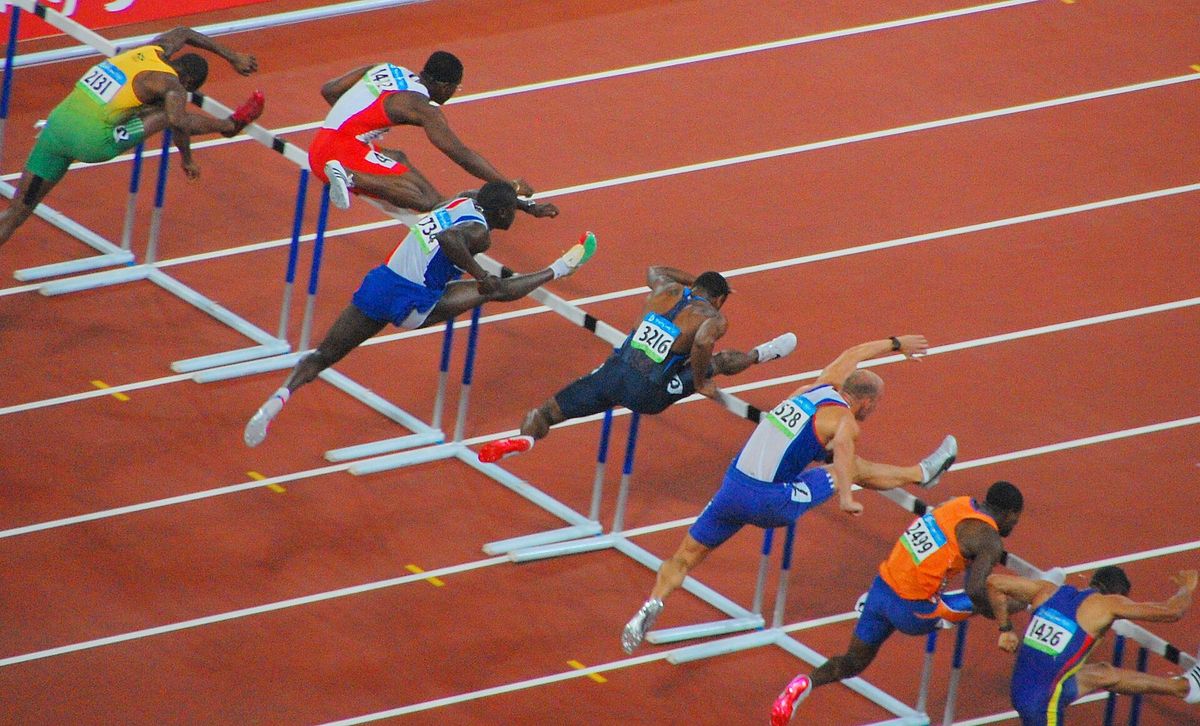
A men's 110 m hurdles semi-final at the Beijing Olympics, 2008 · akiwitz · CC BY-SA 2.0
- Governing body
- World Athletics
- Founded
- International Amateur Athletic Federation founded 1912; renamed International Association of Athletics Federations in 2001 and World Athletics in 2019.
- Olympic status
- 31 editions
- on the 2028 programme
- Also contested at
- Asian Games
A measured sport keeps a number, which means it is the family where a rule change and a comparability break are most obviously the same event. Athletics has done this deliberately and more than once: the men's javelin was redesigned in 1986 and the record book restarted, and the same operation was performed on the women's implement in 1999. It has also declined to do it — shoe technology from 2017 onwards produced a wave of records that were all allowed to stand.
The gamewhat it is now · sections 1 to 5
01How it is played
Athletics is not one game but a programme of events sharing a rulebook, and what unites them is a measurement rather than a contest. Almost every rule is there to make today's number the same kind of thing as a number from another stadium in another decade — which is why the specification of an implement is as much a law here as the definition of a false start.
These figures were entered from the edition named above but have not been checked against its text line by line. Treat them as this site’s reading of the laws, not as a substitute for them.
The object of the events
Cover a set distance in the least time, or send a body or an implement the greatest distance. Competitors are ranked by the measurement, not by what happened between them, which is what makes athletics a measured sport rather than one decided by score.
This has a consequence that shapes the whole rulebook: an opponent is almost irrelevant to the result, so the rules police conditions instead of conduct. Wind, surface, implement mass and timing method all have to be legislated, because all of them change the number.
The arena
A standard outdoor track is 400 m around the inside lane, with a straight long enough for a 100 m race. Field events sit inside and beside it. Distances on the track are measured 30 cm out from the inner kerb, because that is where a runner actually runs, and lanes are staggered so that every athlete covers the same distance.
- Track length
- 400 m
- Lanes
- 8 or 9
- Lane width
- 1.22 m
- Marathon
- 42.195 km
- Hurdle height, men's 110 m
- 1.067 m
- Hurdle height, women's 100 m
- 0.838 m
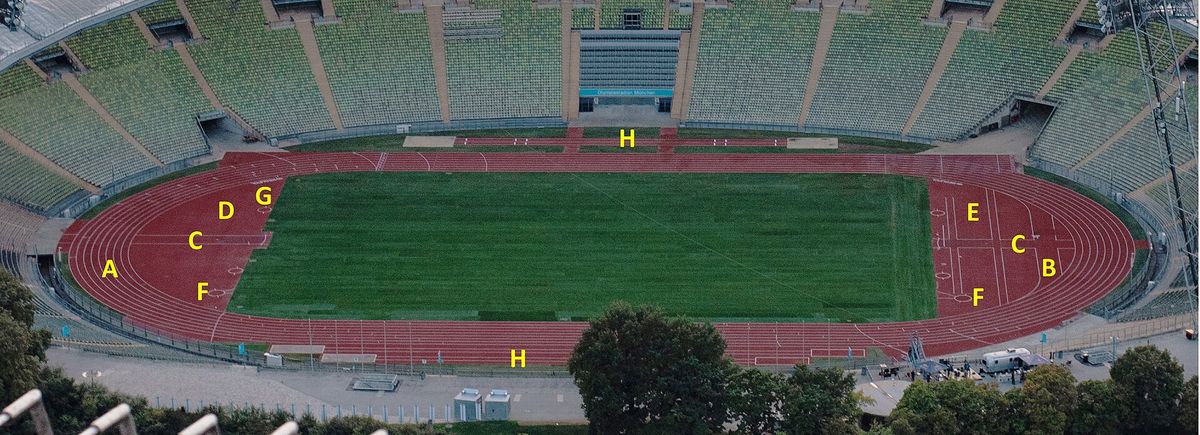
Munich's Olympic Stadium laid out for athletics, annotated.
A: the track. B: the steeplechase section. C: javelin runways. D: high jump. E: pole vault. F: hammer and discus cages. G: a shot put circle. H: long and triple jump. Forty-odd events share one arena, and several of them run at once.
BlackEyedLion · CC BY-SA 4.0 · Wikimedia Commons
World Athletics Technical Rules (Book C, C2.1) · Rule 14 (the track) · article not confirmed
The implements
A throwing implement is defined by mass and dimensions, and in the javelin's case by where its centre of gravity sits — a specification that exists only because the implement was redesigned in 1986 to shorten the throw. Shoes are specified too, by sole thickness and by the number of rigid plates, which is a rule that did not exist before 2020.
- Javelin, men
- 800 g
- 2.6–2.7 m; centre of gravity set by rule since 1986.
- Javelin, women
- 600 g
- Redesigned on the same principle in 1999.
- Shot, men
- 7.26 kg
- Shot, women
- 4 kg
- Discus, men
- 2 kg
- Hammer, men
- 7.26 kg
- Road shoe sole, max
- 40 mm
- Rigid plates per shoe
- 1
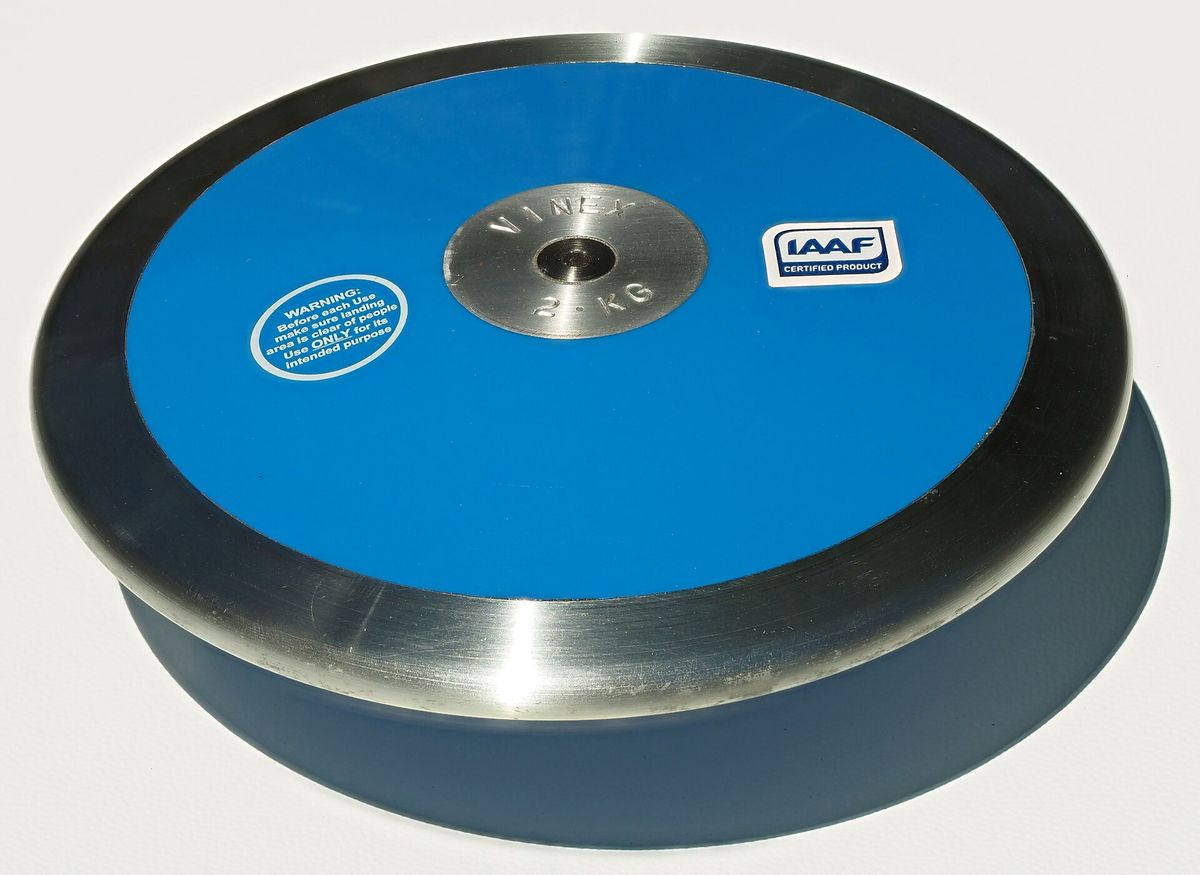
A men's 2 kg competition discus, marked as IAAF certified.
The implement is the rule: mass, diameter and rim are specified, and the certification mark is what makes a throw with it eligible to count.
Karl432 · CC BY-SA 4.0 · Wikimedia Commons
This clause reads this way because of
- 1986 — The men's javelin specification was rewritten to move the centre of gravity forward by four…
- 1992 — Roughened, dimpled and serrated tail surfaces were prohibited, the specification requiring…
- 1999 — The same operation performed on the men's implement in 1986 was performed on the women's…
- 2020 — Competition shoes were given a maximum sole thickness — 40 mm for road events, with lower…
World Athletics Technical Rules (Book C, C2.1) · Rules 5 and 32 (shoes and throwing implements) · article not confirmed
Competitors and officials
Athletes compete individually except in relays and team events. Officials are specialised by event: starters and recallers on the track, judges and measurers in the field, and umpires watching lane infringements. A photo-finish system rather than a person decides a close track result.
Format
Track events run in rounds — heats, semi-finals, a final — with qualification by place and by time. Field events give each competitor a set number of attempts, usually three, with the leading eight taking three more. There is no clock governing the competition itself; the clock is the thing being measured.
Measurement
Sprints up to 400 m require fully automatic timing to one hundredth of a second for a record, a requirement introduced in 1977 that ended the hand-timed era. Distances are measured to the nearest centimetre below the mark in throws, and horizontal jumps to the nearest centimetre from the take-off line.
Wind assistance above 2.0 m/s invalidates a record in sprints and horizontal jumps, which is the plainest statement in any rulebook here that the point of the rules is comparability rather than fairness on the day.
- Timing precision
- 0.01 s
- Legal tailwind limit
- 2.0 m/s
- Timing required for records
- Fully automatic
This clause reads this way because of
World Athletics Technical Rules (Book C, C2.1) · Rule 19 (timing) · article not confirmed
The start
Races up to and including 400 m are started from blocks in a crouch. A single false start disqualifies the athlete who commits it — there is no warning and no allowance for the field. Blocks carry pressure sensors, and a reaction under 0.100 s after the gun is ruled a false start on the assumption that no one can react faster than that.
- False starts allowed
- None
- Reaction-time threshold
- 0.100 s
This clause reads this way because of
World Athletics Technical Rules (Book C, C2.1) · Rule 16 (the start) · article not confirmed
Infringements
On the track: leaving your lane to a rival's disadvantage, stepping inside the kerb, obstructing, or false starting. In the field: touching beyond the foul line, leaving the circle before the implement lands, or leaving it forwards. In throws, the implement must land inside the marked sector and the landing must satisfy the event's own rule — for the javelin, the tip must strike the ground first, which is a rule the 1986 redesign existed partly to make judgeable again.
This clause reads this way because of
Deciding the winner
First across the line, or the best single mark. A tie in a jump is broken by the count of failures at the winning height; a tie in a throw or a horizontal jump is broken by the next-best attempt. Records are a separate question from winning, and are ratified centrally against conditions the athlete does not control.
Everything above is current law. Everything below is how Athletics got here.
02Disciplines and events
The largest programme of any sport at the Games by a wide margin, and the reason the sport→discipline→event hierarchy matters. Forty-eight events under one rulebook, spanning eight seconds of effort to two hours of it, is why "a rule" in athletics usually governs a single event rather than the sport.
- Disciplines
- 5
- Olympic medal events
- 48
- Men’s and women’s counted separately.
Track25
Run on the oval, in lanes for the shorter distances.
- Sprints — 100, 200, 400 m
- Middle distance — 800, 1500 m
- Long distance — 5000, 10,000 m
- Hurdles — 100/110, 400 m1.067 m for men's 110 m, 0.838 m for women's 100 m.
- 3000 m steeplechase
- Relays — 4×100, 4×400, mixed 4×400
Field, jumps8
- High jump
- Pole vaultThe highest entry barrier in the sport: needs a pit, a coach and a facility.
- Long jump
- Triple jump
Field, throws8
Every event here is defined by an implement specification, which is why the throws produce most of this sport's comparability breaks.
- Shot put7.26 kg men, 4 kg women.
- Discus
- Hammer
- JavelinRedesigned in 1986 for men and 1999 for women; both record lists were restarted.
Road5
The sport's largest participation base, and the part of it with no facility requirement at all.
- Marathon42.195 km.
- Race walkingThe only event judged by eye rather than measured, which makes it structurally a judged sport inside a measured one.
Combined events2
- DecathlonTen events scored on a points table, so the table itself is a rule.
- Heptathlon
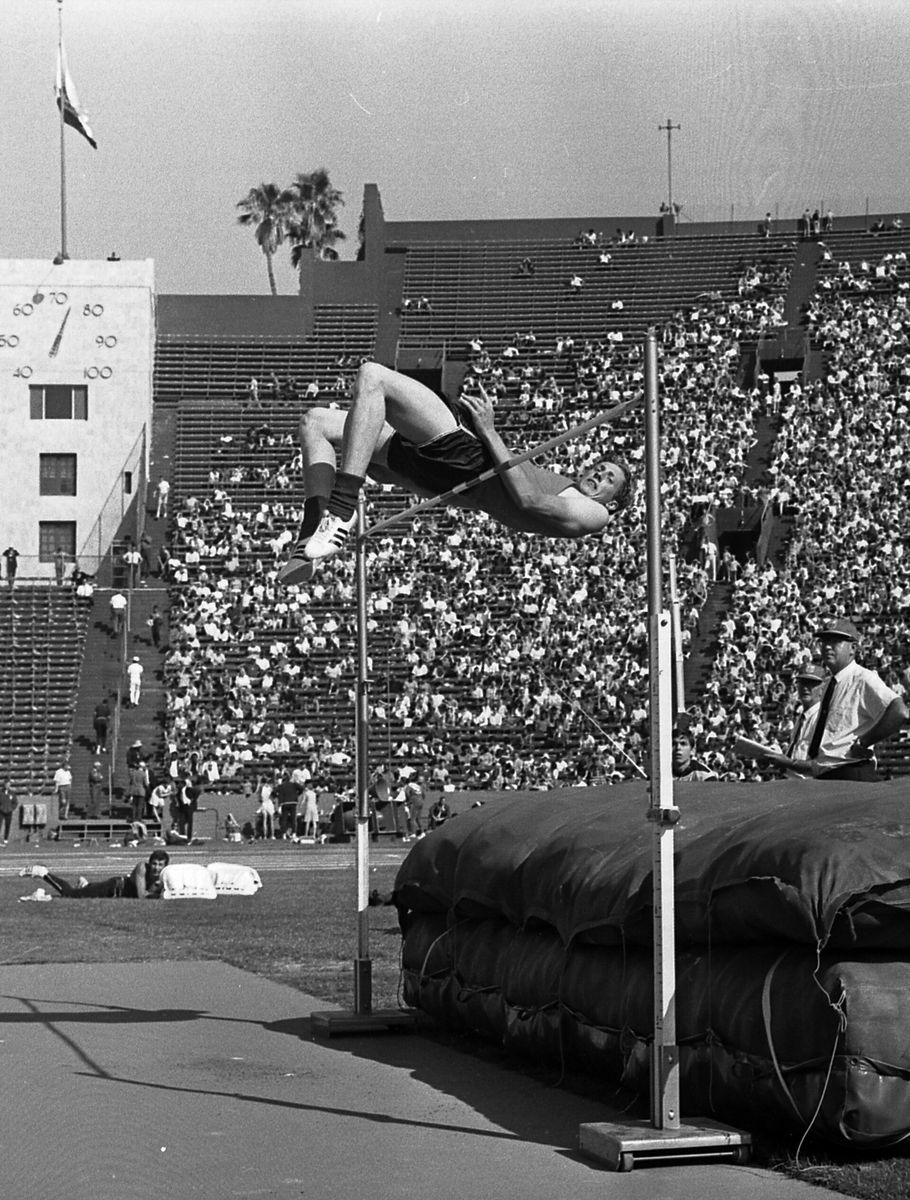
Dick Fosbury clearing the bar at the 1968 US Olympic trials, Los Angeles.
He won the Olympic title that October going over backwards. The rules did not change to allow the flop; the landing mat under the bar is what made it survivable.
Los Angeles Times · CC BY 4.0 · Wikimedia Commons
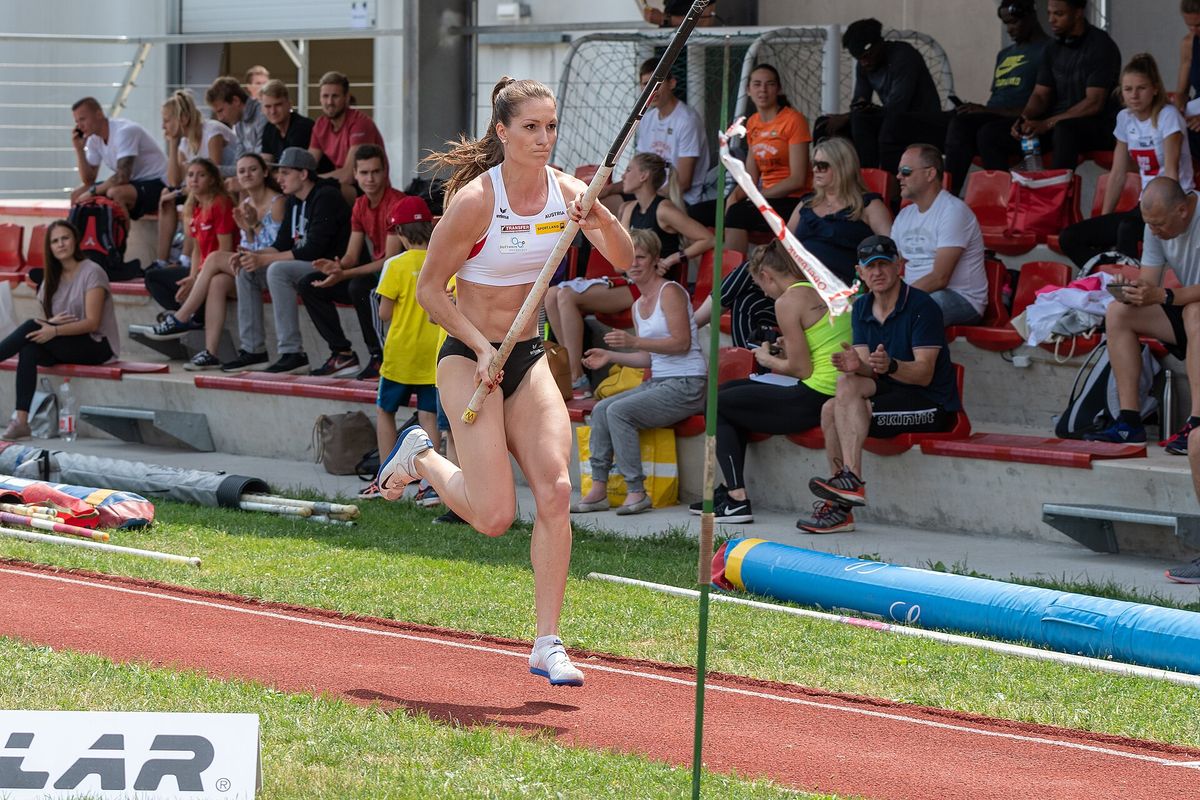
A pole vaulter on the runway at the Linz athletics gala, 2018.
A pole, a box, a mat and a runway: the event is a facility, which is why its geography is a map of facilities.
Isiwal · CC BY-SA 4.0 · Wikimedia Commons
A men's 110 m hurdles semi-final at the Beijing Olympics, 2008.
Ten barriers at 1.067 m, each in its own lane.
akiwitz · CC BY-SA 2.0 · Wikimedia Commons
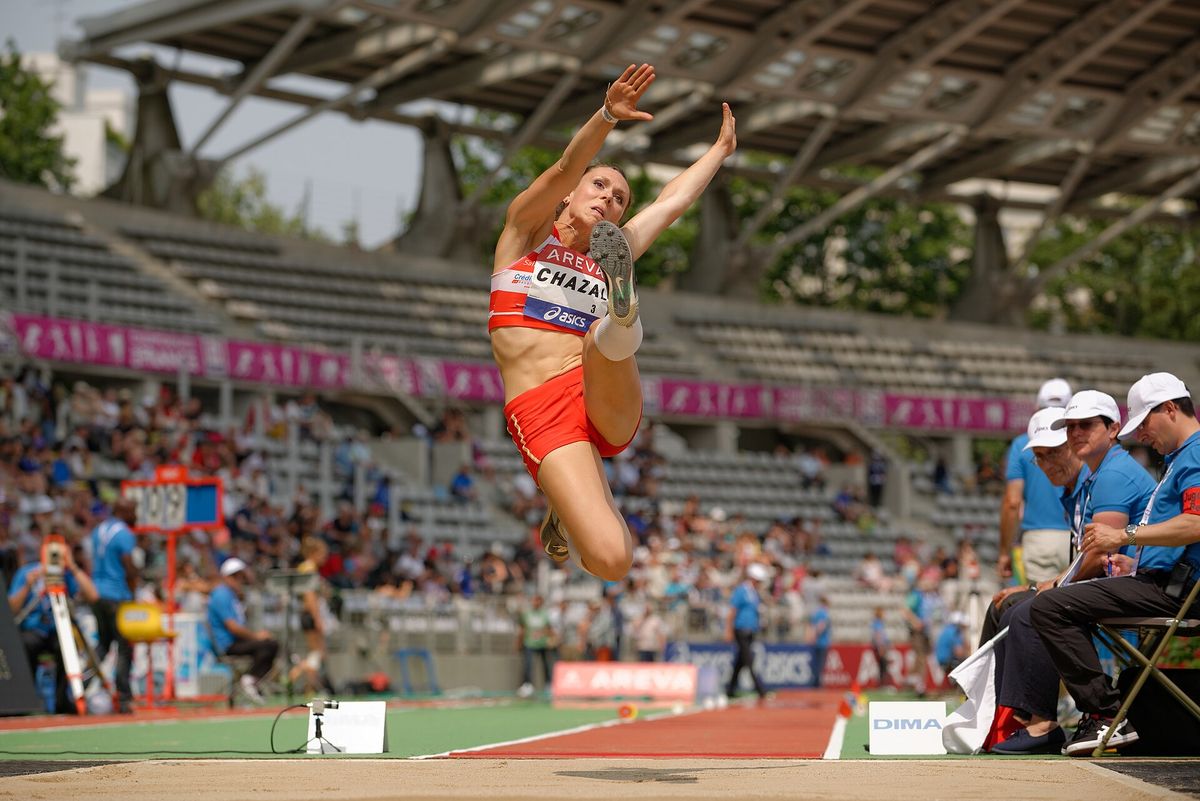
A heptathlete in the long jump at the French championships, Paris, 2013.
The measurement is taken from the take-off line to the nearest mark in the sand, which is why a jump can be won or lost by how the athlete falls.
Marie-Lan Nguyen · CC BY 3.0 · Wikimedia Commons
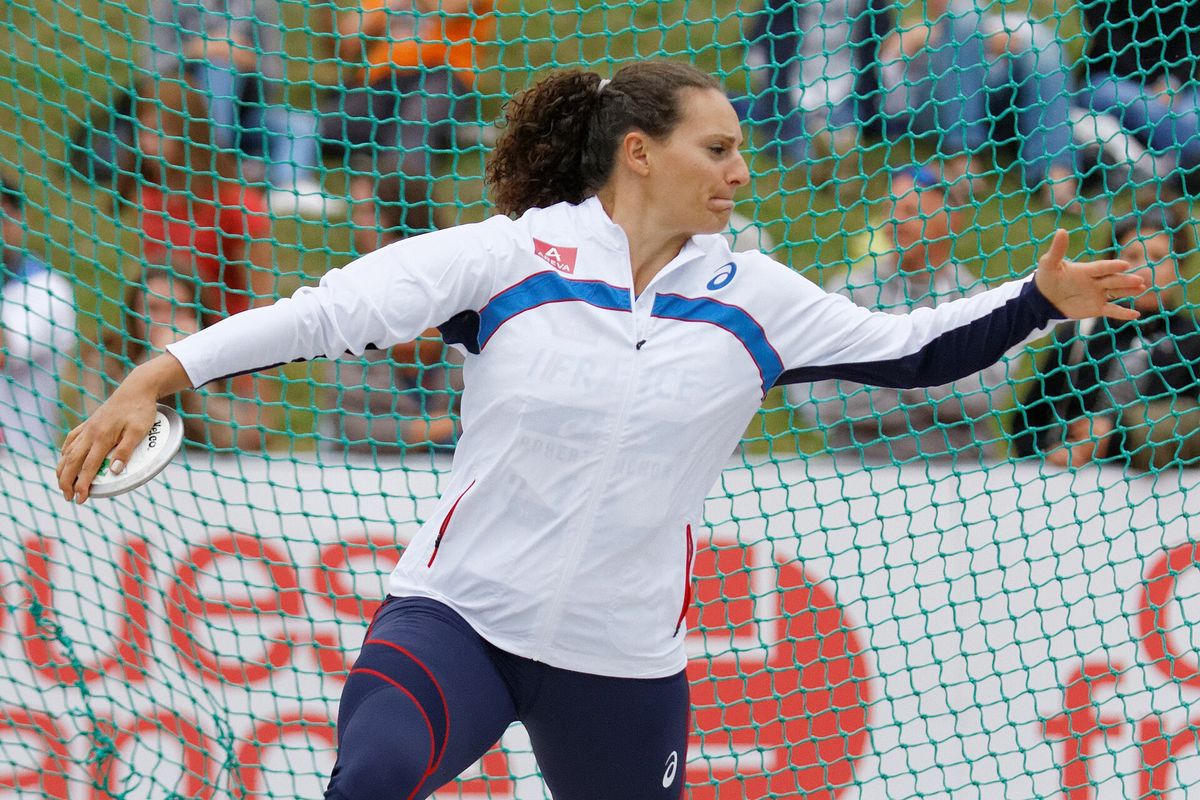
A discus thrower in the cage at DécaNation, Paris, 2014.
The net is there because a 1 kg women's discus leaving the circle at speed is a projectile.
Pierre-Yves Beaudouin · CC BY-SA 4.0 · Wikimedia Commons
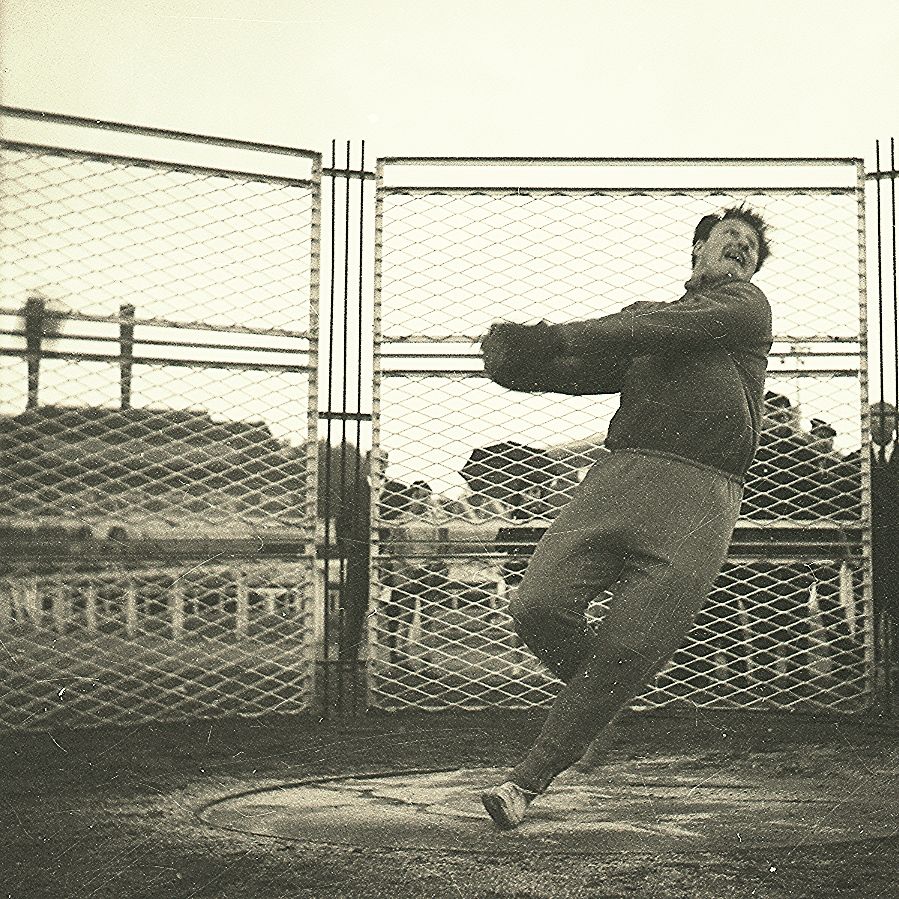
Guy Husson throwing the hammer at Boulogne-Billancourt, June 1962.
The uploader's caption notes the cage as a minimal one. Today's rules specify a far larger and taller cage for the hammer and the discus, because an implement released a fraction early leaves the circle at speed.
Lucien.BJ · CC BY-SA 4.0 · Wikimedia Commons
03Officiating and technology
Athletics has automated more of its officiating than any sport here, and it did so because its officials were being asked to measure rather than to judge. A measurement has a correct answer, so a machine can be trusted with it — and once a machine is doing it, the measurement becomes comparable across stadiums and decades, which is the whole purpose of the rulebook.
The photo finish replaced the judge at the line. Fully automatic timing replaced the stopwatch, and from 1977 a hand-timed mark could no longer be ratified as a record at sprint distances, which reconstituted the record lists around a different instrument. Pressure sensors in the blocks detect a start under 0.100 seconds after the gun, on the assumption that nobody can genuinely react faster than that — note that this is not a measurement of a false start but a threshold below which the sport declines to believe you.
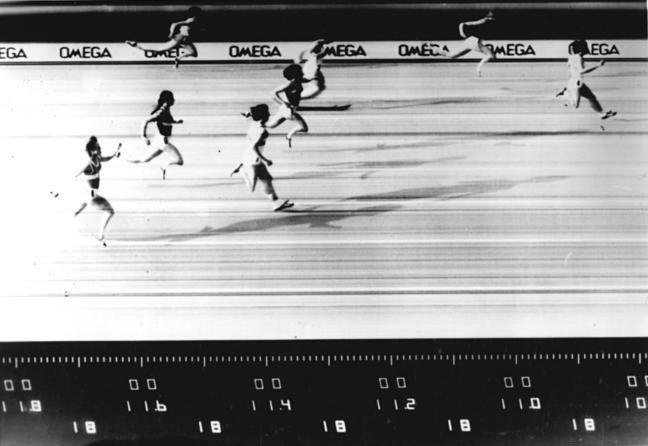
The photo-finish image of Marlies Oelsner's 100 m world record, Dresden, 1 July 1977.
10.88 seconds, the first time a woman broke eleven seconds on automatic timing, in the year hand-timed marks stopped counting for sprint records. The camera does not photograph a moment; it photographs the line over time, which is why the runners look stretched.
Bundesarchiv, Bild 183-S0702-0019 (photographer unknown) · CC BY-SA 3.0 de · Wikimedia Commons
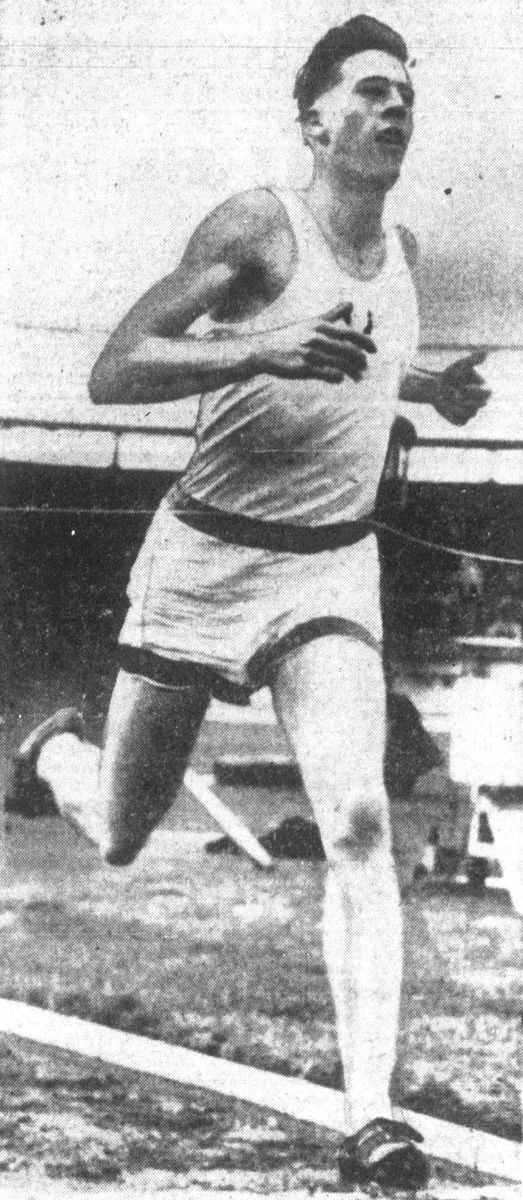
Roger Bannister, 1954.
Described by its source as the run on 6 May 1954 that produced the first sub-four-minute mile. Its 3:59.4 was taken on stopwatches, the instrument that from 1977 could no longer produce a sprint record.
Photographer unknown · Public domain · Wikimedia Commons
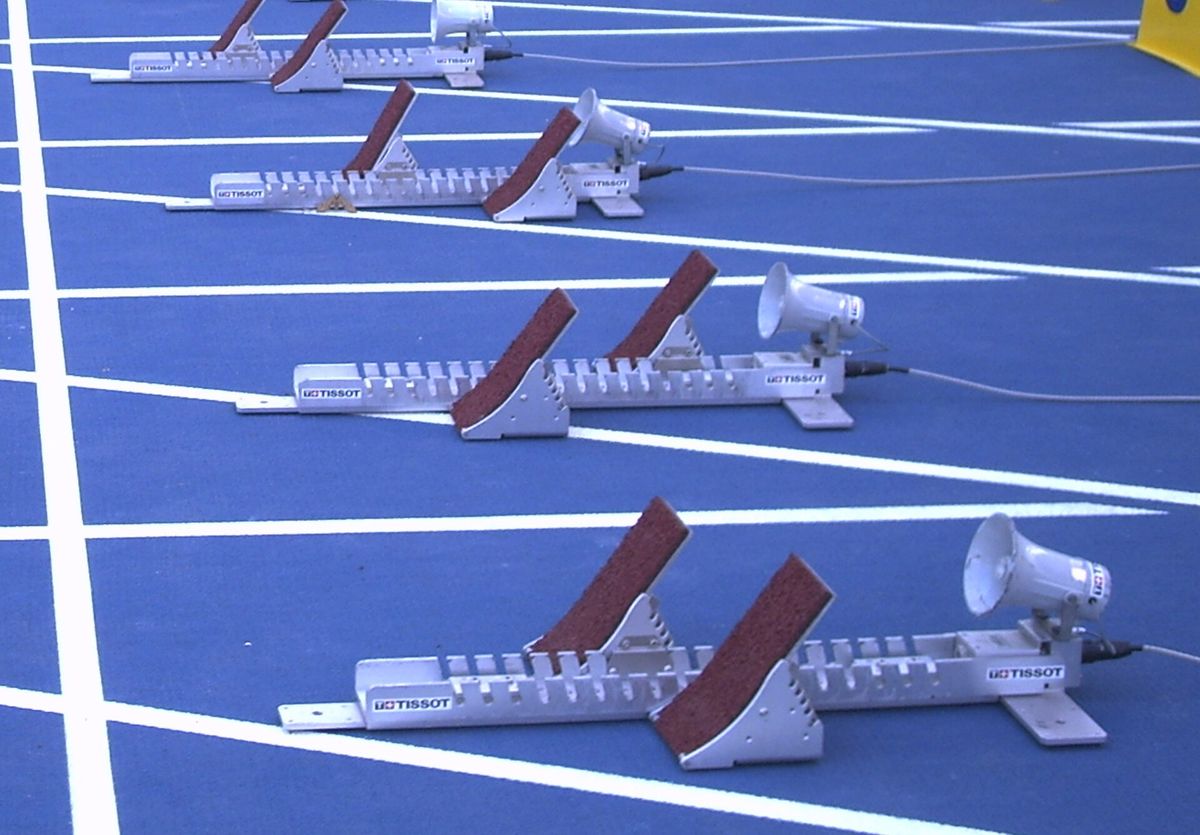
Pressure-sensitive starting blocks on the 100 m line, 2007 Pan American Games, Rio de Janeiro.
The speaker behind each block carries the gun, so every athlete hears it at the same instant. The sensor in the footplate reports anyone who pushes within 0.100 s of it.
Andrew Hecker · Public domain · Wikimedia Commons
Wind gauges and electronic distance measurement do the same job in the field events: they remove the human from the number.
Two things resist all of this. The first is race walking, which is judged by eye — a judge decides whether contact with the ground was lost — and is therefore structurally a judged sport sitting inside a measured one, with all of gymnastics' problems and none of its machinery. The second is the javelin landing, where the tip must strike first. A flat landing cannot be judged, and the 1986 redesign existed partly to make that call possible again. Athletics solved a judging problem by changing the implement, which is a move no other federation on this site has made.
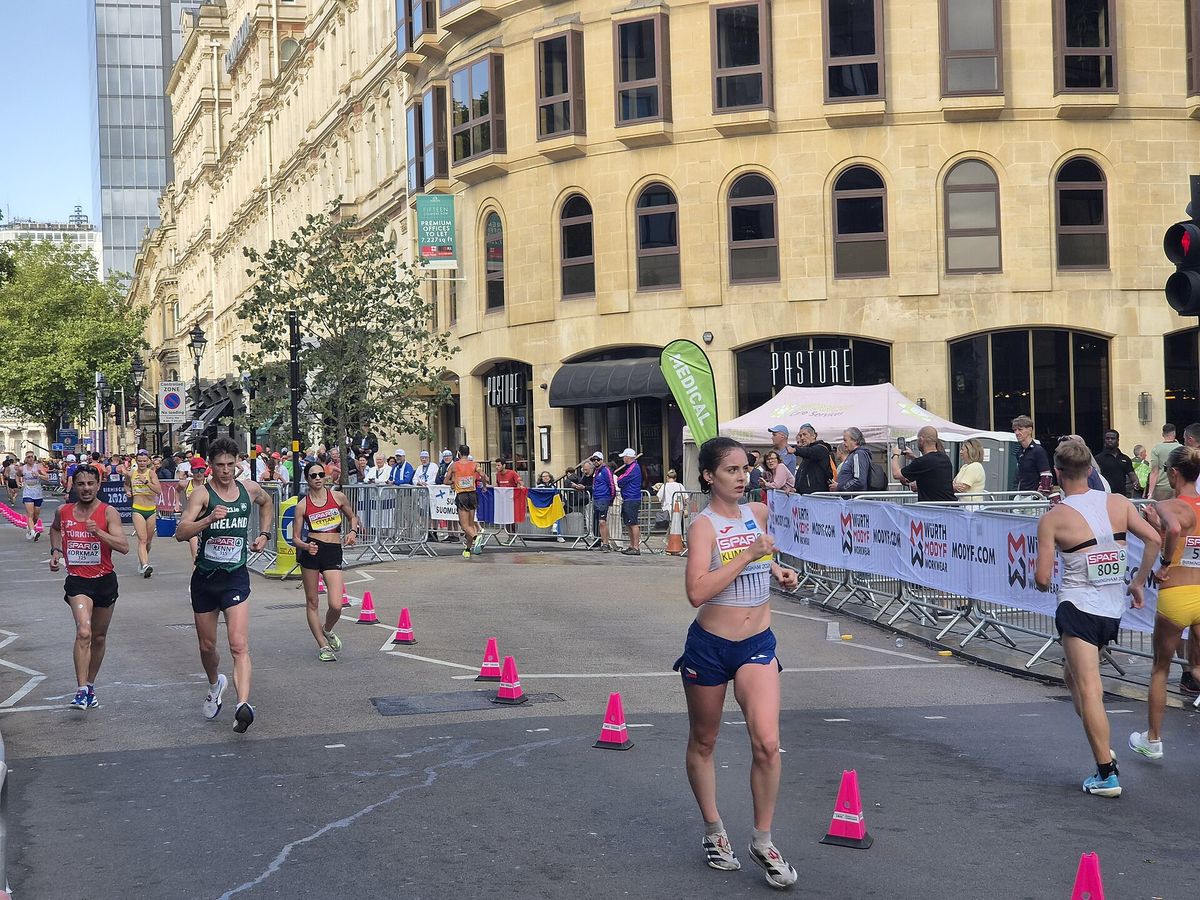
Race walking at the 2026 European Athletics Championships.
The one event decided by eye. Nothing in the picture can tell you whether a foot has left the ground; a judge at the roadside has to.
Bearas · CC BY-SA 4.0 · Wikimedia Commons
04Where it is played
Athletics has the widest participation of any sport on this site after football and the most event-specific competitive geography of any sport anywhere. It is not one map. It is forty.
Distance running is concentrated in the Rift Valley to a degree that has no parallel in sport. Sprinting is concentrated in Jamaica, the United States and West African diaspora populations. The throws are strongest in central and eastern Europe. Race walking is dominated by a handful of nations that maintain a judging and coaching culture for it. Pole vault requires a facility, and its map looks like a map of facilities.
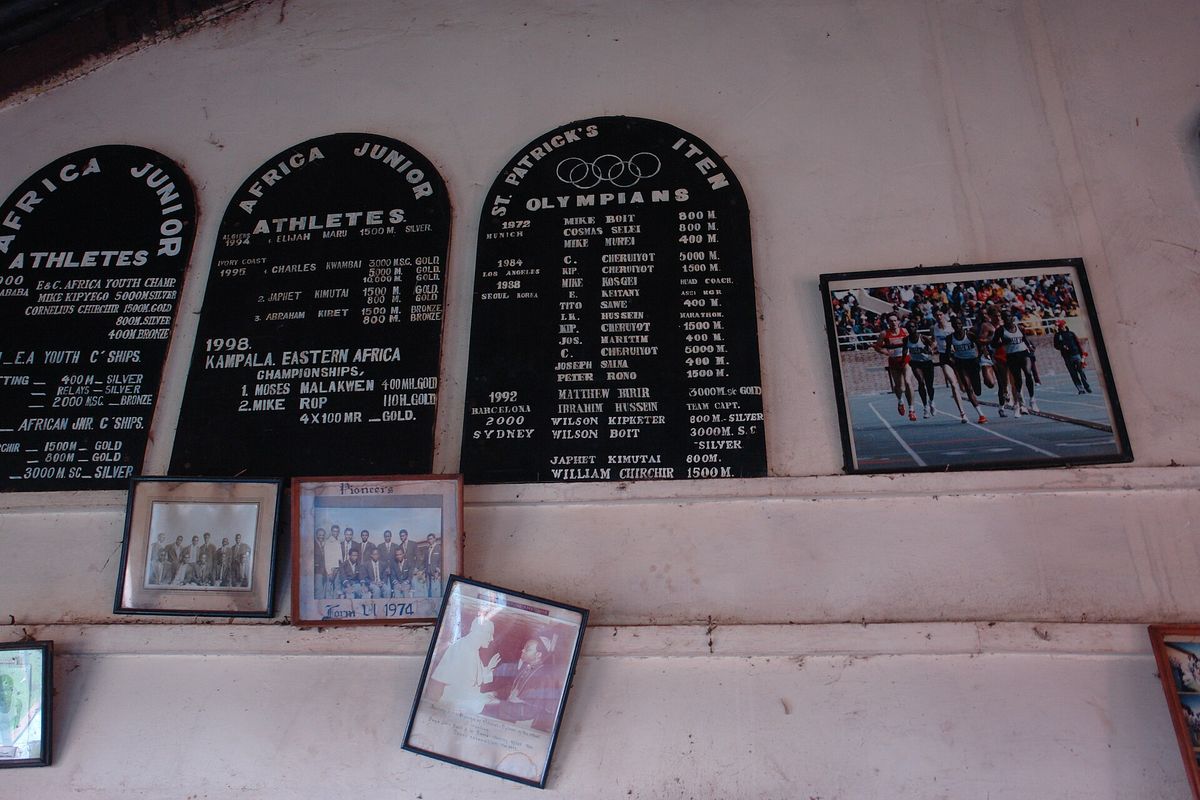
The honours boards inside St Patrick's High School, Iten, Kenya, 2009.
A school in the Rift Valley whose former pupils include Olympic and world champions, listed here with their events. It is evidence of the concentration the section describes, not of the reason for it.
edskoch · CC BY 2.0 · Wikimedia Commons
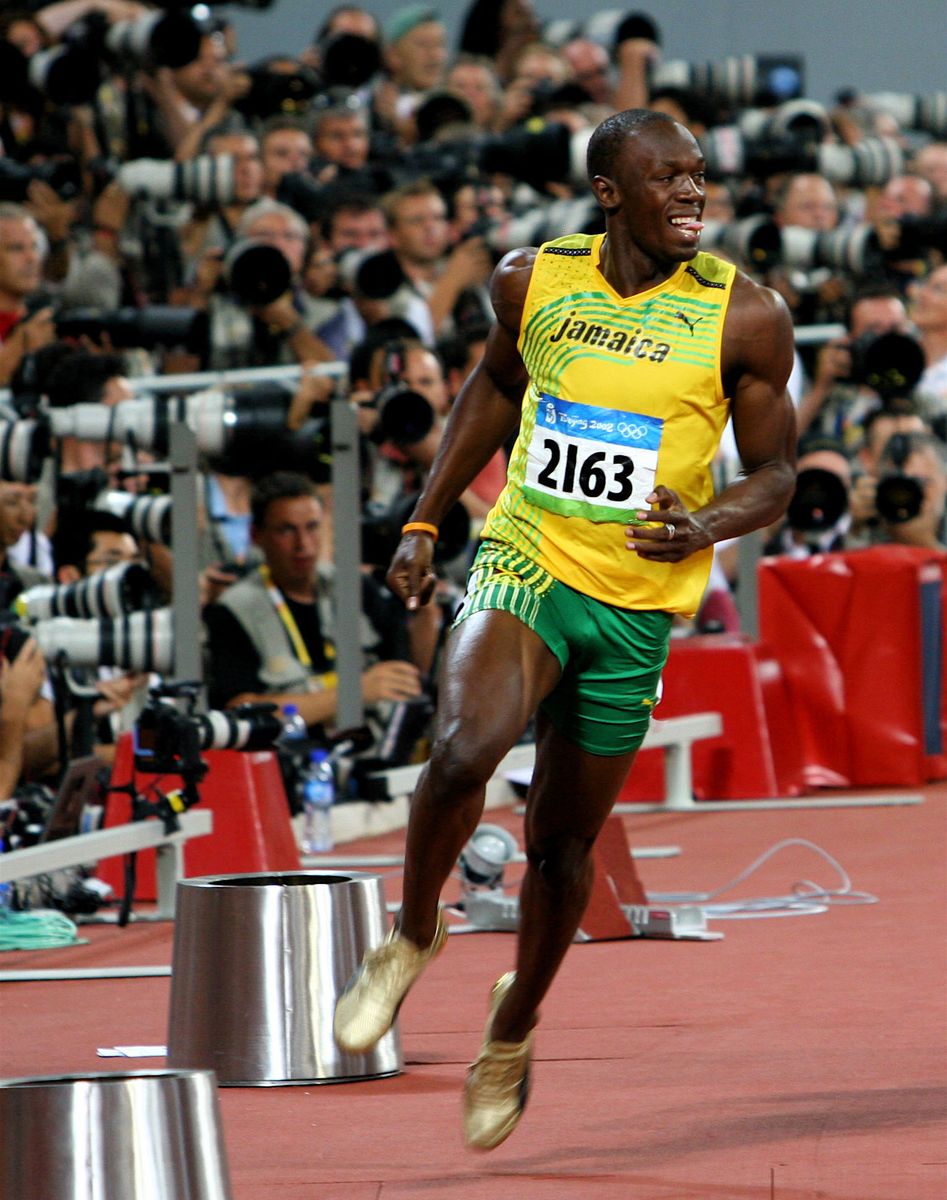
Usain Bolt seconds after winning the 100 m, Beijing 2008.
Jamaica is one of the handful of places the section names for sprinting, and the map of the event is as narrow as that.
Richard Giles · CC BY-SA 2.0 · Wikimedia Commons
The honest thing to say about why is that the sources genuinely disagree.
Altitude, running to school, a coaching tradition, an economic incentive
structure, and selection effects from a very large training population have all
been proposed for the Rift Valley, and no single account is settled. This site
records that the concentration exists and declines to explain it, on the same
principle that governs cause_primary everywhere else — a plausible explanation
is not a sourced one.
What is worth recording is the rule consequence. Because athletics ranks by a number rather than by a head-to-head result, a concentrated talent pool does not produce dominance in the way it does in an invasion sport: it produces a deeper qualifying field. And because entry to a Games is by qualifying standard as well as by national quota, the sport's geography shows up in who is in the final rather than in who is permitted to enter — which is a very different structure from badminton, where the quota is the binding constraint.
05Learning curve
Athletics is not one learning curve but forty, and averaging them would be meaningless. Running needs nothing and is the lowest barrier in sport; pole vault needs a pit, a coach and years. What the events share is a mastery problem no other sport here has: the competition is not only the other athletes, it is a published number set by someone who may be long retired.
Editorial — the site’s reading, not a sourced claim
Barrier to entry
How hard is it to get to a real game?
For the running events, none at all. For the technical events, high.
Nobody has to be taught to run, and the sport's largest participation base — road and distance running — needs no facility, no opponent and no official. This is the lowest entry barrier of anything on this site.
The rest of the programme is not like that. Pole vault, hammer, javelin and the jumps need a specific facility, a coach, and in several cases a landing area that does not exist outside an athletics club. The verdict here is very low because the sport's front door is running; it would be high for the throws taken alone, and this is the clearest case on the site of a single verdict being the wrong shape for the thing it describes.
Evidence
- Kit to start runningShoesobserved
- Facility to start runningNoneobserved
- Facility for the throwsCageobserved
- Time to a first raceOne sessionestimate
- Time to a first legal pole vaultMonthsestimate
Barrier to the top
How hard is it to be good at?
You are competing against a number, and the number does not decline with age.
A measured sport ranks by the mark, so an athlete is never only beating the people present. They are being compared with every performance ever ratified under the same conditions, which is a competitor that never has an off day and never retires.
That comparison is only fair if the conditions really are the same, which is why so much of this sport's rulebook is about eliminating variables: fully automatic timing, a wind limit, a fixed implement specification, a limit on shoe construction. Each of those rules exists to make today's number the same kind of object as an old one, and each of them defines what mastery is measured against.
Peak ages differ sharply by event — sprinters and jumpers earlier, throwers and marathon runners later — which is another reason the single verdict is a compression.
Evidence
- Timing required for recordsFully automaticruleSince 1977, which is where the modern sprint record list begins.1977 — the rule this rests on
- Legal tailwind2.0 m/sruleRecorded here as an example of condition control; the wind limit itself predates this site's earliest athletics entry.2010 — the rule this rests on
- False starts allowedNoneruleOne twitch ends a career-defining final. No other sport here punishes a single error this hard.2010 — the rule this rests on
- Shoe sole limit40 mmrule2020 — the rule this rests on
- Typical peak age25–28estimateSprints and jumps earlier
Why the two differ
The interesting thing about athletics is not the size of the gap but that the sport contains the whole range inside one rulebook. Running is the easiest sport in the world to begin and the pole vault is among the hardest; both are governed by the same book, the same federation and the same competition.
That is also why "a rule" means something different here than in badminton or football. In an invasion sport a rule governs what players may do to each other. In a measured sport a rule mostly governs the conditions, because the conditions are what make the number comparable — and comparability is what mastery is being judged against.
The historyhow it got here · sections 6 to 10
06Origin and invention
Athletics is the only sport in this collection that did not have to be invented, because running, jumping and throwing did not need a rule to exist. What needed inventing was the measurement.
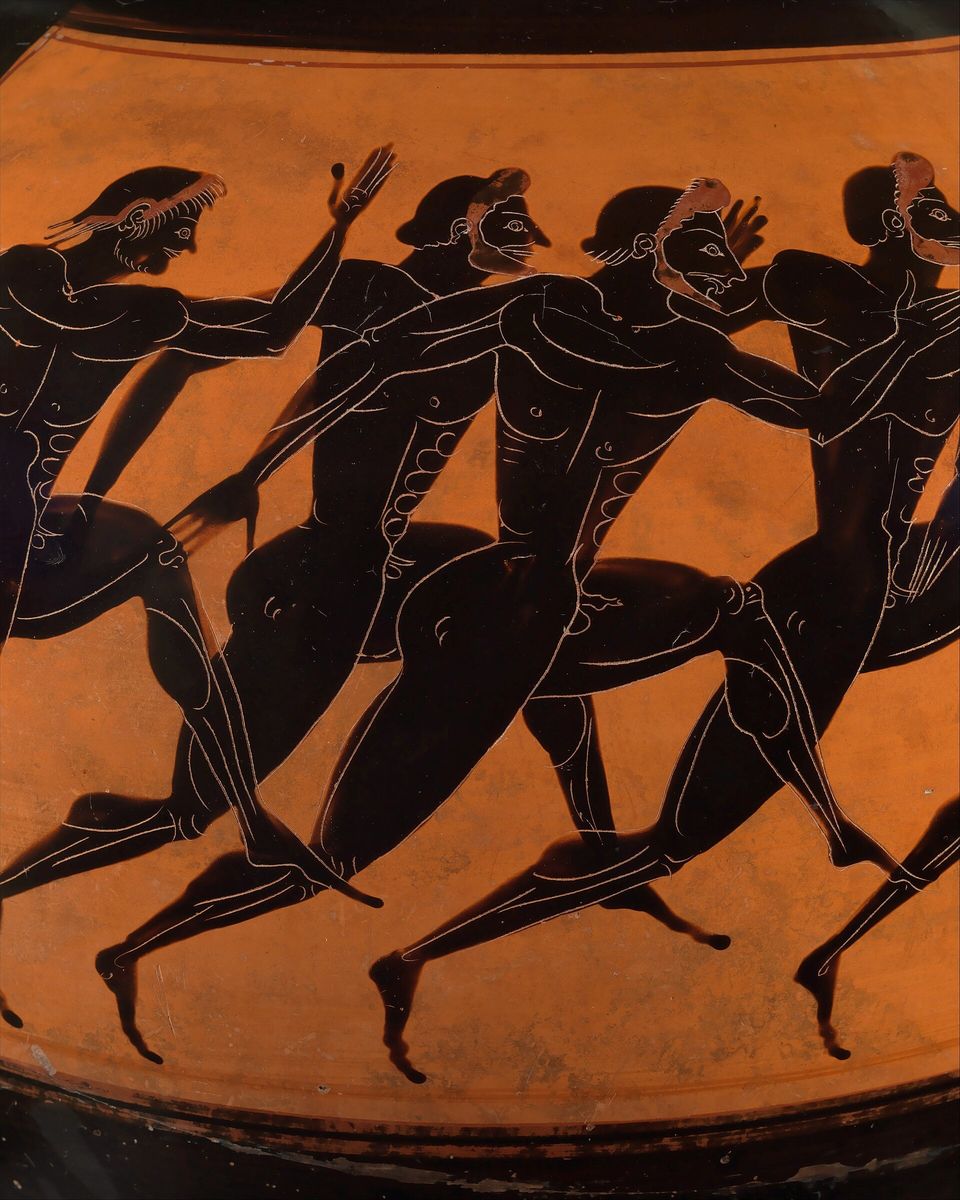
Runners on a Panathenaic prize amphora, Athens, about 530 BC.
Attributed to the Euphiletos Painter, in the Metropolitan Museum of Art. Jars like this were the prize for a foot race: evidence that the race is ancient, and that nobody recorded how long it took.
Euphiletos Painter (attributed); Metropolitan Museum of Art · CC0 · Wikimedia Commons
The events themselves are inherited — from the ancient Olympic programme, from Highland and rural games across northern Europe, from military training. What the nineteenth century added was the apparatus of comparability: a standardised distance, a standardised implement, a standardised surface, and eventually a standardised clock. The International Amateur Athletic Federation was founded in 1912 and its first substantial work was ratifying world records, which is to say deciding what counted as the same performance done twice.
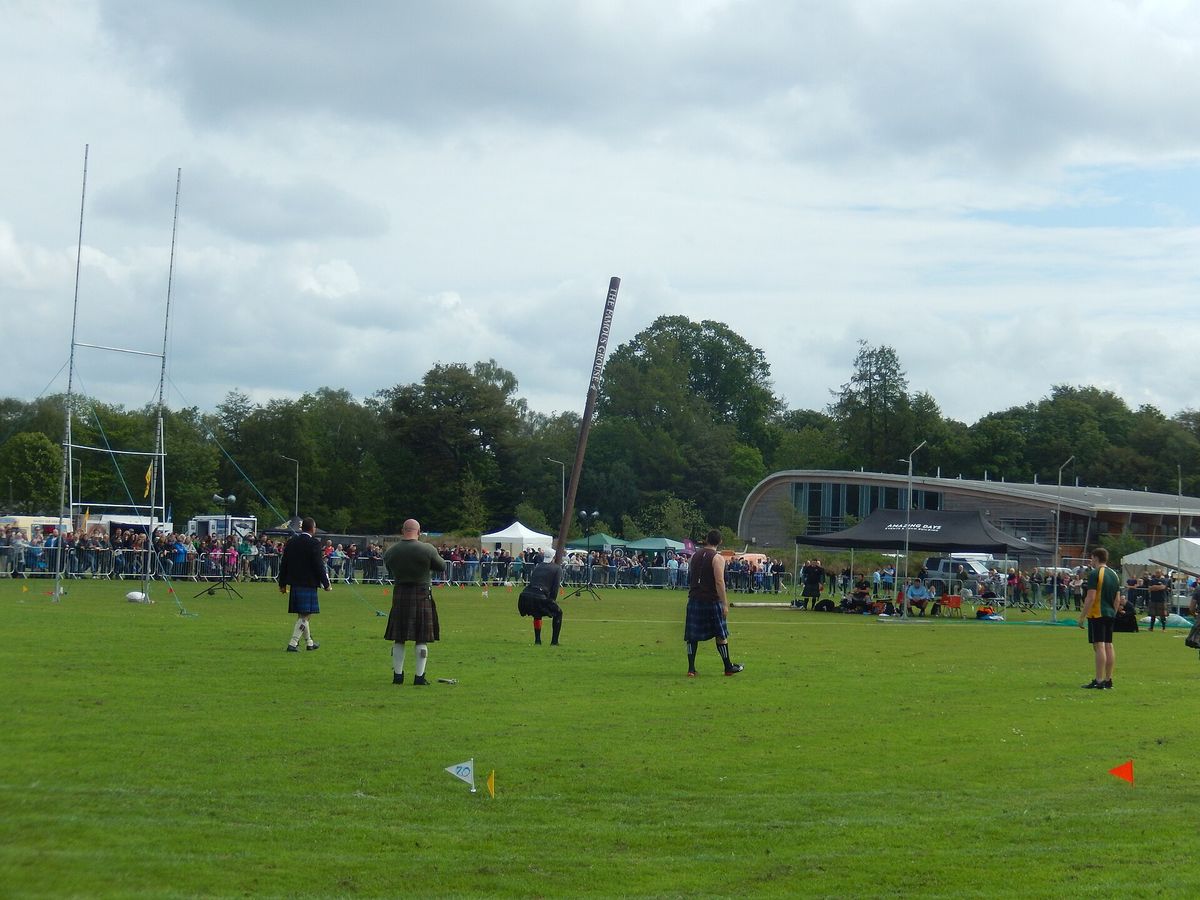
Tossing the caber at the Helensburgh Highland Games, 2019.
One of the rural games athletics drew its throws from. The caber never became a standardised event, and it shows why: an implement that varies from field to field produces a number nobody can compare.
AlasdairW · CC BY-SA 4.0 · Wikimedia Commons
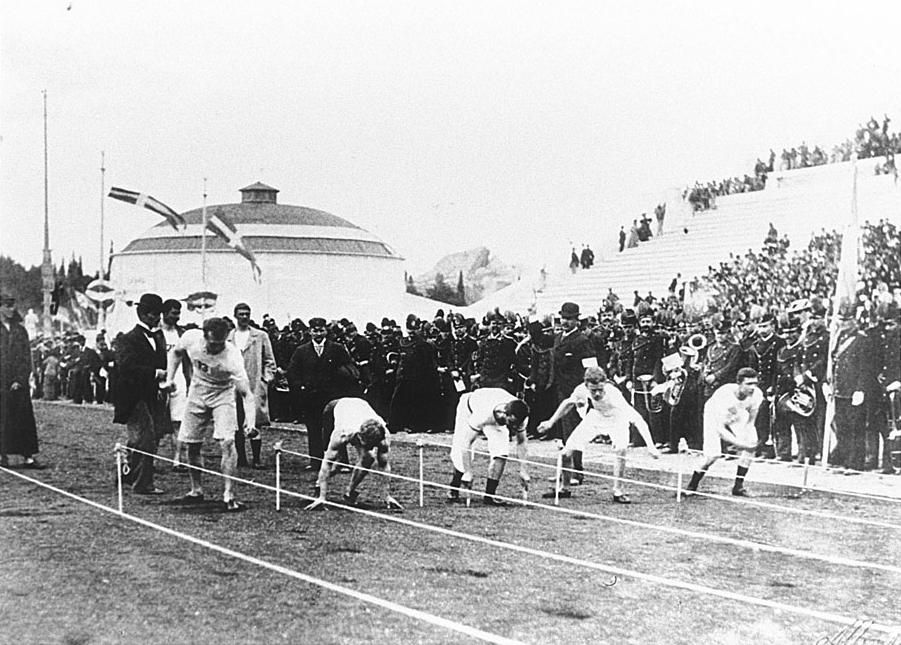
The start of a 100 m heat at the first modern Olympics, Athens, 1896.
Some runners crouch and some stand. The distance was fixed; the start, the surface and the clock were not yet the same from one race to the next.
Photographer unknown · Public domain · Wikimedia Commons
That is why athletics produces more comparability breaks than any other family in this collection. A sport that keeps a number is a sport that must keep deciding whether today's number is the same kind of thing as the number from forty years ago. Every time the answer is no, the record book has to do something about it — and athletics has answered that question in both directions within thirty-five years.
07Rule timeline
The sport’s own lane, expanded. Every entry carries a cause from the closed vocabulary and a citation, and says so where the citation is incomplete.
- 1977-01-01Equipment and technologyadopted 1976
Fully automatic timing to one hundredth of a second became compulsory for world records at distances up to and including 400 metres. Hand-timed marks were no longer ratified at those distances, and the record lists were reconstituted around the automatically timed performances.
Trigger and citationIncomplete — no confirmed article
Trigger
Hand timing rounded to a tenth and carried a systematic reaction-time advantage, so hand-timed and automatically timed marks were not the same measurement. Automatic timing had been available at major championships for a decade before the requirement was imposed.
World Athletics Technical Rules (Book C, C2.1) · IAAF Competition Rules, 1977
- 1986-04-01Safetyalso equipment and technologyadopted 1985
The men's javelin specification was rewritten to move the centre of gravity forward by four centimetres relative to the centre of the implement's length, while keeping the overall mass at 800 grams. The redesigned implement pitches nose-down earlier, cutting distances by roughly ten per cent, and the world record list was restarted from zero on the date the rule took effect.
Comparability break · Record book reset
The implement was redesigned to shift the centre of gravity forward and the record book was restarted on 1 April 1986. Distances either side of this line were produced by different objects and are not comparable. Note that the post-1986 record has climbed back to within six metres of Uwe Hohn's 1984 throw without ever being the same measurement as it. See the series
Trigger and citation
Trigger
In July 1984 Uwe Hohn threw 104.80 m, a distance that in many stadiums would have reached the far running track or the crowd beyond it. The federation also cited the growing proportion of flat landings, which made it impossible to judge whether the tip had struck first and so made the measurement itself disputable.
World Athletics Technical Rules (Book C, C2.1) · IAAF Competition Rules, 1986 · article Rule 193 (javelin specification)
- 1992-01-01Equipment and technologyadopted 1991
Roughened, dimpled and serrated tail surfaces were prohibited, the specification requiring a smooth surface throughout. Marks set with the roughened implements were annulled rather than carried forward, so a second and smaller discontinuity sits inside the post-1986 segment.
Trigger and citationIncomplete — no confirmed article
Trigger
Roughened tails altered the aerodynamics enough to add several metres, restoring part of the distance the 1986 redesign had removed and threatening to undo the reason for it.
World Athletics Technical Rules (Book C, C2.1) · IAAF Competition Rules, 1992
- 1999-04-01Safetyalso equipment and technologyadopted 1998
The same operation performed on the men's implement in 1986 was performed on the women's 600-gram javelin, shifting the centre of gravity forward and restarting the women's record list. That the federation repeated the procedure thirteen years later, knowingly and by the same method, is the strongest evidence available that the 1986 reset was regarded internally as having worked.
Trigger and citationIncomplete — no confirmed article
Trigger
Petra Felke's 80.00 m in 1988 stood unbeaten for a decade and the same combination of arena size and flat landings had reappeared in the women's event.
World Athletics Technical Rules (Book C, C2.1) · IAAF Competition Rules, 1999
- 2010-01-01Broadcast and pacingalso integrityadopted 2009-08
A single false start now disqualifies the athlete who commits it. This replaced the 2003 rule, under which the field was permitted one false start collectively and any athlete false-starting after that was disqualified, which had itself replaced the older rule allowing each athlete one.
Trigger and citation
Trigger
The federation's stated reason was that repeated recalls made the duration of a sprint final unpredictable inside a televised session.
The 2003 collective rule had been introduced to stop athletes using deliberate false starts to unsettle rivals, and the 2010 change is widely read as completing that anti-gamesmanship move rather than as a scheduling decision. Both readings appear in the record; the federation gave the scheduling reason.
World Athletics Technical Rules (Book C, C2.1) · IAAF Competition Rules, 2010–2011 · article Rule 162.7
- 2020-07-28Equipment and technologyalso fairness and eligibilityadopted 2020-01
Competition shoes were given a maximum sole thickness — 40 mm for road events, with lower limits for track — and a limit of one rigid embedded plate. Crucially, every record set in the preceding shoes was allowed to stand. The federation legislated the technology forward and left the record book untouched.
Trigger and citation
Trigger
Carbon-plated, thick-foam racing shoes introduced from 2016 produced an unusually dense run of distance records and were not available to all athletes on equal terms.
The federation framed the limits as preserving the primacy of human performance. Others read the thresholds as having been set where they were in order to permit shoes already on sale rather than to withdraw them. Both readings are recorded.
World Athletics Technical Rules (Book C, C2.1) · World Athletics Technical Rules, Rule 5, 2020 · article Rule 5
08Equipment evolution
The javelin is the clearest case in this collection of a rule written against an implement, and it happened twice.
Through the 1950s the American thrower Bud Held developed javelins with greater surface area and better gliding characteristics, and distances began to climb faster than technique alone would explain. Terje Pedersen passed 90 metres in 1964 with an aerodynamic design; the federation restricted the specification; distances came back down and then climbed again. By 1984, when Uwe Hohn threw 104.80 m, the implement was outrunning the arena that was supposed to contain it.
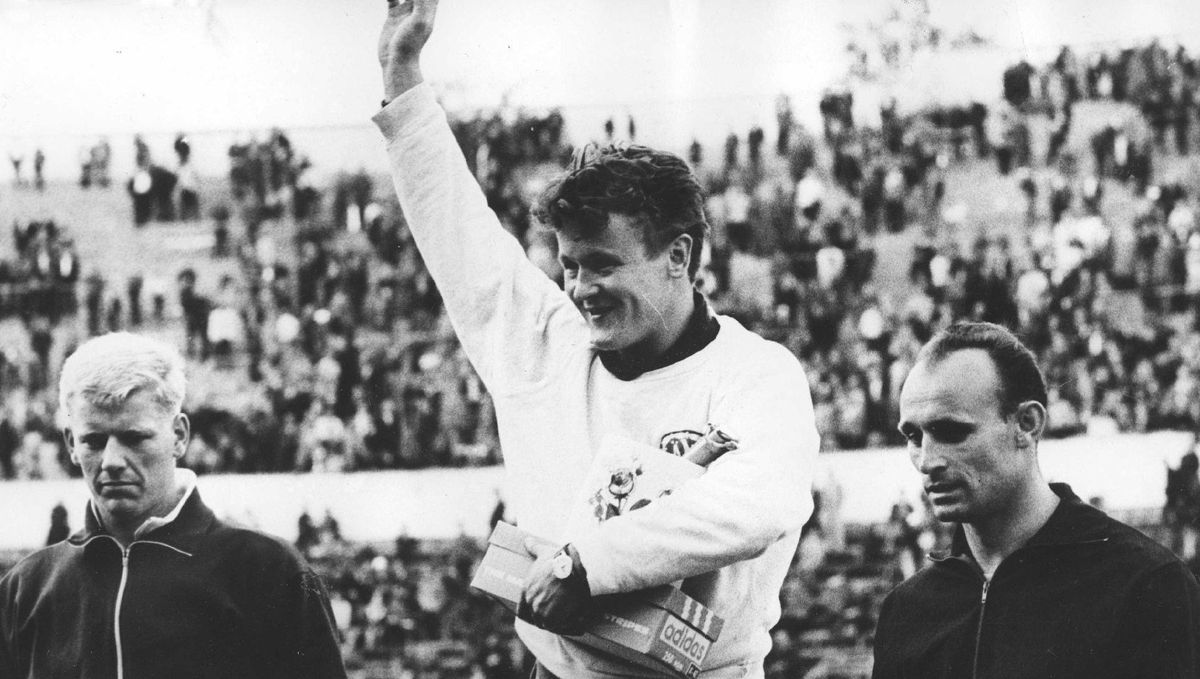
The javelin medallists in Helsinki, June 1965: Terje Pedersen, Jorma Kinnunen and Gergely Kulcsár.
Pedersen, on the left, had become the first man to throw beyond 90 metres the year before. That was the aerodynamic javelin, and the specification was tightened after it.
Photographer unknown · Public domain · Wikimedia Commons
The 1986 redesign is unusually surgical. The mass stayed at 800 grams and the length stayed within the same band; what moved was the centre of gravity, four centimetres forward. That makes the implement pitch nose-down earlier, which both shortens the throw by roughly a tenth and restores a clean tip-first landing. The federation solved a safety problem and a measurement problem with one change to one number, and accepted that it was destroying the comparability of its own record book in order to do it.
Then it happened again in a smaller way. Roughened and dimpled tail surfaces appeared within a few years and recovered part of the lost distance; they were banned with effect from 1992, and the marks set with them were annulled rather than carried forward. And the same operation was performed on the women's 600-gram implement in 1999.
Shoes are the counter-example. Carbon-plated racing shoes from 2016 onward produced a run of records at least as anomalous as anything the javelin ever did. World Athletics wrote limits into the rules in 2020 — a maximum sole thickness, one rigid plate — and left every record standing. Same federation, same kind of problem, opposite decision about the record book. Whether the difference is the physics or the commercial position of the shoe industry is not something the sources settle.
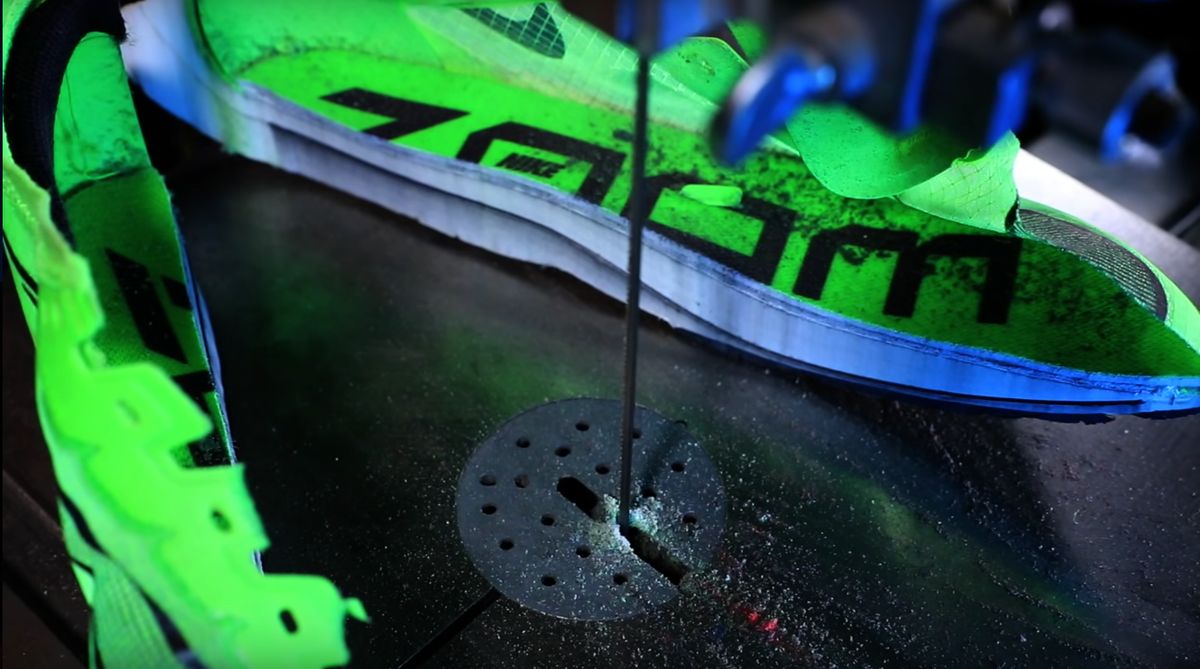
A Nike Vaporfly Next% being cut in half, 2019.
A frame from a video by Seth James DeMoor. The cut edge shows how deep the foam stack is; the 2020 rules cap it at 40 mm for road shoes and allow one rigid plate inside it. The records set in shoes like this stand.
Seth James DeMoor · CC BY 3.0 · Wikimedia Commons
What the 1986 rule changed
Four centimetres, and the record book
Drawn to scale, which is the point: four centimetres on a 2.6 metre shaft is a shift you have to be told to look for, and it took roughly ten per cent off the world record. Moving the balance point towards the tip makes the nose drop earlier, so the implement lands point-first and closer — which is what World Athletics wanted, because flat landings were producing judging arguments and throws were reaching the end of the stadium. The flight paths are schematic; the implement is not.
09Governing body politics
Athletics spent its first eighty years as an explicitly amateur federation and the word sat in its name until 2001. Amateurism was not a philosophy so much as an eligibility rule, and like most eligibility rules it decided who could compete rather than how. Its slow collapse through the 1970s and 1980s — the trust-fund arrangements, then open payment — is the largest rule change in the sport's history and it left no mark on any record book at all, which is why it does not appear on the timeline as a comparability break.
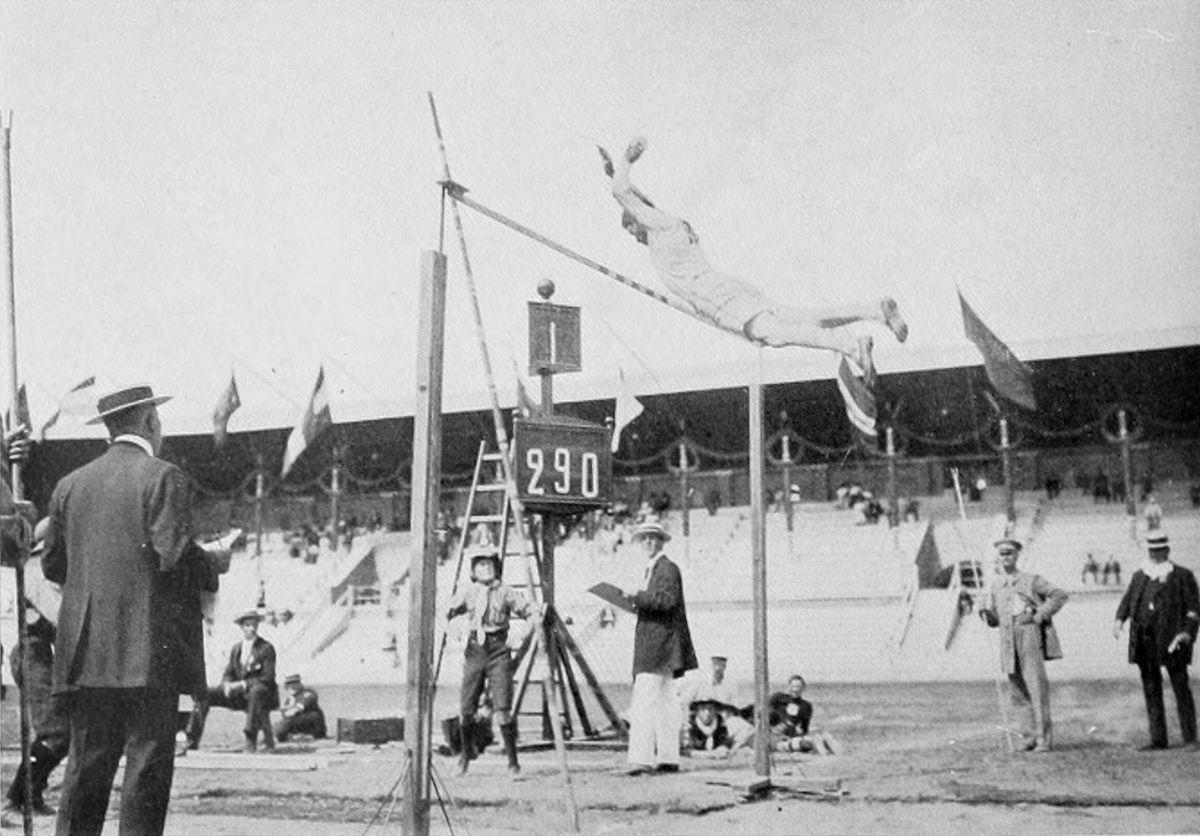
Jim Thorpe in the decathlon pole vault, Stockholm 1912.
Thorpe won the pentathlon and the decathlon here and was stripped of both titles the next year, for having been paid to play baseball. That was the amateur rule doing what it was for: deciding who could compete.
IOC photographer · Public domain · Wikimedia Commons
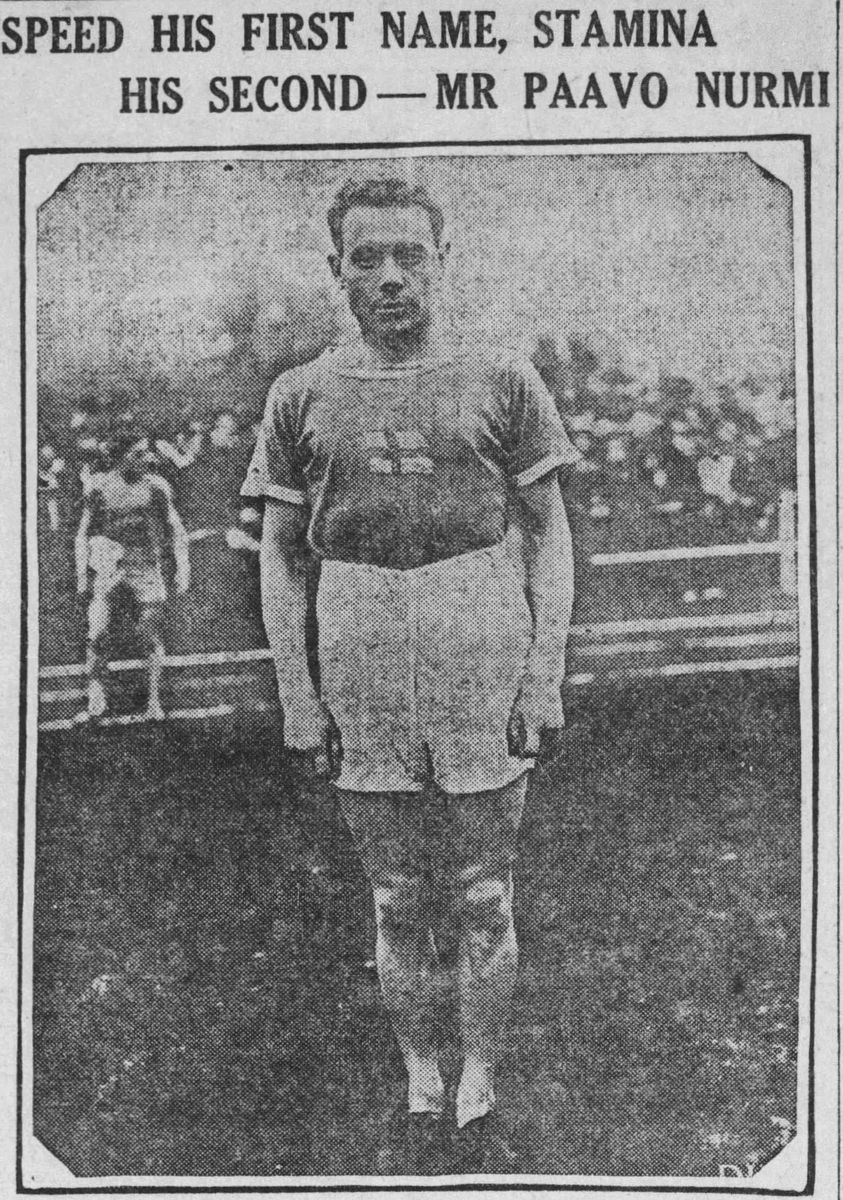
Paavo Nurmi, in a newspaper photograph of 1924.
The dominant distance runner of the decade, and suspended by the federation in 1932 on grounds of professionalism, so he never ran the Olympic marathon he was preparing for.
Photographer unknown · Public domain · Wikimedia Commons
Two renames record two repositionings: to the International Association of Athletics Federations in 2001, dropping amateur, and to World Athletics in 2019, dropping the federation-of-federations framing entirely.
The federation's authority over records is the thing that makes this sport legible here. Because ratification is centralised and the criteria are published, a decision to reset a record list is a dated, attributable act by a named body. Football has no such office, which is why its section of this site looks so different.
10Controversies that forced rule changes
Uwe Hohn, Berlin, 20 July 1984. 104.80 m. The throw is the trigger for the 1986 redesign in the plainest sense — it is the specific incident PRD §3 asks for — but it is worth being precise about what the problem was. The distance alone was a stadium-safety issue in the arenas the sport actually used. The harder problem was that javelins thrown that far were increasingly landing flat, and a flat landing cannot be judged: nobody can say whether the tip struck first, so the measurement itself becomes a matter of opinion. A measured sport can survive throws that are too long. It cannot survive throws it cannot measure.
Hohn never threw with the new implement in competition at that level. His record was not beaten; it was retired along with the object that produced it.
The false start, three times. Each athlete was once allowed one false start. From 2003 the field collectively got one, and the next offender went out — a rule introduced because athletes had learned to use a deliberate false start to unsettle a rival. From 2010 the first false start disqualifies. The federation gave scheduling as its reason. The change is at least as easily read as finishing the anti-gamesmanship job started in 2003, and both readings sit in the entry rather than one being chosen.
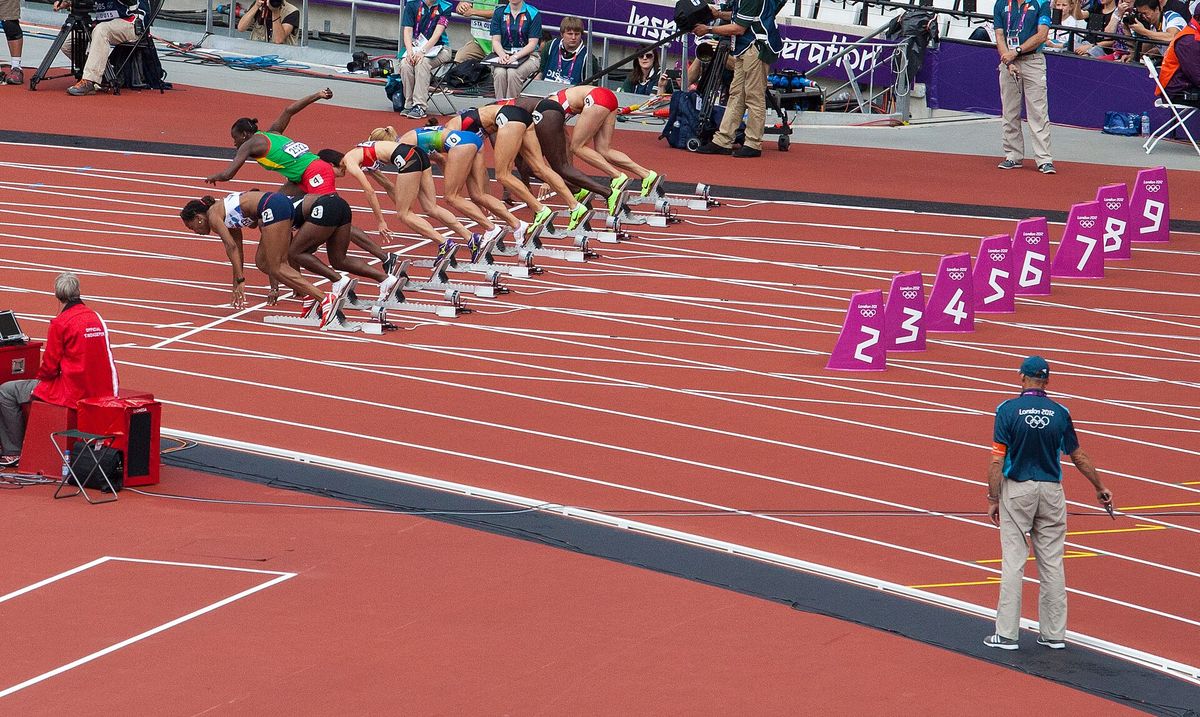
A false start in the women's 100 m hurdles, London 2012.
Two years into the rule that the first false start disqualifies. The athlete who moved, Rahamatou Dramé, was disqualified; there was no warning to give.
Tom Page · CC BY-SA 2.0 · Wikimedia Commons
The shoes. No single incident, which is precisely why it is interesting. A diffuse technological shift produced an unusual density of records across several years, the federation legislated the technology and not the record book, and the marks stand. Set this next to the javelin and the swimming supersuits and the pattern is that governing bodies reset the record book when the break is sharp and datable, and leave it alone when the change arrives gradually.
Where it standsthe record, and what is still open · sections 11 to 12
11Series
Men's javelin world record
Measured in m. Broken at 1986 (record book reset).
- 1912–1986
- 62.32 → 104.80
- spans 42.48 m
- 1986–2026
- 85.74 → 98.48
- spans 12.74 m
1986 Record book reset. The implement was redesigned to shift the centre of gravity forward and the record book was restarted on 1 April 1986. Distances either side of this line were produced by different objects and are not comparable. Note that the post-1986 record has climbed back to within six metres of Uwe Hohn's 1984 throw without ever being the same measurement as it.
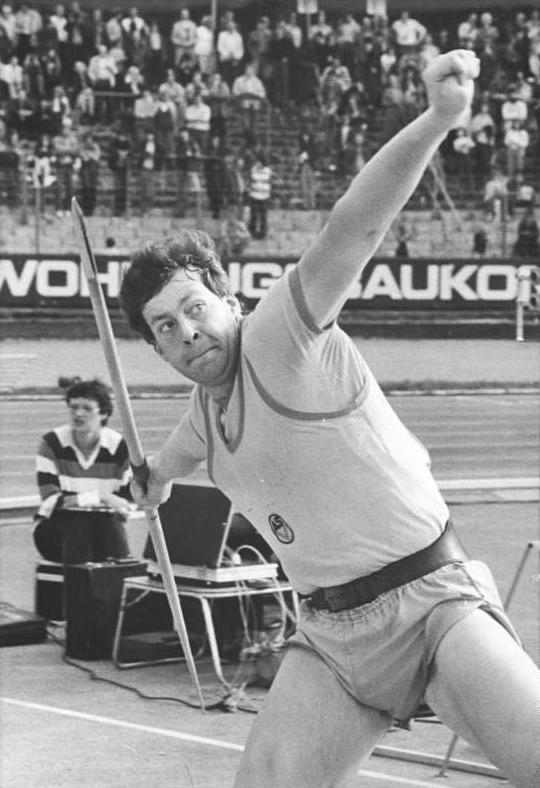
Uwe Hohn in 1984, the year he threw 104.80 m.
A portrait of the thrower, not of the throw. The record it refers to was set on 20 July 1984 in Berlin; two years later the implement was redesigned and the list restarted, which is why this mark has no successor.
Wolfgang Kluge · CC BY-SA 3.0 de · Wikimedia Commons
12What is contested now
Recorded as unsettled.
Shoes. The 2020 rules set a maximum sole thickness and a limit of one rigid plate, and left every record set in the preceding shoes standing. Both halves remain argued. The thresholds are read by some as having been drawn where they were in order to permit shoes already on sale rather than to withdraw them, and the decision not to touch the record book sits directly against this federation's own precedent with the javelin in 1986. The sport has not reconciled those two decisions and shows no sign of trying.
Eligibility. Regulations on athletes with differences of sex development, and on transgender athletes, are the most contested rules in the sport and among the most contested in any sport. They are eligibility rules in this site's vocabulary — they decide who may compete, in what category — and they have been litigated internationally with conflicting outcomes. This site records that the question is open and does not summarise the arguments, because a one-paragraph summary of a dispute this consequential would be worse than silence.
Where a record may be set. Point-to-point courses, pacing technology, in-race lighting systems and heavily engineered surfaces all raise the same question the wind gauge raised a century ago: which conditions must be standard for a number to be comparable. Every answer the sport gives narrows or widens what counts as the same performance done twice.
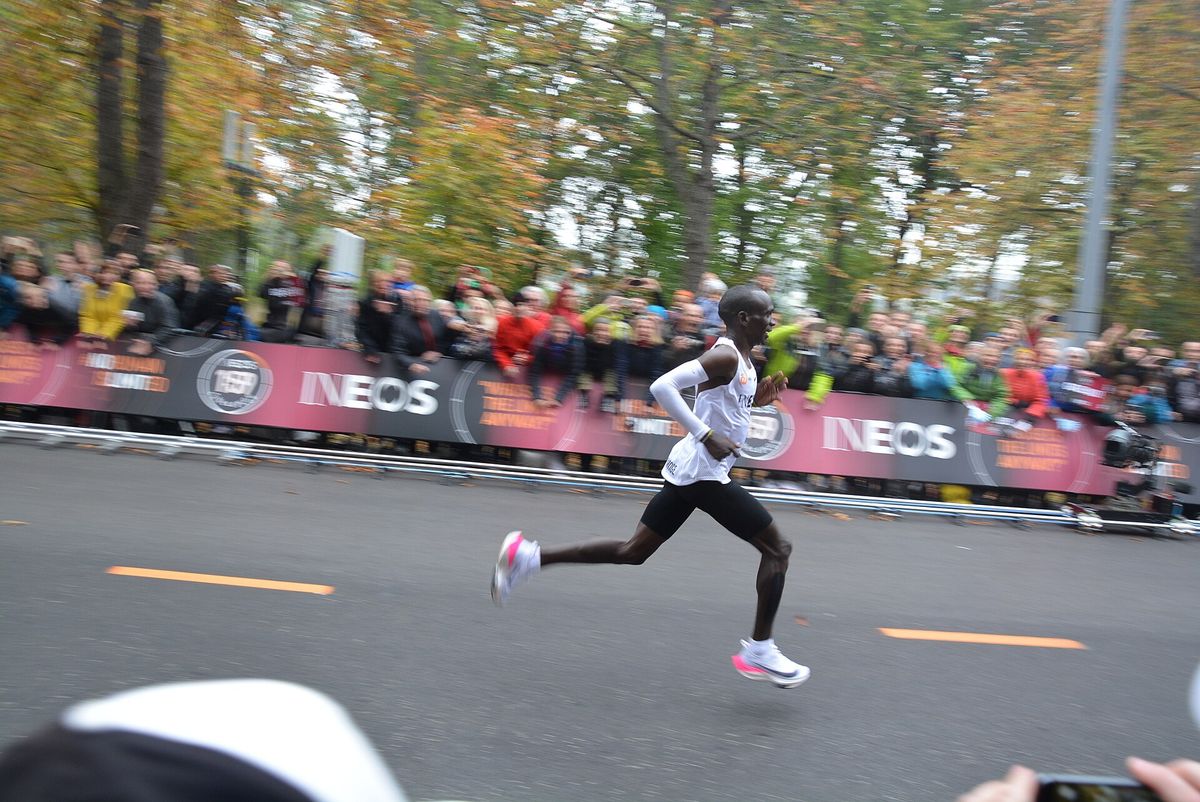
Eliud Kipchoge in the last 200 m of the INEOS 1:59 Challenge, Vienna, October 2019.
The first marathon distance run in under two hours, and not a record: it had rotating pacers, a car projecting the pace on the road, and no open competition. The question of which conditions a record needs, asked of a single run.
Triathlet 79 · CC BY-SA 4.0 · Wikimedia Commons
Race walking's judging. The one event judged by eye rather than measured periodically faces proposals to add sensors or to replace the event. Both would resolve a judging problem by changing what the event is.