Badminton
The racket sport that rewrote its scoring for television and severed its own statistics doing it.
- Official
- Badminton
- Game category
- Net and wall
- Adjudication
- Decided by score
- Standing
- Added and kept
- rule changes
- 5
- comparability break
- 1
- Olympic editions
- 10
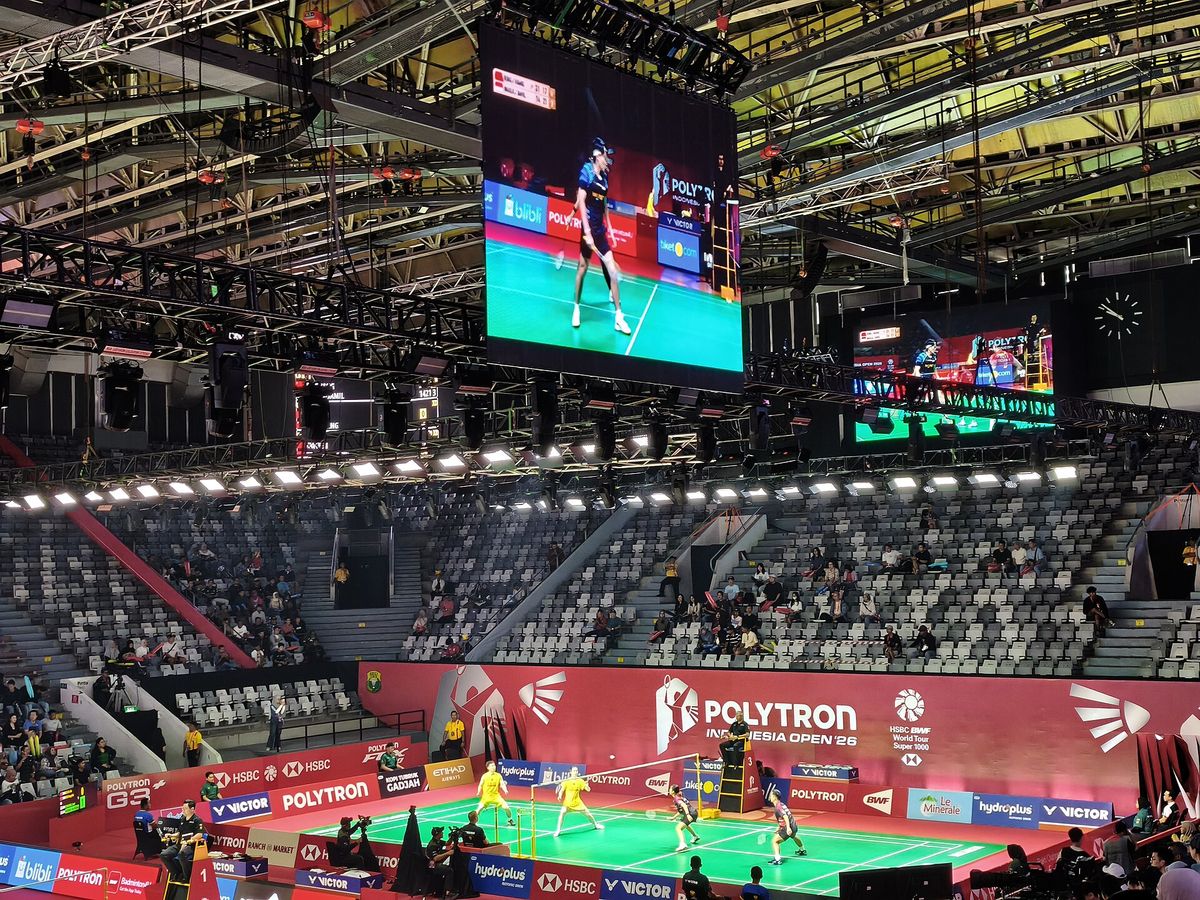
Istora Senayan, Jakarta, during the 2026 Indonesia Open · Griff88 · CC BY-SA 4.0
- Governing body
- Badminton World Federation
- Founded
- International Badminton Federation founded 1934; renamed Badminton World Federation in 2006.
- Olympic status
- 10 editions
- on the 2028 programme
- Also contested at
- Asian Games
Badminton's rules are mostly rules about scoring, and its scoring has been rewritten twice in twenty years for the same reason both times: nobody could tell a broadcaster how long a match would take. The 2006 switch to 21-point rally scoring is the cleanest case in this collection of a governing body stating its reason plainly, and it severed every match statistic before it from every one after.
The gamewhat it is now · sections 1 to 5
01How it is played
Two or four players hit a shuttlecock over a net with rackets, and a rally ends when the shuttle touches the floor or a fault is called. What separates badminton from every other net game is the shuttle: it decelerates so hard that it cannot be hit long from anywhere, which is why the court is small, the rallies are fast, and almost every law that matters is a law about the serve.
These figures were entered from the edition named above but have not been checked against its text line by line. Treat them as this site’s reading of the laws, not as a substitute for them.
The object of the game
Land the shuttle inside the opponent's court, or force them into an error that ends the rally. A rally begins with a serve and ends the moment the shuttle touches the ground, hits a player, goes out, or a fault is called. There is no volleying it back and forth over multiple touches — each side gets exactly one contact per rally turn.
The court
One rectangle with two sets of boundaries drawn on it. Singles uses the long, narrow court; doubles uses the full width but a shorter service box. That is why the tramlines matter differently at the sides than at the back, and why the in-out call changes depending on which discipline is being played and whether the shuttle is a serve.
- Court length
- 13.4 m
- Width, doubles
- 6.1 m
- Width, singles
- 5.18 m
- Net height at centre
- 1.524 m
- Net height at posts
- 1.55 m
- Clear height above court
- 12 m
- Recommended for top-tier play; the shuttle is hit very high.
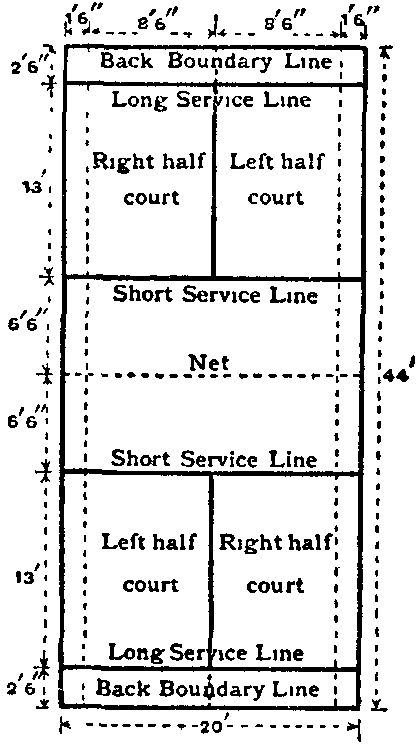
The court, as drawn in the 1911 Encyclopædia Britannica.
44 feet by 20 feet, with the short and long service lines. That is 13.4 by 6.1 metres, today's doubles court exactly: the court is one of the things the sport has not changed.
Encyclopædia Britannica, 11th edition · Public domain · Wikimedia Commons
BWF Laws of Badminton, in the BWF Statutes · Law 1 · article not confirmed
Racket and shuttle
The shuttle is the specified object, not the racket. Competition shuttles use sixteen feathers fixed in a cork base, and the laws prescribe the mass and the feather length rather than the material — which is how synthetic shuttles remain legal in general play while top competition keeps feathers.
Shuttles are also graded by speed, and a shuttle of the correct speed is defined by where it lands when hit full-force from the back line. The law defines the object by its behaviour, not by its construction.
- Shuttle mass
- 4.74–5.50 g
- Feathers
- 16
- Feather length
- 62–70 mm
- Racket frame length
- 680 mm max
- Racket frame width
- 230 mm max
BWF Laws of Badminton, in the BWF Statutes · Laws 2 and 4 · article not confirmed
Players and officials
Singles is one against one; doubles is two against two, including mixed doubles, which is the only Olympic event in any sport where a man and a woman compete as a team against another such team. The umpire runs the match from a raised chair, a service judge watches the serve alone, and line judges call in or out. Instant review of line calls is used at top tier events, on a limited number of challenges per game.
Format
A match is the best of three games. There is no clock: a game ends when somebody reaches the target score, so match length is a consequence of the scoring system rather than something the rules set directly. That relationship is the whole reason the scoring system was rewritten in 2006.
This clause reads this way because of
Scoring
A point is scored on every rally, by whichever side wins it, regardless of who served. A game goes to 21, but a side must lead by two — and if the score reaches 29-all, the next point wins at 30, which is the only hard ceiling in the system.
The side that wins a rally serves next. Serving is therefore a consequence of scoring rather than a precondition for it, which is the exact reversal made in 2006.
- Game to
- 21
- Must win by
- 2
- Hard cap
- 30
- Games per match
- Best of 3
- Change ends
- At 11 in game 3
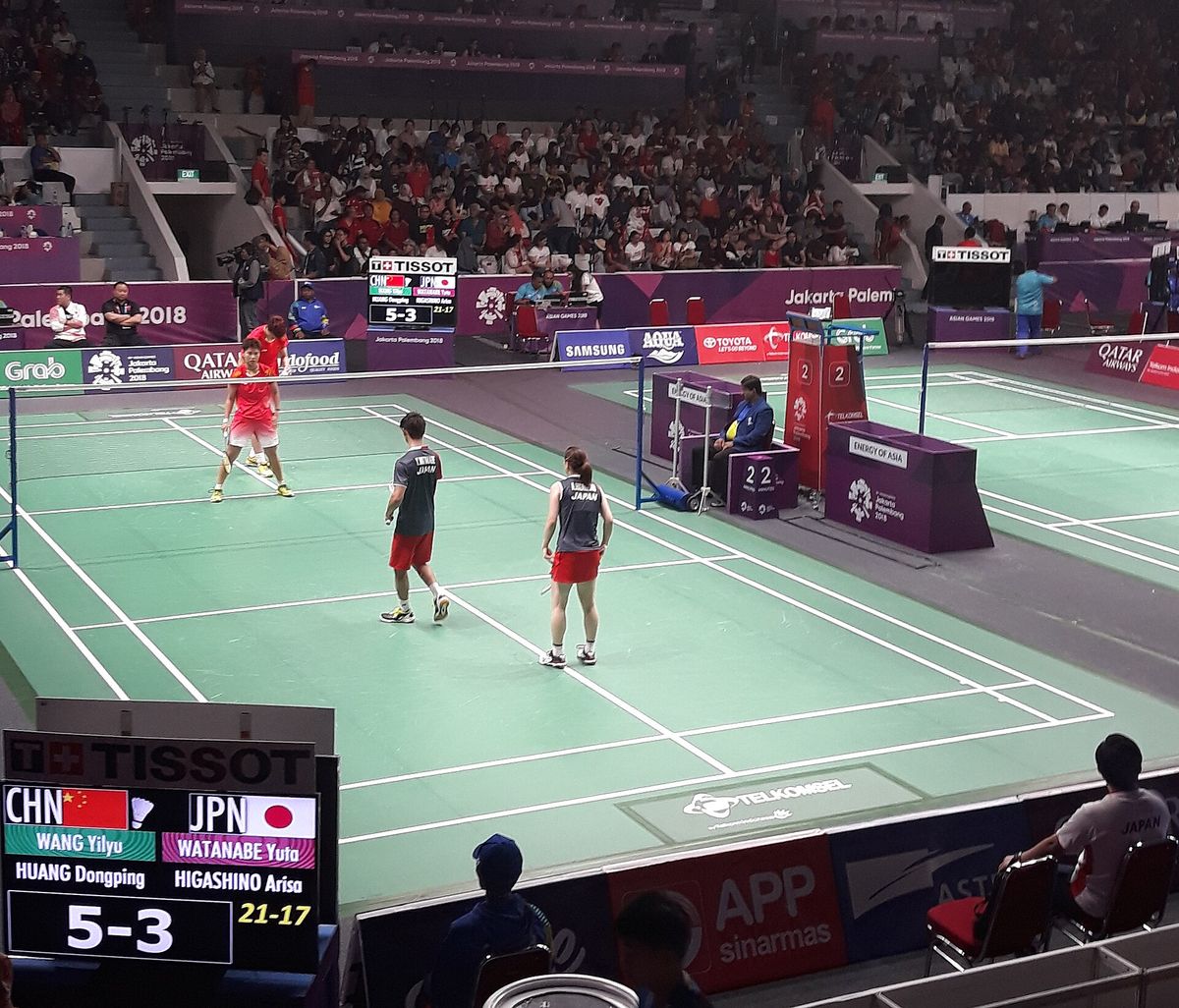
A mixed doubles match at the 2018 Asian Games, Jakarta, with the scoreboard in view.
One game finished at 21–17 and the next under way at 5–3. Under the side- out scoring used until 2006, only the server could score and most games went to 15, so neither number could have appeared.
Griff88 · CC BY-SA 4.0 · Wikimedia Commons
This clause reads this way because of
BWF Laws of Badminton, in the BWF Statutes · Law 7
The serve
The serve is the most heavily regulated action in the sport. It must be hit upward, below a fixed height, with the racket head pointing downwards, both feet stationary and in contact with the floor, and it travels diagonally into the opposite service court.
The fixed height is recent. Until 2018 the test was the server's own waist or lowest rib, which meant the same action was legal for one player and a fault for another. It is now a measurement of the court rather than a judgement about a person.
- Maximum service height
- 1.15 m
- Measured from
- Court surface
- Direction
- Diagonally, upward
This clause reads this way because of
BWF Laws of Badminton, in the BWF Statutes · Law 9
Faults
A fault ends the rally and gives the point to the other side. The main ones: the shuttle lands outside the boundary or fails to cross the net; a player touches the net or the posts with racket, body or dress while the shuttle is in play; a player is struck by the shuttle; the shuttle is hit twice in succession by the same side; or a player invades the opponent's court under the net.
Play is continuous, with two set intervals — a short one when the leading side reaches 11, and a longer one between games.
Deciding the winner
Two games. There is no draw, no tiebreak in the tennis sense and no time limit — the 29-all cap is the only mechanism that can end a game other than a two-point lead.
Everything above is current law. Everything below is how Badminton got here.
02Disciplines and events
One discipline and five events, which is the smallest programme of any sport on this site. Badminton also has the only Olympic event in any sport where a man and a woman compete as a team against another such team.
- Disciplines
- 1
- Olympic medal events
- 5
- Men’s and women’s counted separately.
Badminton5
The IOC treats badminton as a single discipline; the five events are distinguished by who is on court, not by any change in the laws.
- Men's singles
- Women's singles
- Men's doubles
- Women's doubles
- Mixed doublesThe only mixed-sex team event of its kind on the programme.
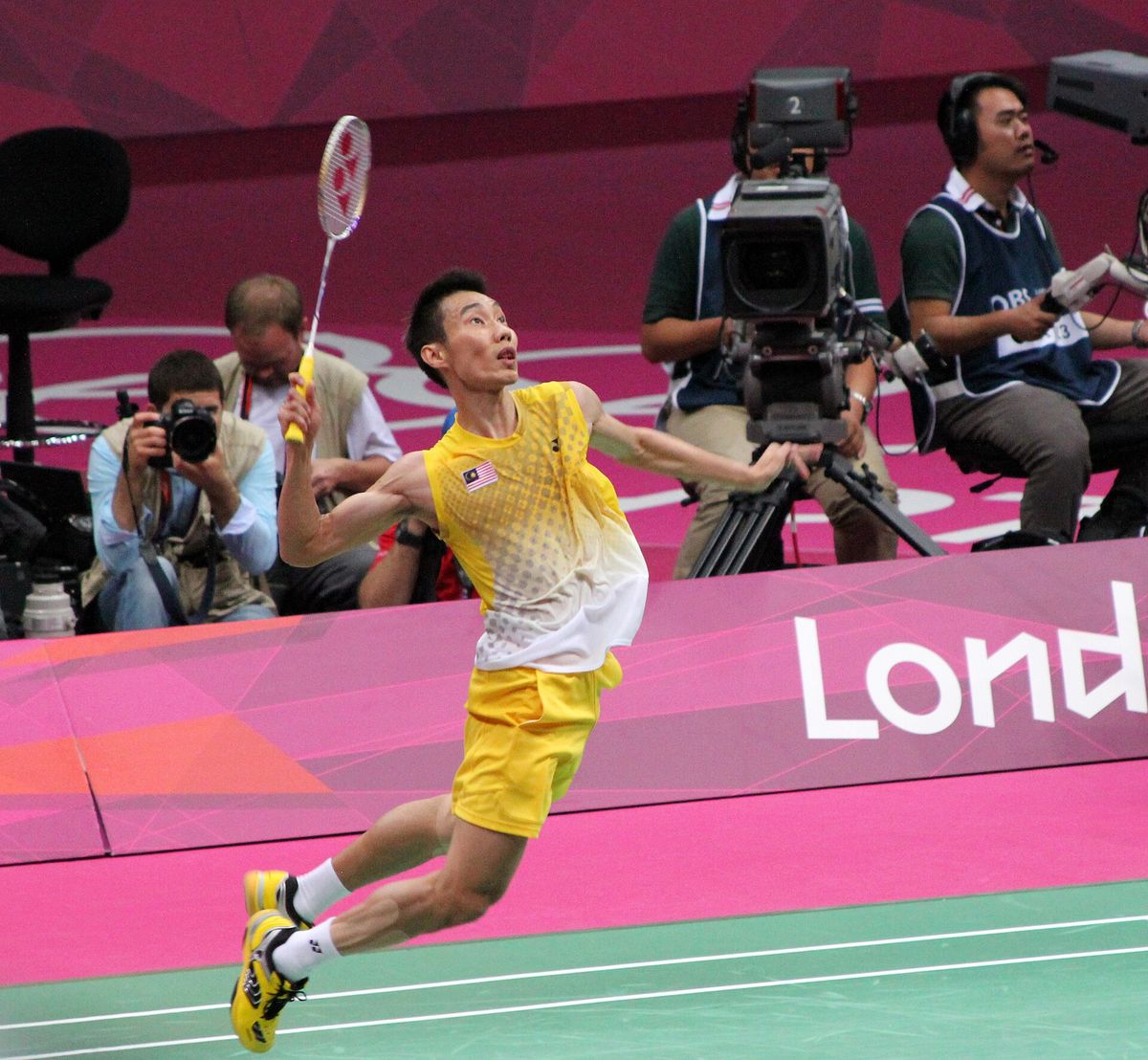
Lee Chong Wei of Malaysia in the Olympic men's singles final, London 2012.
Men's singles, and the event's defining rivalry of its era. He lost this final to Lin Dan, the second of his three Olympic silver medals.
Antony Stanley · CC BY-SA 2.0 · Wikimedia Commons
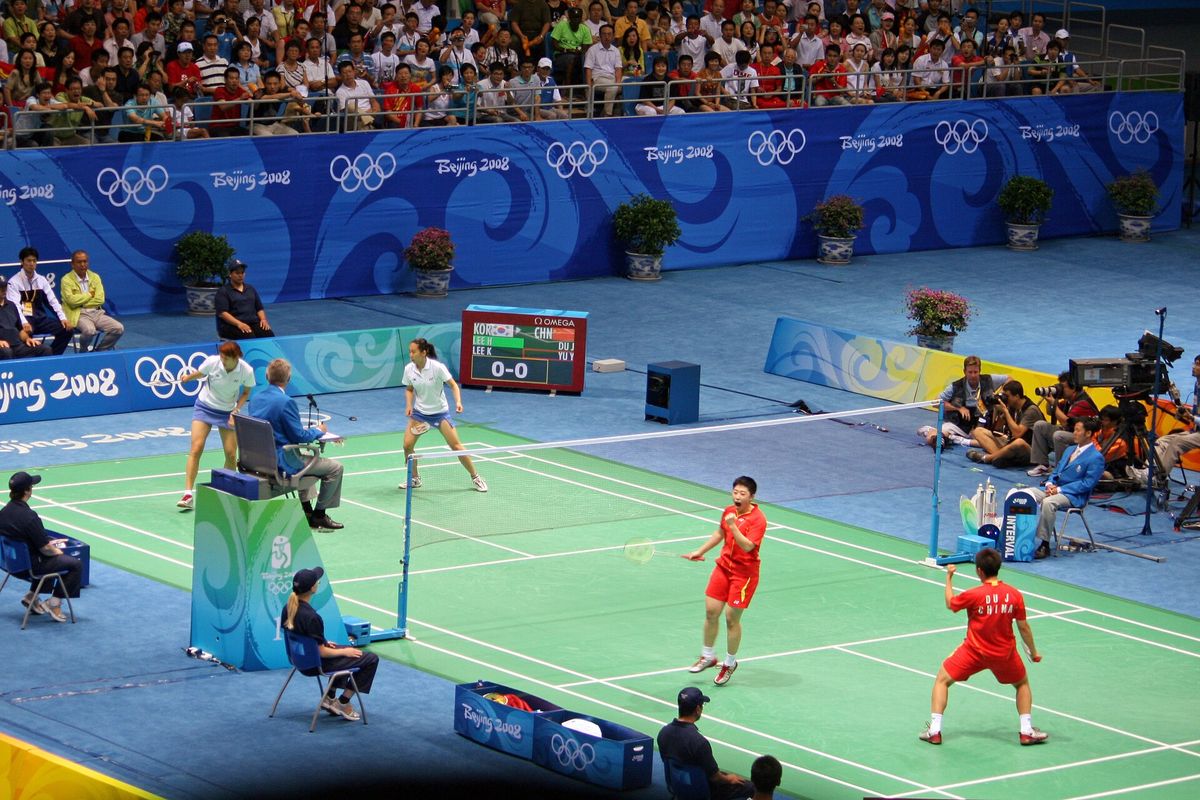
The women's doubles final at the Beijing Olympics, 2008: South Korea against China.
Women's doubles. Four years later, four pairs in this event were disqualified for trying to lose.
Tom Thai · CC BY 2.0 · Wikimedia Commons
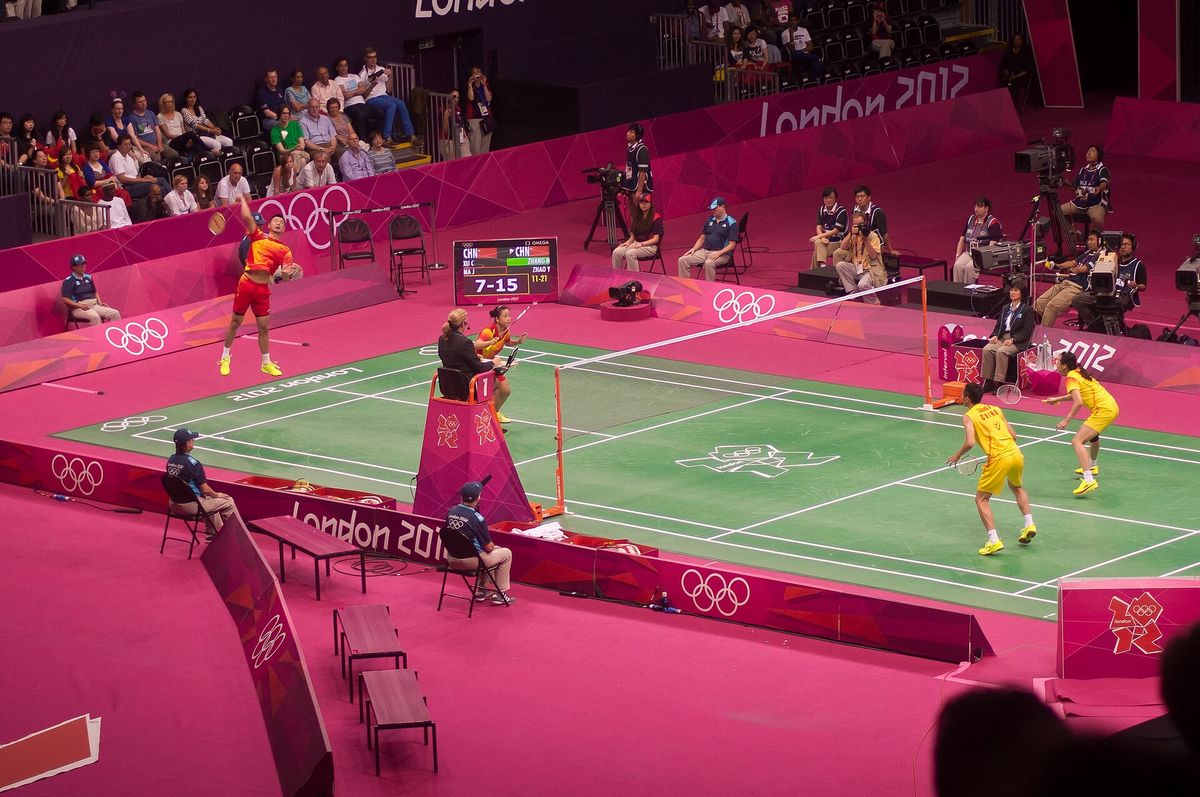
The mixed doubles final at London 2012, two Chinese pairs.
Mixed doubles, in which each pair is a man and a woman. Both finalists were Chinese, one more measure of how concentrated the sport's medals are.
Peter · CC BY-SA 2.0 · Wikimedia Commons
03Officiating and technology
An international match has an umpire in a raised chair, a service judge sitting at the side watching one thing only, and line judges at the boundaries. The service judge exists because badminton decided that one action needed a dedicated official, which is a good indication of how much of this sport's rulebook is about the serve.
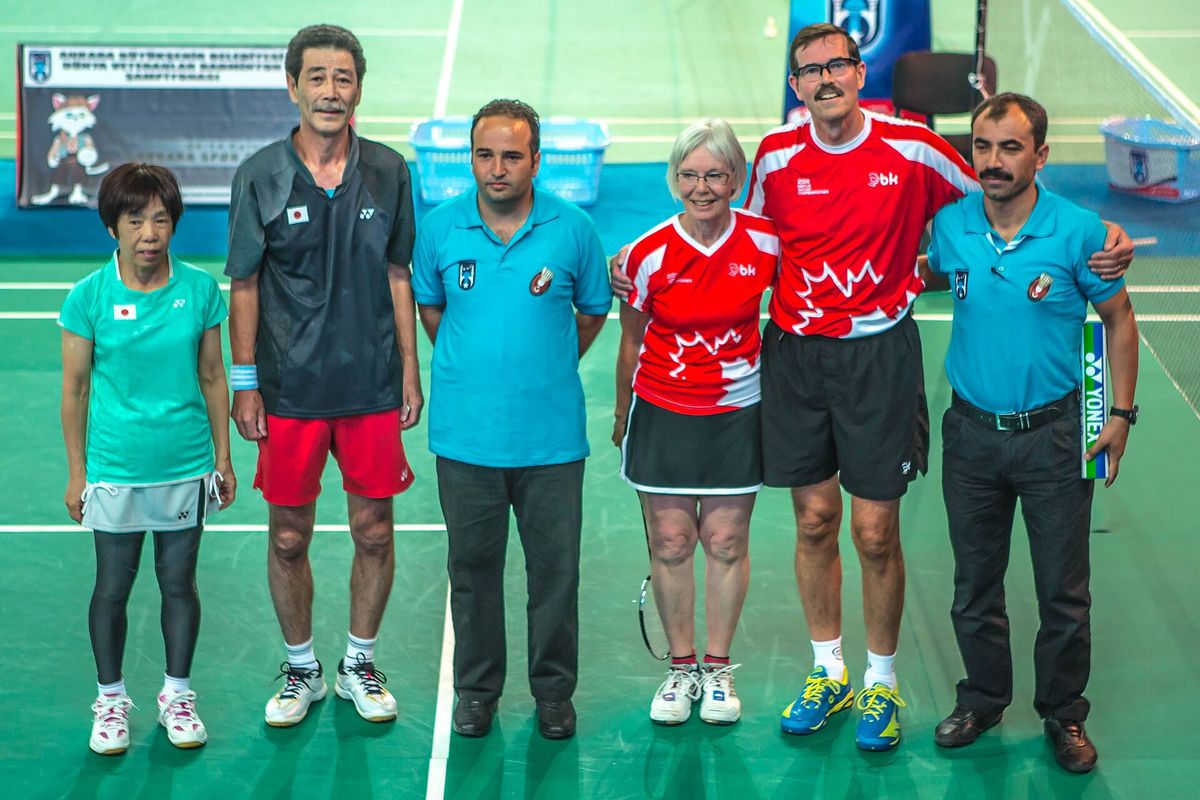
A mixed doubles pair and their opponents with the umpire and service judge, BWF World Senior Championships, Ankara.
The two officials in blue are the umpire and the service judge: the second exists to watch one thing, the serve.
Murray Foubister · CC BY-SA 2.0 · Wikimedia Commons
Instant review arrived early here compared with most sports. Players challenge a line call, a ball-tracking system renders the shuttle's landing point, and the call stands or is overturned within seconds. Each side gets a limited number of unsuccessful challenges per game.
The interesting part is what review did not fix. A line call is a question of fact, and technology answers it well. A service fault was a question of judgement — whether the shuttle was below the server's waist or lowest rib — and no camera can settle that, because the standard itself moved with the player. The sport solved that one by changing the rule rather than by adding technology: since 2018 the test is a fixed 1.15 metres from the floor, which a sensor or a fixed camera can measure identically for everyone.
That is the pattern worth noticing across this site. Technology can adjudicate a fact. Where officials disagree, it is usually because the rule was asking them for an opinion, and the fix is legislative rather than technical.
04Where it is played
Badminton is the clearest case on this site of a sport whose competitive centre and administrative centre were in different places for most of its history. It was codified in England, and the International Badminton Federation was run from England for seventy years. It is played, watched and won overwhelmingly in Asia.
Istora Senayan, Jakarta, during the 2026 Indonesia Open.
Where the sport is watched: a national arena, in a country that is one of the handful winning nearly all the medals.
Griff88 · CC BY-SA 4.0 · Wikimedia Commons
China, Indonesia, Malaysia, South Korea, Japan, Denmark and Chinese Taipei account for very nearly all of the medals. Denmark is the exception that makes the pattern visible: one European nation with a deep club system has stayed competitive for decades while the rest of Europe has not, which suggests the concentration is about participation infrastructure rather than about anything innate.
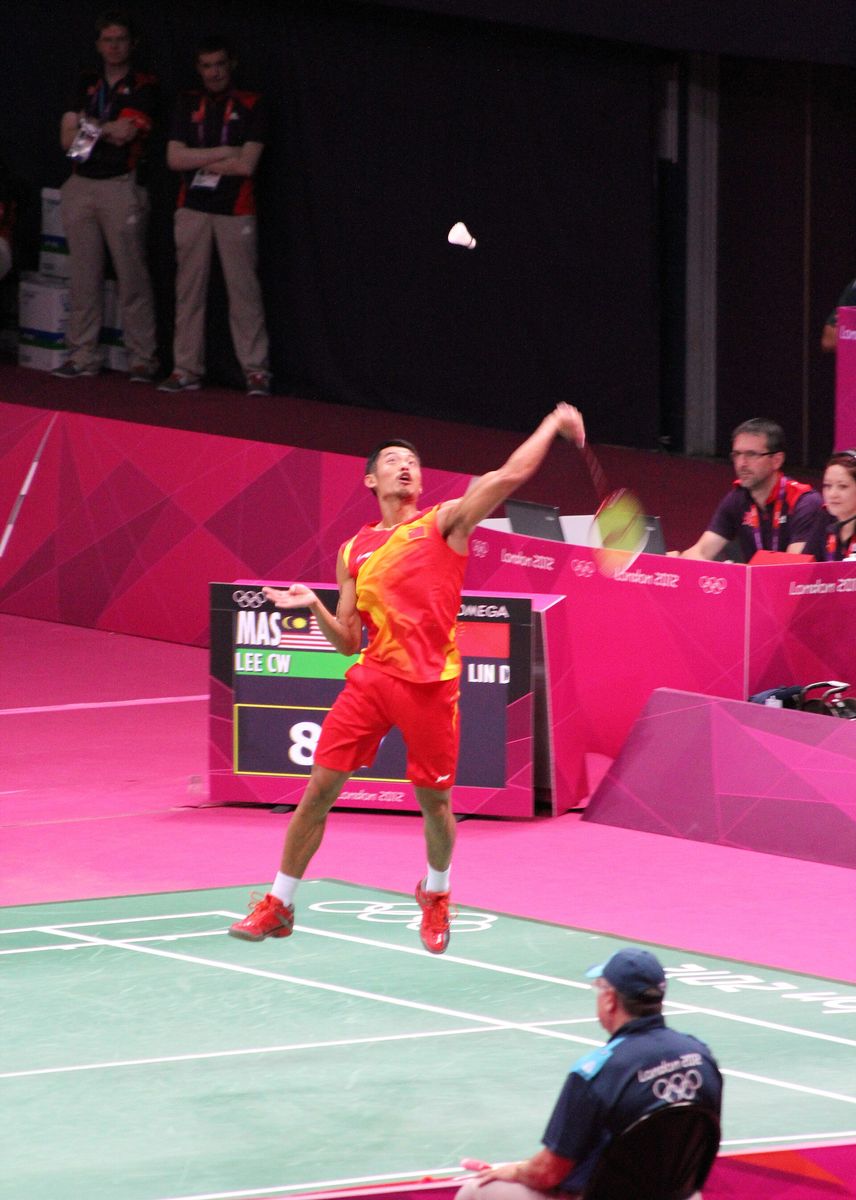
Lin Dan of China in the Olympic men's singles final, London 2012.
He won it, his second Olympic title. China is one of the seven nations that take very nearly all the medals.
Antony Stanley · CC BY-SA 2.0 · Wikimedia Commons
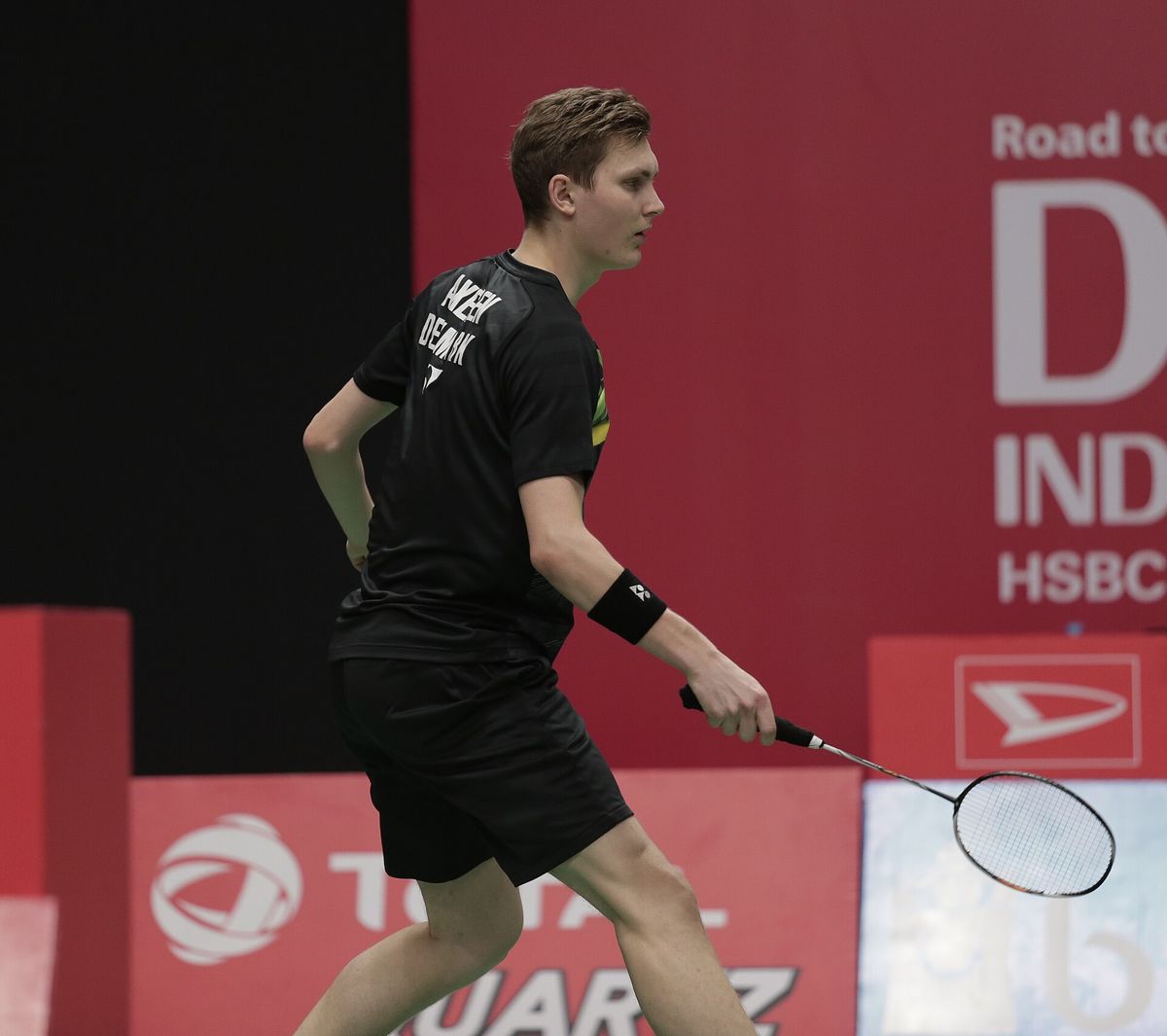
Viktor Axelsen of Denmark at the Indonesia Masters, 2018.
Denmark is the exception the section describes: the one European nation that has stayed competitive, on the strength of a deep club system.
Fauziananta · CC BY 4.0 · Wikimedia Commons
Two consequences show up directly in the rules.
The hardest tournament is often a national trial. Where a country's depth exceeds its Olympic quota, players who would medal for another nation do not qualify at all. That is an eligibility rule shaping the sport's competitive geography as much as any law of play does.
The 2012 tanking episode was a geography story too. All four disqualified pairs came from China, South Korea and Indonesia, because those were the nations with two strong pairs in the same tournament and therefore the only ones with anything to gain from manipulating the draw.
The federation moved its headquarters to Kuala Lumpur in 2005 and renamed itself the Badminton World Federation in 2006 — the same year it changed how the sport scores. The sources do not connect those decisions, and this site does not either. It only notes that they happened within eighteen months of each other.
05Learning curve
One of the two widest gaps on this site — table tennis has the other, for almost the same reason. Badminton is among the easiest sports here to have a real game of on your first afternoon and one of the hardest to be good at, and both facts have the same cause: the shuttle.
Editorial — the site’s reading, not a sourced claim
Barrier to entry
How hard is it to get to a real game?
Two people can have a genuine rally within minutes.
A shuttlecock decelerates so violently that a beginner's mishit mostly stays on court. In tennis the ball keeps going, so a novice rally ends on the second or third shot and the game is unplayable until you can control depth; in badminton the implement does that work for you. The other net sports make you earn the rally. Badminton hands it over.
The rest of the barrier is unusually low too. Two people, one net, and a space smaller than a tennis court. It is played on beaches and in streets across South and Southeast Asia without a court at all, because a version of the game survives with almost nothing.
Evidence
- Players needed2observed
- Kit to startA racket each and a tube of shuttlesobserved
- Court length13.4 mobservedRoughly half a tennis court.
- Time to a real rallyOne sessionestimateThe site's estimate, and the softest claim on this page.
- Shuttle mass4.74–5.50 gobservedThe number that does the work. Sixteen feathers on five grams produce the drag that makes a beginner's shot land in.
Barrier to the top
How hard is it to be good at?
Among the most physically extreme racket sports at the top.
The same drag that makes the shuttle forgiving at the bottom makes it brutal at the top. Because it slows so fast, a smash has to be hit enormously hard to arrive quickly, and because it slows so fast the defender is never truly out of the point. The result is a sport of repeated maximal jumps and full-body rotations, with rally-to-rest ratios that put it among the most demanding events at a Games.
Deception is the other half. A shuttle can be struck late and disguised until the last moment, so elite play is a continuous feint — and reading it is a skill that takes many years to build and does not transfer from any other sport.
Evidence
- Scoring since 2006A point on every rallyruleRemoved the recovery time that side-out scoring allowed.2006 — the rule this rests on
- Service height testFixed at 1.15 mruleA measurement of the court, so a tall player's serve is no longer judged differently.2018 — the rule this rests on
- Typical age of specialisation10–12estimate
- Typical peak age24–28estimate
- Olympic quota per countryLimited per eventobservedThe depth of the strongest nations exceeds the places available to them, so the hardest tournament to win is often a national trial.
Why the two differ
Almost every sport is easier to start than to master. What makes badminton worth recording is the size of the gap and the fact that one object causes both ends of it. The shuttle's drag is a beginner's assistant and an elite player's punishment, and the specification that fixes it — sixteen feathers, under five and a half grams — is a law, not an accident.
The 2006 change to rally scoring widened the gap further. Under side-out scoring a losing player could not concede points while not serving, which gave weaker players shelter; every rally now costs. That was a broadcast decision with a side effect nobody legislated for.
The historyhow it got here · sections 6 to 10
06Origin and invention
Badminton descends from battledore and shuttlecock, a cooperative game with no net, no court and no way to lose, played in Europe and across Asia for centuries before anyone thought to score it. The competitive form is usually traced to British India in the 1860s and 1870s, and the name is taken from Badminton House in Gloucestershire, where the game was played by the Duke of Beaufort's household.

Jean-Siméon Chardin, Girl with Racket and Shuttlecock, 1737.
The parent game in Europe: a racket, a feathered shuttle, and no net, no court and no score. It is played by keeping the shuttle up, not by making the other side miss.
Jean-Baptiste-Siméon Chardin · Public domain · Wikimedia Commons

A woman holding a shuttlecock, with a battledore tucked under her arm. Detail of a Japanese hanging scroll.
The same game in Japan, where it is played at New Year with a flat wooden paddle, the hagoita. The Metropolitan Museum attributes the scroll to Torii Kiyotomo. It is evidence that the game was played widely in Asia, not of where badminton came from.
Torii Kiyotomo (attributed); Metropolitan Museum of Art · CC0 · Wikimedia Commons

Badminton House, Gloucestershire, the east front, photographed for In English Homes in 1909.
The Duke of Beaufort's house, which gave the game its name. The house is evidence of the name, not of where the rules were written.
Charles Latham · Public domain · Wikimedia Commons
The descent matters for the same reason it matters in football. The parent game had no scoring system at all, so the first codified badminton had to borrow one, and it borrowed the side-out convention already in use in racket sports: only the serving side can score. That borrowed convention survived, essentially unaltered in principle, for roughly 130 years. When it was finally replaced in 2006 it was replaced for reasons that had nothing to do with the game and everything to do with the clock.
The Badminton Association of England published the first widely adopted laws in 1893. The International Badminton Federation was founded in 1934 with nine member associations, and renamed itself the Badminton World Federation in 2006 — the same year it changed how the sport scores.
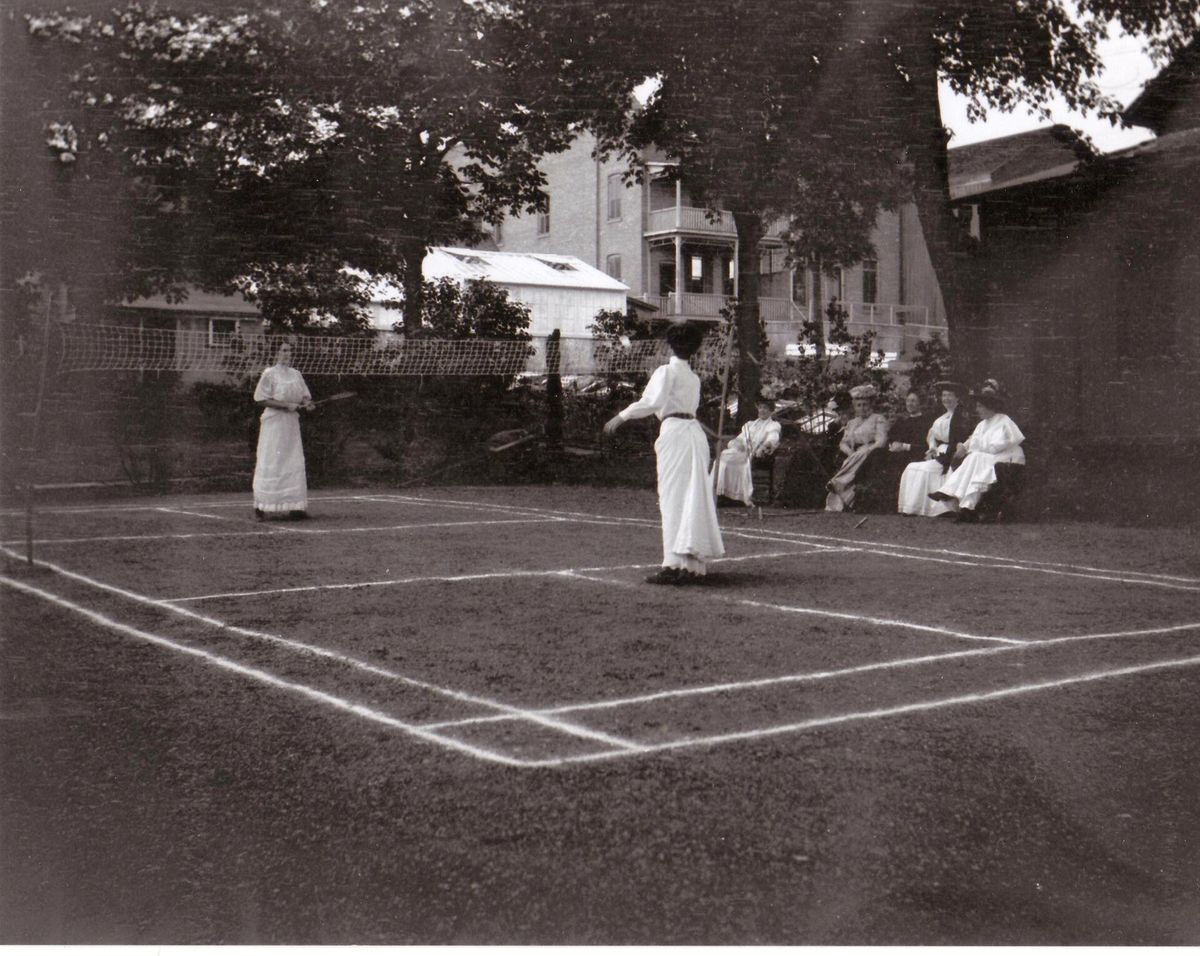
A game on a lined garden court, Deseronto, Ontario, August 1908.
Fifteen years after the first widely adopted laws. The court is marked out with its service lines, on a lawn rather than an indoor floor.
Deseronto Archives · No known copyright restrictions · Wikimedia Commons
07Rule timeline
The sport’s own lane, expanded. Every entry carries a cause from the closed vocabulary and a citation, and says so where the citation is incomplete.
- 2002-01Broadcast and pacingalso commercialTrialled, then abandonedadopted 2001-12
Matches were played as best of five games to seven points, replacing the best of three games to fifteen under side-out scoring. The system was run on the international circuit and abandoned within about two years, leaving fifteen-point side-out scoring in place until 2006.
Trigger and citationIncomplete — no confirmed article
Trigger
The federation was looking for a format that would produce matches of predictable length for television, and tried shortening the games before it tried changing who could score.
Laws of Badminton · IBF Laws of Badminton, 2002 revision
- 2006-05Broadcast and pacingalso commercialadopted 2005-05
Replaced fifteen-point side-out scoring with twenty-one-point rally scoring, best of three games. A point is now scored on every rally regardless of which side served, and the men's fifteen-point and women's eleven-point games were unified into one system. Approved for trial by the membership in 2005, run from December 2005, and confirmed for general use at the 2006 Annual General Meeting.
Comparability break · Record book reset
Every match statistic recorded before May 2006 is measured in a unit that stopped existing in May 2006. Nothing crosses this line. See the series
Trigger and citation
Trigger
Under side-out scoring a rally could be won without scoring, so match length was unbounded in principle and unpredictable in practice, which made scheduled broadcast slots impossible to guarantee.
Laws of Badminton · BWF Laws of Badminton, 2006 revision · article 7
- 2011-06CommercialAdopted, then rescinded before it was ever enforcedadopted 2011-05
A dress regulation requiring women to wear a skirt or dress in play at top-tier events. Announced to take effect in May 2011, deferred to June, and dropped after objection from players and member associations. It was never enforced, and it is recorded here because the reason given for it is unusually explicit.
Trigger and citationIncomplete — no confirmed article
Trigger
The federation's stated aim was to improve the presentation of the women's game to sponsors and broadcasters.
Player associations and several national federations described the rule as sexist and as unworkable for players from countries whose dress norms it conflicted with. Both readings are recorded; the sources do not agree on which consideration ended the rule.
Laws of Badminton · BWF General Competition Regulations, 2011
- 2014Integrityadopted 2013
The group stage of the Olympic tournament was restructured so that the knockout bracket is drawn after the group results are known, removing the situation in which a pair could improve its bracket by losing a group match. The players' code of conduct obligation to use best efforts was enforced alongside it.
Trigger and citationIncomplete — no confirmed article
Trigger
At London 2012 four women's doubles pairs were disqualified for not using best efforts in group matches, having worked out that losing produced an easier knockout draw. The incident is the clearest case in this collection of a rule creating the behaviour it then punished.
Laws of Badminton · BWF Statutes, Players' Code of Conduct
- 2018-03Fairness and eligibilityadopted 2018-03
The service law was rewritten so that the whole shuttle must be below a fixed height of 1.15 metres from the court surface at the moment of contact, replacing the previous test, which was measured relative to the server's own waist or lowest rib. Trialled from March 2018 and retained.
Trigger and citation
Trigger
A test defined against the server's own body could not be applied consistently between players of different heights, and produced service judging that players and umpires disputed. The stated aim was a test a judge could apply identically to everyone.
Laws of Badminton · BWF Laws of Badminton, 2018 revision · article 9.1.6
What the 2006 rule changed
The same rallies, counted twice
One invented run of sixteen rallies, scored under both systems. Under side-out scoring only the serving side could score, so a rally won by the receiver produced no number at all and left nothing behind in the record; from May 2006 every rally produces a point. Same play, different data — which is why no match statistic crosses that line. The rallies are illustrative, not taken from a match.
08Equipment evolution
Badminton is unusual in this collection: its equipment changed enormously and almost none of it was forced by a rule.
Rackets went from wood to steel to aluminium to graphite composite over the second half of the twentieth century, and the laws did not chase them. The Laws of Badminton constrain frame and stringing dimensions, but the sport never had its javelin moment — no implement was redesigned to bring the game back inside the stadium, because the shuttle itself sets the ceiling. A feathered shuttle decelerates so sharply that racket power has a limited effect on how far it travels, and the equipment arms race therefore expressed itself in speed and recovery rather than in distance.
The shuttle is the exception, and the interesting thing about it is what did not happen. Synthetic shuttles have existed for decades and are cheaper, more durable and more consistent than feathers. Top-tier competition still uses sixteen goose or duck feathers set in a cork base, because the two behave differently in flight and the sport declined to change what the game feels like. That is a rule choice too, and it is a rule choice in the opposite direction from most of the entries on this timeline.
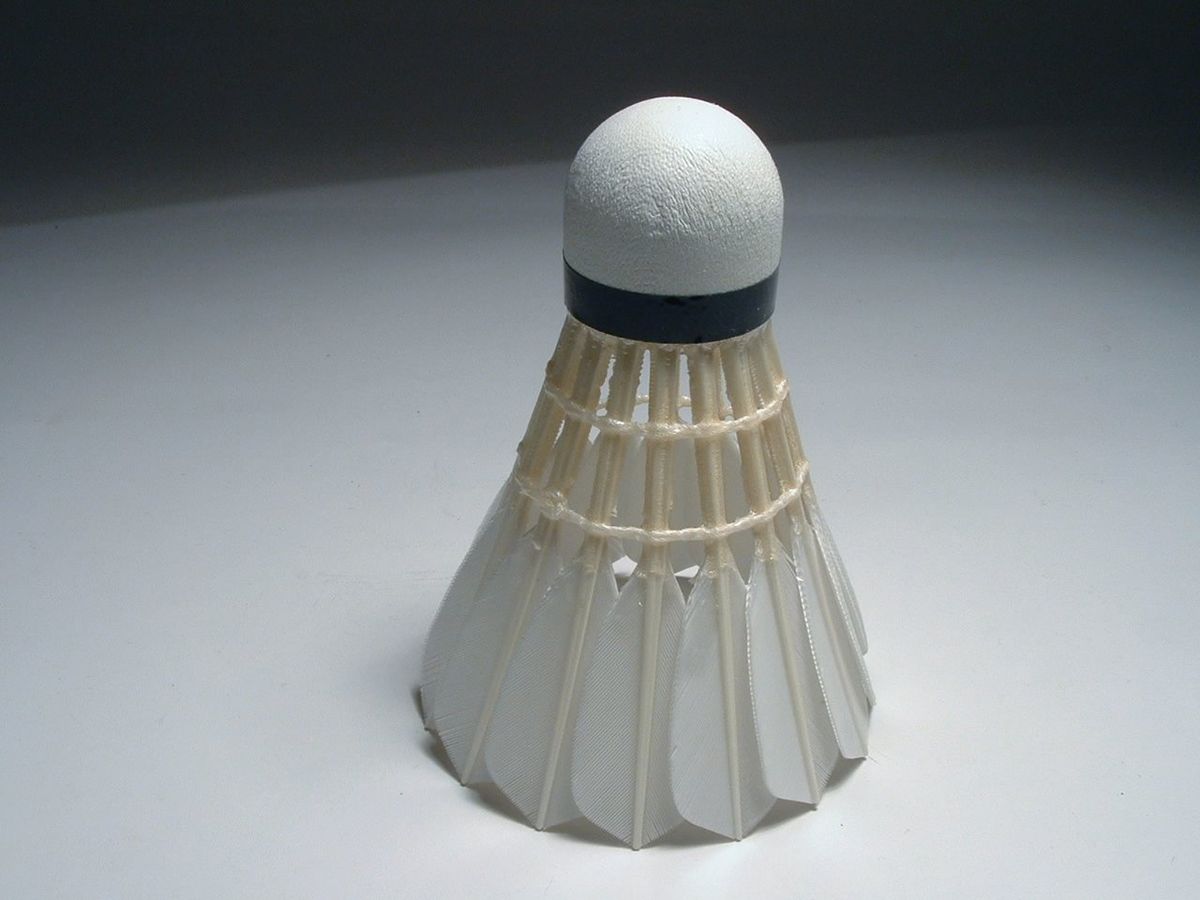
A feathered shuttlecock: sixteen feathers set in a cork base.
The top-level shuttle, still made this way because the sport chose to keep how it flies.
Stanislas PERRIN · Public domain · Wikimedia Commons
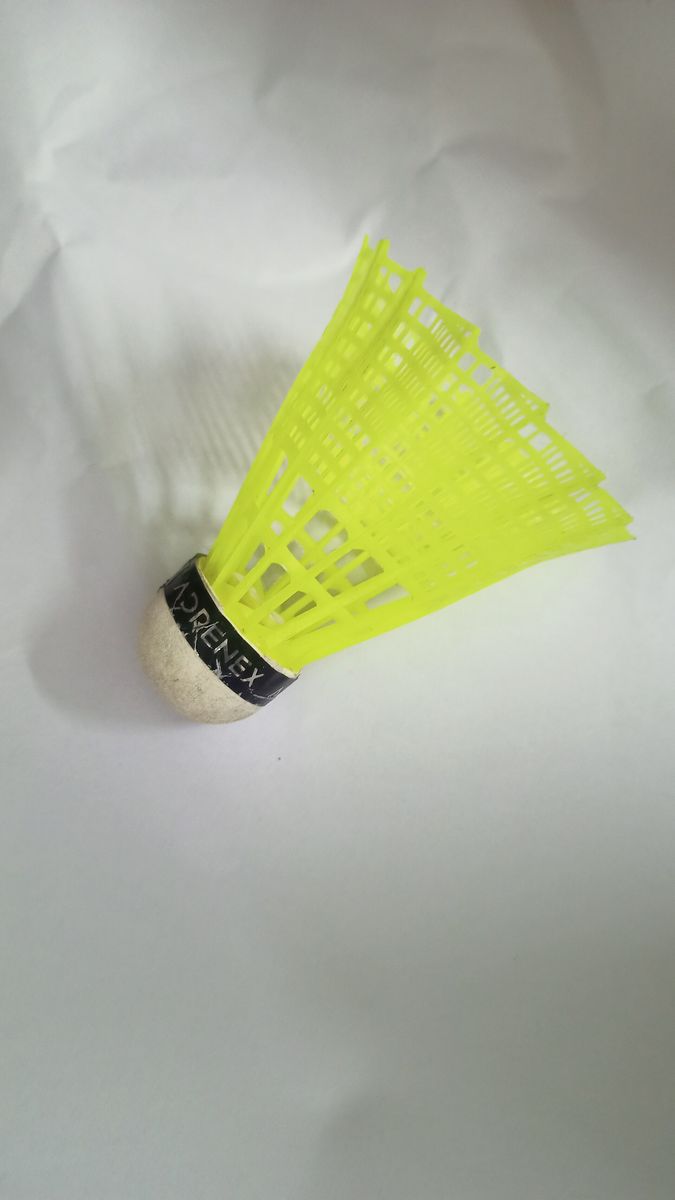
A synthetic shuttlecock, 2022.
Cheaper and far more durable than feathers, and approved for general play. It decelerates differently, which is the reason it is not used at the top.
Janakiraman janaki · CC BY-SA 4.0 · Wikimedia Commons
The one equipment-adjacent rule that did change is the service height, and it changed because of the human body rather than the kit: a test defined against the server's own rib cage could not be applied identically to a player of 1.60 m and a player of 1.95 m. Fixing it at 1.15 metres in 2018 made the measurement independent of the person being measured.
09Governing body politics
The International Badminton Federation spent much of the late twentieth century governing a sport whose competitive centre of gravity had moved to Asia while its administrative centre had not. The federation's headquarters moved from England to Kuala Lumpur in 2005, and the rename to Badminton World Federation followed in 2006. Those two moves and the scoring change happened inside about eighteen months of each other, which is worth noticing even though the sources do not connect them causally.
The most consequential political fact about the BWF for this site is that it is
a rare governing body willing to state a commercial motive in plain terms. The
2011 dress regulation for women was defended publicly on presentation and
sponsorship grounds rather than dressed up as a sporting matter, and it was
withdrawn just as publicly. Most federations in this collection give a sporting
reason for a commercial change, which is exactly why the disputed cause exists
in this vocabulary. Badminton mostly does not need it.
Olympic status has shaped the federation's decisions more than any other single factor. Badminton entered the programme in 1992, and the two rule changes with the clearest triggers — rally scoring in 2006 and the Olympic draw procedure after 2012 — are both, at root, about how the sport performs in the four hours a Games gives it.
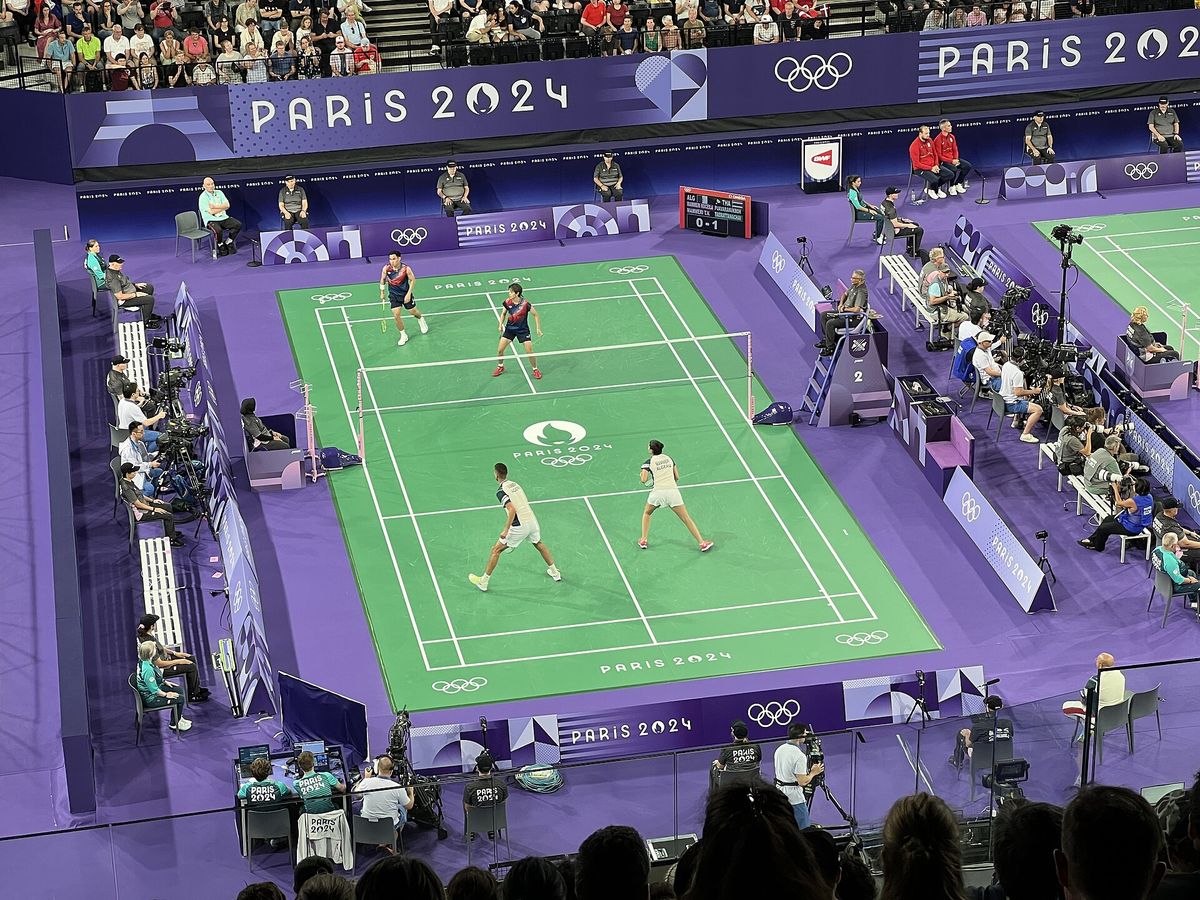
The Olympic badminton court at the Porte de la Chapelle arena, Paris 2024.
Badminton has been on the Olympic programme since 1992. Its two rule changes with the clearest triggers, rally scoring and the post-2012 draw, are both about how the sport performs inside a Games.
Chabe01 · CC BY-SA 4.0 · Wikimedia Commons
10Controversies that forced rule changes
London 2012, women's doubles. Four pairs, from China, South Korea and Indonesia, were disqualified from the Olympic tournament for not using best efforts in group matches. They were not throwing matches for money. The tournament had a group stage followed by a fixed knockout bracket, so a team that finished second in its group met a weaker opponent than a team that finished first, and losing deliberately was the rational move. Serving into the net repeatedly in front of a booing crowd was simply the visible form of an incentive the rules had created.
This is the cleanest example in this collection of a rule punishing behaviour it had itself made optimal. The federation's response was to change the structure rather than only the sanction: from 2014 the knockout bracket is drawn after the group results are known, so there is no bracket to aim for. The best-efforts obligation stayed in the code of conduct, but the reason to break it was removed.
The service judgement. For decades the service law was written against the server's own body, and service faults were consequently among the most disputed calls in the sport — a player could be faulted at one tournament and not at the next for an identical action. The 2018 fixed-height law replaced a judgement about a person with a measurement of a court, which is the same move athletics makes whenever it can.
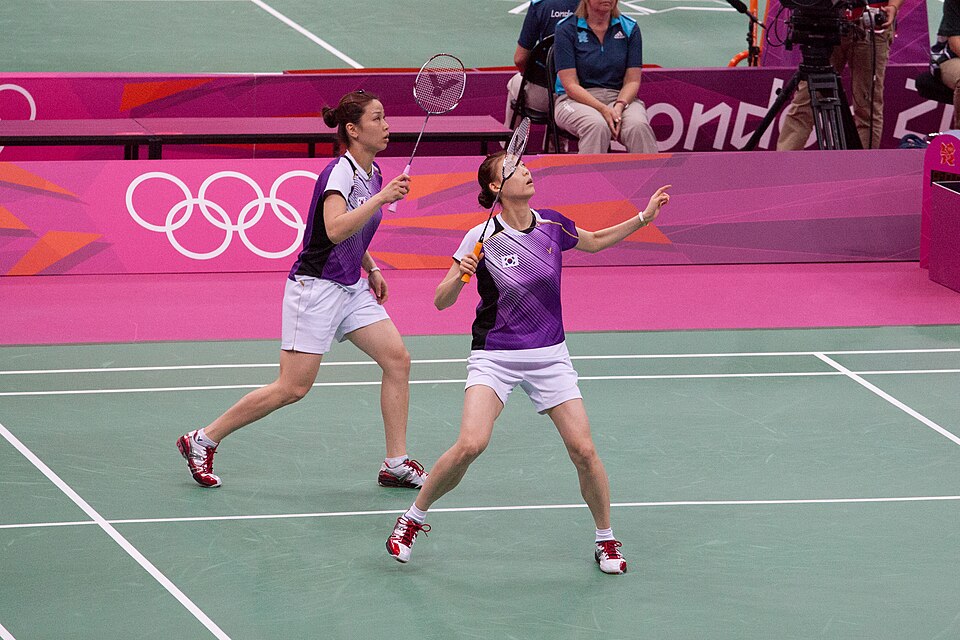
The group match at London 2012 that changed the draw.
Photographed at the 2012 Olympic tournament, in the round where four pairs were later disqualified for not using best efforts. The photographer titled it "Bad losers". It shows the competition, not the specific rally any charge rested on.
Tom Page · CC BY-SA 2.0 · Wikimedia Commons
Where it standsthe record, and what is still open · sections 11 to 12
11Series
No series published
Match statistics across the scoring change
Rally scoring changed what a point is. A point under the fifteen-point side-out system could only be won by the serving side, so a rally won by the receiver produced no number at all; from 2006 every rally produces a point. Rally counts, points per match, match duration and the scoreline itself all mean different things on either side of May 2006, and none of them can be rescaled from one system to the other. This is a different kind of absence from gymnastics. A series here is not impossible in principle — a run of match durations from one tournament held continuously across 2006 would be a real series, and it would show the break clearly. It is absent because no governing body publishes one, and because assembling it from tournament records is work this site has not done. When it is done, the chart appears here, in two segments, with the 2006 rule change between them.
2006Record book resetEvery match statistic recorded before May 2006 is measured in a unit that stopped existing in May 2006. Nothing crosses this line.
12What is contested now
Recorded as unsettled. Nothing here is a rule change, because none of it has been decided; it is on this page because a site about why rules change should be able to show the arguments before they resolve.
Scoring, again. The federation has repeatedly considered replacing 21-point rally scoring with a best-of-five format to 11 points, and the membership has repeatedly declined. The stated case is the same one that produced the 2006 change and the abandoned 2002 experiment: shorter, more predictable matches for broadcast. The case against is that 21-point games give a losing player time to recover a match, and that the sport has already rewritten its scoring twice in twenty years for the same reason without settling the question.
Service height. The fixed 1.15 metres solved the inconsistency of judging against a player's own body, and introduced a different complaint: a single absolute height is not neutral between a player of 1.60 m and one of 1.95 m either, it just moves who is disadvantaged. Whether the rule should scale with the player is an open argument, and it is the same argument the sport had before 2018 running in the opposite direction.
Shuttle supply. Feathered shuttles depend on goose and duck feathers of a specific grade, and cost and availability have both moved. Synthetic shuttles approved for general play behave measurably differently in flight. Whether top competition should move to synthetics is a question about cost and sustainability that would, if answered yes, be an equipment change of exactly the kind that has severed number series in other sports on this site.