Baseball
Ran two different rulebooks inside one sport for forty-nine years, then put a clock on a game that had never had one.
- Official
- Baseball
- Game category
- Striking and fielding
- Adjudication
- Decided by score
- Standing
- Removed, restored
- rule changes
- 5
- comparability breaks
- 3
- Olympic editions
- 7
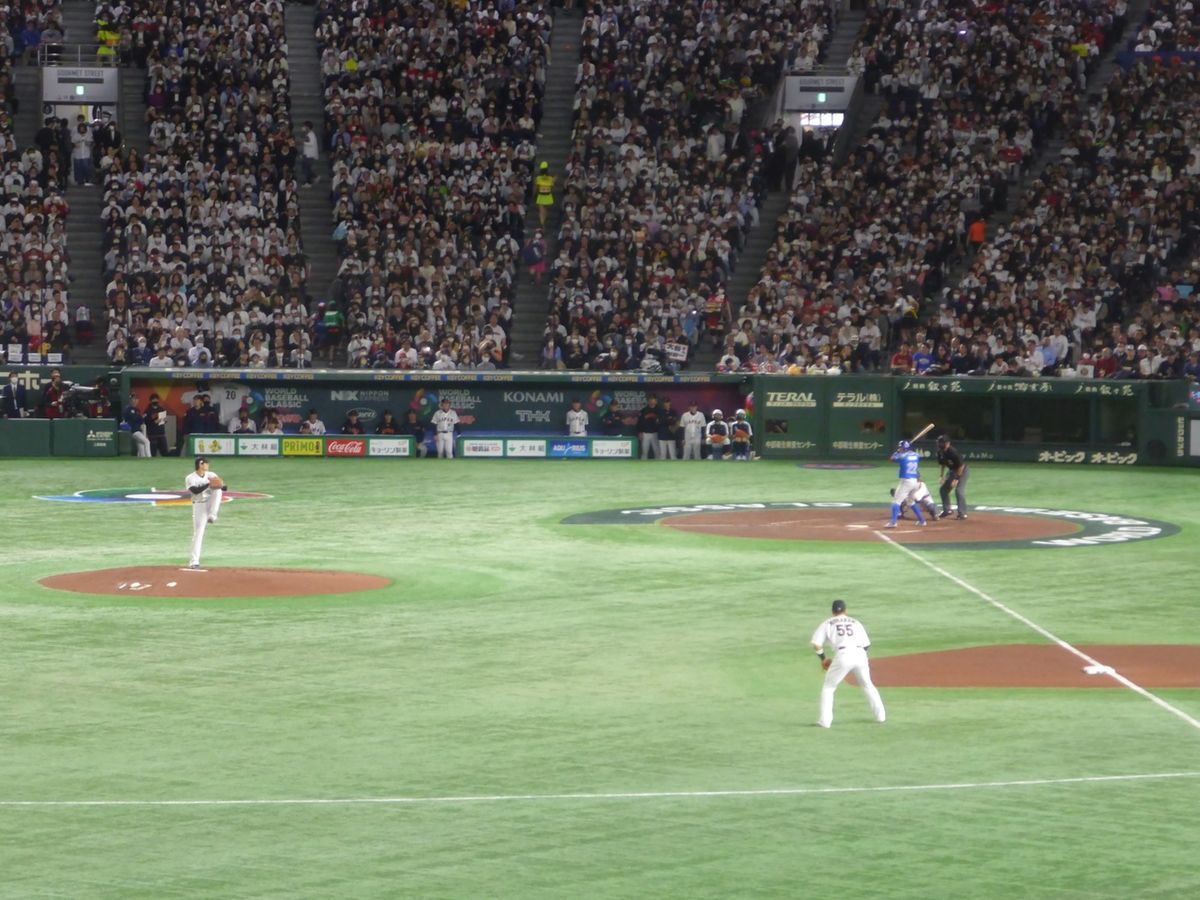
Shohei Ohtani pitching for Japan against Italy at the World Baseball Classic, Tokyo, March 2023 · Scinsvche · CC0
- Governing body
- WBSC internationally; Major League Baseball keeps the rulebook that matters for this site's purposes.
- Founded
- Codified from earlier bat-and-ball games in New York in the 1840s; the National League founded 1876, the American League 1901.
- Olympic status
- 7 editions
- on the 2028 programme
- Also contested at
- Asian Games
Baseball is the most statistically self-aware sport in the world and has severed its own numbers repeatedly. It lowered the pitching mound in 1969 after a season nobody could hit in, ran two leagues under different batting rules from 1973 to 2022, and in 2023 put a clock on a game that had defined itself for a century by not having one.
The gamewhat it is now · sections 1 to 5
01How it is played
Nine a side, alternating between batting and fielding, for nine innings. Like cricket, the two teams do not do the same thing at the same time. Unlike cricket, baseball had no clock at all for a century and a half — and acquired one in 2023, which is the largest single change to how the sport feels since the mound was lowered in 1969.
These figures were entered from the edition named above but have not been checked against its text line by line. Treat them as this site’s reading of the laws, not as a substitute for them.
The object of the game
Score more runs. A run is scored by a batter reaching all four bases in order without being put out. The fielding side records three outs to end an inning, and each side bats nine times.
The central confrontation is one pitcher against one batter, repeated, with seven fielders arranged behind. Everything else in the sport is built on that pairing.
The field
A diamond of four bases with a pitcher's mound at the centre, and an outfield with no fixed dimensions — outfield walls differ from park to park, which is a source of real competitive variation that the rules have never tried to standardise.
The mound's height is specified, and lowering it by five inches in 1969 is one of the largest deliberate rebalancings of any sport on this site.
- Base paths
- 90 ft
- Pitching distance
- 60 ft 6 in
- Mound height
- 10 in
- Lowered from 15 in in 1969.
- Base size
- 18 in square
- Enlarged from 15 in in 2023.
- Outfield dimensions
- Not standardised

The Diamond, Richmond, Virginia, from above, 2023.
The infield is the fixed part: ninety feet between bases, sixty feet six inches to the plate. The outfield is not standardised, and every park draws its own.
Quintin Soloviev · CC BY 4.0 · Wikimedia Commons
This clause reads this way because of
Bat, ball and glove
A wooden bat in professional play, aluminium and composite bats in amateur and college competition — which means the sport runs materially different equipment at different levels and does not pretend the statistics travel.
The ball's construction has been a recurring controversy without ever being a rule change: the sport has repeatedly been accused of altering its ball's aerodynamic properties, and home run rates have moved in ways that correlate with it.
- Ball weight
- 5–5.25 oz
- Bat
- One piece of solid wood, in professional play
- Bat diameter
- 2.61 in max
Players and officials
Nine in the field. In the batting order, the designated hitter may bat in place of the pitcher — a rule the American League adopted in 1973 and the National League refused until 2022, so for forty-nine years one sport ran two batting rulebooks.
Four umpires in the regular season, six in the postseason. Video review covers most calls since 2014; balls and strikes remain with the umpire, and that is the sport's last large unautomated judgement.
- Fielders
- 9
- Designated hitter
- Universal since 2022
- Umpires
- 4, or 6 in the postseason
Time
Nine innings, and until 2023 no clock of any kind. Baseball's lack of a clock was part of its self-description — the game is over when it is over, and a team behind in the ninth always technically has time.
The 2023 pitch clock does not limit the game. It limits the gap between pitches, which is where the time had gone: the sport's own analysis found that game length had risen for decades while the ball was in play for less of it.
- Innings
- 9
- Pitch clock
- Since 2023
- Game clock
- None
- Ties
- Extra innings until resolved
This clause reads this way because of
Scoring
One run per runner reaching home. Baseball's real scoring, though, is its statistics: no sport on this site records itself as thoroughly or is as widely understood through its numbers.
Which is why its rule changes are unusually consequential. The 1969 mound and strike zone changes were made explicitly to raise scoring. The designated hitter removed the weakest batter from one league's lineup for forty-nine years. The 2023 package moved the numbers again on purpose.
Between pitches
Baseball is almost entirely restarts. Every pitch is a discrete event with its own set-up, and the gap between them is where the pitch clock now operates: the pitcher must begin delivery within the time, the batter must be in the box and alert, and violations award a ball or a strike.
A sport that had never told a player to hurry now does so several hundred times a game.
- Pitch clock, bases empty
- Set by rule
- Shortened again since 2023.
- Violation by pitcher
- Ball
- Violation by batter
- Strike
This clause reads this way because of
Restrictions
Balks, interference, obstruction, illegal substances on the ball. Since 2023 there is also a restriction on where fielders may stand: two infielders on each side of second base, both feet on the infield dirt.
That last one is unusual and worth stating plainly. It legislates against a defensive arrangement that teams arrived at by analysing the sport's own batted-ball data — the shift — and it is the same kind of act as basketball banning zone defence or football changing the offside law in 1925: a rule written against a way of playing that was working.
This clause reads this way because of
Deciding the winner
More runs after nine innings, and extra innings until somebody is ahead at the end of one. There is no draw and no clock to run out, which is the thing baseball was proudest of and the thing 2023 partially qualified.
Everything above is current law. Everything below is how Baseball got here.
02Disciplines and events
One Olympic event, and an unusually complicated relationship between the sport's international governing body and the competition that actually matters. Baseball and softball are administered together by the WBSC and appear on the programme together, which is the only case on this site of two distinct sports sharing one Olympic listing.
- Disciplines
- 1
- Olympic medal events
- 2
- Men’s and women’s counted separately.
- Contested elsewhere
- 4
- world championship, professional.
- Listed for context
- 1
- Not counted as this sport.
On the 2028 programme2
- Baseball, men's tournament
- Softball, women's tournamentA separate sport under the same federation and the same Olympic listing.
Where the sport is actually played4
Listed because the rule changes recorded on this page were made by a league rather than by a federation, which is the same situation as basketball's and more extreme.
- Major League BaseballProfessionalMade every rule change on this page. Two leagues under different batting rules from 1973 to 2022.
- Nippon Professional BaseballProfessional
- KBO LeagueProfessional
- World Baseball ClassicWorld championshipThe international tournament that draws the professional players.
Shohei Ohtani pitching for Japan against Italy at the World Baseball Classic, Tokyo, March 2023.
The international tournament the professionals will play in, which is why it, and not the Olympics, is where the best players meet.
Scinsvche · CC0 · Wikimedia Commons
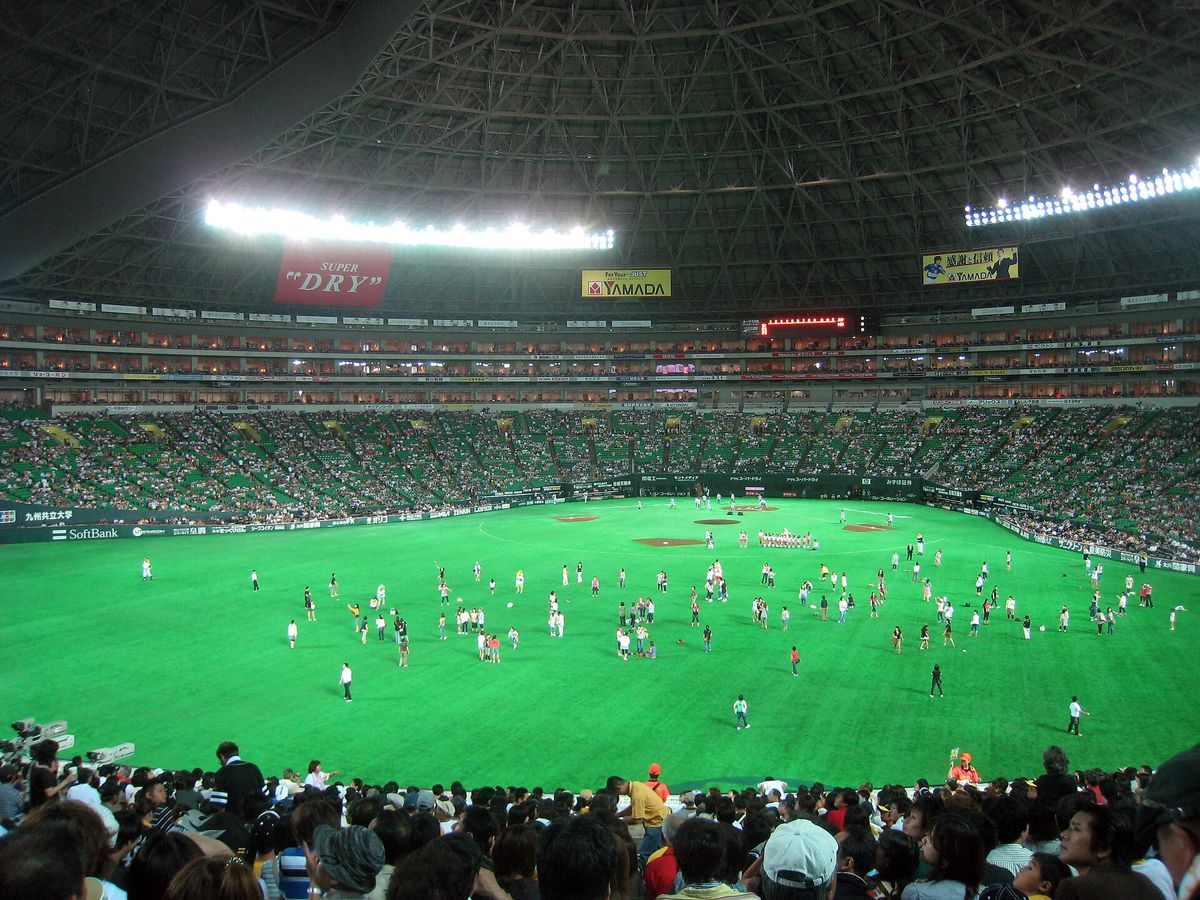
Before a Nippon Professional Baseball game, Fukuoka Dome, 2009.
The SoftBank Hawks against the Rakuten Eagles. Japan's league grew independently and is not a feeder to Major League Baseball.
JoshBerglund19 · CC BY 2.0 · Wikimedia Commons
03Officiating and technology
Baseball is almost perfectly suited to review technology, because nearly every call is a question about where an object or a body part was at a specific instant. Was the foot on the bag before the ball arrived? Did the ball clear the wall? Was it fair or foul?
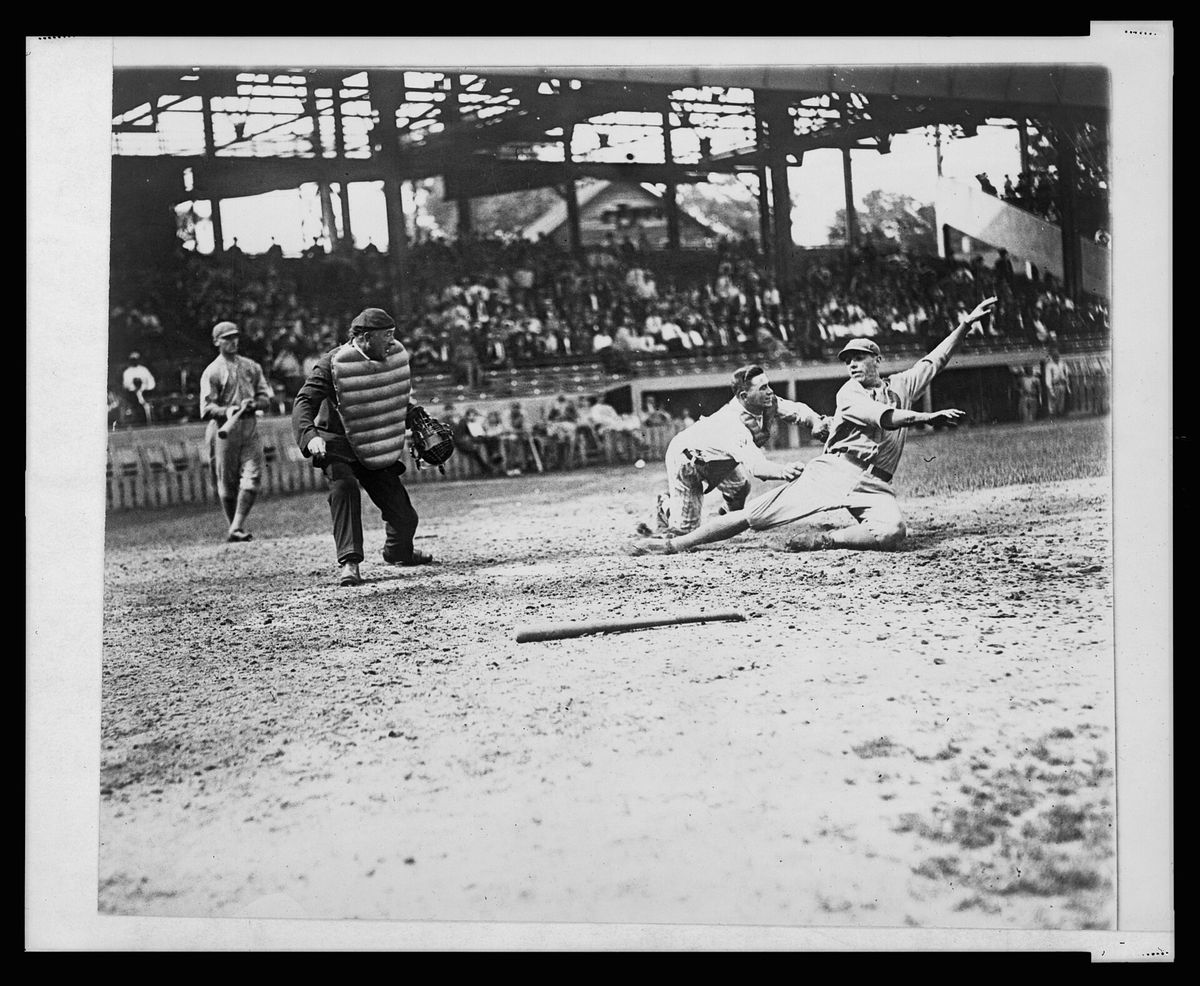
An umpire calling a play at home plate, Washington, between 1910 and 1930.
From the National Photo Company collection at the Library of Congress. Whether the runner's hand reached the plate before the tag is a question of fact about one instant, which is the kind of call replay now settles.
National Photo Company · Public domain · Wikimedia Commons
Replay arrived in 2008 for boundary calls and expanded in 2014 into a manager's challenge covering most of the sport. It is uncontroversial, and the reason is that it answers factual questions with correct answers.
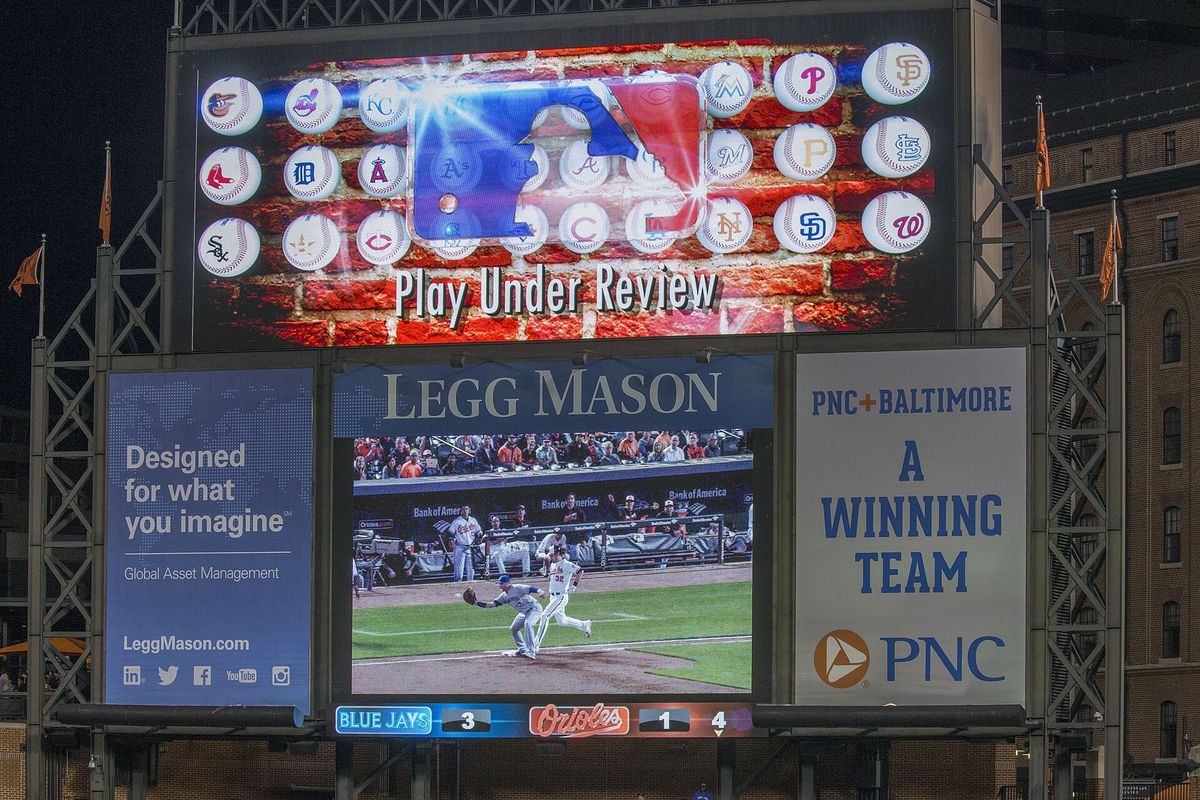
"Play Under Review" on the scoreboard at Camden Yards, Baltimore, 2016.
The manager's challenge, two seasons after replay expanded to cover most of the sport. The replay on the lower screen is the evidence.
Keith Allison · CC BY-SA 2.0 · Wikimedia Commons
The exception is the one that matters most. Balls and strikes are still called by a human, several hundred times a game, and the strike zone is defined partly by the batter's stance — from the midpoint of the torso to below the kneecap, as the batter is prepared to swing. That is a zone that changes shape for every hitter and moves as they move.
Automated ball-strike systems exist, have been trialled extensively in the minor leagues, and are technically capable. The sport has not adopted them at the top level, and the argument against is not accuracy. It is that framing — a catcher's skill in receiving a borderline pitch so that it looks like a strike — is regarded by much of the sport as a real skill worth preserving, and automation would delete it.
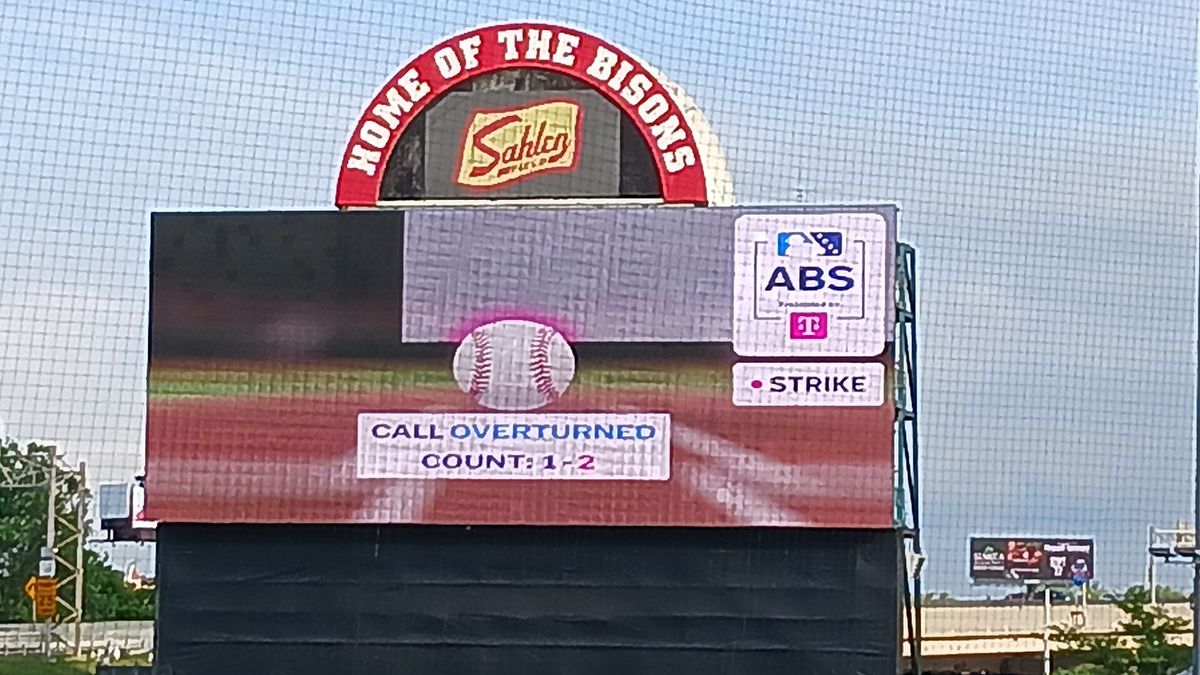
An automated ball-strike challenge at a Triple-A game in Buffalo, June 2025.
The scoreboard shows a pitch tracked against the zone and the call overturned. Trials like this one in the minor leagues are the background to the argument about the major leagues.
James161723 · CC0 · Wikimedia Commons
That is a genuinely unusual position on this site. Tennis removed its line judges because the machine was better. Baseball has a machine that is better and has declined so far, because it values something the machine would remove.
04Where it is played
Baseball is intensely popular in a small number of places and almost absent from the rest of the world, which puts it alongside cricket as one of the two most geographically concentrated sports here — and the two maps do not overlap at all.
The United States, Japan, South Korea, Taiwan, Cuba, the Dominican Republic, Venezuela, Puerto Rico, Mexico, Panama and Nicaragua account for essentially all of it. That distribution follows American military and commercial presence in the late nineteenth and twentieth centuries almost exactly, in the same way cricket's follows the British Empire.
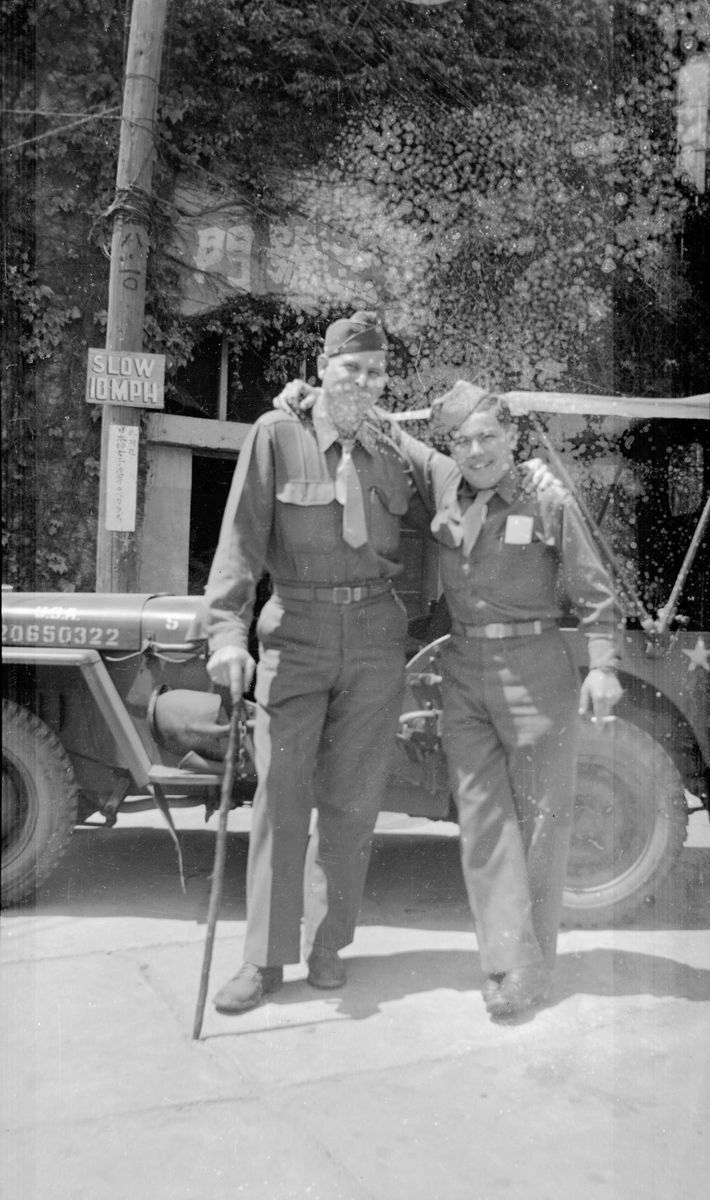
Two US soldiers outside Koshien Stadium, around 1947.
Baseball reached Japan in the 1870s and Koshien opened in 1924, so the occupation did not bring the game. It is evidence of the American presence the sport's map follows.
Photographer unknown · Public domain · Wikimedia Commons
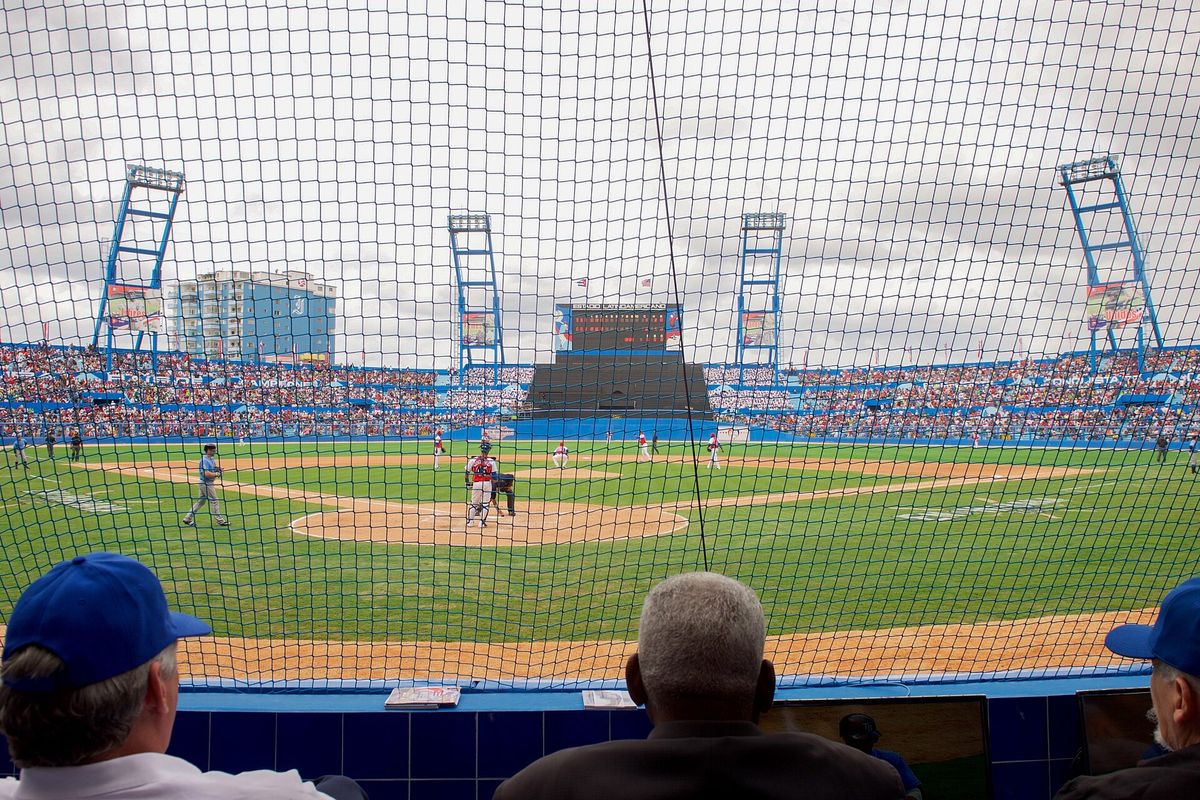
Cuba's national team against the Tampa Bay Rays, Estadio Latinoamericano, Havana, March 2016.
An exhibition game played in front of the presidents of both countries. Cuba is one of the handful of nations where baseball is the national game.
US Department of State · Public domain · Wikimedia Commons
The Caribbean and Central American nations are the most productive relative to population by a wide margin, and the pathway there runs through academies funded by American professional clubs — a recruitment structure with no parallel in any other sport on this site, and one with a documented history of abuses that the league has regulated only recently.
Japan's is the other case worth recording, because it is the one place where a professional structure developed independently and produced a genuinely different version of the sport: different ball, different strike zone in practice, and a distinct playing culture. Nippon Professional Baseball is not a feeder league.
The Olympic consequence is awkward. Baseball has been on and off the programme repeatedly, and the reason it keeps being dropped is that its best players are under contract to a league that will not release them mid-season. A sport whose rules are made by a league also has its Olympic participation decided by one.
05Learning curve
Two skills at the heart of this sport are among the hardest single actions in any of them: hitting a pitched ball, and pitching one accurately at speed without destroying your own arm. Almost everything else about baseball is accessible, which produces one of the widest internal gaps on this board.
Editorial — the site’s reading, not a sourced claim
Barrier to entry
How hard is it to get to a real game?
Catch and throw on day one. Hit a real pitch, not for a long time.
Baseball scales down well. Catch, throw and hit off a tee are learnable immediately, and the informal versions — stickball, wiffle ball, catch in a yard — need almost nothing. Youth baseball is one of the most widely organised children's sports in the countries that play it.
The barrier is the pitched ball. Hitting a baseball thrown competently is routinely described as the hardest single act in sport, and it is not an exaggeration a beginner discovers gradually: a novice facing real pitching does not make contact at all. That is different from badminton, where a beginner's mishit still produces a rally.
Nine a side and a large field are the other constraint, though the sport degrades to smaller versions more gracefully than cricket does.
Evidence
- Players needed18observedFor a full game; the informal versions need far fewer.
- Pitching distance60 ft 6 inobservedAbout 0.4 seconds of flight at professional speed.
- Kit to startA ballobserved
- Bat materialWood professionallyobservedThe amateur game is deliberately easier to hit in.
- Time to hit live pitchingMonthsestimate
Barrier to the top
How hard is it to be good at?
Failing seven times in ten is a good career, and the arm is not built for the job.
A hitter succeeding three times in ten is excellent. No other sport on this site defines competence as a failure rate that high, and the psychological demand of a season built from that is genuinely distinctive.
The pitching half is a physiological problem. Throwing a baseball at professional velocity applies forces to the elbow near the failure point of the ligament, and reconstruction surgery is close to a routine career event. This is the only sport here whose primary skill reliably injures the people who are best at it, and no rule has ever addressed it.
The sport's statistical culture adds a third layer. Because everything is recorded and analysed, elite play is now shaped by data — which is what produced the defensive shift, and in 2023 the shift was banned.
Evidence
- Mound lowered15 in to 10 in, 1969ruleThe sport rebalanced hitting against pitching by moving the ground.1969 — the rule this rests on
- Pitch clockSince 2023ruleRemoved the pitcher's ability to reset at will between deliveries.2023 — the rule this rests on
- Defensive shiftRestricted 2023ruleA rule against a defensive arrangement derived from the sport's own data.2023 — the rule this rests on
- Elite batting averageAbout .300estimateFailing seven times in ten.
- Typical peak age26–30estimate
Why the two differ
Baseball's gap is between two halves of the same sport. Catching, throwing and fielding are ordinary skills that most people can acquire. Hitting a pitched ball and throwing one at ninety-five miles an hour are extraordinary ones, and there is very little between the two.
What makes it worth putting next to cricket — the other striking and fielding sport here — is that cricket's barrier is comprehension and cricket's elite demand is breadth across three formats, while baseball's barrier is a single physical act and its elite demand is tolerating failure at it. Two sports from the same family, arriving at very high by completely different routes.
Baseball is also the only sport on this board whose primary skill injures its best practitioners as a matter of course, and the only one where no rule has ever been written about that.
The historyhow it got here · sections 6 to 10
06Origin and invention
Baseball's origin story was invented, and the invention is more interesting than the truth.
The Doubleday myth — that Abner Doubleday devised the game at Cooperstown in 1839 — was manufactured by a commission set up in 1905 specifically to establish that baseball was American rather than descended from English bat-and-ball games. It was not true. Baseball descends from rounders and similar games, and the first substantial codification is the Knickerbocker rules of 1845 in New York.
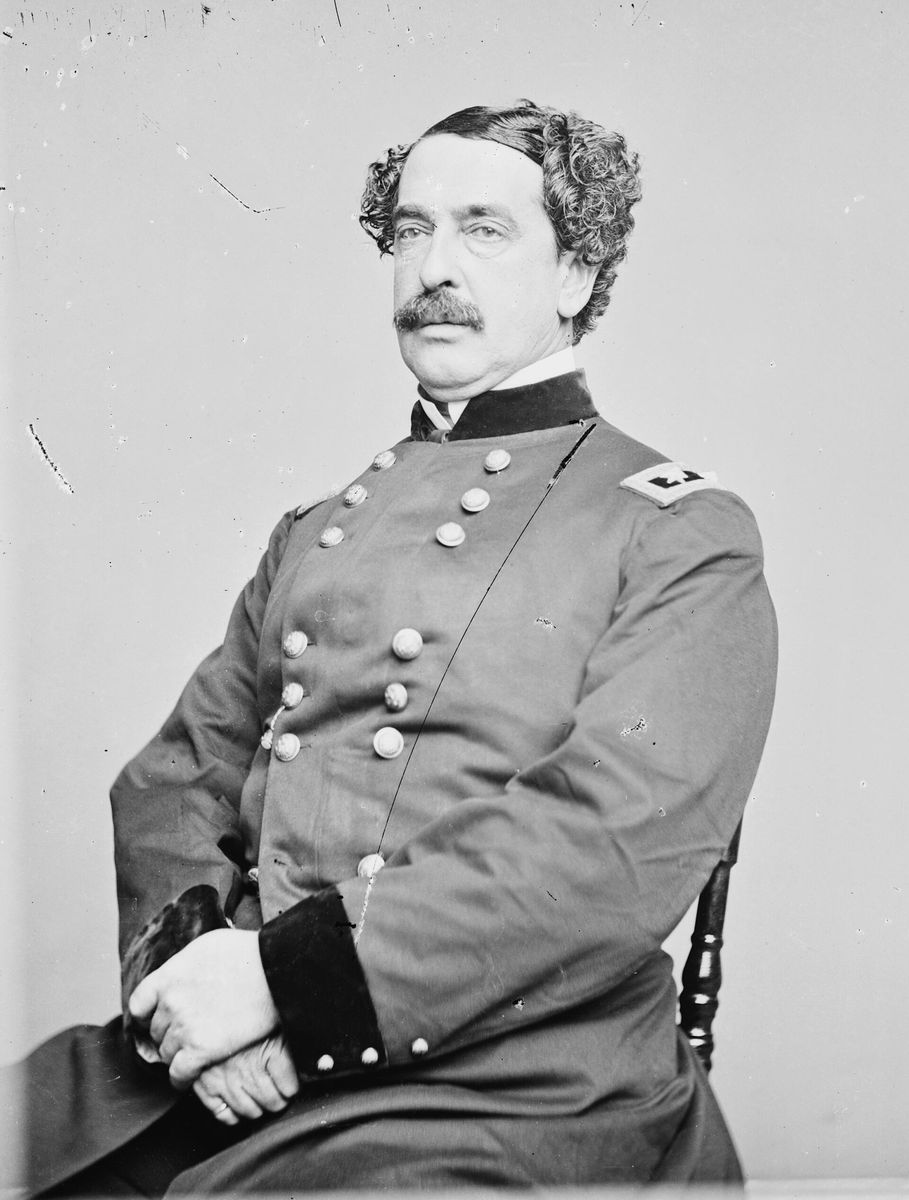
General Abner Doubleday, photographed by Mathew Brady's studio.
A Union general who died in 1893 without ever claiming to have invented anything. The commission credited him with the game in 1907, fourteen years later, because an American inventor was the answer it had been set up to find.
Mathew Brady studio · Public domain · Wikimedia Commons
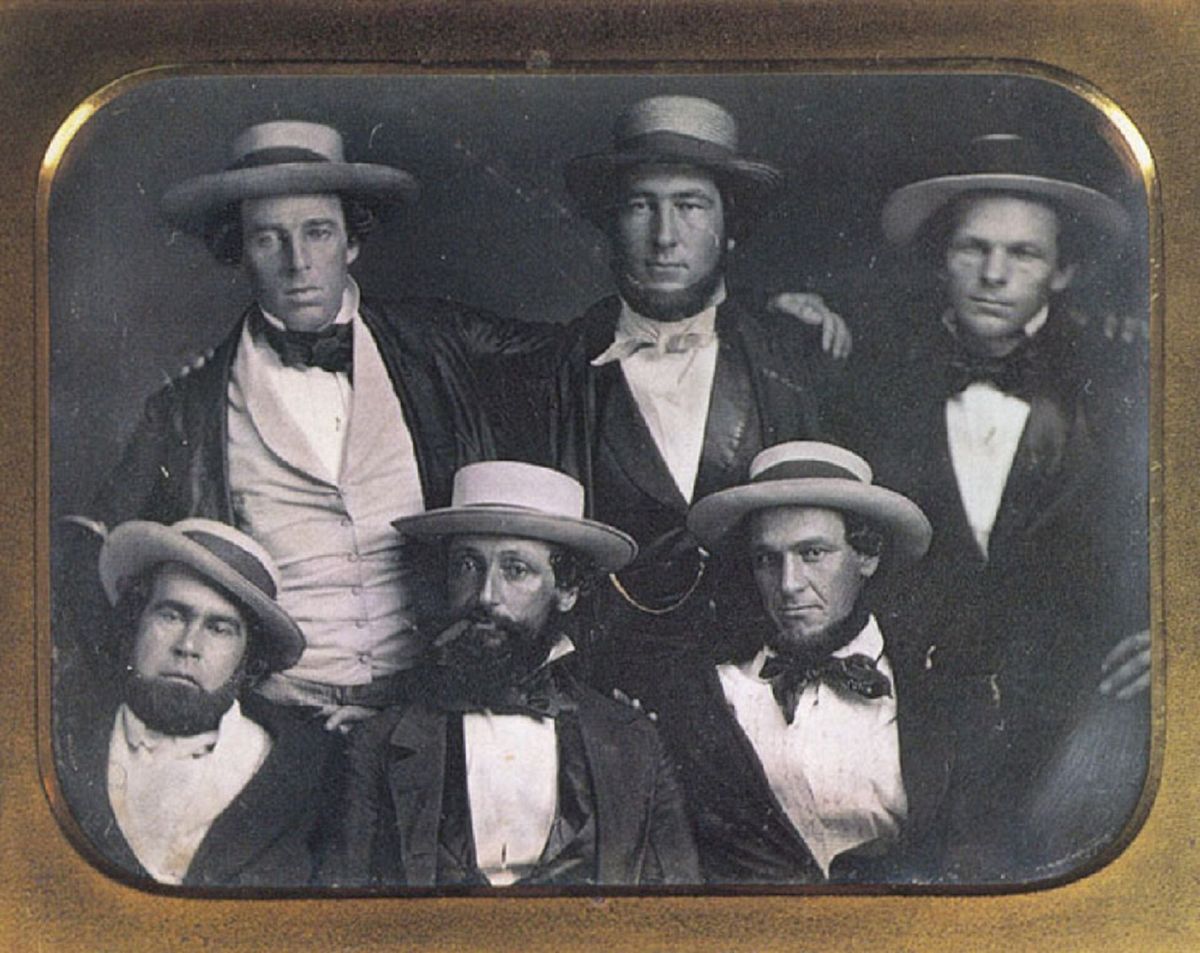
A daguerreotype said to show members of the New York Knickerbocker Base Ball Club, about 1847.
Identified by its source as Alfred and Alexander Cartwright, William Wheaton, Duncan Curry, Daniel Adams and Henry Anthony: the club whose 1845 rules are the first substantial codification. The attribution is the source's, and it is hedged there too.
Photographer unknown · Public domain · Wikimedia Commons
What the myth tells you is that this sport has always understood itself as a national institution first and a game second, which is why its rule changes are argued about in a register no other sport here uses.
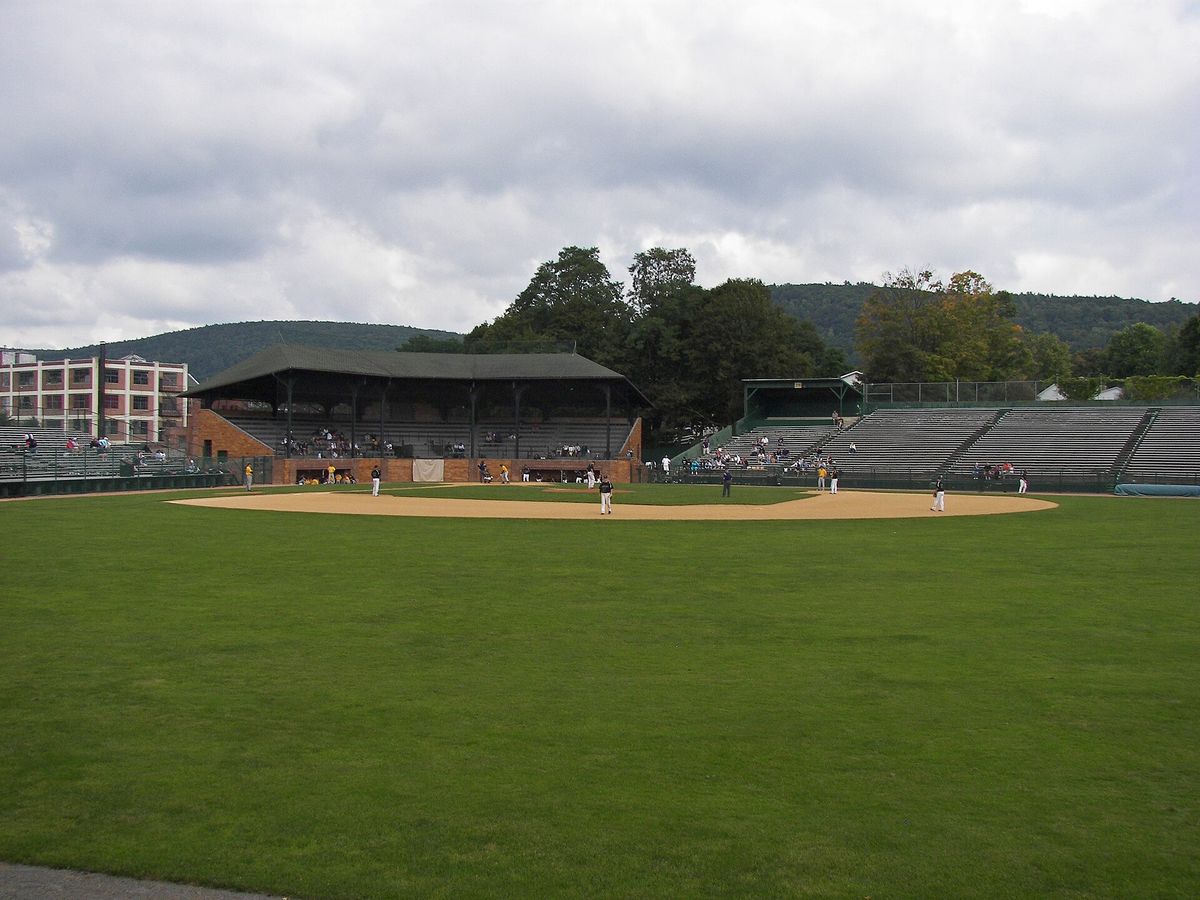
Doubleday Field, Cooperstown, New York, 2009.
The myth has a ballpark, and the Hall of Fame sits in the same small town. Neither is evidence that the game began here; both are evidence of how much the sport wanted it to.
Wknight94 · CC BY-SA 3.0 · Wikimedia Commons
The genuinely inventive parts arrived over the following decades and are all about geometry. Ninety feet between bases is the number the sport is proudest of, because it makes a routine ground ball an almost exactly even race between runner and throw. Sixty feet six inches from mound to plate was settled in 1893 and has not moved since.
The National League was founded in 1876 and the American League in 1901, and the two ran as rivals before merging into one competition — a structure that would matter enormously seventy years later, when one of them adopted a batting rule the other refused for forty-nine years.
07Rule timeline
The sport’s own lane, expanded. Every entry carries a cause from the closed vocabulary and a citation, and says so where the citation is incomplete.
- 1969Broadcast and pacingalso commercialadopted 1968-12
The pitcher's mound was lowered from fifteen inches to ten, and the strike zone was reduced to run from the armpits to the top of the knees. Both changes made it harder to pitch and easier to hit, and they were made together and deliberately.
Comparability break · Scoped to one competition
The mound was lowered five inches and the strike zone shrunk, in the same off-season, explicitly to raise scoring. Every rate statistic moves here. See the series
Trigger and citationIncomplete — no confirmed article
Trigger
1968 is known in the sport as the Year of the Pitcher. Bob Gibson finished with an earned run average of 1.12, Carl Yastrzemski won the American League batting title at .301, and scoring across both leagues fell to a level the sport regarded as unwatchable. The rules were changed within months.
Official Baseball Rules · Official Baseball Rules, 1969
- 1973Broadcast and pacingalso commercialadopted 1973-01
The American League allowed a designated hitter to bat in place of the pitcher. The National League did not. For forty-nine years the two halves of the same competition played under different batting rules, and their statistics were not directly comparable.
Comparability break · Scoped to one competition
One league removed the pitcher from its batting order and the other did not. The break is not between before and after; it is between two halves of the same league, for forty-nine years. See the series
Trigger and citationIncomplete — no confirmed article
Trigger
Attendance and scoring in the American League were lagging behind the National, and removing the weakest batter in every lineup was the available lever.
That one league adopted it and the other refused, and that the split persisted for half a century, is the more remarkable fact. It is the only case on this site of a single competition knowingly running two rulebooks and comparing the results anyway.
Official Baseball Rules · Official Baseball Rules, 1973
- 2008-08Integrityadopted 2008
Video review was introduced, initially only for boundary calls on home runs — fair or foul, over the fence or not, spectator interference — and expanded from 2014 into a manager's challenge covering most calls other than balls and strikes.
Trigger and citationIncomplete — no confirmed article
Trigger
Baseball's calls are almost entirely questions of fact about where an object or a foot was at a moment in time, which is the class of question a camera settles and an umpire at distance does not.
Official Baseball Rules · Official Baseball Rules, replay review regulations
- 2022Fairness and eligibilityalso commercialadopted 2022-03
The designated hitter was adopted by the National League, ending forty-nine years in which the two leagues batted under different rules. Both halves of the sport finally became statistically comparable with each other.
Trigger and citationIncomplete — no confirmed article
Trigger
Interleague play had made the split increasingly awkward — teams were building rosters for one rulebook and playing a substantial number of games under the other — and the pitcher's plate appearance had become close to an automatic out.
Official Baseball Rules · Official Baseball Rules, 2022
- 2023Broadcast and pacingalso commercialadopted 2022-09
Three changes at once. A pitch clock, requiring the pitcher to begin delivery within a set time and the batter to be ready. A restriction on defensive positioning, requiring two infielders on each side of second base with both feet on the infield dirt. And larger bases, increasing the incentive to attempt a steal. A sport that had gone a century and a half without a clock acquired one.
Comparability break · Scoped to one competition
A clock, a restriction on where fielders may stand, and larger bases, all in one season and all intended to change the numbers. See the series
Trigger and citationIncomplete — no confirmed article
Trigger
Average game length had risen steadily for decades while the amount of time the ball was actually in play had fallen, and the sport's own analysis identified dead time between pitches as the problem. The shift restriction addressed a separate finding: defensive positioning based on batted-ball data had suppressed hits.
The shift ban is the more contested half. It legislates against a defensive method arrived at through analysis of the sport's own data, which some regard as penalising teams for thinking correctly. The same objection was made about basketball's illegal-defence rules and about football's 1925 offside change.
Official Baseball Rules · Official Baseball Rules, 2023
08Equipment evolution
Baseball's equipment is regulated tightly at the professional level and loosely everywhere else, and the sport is unusually relaxed about the consequences.
The bat. Professional baseball requires a single piece of solid wood. College and amateur baseball permit aluminium and composite bats, which are lighter, more forgiving and produce faster exit velocities — and the sport does not pretend the statistics travel between the two. A college batting average and a professional one are not compared, and nobody proposes that they should be. That is the correct handling of a comparability problem, arrived at without anyone calling it one.
The ball. The recurring controversy that has never become a rule change. Home run rates have moved sharply between seasons in ways that correlate with changes in the ball's construction and aerodynamic behaviour, and the sport has been accused repeatedly of altering it, deliberately or otherwise. The specification — weight, circumference, construction — has not changed. Whether what is made to that specification has, is the argument.
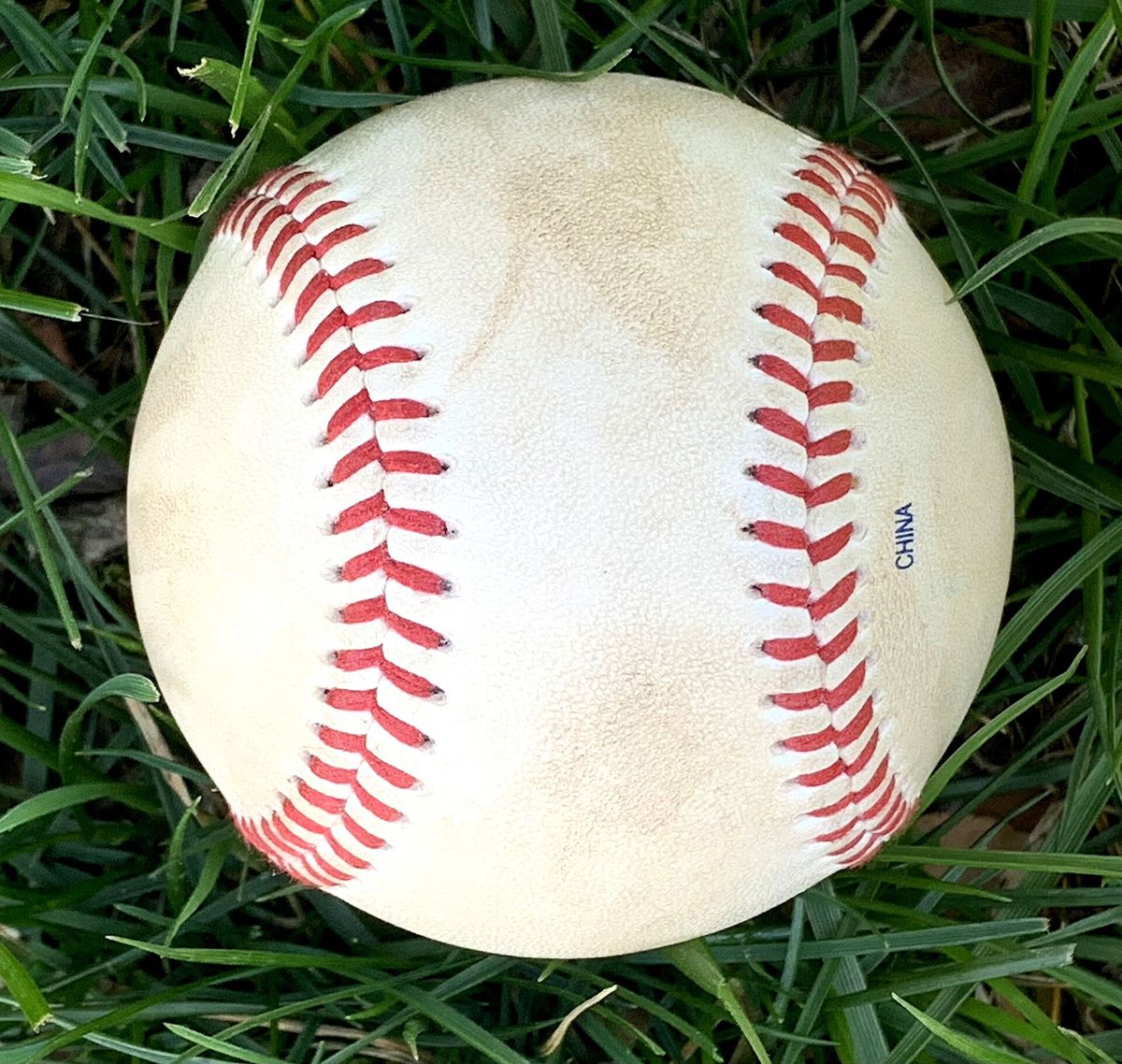
The stitching on a minor league baseball, 2021.
Weight, circumference and construction are specified, and have not changed. The argument is about what happens inside that specification: how tightly it is wound, how high the seams stand.
OKJaguar · CC BY-SA 4.0 · Wikimedia Commons
That is the exact inverse of every other equipment story on this site. In athletics and swimming, the specification was outrun and had to be rewritten. In baseball, the specification has held and the object may have moved inside it.
The glove grew steadily through the twentieth century and is now specified by size. Protective equipment followed injury: batting helmets became mandatory in the 1970s, and helmets with extended jaw protection followed later incidents.
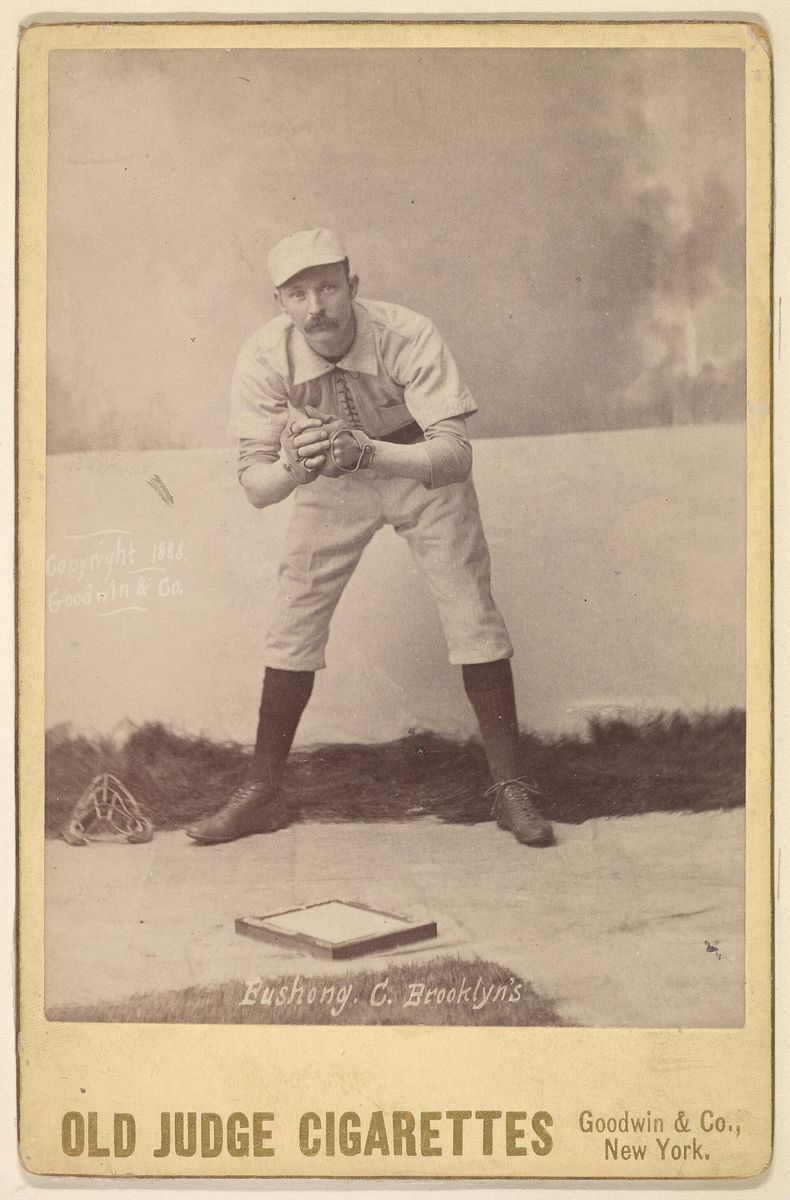
Doc Bushong, Brooklyn's catcher, on an Old Judge cigarette card, 1888.
Posed in a studio, crouched behind a plate. The glove of the period was small and thinly padded; its successors grew through the twentieth century until the rules had to specify a size.
Goodwin & Company · Public domain · Wikimedia Commons
09Governing body politics
Baseball's rules are made by a league, not a federation, and that is the structural fact behind everything on this page.
The WBSC governs internationally and runs the Olympic tournament. Major League Baseball governs itself, and every rule change recorded here — the mound, the designated hitter, replay, the pitch clock — was an MLB decision. This is basketball's arrangement taken further: at least FIBA and the NBA converge over time, whereas baseball's international body largely follows the league.
The internal split is the more remarkable governance fact. From 1973 to 2022, the American League used a designated hitter and the National League did not. One sport, one championship, two batting rulebooks, for forty-nine years — including in the World Series, where the rule in force depended on which park the game was in.
No other sport on this site has done anything comparable. It persisted because the two leagues had separate identities and separate administrations long after they had become one competition, and because each side regarded the other's rule as a departure from what baseball was.
The other permanent feature is labour. Baseball has the most organised player body in American sport and the most contested history of stoppages, and rule changes go through collective bargaining. The 2023 pitch clock was negotiated rather than imposed, which is why it arrived as a package with the shift restriction and larger bases.
10Controversies that forced rule changes
1968, the Year of the Pitcher. Scoring collapsed. Bob Gibson recorded an earned run average of 1.12; Carl Yastrzemski won a batting title at .301, the lowest figure ever to do so. The sport concluded that pitching had won too completely and, within months, lowered the mound from fifteen inches to ten and shrank the strike zone.

Bob Gibson of the St. Louis Cardinals, 1967.
The year before his 1.12 earned run average, the season the sport answered by lowering the mound.
Photographer unknown · Public domain · Wikimedia Commons

Carl Yastrzemski of the Boston Red Sox, 1969.
In 1968 he won the American League batting title at .301, the lowest average ever to win one.
Photographer unknown · Public domain · Wikimedia Commons
That is a governing body reaching into the geometry of the field to change a statistical outcome, and it worked immediately. It also severed every offensive statistic in the sport.
The designated hitter, 1973. Adopted by one league, refused by the other, and the split lasted until 2022. For half a century, comparing an American League pitcher's earned run average with a National League pitcher's was comparing performances under different rules, and everyone did it anyway.
The shift. Through the 2010s, teams used batted-ball data to position fielders where a particular hitter actually hits the ball, and batting averages on ground balls fell accordingly. It was legal, effective, and the product of analysing the sport's own records. In 2023 it was restricted.
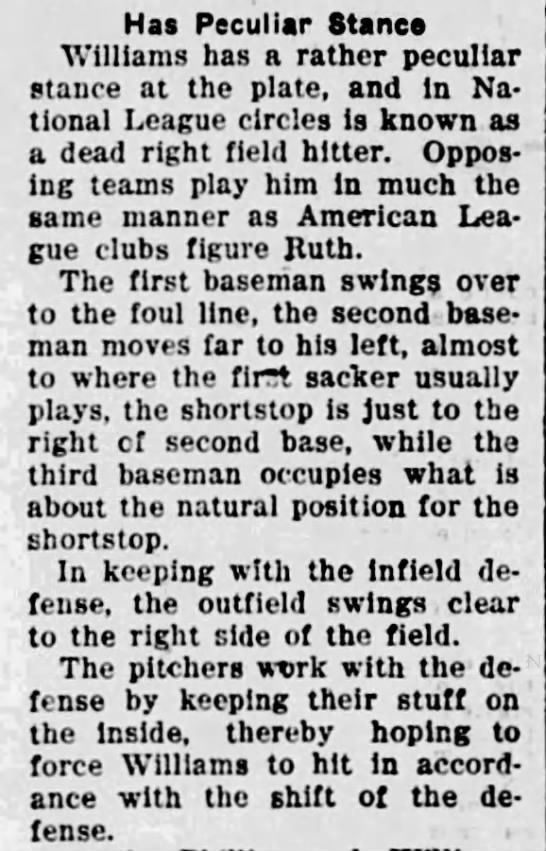
A newspaper description of the shift used against Cy Williams, May 1923.
The shift is not new. Teams were moving fielders to where a pull hitter hit the ball a century before it was restricted. What changed in the 2010s was the data that told every team where every hitter hit it.
Billy Evans · Public domain · Wikimedia Commons
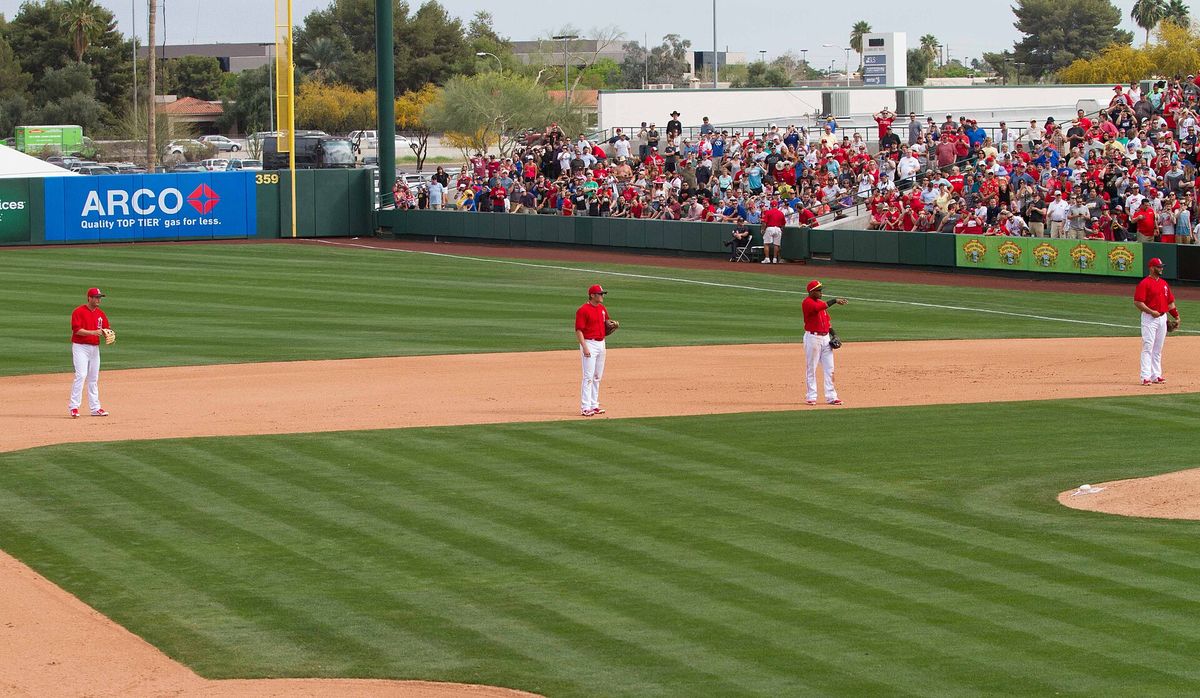
The Los Angeles Angels shifting their infield, 2015.
Three infielders on one side of second base. From 2023 two must stand on each side, with both feet on the infield dirt.
Jon Gudorf Photography · CC BY-SA 2.0 · Wikimedia Commons
This is the same act as basketball banning zone defence and football's 1925 offside change: a rule written against a way of playing that was working too well. The objection — that it penalises teams for thinking correctly — is the same objection in all three cases.
Time. Game length had risen for decades while the ball was in play for less of it. A sport that had defined itself by having no clock put one on the gap between pitches in 2023, and the games got substantially shorter immediately.
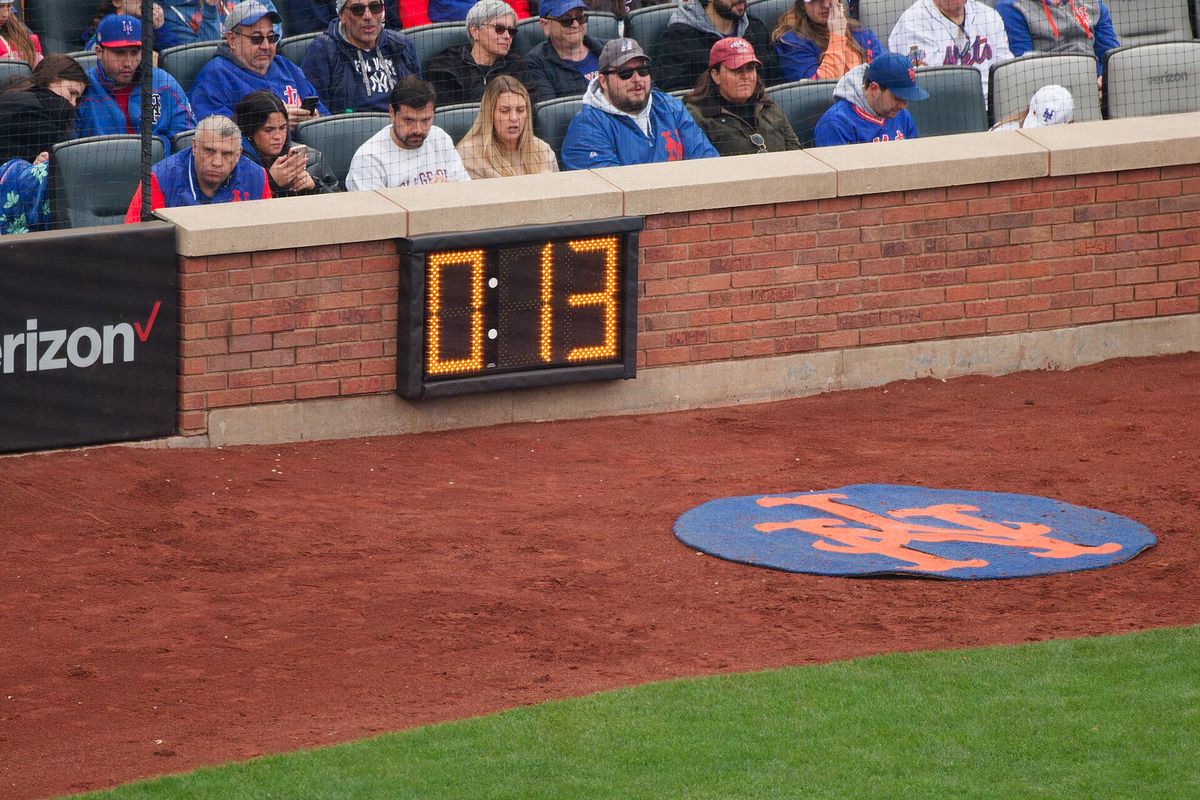
The pitch clock at Citi Field, April 2023, its first month in the major leagues.
Thirteen seconds left. A sport that had defined itself by having no clock put one on the gap between pitches, and games got substantially shorter at once.
D. Benjamin Miller · CC0 · Wikimedia Commons
Where it standsthe record, and what is still open · sections 11 to 12
11Series
No series published
Offensive statistics — Major League Baseball
Baseball keeps better records than any sport on this site and has severed them more often than almost any. Runs per game, batting average, earned run average and every rate statistic built on them respond directly to rule changes, and this sport has made three large ones. The mound was lowered and the strike zone shrunk in 1969, both designed to make hitting easier. The designated hitter arrived in one league in 1973 and the other in 2022, which means that for forty-nine years the two halves of the same competition were not comparable with each other, let alone across time. The pitch clock and shift restriction in 2023 moved the numbers again. The series is scoped to one league because there is no such thing as baseball's runs per game: the international game, the professional leagues of Japan and Korea, and MLB all differ, and MLB itself was two rulebooks for half a century. The figures are not entered because they have not been taken from a cited source. When they are, the chart appears here in segments — and it will need more of them than any other chart on this site.
1969Scoped to one competitionThe mound was lowered five inches and the strike zone shrunk, in the same off-season, explicitly to raise scoring. Every rate statistic moves here.
1973Scoped to one competitionOne league removed the pitcher from its batting order and the other did not. The break is not between before and after; it is between two halves of the same league, for forty-nine years.
2023Scoped to one competitionA clock, a restriction on where fielders may stand, and larger bases, all in one season and all intended to change the numbers.
12What is contested now
Recorded as unsettled.
Automated balls and strikes. The technology works and has been trialled for years. The sport has not adopted it at the top level, and the argument is not about accuracy — it is about whether pitch framing, a real and trained skill, should continue to exist. Baseball is the only sport on this site actively declining a working automation for a stated reason other than error rate.
Whether the shift ban was right. Restricting where fielders may stand legislates against a conclusion teams reached by analysing the sport's own data. Supporters say it restored a balance the data had destroyed; opponents say a sport should not punish correct thinking. The same argument attaches to basketball's illegal-defence rules and football's 1925 offside change, and it has never been settled in any of them.
The ball. Home run rates keep moving in ways that the specification does not explain, and the sport has never satisfactorily accounted for it. Until it does, every power record of the last decade carries an asterisk nobody has written down.
Pitcher injuries. Elbow reconstruction is close to a routine career event, velocity keeps rising, and no rule has ever been written about it. This is the largest unaddressed problem in the sport and the one this site finds most striking: a governing body that will move the pitching mound to raise scoring has not moved anything to stop its pitchers breaking.
Olympic participation. The sport returns in 2028 without a settled answer on whether its best players will be released to play.