Floorball
An indoor stick sport whose goalkeeper has no stick, plays on their knees, and catches the ball with their hands.
- Official
- Floorball
- Game category
- Invasion
- Adjudication
- Decided by score
- Standing
- Never Olympic
- rule changes
- 4
- comparability breaks
- 0
- Olympic editions
- 0
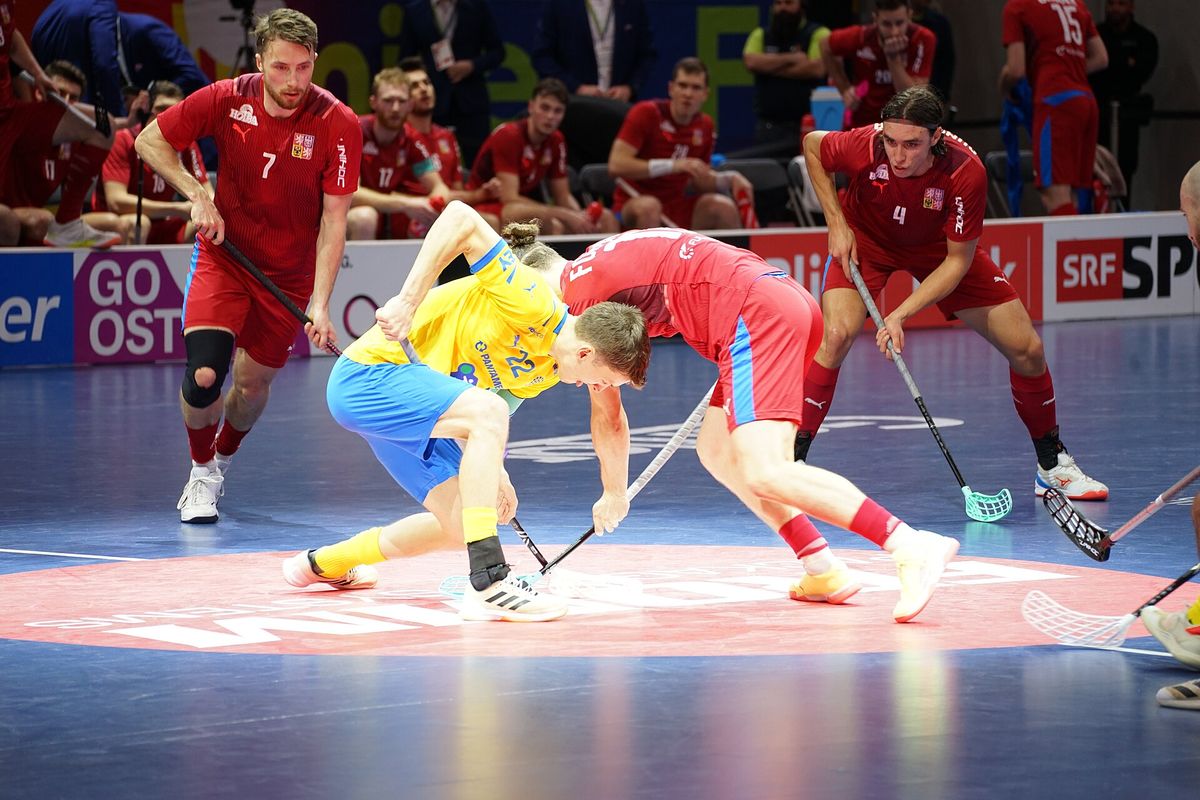
A face-off between Sweden and the Czech Republic in the 2022 world final · Albinfo · CC BY-SA 4.0
- Governing body
- International Floorball Federation
- Founded
- Developed in Sweden, Finland and Switzerland through the 1970s from American floor hockey equipment; the International Floorball Federation was formed in 1986.
- Olympic status
- Not on the Olympic programme
- Also contested at
- World Games
Five outfield players and a goalkeeper on a rink forty metres by twenty, playing a light plastic ball with a stick that may never be raised above the waist. There is no offside and no body checking, and the goalkeeper carries no stick at all — they play kneeling and use their hands, which makes them the only goalkeeper in any stick sport who is not holding one.
The gamewhat it is now · sections 1 to 5
01How it is played
Five outfield players and a goalkeeper, three periods of twenty minutes, on a boarded rink forty by twenty metres. No offside, no body checking, no stick above the waist — and a goalkeeper who plays without one.
These figures were entered from the edition named above but have not been checked against its text line by line. Treat them as this site’s reading of the laws, not as a substitute for them.
The object of the game
Put a light plastic ball into a goal 160 centimetres wide and 115 high, using a stick. More goals wins.
Because there is no offside, both teams can commit fully forward at any moment, and the game runs end to end at a pace closer to indoor handball than to either hockey code.
This clause reads this way because of
The rink
Forty metres by twenty, enclosed by boards fifty centimetres high with rounded corners. The ball stays in play off the boards, which is what keeps the game continuous — there are far fewer restarts than in field hockey, and the corners are deliberately curved so the ball keeps moving.
- Rink
- 40 × 20 m
- Boards
- 50 cm, with rounded corners
- Goal
- 160 × 115 cm
- Offside
- Does not exist
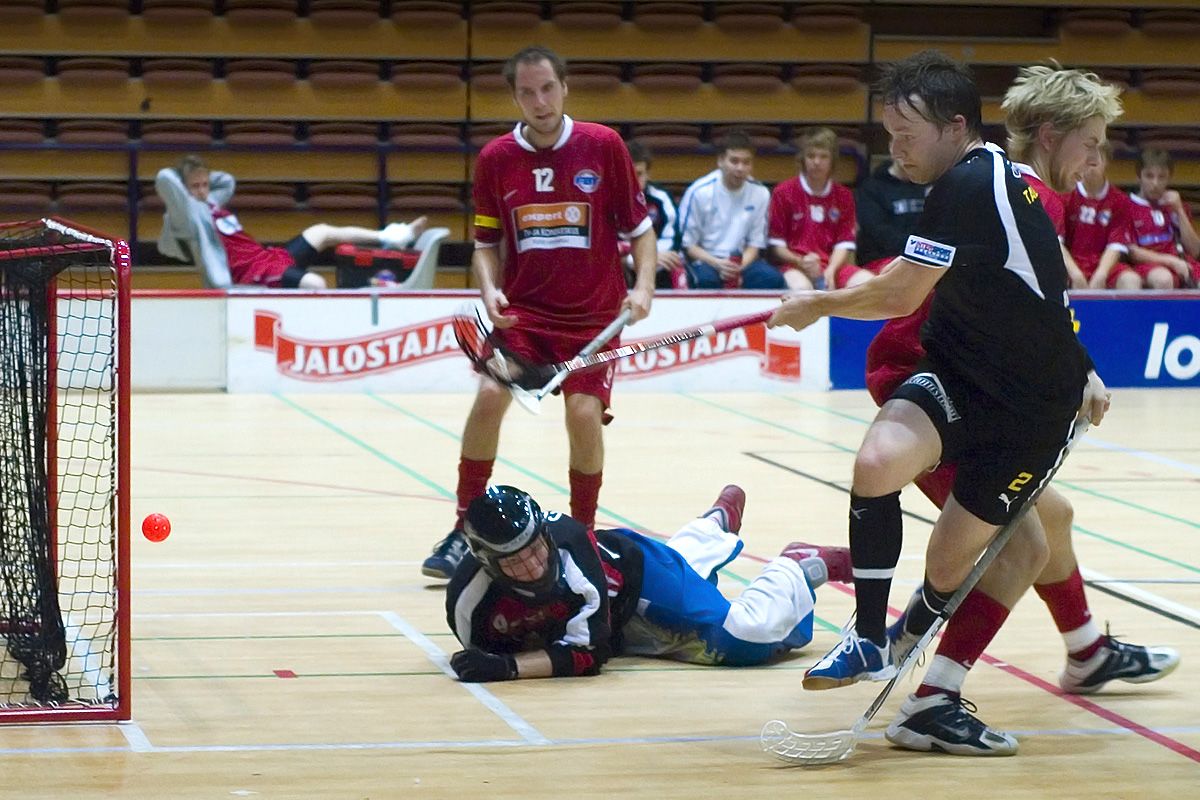
A goalmouth scramble at a league game in Turku, Finland, 2005, the goalkeeper down on the floor.
A hall floor, low boards and a small goal.
Anssi Koskinen · CC BY 2.0 · Wikimedia Commons
Equipment
A stick of composite plastic weighing around 350 grams — far lighter than a field hockey or ice hockey stick — with a blade whose curve is limited by rule.
The ball is hollow plastic, 72 millimetres across, 23 grams, and pierced with 26 holes. The holes are not decorative: they reduce air resistance and make the ball's flight stable and predictable, which is what allows a very light ball to be controlled at speed indoors.
Outfield players wear no protective equipment at all. The goalkeeper wears padding, a helmet and gloves, and carries nothing.
- Stick
- About 350 g, limited blade curve
- Ball
- 72 mm, 23 g, 26 holes
- Outfield protection
- None
- Goalkeeper's stick
- None
This clause reads this way because of
Players and officials
Five outfield players and a goalkeeper, with rolling substitutions that run continuously — lines change on the fly as in ice hockey, so a squad of twenty players is used across a match.
The goalkeeper is the sport's structural oddity: no stick, playing from the knees, catching the ball with the hands and throwing it back into play. In a sport where no outfield player may touch the ball with a hand, the goalkeeper does nothing else.
- On the rink
- 5 outfield and a goalkeeper
- Substitution
- Rolling, on the fly
- Goalkeeper position
- Kneeling
This clause reads this way because of
Time
Three periods of twenty minutes with the clock stopped at every whistle, which makes a match considerably longer in real time than the sixty minutes suggest.
- Periods
- 3 × 20 min
- Clock
- Stopped at every whistle
Scoring
One goal, one point. A goal may not be scored with any part of the body, only with the stick — so a ball deflected in off a foot or a knee does not count, deliberately or otherwise.
Starting and restarting
A face-off starts each period and follows a goal. Almost everything else restarts with a free hit: the ball is placed and struck without an opponent within three metres, and play does not stop for the opposing team to organise.
That choice — free hit rather than face-off — is why floorball flows. Field hockey and ice hockey both stop far more often.
A face-off between Sweden and the Czech Republic in the 2022 world final.
A face-off starts each period and follows a goal. Almost everything else restarts with a free hit.
Albinfo · CC BY-SA 4.0 · Wikimedia Commons
This clause reads this way because of
Infringements
Raising the stick above the waist, at any point in the swing. Body checking, pushing, holding, and playing an opponent's stick. Playing the ball with the head or above knee height. Playing the ball with the hand. Jumping to play the ball. Kicking the ball twice in succession, and scoring with the foot.
Penalties are served in a box, as in ice hockey — two minutes, five minutes, or a match penalty — so a team plays short-handed rather than conceding a free hit.
This clause reads this way because of
Deciding the winner
More goals. A tie in knockout play goes to sudden-death overtime and then to a penalty sequence, in which a player runs at the goalkeeper from the centre and must keep the ball moving forward.
Everything above is current law. Everything below is how Floorball got here.
02Disciplines and events
No Olympic events. The IFF holds men's and women's world championships in alternating years and floorball has been on the World Games programme since 2017, with IOC recognition since 2011.
- Disciplines
- 1
- Olympic medal events
- 0
- Men’s and women’s counted separately.
- Contested elsewhere
- 6
- world games, world championship, federation only.
- Listed for context
- 2
- Not counted as this sport.
Floorball2
Six a side including the goalkeeper, on a 40 × 20 m boarded rink.
- Men's tournamentWorld GamesWorld championship
- Women's tournamentWorld GamesWorld championship
Other formats3
- Three-a-sideFederation onlyA small-rink format used for development and for schools.
- Powerchair floorballFederation onlyPlayed from electric wheelchairs with a stick fixed to the chair; governed nationally in several countries.
- Special Olympics floorballFederation onlyContested at Special Olympics World Games, under adapted rules.
The sports it sits between3
Floorball is routinely described as indoor hockey and is not the same sport as either code it resembles.
- Field hockeyOutdoors, heavier stick and ball, offside abolished in 1998.
- Ice hockeyOn ice, with body checking and an offside rule; a Winter Games sport.
- Rink and floor hockey variantsFederation onlyThe North American school-equipment games from which floorball's original sticks came.
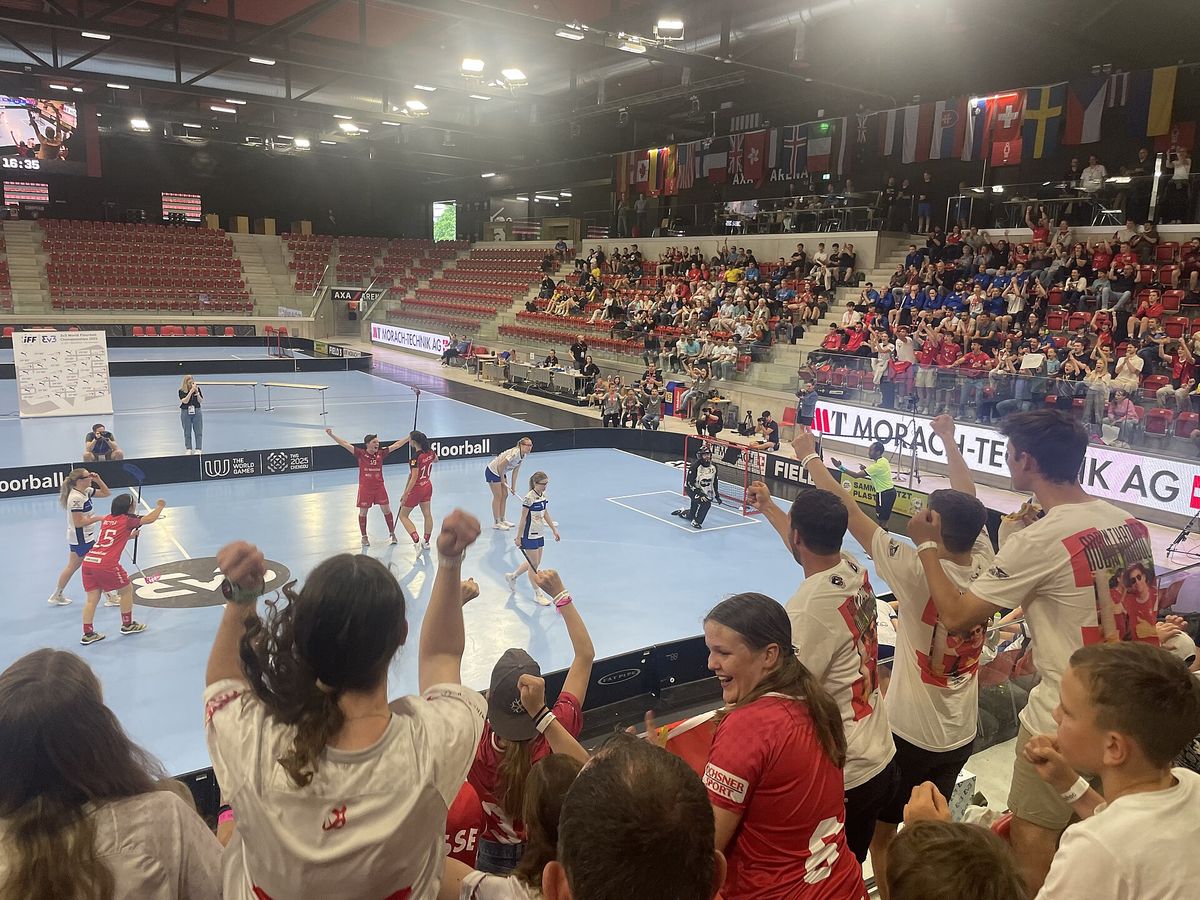
Swiss fans as Switzerland take the lead in the women's final of the 2025 three-a-side world championships.
The small-rink format, which now has world championships of its own.
Gyokuro-du-Rhin · CC0 · Wikimedia Commons
03Officiating
Two referees, both with equal authority, moving diagonally around a small boarded rink — and one call that dominates everything.
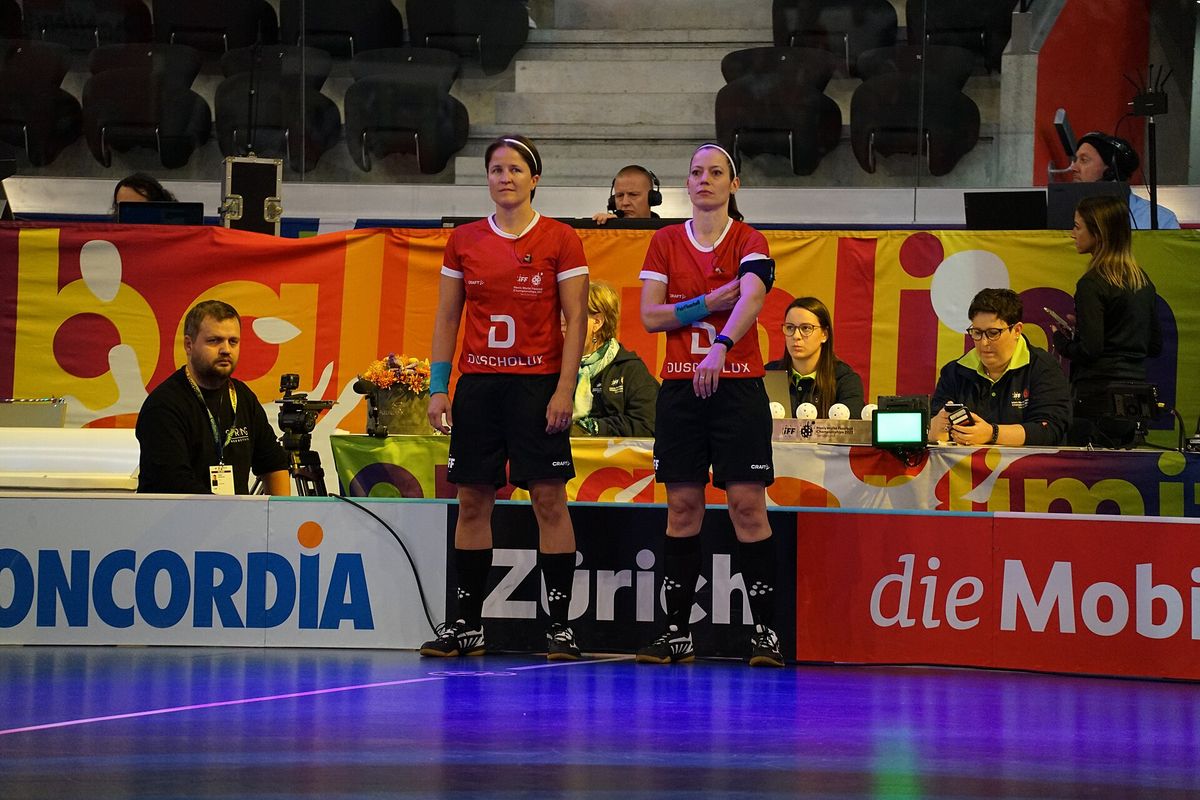
Swiss referees Corina Wehinger and Sandra Zurbuchen at Sweden against Finland, 2022 World Championships.
Two referees with equal authority, working diagonally around the rink.
Albinfo · CC BY-SA 4.0 · Wikimedia Commons
Stick height. The stick may not go above the waist at any point: not on the backswing, not on the follow-through. It is the sport's safety foundation and its most frequent penalty, and it is judged by eye against a body part whose height changes as a player bends. A hard shot is naturally taken with a bigger swing, so the rule is fighting the technique players instinctively want to use.
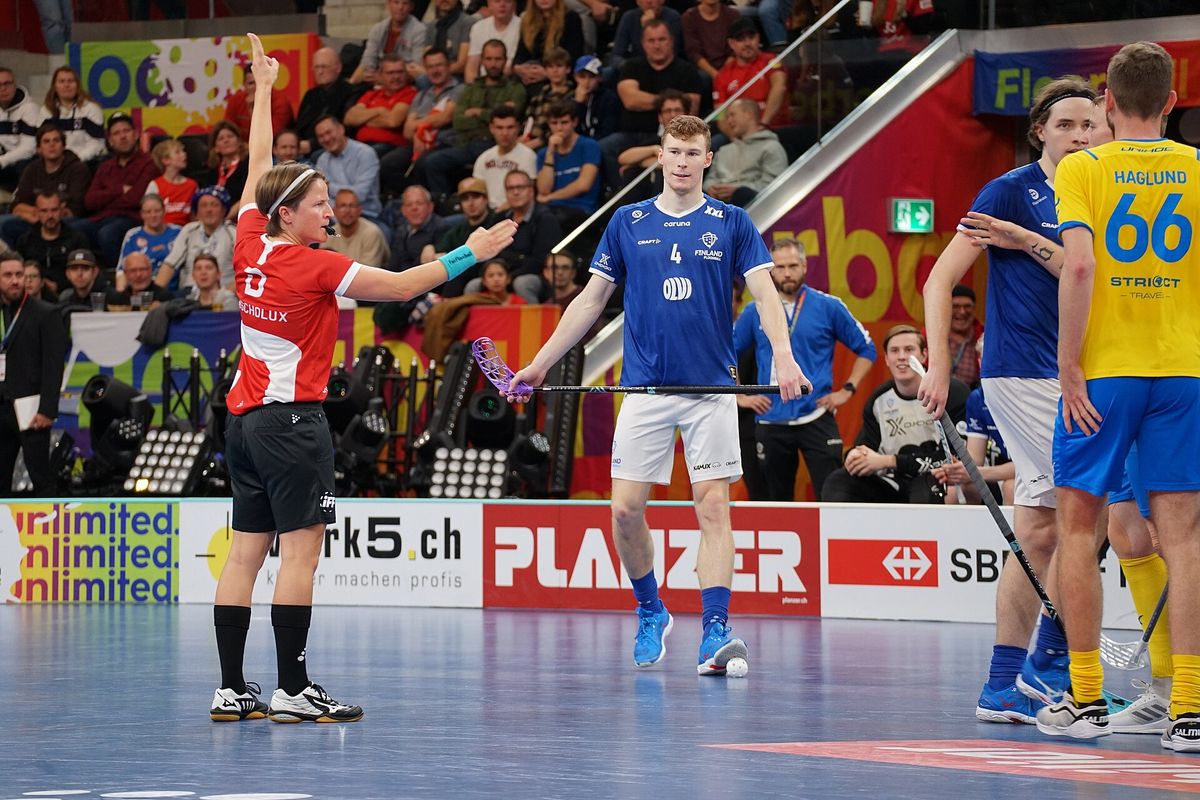
Corina Wehinger indicating a penalty during Sweden against Finland, 2022.
Stick above the waist, a played stick, contact: the calls that send a player to the box.
Albinfo · CC BY-SA 4.0 · Wikimedia Commons
Contact. Body checking is prohibited outright, so as in flag football and korfball the official is deciding whether contact happened rather than whether it was excessive. In a forty-by-twenty rink with rolling substitutions and no offside, players are in each other's space constantly.
Playing the stick. Lifting, holding or striking an opponent's stick is a foul, and separating a legitimate attempt at the ball from a played stick at speed is the sport's most argued judgement.
The crease. An outfield player may not enter the goalkeeper's area, and the goalkeeper — kneeling, without a stick — is protected by rules about how far they may come out and how long they may hold the ball.
Penalties are served in a box as in ice hockey, so a foul costs a team a player for two or five minutes rather than conceding a set piece. That makes each individual call more consequential than a free hit would be, and it is why the sport's officiating is scrutinised more than the low profile of the game suggests.
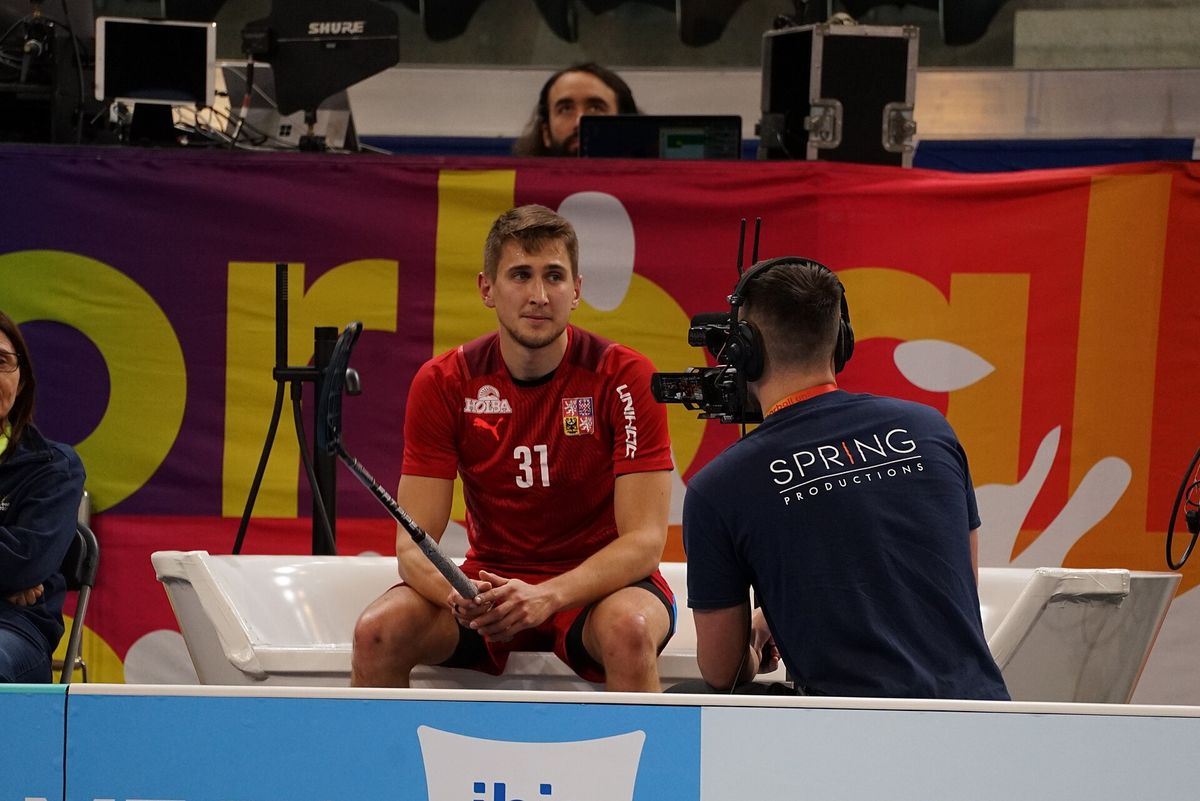
Josef Rýpar of the Czech Republic in the penalty box against Slovakia, 2022 World Championships.
Two minutes, as in ice hockey: a player off rather than a set piece conceded.
Albinfo · CC BY 4.0 · Wikimedia Commons
There is no video review in most competition, and no ball-tracking anywhere.
04Where it is played
Two countries dominate, four more compete, and the participation map is much wider than the results map.
Sweden and Finland are the sport. Both have substantially professional leagues, deep club structures, floorball in the school curriculum, and participation numbers that place it among the largest team sports in each country. Between them they have won almost every world championship contested, in both the men's and women's game.
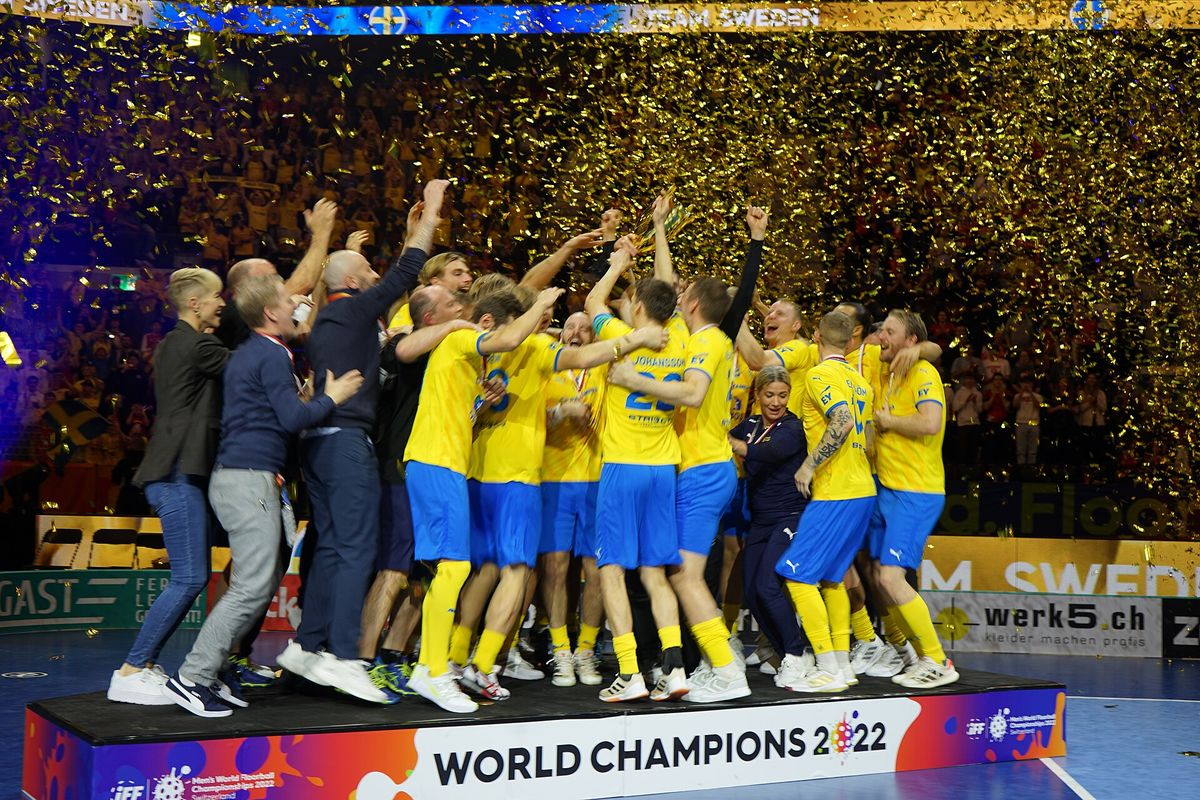
Sweden celebrating the 2022 world title in Zurich.
Sweden and Finland between them have won almost every world championship contested.
Albinfo · CC BY-SA 4.0 · Wikimedia Commons
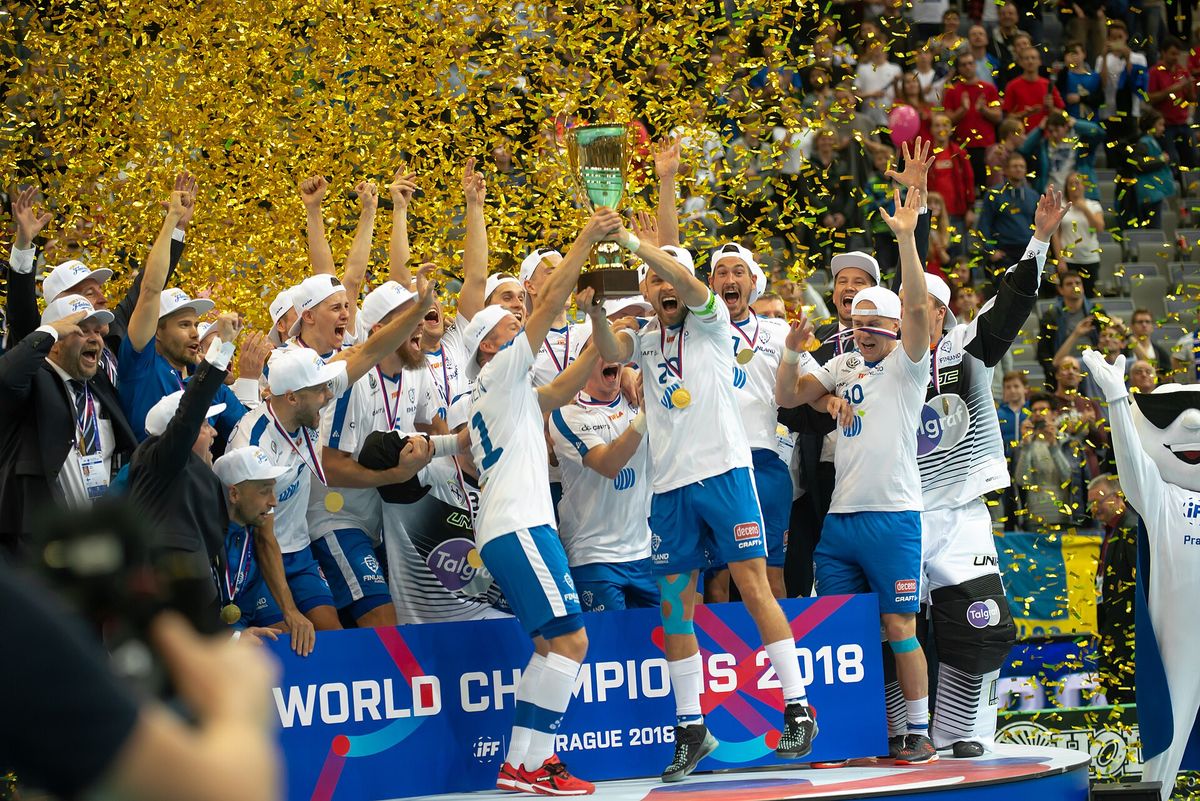
Finland with the trophy after beating Sweden in the 2018 world final, Prague.
The other half of the duopoly, beating the first half in the final.
Rolandhino1 · CC BY-SA 4.0 · Wikimedia Commons
The Czech Republic and Switzerland are the only consistent challengers, and Switzerland's involvement is foundational — it was one of the three associations that created the federation in 1986.
Beyond that core, floorball has real presence in Norway, Denmark, Latvia, Estonia, Germany and Poland, and a growing one in Asia — Singapore in particular has invested in it as a school sport, with Japan, Thailand and Malaysia also competing — as well as in Australia and New Zealand.
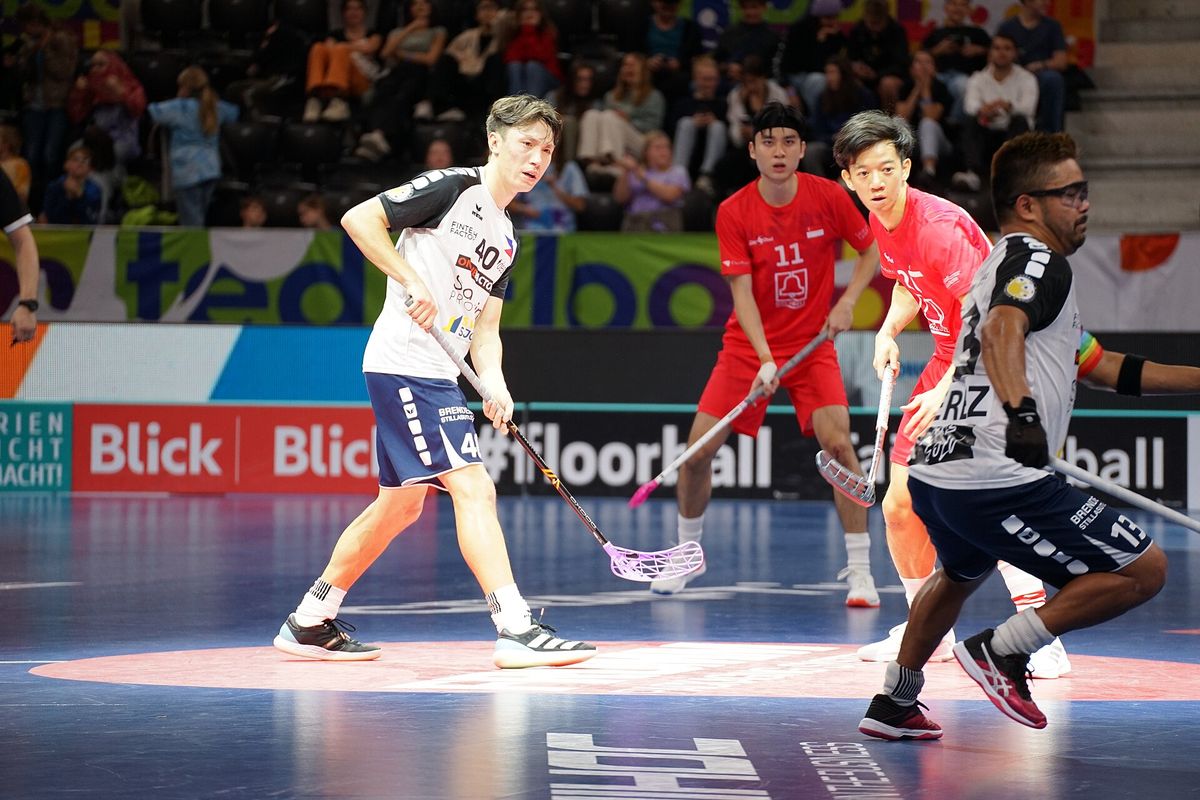
Singapore against the Philippines at the 2022 World Championships.
Singapore has invested in floorball as a school sport.
Albinfo · CC BY-SA 4.0 · Wikimedia Commons
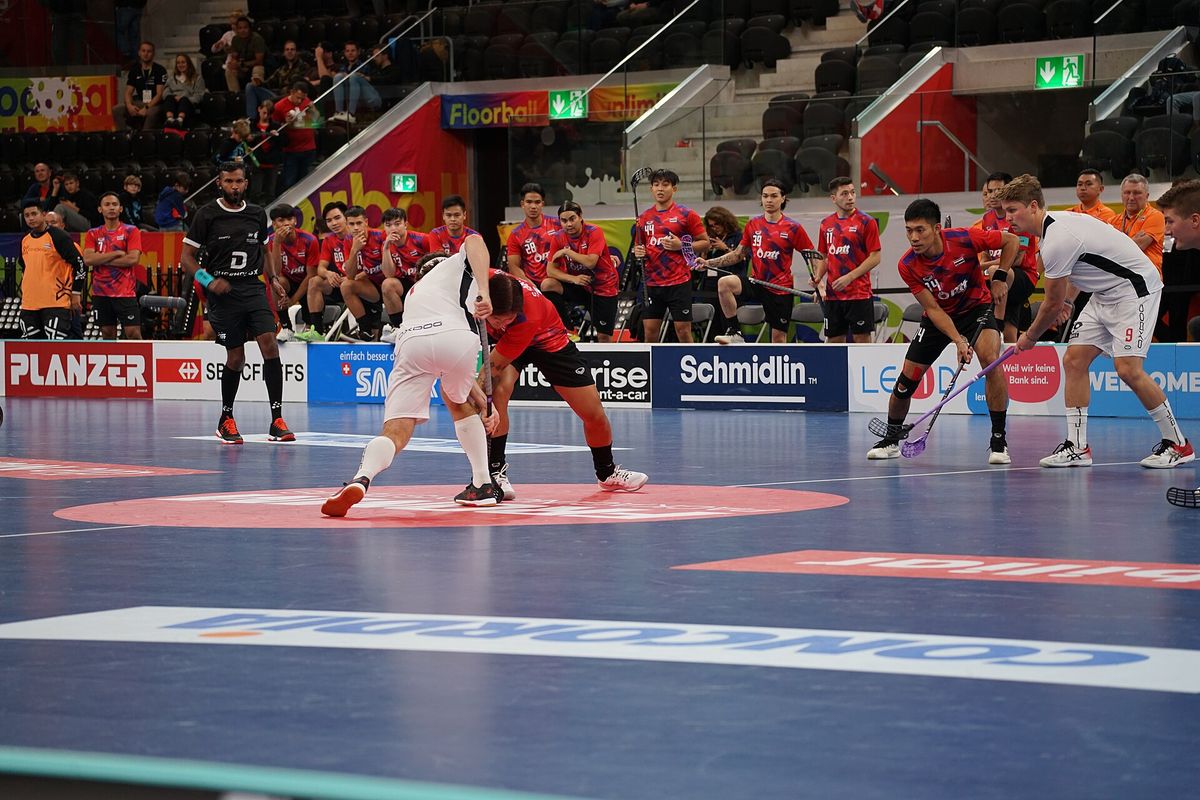
Canada against Thailand at the 2022 World Championships.
Two teams from outside the European core: the participation map is wider than the results map.
Albinfo · CC BY-SA 4.0 · Wikimedia Commons
The gap between participation and results is the sport's defining geographic feature. Floorball is played by very large numbers of people across a wide range of countries, because it is cheap, safe and fits in any sports hall. It is won by two. A federation making an international case has both of those facts to explain at once, and they point in opposite directions.
The reason for the concentration is not mysterious: Sweden and Finland are the only places where a floorball player can be a full-time athlete, so everyone good enough eventually plays there.
05Learning curve
Probably the easiest stick sport in the world to begin — a light stick, a light ball, no contact and a flat indoor floor — and a fast, high-skill game at the top that only two countries have ever really won.
Editorial — the site’s reading, not a sourced claim
Barrier to entry
How hard is it to get to a real game?
A sports hall, twelve people and a stick that weighs a third of a kilo.
Floorball was designed into school halls and it shows. The stick is light enough for a child to swing accurately, the ball is 23 grams and does not hurt, the floor is flat and indoors, and body checking is banned outright, so a beginner is never hit.
The rule that most helps beginners is the one capping the stick at waist height. It removes the dangerous swing that makes field hockey and ice hockey intimidating to learn, and it means a mixed-ability group can play together safely on the first attempt.
It is a genuine mass-participation school sport in Sweden, Finland, Switzerland and the Czech Republic for exactly these reasons, and the equipment cost is among the lowest of any team sport covered here.
Evidence
- Players needed12rule1986 — the rule this rests on
- StickAbout 350 gobserved
- ContactProhibitedrule1986 — the rule this rests on
- Stick heightNever above the waistruleRemoves the swing that makes the other stick sports frightening to learn.1986 — the rule this rests on
- Time to a real gameOne sessionestimate
Barrier to the top
How hard is it to be good at?
A continuous end-to-end game with no offside, played by full-time athletes in two countries.
Take away offside and the game never settles. Both teams can commit forward at any moment, the boards keep the ball live, and free hits restart play without letting a defence reorganise — so elite floorball is played at a sustained pace that requires rolling line changes to survive.
The technical ceiling is higher than the light equipment suggests. A shot generated entirely below waist height has to come from wrist and blade control rather than from a swing, and the sport's best players do things with a 23-gram ball on a blade — dragging, lifting, shooting on the turn — that have no equivalent in the heavier stick sports.
The goalkeeper is effectively a separate sport. No stick, kneeling, reading a shot that can come from anywhere and arrive with almost no wind-up.
What caps the ceiling is the sport's concentration. Sweden and Finland have professional or semi-professional leagues and have won almost everything; for a player anywhere else, the pathway leads to one of those two countries or stops.
Evidence
- No offsideNever adoptedruleThe game runs end to end with no structural pause.1986 — the rule this rests on
- Shot generated below the waistRequiredrulePower must come from blade and wrist control, not from a swing.1986 — the rule this rests on
- Goalkeeper without a stickKneeling, catching by handruleA position with no counterpart in any other stick sport.1986 — the rule this rests on
- Typical peak age23–31estimate
Why the two differ
Very low to high, and it is the sport on this site that most clearly gets both halves of the gap from the same decision.
Field hockey and ice hockey are hard to start because of the stick — a hard swing, a hard ball or puck, and contact. Floorball capped the stick at the waist, banned checking and used a hollow plastic ball, which removed the danger and therefore the barrier. That same cap is what makes the elite game technical rather than powerful: if you cannot swing, everything has to come from touch.
Set it against hockey, elsewhere on this site, which abolished its offside rule in 1998 to speed the game up. Floorball never had one to abolish, and arrived at the same continuous shape by not writing the rule in the first place.
The historyhow it got here · sections 6 to 10
06Origin and invention
Floorball began as school equipment and became a sport by accident.
Plastic floor hockey sets — light sticks and hollow balls, made for physical education classes — were manufactured in the United States and exported to Sweden in the late 1960s and early 1970s. They were toys for a gym lesson. What happened next did not happen in the country that made them: Swedish, Finnish and Swiss players started organising clubs and competitions around the equipment, and by the late 1970s each had a codified game.
The three codes were not the same. Rink sizes, team sizes and restart conventions differed, which meant three countries had independently invented closely related sports that could not play each other. The International Floorball Federation, formed in 1986 by the three national associations, exists because of that problem, and its founding job was to choose between them.
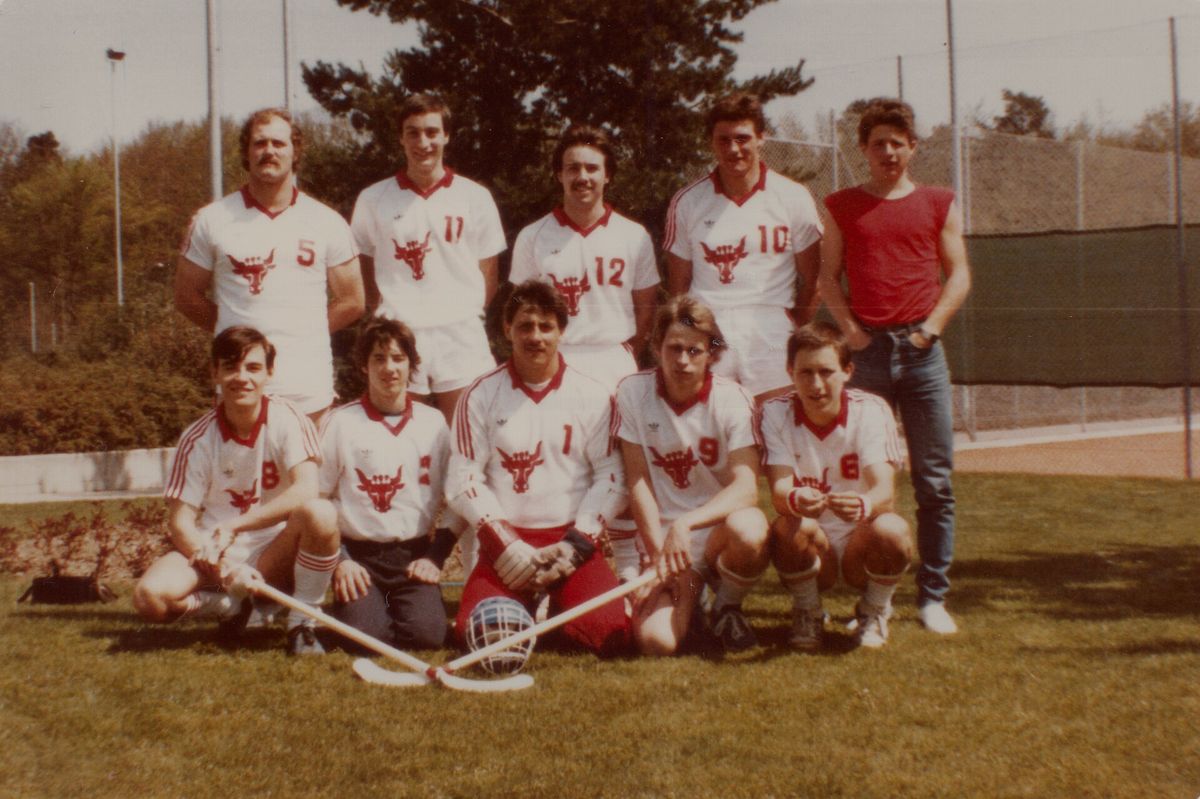
UHC Urdorf on the opening day of the first Swiss national league season, 6 November 1983, with their plastic sticks on the grass in front of them.
The team went on to win the first official Swiss championship in March 1984; Sweden's had begun in 1982. Each country had its own code before the federation existed.
The Floorballer · CC BY-SA 4.0 · Wikimedia Commons
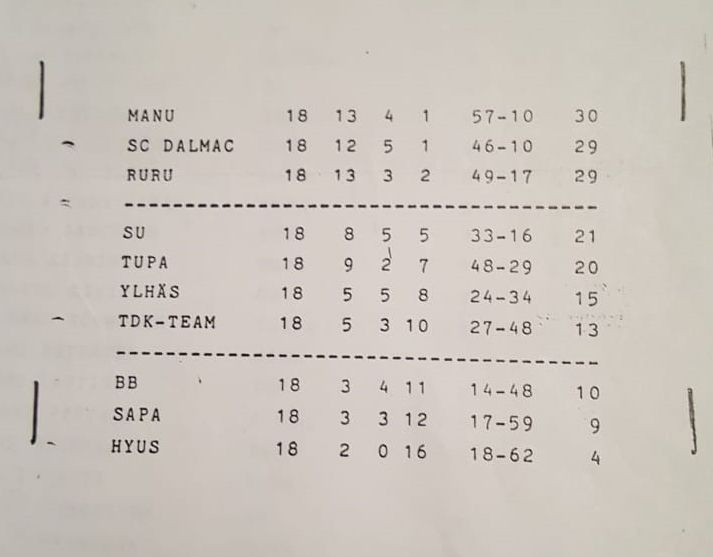
The final table of the first Finnish championship season, 1986–87.
Finland's first national championship season began in 1986, the year the Finnish, Swedish and Swiss associations formed the federation.
Japetus16 · CC BY-SA 4.0 · Wikimedia Commons
What it produced is the sport described here: five outfield players and a goalkeeper, a forty-by-twenty rink with low boards and rounded corners, three periods of twenty minutes, free hits rather than face-offs, and a stick that may never be raised above the waist.
Two of its decisions are the interesting ones. It gave the goalkeeper no stick, which no other stick sport has ever done. And it did not write an offside rule, which it has never added — field hockey abolished its own in 1998 and ice hockey still has one, while floorball simply never had the thing to remove.
The IFF received IOC recognition in 2011 and floorball joined the World Games programme in 2017. It has never been at an Olympic Games.
07Rule timeline
The sport’s own lane, expanded. Every entry carries a cause from the closed vocabulary and a citation, and says so where the citation is incomplete.
- 1986Fairness and eligibilityadopted 1986
The IFF was formed by the Swedish, Finnish and Swiss associations and produced one rulebook from three national codes: five outfield players and a goalkeeper, a rink of forty by twenty metres enclosed by low boards, three periods of twenty minutes, and a free hit rather than a face-off to restart after most stoppages. It also declined to adopt an offside rule, which the sport has never had. Field hockey abolished its own in 1998 and ice hockey retains one; floorball simply never wrote it, and the game's continuous, end-to-end shape follows from that.
Trigger and citationIncomplete — no confirmed article
Trigger
Three countries had developed the sport in parallel through the 1970s with different rink sizes, team sizes and restart conventions, and could not play each other.
IFF Rules of the Game · IFF Rules of the Game
- 1986Safetyalso fairness and eligibilityadopted 1986
The goalkeeper plays without a stick. They defend the goal from a kneeling position, catch and hold the ball with their hands, and return it to play by throwing. No other stick sport does this. An ice hockey or field hockey goalkeeper holds a stick and stands; a floorball goalkeeper is closer to a handball goalkeeper in what they do, in a sport where nobody else may touch the ball with their hands at all.
Trigger and citationIncomplete — no confirmed article
Trigger
The ball is light plastic and travels fast in a small rink. A kneeling, padded goalkeeper covering the lower part of a small goal with the body and hands was judged both safer and better matched to the goal's dimensions than a standing keeper with a stick.
IFF Rules of the Game · IFF Rules of the Game, the goalkeeper
- 1986Safetyadopted 1986
The stick may not be raised above the waist at any point — not on the backswing, not on the follow-through, and not when playing the ball. Body checking is prohibited outright, and a stick may not be lifted, held or struck. Together these make floorball a genuinely non-contact stick sport, which is unusual: field hockey permits far more, and ice hockey is built around contact. The restriction also caps shot power, because a shot must be generated from a low, controlled swing rather than a slap.
Trigger and citationIncomplete — no confirmed article
Trigger
A hard swing with a stick in a confined indoor rink, among players wearing no protective equipment, is a straightforward injury mechanism.
IFF Rules of the Game · IFF Rules of the Game, playing the ball and fouls
- 2011Participation and accessadopted 2011
The IFF received full IOC recognition, which confers standing to campaign for inclusion without conferring a place on any programme. Floorball has been on the World Games programme since 2017 and has never been at an Olympic Games.
Trigger and citationIncomplete — no confirmed article
Trigger
The federation had grown from three founding members to a large membership across Europe, Asia and Oceania, and sought the recognition that precedes any candidacy.
IFF Rules of the Game · IOC recognition, 2011
08Equipment evolution
The sport is named after a floor and defined by a ball with holes in it.
The ball is hollow plastic, 72 millimetres across, 23 grams, and pierced with 26 holes. The holes are aerodynamic rather than decorative: they cut air resistance and stabilise the flight, which is what makes a ball this light controllable at speed in a small hall. A solid ball of the same mass would be unusable. It is one of the more elegant pieces of equipment design on this site, and it came out of a toy.
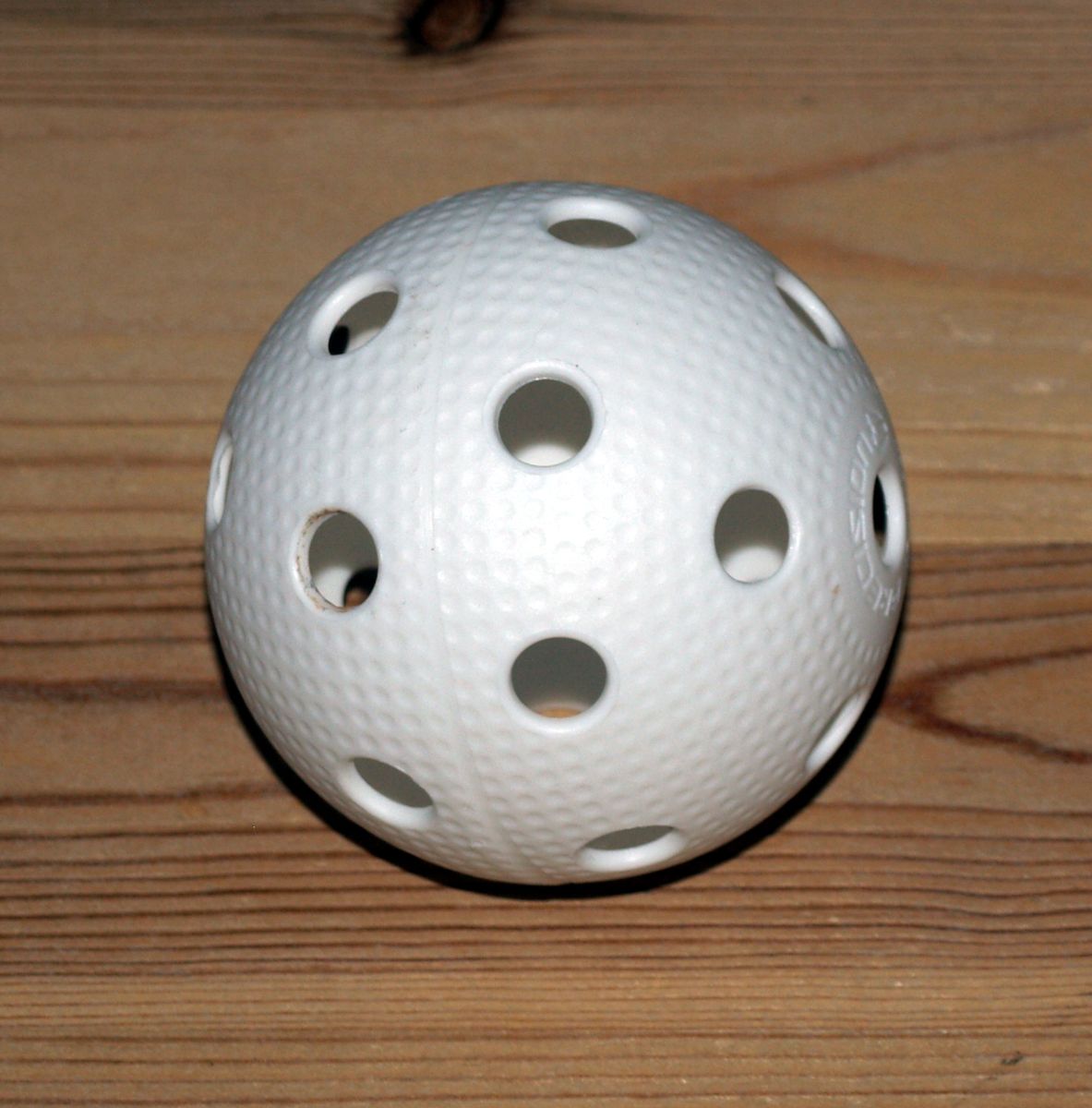
A floorball ball.
Hollow plastic, 72 millimetres, 26 holes: the holes steady a ball this light in flight.
Santeri Viinamäki · CC BY 4.0 · Wikimedia Commons
The stick weighs around 350 grams — roughly half a field hockey stick and much less than an ice hockey one — and is made of composite plastic. The blade's curve is limited by rule, which is the sport's equivalent of the bat and implement regulations elsewhere on this site: without a cap, a deeper curve would let a player lift and shoot the light ball in ways the rules did not intend.
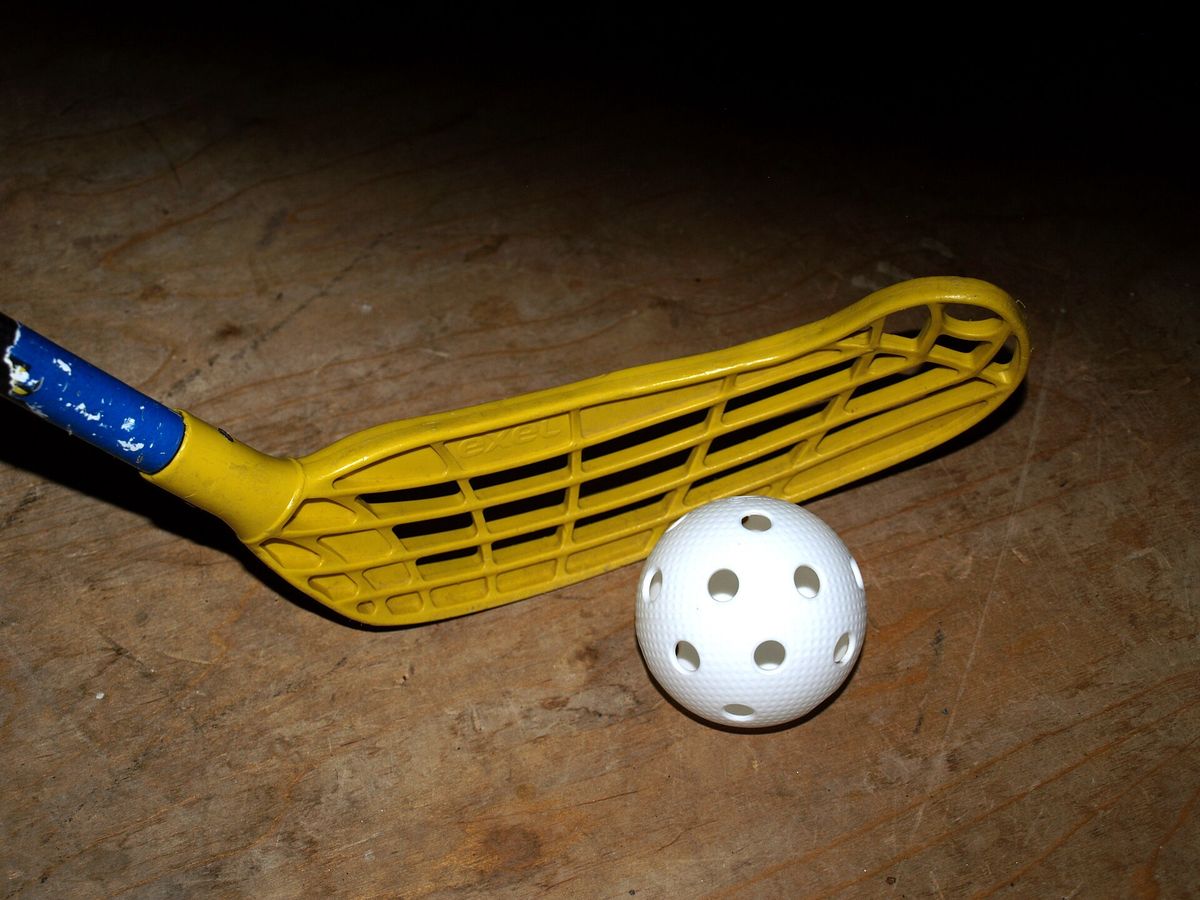
A floorball blade and ball.
A moulded plastic blade on a composite shaft. How deep it may curve is capped by rule.
Santeri Viinamäki · CC BY-SA 4.0 · Wikimedia Commons
The goalkeeper carries nothing. They wear padding, a helmet and gloves, and play from their knees, catching the ball and throwing it back into play. Every other stick sport hands its goalkeeper a stick — usually a specialised one — and floorball took it away.
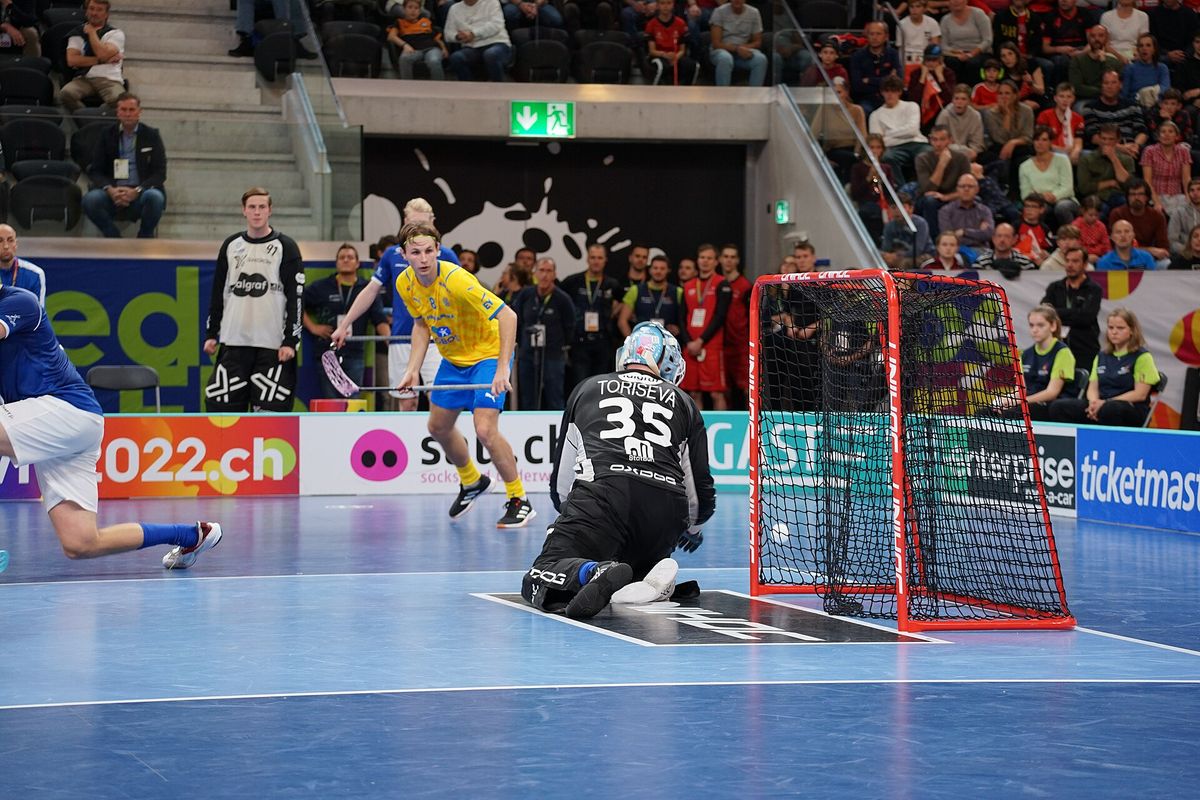
Finland's goalkeeper Lassi Toriseva on his knees in front of goal against Sweden at the 2022 World Championships.
Padding, helmet and gloves, and no stick: the only stick sport whose goalkeeper has none.
Albinfo · CC BY-SA 4.0 · Wikimedia Commons
Outfield players wear no protection at all. No pads, no gloves, no helmet, no mouthguard requirement in most competition. That is only possible because of the two rules that cap the sport's violence: no body checking, and no stick above the waist.
The rink itself is equipment. Boards fifty centimetres high with rounded corners keep the ball live and keep it moving, and the sport's continuous flow is as much a product of that geometry as of any rule about restarts.
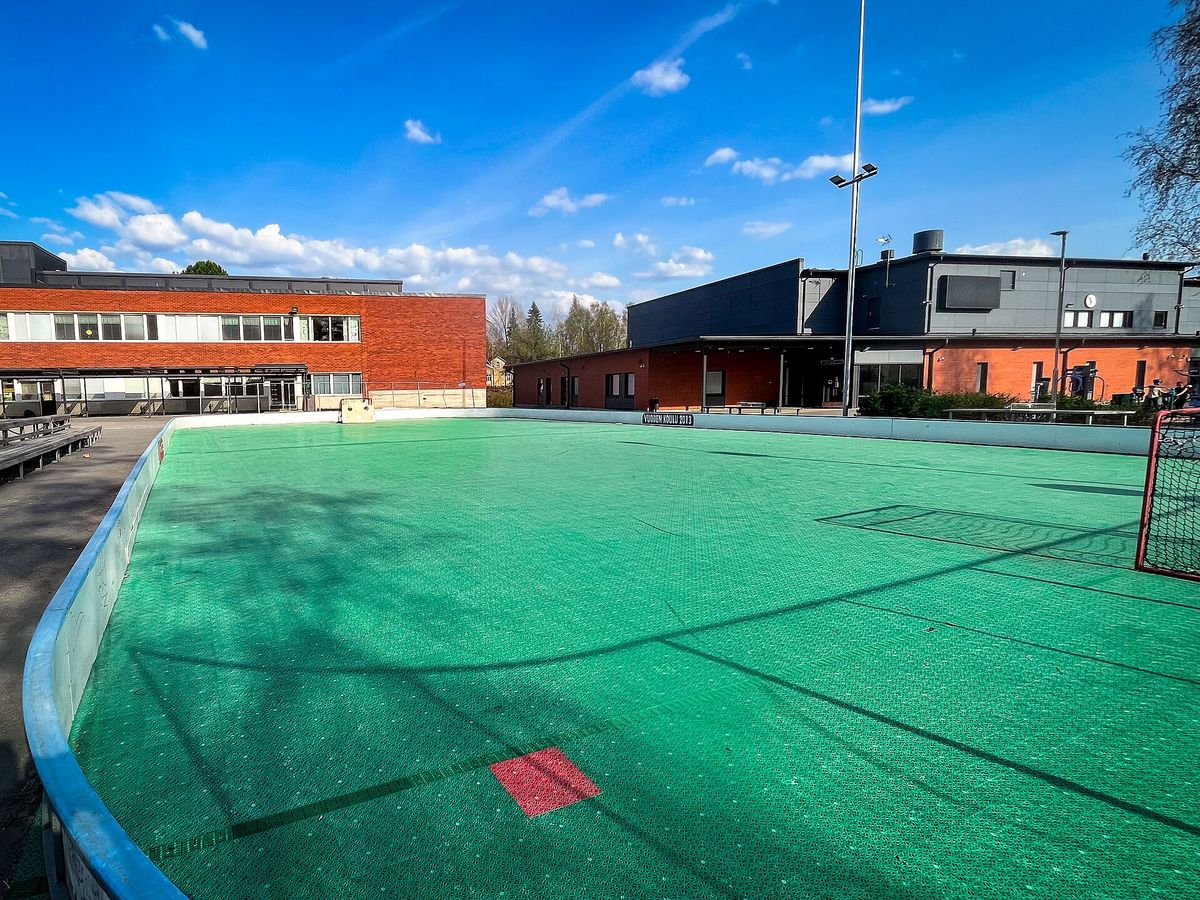
An outdoor floorball rink in the yard of Seinäjoki co-educational school, Finland, 2023.
Low boards with rounded corners: the geometry that keeps the ball live and the game moving.
Weisself · CC BY-SA 4.0 · Wikimedia Commons
09Governing body politics
The IFF has done everything a small federation is supposed to do, and it has not been enough.
It resolved three competing national codes into one rulebook in 1986. It grew from three founding members to a large international membership across Europe, Asia and Oceania. It obtained IOC recognition in 2011, joined the World Games programme in 2017, and runs men's and women's world championships in alternating years with genuine broadcast production in its core countries.
The obstacle is the one this site keeps recording for sports of this size, and in floorball's case it is unusually stark: the competitive concentration. Sweden and Finland have won almost everything the sport has ever offered, with the Czech Republic and Switzerland the only consistent challengers. A sport making a universality argument with those results has a problem it cannot argue its way out of.
The federation's response has been developmental rather than rhetorical — school programmes, small-sided formats, and growth in Asia, particularly Singapore, Japan and Thailand, and in Australia and New Zealand. Participation is genuinely broad. Elite results are not.
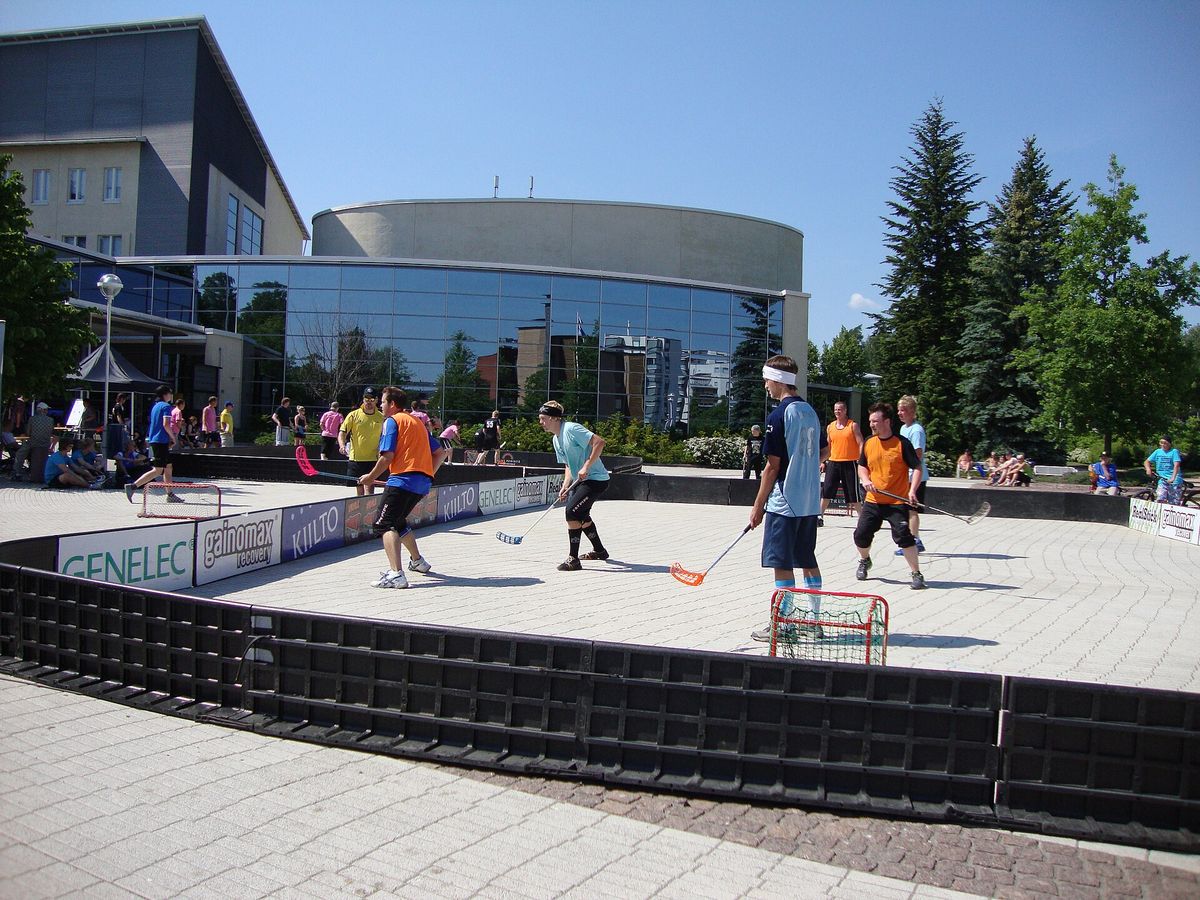
A street floorball tournament on Paasikivi Square, Finland, 2011.
Cheap, safe and small: a rink that fits in a town square, which is the federation's development argument.
Anneli Salo · CC BY-SA 3.0 · Wikimedia Commons
There is a second political question that floorball shares with the other indoor sports here: it competes for the same halls, the same school time and the same funding as handball, basketball and volleyball, all of which are already on the Olympic programme. A sport can be cheap, safe and popular in schools and still lose every argument about facilities to an incumbent.
10Controversies that forced rule changes
Floorball has had a legislatively quiet history, and the reasons are worth recording as much as the events.
The founding negotiation. Three national codes with different rink sizes, team sizes and restart conventions had to become one in 1986. Nothing about that was a scandal, but it was the moment the sport decided what it was, and several things that could have been in it — an offside rule, a goalkeeper with a stick, permitted body contact — were decided against then rather than removed later.
The blade curve. The one genuine equipment arms race the sport has had. A more deeply curved blade lets a player lift and shoot a very light ball with more control than the rules intended, and the permitted curve is capped and measured. It is a small version of the same problem the javelin, the swimsuit and the composite bat produced elsewhere on this site, caught early.
Waist height. The rule that makes the sport non-dangerous is also the rule players are most often penalised under, because a natural follow-through goes above the waist and has to be trained out. It is enforced strictly and is the commonest call in the game.
Concentration. Not a rule change but the sport's central competitive problem: two countries win everything. The IFF's format decisions — the structure of world championship divisions, promotion and relegation between them — are all responses to it, and none has changed the result.
What floorball has not had is a safety crisis, a doping scandal of any scale, or a schism. For a sport nearly forty years old with a large playing base, that is an unusually clean record, and it is largely because the founding rulebook removed the mechanisms that generate those problems elsewhere.
Where it standsthe record, and what is still open · sections 11 to 12
11Series
No series published
Goals per game
No goals-per-game series is entered for floorball, for the reason that recurs in every young sport on this site: the figures exist inside national leagues and nowhere in a form that compares across them. The Swedish and Finnish leagues are the only substantially professional competitions in the world, and a rate taken from either would describe that league rather than the sport. Rule 4 would require it to be labelled that way, which is the position football is in for the same reason. There is also very little to break a series against. Floorball's defining laws — no offside, no checking, the waist-height cap, the goalkeeper without a stick — were written into the 1986 rulebook and have not been reversed. A continuous series is genuinely possible here in a way it is not for gymnastics or badminton. It has simply never been published. What the sport does have, and this site records rather than charts, is a competitive concentration so extreme that a scoring rate would mostly measure how often Sweden and Finland played somebody else.
12What is contested now
Recorded as unsettled.
Whether two countries winning everything can be fixed. Sweden and Finland have taken almost every title the sport has offered. World championship division structures and development programmes are the federation's answers, and none has changed the outcome. Until it does, the universality argument required for Olympic inclusion is not available.
Olympic candidacy. IOC recognition since 2011, a World Games place since 2017, and no realistic route onto a programme where handball, basketball and volleyball already occupy the indoor team-sport slots. Whether to keep campaigning, or to consolidate as a school and club sport, is a genuine strategic question inside the federation.
Stick height enforcement. The rule that keeps the sport safe is also the one that penalises a natural follow-through, and how strictly it should be called is argued at every level.
The blade curve. Capped and measured, and manufacturers keep pressing against the limit. A sport with a 23-gram ball is unusually sensitive to what a blade can do to it.
Whether it should stop being called indoor hockey. Floorball is routinely described as a version of a sport it is not: no offside, no checking, a waist-height cap and a goalkeeper without a stick add up to a different game. The federation's naming and positioning problem is real, and it affects everything from broadcast framing to which national sports bodies will fund it.