Flag football
American football with the tackle removed — which turns out to change almost everything else.
- Official
- Flag football
- Game category
- Invasion
- Adjudication
- Decided by score
- Standing
- Added and kept
- rule changes
- 5
- comparability breaks
- 2
- Olympic edition
- 1
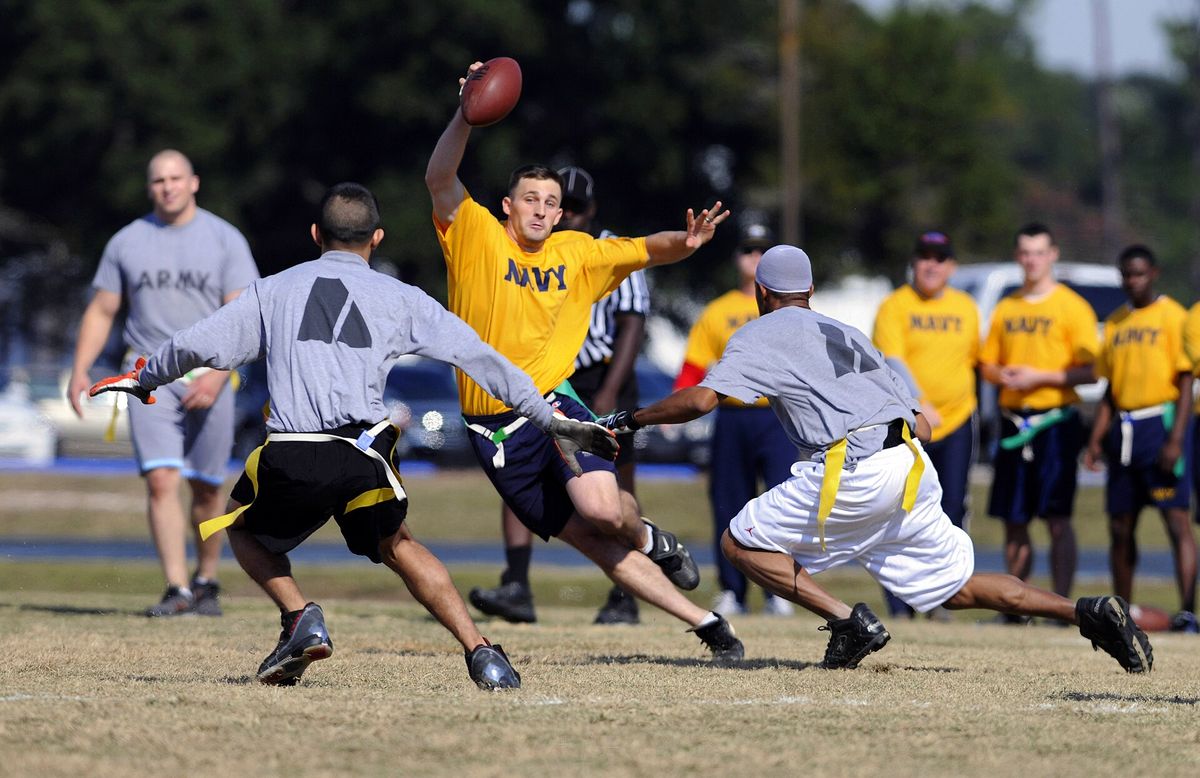
Two Army defenders reaching for the flags of a Navy quarterback at Corry Station, Pensacola, 2007 · Gary Nichols, U.S. Navy · Public domain
- Governing body
- IFAF
- Founded
- Played in the United States military from the 1940s as a non-contact form of American football; codified internationally by IFAF, with world championships from 2002 and Olympic inclusion for 2028.
- Olympic status
- 1 edition
- on the 2028 programme
- Also contested at
- No other programme here
Removing the tackle from American football was supposed to make it safe. It also removed the offensive line, the punt, the run-first playbook and the two-hundred-pound body type, and what is left is a five-a-side passing game that fits in a fraction of the space. Flag football is the newest sport on the 2028 programme and the only one whose founding rule is a subtraction.
The gamewhat it is now · sections 1 to 5
01How it is played
Five a side, twenty-minute halves, on a field a quarter the size of an American football pitch. No tackling, no blocking, no kicking of any kind. A ball carrier is down when someone pulls a flag off their belt.
These figures were entered from the edition named above but have not been checked against its text line by line. Treat them as this site’s reading of the laws, not as a substitute for them.
The object of the game
Advance the ball into the opponent's end zone. The offence has four downs to reach the halfway line and, having reached it, four more to score.
Because there is no punt and no field goal, a failed drive simply hands the ball over where it lies. Every possession ends in a touchdown or a turnover, which is why the game is played at the pace it is.
This clause reads this way because of
The field
Fifty yards by twenty-five, with ten-yard end zones at each end — about a quarter of the area of an American football field.
Five yards before each first-down line, and five yards before the end zone, sit the no-run zones. Inside them the offence must pass.
- Field of play
- 50 × 25 yd
- End zones
- 10 yd each
- No-run zones
- 5 yd before the halfway and goal lines

Soldiers playing flag football on Audi Field, Washington, after an XFL season opener, 2020.
The flag field is smaller than this one: fifty by twenty-five yards, with ten-yard end zones.
Sgt. Nicholas T. Holmes, U.S. Army · Public domain · Wikimedia Commons
Equipment
A belt carrying two flags on each hip, and a ball. No helmet, no pads, no protective equipment of any kind, because there is nothing to protect against.
Flags must detach cleanly, which sounds trivial and is the most disputed piece of equipment in the sport: a flag that is tucked, held or tightened changes whether a defender can end a play.
- Flags
- Two per player, one on each hip
- Protective equipment
- None
- Ball
- Smaller than an eleven-a-side ball
This clause reads this way because of
Players and officials
Five a side, with rolling substitutions between plays. There is no offensive line, so there is no position that exists to absorb contact, and every player on the field is eligible to receive a pass.
That is the deepest consequence of removing the tackle: the sport has no use for size. The body type of a flag football player is a sprinter's.
- On the field
- 5
- Roster
- Up to 12
- Eligible receivers
- Every player
This clause reads this way because of
Time
Two halves of twenty minutes, with a running clock that stops only in the final two minutes of each half and for specified events. A whole match is shorter than one quarter of an eleven-a-side game.
- Halves
- 2 × 20 min
- Clock
- Running, except the last two minutes
- Play clock
- Typically 25 s
This clause reads this way because of
Scoring
A touchdown is six points. The conversion is a single play from one, five or ten yards out, worth one, two or three points respectively — the three-point conversion has no equivalent in any other football code and makes a two-score deficit recoverable in a way the eleven-a-side game does not.
A defence that intercepts a conversion attempt and returns it scores. There are no field goals.
- Touchdown
- 6
- Conversion
- 1, 2 or 3 points, by distance
- Safety
- 2
- Field goal
- Does not exist
This clause reads this way because of
Starting and restarting
No kick-off. Play begins with the ball on the offence's own five-yard line, and every change of possession does the same. The snap is from the ground or between the legs to a quarterback who must release the ball within a short count.
This clause reads this way because of
Infringements
Flag guarding — using a hand, arm or the ball to shield a flag — is the offence that keeps the sport non-contact from the ball carrier's side. It is called constantly and is the most argued call in the game.
Blocking, screening with contact, diving to advance the ball, and stripping the ball are all prohibited. So is contact by a defender making a flag pull.
This clause reads this way because of
Deciding the winner
More points at full time. A tie is resolved by alternating single plays from the five-yard line, each team getting the same number of attempts — a shoot-out with no kicking in it.
Everything above is current law. Everything below is how Flag football got here.
02Disciplines and events
Two Olympic events, both new for 2028, in a sport that has never previously appeared at a Games. Men's and women's tournaments, five a side.
- Disciplines
- 1
- Olympic medal events
- 2
- Men’s and women’s counted separately.
- Contested elsewhere
- 2
- world championship, federation only.
- Listed for context
- 1
- Not counted as this sport.
Flag football2
Five a side, 50 × 25 yards, no contact and no kicking.
- Men's tournamentNew for 2028.
- Women's tournamentNew for 2028.
Governed by the same federation, not on the programme2
- American footballWorld championshipThe eleven-a-side tackle code; IFAF governs it internationally and it is not proposed for any Games.
- Seven and eight-a-side flagFederation onlyPlayed domestically in several countries under national rules.

United States players with their medals at the 2023 IFAF Americas Continental Flag Football Championship.
Continental and world championships, and from 2028 an Olympic tournament for women and for men.
USA Football · CC BY 3.0 · Wikimedia Commons
03Officiating
Flag football's officiating problem is the inverse of most sports on this site. Elsewhere officials judge whether contact was excessive. Here they judge whether contact happened at all, and the threshold is very low.
The defining calls:
Flag guarding. Did the ball carrier use a hand, an arm, or the ball to prevent a defender reaching the flag? A runner's arms move. Deciding when natural motion becomes a shield is a judgement made in a fraction of a second and it decides possessions.
The pull. Was the flag pulled cleanly, or did the defender make contact with the body first, or hold the runner, or pull an already-detached flag? A flag that falls off on its own leaves the runner down where it fell, which means an equipment failure is adjudicated as a play.
Two Army defenders reaching for the flags of a Navy quarterback at Corry Station, Pensacola, 2007.
Was the flag pulled cleanly, or was the runner touched first? A judgement about whether contact happened at all.
Gary Nichols, U.S. Navy · Public domain · Wikimedia Commons
The line of scrimmage and the no-run zone. Where the ball was when it was thrown, and whether a run began inside a no-run zone, are positional judgements on a small field with a running clock.
There is no scrum of bodies to see through, which makes the game easier to officiate than tackle football. There is also no protective equipment absorbing marginal contact, which makes the standard stricter. Elite competition uses video review sparingly; the sport is too young to have settled what it should be used for.
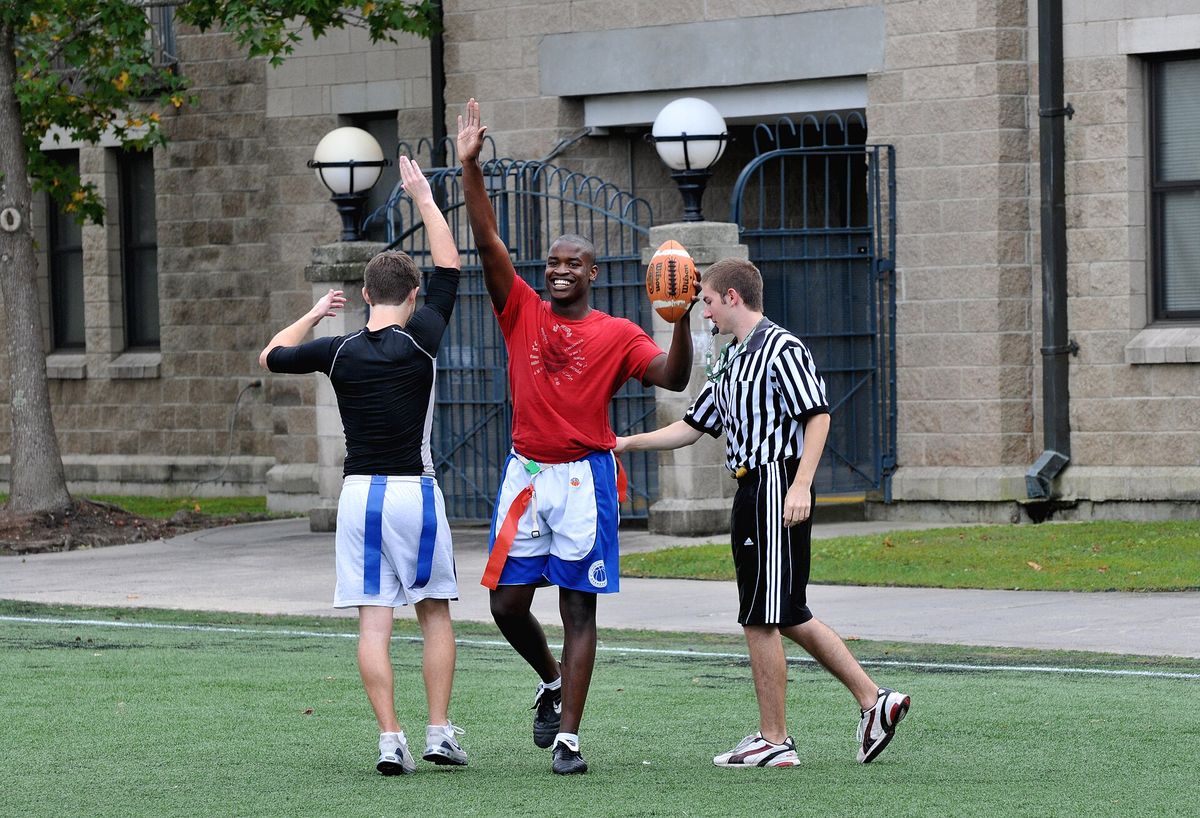
An intramural touchdown celebration at Tulane University, 2009, the referee beside the scorer.
No pile of bodies to see through, and no padding to absorb marginal contact.
Tulane Public Relations · CC BY 2.0 · Wikimedia Commons
04Where it is played
Flag football's map is wider than American football's and still centred on the same place.
The United States is the largest playing base by a distance, through school, collegiate, park and league play, and the National Football League's youth programmes push the format directly. Mexico is the strongest challenger and has been for years — Mexican teams have won world championships and the sport has a domestic depth there that predates any Olympic interest.
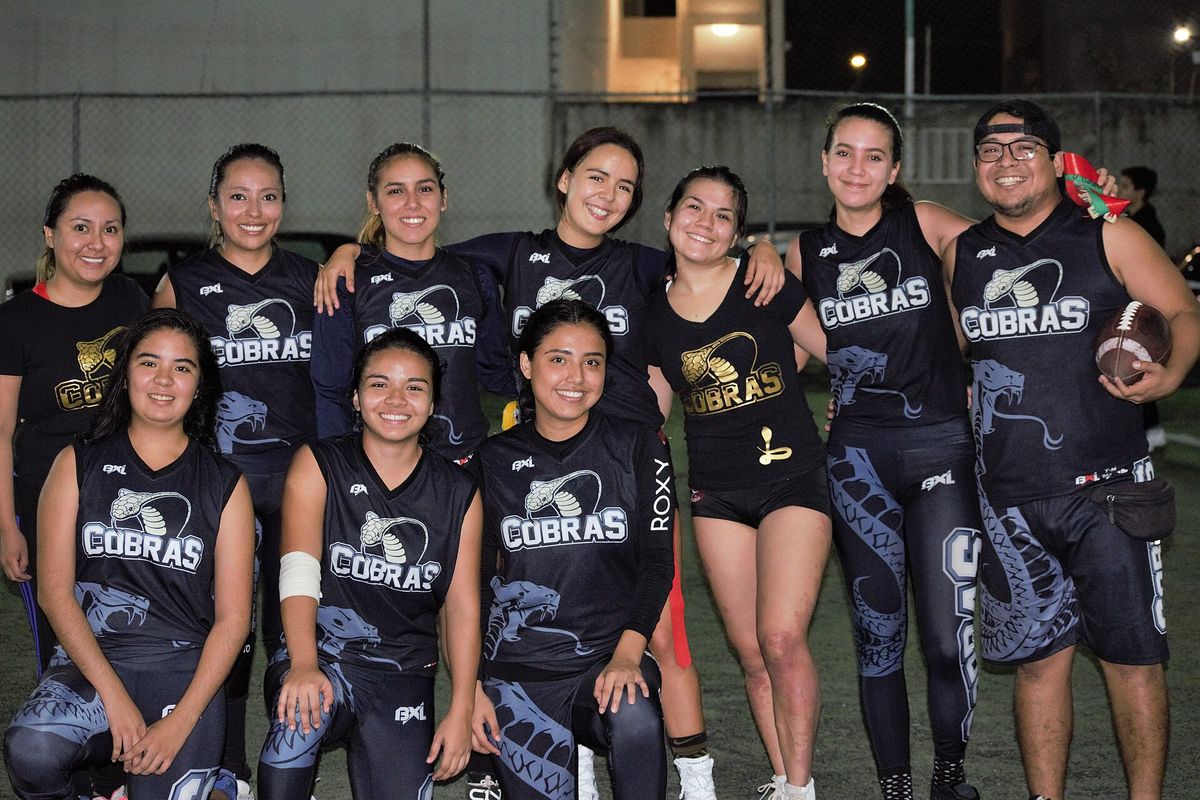
The women's team of Cobras Cancún after their first win of the 2019 season.
Mexico's domestic depth, which predates the Olympic interest.
Edison20 · CC BY-SA 4.0 · Wikimedia Commons
Beyond those two, Panama, Austria, Italy, Israel, Japan and Canada have been competitive at world level, which is a more scattered list than most invasion sports produce. That scatter is the product of the format: a country needs a patch of grass and twenty belts, so the sport spreads where somebody enthusiastic starts it rather than where infrastructure exists.
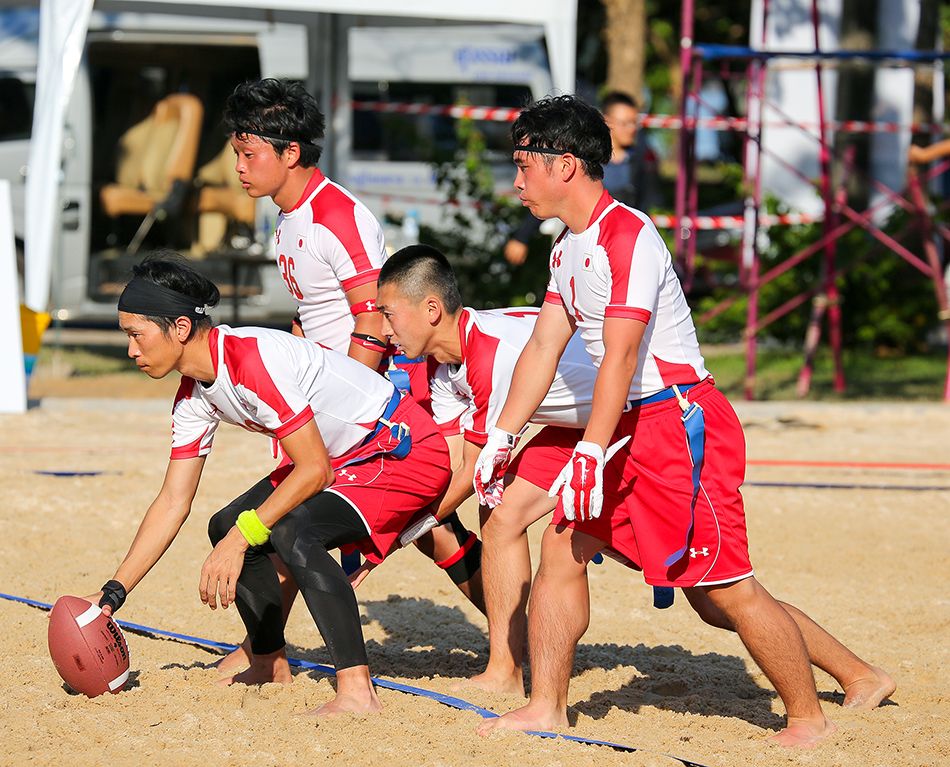
A Japanese team at the snap in a beach flag football game, Phuket.
Japan is among the scattered list of countries competitive at world level; this is the sand variant of the game.
Phuket@photographer.net · CC BY 2.0 · Wikimedia Commons

The Laski flag football team of Petrozavodsk, Russia, 2017.
A patch of grass and a set of belts: the sport spreads wherever somebody starts it.
Gunners 27 · CC BY-SA 4.0 · Wikimedia Commons
The women's game is unusually close to the men's in institutional terms, because both were codified at the same time and neither carries a century of exclusion. Los Angeles 2028 contests both tournaments, on the same format, with the same number of teams.
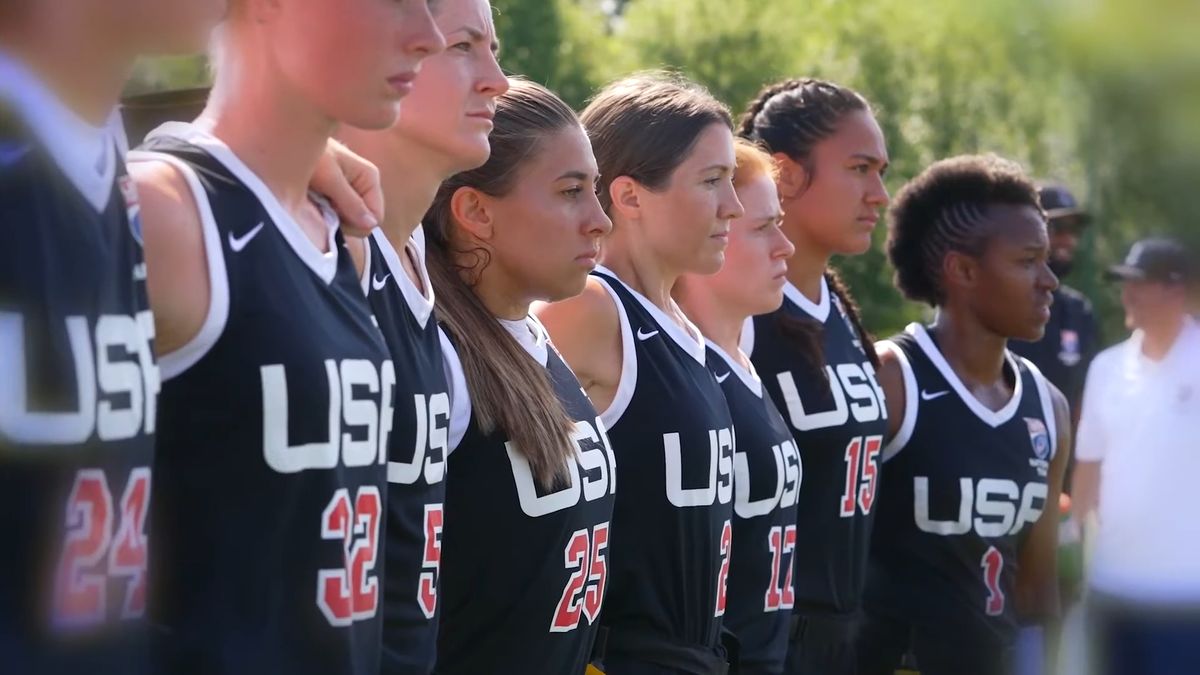
The United States women's team lined up at the 2023 IFAF Americas Continental Flag Football Championship.
The women's game was codified alongside the men's, and Los Angeles 2028 contests both on the same format.
USA Football · CC BY 3.0 · Wikimedia Commons
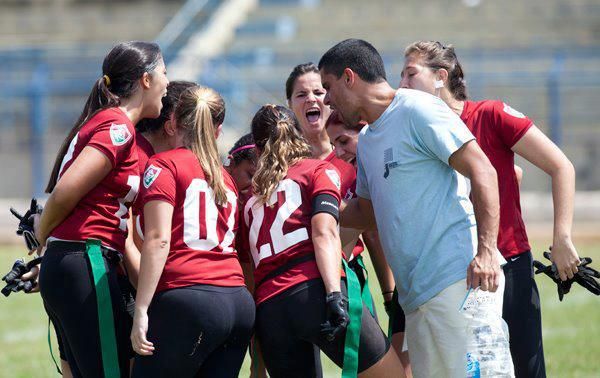
Fluminense Guerreiras celebrating in a Brazilian five-a-side flag final against SP Storm.
The women's club game in Brazil, played to the same five-a-side format.
Vanessa Yorio · CC BY-SA 3.0 · Wikimedia Commons
What flag football does not yet have anywhere is a professional layer. The pathway from a national team place to a living is short and mostly runs through another sport.
05Learning curve
The easiest sport on this site to start, because it was designed to be, and much harder than it looks at the top, because with the collision removed the game becomes almost entirely about reading space in the first two seconds.
Editorial — the site’s reading, not a sourced claim
Barrier to entry
How hard is it to get to a real game?
A belt, a ball, a small field, ten people. No equipment and nothing that hurts.
Flag football exists because American football's barriers were removed one at a time. There is no protective equipment to buy, no contact to be frightened of, no full-size field to find, and a match takes forty minutes.
Five a side means ten people make a game, and rolling substitution means an uneven number still does. Every player is an eligible receiver, so a beginner is never assigned to a position whose job is to be hit.
What stops it being trivially easy is that the offence runs plays: even at a casual level someone must call something and four people must know what it means.
Evidence
- Players needed10rule2002 — the rule this rests on
- Kit to startA belt with flags and a ballobserved
- Protective equipmentNonerule1940 — the rule this rests on
- Match length40 minrule2002 — the rule this rests on
- Time to a real gameOne sessionestimate
Barrier to the top
How hard is it to be good at?
A passing game with no line to hide behind, decided in about two seconds.
Take away the tackle and you take away the offensive line, which is the thing that buys an American football quarterback time. In flag football the rush arrives almost immediately, the read must be made before it does, and there is no version of the play where a passer survives by being protected.
The defensive equivalent is that a flag pull is a precision act performed at a sprint by someone who is not allowed to touch the ball carrier's body. It is harder than a tackle, not easier: a tackle can be imprecise and still work.
The no-run zones and the tiered conversion make the game unusually strategic for its length — the choice of a one, two or three-point conversion is a live decision several times a match.
The ceiling is lower than most sports here for one reason: the elite competitive history is short. The international format dates from 2002 and the sport has never been at a Games.
Evidence
- No blockingSince inceptionruleNo offensive line, so no protection for the passer.1940 — the rule this rests on
- No-run zones5 ydruleThe short-yardage play must be a pass, which removes the last refuge of mass.2002 — the rule this rests on
- International formatSince 2002ruleA short elite history compared with every other sport on this site.2002 — the rule this rests on
- Typical peak age22–30estimate
Why the two differ
Very low to high — the widest ratio on this site between how easy a sport is to start and how demanding it is at the top, and the only case where that gap was engineered rather than inherited.
Every other sport here arrived at its entry barrier by accident of history. Flag football's low barrier is the product: the tackle, the equipment, the field size, the squad size and the kicking game were removed deliberately so that people could play. What remained turned out to be a fast, spatial, read-and-react game that rewards a different athlete entirely from the one American football rewards.
It is also the sport with the shortest professional pathway on this site, which flattens the top of the curve. That will change if the 2028 Games do what its federation expects.
The historyhow it got here · sections 6 to 10
06Origin and invention
Flag football is American football with one thing taken out, and it was taken out by the United States military.
American football was played as recreation on military bases through the 1930s and 1940s, and it produced the injuries it produces everywhere. Injured servicemen were a cost the war effort would not carry, so bases played a version in which a ball carrier was down when a flag was pulled from a belt rather than when they were knocked over. The game is generally credited to Fort Meade, Maryland, in the early 1940s, and it spread through the services.
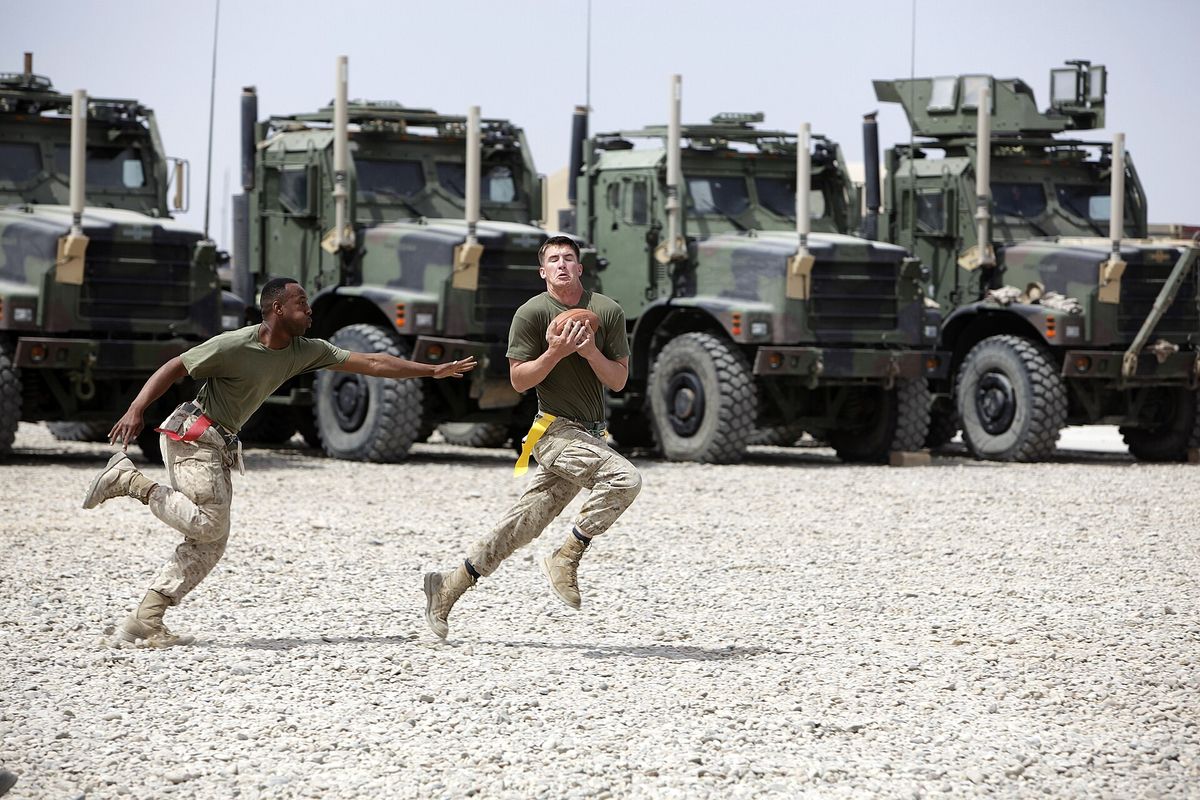
U.S. Marines of Combat Logistics Company 28 playing flag football between their trucks at Camp Dwyer, Helmand province, Afghanistan, 2013.
Seventy years after the Second World War bases, the military game is still played the same way: in belts, on whatever ground there is.
Sgt. Anthony Ortiz, U.S. Marine Corps · Public domain · Wikimedia Commons
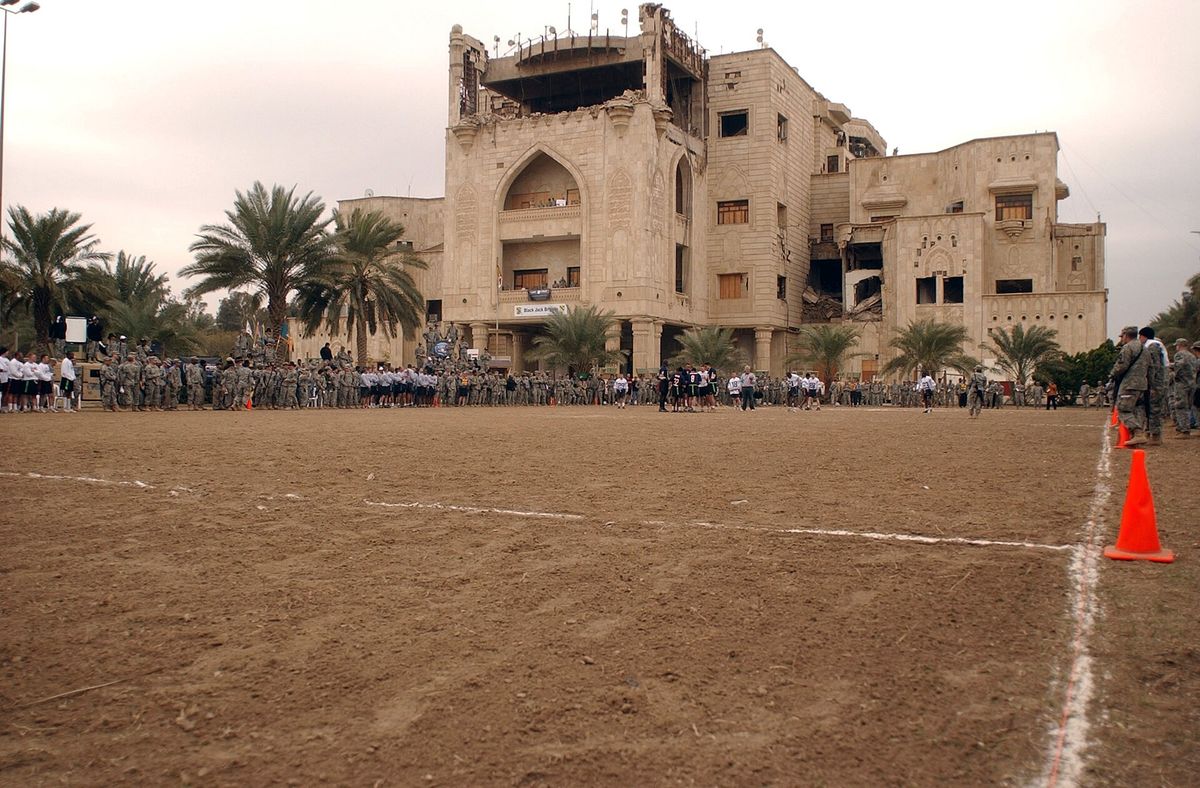
Soldiers of the 1st Cavalry Division lining a dirt field at Al Salam Palace, Baghdad, for the 2007 Baghdad Bowl flag football game.
A game that needs no pads and no stadium, played where the servicemen are.
Staff Sgt. Sean A. Foley, U.S. Army · Public domain · Wikimedia Commons
It came home with the servicemen. Through the second half of the twentieth century flag football existed in the United States as intramural, school, church league and park sport, in a dozen incompatible local codes: four a side, seven a side, eight a side, with blocking and without, on fields of whatever size was available.
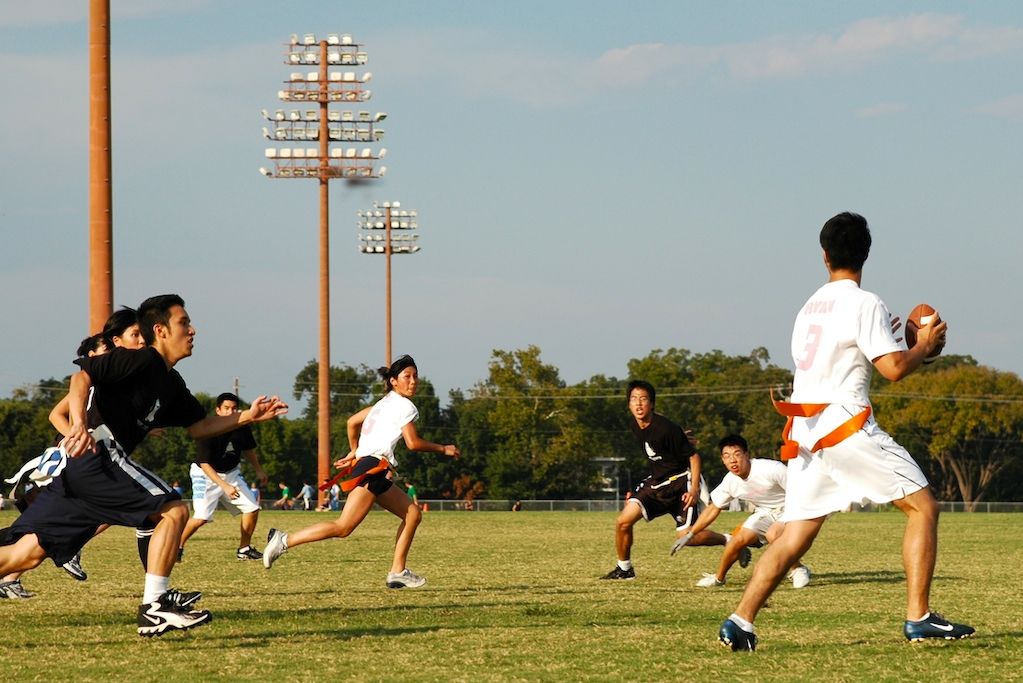
An intramural flag football game at the University of Texas at Austin, 2006.
Intramural, school and park sport: where flag football lived in the United States for half a century, in local codes.
Enoch Lai · CC BY-SA 3.0 · Wikimedia Commons
International codification is recent. IFAF ran the first world championship in 2002, and the five-a-side format on a fifty-by-twenty-five-yard field was written to be exportable — a game a country with no American football infrastructure could adopt.

A United States player carrying the ball at the 2023 IFAF Americas Continental Flag Football Championship.
The five-a-side international format, written to be exported.
USA Football · CC BY 3.0 · Wikimedia Commons
The 2023 decision to include it at Los Angeles 2028 makes it the newest sport on the programme by a wide margin, and the only one whose founding rule is a subtraction.
07Rule timeline
The sport’s own lane, expanded. Every entry carries a cause from the closed vocabulary and a citation, and says so where the citation is incomplete.
- 1940Safetyalso participation and accessadopted 1940
A ball carrier is down when a flag is pulled from their belt, not when they are tackled. Blocking below the waist, and eventually blocking with contact at all, went with it. Everything downstream follows. With no tackle there is no need for an offensive line to protect a passer by force, no reward for mass, and no scrum of bodies at the line of scrimmage — so the game became a passing game played by small fast people.
Comparability break · Scoped to one competition
The flag pull replaces the tackle. Nothing in tackle football's record is comparable with what follows. See the series
Trigger and citationIncomplete — no confirmed article
Trigger
American football was played in the United States military during the Second World War as recreation, and injuries to servicemen from a contact game were an unacceptable cost. The flag replaced the tackle so the game could be played without removing men from duty.
IFAF Flag Football Competition Rules · IFAF Flag Football Competition Rules, definitions
- 2002Participation and accessalso broadcast and pacingadopted 2002
The international format is five a side on a field 50 yards by 25, with 10-yard end zones — roughly a quarter of the area of an American football field, for less than half the players. Twenty-minute halves and a running clock stopped only in the last two minutes make a whole match shorter than one quarter of the eleven-a-side game.
Trigger and citationIncomplete — no confirmed article
Trigger
A sport that needs a full-size field, eleven a side, protective equipment and a squad of forty cannot be adopted by countries without that infrastructure. The five-a-side format was written to be exportable.
IFAF Flag Football Competition Rules · IFAF Flag Football Competition Rules, field and team
- 2002Fairness and eligibilityalso safetyadopted 2002
In the five yards before each first-down line and before the end zone, the offence may not run the ball. It must pass. Without this the short-yardage play would be a quarterback sneak behind a wall of bodies, which is the one situation where mass would still win in a game designed to remove that advantage.
Comparability break · Scoped to one competition
The international five-a-side code, with no-run zones, supersedes a family of local formats that scored differently. See the series
Trigger and citationIncomplete — no confirmed article
Trigger
A no-contact game still rewards a pile of players pushing forward one yard. The no-run zone removes the last place where that tactic worked.
IFAF Flag Football Competition Rules · IFAF Flag Football Competition Rules, no-run zones
- 2002Safetyalso broadcast and pacingadopted 2002
There is no kicking of any kind: no punt, no field goal, no kick-off. A team that fails to advance simply turns the ball over where it stands, and a conversion after a touchdown is a play from one, five or ten yards for one, two or three points.
Trigger and citationIncomplete — no confirmed article
Trigger
Kick-offs and punt returns are the plays in American football with the highest injury rate, because they are the only ones with players running at full speed into each other from a distance. A sport built to remove collisions removed those plays entirely rather than regulate them.
IFAF Flag Football Competition Rules · IFAF Flag Football Competition Rules, scoring and possession
- 2028Commercialalso participation and accessadopted 2023-10
Flag football was added to the Los Angeles 2028 programme as a host-city proposal, with men's and women's tournaments, having never previously appeared at a Games.
Trigger and citationIncomplete — no confirmed article
Trigger
The proposal was made by the Los Angeles organisers and backed by the National Football League, which stands to gain an international showcase for a game whose eleven-a-side form cannot be exported.
IFAF presents the inclusion as recognition of a genuinely global amateur sport. Both readings are recorded: a host city added a sport whose commercial sponsor is domestic, and the sport does have a world championship dating from 2002.
IFAF Flag Football Competition Rules · IOC Session decision, Mumbai, October 2023
08Equipment evolution
The equipment story here runs backwards. Every other sport on this site added protective equipment as it discovered what it was doing to its players. Flag football removed the injury and then removed the equipment.
American football's helmet and pads exist to make collisions survivable, and they have the well-documented second-order effect of making collisions more frequent, because a padded player will hit in ways an unpadded one will not. Flag football has neither, and needs neither, because contact is illegal rather than cushioned.
What is left is a belt. It carries two flags, one on each hip, attached so that they detach cleanly under a pull. This is a more consequential piece of equipment than it sounds: a flag that is tucked into shorts, held down, worn too tight or attached at the wrong angle changes whether a defender can end a play at all, and tampering with it is an offence.
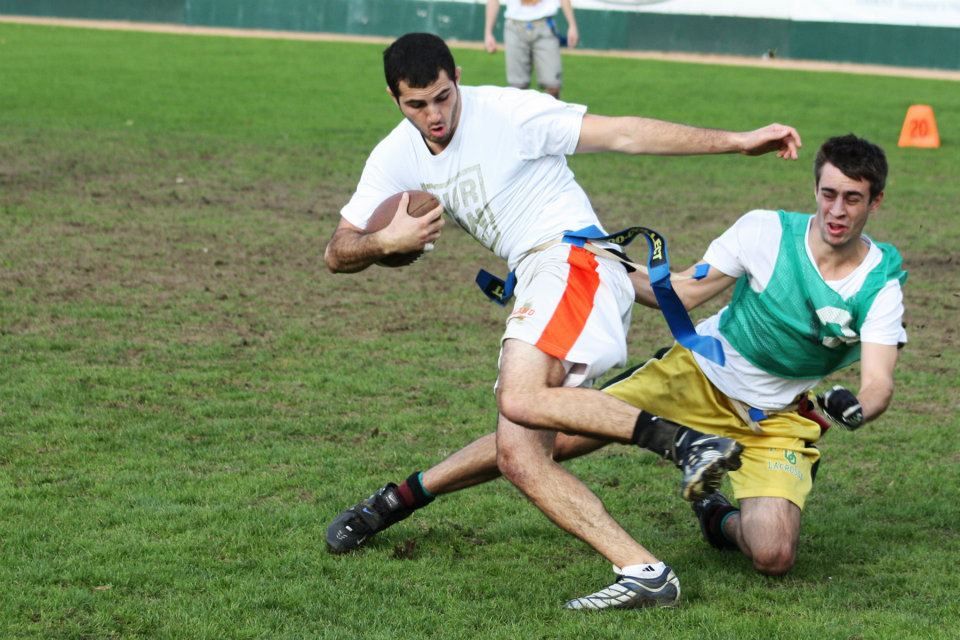
A ball carrier twisting away from a defender's grab, both wearing flag belts.
Two flags on a belt, one on each hip: the whole of the protective equipment, and the thing a defender has to reach.
JJ Hohorst · CC BY-SA 3.0 · Wikimedia Commons
The ball is smaller than the eleven-a-side ball, which matters because everything is a pass and hands vary. Uniforms must not have anything a flag can catch on, and shirts must be tucked, for the same reason.
The absence of a kicking game means the sport has no kicking tee, no goalposts, and no equipment associated with the plays that injure most people in the eleven-a-side game.
09Governing body politics
The politics of flag football are the politics of American football's international ambitions.
IFAF, the international federation, governs both the tackle code and the flag code. Its tackle code cannot be exported: it requires a large field, forty players, protective equipment for all of them, and a medical infrastructure that most national federations do not have. Its flag code needs a belt.
So the flag game became the vehicle. IFAF pursued Olympic recognition on the back of a format explicitly designed for countries with no American football tradition, and the National Football League backed the campaign — a professional league in one country funding the Olympic candidacy of a variant its own competition does not play.
The federation has had its own difficulties. IFAF spent much of the 2010s in a leadership dispute serious enough to produce two competing bodies claiming the same name and holding rival congresses, resolved only in the following years. An Olympic campaign conducted from that position was not obviously going to work.
It worked in 2023, as a host-city proposal from Los Angeles. That mechanism — the host organising committee proposing additional sports — is the same one that brought karate in for Tokyo and dropped it afterwards, and it carries no commitment beyond the single Games.
10Controversies that forced rule changes
The pile at the goal line. A game with no tackling still rewarded shoving a ball carrier forward one yard behind a wall of bodies, which was both a contact play and the exact tactic the sport was meant to eliminate. The no-run zone — five yards before every first-down line and before the end zone, inside which the offence must throw — removed it. It is the most artificial rule in the sport and the clearest example of a rule written to protect the sport's own premise.
Kick-offs and punt returns. These plays produce the highest injury rates in tackle football, because they are the only ones where players collide at full sprint from a distance. Flag football did not regulate them; it deleted the kicking game entirely, and replaced the punt with an ordinary turnover on downs.
Flag guarding. The ball carrier's own contribution to contact is shielding the flag with a hand, an arm or the ball, and it is instinctive. It is penalised, called constantly, and remains the most argued decision in the game, because a runner's arm has to be somewhere.
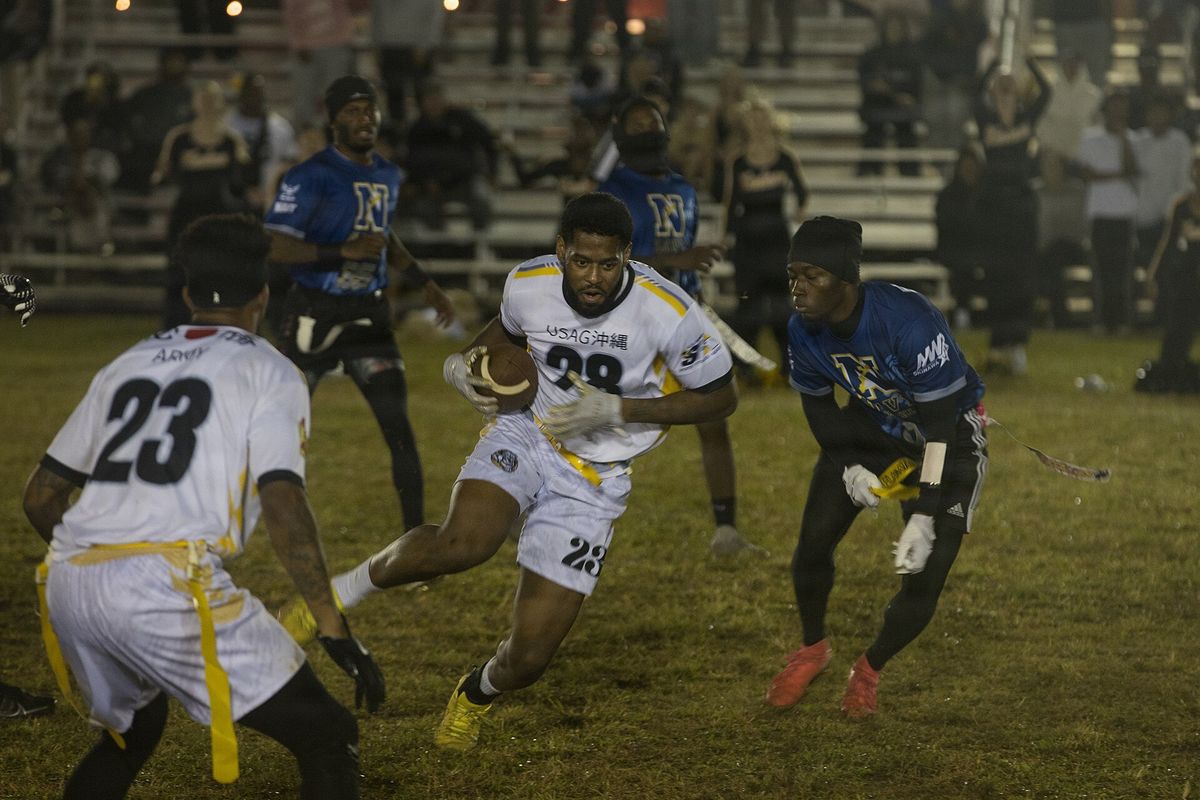
A ball carrier running between defenders in a Navy against Army game at Camp Shields, Okinawa, 2025.
Where the runner's arm is when a defender reaches for the flag is the sport's most argued call.
Justin Rayburn, U.S. Navy · Public domain · Wikimedia Commons
Whose sport got in. Inclusion for 2028 was proposed by the host city and supported by an American professional league. IFAF's account is that a global amateur sport with a world championship since 2002 was recognised. Both are recorded; neither is settled.
Where it standsthe record, and what is still open · sections 11 to 12
11Series
No series published
Points per game
No continuous scoring series exists for flag football, and the reason is that the sport is younger than most of its own rule changes. The five-a-side international format dates from 2002. Before that, flag football was a family of local codes — four a side, seven a side, eight a side, with and without contact blocking, on fields of varying size — and figures from those codes describe different games. Since 2002 the format has been stable but the competition record is thin: a world championship every two years, with a field whose strength varies more between editions than the scoring does. A rate statistic drawn from it would measure who entered, not how the game is played. What can be said is structural. There is no punt and no field goal, so every possession ends in a score or a turnover on downs, and scoring rates are high by the standards of any football code. Whether they have moved is not something a cited source currently supports.
1940Scoped to one competitionThe flag pull replaces the tackle. Nothing in tackle football's record is comparable with what follows.
2002Scoped to one competitionThe international five-a-side code, with no-run zones, supersedes a family of local formats that scored differently.
12What is contested now
Recorded as unsettled.
Whether it stays. Inclusion for 2028 came through the host-city mechanism, which grants one Games and no more. Karate was admitted that way and dropped; breaking was admitted that way and dropped. Flag football's federation is planning for a future that the decision it has does not guarantee.
Whose interests brought it in. The proposal came from Los Angeles with American professional backing, for a sport whose largest playing base is American. The counter-argument — a world championship since 2002, Mexican and European teams winning it — is real. The dispute is over which fact is the operative one.
Professional participation. Whether players from the American professional tackle league should be eligible has been discussed publicly and not settled. It is the same question baseball's Olympic status foundered on, arriving from the opposite direction.
Flag guarding. The sport's most frequent call rests on distinguishing a deliberate shield from the ordinary motion of a running person's arm. No proposal to make it objective has gained ground.
Whether the format is finished. Five a side, fifty by twenty-five, no-run zones and a tiered conversion are recent decisions, not inherited law. A sport this young may well change the rules its Olympic debut is played under, and some of its national federations play different ones already.