Fistball
A net sport in which the ball is allowed to hit the ground — once, between every touch.
- Official
- Fistball
- Game category
- Net and wall
- Adjudication
- Decided by score
- Standing
- Never Olympic
- rule changes
- 4
- comparability break
- 1
- Olympic editions
- 0
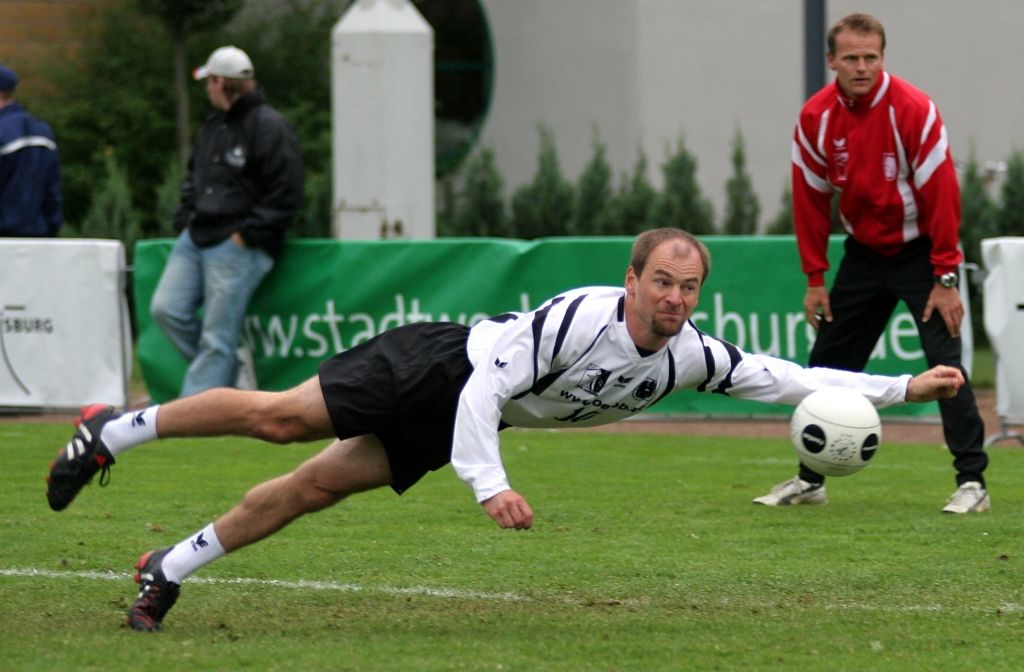
A fistballer defending at full stretch on grass · Heino Kreyenfeld · CC BY-SA 3.0
- Governing body
- International Fistball Association
- Founded
- Descended from European ball games with rules written as early as the sixteenth century; codified in Germany in the late nineteenth century, with the International Fistball Association formed in 1960.
- Olympic status
- Not on the Olympic programme
- Also contested at
- World Games
Five a side over a tape two metres up, three touches a side, struck with the fist or the forearm and never with an open hand. The rule that makes it its own sport is that the ball may bounce once before each touch — so a fistball rally has the ground in it, and the game is played at a walking pace between moments of violence rather than in volleyball's continuous scramble.
The gamewhat it is now · sections 1 to 5
01How it is played
Five a side on a 50 by 20 metre field split by a tape two metres up. Three touches a side, struck with a fist or forearm, and the ball may bounce once before each of them.
These figures were entered from the edition named above but have not been checked against its text line by line. Treat them as this site’s reading of the laws, not as a substitute for them.
The object of the game
Play the ball over the tape so that the opposition cannot return it legally. A side loses the rally if the ball bounces twice, is touched more than three times, is hit with anything but a fist or forearm, or lands outside the field.
This clause reads this way because of
The field
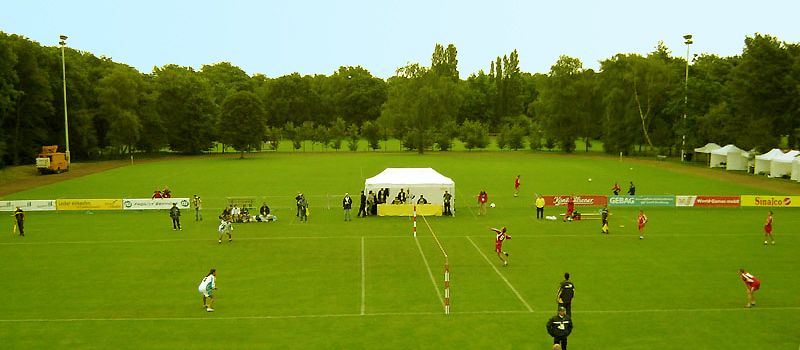
Fifty metres by twenty, divided across the middle, with a tape rather than a net — a band strung between two posts, with open space above and below the sightline that a volleyball net would block.
The field is long. Each half is twenty-five metres deep, which is more than twice a volleyball court, and that length is what the bounce rule pays for: a ball can be allowed to land and still be retrieved.
- Field
- 50 × 20 m
- Each half
- 25 m deep
- Tape height
- 2 m for men
- Barrier
- A tape, not a net
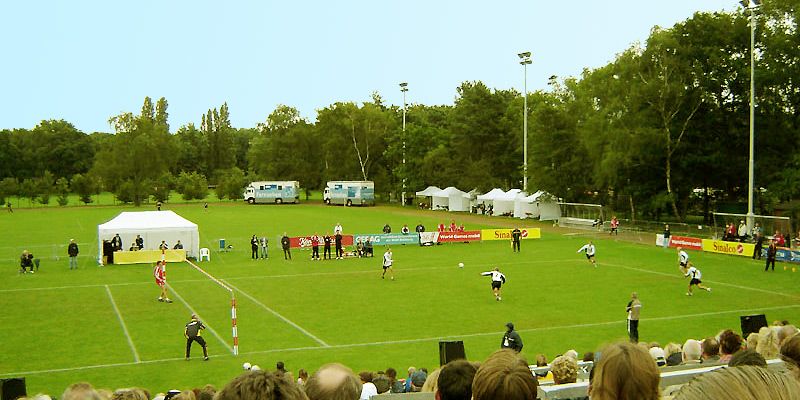
Germany against Switzerland at the 2005 World Games, Duisburg: the whole grass field, with the tape across its centre.
Fifty metres by twenty on grass, with the tape at two metres.
Flingeflung · CC BY-SA 3.0 · Wikimedia Commons
Equipment
A ball a little smaller and lighter than a football, inflated hard, and nothing else. No net, no protective equipment, and no specialised footwear beyond a boot for grass or a court shoe indoors.
The sport is played outdoors on grass in summer and indoors in winter, with the same rules and a shorter field indoors.
- Ball
- Slightly smaller and lighter than a football
- Surfaces
- Grass outdoors, hall indoors
Players and officials
Five a side, with defined roles that the field's length produces: defenders deep, a setter, and an attacker who strikes. Substitutions are permitted between rallies.
- On the field
- 5
- Touches per side
- 3
Time
No clock. Sets are played to eleven points with a two-point margin, and a match is decided on sets — the number varying by competition.
- Set
- 11 points, two clear
- Scoring
- Rally scoring since 2000
This clause reads this way because of
Scoring
A point on every rally, to whichever side wins it, regardless of who served. Fistball adopted this in 2000, joining volleyball, table tennis and badminton in the same short wave of scoring rewrites — and, like all of them, severing its own match statistics in the process.
This clause reads this way because of
Serving
The serve is struck with a fist or forearm from behind the back line and must cross the tape without touching it. Unlike volleyball, the serve may bounce in the server's own half first, which makes it a far less dominant act — there is no fistball equivalent of an ace-driven game.
This clause reads this way because of
Infringements
Two bounces between touches. A fourth touch. Contact with an open hand, with both hands, or with any part of the body other than one fist or forearm. Touching the tape or the posts. Crossing the centre line.
There is no rule against reaching over, because there is nothing to reach over — a tape two metres up with open space above it makes blocking as volleyball understands it impossible.
This clause reads this way because of
Deciding the winner
The side taking the required number of sets. There is no tie-break device beyond the two-point margin, and no clock to run down.
Everything above is current law. Everything below is how Fistball got here.
02Disciplines and events
No Olympic events. The IFA runs outdoor and indoor world championships and fistball is on the World Games programme, where it has been contested since the event's early editions.
- Disciplines
- 2
- Olympic medal events
- 0
- Men’s and women’s counted separately.
- Contested elsewhere
- 6
- world games, world championship, federation only, lapsed.
- Listed for context
- 1
- Not counted as this sport.
Outdoor2
On grass, 50 × 20 m. The primary form of the sport.
- Men's competitionWorld GamesWorld championship
- Women's competitionWorld GamesWorld championship
Indoor2
In a hall on a shorter field, played through the northern winter.
- Men's competitionWorld championship
- Women's competitionWorld championship
The family it belongs to2
Fistball descends from a group of European ball games in which a ball is struck with the arm and allowed to bounce. Most of them did not survive codification.
- Pallone col braccialeLapsedThe Italian ancestor, struck with a wooden arm-guard; once a major professional sport and now nearly extinct.
- Valencian and Basque hand gamesFederation onlyRegional survivals of the same family, governed locally.
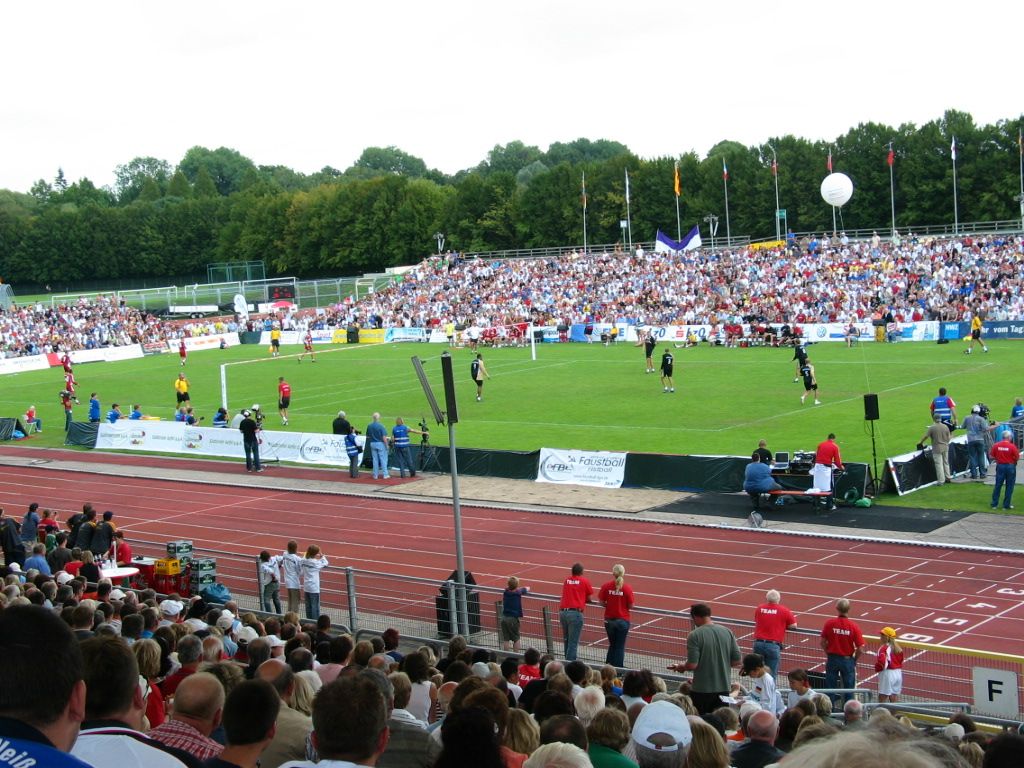
The bronze-medal match at the 2007 World Championships in the Marschwegstadion, Oldenburg.
Outdoor world championships drawing a stadium crowd in the German heartland.
Gruni70 · CC BY-SA 3.0 · Wikimedia Commons
03Officiating
The referee's difficult call in fistball is one that does not exist in any other net sport: how many times has the ball touched the ground?
The ball may bounce once before each contact. So a legal sequence can be bounce, touch, bounce, touch, bounce, touch — six events, alternating, at speed, across fifty metres, with five players from each side moving through them. A second bounce before a touch ends the rally, and separating "bounced then hit" from "hit then bounced" at the margin is the sport's characteristic judgement.
A fistballer defending at full stretch on grass.
The ball may bounce once before each touch. Whether this one has already bounced twice is the referee's call.
Heino Kreyenfeld · CC BY-SA 3.0 · Wikimedia Commons
The second call is the contact itself. One closed fist or one forearm is legal; an open hand, two hands, or any other part of the body is not. At speed, a forearm contact and a heel-of-the-hand contact look very similar, and the distinction decides the rally.
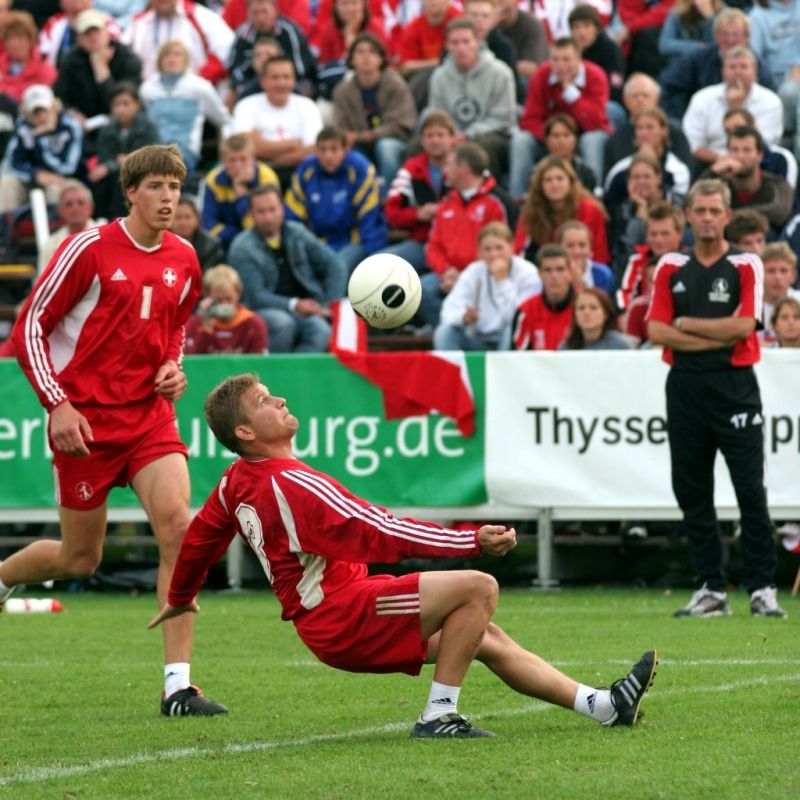
Marcel Stoffel of Switzerland setting for Cyrill Schreiber, sliding in to play the ball off his forearm.
One fist or one forearm is legal; an open hand is not, and at speed the two look alike.
Heino Kreye · CC BY-SA 3.0 · Wikimedia Commons
Beyond those: touches of the tape, crossing the centre line, the number of contacts per side, and whether a ball landed in or out on a large grass field where the lines are marked rather than painted on a hard surface.
There is no video review, no ball-tracking and no sensor of any kind. A sport whose central call is the number and order of ground contacts could be instrumented more usefully than most and has not been, for the reason that runs through every small federation on this site: nobody can pay for it.
04Where it is played
Two clusters, separated by an ocean and connected by emigration.
The European core is Germany, Austria and Switzerland, with Germany the dominant power in both the men's and women's game by a wide margin. The club structure there is genuine and old — fistball sits inside the German gymnastics-club system, which gives it facilities, coaching and continuity that sports of its size usually lack. Italy and the Czech Republic play it too.
The South American cluster is Brazil, Argentina and Chile, and it exists because German-speaking emigrants took the sport with them in the nineteenth and early twentieth centuries. It is not a development-programme import; it is a century-old tradition, and Brazil and Argentina are consistently among the best teams in the world.
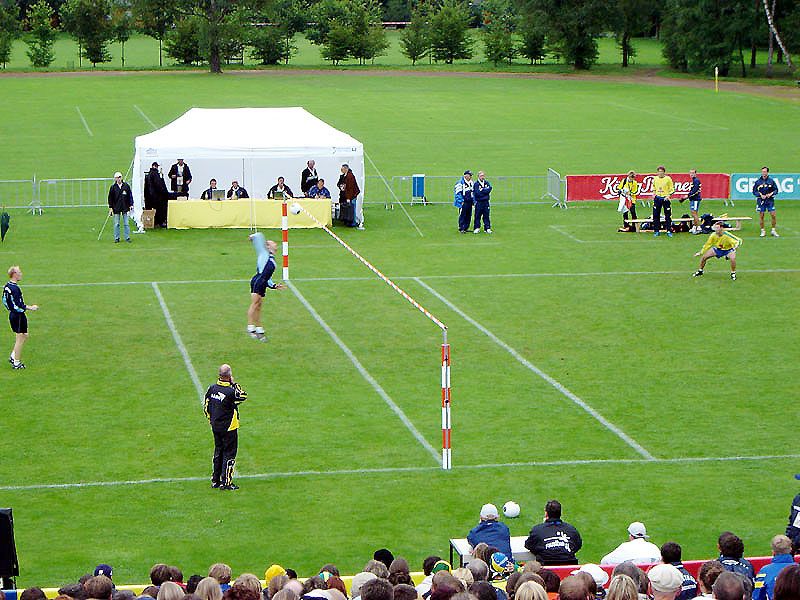
Niels Pannewig attacking for Germany against Brazil in the group stage of the 2005 World Games, Duisburg.
The two clusters of the sport's map, meeting on one field.
Flingeflung · CC BY-SA 3.0 · Wikimedia Commons
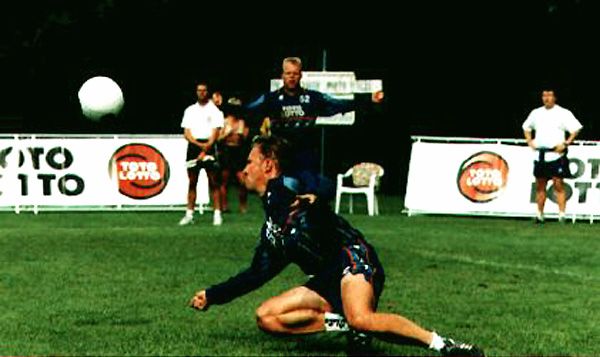
Ralf Kallmeyer of Turnerschaft Hannover defending in the 1997 World Cup final against Sogipa of Porto Alegre.
A German club against a Brazilian one founded in the same tradition, in the final of a club world cup.
Flingeflung · CC BY-SA 3.0 · Wikimedia Commons
Namibia is the outlier and the same story again. Fistball arrived with German settlers under colonial rule and remained after that rule ended, and the country fields international teams — a sport preserved by a community long after the circumstances that brought it there had gone.
The pattern says something the sport cannot easily change. Fistball's map is almost exactly the map of German emigration, and every country where it is strong got it the same way. There is no example on this site of a sport with a more legible diaspora footprint, and it means the federation's growth problem is not distribution but origination: it has never yet taken root anywhere that did not receive it from a German-speaking community.
05Learning curve
Much easier to start than volleyball, because the ball is allowed to land and nobody has to dive — and correspondingly hard at the top, because a closed fist is a poor instrument for precision and the field is enormous.
Editorial — the site’s reading, not a sourced claim
Barrier to entry
How hard is it to get to a real game?
A ball and a rope between two posts. The floor is not your enemy.
The bounce rule removes the single hardest thing about starting a net sport. In volleyball a beginner who fails to reach the ball has lost the rally, so the sport demands a diving, sprawling defence from the first session. In fistball the ball may land once, which converts defence from a reaction test into a positioning problem.
Striking with a fist is also more intuitive than a volleyball dig or set: it is closer to hitting something than to controlling it.
What holds the verdict at low rather than very low is the field. Twenty-five metres of depth per side needs a large piece of grass and ten people, which is a real organisational barrier outside the countries where clubs exist.
Evidence
- Players needed10rule1960 — the rule this rests on
- Kit to startA ball and a tapeobserved
- Bounce permittedOnce before each touchruleRemoves the diving defence that makes volleyball hard to begin.1894 — the rule this rests on
- Field needed50 × 20 mobserved
- Time to a real gameOne sessionestimate
Barrier to the top
How hard is it to be good at?
Precision from a closed fist, across a field twice the depth of a volleyball court.
The fist is the constraint that raises the ceiling. A volleyball setter shapes a ball with ten fingers; a fistball setter must place it accurately with a curved, unyielding surface the size of a fist, and the margin for error is far smaller. Elite setting in this sport is genuinely difficult and almost invisible to a spectator.
The attack is a strike with a straight arm at a ball dropping out of the air, aimed into twenty-five metres of defended ground. Power alone achieves nothing on a field that size, so the attacker is solving an angle problem at speed.
And the bounce that makes the sport easy to begin makes it harder to finish: a defence that is allowed one bounce can retrieve balls that would end a volleyball rally, so points must be won rather than merely started.
The ceiling is flattened by the sport's size. There is a strong club structure in a handful of countries and effectively no professional layer.
Evidence
- Fist or forearm onlyNo open handruleThe setting surface is small and curved, which is the sport's technical bottleneck.1894 — the rule this rests on
- Field depth25 m per sideobservedMore than twice a volleyball court, so power alone does not win a rally.
- Rally scoringSince 2000ruleEvery rally is a point, which raised the cost of a technical error.2000 — the rule this rests on
- Typical peak age24–32estimate
Why the two differ
Low to high, and the sport is the cleanest natural experiment on this site for a single rule's effect on a learning curve.
Fistball and volleyball are close relatives: a net sport, three touches, five or six a side, and a scoring system both rewrote within a year of each other. The one substantive difference is that fistball lets the ball bounce. That single permission moves the entry barrier down a full step, because the diving defence that makes volleyball punishing for beginners is simply not required — and it does not lower the ceiling at all, because retrievable defence means rallies have to be won outright.
If you want evidence that a sport's accessibility is a property of its laws rather than of its culture, this is the pair to look at.
The historyhow it got here · sections 6 to 10
06Origin and invention
Fistball is old enough that its codification is the recent part.
Ball games in which a ball is struck with the arm and allowed to bounce are attested across Europe for centuries. The Italian pallone col bracciale, played with a spiked wooden cylinder worn on the forearm, was a major professional spectator sport into the nineteenth century, with purpose-built arenas. Antonio Scaino's treatise of 1555 is generally cited as the first written rules of a ball game of this family, and the German Faustball that this page describes belongs to the same lineage.
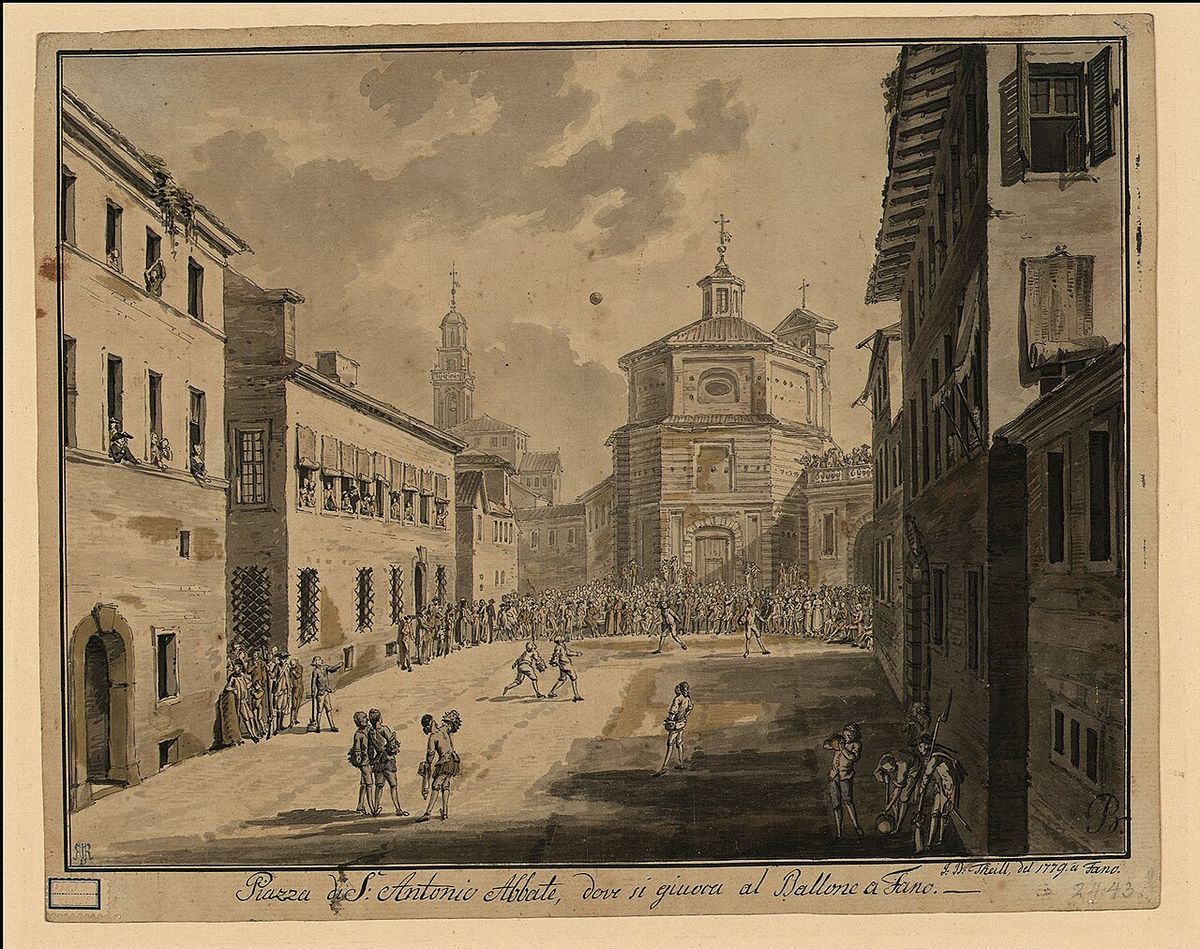
Piazza di Sant'Antonio Abate, Fano, where pallone was played: an ink-and-wash view by G. B. Theill, 1779.
Pallone played in a town square, with spectators at the windows: the struck-ball family as an eighteenth-century street game.
G. B. Theill · Public domain · Wikimedia Commons
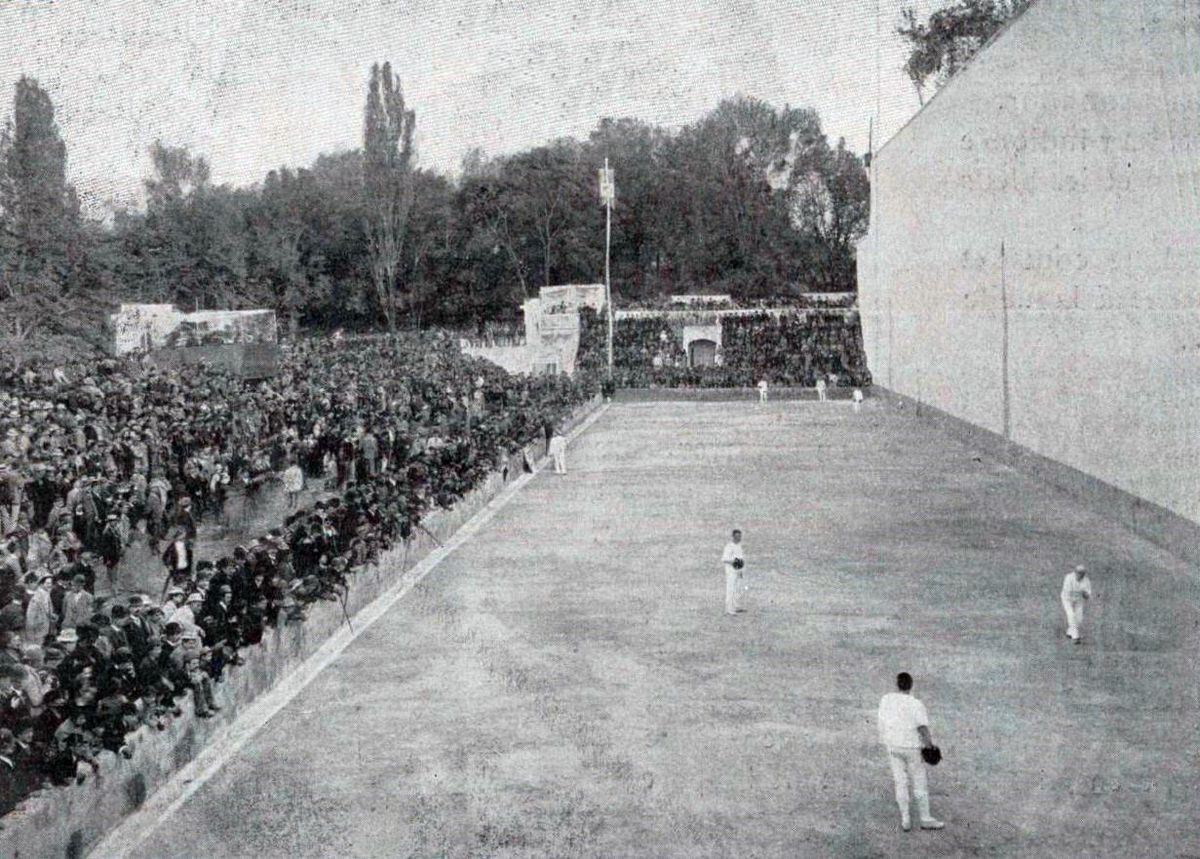
The sferisterio at the Cascine in Florence, with a crowd along one side and players on the long court.
A purpose-built arena for pallone col bracciale, the professional spectator sport of nineteenth-century Italy.
Unknown photographer (uploaded by DAF, Italian Wikipedia) · Public domain · Wikimedia Commons
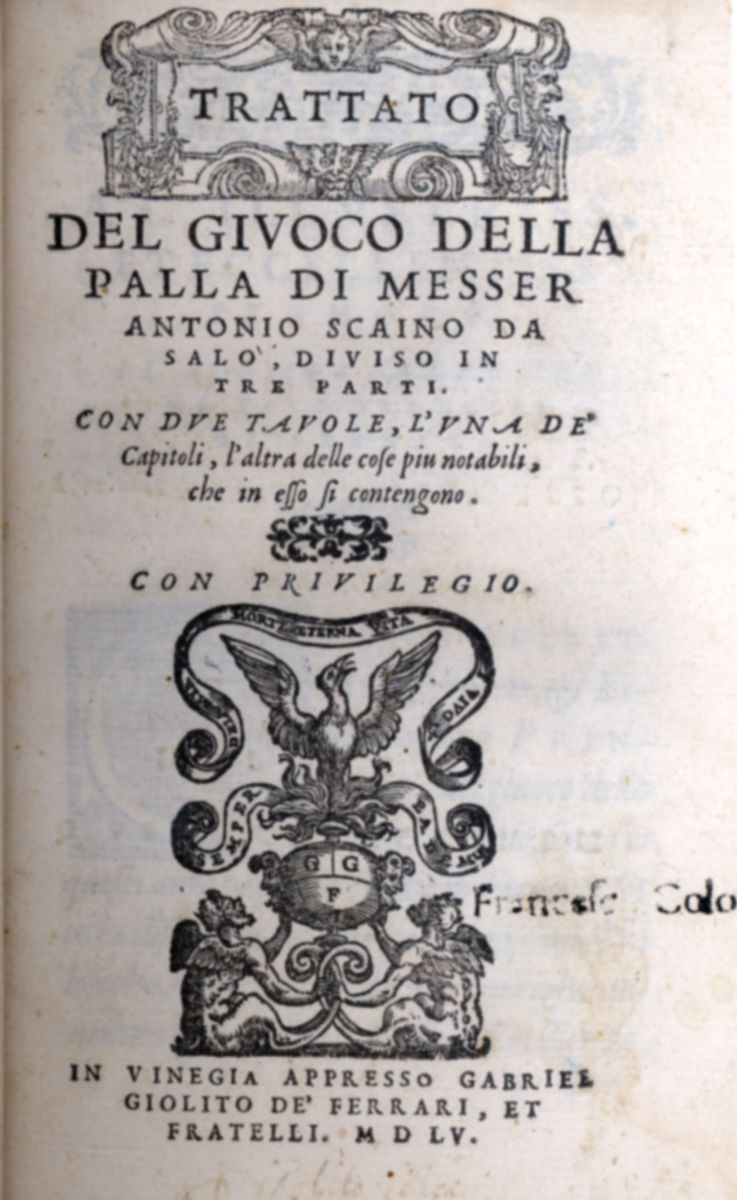
The title page of Antonio Scaino's Trattato del giuoco della palla, Venice, 1555.
Generally cited as the first written rules for a ball game of this family.
Antonio Scaino · Public domain · Wikimedia Commons
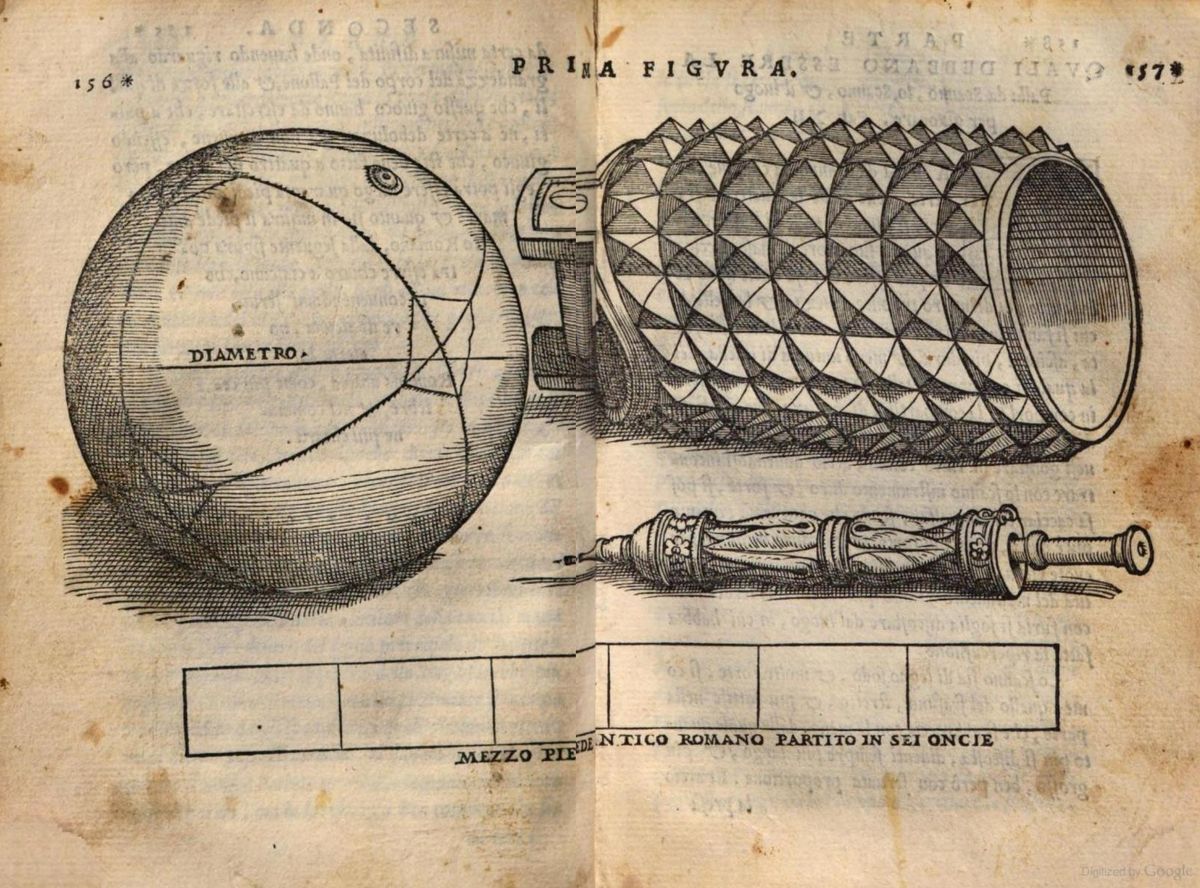
A spread from Scaino's treatise, 1555: the ball drawn with its diameter, beside the spiked bracciale worn on the forearm.
The implement fistball would eventually do without.
Antonio Scaino · Public domain · Wikimedia Commons
The modern sport was codified in the German gymnastics movement in the late nineteenth century, with rules published in the 1890s. That inheritance is visible in what the sport kept: it is played outdoors on grass, on a long field, with a tape rather than a net, and with a ball that is allowed to land — all of which are properties of a game that grew up outside rather than one designed for a hall.
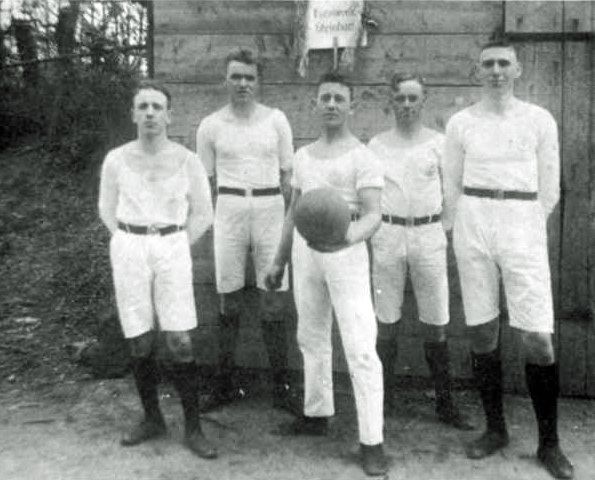
The first fistball team of TV Steinbach, 1926: Oswald Kring, Julius Otto, Reinhard Pulverich, Ernst Kring and Richard Pulverich.
Five players in gymnastics whites: the German Turnverein, the club system fistball was codified in and still lives inside.
TSV Steinbach Haiger · CC BY-SA 4.0 · Wikimedia Commons
Emigration did the rest. German-speaking communities carried fistball to Brazil, Argentina, Chile and what is now Namibia, where it took root and developed for decades in isolation from the European game. By the time the International Fistball Association was formed in 1960, there were two continents playing under rules that had drifted apart, and the federation's first job was to reconcile them.
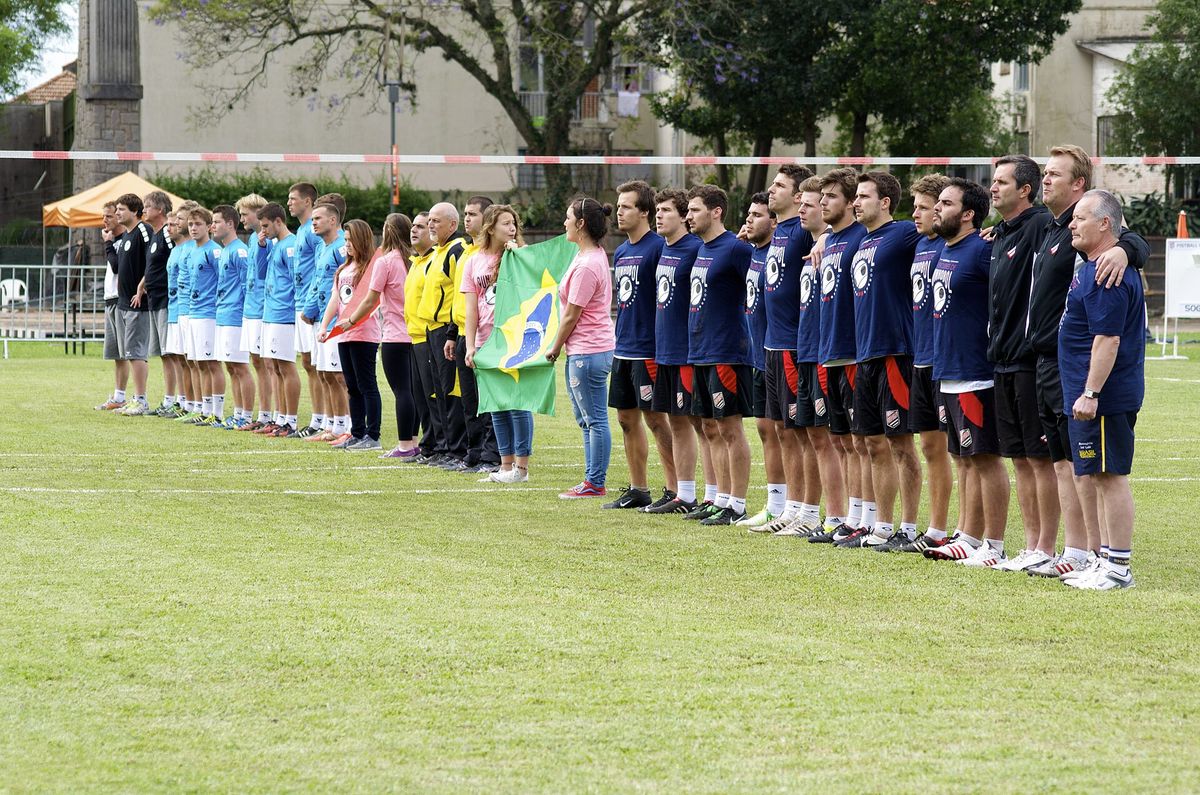
Teams lined up before the 2015 club world championship, the Mundial de Punhobol Interclubes, a Brazilian flag among them.
Punhobol is fistball's Portuguese name: the game emigration carried to Brazil.
Nouem Comunicação Integrada · CC BY-SA 4.0 · Wikimedia Commons
It has never been on the Olympic programme. It is on the World Games one, where a sport with clubs in a dozen countries and a century of continuous play is exactly the intended constituency.
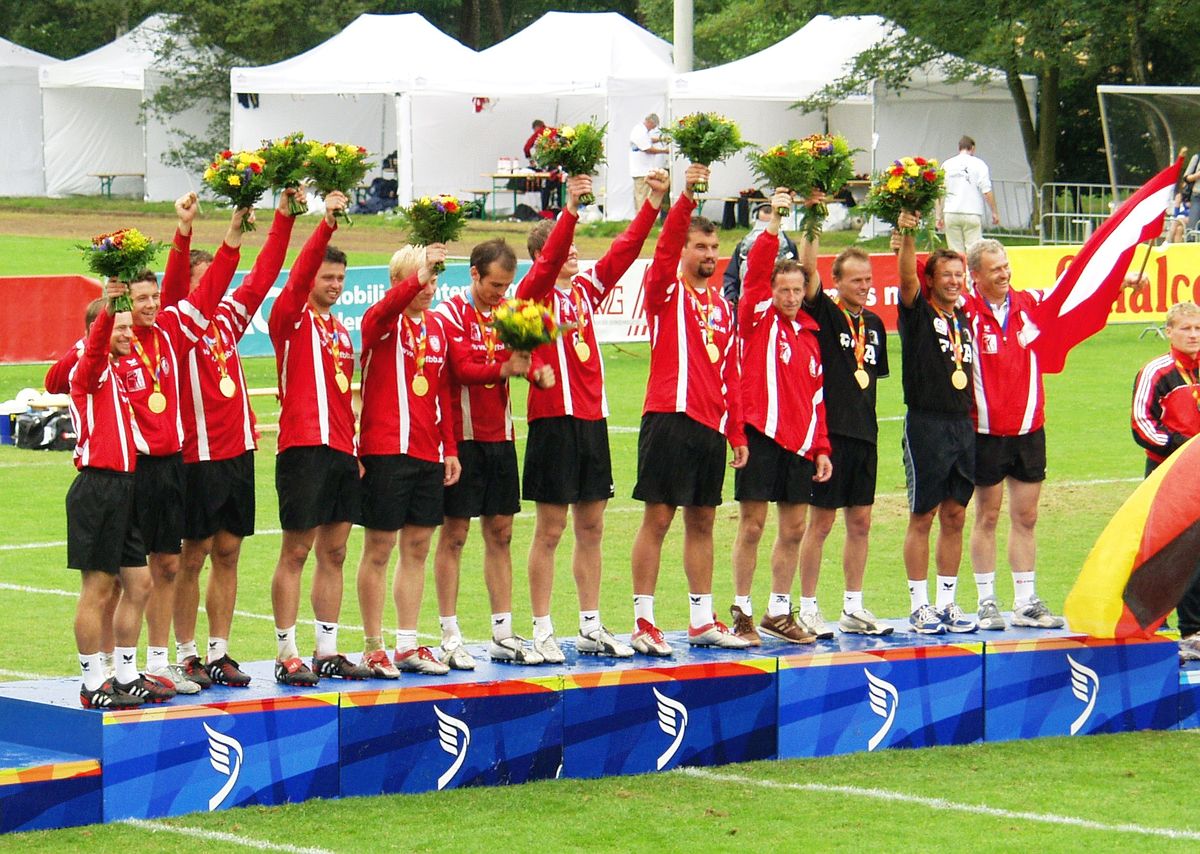
The medal ceremony after the fistball final at the 2005 World Games in Duisburg.
The World Games is the programme fistball is on, and the ceiling of its multi-sport ambitions.
Raimond Spekking · CC BY-SA 4.0 · Wikimedia Commons
07Rule timeline
The sport’s own lane, expanded. Every entry carries a cause from the closed vocabulary and a citation, and says so where the citation is incomplete.
- 1894Participation and accessadopted 1894
The ball may touch the ground once before each contact, including between the three touches a side is allowed. A rally therefore contains bounces, and a ball that has landed is still live. Every comparison with volleyball breaks on this one rule. Volleyball's entire structure — the dig, the libero, the defensive dive — exists because the floor ends the rally. Fistball's does not, so its defence is a positioning problem rather than a diving one, and the game can be played by people who are not prepared to throw themselves at the ground.
Trigger and citationIncomplete — no confirmed article
Trigger
The game descends from open-air ball games played on grass, where a ball that has bounced was always still in play. The codified sport kept the inheritance rather than adopting the indoor convention.
IFA Rules of the Game · IFA Rules of the Game, playing the ball
- 1894Fairness and eligibilityadopted 1894
The ball may be struck with one closed fist or one forearm, and never with an open hand, two hands together, or any other part of the body. This is what caps the sport's precision. A closed fist has a small, curved striking surface and no fingers to shape a contact, so a fistball attack is a hit rather than a placement, and the setter's touch is far harder than a volleyball set.
Trigger and citationIncomplete — no confirmed article
Trigger
The restriction is the sport's name and predates its codification: the game was played with the fist in its folk forms and the written rules recorded the practice.
IFA Rules of the Game · IFA Rules of the Game, permitted contact
- 1960Fairness and eligibilityadopted 1960
The IFA was formed and brought the German, Austrian, Swiss and South American codes into one rulebook — field dimensions, the height of the tape, the number of touches and the scoring. The South American half matters: fistball had been carried to Brazil, Argentina and Chile by German-speaking emigrants and had developed there for decades with no reference to the European game.
Trigger and citationIncomplete — no confirmed article
Trigger
The sport was being played on two continents under rules that had diverged in isolation, with no body able to reconcile them.
IFA Rules of the Game · IFA statutes
- 2000Broadcast and pacingalso commercialadopted 2000
Fistball moved to rally scoring, in which a point is scored on every rally regardless of which side served, with sets played to eleven. It belongs to the same wave as volleyball in 1999, table tennis in 2001 and badminton in 2006 — a set of sports rewriting their scoring within seven years of each other so that a match would fit a predictable slot.
Comparability break · Record book reset
Rally scoring replaces service-based scoring. Points, rallies and set lengths are not comparable across this line. See the series
Trigger and citationIncomplete — no confirmed article
Trigger
Under service-based scoring a match had no reliable length, which made it unschedulable for broadcast and difficult to run to a tournament timetable.
IFA Rules of the Game · IFA Rules of the Game, scoring
08Equipment evolution
Almost nothing, and one deliberate absence.
The ball is slightly smaller and lighter than a football and inflated hard. Its behaviour matters more here than in most net sports, because it has to bounce predictably off grass and off a hall floor and produce the same game on both — a ball that died on turf or sat up off a wooden floor would change the sport between seasons.
The striking surface is the human fist, and there is no equipment permitted to modify it. That is worth noticing against the sport's own ancestor: pallone col bracciale was played with a heavy spiked wooden cylinder strapped to the forearm, an implement that turned the arm into a bat. Fistball descends from that family and went the other way, removing the implement entirely.
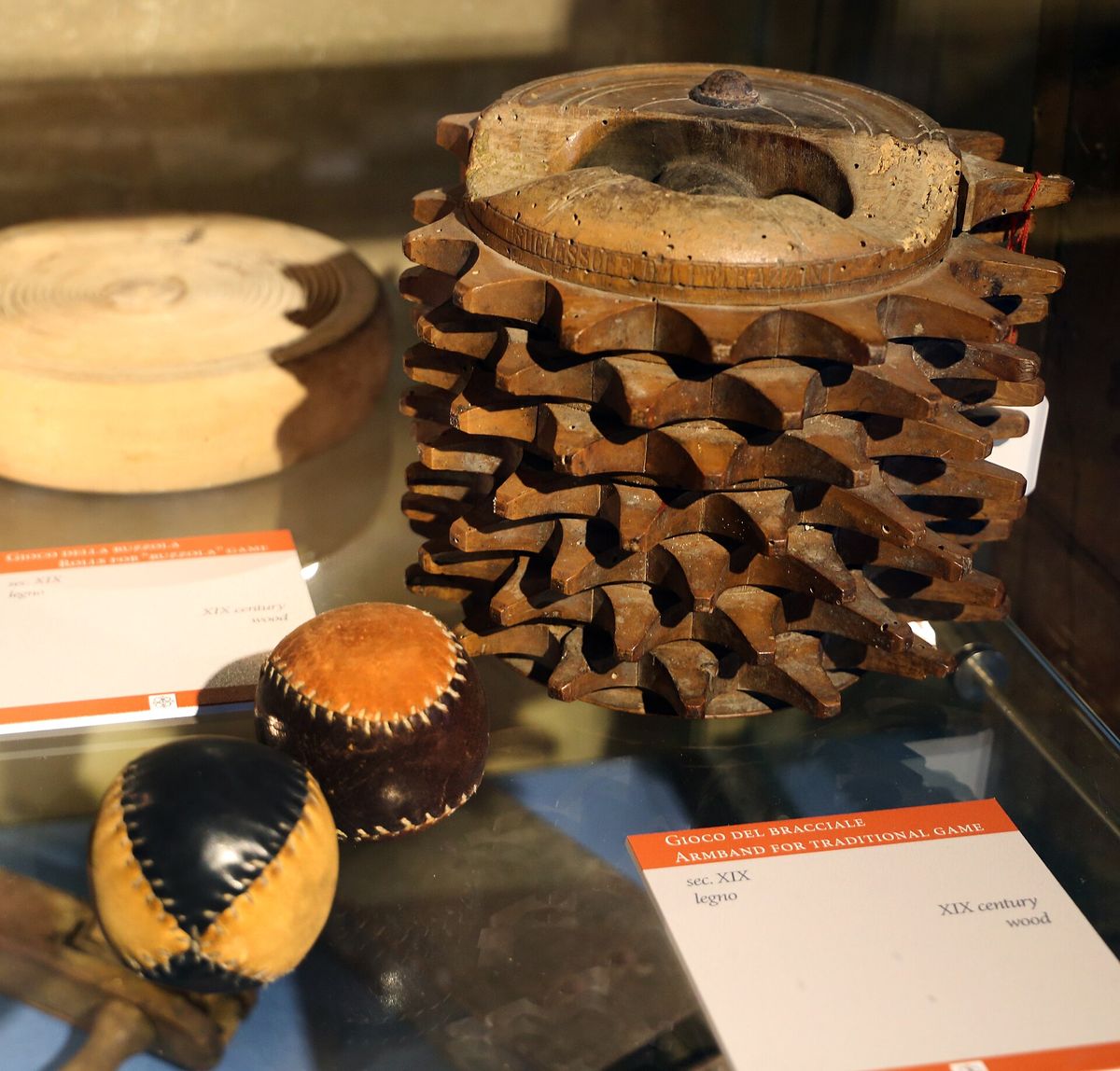
A nineteenth-century wooden bracciale, with two balls, in the Museo di Palazzo Taglieschi, Anghiari.
A spiked wooden cylinder worn on the forearm: an implement that turned the arm into a bat.
Sailko · CC BY 3.0 · Wikimedia Commons
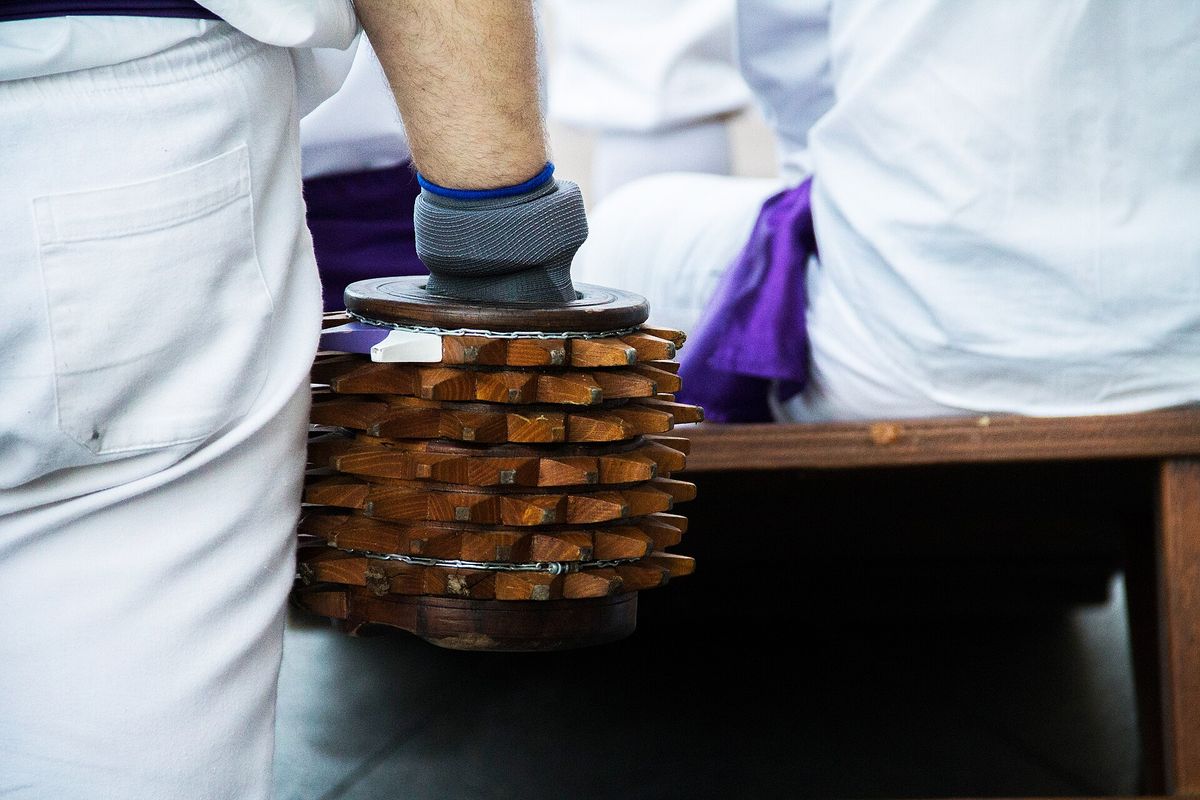
A bracciale on a player's arm before a strike, Treia, 2018.
The ancestral game is still played in the Marche. Its descendant kept the ball and dropped the implement.
Cristina Morettini 95 · CC BY-SA 4.0 · Wikimedia Commons
The barrier between the sides is a tape, not a net — a band strung between two posts at two metres, with open air above it. This is not a cost-saving simplification; it changes the game. A volleyball net is a visual and physical wall, which is why blocking exists and why the sport is played in the narrow band immediately above it. A tape leaves the sightline open, so play happens in the depth of the field rather than at the barrier, and there is nothing to block against.
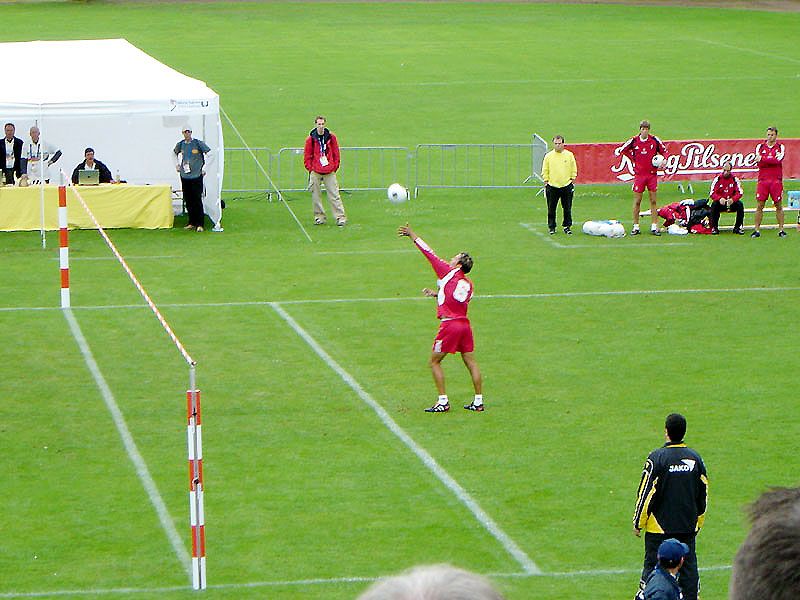
A Swiss player preparing to serve at the 2005 World Games in Duisburg, the tape running between its two posts.
A band at two metres with open air above it: nothing to block against, and nothing in the way of the sightline.
Flingeflung · CC BY-SA 3.0 · Wikimedia Commons
Otherwise: boots for grass, court shoes indoors, and no protective equipment at all, because there is no diving defence to protect against and no contact.
09Governing body politics
The IFA's history is a reconciliation followed by a long, patient campaign.
The reconciliation came first. Fistball had developed on two continents in isolation — German, Austrian and Swiss clubs on one side, and South American clubs founded by German-speaking emigrants on the other — with rules that had drifted apart over decades. The federation formed in 1960 to produce a single rulebook, and South America has been a full competitive partner rather than a periphery ever since. Brazil, Argentina and Chile all contest world titles.
Switzerland against Argentina in the group stage of the 2005 World Games, Duisburg.
Europe against South America on one rulebook, which is what the 1960 federation was formed to produce.
Flingeflung · CC BY-SA 3.0 · Wikimedia Commons
The campaign is the ordinary one for a sport this size: recognition, a World Games place, and no realistic Olympic prospect. The sport's honest position is that it has strong clubs in about a dozen countries and very little presence outside them, and that is not a case anybody can argue into a programme that selects on global reach and broadcast value.
The 2000 move to rally scoring belongs to the politics rather than to the sport. It was made for the same reason volleyball, table tennis and badminton made theirs within a few years either side: a match of unpredictable length cannot be scheduled, and a sport that cannot be scheduled cannot be televised or fitted into a multi-sport programme. Fistball paid the same price they all paid, in severed statistics, for a benefit that was always going to be smaller because the sport is smaller.
Namibia is the federation's most unusual member, and the reason is colonial: fistball arrived with German settlers and stayed after they no longer governed.
10Controversies that forced rule changes
Fistball has had a quiet legislative history, and its two significant changes both came from outside the sport.
Rally scoring, in 2000. The broadcast wave that rewrote volleyball in 1999, table tennis in 2001 and badminton in 2006 caught fistball too. The stated reason was the same everywhere: a match under service-based scoring has no predictable length. The consequence was the same everywhere too — the sport's own match statistics stopped being comparable across the change, and in fistball's case nobody had compiled them on either side.
Reconciling two continents. The 1960 federation had to settle differences between European and South American codes that had developed apart for decades. This was a negotiation rather than a controversy, but it is the moment the sport chose which of its variants was the sport.
The tape height and the women's game. Fistball sets a lower tape for women's competition, which is standard across net sports and periodically argued in all of them. The argument here is the usual one and has not produced a change.
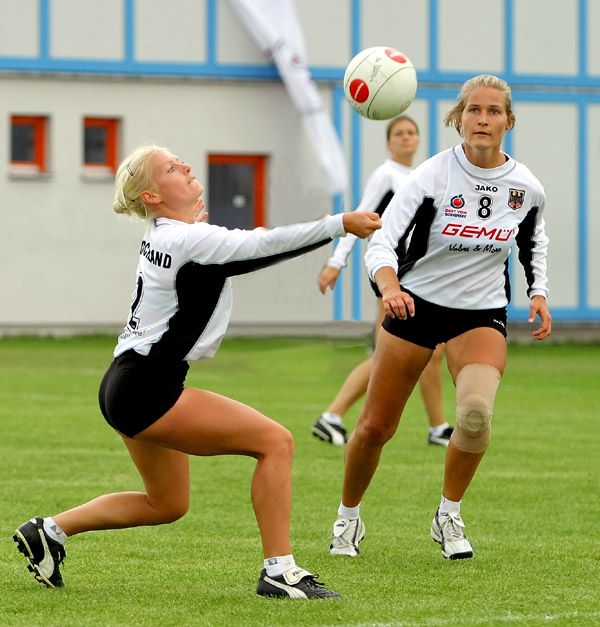
Janna Meiners setting for Bianca Mollenhauer of Germany, 2004 European Championships.
The women's game is played under a lower tape.
Felix Stoeldt · CC BY-SA 3.0 · Wikimedia Commons
What fistball has not had is a safety controversy, an equipment arms race or a doping scandal of any scale. A sport with no contact, no implement and no professional money has had comparatively little to legislate about — which makes it a useful control case against the sports on this site that have had all three.
Where it standsthe record, and what is still open · sections 11 to 12
11Series
No series published
Points per set
Fistball severed its own match statistics in 2000 and did not publish either side of the break. Under the old scoring, a side could only score while serving, so a set was a sequence of service exchanges of unpredictable length. Under rally scoring every rally is a point and a set ends at eleven. Counts of points, of rallies, and of anything expressed per set describe two different games before and after. This is the same severance volleyball made in 1999, table tennis in 2001 and badminton in 2006 — four sports, one broadcast pressure, four severed record sets within seven years. Fistball is the smallest of them and the only one where the before-and-after figures were never compiled in the first place. Nothing is entered because nothing has been taken from a cited source.
2000Record book resetRally scoring replaces service-based scoring. Points, rallies and set lengths are not comparable across this line.
12What is contested now
Recorded as unsettled.
Whether the sport can grow outside its diaspora. Every country where fistball is strong received it from German-speaking emigrants. The federation has never established the sport somewhere with no such connection, and whether it can is the question that determines everything else about its future.
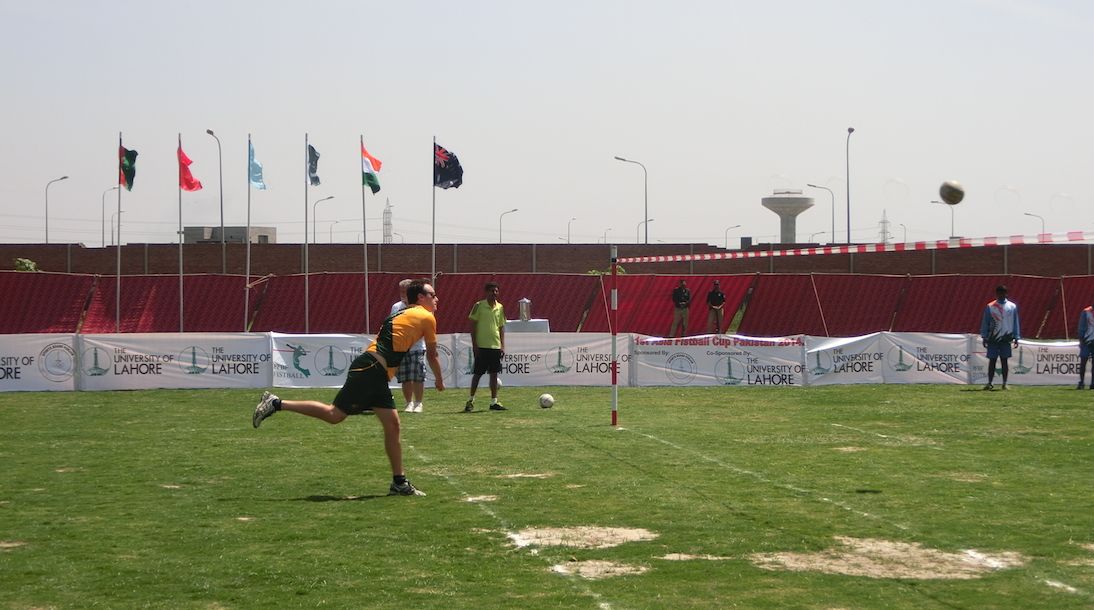
An Australian player serving at the 2014 Asian Fistball Championships.
The federation's attempt to take the sport beyond its diaspora, recorded as a question rather than a result.
Themilney · CC BY-SA 3.0 · Wikimedia Commons
Whether rally scoring was worth it. The change was made for schedulability, which a sport of this size gets very little from. It cost the comparability of its own statistics. The same trade was made by three larger sports in the same period and is argued in all of them.
Indoor or outdoor. Two forms with separate world championships, played on different field sizes in different seasons. Which is the real sport is not settled, and the World Games contests the outdoor game.
The tape height for women. Set lower than the men's, as in most net sports, and argued for the same reasons it is argued everywhere else.
Whether to keep pursuing the Olympic programme. Fistball has a genuine century of continuous play, a real club structure and world championships on two continents, and no plausible route onto a programme that selects on global reach. Whether the campaign is worth the federation's limited resources, or whether the World Games is simply the right home, is a live internal question — and one that several sports on this site are having at the same time.