Finswimming
The fastest a human can move through water, and a sport that could never ban its equipment because the equipment is the sport.
- Official
- Finswimming
- Game category
- Performance
- Adjudication
- Measured
- Standing
- Never Olympic
- rule changes
- 3
- comparability break
- 1
- Olympic editions
- 0
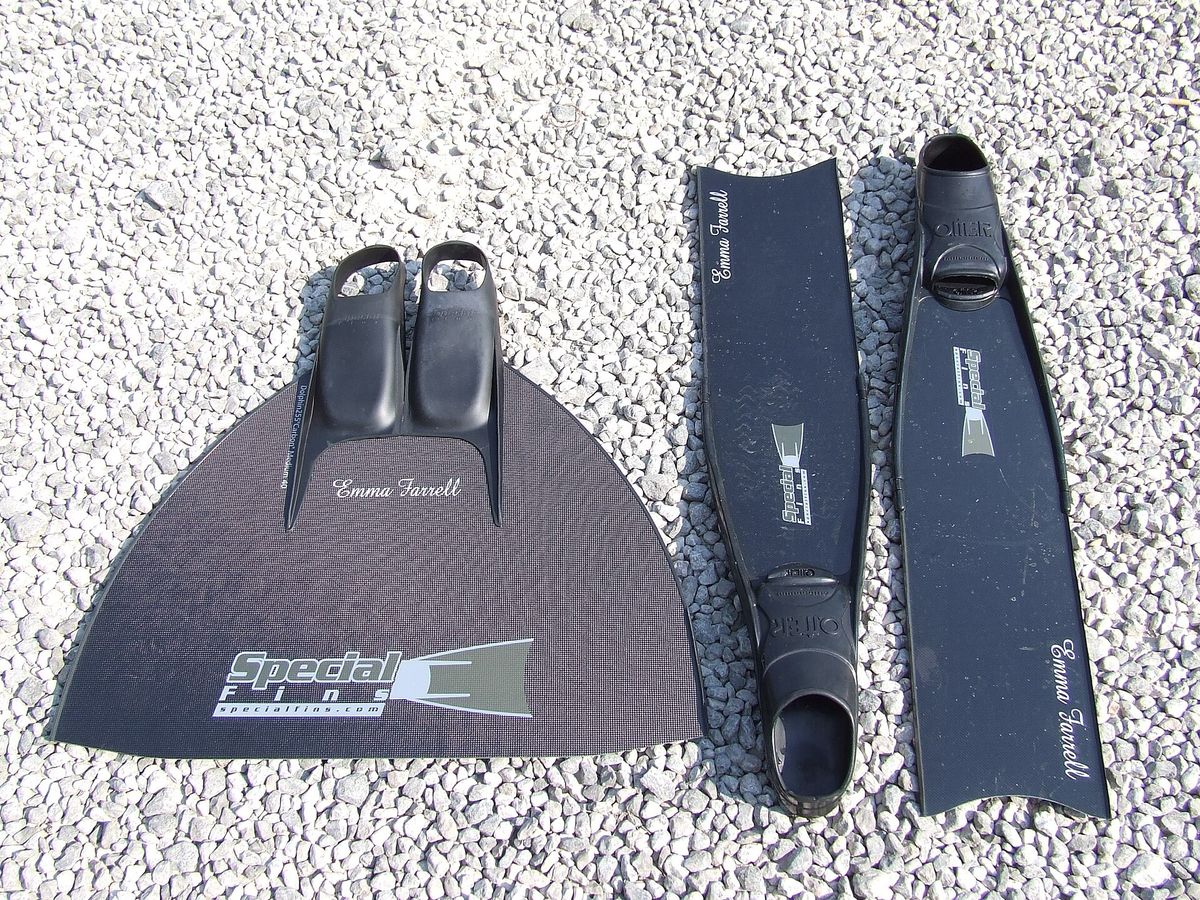
A monofin beside a pair of long bi-fins · Emma & Michael's Excellent Adventures · CC BY 2.0
- Governing body
- CMAS
- Founded
- Governed since 1959 by CMAS, the world underwater federation founded with Jacques Cousteau as its first president; the first finswimming world championships were held in 1976.
- Olympic status
- Not on the Olympic programme
- Also contested at
- World Games
Racing in a pool with a monofin — a single large fin worn on both feet, driven by a dolphin kick — and, in the surface events, a snorkel. It is substantially faster than swimming over the same distances, which makes it the quickest form of human-powered movement in water. It also occupies the opposite corner from swimming on this site's central question: swimming banned the supersuits and kept the records, while finswimming cannot ban its equipment at all.
The gamewhat it is now · sections 1 to 5
01How it is played
Pool racing with a monofin, in three respiratory conditions: on the surface breathing through a snorkel, underwater on a single breath, or underwater carrying a compressed-air cylinder. There is also a bi-fins discipline, using two conventional fins, kept in a separate record book.
These figures were entered from the edition named above but have not been checked against its text line by line. Treat them as this site’s reading of the laws, not as a substitute for them.
The object of the game
Cover the distance faster than everybody else. It is a race, with heats and finals and lanes, and by the ordinary logic of a measured sport nothing about it is complicated.
What is unusual is that the sport contests the same distances under different breathing rules, so the discipline determines the technique entirely and the times are not comparable between them.
This clause reads this way because of
The pool
A standard fifty-metre competition pool with lanes, as in swimming. Surface events are swum face-down along the surface; apnea and immersion events are swum underwater, typically close to the bottom, with the athlete out of sight of the crowd for the whole race.
- Pool
- 50 m, lanes as in swimming
- Surface events
- Face-down, on the surface
- Apnea and immersion
- Swum underwater
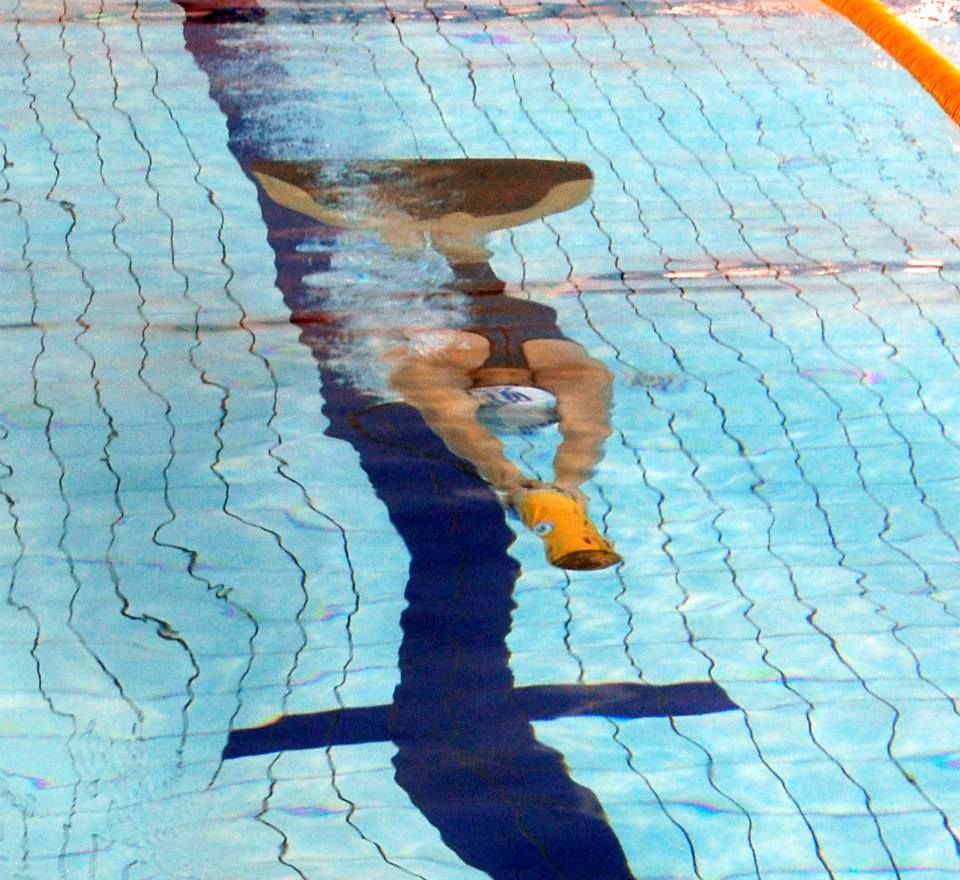
Jakub Jarolím swimming a monofin dolphin kick, seen from above, 2013.
Lanes, lane ropes and the pool floor markings of an ordinary competition pool.
Cimba69 · CC BY-SA 4.0 · Wikimedia Commons
Equipment
The monofin is a single large blade worn on both feet, driven by a whole-body dolphin kick. It is capped by dimension rather than standardised, so blades differ in stiffness and profile and are matched to an athlete.
The snorkel is used in surface events: a large-bore centre-mounted tube that lets the swimmer keep their head down for the whole race.
The cylinder is used in immersion: an open-circuit compressed-air set carried through the race, which makes finswimming the only racing sport covered here where the athlete carries a breathing apparatus.
Bi-fins events use two conventional fins and are a separate discipline with separate records.
- Monofin
- Capped by dimension, not standardised
- Snorkel
- Surface events
- Compressed air
- Immersion events
- Bi-fins
- A separate discipline and record book
This clause reads this way because of
Competitors and officials
One athlete per lane, with relays in the surface discipline. Officials judge starts, turns and finishes as in swimming, and in apnea events they also watch for a swimmer surfacing — which ends the race.
- Per lane
- One
- Relays
- In surface events
Time
Whatever the race takes, timed by touchpad to the hundredth. Distances run from 50 metres to 1500 in the surface discipline; apnea is contested at 50 metres only, because a single breath does not go further at racing speed.
- Surface distances
- 50 m to 1500 m
- Apnea
- 50 m, on one breath
- Timing
- To the hundredth
Scoring
Elapsed time. Records are kept per discipline, per distance and per fin type, and are never pooled — a monofin time and a bi-fins time over the same distance are two different measurements.
This clause reads this way because of
Starts and turns
A dive start from blocks, as in swimming. Turns are made at the wall with a rotation rather than a tumble, because a monofin does not permit the same push-off mechanics as feet.
In apnea, the whole race including the turn happens on one breath and any break of the surface ends it.
Infringements
Surfacing during an apnea race. Using a fin outside the permitted dimensions. Using a propulsion aid other than the fin. Breathing apparatus in the wrong discipline — a snorkel is required in surface events and forbidden where the event is raced on a breath.
As in swimming: false starts, failing to touch at a turn, and interfering with another lane.
Deciding the winner
Fastest time in the final. Because the disciplines are physically different events, an athlete's standing is discipline-specific in a way it is not for a swimmer, who is broadly comparable across strokes.
Everything above is current law. Everything below is how Finswimming got here.
02Disciplines and events
No Olympic events. Finswimming is on the World Games programme and holds CMAS world championships across four disciplines — and it is a pool racing sport governed by an underwater federation rather than by World Aquatics.
- Disciplines
- 4
- Olympic medal events
- 0
- Men’s and women’s counted separately.
- Contested elsewhere
- 11
- world games, world championship.
- Listed for context
- 1
- Not counted as this sport.
Surface15
Face-down on the surface with a monofin and a snorkel. The main discipline.
- 50 and 100 mWorld GamesWorld championship
- 200 and 400 mWorld GamesWorld championship
- 800 and 1500 mWorld championship
- RelaysWorld GamesWorld championship
Apnea2
Swum entirely underwater on a single breath.
- 50 m apneaWorld championshipThe only distance contested; a breath does not go further at racing speed.
Immersion6
Swum underwater carrying an open-circuit compressed-air cylinder — the only racing event covered on this site where the athlete carries a breathing apparatus.
- 100, 400 and 800 m immersionWorld championship
Bi-fins6
Two conventional fins rather than a monofin. Separate records, never pooled.
- 50, 100 and 200 m bi-finsWorld championship
Governed by the same federation4
CMAS is an underwater federation that runs a racing sport, not a racing federation that permits fins.
- FreedivingWorld championshipDepth and static disciplines, governed by CMAS alongside other bodies.
- Underwater hockeyWorld championshipPlayed on the bottom of a pool on a single breath.
- Underwater rugbyWorld championshipPlayed in three dimensions in a deep pool.
- Underwater orienteeringWorld championshipNavigation with a compass and a depth gauge, using a diving set.
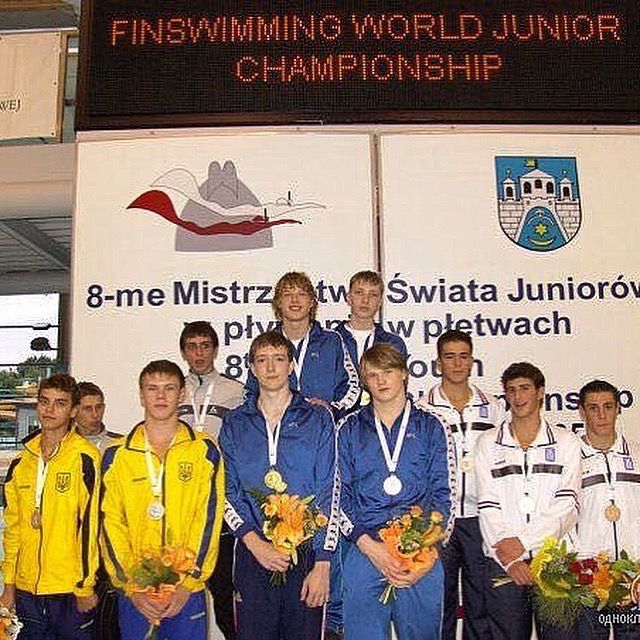
Ukraine's relay team on the podium at the 8th World Junior Finswimming Championships, Bratislava, 2005.
Relays are contested in the surface discipline only.
Ласта2005 · CC BY 4.0 · Wikimedia Commons
03Officiating
Mostly swimming's officiating, with two additions that are unlike anything else on this site.
The familiar half: touchpads, lane judges, starters, false-start detection and turn judges, all working as they do in swimming. Times to the hundredth, records ratified per discipline and per distance.
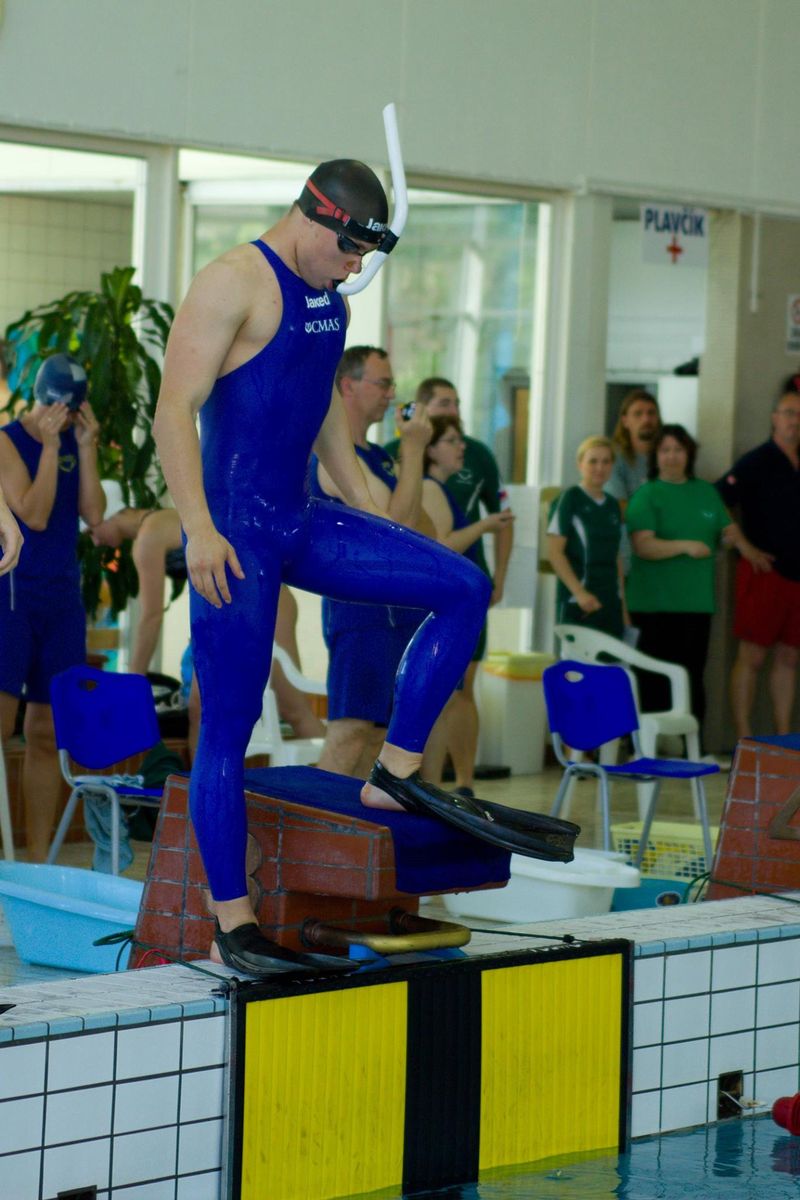
Jakub Jarolím of Czechia stepping onto the starting block in a monofin and centre snorkel, 2016.
Blocks, lanes, lane ropes and touchpads: swimming's apparatus, and swimming's officiating along with it.
Cimba69 · CC BY-SA 4.0 · Wikimedia Commons
Surfacing. In apnea events the swimmer must remain underwater for the whole 50 metres. Any break of the surface ends the race, and judging it is a binary observation of a swimmer who is deliberately invisible for the duration. It is the only race on this site where being seen is the infringement.
Equipment inspection. Because the monofin is capped by dimension rather than standardised, fins are measured before competition — surface area and dimensions checked against the limits. A sport that permits equipment variation has to police the boundary of that variation physically, and finswimming does it with a ruler.
The immersion discipline adds a third: the breathing set must be an open-circuit configuration of the permitted type, which is a technical-diving inspection performed on a racing athlete.
What none of this instruments is the technique itself. The undulation that makes the sport fast is not judged at all — there is no equivalent of swimming's stroke-legality rules for breaststroke or butterfly, because there is only one way to drive a monofin and no incentive to do anything else.
04Where it is played
Finswimming's map looks nothing like swimming's, and the difference is institutional rather than aquatic.
The historic powers are Russia and Ukraine, whose Soviet-era development of the monofin and of the sport's technique still shows in results; Italy, one of the sport's founding centres; Hungary, Greece and Spain; China, which has invested heavily; and Colombia, which is the most striking case — a country with a modest swimming record and a genuinely world-class finswimming programme.

The poster for the 1980 world finswimming and underwater speed championships, Stadio del Nuoto, Bologna.
Italy was one of the sport's founding centres, and hosted its world championships four years after the first.
Andrea Pavone Coppola · CC BY-SA 4.0 · Wikimedia Commons
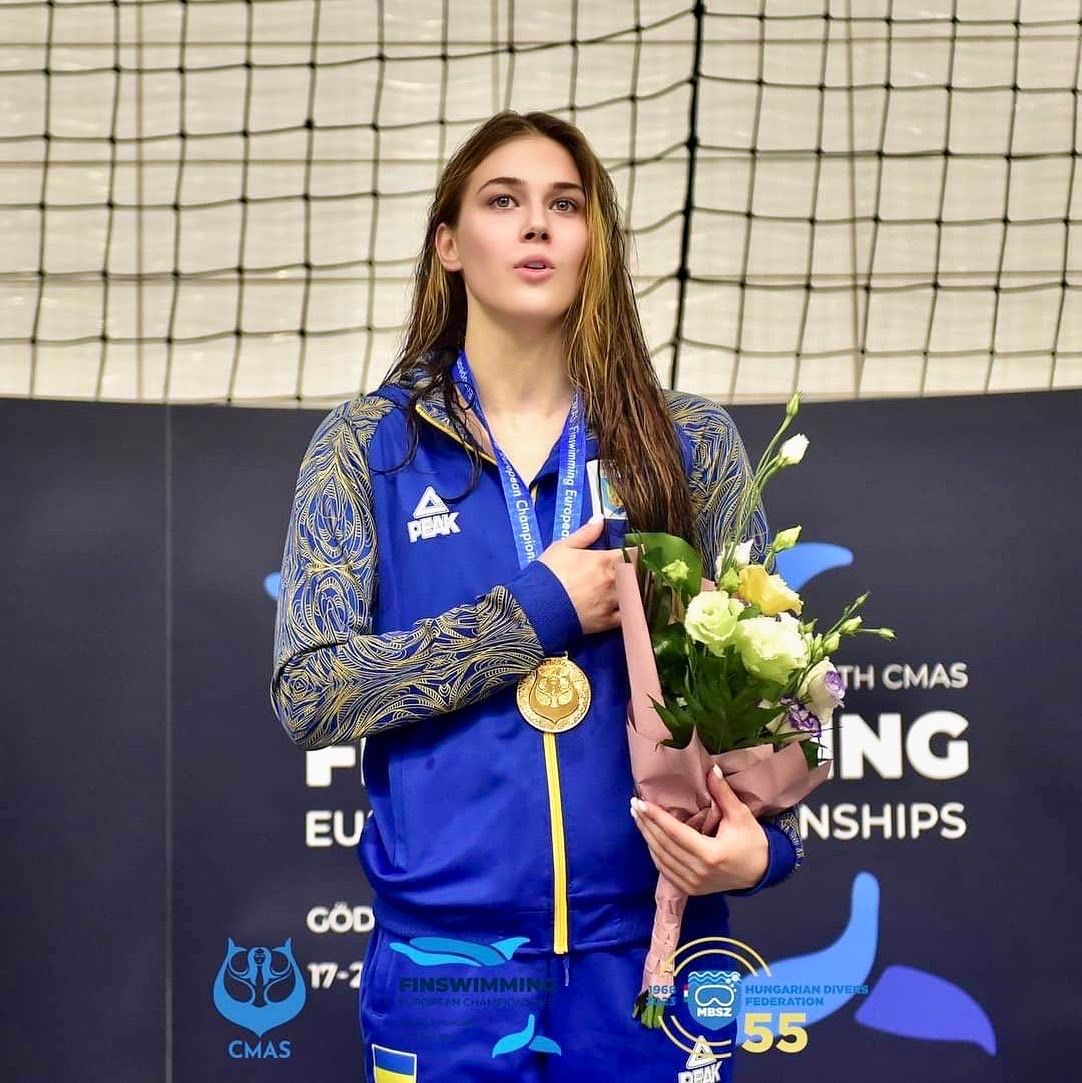
Viktoriia Uvarova of Ukraine with a gold medal at the 2023 CMAS Finswimming European Championships.
Ukraine's Soviet-era inheritance, still on the podium.
MarySport · CC0 · Wikimedia Commons
None of that follows the map of swimming strength. Australia and the United States, which dominate swimming, are marginal here. The reason is that finswimming grew inside CMAS-affiliated diving federations, so the sport took root where those federations were active and funded, not where pools and swimming clubs were most numerous.
That is an unusually clean example of a phenomenon this site keeps finding: a sport's geography is often a map of which institution happened to adopt it rather than of who is best placed to play it. Fistball follows German emigration. Sepak takraw follows childhood exposure. Finswimming follows diving federations.
The facility requirement is the ordinary one and it is a real constraint: a 50-metre pool with lane time available, which is contested everywhere. Where finswimming has to share water with a strong national swimming federation, it generally loses.
05Learning curve
If you can already swim, the first length in a monofin is exhilarating and immediate. Everything after that is a whole-body undulation trained over years, in a sport with clubs in relatively few countries.
Editorial — the site’s reading, not a sourced claim
Barrier to entry
How hard is it to get to a real game?
You must already swim, find a club that owns monofins, and get pool time.
The prerequisite is real: this is not a sport you can begin without being a competent swimmer, and it needs a lane in a pool, which is the most contested facility in amateur sport almost everywhere.
The equipment is the second barrier. A monofin is a specialised item that beginners borrow from a club rather than buy, and clubs exist in a limited set of countries — mostly those with a CMAS-affiliated diving federation that runs racing.
What makes it moderate rather than high is that the first experience is genuinely easy and genuinely thrilling. A swimmer putting on a monofin moves faster than they ever have under their own power, immediately, and the basic dolphin kick is intuitive enough to produce that on the first attempt.
Evidence
- PrerequisiteCompetent swimmingestimate
- FacilityA 50 m pool laneobserved
- Kit to startA club monofin and snorkelrule1976 — the rule this rests on
- ClubsConcentrated in CMAS federation countriesobserved
- Time to a first raceMonthsestimate
Barrier to the top
How hard is it to be good at?
A whole-body undulation at maximal output, in three incompatible respiratory conditions.
Elite finswimming is the fastest human-powered movement in water, and the technique that produces it is a continuous whole-body wave from the chest through the hips to the blade. It is closer to what a dolphin does than to anything in swimming, it takes years to acquire, and small differences in the timing of the undulation produce large differences in speed.
The apnea discipline adds something almost nothing else on this site requires: a 50-metre race, at maximum output, on a single breath. The physiological demand of sprinting anaerobically while also not breathing is a distinct trained capacity.
The equipment is a technical project of its own. A monofin is capped by dimension but not standardised, so blade stiffness and profile are matched to the athlete and to the distance, and part of elite preparation is equipment selection in a way swimming has not permitted since 2010.
The ceiling is capped institutionally rather than athletically. There is no Olympic event, the professional layer is minimal, and the sport's competitive depth is concentrated in a small number of countries.
Evidence
- Three respiratory conditionsSnorkel, one breath, compressed airruleThree physically different events under one sport.1976 — the rule this rests on
- Monofin capped, not standardisedBy dimensionruleEquipment selection is part of preparation, which swimming removed in 2010.1976 — the rule this rests on
- SpeedFaster than swimming over the same distanceobserved
- Typical peak age20–28estimate
Why the two differ
Moderate to very high, and the sport is most interesting held against swimming, which this site covers in depth.
They share a pool, a lane, a touchpad and a start. Swimming's supersuit episode ended with the equipment banned and the records left standing, which is why several of them are still unbeaten. Finswimming faced the same pressure and had no such option, because a finswimmer without a fin is a swimmer. So it did the only other thing available: capped the equipment by dimension, and split the record books by fin type.
That makes it the third distinct answer on this site to the equipment-and-records question — after swimming's ban-and-keep and athletics' redesign-and-reset — and the only one taken by a sport that could not contemplate removing the object in dispute.
The historyhow it got here · sections 6 to 10
06Origin and invention
Finswimming exists because a diving federation decided to hold races.
CMAS — the Confédération Mondiale des Activités Subaquatiques — was founded in 1959 to govern underwater activity broadly: diving instruction, underwater photography, scientific and technical work. Jacques Cousteau was its first president. Racing was one item among many, and the sport that resulted carries the fingerprints of that parentage in a way nothing else on this site does.
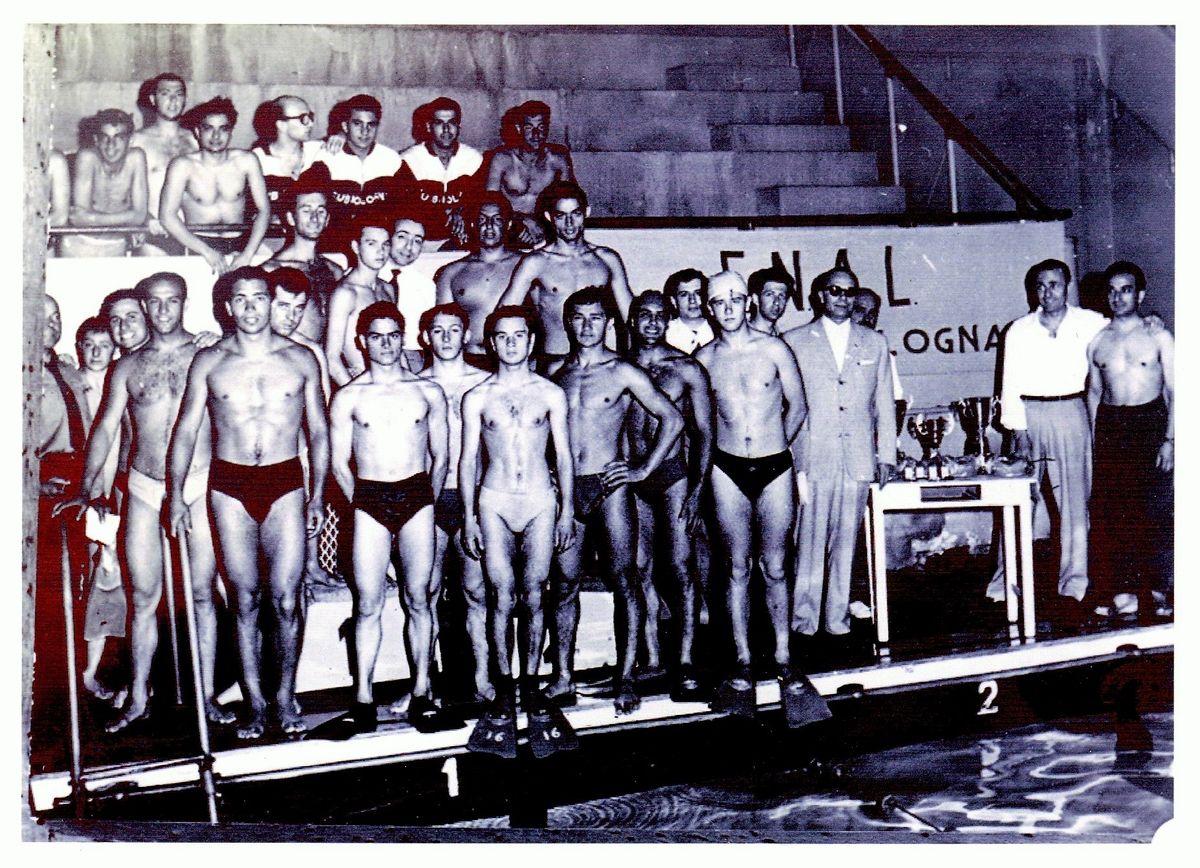
Competitors at a four-club finswimming meet in the covered municipal pool, Bologna, 17 May 1959.
Organised by Franco Pavone of Sub Bologna between clubs from Bologna, Genoa, Milan and Turin, and described by its uploader as the first pool finswimming competition anywhere. It is diving clubs racing: the sport's parentage in one photograph.
Andrea Pavone Coppola · CC BY-SA 4.0 · Wikimedia Commons
Look at the disciplines. Surface is a pool race swum face-down with a snorkel. Apnea is a pool race swum entirely underwater on a single breath. Immersion is a pool race swum underwater carrying an open-circuit compressed-air cylinder. Those are not three formats of one event; they are three answers to the question of how a person breathes, and only a federation whose primary business was being underwater would have organised a racing sport that way.
The monofin is what made it fast. A single blade worn on both feet, driven by a whole-body undulation, moves a swimmer through water substantially quicker than any stroke — finswimming is the fastest human-powered movement in water there is. Development through the 1960s and 1970s, particularly in the Soviet Union and in Italy, turned a diving aid into a racing implement.
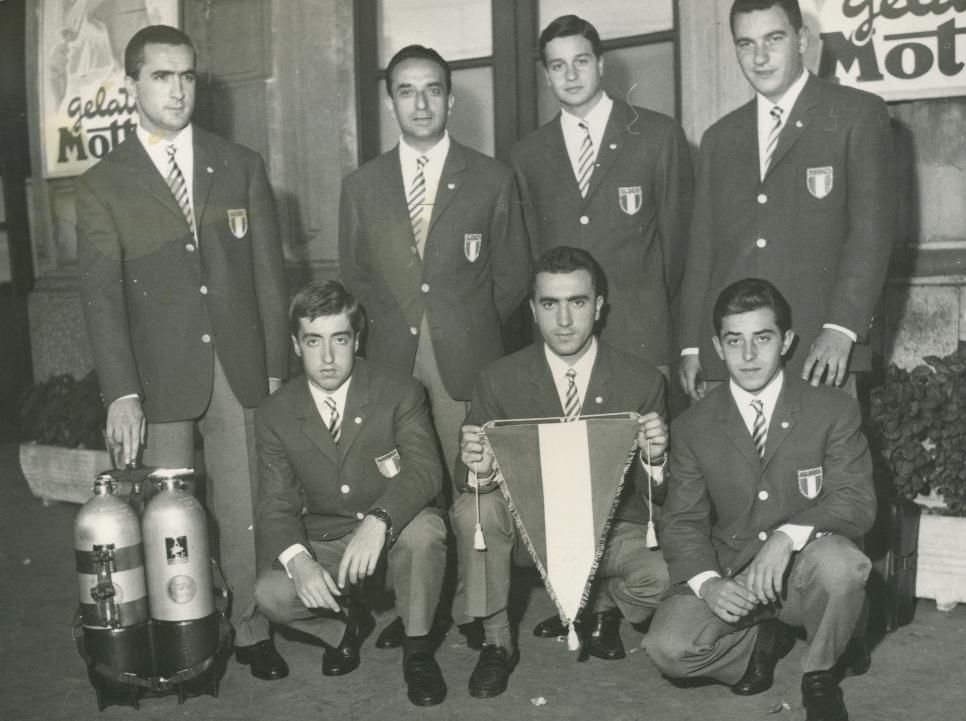
Franco Pavone, centre, with Italy's first national finswimming team in Russia, 1965. Air cylinders stand at their feet.
A national team travelling to the Soviet Union eleven years before there was a world championship to travel to.
Andrea Pavone Coppola · CC BY-SA 4.0 · Wikimedia Commons
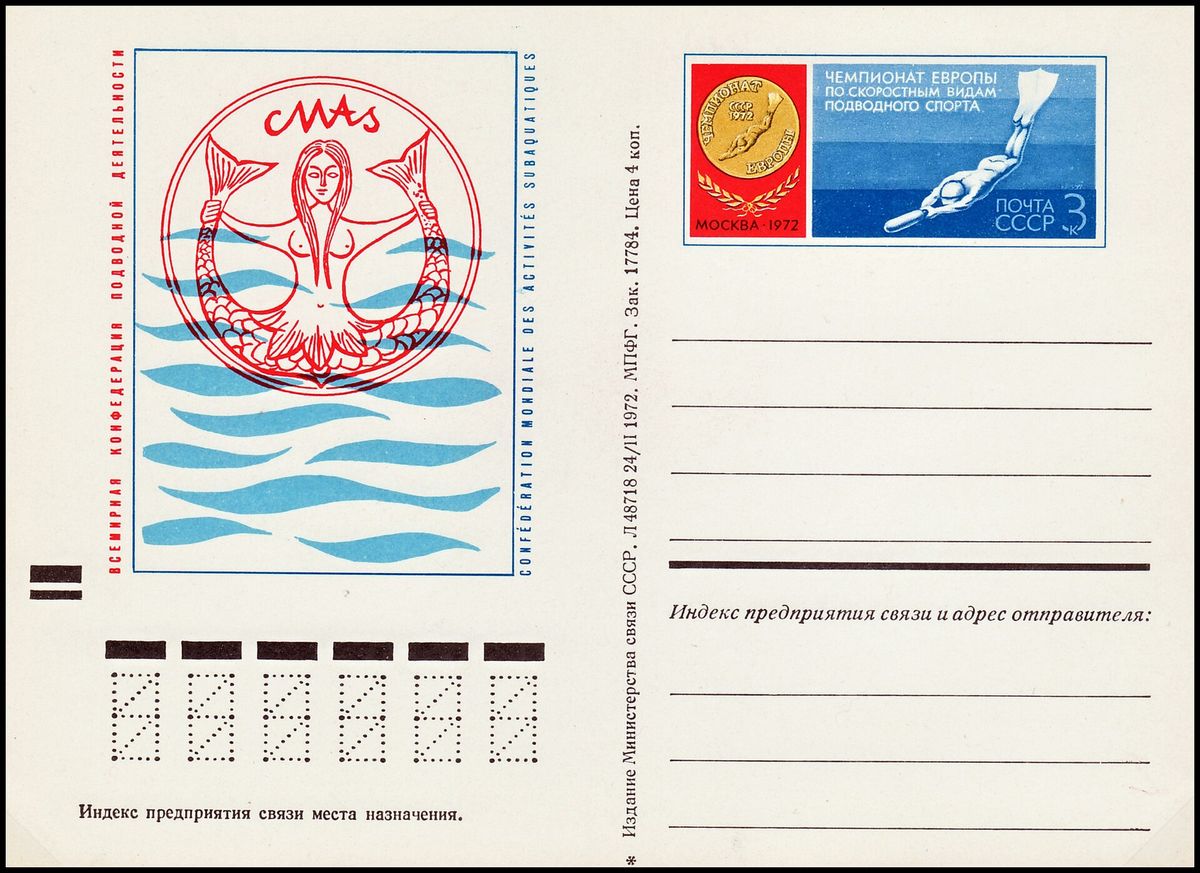
A Soviet postal card for the European Championships in speed underwater sports, Moscow, 1972, with the CMAS emblem and a gold-medal stamp.
The Soviet state printed the sport onto its stationery four years before the first world championships.
Ministry of Communications of the USSR · Public domain · Wikimedia Commons
The first world championships were held in 1976, codifying the disciplines the sport still contests. Finswimming has never been on an Olympic programme, in any form, and is contested at the World Games.
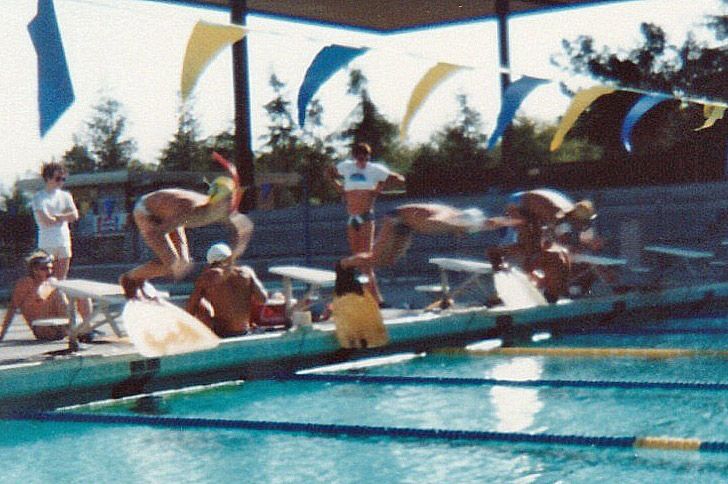
Finswimmers starting from the blocks at the first World Games, Santa Clara, 1981.
Finswimming was on the programme of the first World Games, which is as far as the sport's multi-sport ambitions go.
Jeff in CA · CC BY-SA 4.0 · Wikimedia Commons
07Rule timeline
The sport’s own lane, expanded. Every entry carries a cause from the closed vocabulary and a citation, and says so where the citation is incomplete.
- 1959Participation and accessadopted 1959
CMAS was founded as the world federation for underwater activities, with Jacques Cousteau as its first president, and took responsibility for the racing disciplines alongside diving instruction, underwater photography and scientific work. That inheritance explains the sport's shape. Finswimming is governed by a body whose primary business is being underwater rather than racing, which is why its events include one raced on a single breath and one raced carrying compressed air.
Trigger and citationIncomplete — no confirmed article
Trigger
Recreational and technical diving organisations across Europe had no international body, and the federation formed to hold standards for underwater activity generally rather than for a sport specifically.
CMAS Finswimming Rules · CMAS statutes
- 1976Fairness and eligibilityadopted 1976
The first finswimming world championships were held, codifying the disciplines the sport still contests: surface, swum face-down with a monofin and a snorkel; apnea, swum entirely underwater on a single breath; and immersion, swum underwater carrying an open-circuit compressed-air cylinder. No other racing sport on this site contests events under three different respiratory conditions. One is breathing through a tube, one is not breathing at all, and one is carrying a tank.
Comparability break · Scoped to one competition
Surface, apnea and immersion codified as separate disciplines. Times across them are not comparable. See the series
Trigger and citationIncomplete — no confirmed article
Trigger
Finswimming had developed through the 1960s and early 1970s with national variants, particularly in the Soviet Union and Italy, and world championships required a settled programme.
CMAS Finswimming Rules · CMAS Finswimming Rules, disciplines
- 1976Equipment and technologyalso fairness and eligibilityadopted 1976
The monofin — a single large blade worn on both feet — is regulated by dimension rather than banned or standardised: maximum surface area and dimensions are capped, and materials are broadly open, so fins vary in stiffness and profile between manufacturers and between athletes. Bi-fins events, swum with two conventional fins, are contested as a separate discipline with a separate record book, because a monofin and a pair of fins are not the same sport. This is the site's clearest case of a governing body that cannot reach for the instrument its neighbours used. Swimming banned the polyurethane suits in 2010 and let the records stand. Athletics redesigned the javelin and reset the book. Finswimming can do neither, because without the fin there is no event.
Comparability break · Scoped to one competition
Monofin and bi-fins records are kept apart, because the equipment defines the event rather than assisting it. See the series
Trigger and citationIncomplete — no confirmed article
Trigger
Monofin design advanced quickly once the sport was competitive, and an unregulated blade would have made the equipment the only variable that mattered.
CMAS Finswimming Rules · CMAS Finswimming Rules, equipment
08Equipment evolution
This is the sport where the equipment question has no exit.
The monofin is a single large blade worn on both feet. It converts a whole-body undulation — chest, hips, legs, blade — into propulsion far more efficiently than kicking with separate feet, and it is the reason finswimming is quicker than swimming over the same distance. Blades are made from composites and glass fibre, vary in stiffness and profile, and are matched to the athlete and the distance.
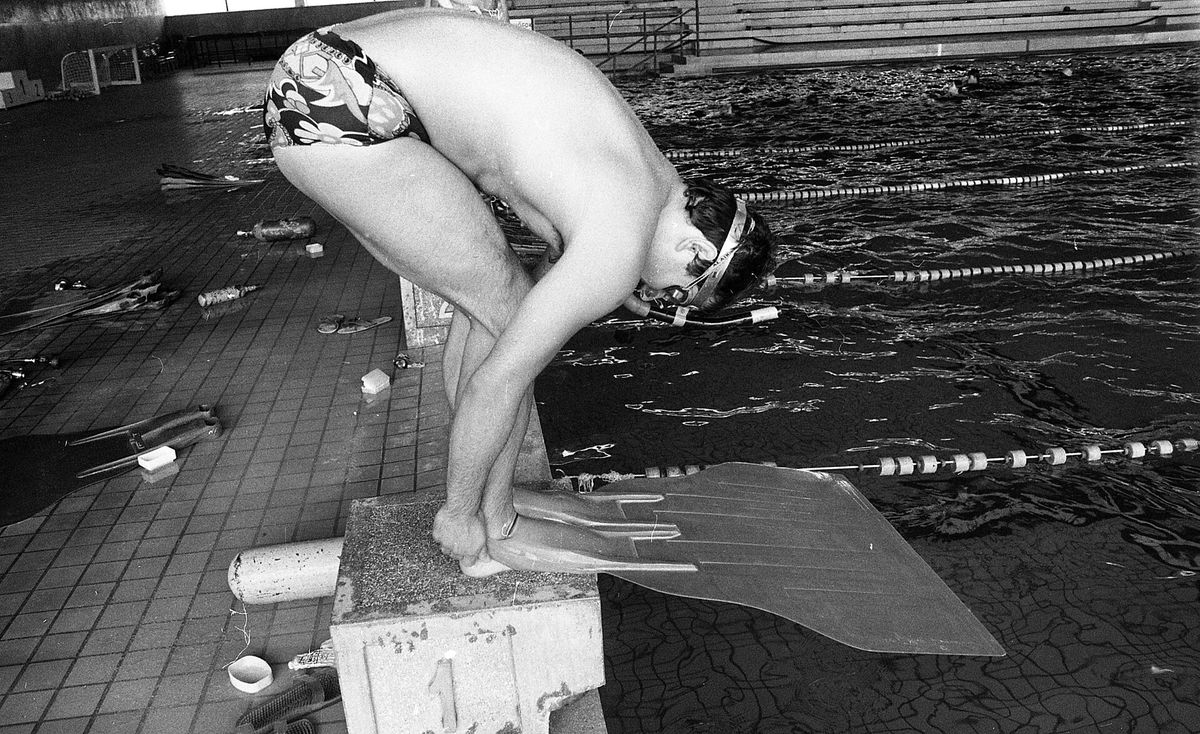
A finswimmer in training at the covered pool on Izsáki út, Kecskemét, Hungary, 1976, a monofin laid over the starting block.
An early monofin: a flat, wide blade on a pair of foot pockets.
Fortepan (donor Tamás Urbán) · CC BY-SA 3.0 · Wikimedia Commons
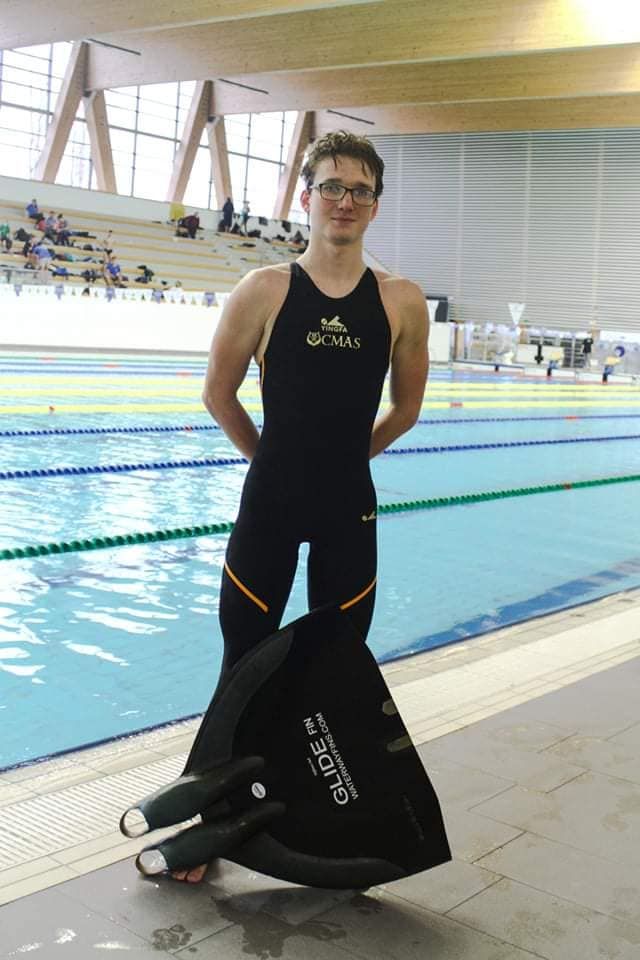
Nándor Kiss in a CMAS racing suit, a modern monofin in his hand.
The same idea, forty-odd years on: a profiled composite blade, capped by dimension and matched to the swimmer.
Finswimmer Magazine · CC BY-SA 4.0 · Wikimedia Commons
CMAS regulates it by dimension: maximum surface area and dimensions are capped, materials are broadly open. That choice is the whole story, and it is worth setting against the two other answers this site records.
- Swimming, faced with polyurethane suits in 2009, banned the suits and let the records stand. Several are still unbeaten.
- Athletics, faced with a javelin flying too far, redesigned the implement and reset the record book.
- Finswimming could do neither. Ban the fin and there is no sport. Redesign it to a single standard and you remove the athlete's ability to match equipment to their own undulation, which is a real part of the craft.
So it capped the dimensions, left the materials open, and split the record book by fin type: monofin records and bi-fins records are kept separately, because two conventional fins and one large blade are not the same event.
A monofin beside a pair of long bi-fins.
One blade on both feet, or one fin on each: two instruments that CMAS keeps in separate record books.
Emma & Michael's Excellent Adventures · CC BY 2.0 · Wikimedia Commons
The other equipment follows the discipline. A large-bore centre snorkel for surface events, so the head never lifts. Nothing at all for apnea. An open-circuit compressed-air cylinder for immersion, carried through the race — the only racing event covered here in which the athlete brings their air with them.
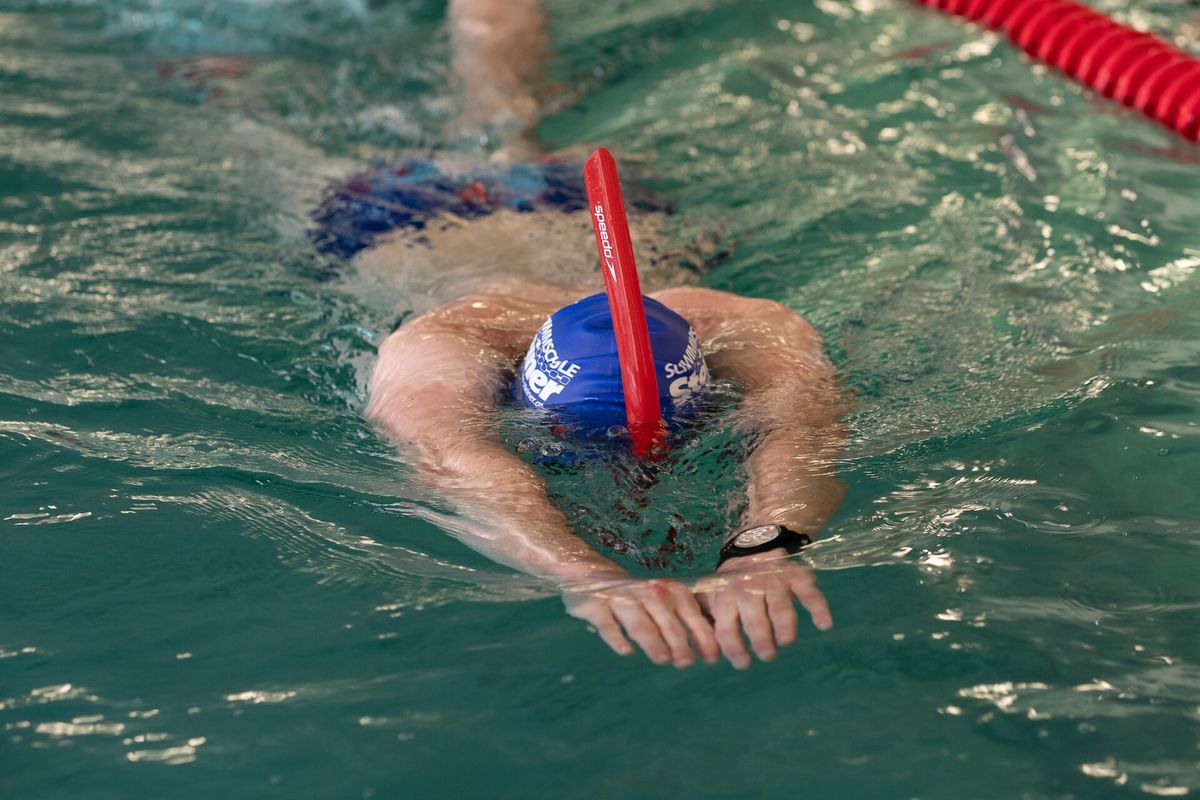
A swimmer with a centre-mounted snorkel running over the forehead.
The surface-event snorkel sits on the centre line rather than at the side, so the head never has to lift or turn.
Schwimmschule Steiner · CC BY-SA 4.0 · Wikimedia Commons
09Governing body politics
Finswimming's governance problem is that it is a swimming sport and swimming's federation has nothing to do with it.
CMAS governs finswimming as one activity among many underwater pursuits. World Aquatics governs swimming, diving, water polo, artistic swimming and open water. The two sports share a pool, a lane, a touchpad, a start and a timekeeping convention, and are institutionally unconnected.
That matters for a specific reason. When a sport wants a place on a multi-sport programme, it competes against sports in its own category, and finswimming's category is already fully occupied by a federation with five Olympic disciplines and a century of standing. A pool sport arriving from the diving federation has no obvious route in.
CMAS's own priorities are also not primarily competitive. It certifies divers, sets technical standards, and runs scientific and environmental programmes; a racing discipline is a smaller part of its work than finswimming's athletes would like. This is a milder version of the tension recorded on this site for lifesaving, whose federation is a drowning-prevention body first.
Where finswimming has done well is the World Games, which is the intended home for exactly this kind of sport: organisationally mature, genuinely international, and with no plausible Olympic path.
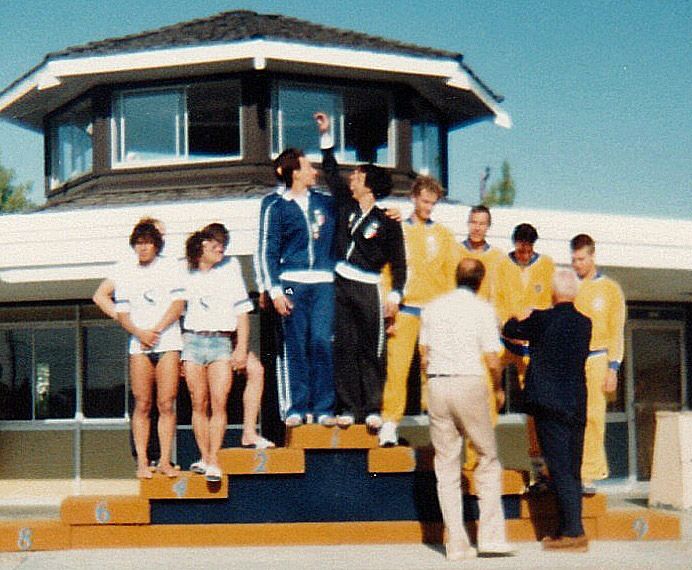
The finswimming relay medal ceremony at the first World Games, 1981.
The World Games: the intended home for a mature, international sport with no Olympic route.
Jeff in CA · CC BY-SA 4.0 · Wikimedia Commons
The sport's geography reflects a further political inheritance. Its historic strength is in Russia, Ukraine, Italy, Hungary, China, Colombia and Greece — substantially the countries where state or club diving federations invested in racing, rather than the countries that are strongest in swimming.
10Controversies that forced rule changes
Capping the fin. The recurring one. Monofin design advanced quickly once the sport was competitive, and an unregulated blade would have made equipment the only variable that mattered. CMAS capped surface area and dimensions and left materials open — a partial answer that keeps equipment selection in the sport, deliberately, and is periodically argued about for exactly that reason.
Splitting bi-fins off. Two conventional fins and one monofin produce different speeds and different techniques, and pooling them would have made one of them pointless. The sport separated them into disciplines with separate records rather than choosing between them — the same instrument powerlifting used for raw and equipped, and cycling for the hour record.
Apnea safety. Racing 50 metres underwater at maximum output on a single breath carries a hypoxic blackout risk, and the supervision requirements around apnea competition exist because of it. It is the sport's real safety question and it is handled by protocol rather than by changing the event.
Immersion and the cylinder. An event in which the athlete carries compressed air raises equipment questions no other racing sport has: cylinder type, valve configuration and what counts as an open circuit. The rules are technical diving rules imported into a race.
Which federation should govern it. Not a rule change and arguably the sport's largest structural issue: a pool racing sport administered by an underwater-activities body, in a world where the pool federation is one of the most powerful in the Olympic movement.
Where it standsthe record, and what is still open · sections 11 to 12
11Series
No series published
World record progression
Finswimming keeps world records and they are, within a discipline and a fin type, genuinely comparable — which makes this one of the few absences on this site caused only by the figures not having been assembled from a cited source rather than by anything in the sport. What the sport does have is a record book divided more finely than most. Surface, apnea, immersion and bi-fins are four physically different events; a monofin time and a bi-fins time over the same distance are two different measurements and are never pooled. The reason this page exists rather than a chart is worth stating, because it is the site's central question answered a third way. Swimming faced polyurethane suits in 2009, banned them, and let the records stand — which is why several remain unbeaten. Athletics faced the javelin in 1986, redesigned it, and reset the book. Finswimming has never been able to consider either, because an athlete without a fin is not competing in this sport at all. So it caps the fin by dimension, leaves materials broadly open, and splits the book by fin type. Equipment selection remains part of the sport, openly, and the records carry that with them.
1976Scoped to one competitionSurface, apnea and immersion codified as separate disciplines. Times across them are not comparable.
1976Scoped to one competitionMonofin and bi-fins records are kept apart, because the equipment defines the event rather than assisting it.
12What is contested now
Recorded as unsettled.
How much the fin should be allowed to do. Dimensions are capped and materials are open, so blade design is a live technical field and part of elite preparation. Whether that is a legitimate craft or an unpoliced performance variable is argued, and it is the same argument powerlifting has about supportive equipment.
Whether the record books should stay split. Monofin and bi-fins, surface and apnea and immersion — the sport keeps several books, which is honest and which fragments an already small competitive field.
Which federation should govern a pool sport. Finswimming is administered by an underwater-activities body while the pool is institutionally owned by another federation entirely. Nothing about this is likely to change, and it constrains every ambition the sport has.
Apnea's risk. Racing underwater at maximal output on one breath carries a blackout risk managed by supervision protocol rather than by altering the event. Whether that is sufficient is a question the sport revisits.
Olympic prospects. There are none in view. Finswimming is faster than swimming, contested internationally since 1976, and has no path onto a programme where the aquatic slots belong to somebody else. The World Games is, realistically, the ceiling — which the sport has largely accepted, and which makes it one of the more clear-eyed federations covered here.