Fencing
Made a judged sport measurable in three instalments across fifty-two years, one weapon at a time.
- Official
- Fencing
- Game category
- Outside this taxonomy
- Adjudication
- Combat
- Standing
- Never off
- rule changes
- 5
- comparability breaks
- 3
- Olympic editions
- 31
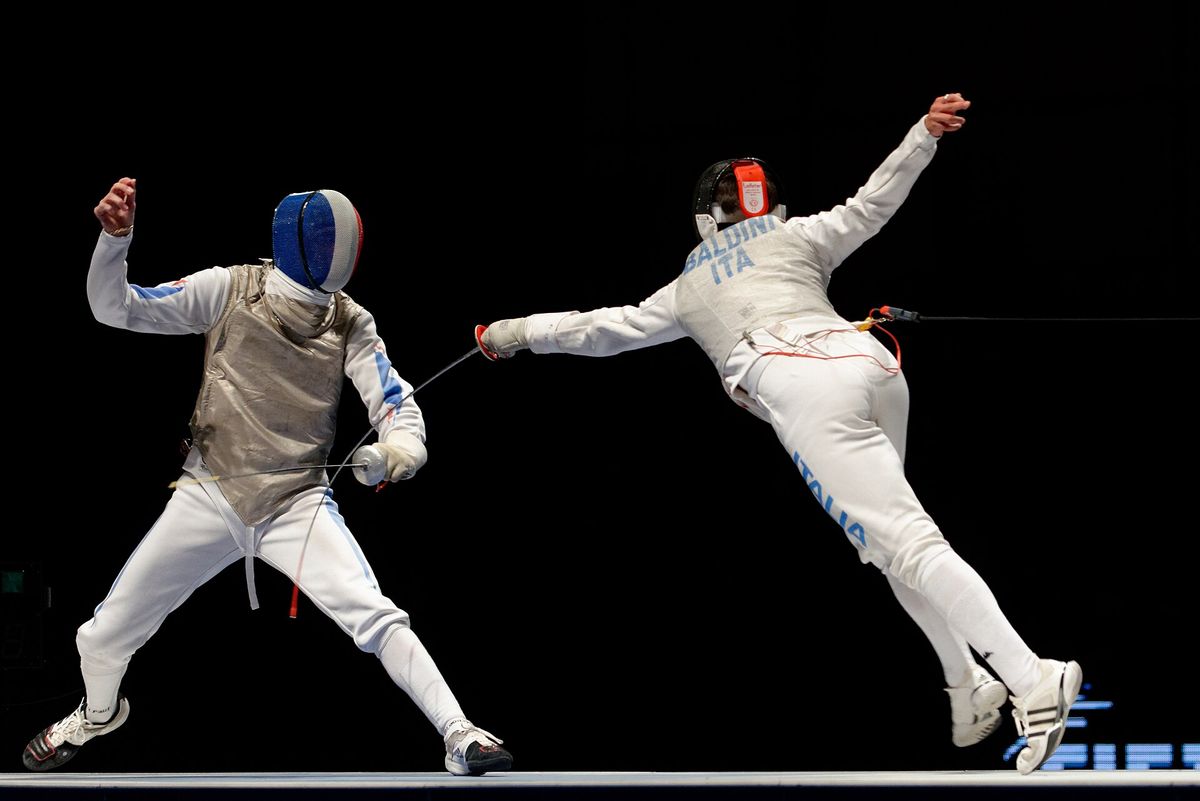
Jérémy Cadot of France parrying a flèche from Andrea Baldini of Italy, foil, Paris, 2013 · Marie-Lan Nguyen · CC BY 2.5
- Governing body
- Fédération Internationale d'Escrime
- Founded
- Fédération Internationale d'Escrime founded 1913.
- Olympic status
- 31 editions
- on the 2028 programme
- Also contested at
- Asian Games
Taekwondo installed sensors in 2009 and stopped being a judged sport overnight. Fencing did the same thing fifty years earlier and took half a century to finish: épée was electrified in 1936, foil in 1957 and sabre in 1988. Each time, a hit stopped being something four judges agreed they saw and became something a circuit registered — and each time the sport that weapon produced changed within a season.
The gamewhat it is now · sections 1 to 5
01How it is played
Three weapons, three different sports, one federation. Épée is the whole body and no priority; foil is the torso with priority; sabre is everything above the waist, with the edge, with priority. Almost every rule in fencing is a rule about one weapon, which is why this sport electrified in three instalments rather than once.
These figures were entered from the edition named above but have not been checked against its text line by line. Treat them as this site’s reading of the laws, not as a substitute for them.
The object of the bout
Hit the opponent's valid target area without being hit, or — in the two weapons with priority — hit them while holding right of way.
Right of way is the concept that makes foil and sabre unlike anything else on this site. If both fencers land, the point goes to whoever had the attack, and a referee decides which that was. So two of fencing's three weapons are measured and judged at the same moment: the machine says who landed, a human says who deserves it.
The piste
A narrow strip. Fencing is the only combat sport here contested on a line rather than in an area, which means retreat is finite: run out of piste and the opponent scores.
- Piste length
- 14 m
- Piste width
- 1.5–2 m
- Retreating off the end
- A hit against you
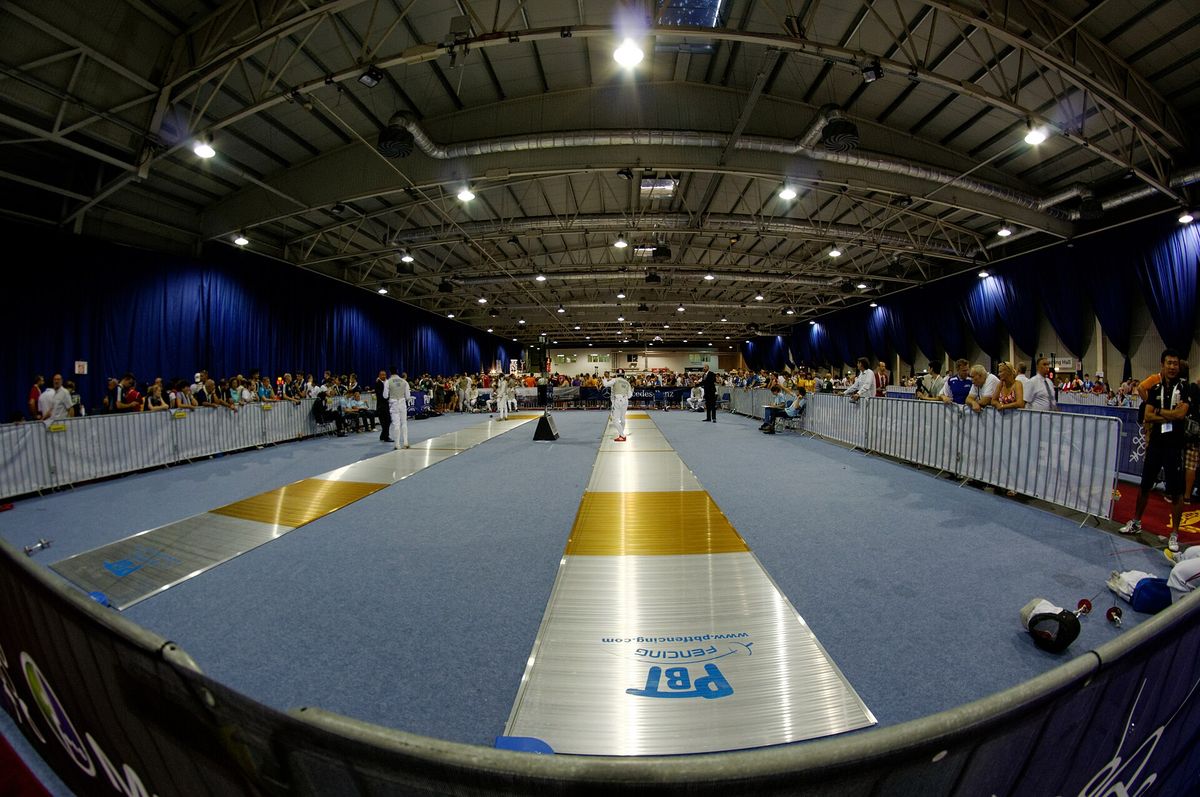
Pistes in Hall B at the 2013 World Championships, Budapest, during the team épée.
Fourteen metres by one and a half to two, with the lines and warning zones marked on a conductive strip.
Marie-Lan Nguyen · CC BY-SA 3.0 · Wikimedia Commons
Weapons and apparatus
A blade, a conductive jacket, a mask, a body wire and a scoring machine. In modern fencing the equipment is the referee for the question of whether a hit landed, which is why the Material Rules are a separate book from the Technical Rules and why this sport's largest changes are in the first of them.
Blades must be maraging steel, which fails without producing the long sharp fragment ordinary steel produces, and masks and uniforms must resist puncture to a stated force. Those requirements date from 1984 and exist because a fencer was killed by a broken blade in 1982.
- Blade steel
- Maraging
- Uniform
- Puncture-resistant to a stated force
- Épée electrified
- 1936
- Foil electrified
- 1957
- Sabre electrified
- 1989
Fencers and officials
Two fencers and one referee. The referee's job has shrunk enormously since electrification — they no longer decide whether a hit landed — and what remains is priority, which is the hardest judgement in the sport and the only one that has never been mechanised.
Video review is available to fencers in the form of a limited number of appeals, and it reviews the referee's priority call rather than the apparatus.
Format
Individual bouts run to fifteen hits or nine minutes of fencing time, in three periods. Pool bouts run to five hits. Team matches are a relay of nine bouts to a cumulative forty-five.
- Direct elimination bout
- 15 hits or 9 min
- Pool bout
- 5 hits
- Team match
- 45 hits, relay of 9
Scoring
One hit, one point, and what counts as a hit depends entirely on the weapon. Épée: anywhere on the body, and if both land within about forty milliseconds both score. Foil: torso only, one point to whoever had priority. Sabre: everything above the waist including the head and arms, with the edge or the point, priority again.
Before electrification all of this was decided by watching. The apparatus answers the first question and has never been able to answer the second.
- Épée target
- Whole body
- Foil target
- Torso
- Sabre target
- Above the waist
- Double hit
- Both score, in épée only
This clause reads this way because of
Between hits
The referee halts after every exchange and returns the fencers to guard, so a bout is a sequence of discrete engagements rather than continuous play.
The timing intervals inside the scoring apparatus govern which of those exchanges register as one hit or two, and revising them in sabre in 2005 changed the weapon's dominant style within a season without a word of the conduct rules changing.
This clause reads this way because of
Penalties
Cards rather than points, mostly: yellow for a first offence, red for a hit against, black for exclusion. Offences include bodily contact, turning the back, covering the target, and — in sabre since 1989 — crossing the feet, which had made a running attack possible.
There is also a substantial body of rules about equipment that fails testing, because in a sport where the apparatus decides the point, a faulty body wire is a competitive matter.
This clause reads this way because of
Deciding the winner
Fifteen hits, or the higher score when time expires. A bout tied at time goes to a one-minute period with priority randomly assigned in advance — so if nobody scores, the fencer who was awarded priority by lot wins. That is the only coin toss deciding a result anywhere on this site.
Everything above is current law. Everything below is how Fencing got here.
02Disciplines and events
Twelve Olympic events — three weapons, individual and team, for each sex. For decades the programme rotated, dropping some team events each Games because of quota limits, and only recently settled at the full twelve.
- Disciplines
- 3
- Olympic medal events
- 12
- Men’s and women’s counted separately.
- Contested elsewhere
- 2
- paralympic, world championship.
- Listed for context
- 1
- Not counted as this sport.
Foil4
Torso only, with right of way. Electrified 1957.
- Men's individual
- Women's individual
- Men's team
- Women's team
Épée4
Whole body, no priority, and double hits score for both. Electrified 1936.
- Men's individual
- Women's individual
- Men's team
- Women's team
Sabre4
Above the waist, edge and point, with right of way. Electrified 1989.
- Men's individual
- Women's individual
- Men's team
- Women's team
Contested away from the Games2
- Wheelchair fencingParalympic
- Veterans competitionWorld championship
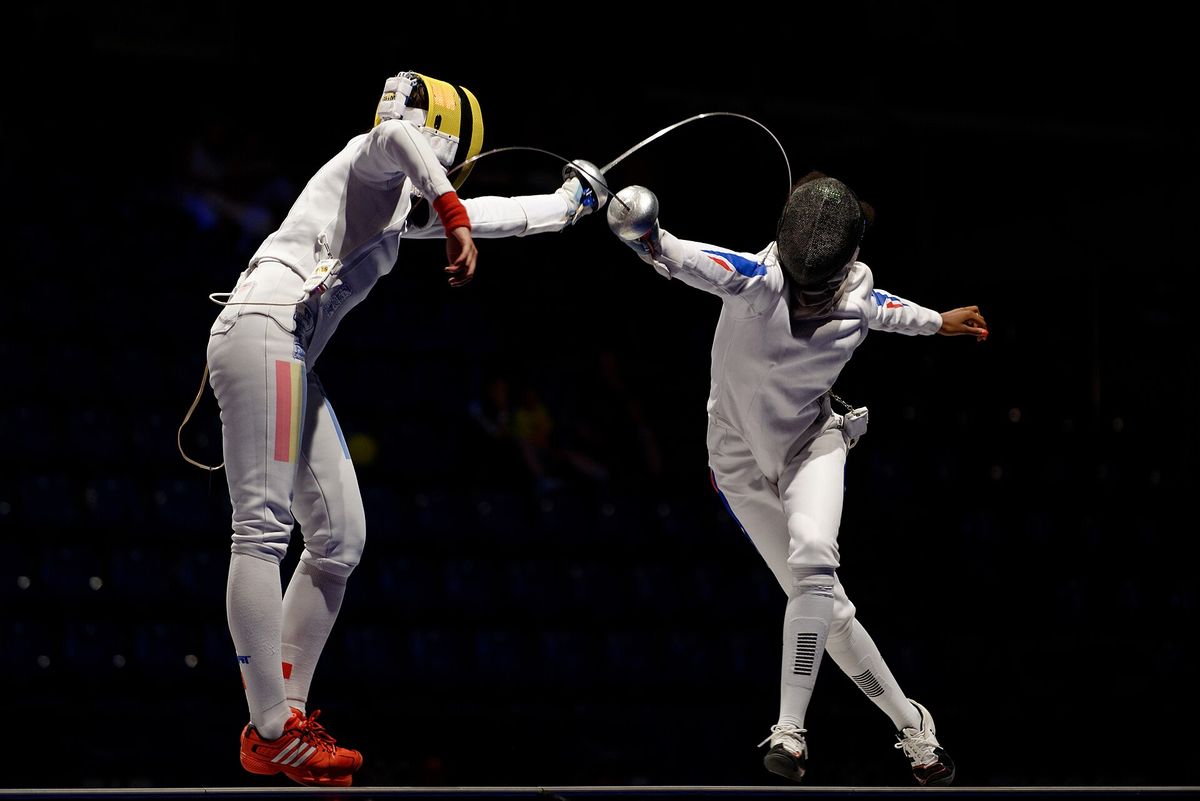
Ana Maria Brânză of Romania against Lauren Rembi of France in the team épée bronze match, 2013 World Championships.
Individual and team events in all three weapons, for women and men: twelve in all.
Marie-Lan Nguyen · CC BY 3.0 · Wikimedia Commons
03Officiating and technology
Fencing is the best illustration on this site of a boundary that keeps appearing: a machine can answer what happened, and cannot answer what it meant.
What happened was solved in three stages. Épée in 1936, foil in 1957, sabre in 1989. A hit now registers because a circuit closed, and the four side judges who used to decide it no longer exist. That is a category of official abolished by technology, which puts fencing alongside tennis and its line judges — except fencing did it seventy years earlier and did not stop being a judged sport, because of what was left.
What it meant is priority, and it has never been mechanised. In foil and sabre, when both fencers land, the point goes to whoever had right of way — whoever's attack was correctly formed and initiated first. That is a judgement about the structure of an action rather than about a position at an instant, which is exactly the class of question that football's handball law asks and that no camera has ever settled anywhere on this site.
So a modern fencing referee has one job, and it is the hard one. Video appeal exists in a limited form and reviews the referee's priority call, which means the review is a second opinion rather than a measurement.
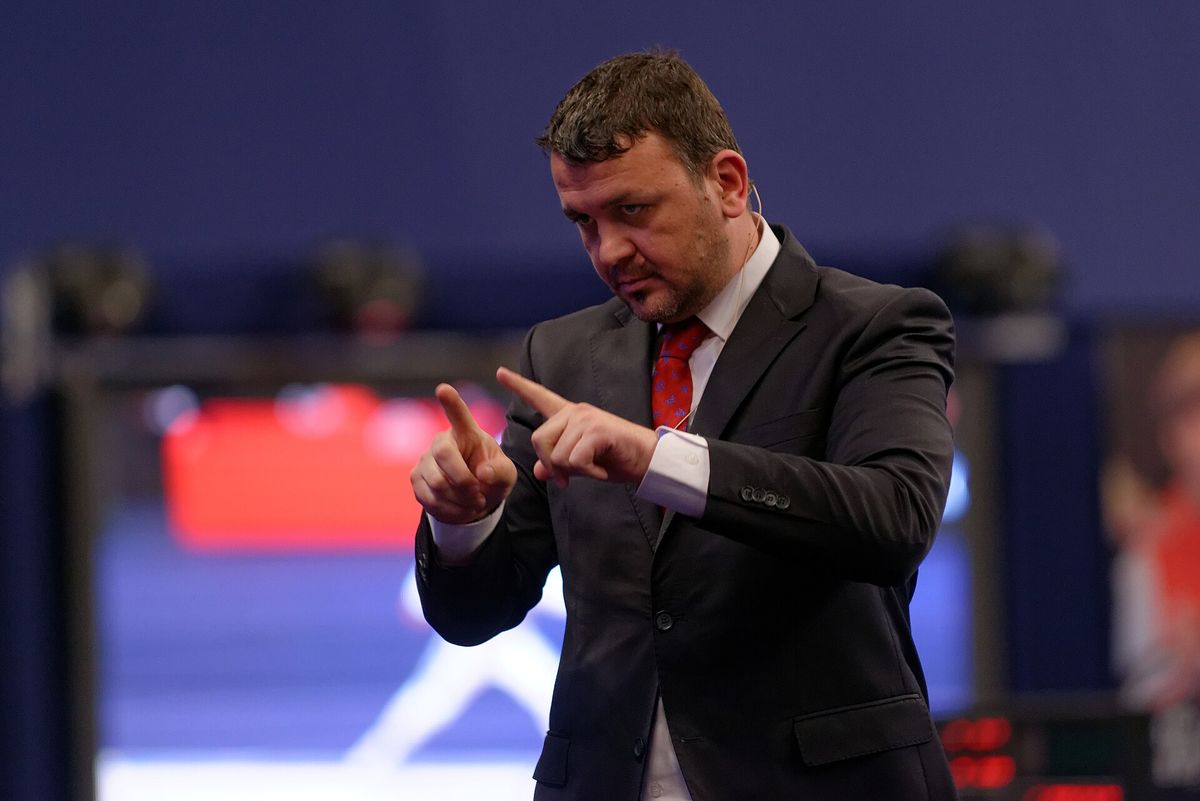
Referee Florin Gheorghe asking for video review in the final of the Challenge International de Paris, 2014.
The machine has already said that both fencers hit. The referee is deciding priority, the one judgement fencing has never mechanised.
Marie-Lan Nguyen · CC BY 3.0 · Wikimedia Commons
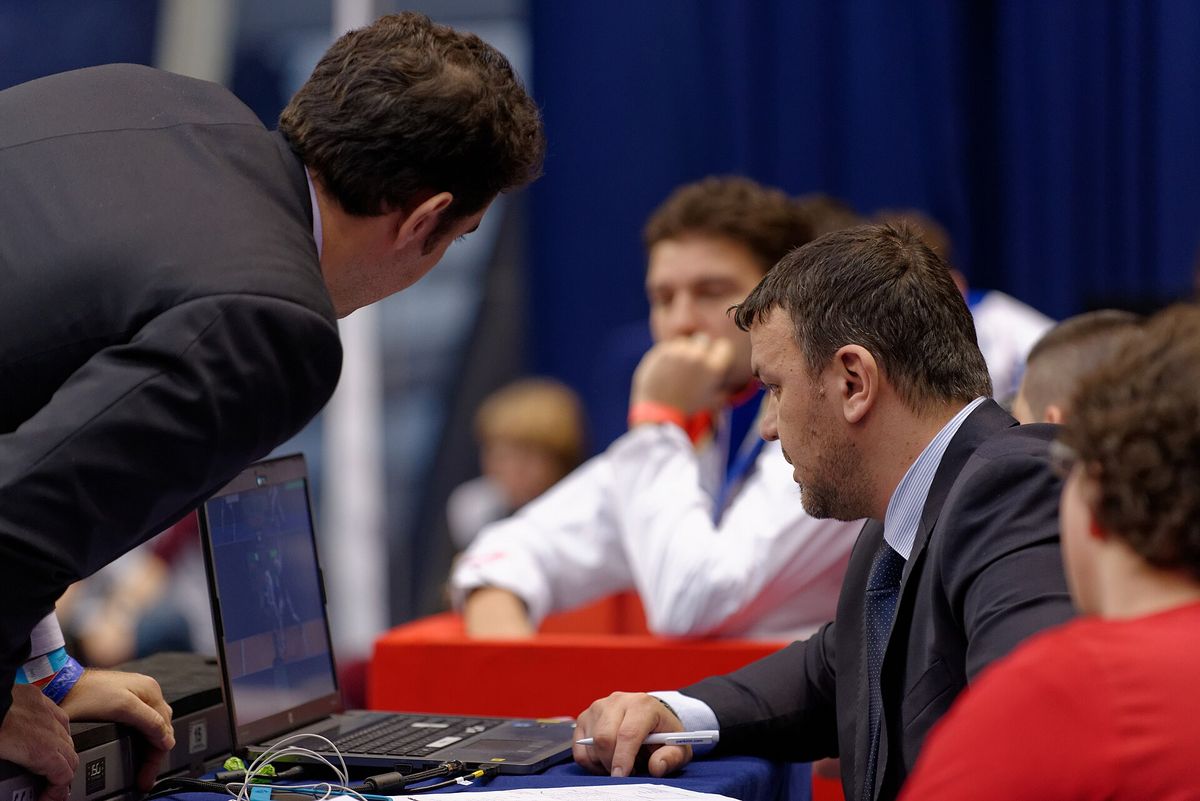
The referee and the video consultant watching a replay together, Challenge International de Paris, 2014.
A second opinion on a judgement, rather than a measurement.
Marie-Lan Nguyen · CC BY 3.0 · Wikimedia Commons
The apparatus itself has become an officiating instrument in a subtler way. Its timing constants decide which exchanges register as one hit and which as two, and the federation sets them. That is a rule with no words, applied by equipment, and revising it in sabre in 2005 did more to that weapon than any rule change in its history.
04Where it is played
Fencing's map is Europe plus a small number of deliberate outliers, and the outliers are the interesting part.
Italy, France, Hungary and Russia have dominated for a century, and the reason is institutional continuity: fencing academies, military and civilian, that have run without interruption for generations. Germany, Poland, Ukraine and Romania add depth. This is one of the oldest and most stable competitive maps on this site.
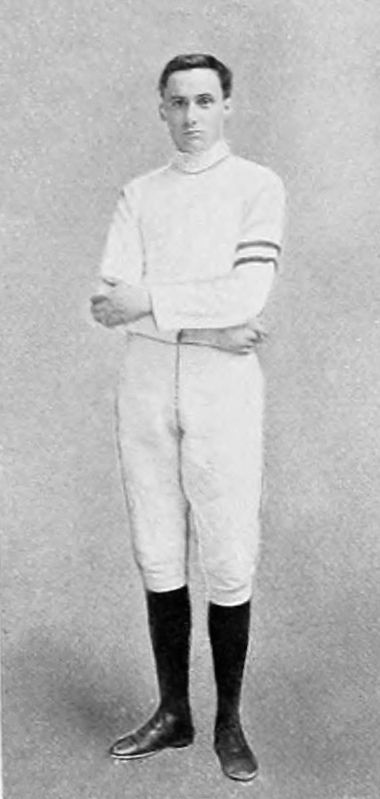
Nedo Nadi of Italy at the 1912 Stockholm Olympics.
A product of the Italian fencing tradition that, with France, Hungary and Russia, has dominated for a century.
IOC photographer · Public domain · Wikimedia Commons
The additions are South Korea, China, Japan and the United States, and each arrived by a decision rather than by tradition. South Korea in particular identified fencing as a sport where investment could produce medals against a concentrated European field, built a programme around sabre, and became a leading nation within about two decades. That is a strategy this site has seen before — Britain's track cycling programme is the closest parallel.
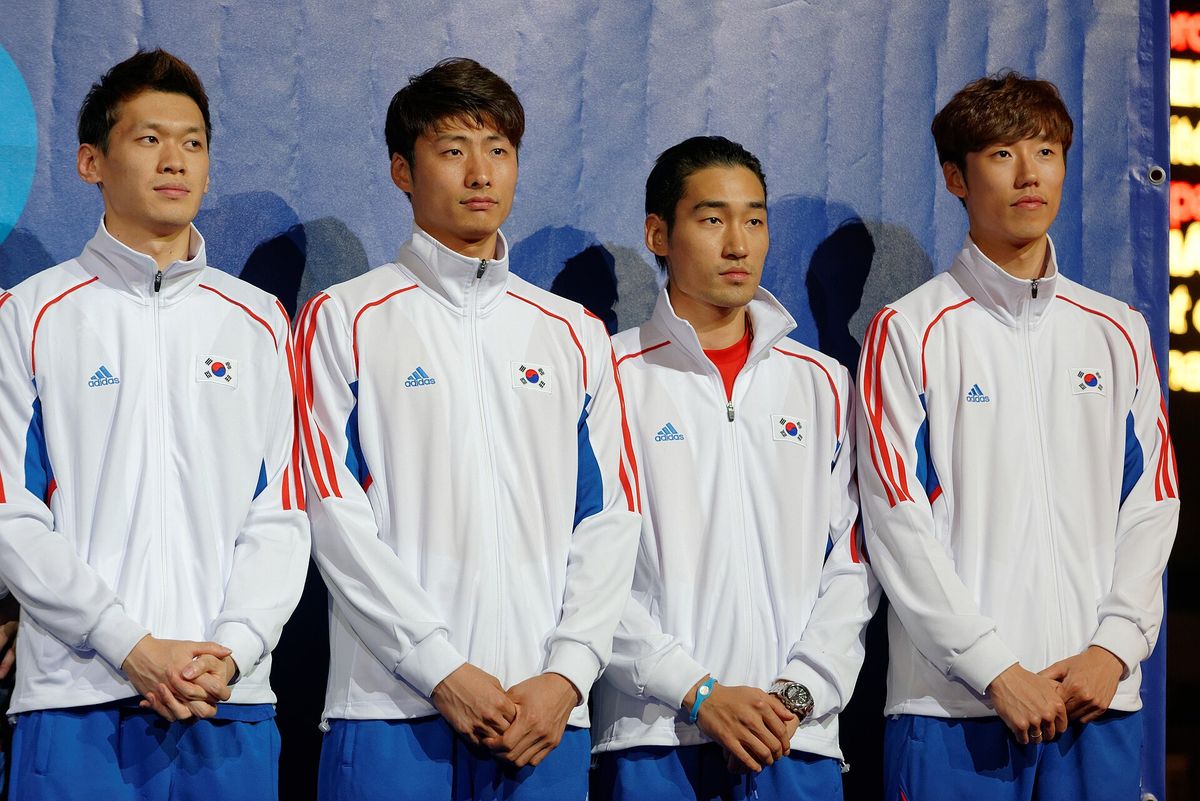
South Korea's men's sabre team — Gu Bon-gil, Kim Jung-hwan, Oh Eun-seok and Won Jun-ho — on the podium at the 2013 World Championships.
A national programme built deliberately around sabre, and one of the few changes to fencing's century-old map.
Marie-Lan Nguyen · CC BY 3.0 · Wikimedia Commons
Egypt and several other African and Middle Eastern nations have produced world medallists in recent years from very small bases.
The barrier keeping the map narrow is equipment and coaching rather than facility. A piste and a scoring machine are affordable; a coaching tradition that knows how to teach priority is not, and it cannot be bought quickly. That is why fencing's geography has changed by deliberate national programmes rather than by diffusion, and why it has changed so little otherwise.
05Learning curve
A sport whose entry barrier is almost entirely equipment and coaching rather than physical, and whose elite version demands a decision speed that sits at the edge of human reaction. Fencing is also the only sport here where a beginner must learn a rule — right of way — before they can understand who won a point they just watched.
Editorial — the site’s reading, not a sourced claim
Barrier to entry
How hard is it to get to a real game?
A club, a coach, several hundred pounds of kit, and a rule you cannot see.
Fencing cannot be improvised. It needs a piste, a scoring machine, a mask, a jacket, a body wire and a weapon, and it needs a coach because the actions are unintuitive and the equipment is dangerous without instruction. Clubs lend kit to beginners, which is the only reason the barrier is high rather than very high.
The distinctive difficulty is conceptual. In foil and sabre, both fencers frequently land, and the point goes to whoever had priority — a rule about who initiated a correctly formed attack. A beginner watching a bout cannot tell who scored or why, and neither can most spectators. No other sport on this site requires you to learn a rule in order to perceive the result.
Evidence
- Kit to startMaskobserved
- FacilityA club with a piste and a scoring machineobserved
- Coach neededYesestimate
- Weapons to choose between3observedThey are close to different sports; most fencers specialise early.
- Time to understand priorityMonthsestimate
Barrier to the top
How hard is it to be good at?
Decisions inside a fifth of a second, on a strip where retreat runs out.
Elite fencing exchanges happen faster than deliberate reaction allows, so the skill is largely pre-loaded: reading distance and tempo well enough to have already chosen. The physical demand is real but the decision demand is what separates the top.
Three of the sport's changes have moved that target under its athletes. Each electrification changed what registers as a hit, and the sabre timing revision in 2005 changed which actions the machine rewards without changing a single rule about what a fencer may do — a whole dominant style became unrewarding in a season.
That is an unusual kind of instability. Judo removed techniques and said so. Fencing adjusted a constant inside a box.
Evidence
- Sabre timing revised2005ruleA dominant style stopped working, with no change to the rules of conduct.2005 — the rule this rests on
- Sabre electrified1989ruleAnd crossing the feet prohibited at the same time.1989 — the rule this rests on
- Blade and mask standards1984ruleWritten after a fencer was killed by a broken blade in 1982.1984 — the rule this rests on
- PriorityStill a referee's judgementobservedThe one thing seventy years of apparatus has not mechanised.
- Typical peak age24–32estimate
Why the two differ
Fencing's gap is high-to-very-high rather than low-to-very-high, and the reason is that its beginner's version is not simpler than its elite version, only slower. There is no informal fencing.
What it shares with taekwondo is the instrument, and the comparison is the point of having both. Taekwondo automated its scoring in one act in 2009 and has spent fifteen years chasing the consequences. Fencing automated in three acts across fifty-two years and had the same experience three times, weapon by weapon. Both sports discovered that once a machine decides what scores, athletes optimise for the machine — and both responded by adjusting the machine rather than the rules.
The historyhow it got here · sections 6 to 10
06Origin and invention
Fencing descends from the duel, and the three weapons are three different answers to the question of what a duel was for.
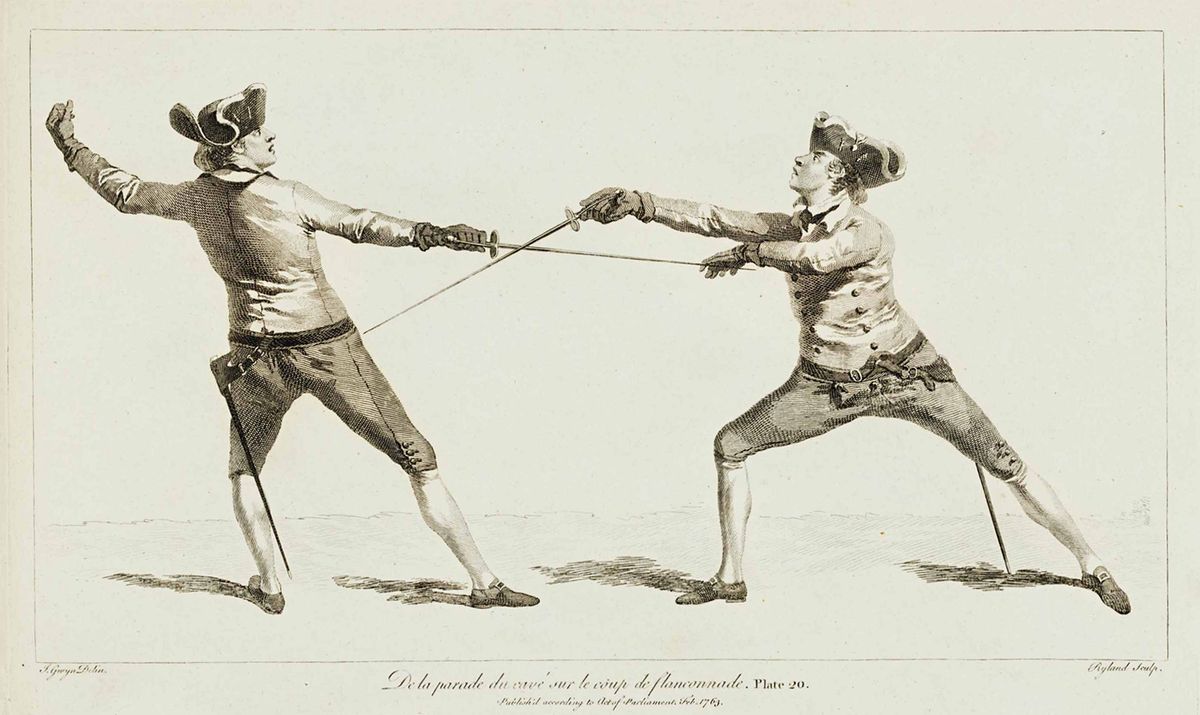
A plate from Domenico Angelo's The School of Fencing, London, 1765.
The smallsword of the eighteenth-century gentleman, taught as an art: the weapon and the world the three modern weapons were inherited from.
Domenico Angelo · Public domain · Wikimedia Commons
Épée is the duelling sword itself. The whole body is target because a real duel had no target restrictions, and there is no priority because in a real duel there was no referee to award one — if both parties hit, both were hit. Épée's rules are the closest thing on this site to a sport that simply describes what would have happened.
Foil was the practice weapon. Its restricted target — the torso — reflects where a killing thrust was aimed, and its right-of-way convention is a training rule: do not fling yourself onto your opponent's point to score, because in the real thing that kills you. Foil's priority rules are an artefact of a sport teaching survival.
Sabre is the cavalry weapon. Target is everything above the waist because that is what a mounted opponent could reach, and it scores with the edge because a sabre cuts.
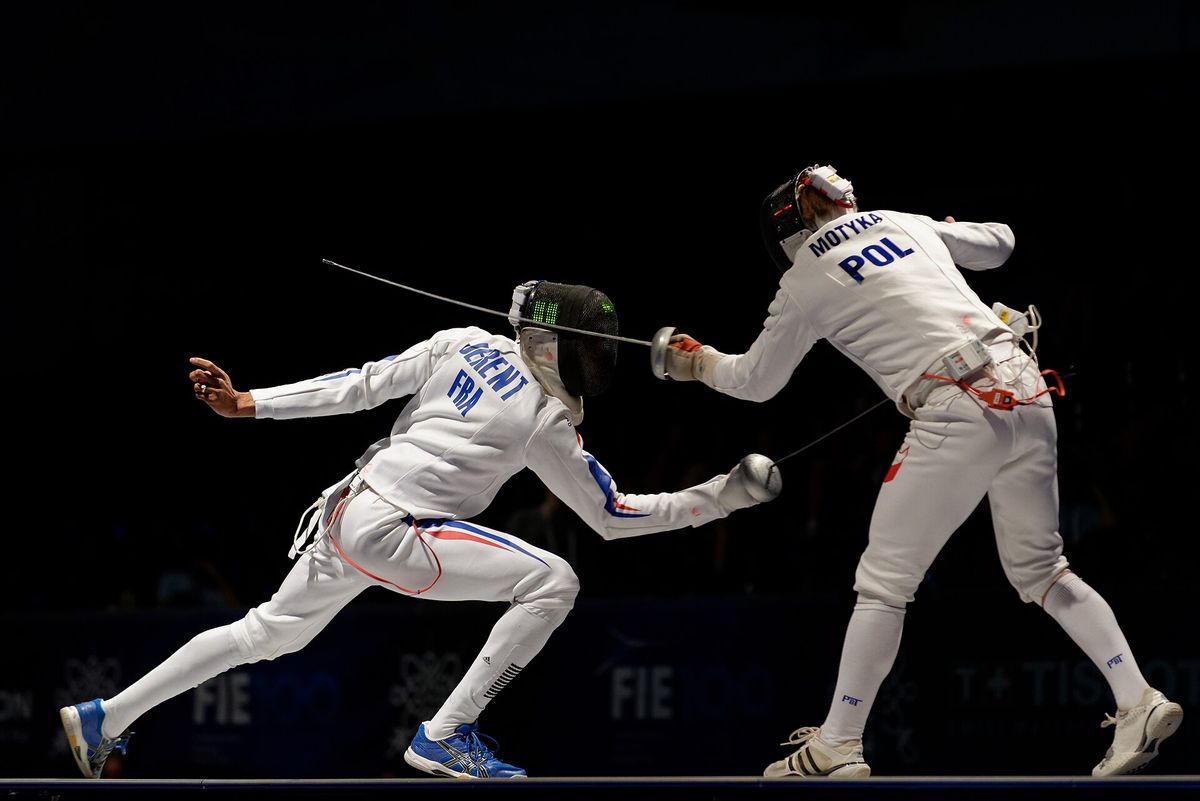
Daniel Jérent of France against Tomasz Motyka of Poland in team épée, 2013 World Championships, Budapest.
Épée, the duelling sword: the whole body is target, no conductive jacket is needed, and if both land, both score.
Marie-Lan Nguyen · CC BY 3.0 · Wikimedia Commons
Jérémy Cadot of France parrying a flèche from Andrea Baldini of Italy, foil, Paris, 2013.
Foil, the practice weapon: the torso-only target is covered by the metallic jacket, and when both land, right of way decides.
Marie-Lan Nguyen · CC BY 2.5 · Wikimedia Commons
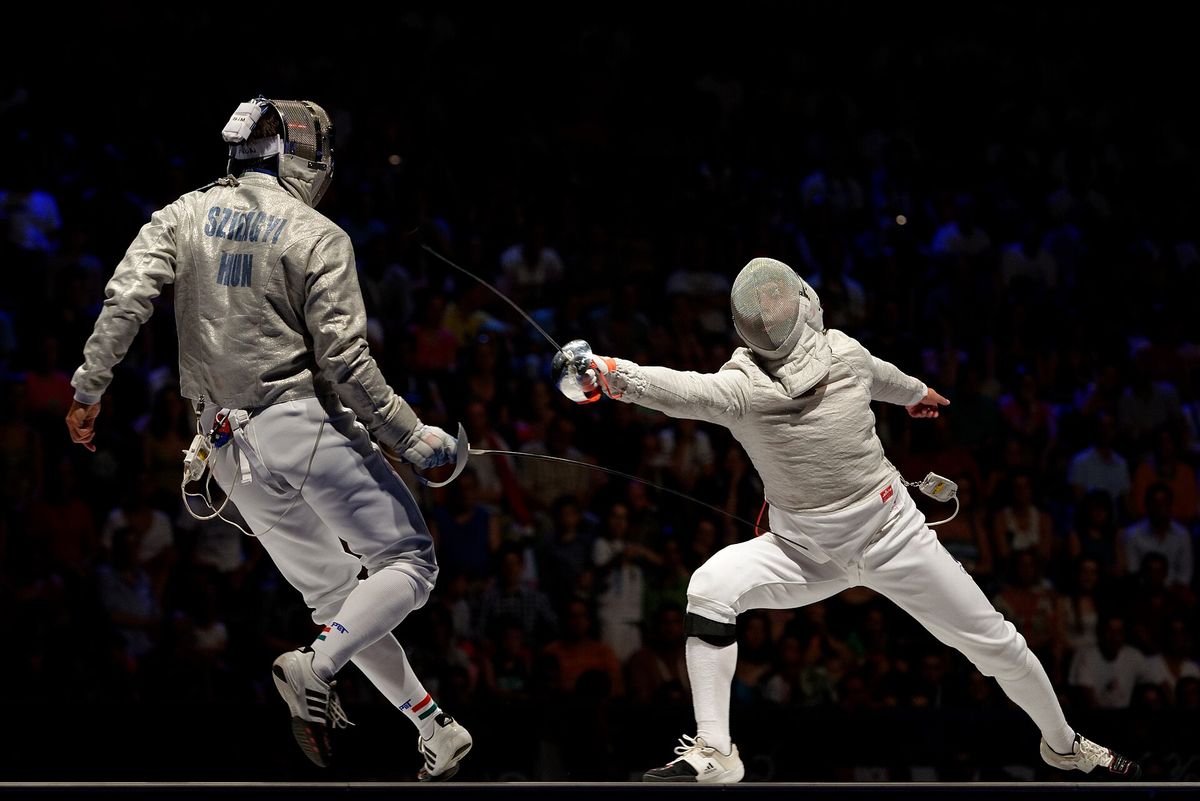
Áron Szilágyi of Hungary against Nikolay Kovalev of Russia in the sabre semi-final, 2013 World Championships, Budapest.
Sabre, the cavalry weapon: everything above the waist is target, and it scores with the edge as well as the point.
Marie-Lan Nguyen · CC BY 3.0 · Wikimedia Commons
So fencing's three sets of rules are three historical situations preserved in regulation, which is unusual — most sports here have rules that were designed for a game. Fencing's were inherited from something that was not.
The FIE was founded in 1913 and fencing has been on every modern Olympic programme. It is one of only five sports of which that is true.
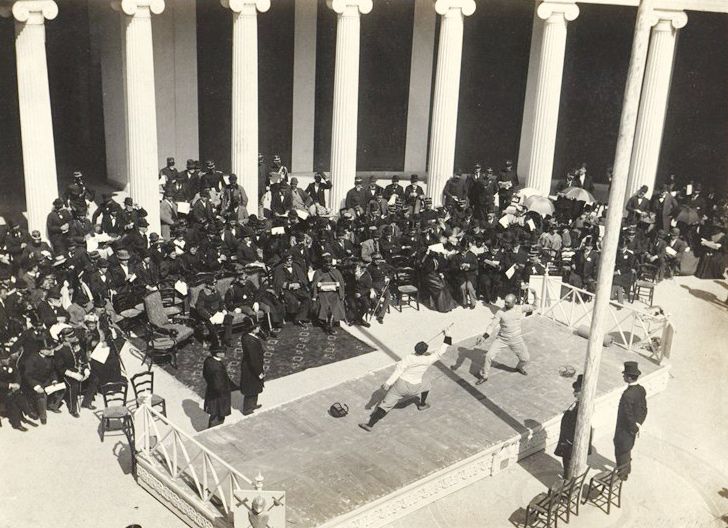
The final sword match at the first modern Olympics, Athens, 1896.
Fencing has been on every modern Olympic programme since this one.
Albert Meyer · Public domain · Wikimedia Commons
07Rule timeline
The sport’s own lane, expanded. Every entry carries a cause from the closed vocabulary and a citation, and says so where the citation is incomplete.
- 1936Integrityalso fairness and eligibilityadopted 1933
Épée was electrified. A hit began to be registered by a circuit closed through the blade tip and the opponent's conductive equipment, rather than by four judges and a president watching and agreeing. Épée went first because it is the simplest case: the whole body is target and there is no priority to interpret, so a machine only has to answer whether the point landed.
Comparability break · Measurement scale changed
Épée first, because it is the simplest case: whole-body target, no priority, so a machine only has to answer whether the point landed. See the series
Trigger and citationIncomplete — no confirmed article
Trigger
Visual judging could not reliably see a light touch at speed, and national bias among panels of judges was a standing complaint. Épée's double hits — both fencers scoring within a few hundredths of a second — were essentially unjudgeable by eye.
FIE Technical Rules · FIE Technical Rules, 1936
- 1957Integrityadopted 1955
Foil was electrified, twenty-one years after épée. Because foil has a restricted target area, the apparatus had to distinguish a valid hit on the torso from an off-target one, which required a conductive jacket as well as a scoring machine. What the machine could not do was decide priority. Foil is governed by right of way — which fencer's attack has precedence — and that remained a judgement made by one referee, as it still is.
Comparability break · Measurement scale changed
Foil needed apparatus that could tell target from off-target. Priority stayed with the referee and still does. See the series
Trigger and citationIncomplete — no confirmed article
Trigger
The same problem as épée and a harder engineering case. Foil had waited two decades for equipment that could tell target from non-target.
FIE Technical Rules · FIE Technical Rules, 1957
- 1984Safetyadopted 1983
Blade steel, mask construction and uniform fabric were given strength standards. Maraging steel became the requirement for blades because it fails without producing the long sharp fragment ordinary steel produces, and uniforms were required to resist puncture to a stated force.
Trigger and citationIncomplete — no confirmed article
Trigger
In 1982 Vladimir Smirnov, the reigning Olympic foil champion, was killed at the world championships when an opponent's blade broke and the fragment passed through his mask. The federation rewrote its material rules within two years.
FIE Technical Rules · FIE Material Rules, 1984
- 1989Integrityalso broadcast and pacingadopted 1988
Sabre was electrified, fifty-two years after épée. Sabre scores with the edge as well as the point, so the apparatus had to register contact anywhere along the blade against a conductive jacket covering the whole upper body — the hardest of the three engineering problems, which is why it was last. Crossing the feet, which had made a running attack possible, was prohibited at the same time.
Comparability break · Measurement scale changed
Sabre last, because a cut scores with the edge anywhere along the blade. Fifty-two years after épée, the sport finished the job. See the series
Trigger and citationIncomplete — no confirmed article
Trigger
Sabre judging by eye had become the least credible in the sport, because a cut can land almost anywhere and the exchanges are the fastest in fencing.
FIE Technical Rules · FIE Technical Rules, 1989
- 2005Broadcast and pacingadopted 2004
The timing intervals in sabre were revised, changing how long after one fencer's hit the apparatus will still register the other's, and with it which actions the referee awards. A style of attack that had dominated the weapon became unrewarding within a season, and sabre bouts became markedly shorter and faster.
Trigger and citationIncomplete — no confirmed article
Trigger
Sabre had converged on a single dominant approach — a long, committed running attack from the line — which made bouts repetitive and hard to follow. Changing a timing constant in the apparatus changed the sport without changing a word about what fencers may do.
That a federation can reshape a weapon by adjusting a number inside a box, without amending any rule of conduct, is the fact worth recording. No other sport on this site has a dial of quite this kind.
FIE Technical Rules · FIE Technical Rules, 2005
08Equipment evolution
Fencing is the sport on this site where equipment changes did the most and are discussed the least, because they arrived slowly and one weapon at a time.
Electrification is the whole story. Before it, a hit existed when a president and four judges agreed they had seen one. Afterwards it existed when a circuit closed. Épée in 1936, foil in 1957, sabre in 1989 — fifty-two years to convert one sport, weapon by weapon, in order of engineering difficulty.
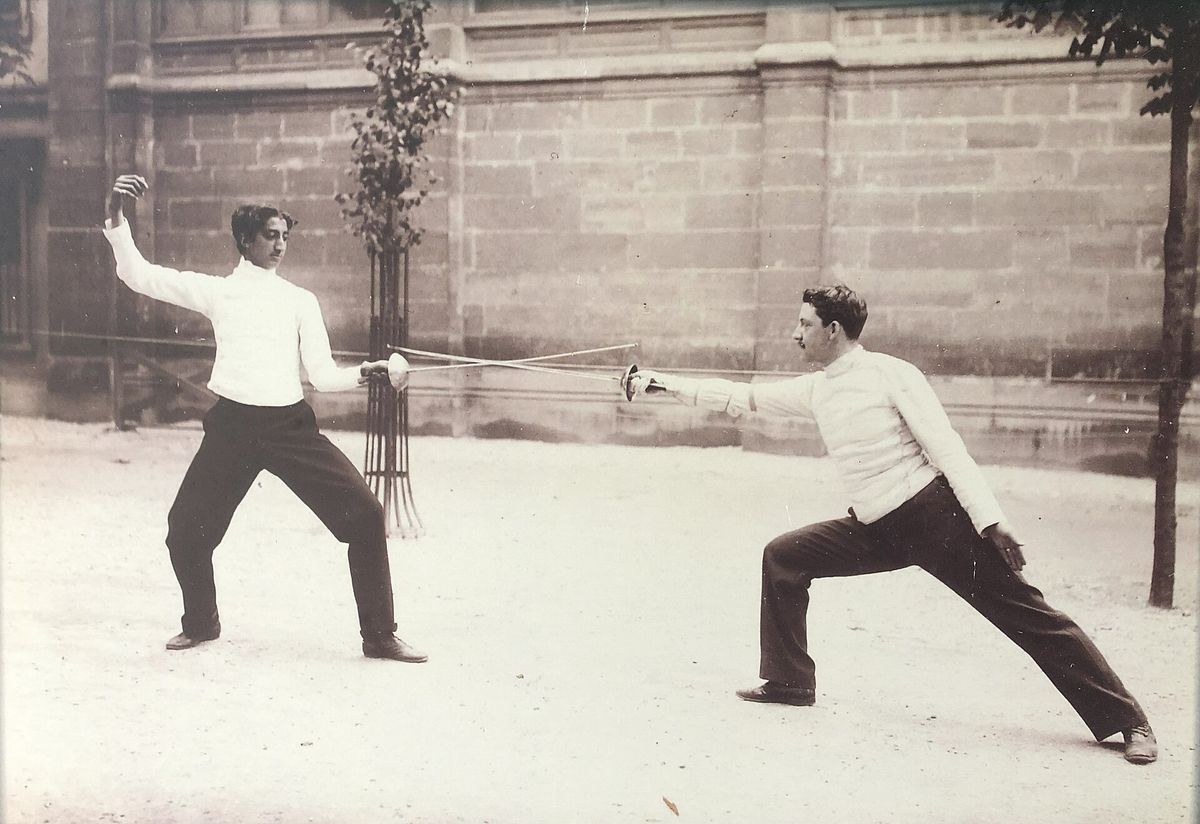
Albert Ayat and Ramón Fonst in the Tuileries during the 1900 Paris Games.
No wires and no machine: in 1900 a hit existed when the president and the judges agreed they had seen one. Épée was not electrified until 1936.
Jules Beau · Public domain · Wikimedia Commons
Épée was first because it is the simplest: the whole body is target, so the apparatus only has to register a point landing anywhere. Foil needed a conductive jacket so the machine could tell torso from arm. Sabre needed a jacket covering everything above the waist and had to register contact anywhere along an edge, which is why it waited another thirty-two years.
Maraging steel is the safety change, and it has a date and a name. In 1982 Vladimir Smirnov, the reigning Olympic foil champion, was killed at the world championships when an opponent's blade broke and the fragment went through his mask. Within two years the federation required blade steel that fails without producing a long sharp fragment, and set puncture-resistance standards for masks and uniforms.
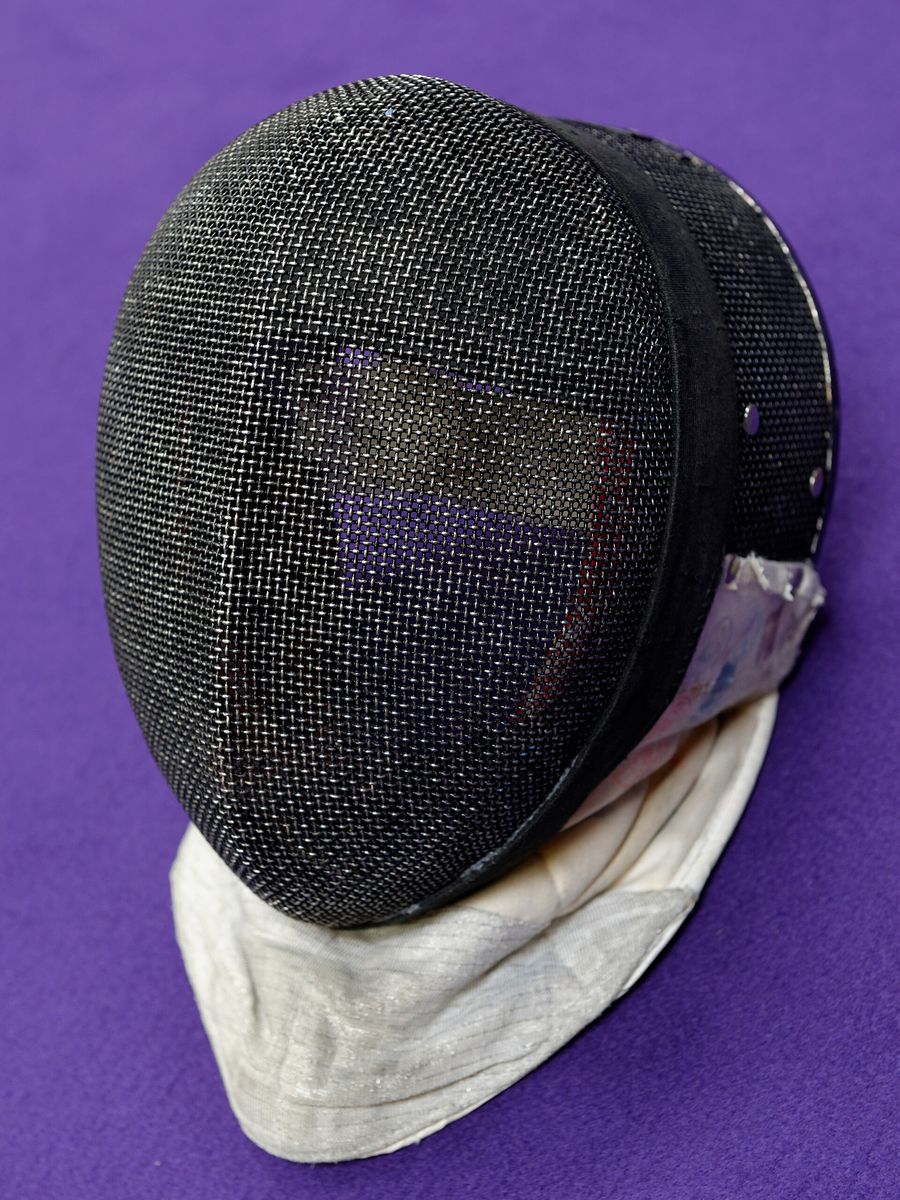
A fencing mask at the French Championships, 2013.
Mesh, bib and puncture-resistance standard: masks, uniforms and blades were all respecified after 1982.
Marie-Lan Nguyen · CC BY 2.5 · Wikimedia Commons
The scoring machine's timing constants are the strangest equipment rule here. How long after one fencer's hit the apparatus will still register the other's is a number inside a box, and changing it in sabre in 2005 changed the weapon's dominant style within a season. A federation reshaped a sport by adjusting a setting, without amending a single rule about what fencers may do.
09Governing body politics
Fencing's governance has been shaped by one recurring accusation — that judging favoured particular nations — and its answer has been to remove judging wherever it could.
Before electrification, a bout was decided by a president and four side judges, and panels were assembled from the nations present. The suspicion that this produced national bias was constant and occasionally proven; the most notorious case is the 1976 Games, where a competitor in modern pentathlon's fencing phase was found to have rigged his épée to register hits that had not landed, which is a fraud only possible in a sport where the apparatus is the arbiter.
Electrification was the federation's structural answer, and it worked for the question it addressed. What it could not address was priority, and priority disputes remain the sport's political sore point — a single referee decides, appeals are limited, and the decision often determines a medal.
The other long-running argument is the programme. Fencing has twelve possible Olympic events and for decades could not run them all within its athlete quota, so team events rotated out by weapon and sex each Games. Which team event was dropped was a genuine political question with medals attached, resolved differently each cycle until the full twelve were accommodated.
The weapons themselves also compete for institutional attention. They have different constituencies, different national strengths and different views on what fencing is, and every timing or rule revision to one of them is argued about by the other two.
10Controversies that forced rule changes
The judges. Not an incident but a century of them. Visual judging of a touch delivered in a fraction of a second, by a panel drawn from competing nations, produced results that could not be verified and were routinely disputed. The federation's response was the most thorough automation of any sport of its era, delivered in three instalments as the engineering allowed.
Vladimir Smirnov, Rome, 1982. The reigning Olympic foil champion was killed when an opponent's blade broke during a bout and the fragment passed through his mask and into his brain. He died nine days later.
The federation's response was material rather than procedural: maraging steel for blades, because it fails without producing a long sharp fragment; puncture-resistance standards for masks and uniforms. Fencing is one of very few sports on this site whose safety rules were written after a death in competition, and the standards have held — there has been no comparable fatality at elite level since.
Sabre's monoculture. By the early 2000s sabre had converged on a single dominant approach, a long committed attack from the line, which made bouts repetitive and difficult for anyone to follow. The federation revised the timing constants in the scoring apparatus in 2005 and the weapon changed within a season.
This is the entry this site finds most striking in fencing. No rule of conduct was amended. The sport was reshaped by changing a number that governs when a machine stops listening.
Transparent masks. Introduced to make the sport more watchable, withdrawn after failures in testing. A rare case of a broadcast-motivated equipment change reversed on safety grounds.
Where it standsthe record, and what is still open · sections 11 to 12
11Series
No series can exist
What a hit is, across the three electrifications
There is no chart here because fencing changed what a hit is three times, one weapon at a time, over fifty-two years. Before electrification a hit existed when a president and four judges agreed they had seen one. Afterwards it exists when a circuit closes. Those are different quantities in exactly the way a taekwondo judge's button and a taekwondo sensor are different quantities — one is an agreement about perception, the other a physical event. What makes fencing unlike taekwondo is that it did this three separate times and produced three separate discontinuities in one sport. Épée in 1936, foil in 1957, sabre in 1989. For twenty-one years the sport ran one measured weapon and two judged ones; for another thirty-two years, two and one. So a 5–3 in épée in 1938 and a 5–3 in sabre in 1938 were not the same kind of result, and neither is comparable with the same score in its own weapon before its own electrification. There is no continuous quantity across any of it.
1936Measurement scale changedÉpée first, because it is the simplest case: whole-body target, no priority, so a machine only has to answer whether the point landed.
1957Measurement scale changedFoil needed apparatus that could tell target from off-target. Priority stayed with the referee and still does.
1989Measurement scale changedSabre last, because a cut scores with the edge anywhere along the blade. Fifty-two years after épée, the sport finished the job.
12What is contested now
Recorded as unsettled.
Priority. The last unmechanised judgement in the sport, decided by one referee, frequently deciding medals, and disputed in almost exactly the terms it was disputed in before electrification. Proposals to define it more tightly, to expand video review, or to add a second referee circulate. None addresses the underlying problem, which is that priority is a judgement about the shape of an action rather than a fact about a moment.
The timing constants. The federation can reshape a weapon by adjusting a number inside the scoring apparatus, as it did to sabre in 2005. There is a real argument that decisions of that consequence should go through the same scrutiny as a rule change, and currently they do not.
Whether the three weapons should share a sport. Épée, foil and sabre have different rules, different constituencies and different national strengths, and fencers specialise from an early age. Whether they are one sport with three weapons or three sports with one federation is an old question that resurfaces whenever the Olympic programme is reviewed.
Watchability. Fencing's central difficulty is that a spectator cannot tell who scored without knowing the priority rule, and the sport has tried transparent masks, better graphics and format changes without solving it. The 2005 sabre revision was partly an attempt at the same problem, by making the weapon's exchanges shorter and clearer.