Esports
The only sport whose field of play is privately owned, and whose rules can be rewritten by a company overnight without asking anybody.
- Official
- Esports
- Game category
- Outside this taxonomy
- Adjudication
- Decided by score
- Standing
- Never Olympic
- rule changes
- 5
- comparability breaks
- 2
- Olympic editions
- 0
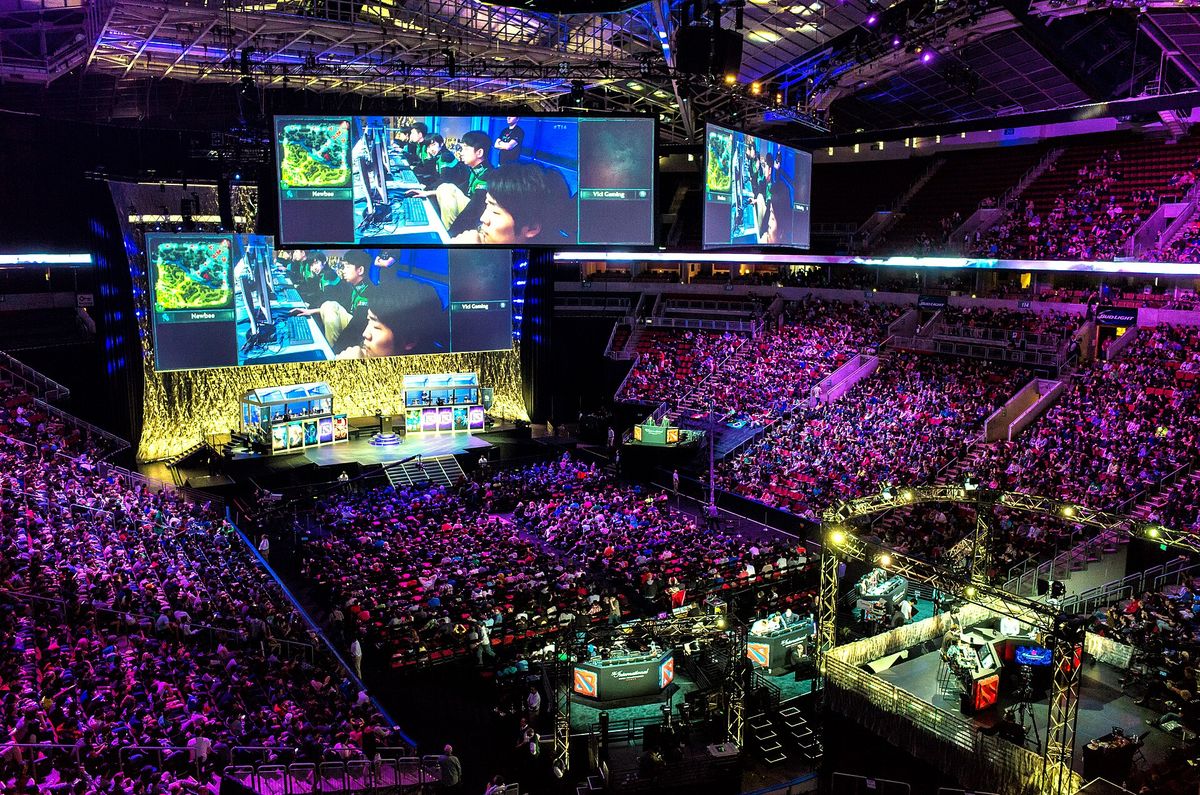
The International, the Dota 2 world championship, at KeyArena, Seattle, 2014 · Dota 2 The International · CC BY 2.0
- Governing body
- International Esports Federation, and the publishers who own the games
- Founded
- Competitive video gaming dates from the 1970s and organised international competition from the 1990s; the International Esports Federation was formed in 2008, and esports became an Asian Games medal sport in 2022.
- Olympic status
- Not on the Olympic programme
- Also contested at
- Asian Games
A set of competitive video games contested as a multi-sport listing. What makes it structurally unlike everything else here is ownership: each game is a commercial product belonging to a company that can change its rules by patch at any time, without consultation, and can withdraw it entirely. No federation governs the laws of play, because no federation owns them.
The gamewhat it is now · sections 1 to 5
01How it is played
A set of competitive video games played under two layers of rules: the publisher's software, which defines what is possible, and the organiser's regulations, which define the conditions. Only the second layer belongs to anybody in the sport.
These figures were entered from the edition named above but have not been checked against its text line by line. Treat them as this site’s reading of the laws, not as a substitute for them.
The object of the game
Whatever the title says. Destroy the opposing base, defuse or plant the bomb, reduce the opponent's health to zero, finish first, score more goals.
There is no common objective across esports, because there is no common game. What the disciplines share is a control interface and a screen, and almost nothing else — which is a looser grouping than boules or billiards, the site's other umbrella sports, whose codes at least share an ancestor.
- Common objective
- None across titles
The game
The field of play is software, and it belongs to a company.
A map's geometry, a character's abilities, a weapon's damage, the economy and the pace are all defined by the current version, and the version changes — typically on a cycle of weeks. A competitive season is played across several of them, and teams re-learn parts of the game between tournaments.
Physically, competitors sit at identical machines with peripherals they generally bring themselves, on a stage, usually in soundproofed booths or wearing noise-cancelling headsets so that crowd reaction cannot convey information about the opposing team's position.
- Field of play
- Software, owned by the publisher
- Version cycle
- Typically weeks
- Booths
- To stop crowd noise conveying information
This clause reads this way because of
Equipment
Standardised machines supplied by the organiser, and personal peripherals — mouse, keyboard, controller, headset — which competitors bring and are inspected.
Configuration is regulated in detail: input device settings, macros (generally prohibited), permitted software, and in-game settings that are locked to a tournament configuration.
The distinction that matters is between the client, which is standardised and controlled, and the hardware, where a player's own mouse and its settings are as personal as a fencer's grip.
- Machines
- Supplied and standardised
- Peripherals
- Personal, inspected
- Macros
- Generally prohibited
Competitors and officials
Individuals or teams of five, depending on the title. Referees enforce conditions rather than play — the software adjudicates the game itself, absolutely and without appeal.
That is the cleanest adjudication on this site. Whether a shot connected is not a judgement; it is a calculation the server already performed.
- Team size
- By title; often five
- Adjudication of play
- By the software, not an official
Time
By title. A fighting game round lasts under a minute; a strategy match can run over an hour with no clock at all. Series are best-of-three or best-of-five, and tournaments run over days.
- Range
- Under a minute to over an hour
Scoring
Games won within a series, and series won within a bracket. The internal scoring of each title — kills, objectives, rounds, goals — decides the game and is not comparable to any other title's.
Pauses and remakes
The distinctive procedure in esports is the technical pause. A player may pause competitive play for a hardware failure, a software fault or a disconnection, and the match resumes from the paused state — sometimes after a long delay, sometimes with a game state restored from a save.
In a severe case a game is remade and replayed from the start. Both are necessary because the field of play can fail in ways a pitch cannot, and both are open to abuse as a tactical reset, which is why their use is regulated and logged.
- Technical pause
- For hardware or software failure
- Remake
- A game replayed from the start
Infringements
Cheating software — aim assistance, wall vision, automation — which is the sport's equivalent of doping and is detected by anti-cheat software running on the machine and by statistical analysis of inputs.
Match fixing, which esports has had at a scale that has produced criminal prosecutions in several countries, driven by heavy betting markets and young, low-paid players in unregulated leagues.
Ghosting — receiving information about the opposing team's position from outside the booth — which is why booths and headsets exist.
Also: unauthorised macros, exploiting known software bugs where the ruleset forbids it, and account sharing, which is a form of impersonation the sport has to police because identity is a login.
Deciding the winner
The series score. Because the software adjudicates play absolutely, there is no equivalent of a disputed decision on the field — every dispute in esports is about conditions, conduct or software, never about what happened in the game.
Everything above is current law. Everything below is how Esports got here.
02Disciplines and events
No Olympic events. Esports was a demonstration at the 2018 Asian Games and a full medal sport at Hangzhou 2022 — and the titles contested change every edition, because which games exist competitively is a commercial matter.
- Disciplines
- 1
- Olympic medal events
- 0
- Men’s and women’s counted separately.
- Contested elsewhere
- 9
- asian games, world championship, federation only.
- Listed for context
- 3
- Not counted as this sport.
Contested at the Asian Games6
A slate of titles chosen per edition, several of them in versions modified by their publishers for the event.
- Multiplayer online battle arena titlesAsian GamesLeague of Legends, Dota 2 and Arena of Valor at Hangzhou 2022.
- Sports simulation titlesAsian GamesEA Sports FC Online.
- Shooter titlesAsian GamesPUBG Mobile, contested in an Asian Games version with content and monetisation altered.
- Fighting game titlesAsian GamesStreet Fighter V.
What the IOC has staged1
Built around simulations of physical sports rather than the largest competitive titles, on the stated ground that games depicting violence do not align with Olympic values.
- Virtual sports eventsFederation onlyVirtual cycling, rowing, sailing, archery, taekwondo, motorsport and baseball — a different set of games from the ones the industry competes in.
Where the sport actually is2
The largest esports competitions are run by publishers and commercial organisers, not by either international federation, and that is where the money, the audience and the professionals are.
- Publisher-run leagues and world championshipsFederation onlyFranchised leagues and annual world championships operated by the companies that own the games.
- Third-party circuitsFederation onlyIndependent organisers running events under licence from the publisher.
Claimed by two federations2
- International Esports FederationWorld championshipFormed 2008, with national member associations and a world championship.
- Global Esports FederationWorld championshipFormed 2019, with an overlapping mandate. Neither controls a single game.
03Officiating
The cleanest adjudication of play on this site, and the messiest adjudication of everything else.
Play needs no officials at all. Whether a shot connected, whether an ability landed, whether a player was inside a zone are not judgements — the server already calculated them, deterministically, and the result is not appealable. No sport covered here has less to argue about regarding what happened.
Everything an esports referee does is therefore about conditions:
Technical pauses. A competitor may stop play for a hardware failure, software fault or disconnection, and the match resumes from the paused state or, in a serious case, the game is remade from the start. This is necessary because the field of play can fail, and it is open to abuse as a tactical reset, so its use is regulated and logged.
Which version. Officials rule on the build a competition is played on and whether a patch may land inside an event. In every other sport the laws are fixed for the season; here somebody has to decide when to stop accepting updates.
Ghosting and outside information. Booths and noise-cancelling headsets exist because a crowd reacting at the right moment tells a team where the opposition is. Officials police the physical environment for the same reason bridge built screens.
Anti-cheat and integrity. Software monitoring on the machines, plus statistical review of inputs, plus betting-market monitoring for fixing.
So the referee never rules on the game, and rules on almost everything around it.
04Where it is played
An unusually genuine global spread, with three centres of gravity and a different map for every title.
South Korea built professional esports first — televised leagues, salaried players, team houses and a training culture from the early 2000s — and remains the sport's reference point for professionalisation.
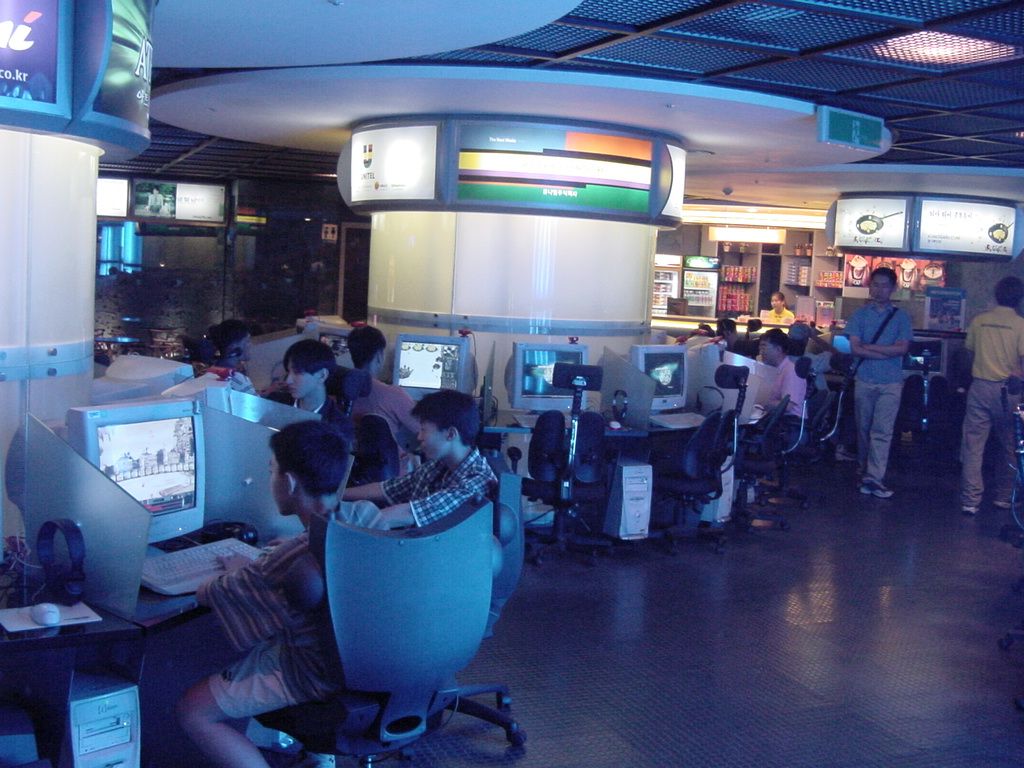
A PC bang, a Korean gaming café, in 2001.
Rows of networked computers for hire by the hour: the infrastructure behind the Korean professional scene that appeared at the same time.
Alex C · CC BY 2.0 · Wikimedia Commons
China is the largest market and, increasingly, the largest competitive force, with franchised leagues, enormous domestic audiences and mobile titles whose player numbers exceed anything in the West. Hangzhou 2022 was a statement of that.
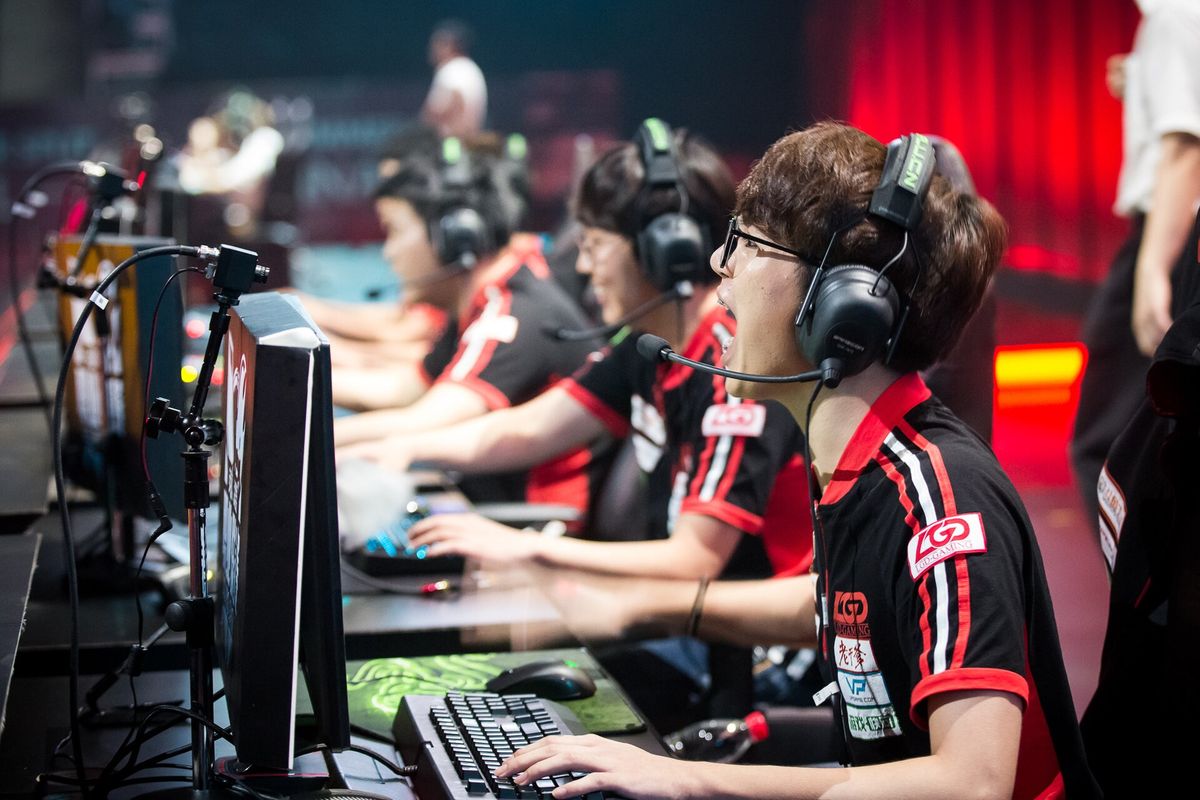
LGD Gaming at the 2015 LPL summer final, China's League of Legends league.
China is the largest market and increasingly the largest competitive force, with franchised leagues run under the publisher.
Bruce Liu · CC BY-SA 3.0 · Wikimedia Commons
Europe and North America carry major franchised leagues and much of the Western audience, with strong national scenes in Denmark, Sweden, France, Germany, Poland, Ukraine and Russia — Nordic and Eastern European dominance in shooter titles being long-standing and unexplained by anything but culture and early adoption.
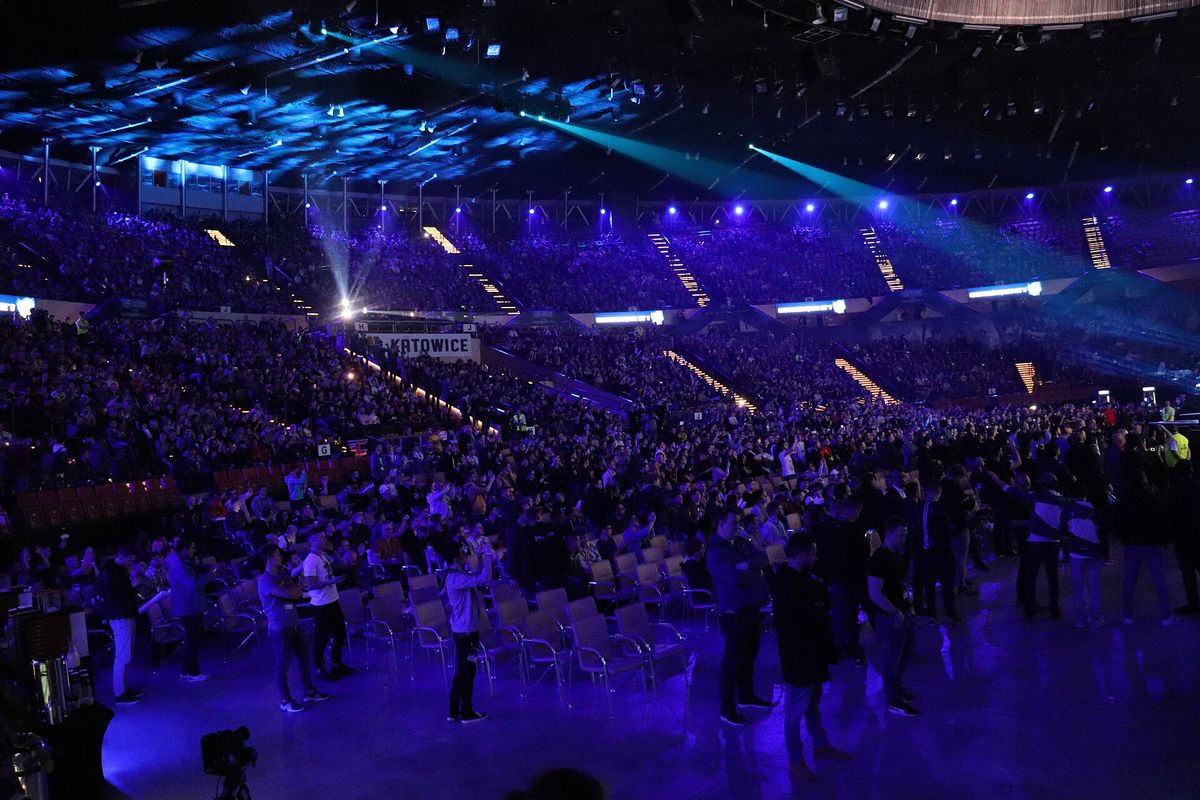
The Spodek arena, Katowice, during IEM Katowice Major 2019.
Poland's Katowice has hosted one of the sport's biggest annual events for more than a decade, and Eastern European shooter scenes are among the strongest.
Esports Kingdom · CC BY 2.0 · Wikimedia Commons
Brazil and Southeast Asia are major and often underrated, particularly in mobile titles, where the device barrier is far lower than a gaming computer.
What no other sport on this site has is that the map is per title. A country strong in one game may be irrelevant in another, because the games are unrelated products with separate scenes, and a title's regional strength can shift within a couple of years.
The binding constraint is a device and a connection. That is a lower barrier than any facility on this site and a real exclusion where connectivity is poor — which mobile titles have partly answered, and which is why the fastest growth is where phones outnumber computers.
05Learning curve
The lowest entry barrier of any sport on this site — the game is free and matchmaking finds you an exact opponent instantly — and a professional ceiling reached younger, held more briefly, and demolished more often by forces outside the athlete than anything else here.
Editorial — the site’s reading, not a sourced claim
Barrier to entry
How hard is it to get to a real game?
A computer or a phone. The game is often free and it will find you an opponent at your exact level.
Nothing else here is this frictionless. Many of the largest competitive titles are free to download. There is no facility, no club, no equipment beyond a device most people already own, no travel and no opponent to arrange — automated matchmaking supplies one at your rating within seconds, at any hour.
There is no physical prerequisite, no minimum age in practice, and the ranked ladder means a beginner competes against other beginners from the first game rather than being beaten by somebody serious.
The barrier that does exist is a device and a connection, which is a real exclusion in much of the world and an invisible one everywhere else.
Evidence
- Kit to startA device many people already ownobserved
- CostMany major titles are freeobserved
- OpponentMatched automatically at your ratingobserved
- FacilityNoneestimate
- Time to a competitive gameMinutesestimate
Barrier to the top
How hard is it to be good at?
Elite reaction and decision-making in a game that changes underneath you every few weeks.
The mechanical demand is genuine and is usually underestimated by people outside it: elite players sustain very high accurate action rates, react at the limit of human latency, and hold that under tournament pressure for hours.
The strategic demand is the part that has no equivalent on this site. The game changes. A publisher patch can rebalance a character, a weapon, an economy or a map on a cycle of weeks, and a professional's accumulated knowledge is partially invalidated each time. A footballer's decade of experience is worth something for a career; an esports professional's is worth something until the next version.
So the skill being trained is partly meta-skill: how fast can you re-solve a game you already knew.
Careers are correspondingly short. Peak ages in the low twenties are normal across most titles, retirement in the mid-twenties is common, and a professional's discipline can be ended outright by a publisher de-prioritising the title — a career terminated by a commercial decision at a company the player has no relationship with.
Evidence
- The rules change by patchTypically every few weeksruleAccumulated knowledge is partially invalidated on a schedule.2008 — the rule this rests on
- A title can be discontinuedBy its ownerruleA discipline can cease to exist for commercial reasons.2008 — the rule this rests on
- Adjudication is absoluteBy softwareobservedNo disputed decisions about play — only about conditions.
- Typical peak age19–24estimateThe youngest peak of any sport covered here.
Why the two differ
Very low to very high, on the smallest entry cost on this site — and the gap has a shape nothing else does, because the top of it keeps being moved by someone who is not competing.
Every other sport here has stable laws. A gymnast's Code of Points is revised every four years and the sport treats that as a major event; this site records it as a comparability break. Esports revises its equivalent every few weeks, unilaterally, by a company, for reasons that include commercial ones — and the professionals absorb it as normal.
The other distinctive feature is how the career ends. Elsewhere a career ends when the body does. Here it can end because a publisher stopped supporting a title, and a world champion's discipline can simply cease to exist while they are still at their peak.
That is the sport's real difficulty and its real vulnerability, and no federation on either side of it can do anything about it.
The historyhow it got here · sections 6 to 10
06Origin and invention
Esports has no founding rulebook, because it has never had rules of its own.
Competitive video gaming is as old as video games — a Spacewar tournament was held at Stanford in 1972 — and it grew through arcade high-score competition in the 1980s, networked play in the 1990s, and the South Korean broadcast leagues of the early 2000s, which are where esports first became a professional spectator sport with televised leagues and salaried players.
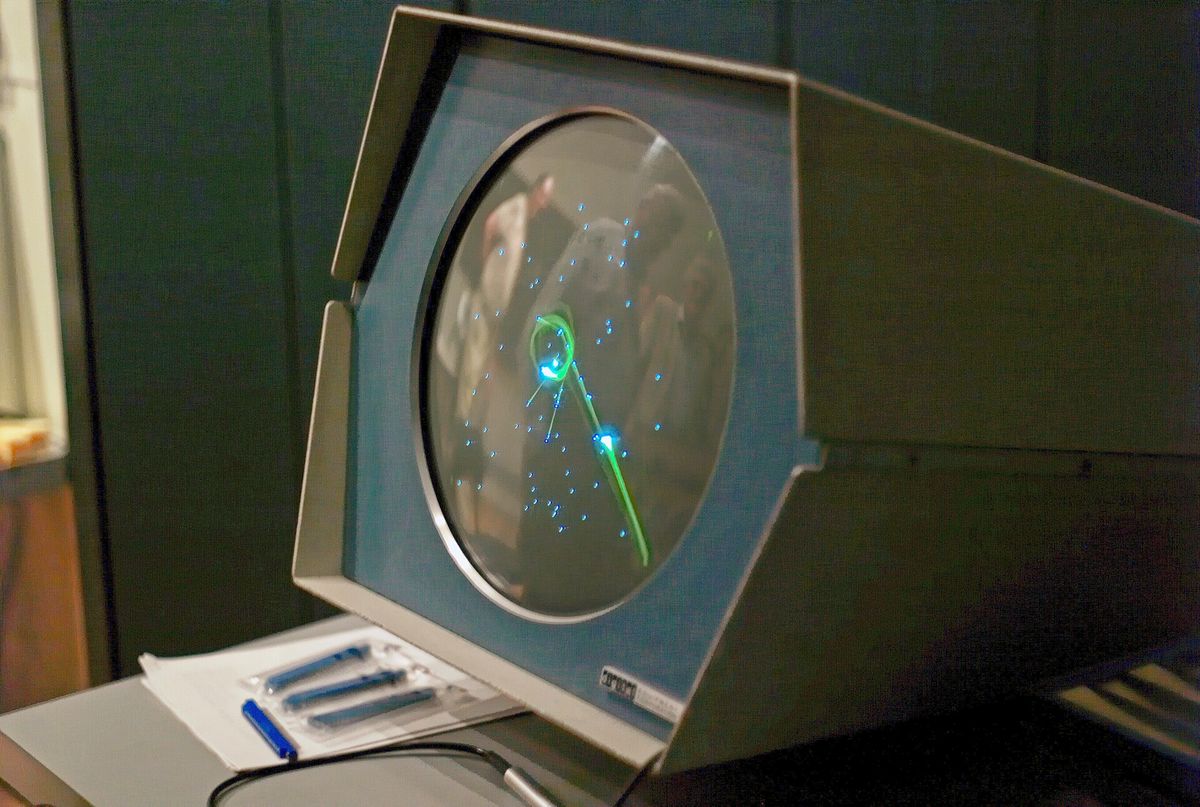
Spacewar! running on the restored PDP-1 at the Computer History Museum, California.
The game of the 1972 Stanford tournament, on the machine it was written for in 1962. Competitive gaming is as old as the games.
Joi Ito · CC BY 2.0 · Wikimedia Commons
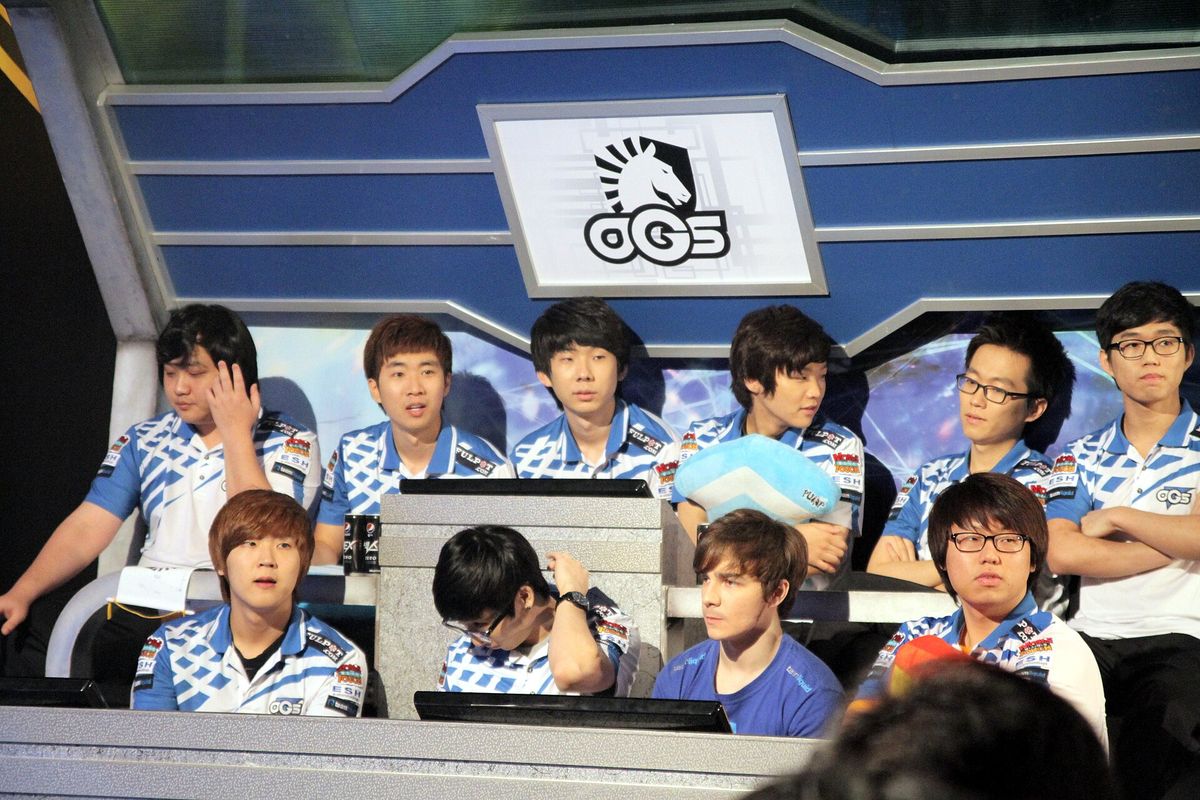
A StarCraft team at the GOMTV studio in Seoul before a Global StarCraft League match, 2011.
South Korea's broadcast leagues are where esports first became a televised spectator sport with salaried players.
Nick Pettit · CC BY 2.0 · Wikimedia Commons
What it did not develop, at any point, was a governing body that owned the games.
That is the difference between esports and everything else on this site. Football's laws belong to a board. Athletics' technical rules belong to a federation. Even the sports here whose professional structures sit outside their federations — sumo, muaythai, snooker — have laws that some sporting body wrote. Esports' laws are software, and the software belongs to the companies that made it.
The International Esports Federation was formed in South Korea in 2008 and the Global Esports Federation in 2019, both with national members, world championships and the apparatus of a recognised sport. Neither owns a game. Both must ask a publisher's permission to stage one.
Multi-sport recognition came from Asia first: a demonstration at the 2018 Asian Games in Jakarta, and full medal status at Hangzhou in 2022 — a Games named for 2022 and held in 2023 after postponement, at which several titles were contested in versions their publishers had modified for the occasion.
The IOC has run virtual sports events since 2021 built around simulations of physical sports rather than the games esports is actually played on.
07Rule timeline
The sport’s own lane, expanded. Every entry carries a cause from the closed vocabulary and a citation, and says so where the citation is incomplete.
- 2008Participation and accessalso disputedadopted 2008
An international federation was formed, in South Korea, to represent esports internationally: national member associations, world championships, athlete eligibility, anti-doping compliance and the apparatus a sport needs to be recognised. It governs everything about competition except the games. A second body, the Global Esports Federation, was formed in 2019 with an overlapping mandate, and commercial publishers run the largest competitions themselves.
Trigger and citationIncomplete — no confirmed article
Trigger
Competitive gaming had a large professional structure and no representation in the international sports system, which national associations in South Korea and elsewhere set out to build.
Two international federations claim the space and neither controls the games. Which of them speaks for esports is disputed between them and largely irrelevant to the publishers.
IESF competition regulations · IESF statutes
- 2008Commercialalso equipment and technologyadopted 2008
The rules of every esport are the software, and the software belongs to a company. A publisher can rebalance any element of the game by patch — a weapon's damage, a character's abilities, a map's geometry, the economy — usually on a cycle of weeks, and competitive seasons are played across multiple versions. It can also decline to license the game for an event, or stop supporting it, at which point the sport built on it ends. Every other sport covered on this site has laws written by a body accountable, however imperfectly, to the people who play. Here the laws are a product, revised for commercial reasons that include competitive balance and are not limited to it.
Comparability break · Measurement scale changed
The rules are software owned by a company and revised on a cycle of weeks. Every version is a different game. See the series
Trigger and citationIncomplete — no confirmed article
Trigger
Competitive games are live commercial products with revenue models that depend on continuing change, and balance patches serve the wider player base as well as the professional tier.
IESF competition regulations · IESF competition regulations, title licensing
- 2018Commercialalso participation and accessadopted 2018
Esports was contested at the Asian Games in Jakarta in 2018 as a demonstration event, the first appearance of competitive video gaming at a major multi-sport games.
Trigger and citationIncomplete — no confirmed article
Trigger
The Olympic Council of Asia moved earlier than any other multi-sport body on esports, working with regional partners and publishers.
Asian Games sport programme listings · Olympic Council of Asia programme listings
- 2021Commercialalso disputedadopted 2021
The IOC ran a virtual series built around simulations of physical sports — virtual cycling, rowing, sailing, motorsport, baseball — rather than around the largest competitive esports titles, and has maintained that games must align with Olympic values, which excludes those depicting violence. That is a content criterion, and no other sport on this site has one. A programme decision about esports is a decision about what the games are *about*, and it rules out most of the titles that constitute the activity commercially. It also creates a split: the esports the IOC will stage and the esports people actually watch are largely different games.
Comparability break · Scoped to one competition
The titles a multi-sport programme will stage are a different set from the titles the sport is played on commercially. See the series
Trigger and citationIncomplete — no confirmed article
Trigger
The IOC sought to engage a young audience through gaming while maintaining a position against games depicting violence.
Much of the esports industry regards a programme built on sports simulations as missing the sport entirely, since those titles have small competitive scenes relative to the games that were excluded. The IOC's position is that its values are not negotiable for audience reach. Both are recorded.
IESF competition regulations · IOC statements on virtual sports and esports
- 2022Commercialalso participation and accessadopted 2022
Esports became a full medal sport at the Asian Games in Hangzhou, with titles including League of Legends, Dota 2, Arena of Valor, EA Sports FC Online, PUBG Mobile and Street Fighter V. The Games, named for 2022, were held in 2023 after being postponed. Several titles were contested in modified versions made for the event, with in-game monetisation removed and content adjusted. That is worth stating plainly: the field of play was rebuilt by its owner to suit the programme, which is a thing no other sport could do if it wanted to.
Trigger and citationIncomplete — no confirmed article
Trigger
The demonstration in 2018 was judged successful and the host had a very large domestic gaming industry and audience.
Asian Games sport programme listings · Olympic Council of Asia programme listings
08Equipment evolution
The equipment question splits cleanly in two, and the interesting half is not hardware.
The hardware is standardised. Organisers supply identical machines, and the one thing competitors bring is peripherals — mouse, keyboard, controller, headset — which are personal, inspected, and as individual as a fencer's grip or a bowler's drilled ball. Settings are locked to a tournament configuration and macros are generally prohibited.
The software is the field of play, and it is owned. Every element that would be a law of the game in any other sport — what a weapon does, how fast a character moves, what a map's sightlines are, how the economy works — is a value in a build, and the build changes on a cycle of weeks.
That makes esports' equivalent of an equipment arms race unlike any other on this site. There is no javelin to redesign or bat to certify, because the implement is not a physical object anyone owns: it is a version number.
Two pieces of physical equipment exist for reasons worth recording. Booths and noise-cancelling headsets stop crowd reaction telling a team where the opposition is — a spectator gasping at the right moment is unauthorised information, the same problem bridge built screens to solve. And anti-cheat software runs on the competition machines, which is a class of equipment that inspects the competitor rather than serving them.
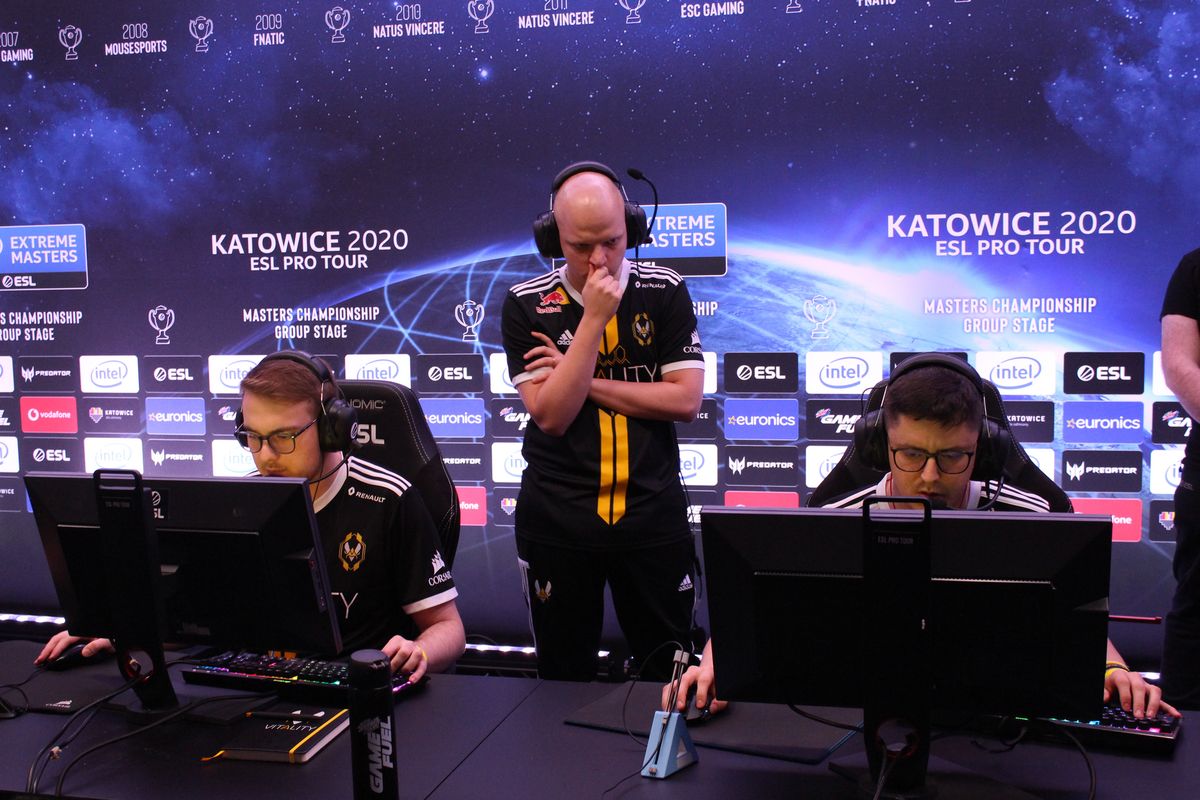
Players at their machines at IEM Katowice, 2020.
Supplied machines, personal peripherals and closed headsets: the headsets exist so that the crowd's reaction cannot tell a team where its opponents are.
VaKarM.net · CC BY 2.0 · Wikimedia Commons
The peripheral market is the sport's only conventional equipment industry, and it behaves like every other one: incremental gains, sponsorship, and claims about latency that are difficult to verify.
09Governing body politics
Two international federations, neither of which governs a game, and a set of companies that do.
The International Esports Federation (2008) and the Global Esports Federation (2019) both have national member associations, world championships, anti-doping compliance and the institutional apparatus that recognition requires. Their mandates overlap and their relationship has been uneasy.
Neither has the thing that matters. A publisher owns its game outright, decides its competitive rules, licenses or refuses to license it for any event, runs its own franchised league if it chooses, and can discontinue the title. This site records fragmented governance in powerlifting and kickboxing, and professional structures outside the federation in sumo, muaythai and snooker. Esports is a further category again: the federations do not govern a diminished version of the sport, they govern none of its laws.
The International, the Dota 2 world championship, at KeyArena, Seattle, 2014.
A tournament run by the game's own publisher, with the arena full. The federations govern none of this.
Dota 2 The International · CC BY 2.0 · Wikimedia Commons
The IOC's position adds a second split. Its virtual sports events have been built around simulations of physical sports — virtual cycling, rowing, archery, taekwondo — on the stated ground that games depicting violence do not align with Olympic values. That is a content criterion, and it excludes most of the titles esports is commercially made of.
So there are effectively two esports. The one the Olympic movement will stage, which has small competitive scenes, and the one with the audiences, the money and the professionals, which it will not.
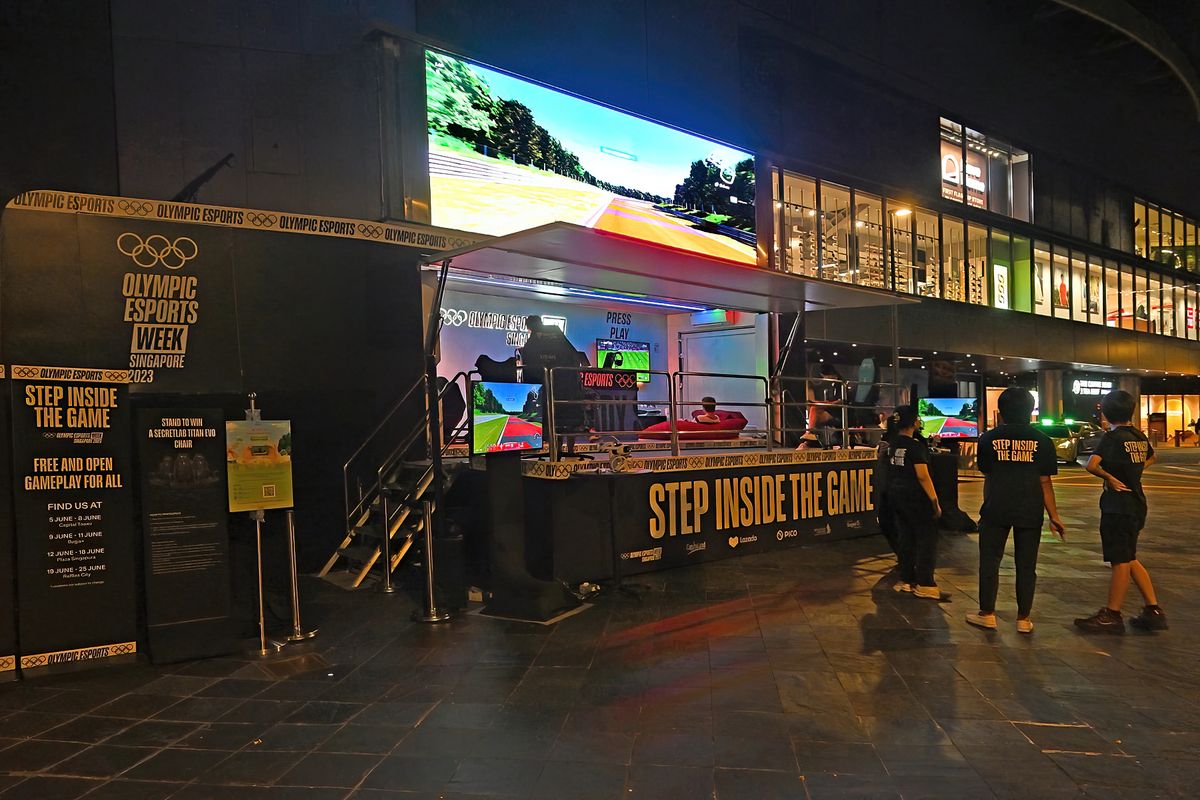
A trailer for the Olympic Esports Week at Raffles City, Singapore, 2023.
The IOC's version of esports, built on simulations of physical sports; the screen shows a driving game, not the titles the professional scene plays.
Choo Yut Shing · CC BY 2.0 · Wikimedia Commons
The Asian Games took the second one. Hangzhou 2022 contested League of Legends, Dota 2, PUBG Mobile and Street Fighter V — with publishers producing modified versions for the event, which is the clearest possible demonstration of who holds the pen.
10Controversies that forced rule changes
Match fixing. Esports' most serious integrity problem and one it has at scale. Heavy betting markets, young players, low pay in the tiers below the top, and unregulated leagues have produced fixing cases in many countries, including criminal prosecutions and lifetime bans. The structural conditions are worse than in most sports here, and the response — integrity units, betting monitoring, education — is the conventional one.
Cheating software. Aim assistance, wall vision and input automation are the sport's doping equivalent, and detection runs through anti-cheat software on the machine plus statistical analysis of inputs. As in chess, the assistance does not improve a competitor so much as replace them.
Player welfare. Very young professionals, extremely long practice hours, repetitive strain injuries, and contracts that have been found exploitative have all produced reform in the larger leagues — minimum ages, contract standards, mandated rest. It is a labour history more than a sporting one, because the employers are companies rather than federations.
Who governs. Two international federations with overlapping mandates and no control over any game, alongside publishers who need neither.
The Olympic content line. A programme built on sports simulations rather than on the games people actually compete in. The industry regards it as missing the sport; the IOC regards its values as not negotiable. Nothing has moved.
Patches mid-tournament. Which version a competition is played on, and whether a patch may land inside a season, is a competition rule the organisers do control — and it exists because the game would otherwise change underneath the event.
Where it standsthe record, and what is still open · sections 11 to 12
11Series
No series can exist
Competitive statistics
Esports produces more data than any sport on this site and almost none of it survives a comparison across time. Every action in a competitive match is logged by the server, so the raw material is extraordinary — complete positional, economic and outcome data for every game ever played. It is also worthless for progression, because the game the data describes is replaced every few weeks. A publisher patch can rebalance a character, a weapon, an economy or a map. A statistic drawn from one version measures a game that no longer exists, and a professional season is played across several versions. Compare gymnastics, which rewrote its scoring scale once in 2006 and severed its history doing it: esports does the equivalent on a schedule, by a company, without consulting anybody. Then the discontinuities that are not patches. A title can be discontinued, and its competitive record ends. A title can be replaced by a sequel, and the numbers do not carry across. A title can be contested at a multi-sport games in a specially modified version, as several were at Hangzhou 2022 — so even a single tournament's data may describe a game built for that tournament. There is no line to draw here, and no federation with the standing to draw one, because none of them owns the game.
2008Measurement scale changedThe rules are software owned by a company and revised on a cycle of weeks. Every version is a different game.
2021Scoped to one competitionThe titles a multi-sport programme will stage are a different set from the titles the sport is played on commercially.
12What is contested now
Recorded as unsettled.
Whether a sport can be privately owned. The question underneath everything else. No federation controls any esport's rules, and no institutional arrangement has been proposed that would change that without a publisher volunteering its property. Recognition, governance reform and multi-sport places do not touch it.
Two federations. The IESF and the GEF have overlapping mandates and neither owns a game. Which speaks for esports matters to them and to almost nobody else.
The Olympic content line. A virtual programme built on sports simulations excludes the titles esports actually consists of. The industry's view is that this is not esports; the IOC's is that its values are not for sale. There is no visible compromise.
Match fixing. Structural conditions — betting, young players, low pay in lower tiers — that other sports have taken decades to manage, arriving all at once in a sport whose employers are companies.
Player welfare. Careers peaking at twenty-two, practice hours that have caused injury, and contracts that have needed reform. Improving, and driven by leagues rather than by governing bodies.
What happens when a game dies. A discipline can end because its owner stops supporting it, and its professionals' careers end with it. Every other sport on this site can at least promise its athletes that the sport will still be there next year.