
Football
The sport with no central record book, and therefore no way to break one.
- Official
- Football
- Game category
- Invasion
- Adjudication
- Decided by score
- Standing
- Removed, restored
- rule changes
- 6
- comparability break
- 1
- Olympic editions
- 29
Schoolchildren playing football on a dirt pitch, Margarita Island, Venezuela, 2014 · Wilfredor · CC0
- Governing body
- FIFA, with the Laws held by the International Football Association Board
- Founded
- Laws of the Game first codified by the Football Association in 1863; the International Football Association Board formed in 1886 and has held the Laws since.
- Olympic status
- 29 editions
- on the 2028 programme
- Also contested at
- Asian Games
Football's rules govern space and time rather than an implement or a scale, so its comparability problem takes a different shape. There is no world record to reset, and no single body that keeps a continuous quantitative series for the sport. Any rate statistic — goals per game above all — belongs to one named competition and must be labelled as that competition wherever it appears.
The gamewhat it is now · sections 1 to 5
01How it is played
Eleven against eleven, get the ball into the goal, use anything but your hands. The Laws run to seventeen and are unusually short for a sport this large — they specify the pitch loosely, the ball loosely, and spend most of their length on what a referee should do about conduct. Football legislates space and time rather than an implement, which is why it has no record book and nothing central to break.
These figures were entered from the edition named above but have not been checked against its text line by line. Treat them as this site’s reading of the laws, not as a substitute for them.
The object of the game
Move the ball into the opponent's goal more often than they move it into yours. A goal is scored when the whole ball crosses the whole goal line between the posts and under the bar — the only completely unambiguous definition in the Laws, and the one thing goal-line technology exists to settle.
The pitch
Law 1 gives ranges rather than dimensions, which is why no two grounds are the same size and why a home advantage can be built into the turf. International matches use a narrower band, but even there a pitch may be 100 m long or 110 m long.
- Length
- 90–120 m
- 100–110 m for international matches.
- Width
- 45–90 m
- 64–75 m for international matches.
- Goal
- 7.32 × 2.44 m
- Penalty spot
- 11 m from goal line
- Penalty area
- 16.5 m deep
- Centre circle
- 9.15 m radius

FAR Rabat against TP Mazembe in the final of the 2024 CAF Women's Champions League.
Halfway line, centre circle, penalty area: a marked grass pitch, which the Laws allow but do not require.
Reda Benkhadra · CC BY-SA 4.0 · Wikimedia Commons
IFAB Laws of the Game, current season · Law 1
The ball and the kit
Law 2 specifies circumference, weight and pressure, and says nothing at all about construction. That looseness is the reason football has no equipment-driven comparability break: the ball went from waterlogged leather to thermally bonded synthetic panels over forty years without the specification ever having to move.
Shin guards are compulsory. Anything dangerous, including most jewellery, is not permitted.
- Ball circumference
- 68–70 cm
- Ball weight at kick-off
- 410–450 g
- Pressure
- 0.6–1.1 atm
- Shin guards
- Compulsory
IFAB Laws of the Game, current season · Laws 2 and 4
Players and officials
Eleven a side, one of whom is the goalkeeper, and a match may not continue if a team falls below seven. Substitutions are set by the competition, commonly five, made in a limited number of stoppages.
The referee's decision is final on fact. A video assistant referee may recommend a review, but only in four categories — goals, penalty decisions, direct red cards, and mistaken identity — and only for a clear and obvious error or a serious missed incident.
- Players per side
- 11
- Minimum to continue
- 7
- Reviewable by VAR
- 4 categories
This clause reads this way because of
IFAB Laws of the Game, current season · Law 3 and the VAR protocol
Time
Two halves of 45 minutes, plus whatever the referee adds for stoppages. Football is the rare sport where the clock is not stopped and the exact finish time is at one official's discretion.
Where a knockout tie needs a winner, extra time is two further periods of 15 minutes, played out in full. It was not always played out in full: from 1993 a goal in extra time could end the match immediately, and that was removed in 2004 on the reading that it had made extra time more cautious rather than more attacking.
- Halves
- 2 × 45 min
- Extra time
- 2 × 15 min
- Added time
- Referee's discretion
This clause reads this way because of
IFAB Laws of the Game, current season · Law 7
Scoring
One goal, one point, from anywhere, by any legal part of the body. There is no equivalent of a two-point line, no bonus for difficulty, and no partial credit — which is why football produces such low scores and why a single rule change can move its rate statistics noticeably.
There is no central goals-per-game series for the sport, because there is no body that keeps one. Any such figure belongs to a named competition.
Restarts
Kick-off, throw-in, goal kick, corner kick, free kick — direct or indirect — penalty kick, and dropped ball. Which restart applies is usually the referee's most consequential decision, because a direct free kick near the area and an indirect one are very different things.
The goalkeeper's restart options were rewritten in 1992: they may no longer handle a ball deliberately kicked to them by a team-mate, which is punished by an indirect free kick. That single clause is why modern goalkeepers are selected for their feet.
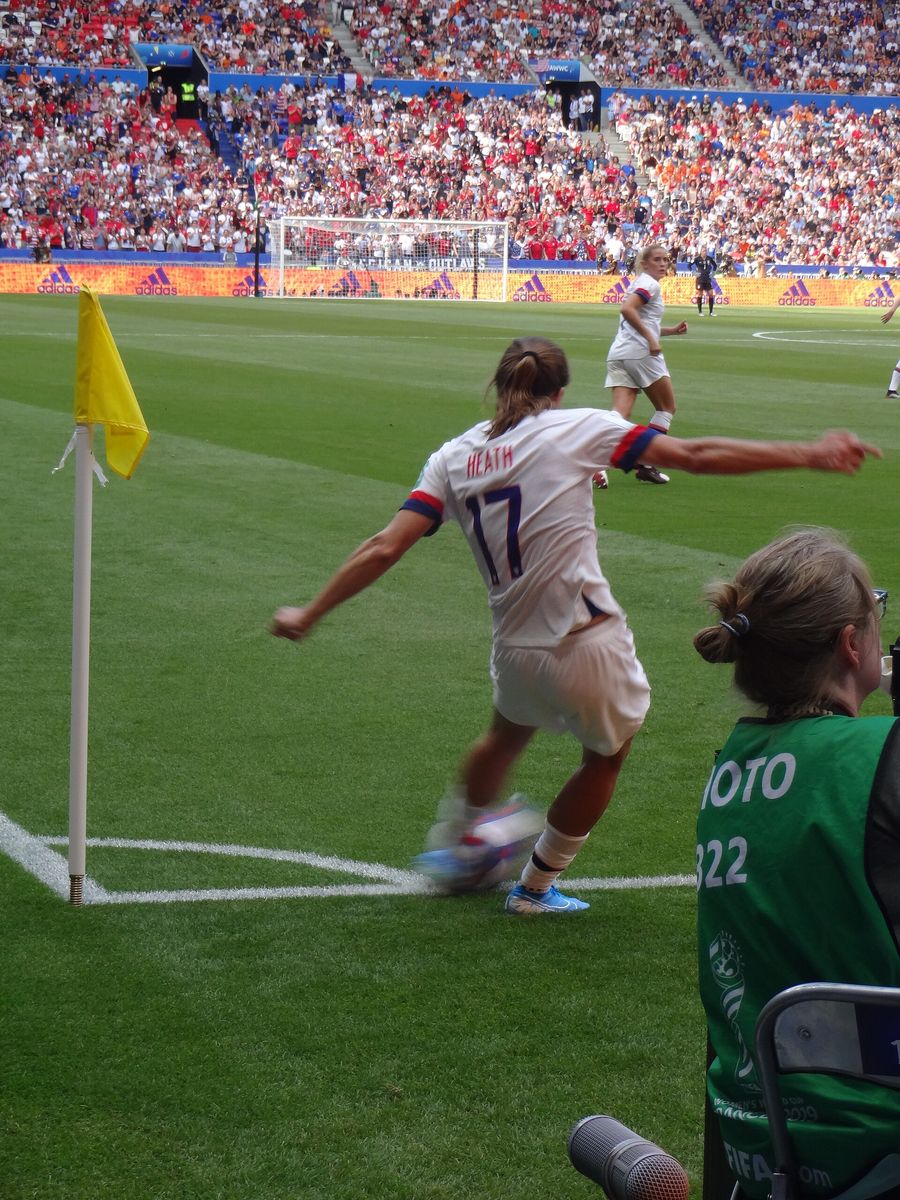
Tobin Heath of the United States taking a corner in the 2019 Women's World Cup final, Lyon.
One of the Laws' restarts, taken from the quarter-circle by the corner flag.
Holly Cheng · CC BY-SA 4.0 · Wikimedia Commons
This clause reads this way because of
IFAB Laws of the Game, current season · Law 12
Fouls, misconduct and offside
Careless, reckless or excessively forceful contact is a direct free kick; the last of the three is also a red card. A tackle from behind that endangers an opponent has been a sending-off offence since 1998. Handball is judged on whether the arm made the body unnaturally bigger, a test rewritten repeatedly and still the most argued clause in the book.
Offside is Law 11 and needs two opponents, not three, between the attacker and the goal line — a change made in 1925 to stop a defensive method that had become reliable enough to suppress scoring across a whole league.
- Opponents needed to play onside
- 2
- Tackle from behind endangering an opponent
- Red card
This clause reads this way because of
IFAB Laws of the Game, current season · Laws 11 and 12
Deciding the winner
More goals. A draw is a legitimate result in league play, which distinguishes football from every other sport on this site. Where a competition needs a winner: extra time played in full, then kicks from the penalty mark, which the Laws are careful to describe as a method of determining the winner rather than as part of the match.
Everything above is current law. Everything below is how Football got here.
02Disciplines and events
Two Olympic events under one set of Laws, which is the most extreme case on this site of a huge sport with a tiny programme. Football's competitive life happens almost entirely outside the Games, and the Olympic men's tournament is age-restricted for that reason — an eligibility rule imposed to stop it competing with the World Cup.
- Disciplines
- 1
- Olympic medal events
- 2
- Men’s and women’s counted separately.
- Contested elsewhere
- 2
- world championship.
- Listed for context
- 1
- Not counted as this sport.
Football2
One discipline. The variants below share the Laws in modified form and are governed by FIFA, but none is a separate Olympic discipline.
- Men's tournamentAge-restricted, with a limited number of older players per squad.
- Women's tournamentNo age restriction.
Variants under modified Laws2
Recorded because they show what the Laws are load-bearing for: change the number of players and the size of the pitch, and almost everything else in the book still works.
- FutsalWorld championship
- Beach soccerWorld championship
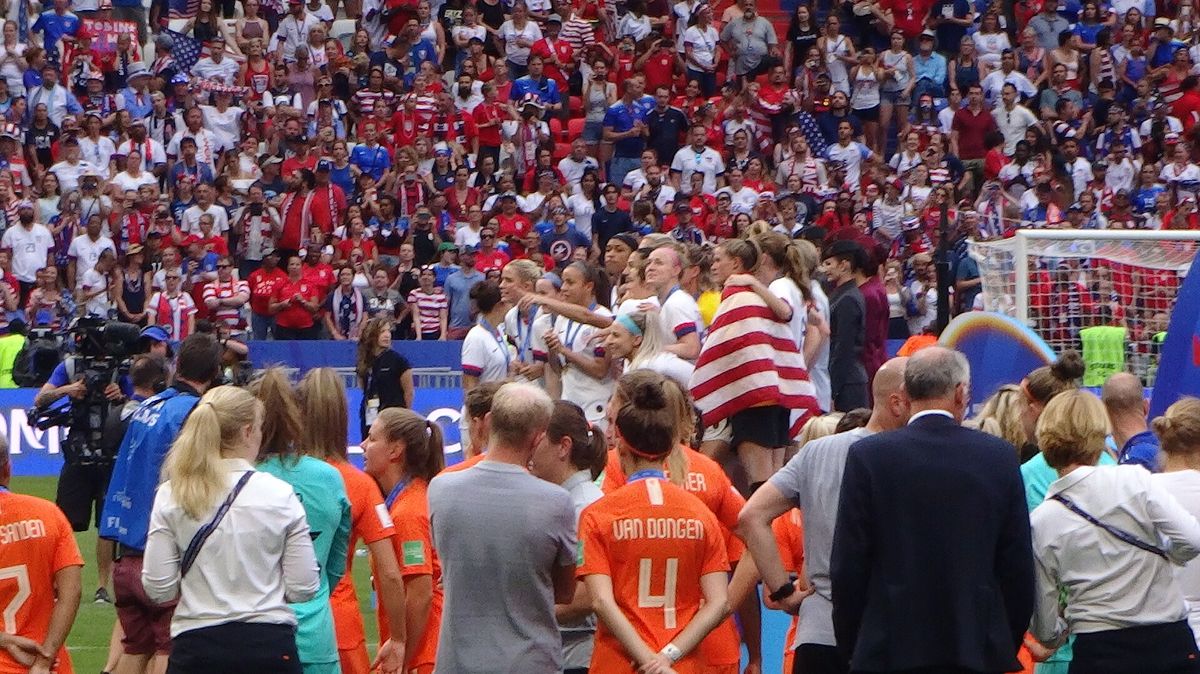
The United States receiving their medals after the 2019 Women's World Cup final, Lyon.
Men's and women's World Cups, the sport's two senior world championships.
Holly Cheng · CC BY-SA 4.0 · Wikimedia Commons
03Officiating and technology
Football resisted officiating technology longer than any comparable sport, and the argument was never really about accuracy. The Laws give the referee authority over matters of fact, and the concern was that a review system would transfer that authority to a screen — which, in a game with continuous play and no natural stoppages, also means transferring control of the clock.
Goal-line technology came first and was uncontroversial, because a goal has the one completely unambiguous definition in the Laws: the whole ball across the whole line. There is nothing to interpret, so a machine can answer it.
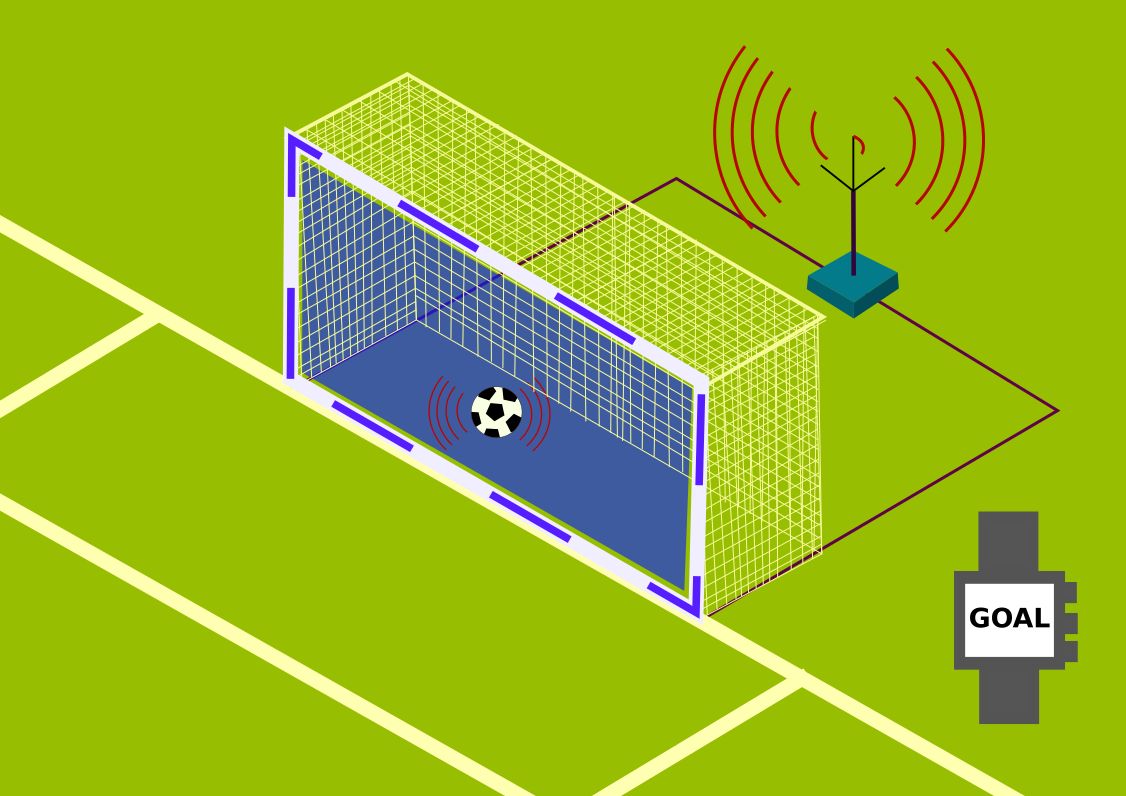
A diagram of goal-line technology: sensors on the goal frame, a signal to the referee's watch.
The one unambiguous definition in the Laws, the whole ball over the whole line, answered by a machine.
Ranjithsiji · CC BY-SA 4.0 · Wikimedia Commons
VAR, written into the Laws in 2018, is a different kind of thing. It reviews four categories — goals, penalty decisions, direct red cards, mistaken identity — and only for a clear and obvious error or a serious missed incident. That threshold is doing enormous work, because most of what VAR is asked to review is not a fact but a judgement: whether contact was careless, whether an arm made the body unnaturally bigger, whether a foul was in the area.
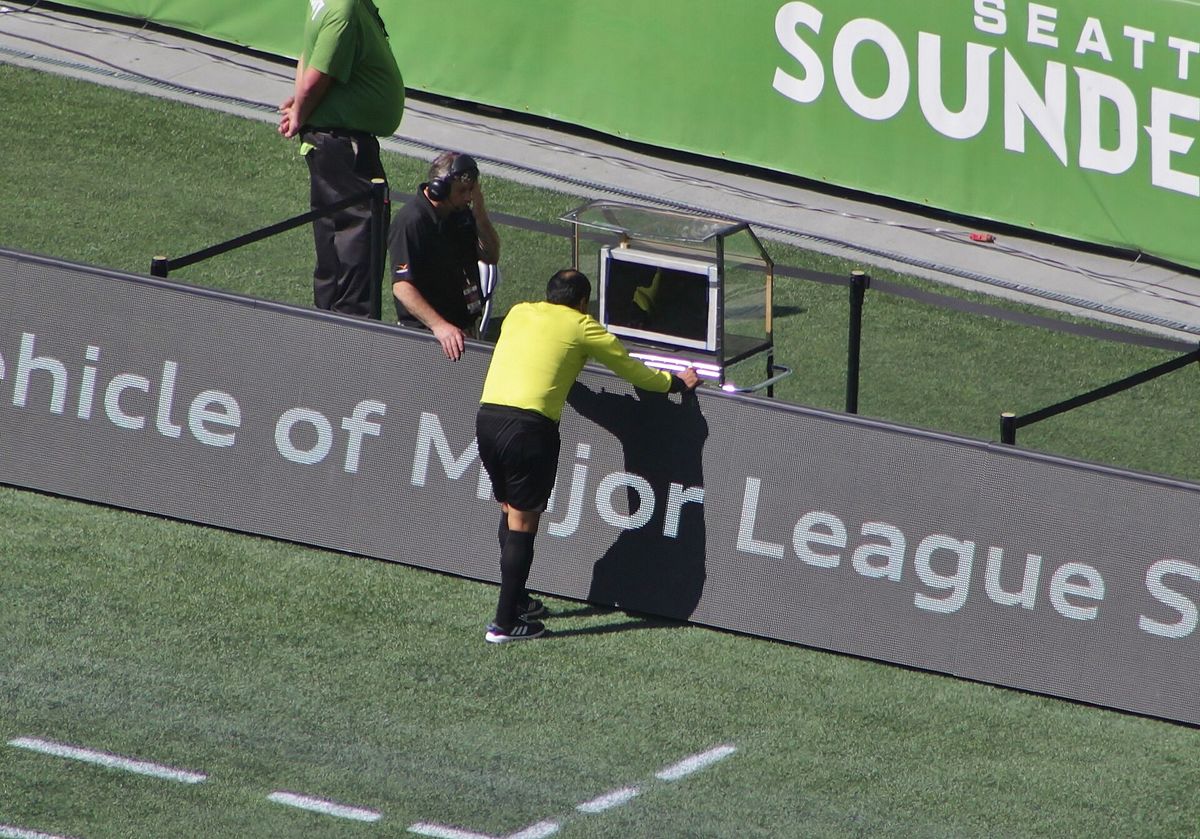
Referee Baldomero Toledo at the pitchside monitor during Seattle Sounders against Sporting Kansas City, 2018. The review ended in a red card.
A direct red card, one of the four reviewable categories.
SounderBruce · CC BY-SA 4.0 · Wikimedia Commons
The result is that football has automated its unambiguous decisions and left its ambiguous ones exactly where they were, while making them visible to everyone in slow motion. Offside is the awkward middle case: it is a question of fact, so it can be measured, and measuring it to the centimetre has produced decisions that are correct and widely felt to be wrong. That is not a technology failure. It is a rule written in 1925 for a human eye, now being enforced to a precision it was never drafted for.
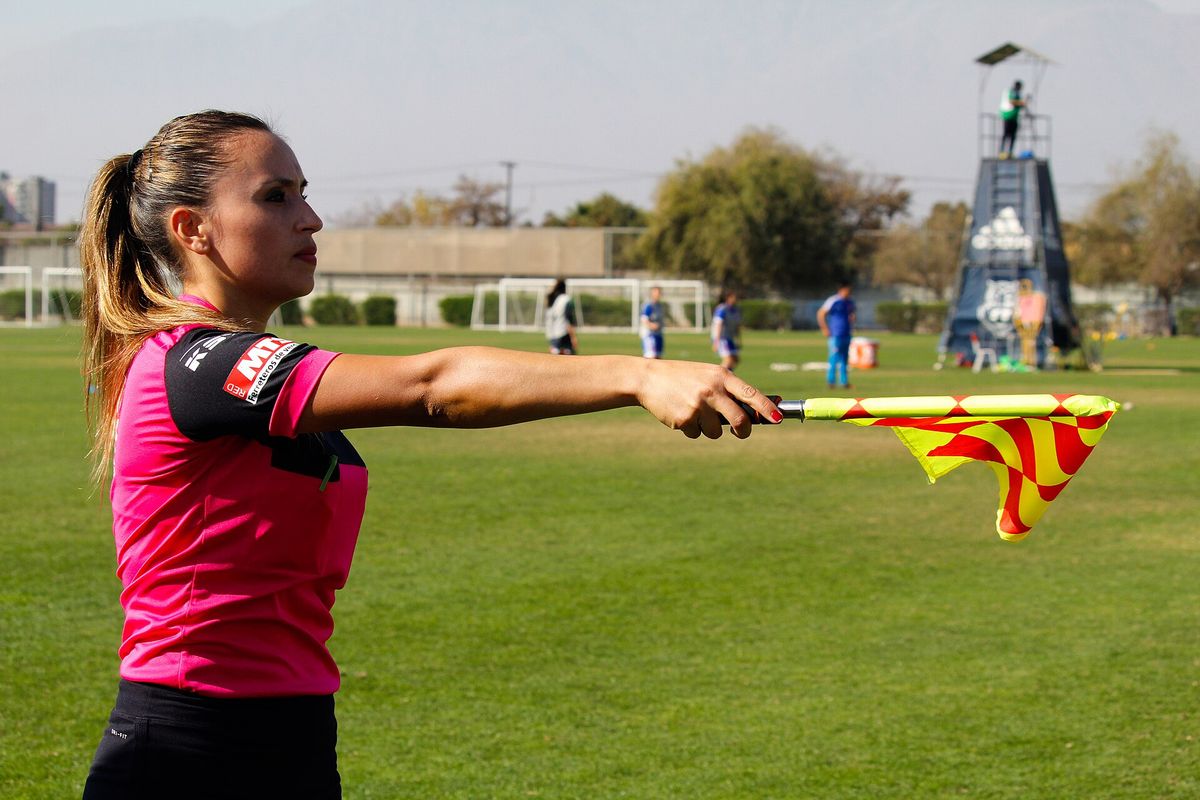
The Chilean FIFA assistant referee Marcia Castillo flagging during Universidad de Chile against Santiago Wanderers, 2018.
The eye the 1925 offside law was written for.
Javiera Mera García · CC BY-SA 2.0 · Wikimedia Commons
04Where it is played
Everywhere, which sounds like a non-answer and is actually the most important fact about the sport's rules. Football is the only sport on this site with no meaningful geographic barrier to entry, and that is why its Laws are so short.
A rulebook that has to work in every country, on every surface, at every level of resourcing cannot specify much. Law 1 gives the pitch as a range rather than a dimension. Law 2 specifies the ball by weight and pressure and says nothing about how it is made. There is no requirement for a marked pitch to have grass, no requirement for goal-line technology, no requirement for a fourth official. Everything that a wealthy competition adds is an option that competitions may take up, not a Law.
That looseness is what lets the same seventeen Laws govern a World Cup final and a game on packed earth, and it is why football produced no equipment-driven comparability break while athletics produced several.
Schoolchildren playing football on a dirt pitch, Margarita Island, Venezuela, 2014.
No grass, no markings, no nets: nothing the Laws require that this game lacks.
Wilfredor · CC0 · Wikimedia Commons

Children playing football in a dirt courtyard.
A game on packed earth, under the same seventeen Laws as a World Cup final.
Johnnybam · CC0 · Wikimedia Commons
The competitive geography is more concentrated than the participation geography and has moved. European and South American nations have won every men's World Cup; the women's game has a different and shifting map, with the United States, Germany, Japan, Spain and England having held the title, largely reflecting which countries funded the women's game and when — England's Football Association banned women's football from its members' grounds for fifty years, which is a rule with a measurable effect on where the sport is strong today.
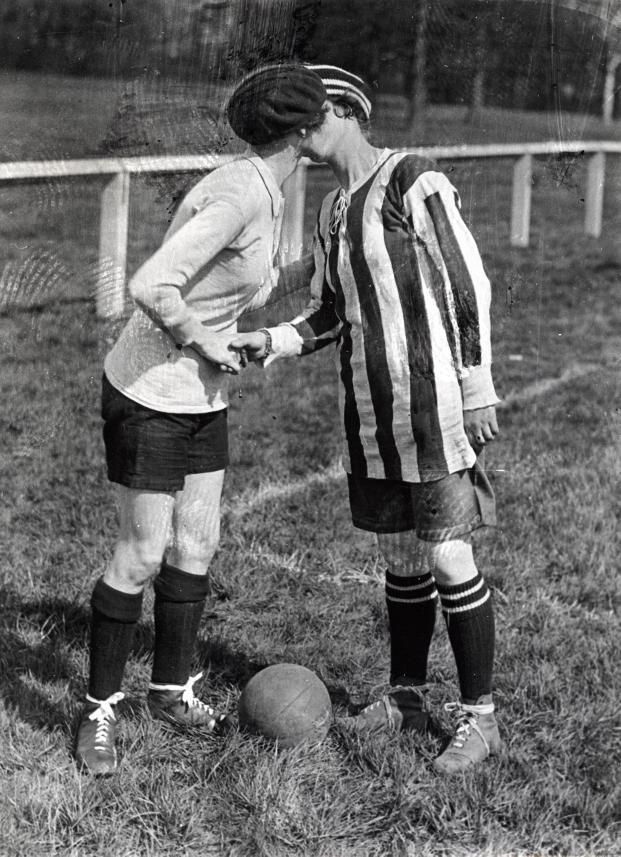
The captains Alice Kell of Dick, Kerr Ladies and Madeleine Bracquemond of France greeting before the first women's international, Preston, 1920.
A year later the FA banned women's football from its members' grounds, a ban that lasted fifty years.
Unknown photographer · Public domain · Wikimedia Commons
05Learning curve
The lowest entry barrier of any sport in the world, and the reason it is the world's sport. What makes it unusual here is that the barrier to the top is not mainly technical — it is competitive. The skills are learnable. The problem is that a quarter of a billion people are learning them.
Editorial — the site’s reading, not a sourced claim
Barrier to entry
How hard is it to get to a real game?
One ball, any surface, any number of people.
Football is the only sport on this site whose entry requirements can be met with a single object and no marked space. Goals can be jumpers, teams can be uneven, and the game degrades gracefully all the way down to one person against a wall. Nothing in the Laws is needed to have a game; the Laws describe the formal version of something people already play.
The first skill — moving a ball with your feet — is awkward for an adult and near-automatic for a child, which is why the sport recruits at an age when nobody is deciding to take up a sport.
Evidence
- Players neededAny numberobserved
- Kit to startA ballobserved
- Pitch length in the Laws90–120 mobservedA range
- Time to a real gameOne sessionestimate
Barrier to the top
How hard is it to be good at?
Not the hardest set of skills. Comfortably the hardest field to get out of.
The individual actions in football are less technically extreme than a gymnastics tumbling pass or a javelin throw, and elite players are not physiological outliers in the way elite swimmers and throwers are. What makes the top nearly unreachable is population. Every country plays it, academies recruit from the age of six or seven, and the funnel from registered youth player to professional is the narrowest in team sport.
The tactical ceiling is genuinely high and genuinely invisible. Almost everything an elite player does happens before they receive the ball, in the positioning that the offside law and the shape of the pitch make valuable, and it is the part a spectator cannot see and a coach cannot easily teach.
Evidence
- Onside requires2 opponentsruleThe clause that makes positioning the game's central skill. A defensive line only exists because this law does.1925 — the rule this rests on
- Goalkeeper handling a back-passForbidden since 1992ruleRewrote one position entirely; goalkeepers are now selected for their feet.1992 — the rule this rests on
- Typical age of academy entry6–9estimate
- Typical peak age26–29estimate
- Draws are a legitimate resultYesobservedThe only sport here where not winning is a normal outcome
Why the two differ
Football's two verdicts sit at opposite ends for a reason that is almost entirely social rather than physical. The sport is trivially easy to begin because it demands nothing, and that is exactly why it is nearly impossible to reach the top of: the same absence of barriers that lets anyone start means everyone did.
It is worth setting this against gymnastics, which is hard at both ends and for the opposite reason — a small population, a huge technical demand, and a specialisation age in single digits. Two sports can arrive at "very high" by completely different routes, which is why this section records why rather than only how much.
The historyhow it got here · sections 6 to 10
06Origin and invention
Football's origin is a schism, not an invention. Through the middle of the nineteenth century English schools and clubs each played their own code, and the codes disagreed on two questions: whether the ball could be carried, and whether an opponent could be hacked. The meetings that produced the Football Association's laws in 1863 turned on exactly those points, and the clubs that wanted carrying and hacking left. What they left with became rugby.
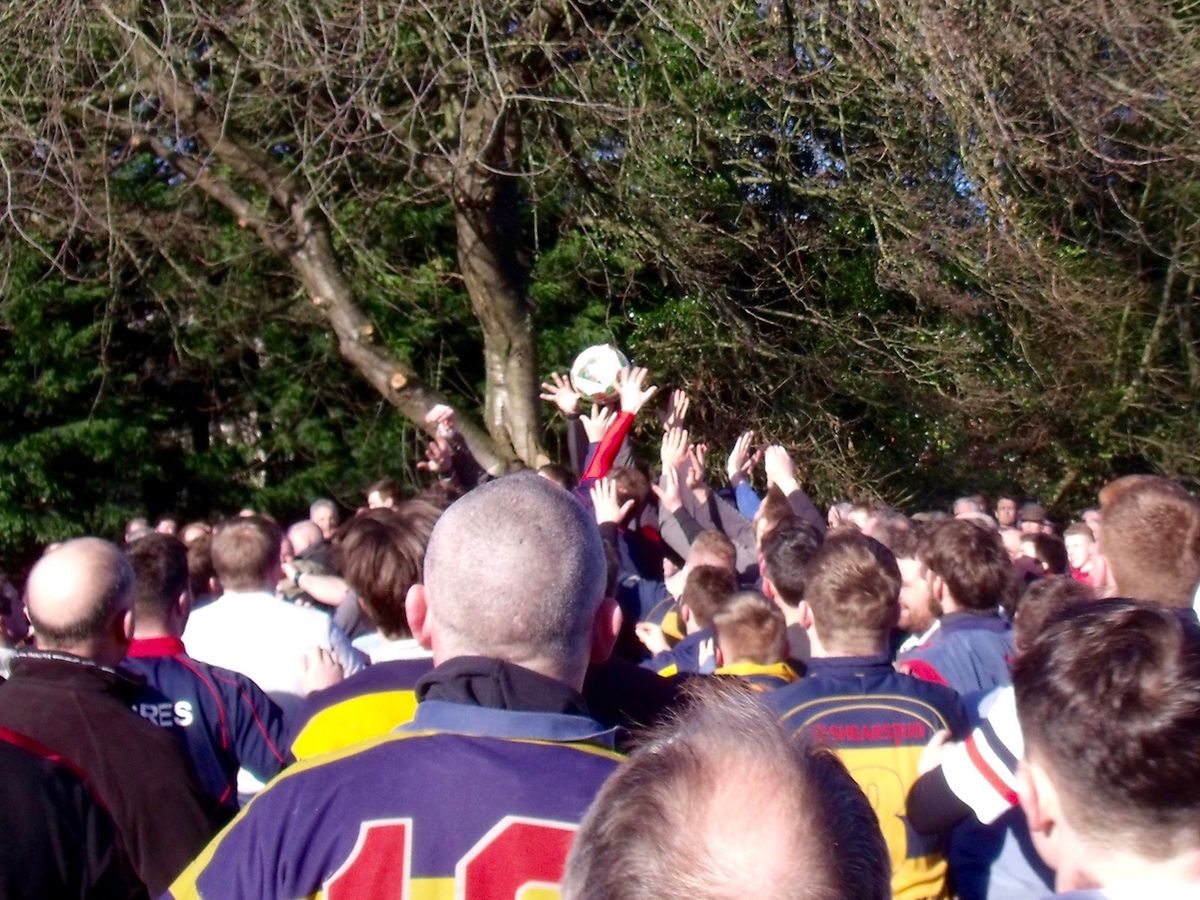
Royal Shrovetide Football at Ashbourne, Derbyshire, Ash Wednesday 2016: a crowd, a ball held aloft, and no pitch.
A surviving local code of the kind the 1863 meetings were called to replace.
Ian Calderwood · CC BY-SA 2.0 · Wikimedia Commons
So association football and rugby are not related sports so much as the two surviving answers to one argument, and the descent is legible in both rule books to this day.
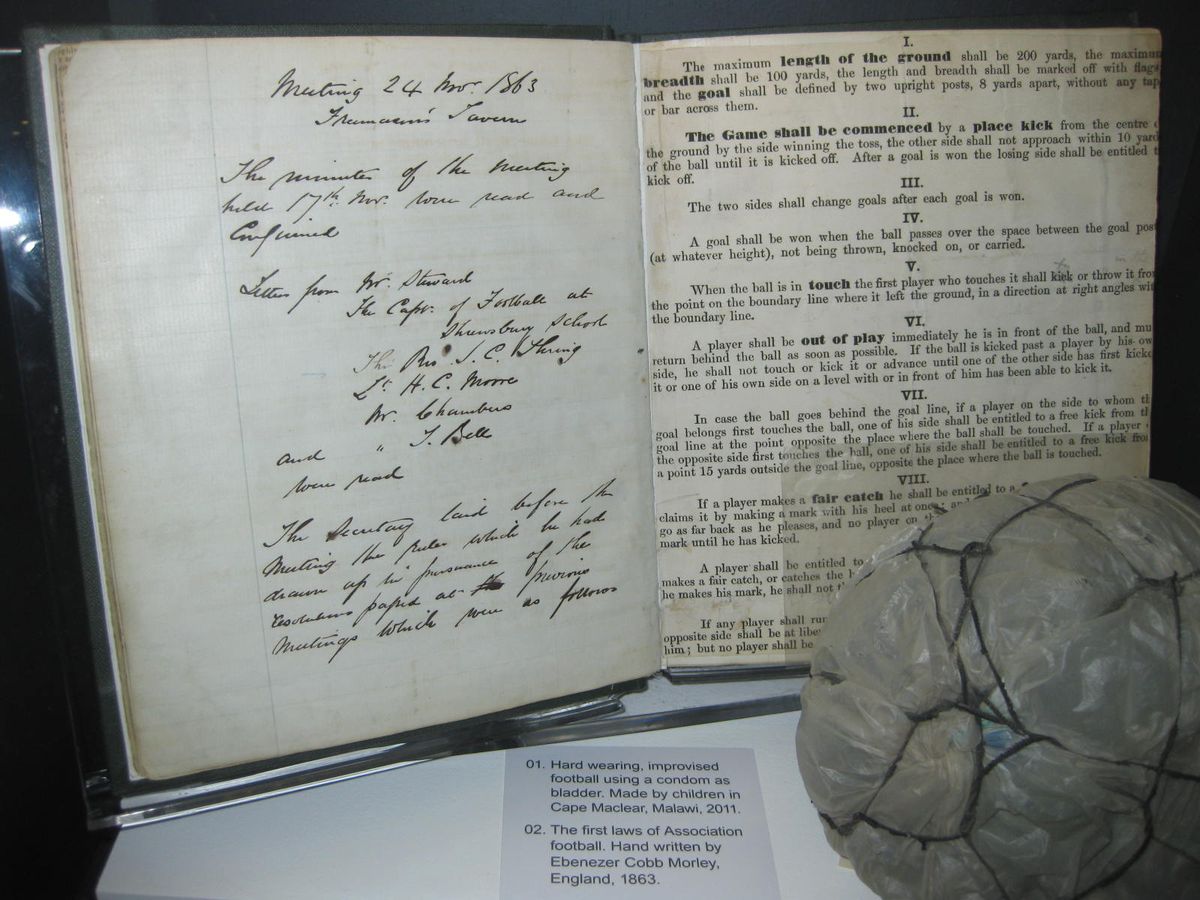
The Football Association's minute book at the National Football Museum, Manchester, open at Ebenezer Cobb Morley's minutes of the Freemasons' Tavern meeting of 24 November 1863, beside the printed first laws.
The laws that settled the carrying and hacking questions. The ball beside it, a museum label says, is an improvised one made by children at Cape Maclear, Malawi, in 2011.
Adrian Roebuck · CC BY-SA 3.0 · Wikimedia Commons
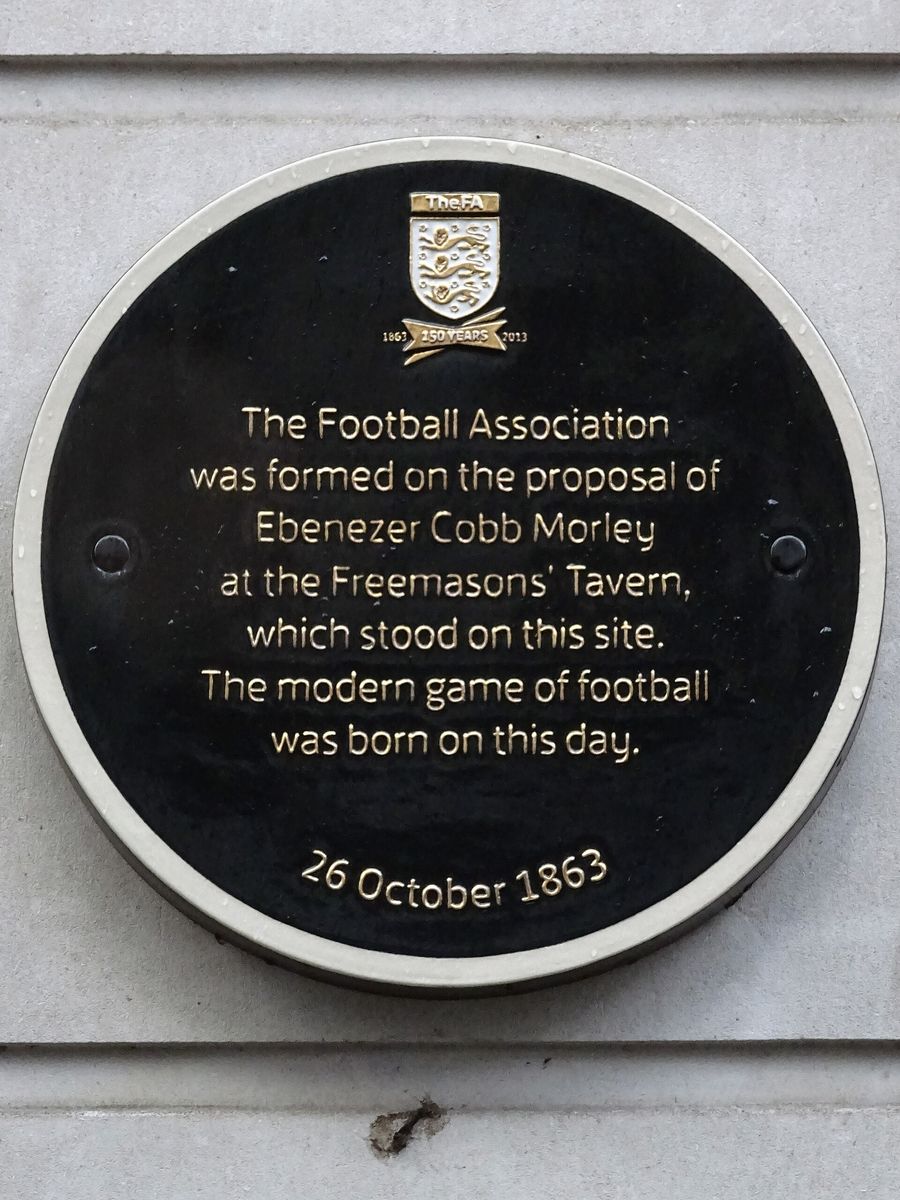
The Football Association's plaque at 61–65 Great Queen Street, London, the site of the Freemasons' Tavern.
"The modern game of football was born on this day": 26 October 1863, the first of the meetings.
Spudgun67 · CC BY-SA 4.0 · Wikimedia Commons
The second structural fact is that the FA did not keep the laws. The International Football Association Board was formed in 1886 by the four British associations to hold them jointly, and it still does — FIFA runs the sport's competitions and holds half the Board's votes, but a change to the Laws of the Game is an IFAB act. Football is therefore the only sport in this collection where the body that owns the rules is not the body that owns the sport.
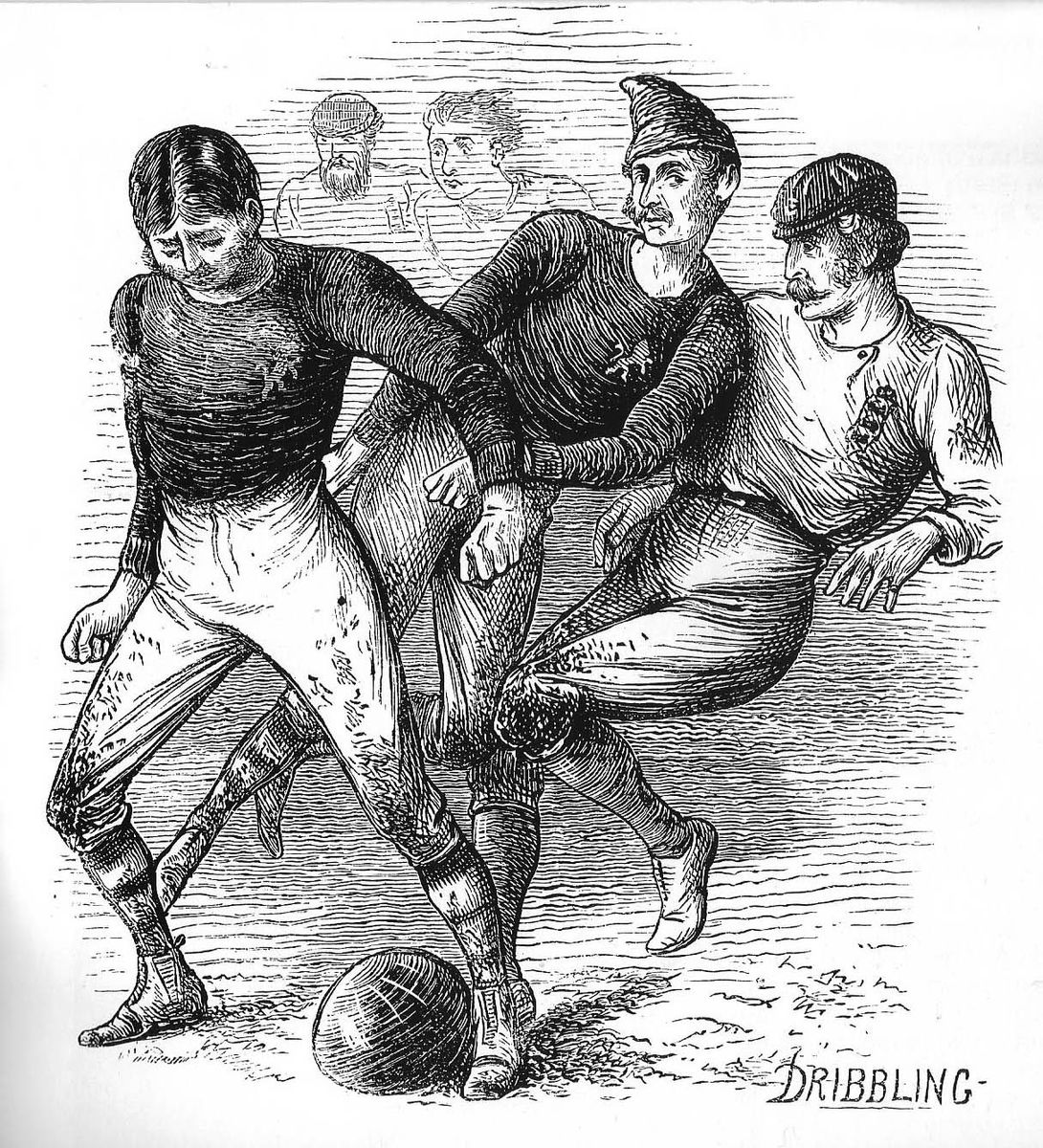
William Ralston's drawing of the first international, Scotland against England, Hamilton Crescent, Glasgow, 1872.
Played between two of the four British associations that would later form the Board to hold the laws jointly.
William Ralston · Public domain · Wikimedia Commons
That separation is why football has no record book. There is no office with the authority to ratify a football number, so there is no number for a rule change to break.
07Rule timeline
The sport’s own lane, expanded. Every entry carries a cause from the closed vocabulary and a citation, and says so where the citation is incomplete.
- 1925-07Dominance suppressionalso commercialadopted 1925-06
Law 11 was amended so that two opponents, rather than three, must be between an attacker and the goal line for the attacker to be onside. The change is small on the page and enormous on the pitch: it is the origin of the modern defensive line and, indirectly, of the centre-half becoming a defender.
Trigger and citation
Trigger
The offside trap as developed at Newcastle United, associated with Bill McCracken, had become reliable enough to suppress scoring across the English league, and attendances were understood to be suffering for it. The Board legislated against a tactic rather than against a team.
Laws of the Game · Laws of the Game, 1925/26 · article Law 11
- 1992-07Broadcast and pacingalso commercialadopted 1992-06
A goalkeeper may no longer handle the ball after it has been deliberately kicked to them by a team-mate; doing so is an indirect free kick. The rule removed the single most effective method of running down the clock and forced goalkeepers to become players who use their feet.
Comparability break · Scoped to one competition
The break is real but it is a break in a competition's series, not in the sport's. Football has no series for the sport as a whole to break. See the series
Trigger and citation
Trigger
The 1990 World Cup is the standard reference: the lowest goals-per-game figure of any finals tournament, and sustained time-wasting in which the ball was passed back and picked up. The Board's concern was the watchability of the game as a broadcast product.
Laws of the Game · Laws of the Game, 1992/93 · article Law 12
- 1993Broadcast and pacingadopted 1993
Competitions were permitted to end extra time immediately upon a goal being scored, the match finishing at that moment. Adopted into the Laws as an option for competition organisers rather than as a universal requirement.
Trigger and citationIncomplete — no confirmed article
Trigger
The stated aim was to encourage attacking play in extra time and to reduce the number of ties decided by penalty kicks.
In practice it was widely reported to have had the opposite effect, with teams becoming more cautious because a single concession ended the match with no chance to reply. That reading is what the 2004 reversal rests on.
Laws of the Game · Laws of the Game, 1993/94
- 1998-06Safetyadopted 1998
A tackle from behind that endangers the safety of an opponent was made a sending-off offence, rather than a cautionable one. Applied from the 1998 World Cup.
Trigger and citation
Trigger
A sustained pattern of serious leg injuries from challenges made from behind, where the player being tackled cannot see the challenge coming and cannot protect the standing leg.
Laws of the Game · Laws of the Game, 1998/99 · article Law 12
- 2004Broadcast and pacingadopted 2004-02
Golden goal, and the silver goal variant that had briefly replaced it, were removed from the Laws. Extra time returned to two full periods played out in full. Eleven years after adopting a change to make extra time more attacking, the Board concluded that it had made it less so and reversed it.
Trigger and citationIncomplete — no confirmed article
Trigger
The reversal is one of the few cases in this collection where a governing body publicly accepted that a rule change had produced the opposite of its stated aim.
IFAB annual Law amendment circulars · IFAB Annual General Meeting, 2004
- 2018-06Integrityalso fairness and eligibilityadopted 2018-03
Video assistant referees were written into the Laws of the Game after a two-year trial, permitting review of four categories of decision: goals, penalty decisions, direct red cards, and mistaken identity. Review is limited to clear and obvious errors and serious missed incidents; the referee's decision remains the decision.
Trigger and citation
Trigger
No single incident. The Board's stated case was the accumulated weight of match-deciding errors that broadcast cameras had already shown to everyone watching, which had made the discrepancy between what the referee could see and what the audience could see untenable.
Laws of the Game · Laws of the Game, 2018/19 · article VAR protocol
08Equipment evolution
Football has changed its equipment more than the timeline suggests, and almost none of it appears as a rule change, because Law 2 has always specified the ball loosely — circumference, weight, pressure — and left the construction alone.
The leather ball absorbed water and roughly doubled in weight over a wet match, which is a fact about the game before the 1980s that no rule records. Synthetic coatings, then thermally bonded panels, changed the flight of the ball substantially over three decades within a specification that never had to move. Every argument about a World Cup ball since 2006 has been an argument about an object that is entirely legal.

The Adidas Telstar Durlast, official ball of the 1970 World Cup in Mexico.
Leather panels, stitched: the ball that soaked up water, legal under the same loose Law 2 as everything since.
Zac Allan · Public domain · Wikimedia Commons
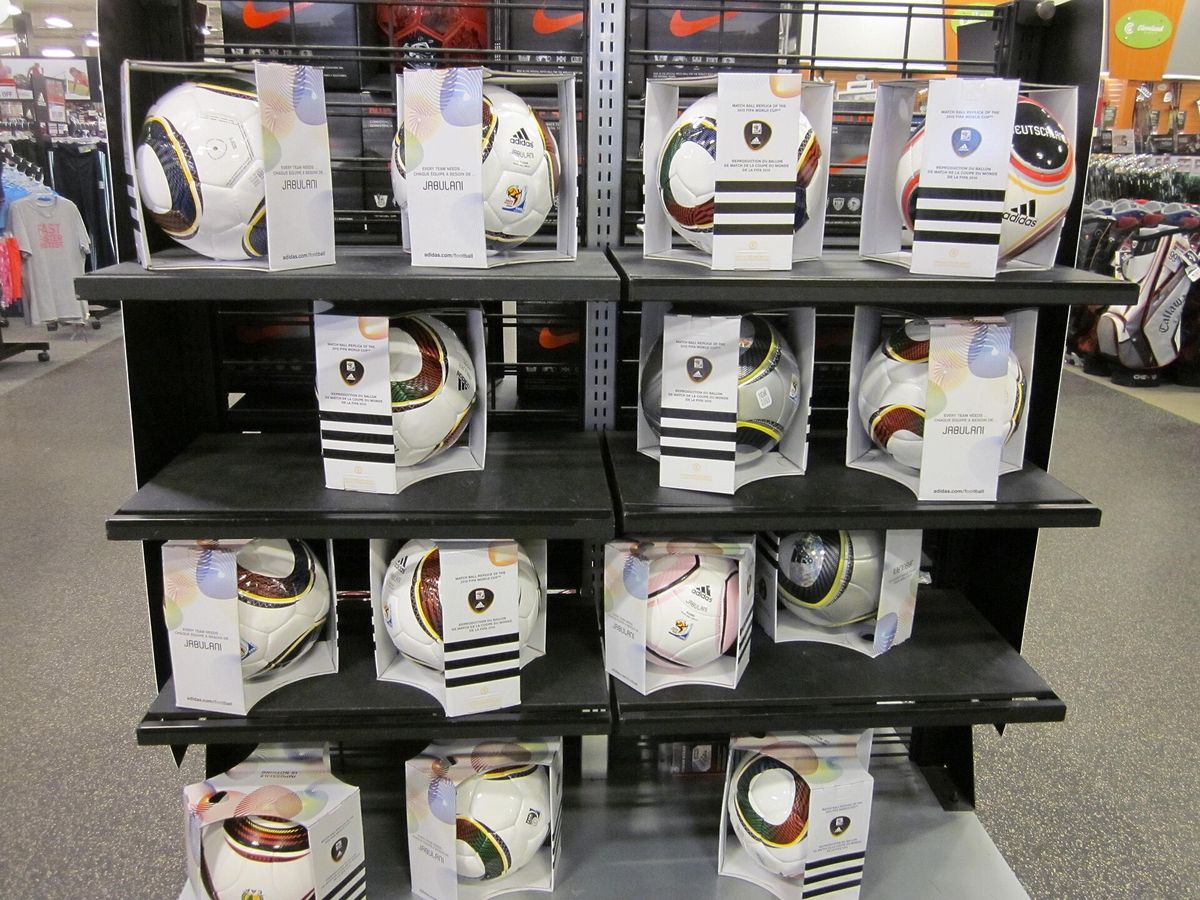
Adidas balls for the 2010 World Cup on sale, among them versions of the Jabulani.
Thermally bonded panels and a flight that players complained about, inside a specification that never had to move.
BrokenSphere · CC BY-SA 3.0 · Wikimedia Commons
Goalkeeper gloves went from optional to universal in the 1970s without a rule. Shin guards became compulsory in 1990, which is one of the few equipment changes here with a safety cause and a date.
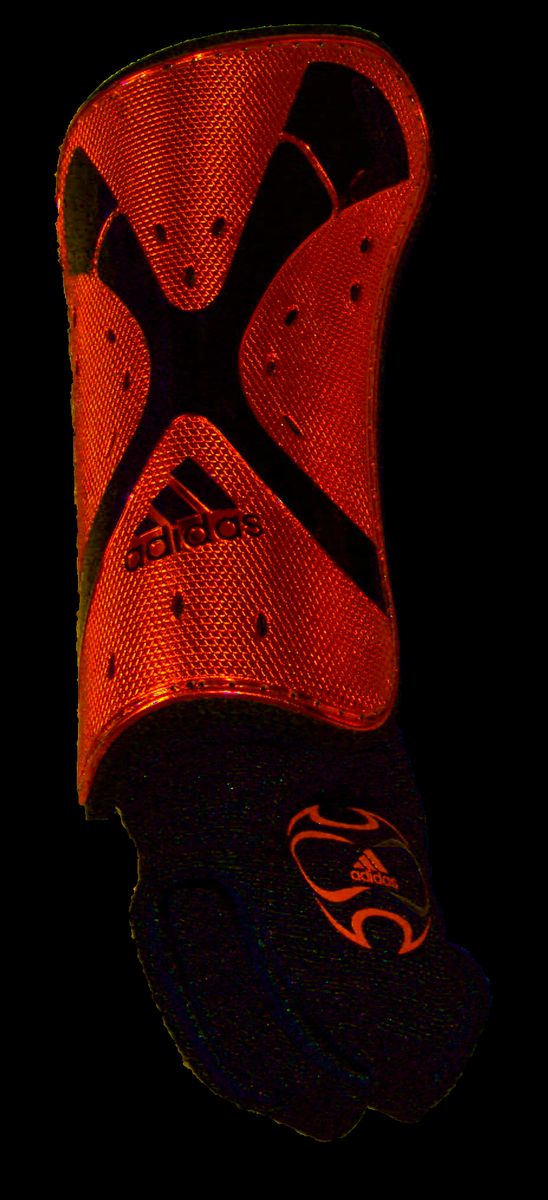
A modern shin guard.
Compulsory since 1990: one of the few equipment changes with a safety cause and a date.
Luxo · CC BY 2.5 · Wikimedia Commons
The point of this section for a site about rules is the negative one. Football's equipment was allowed to evolve inside a loose specification, so it produced no comparability break — while athletics wrote its specification tightly and therefore had to keep amending it, and each amendment cut the record book. How tightly a sport specifies its equipment determines how often it has to break its own numbers.
09Governing body politics
The Laws are held by the International Football Association Board: the four British associations hold one vote each, FIFA holds four, and a change requires six. Neither side can amend the Laws alone. This arrangement is a settlement of a 1900s dispute about who owned the game, and it has survived every subsequent realignment of power in the sport.

The Home of FIFA, the federation's headquarters in Zurich.
FIFA runs the competitions and holds four of the Board's eight votes. The laws are an IFAB act.
Albinfo · CC BY-SA 4.0 · Wikimedia Commons
Its effect on this site is concrete. Because IFAB publishes an annual edition of the Laws plus a circular listing that season's amendments, football rule changes are among the best-documented in this collection — a dated act by a named body with a published text. Compare gymnastics, where the scoring system is republished wholesale each quadrennium and the amendments are not separately enumerated.
The professionalism schism came early here and was settled early. The FA accepted professionalism in 1885, decades before athletics, tennis or rugby union faced the same question. Football therefore has no equivalent of the amateurism rules that shaped who could compete in the other sports on this timeline, and no eligibility rule changes to show for it.
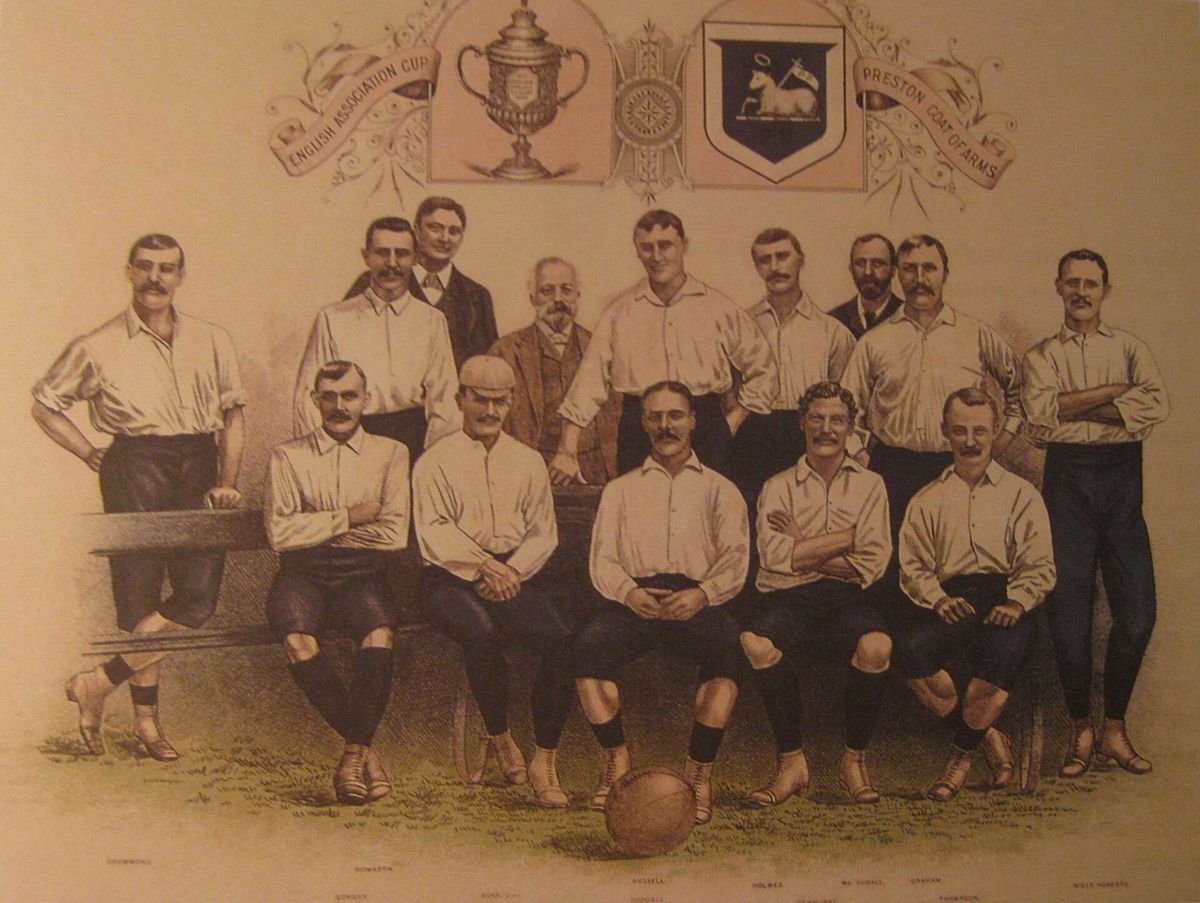
Preston North End, the first Football League champions, 1888–89.
Champions of the first Football League season, three years after the FA accepted professionalism.
Unknown photographer · Public domain · Wikimedia Commons
10Controversies that forced rule changes
Italia '90. The tournament is the standard trigger cited for the back-pass rule: sustained time-wasting in which the ball was played back to a goalkeeper who picked it up, and the lowest scoring rate of any World Cup finals. Two years later a goalkeeper could no longer handle a deliberate back-pass, and the goalkeeping position was rewritten around the change. It is the clearest case in this collection of a rule change altering a position rather than a procedure.
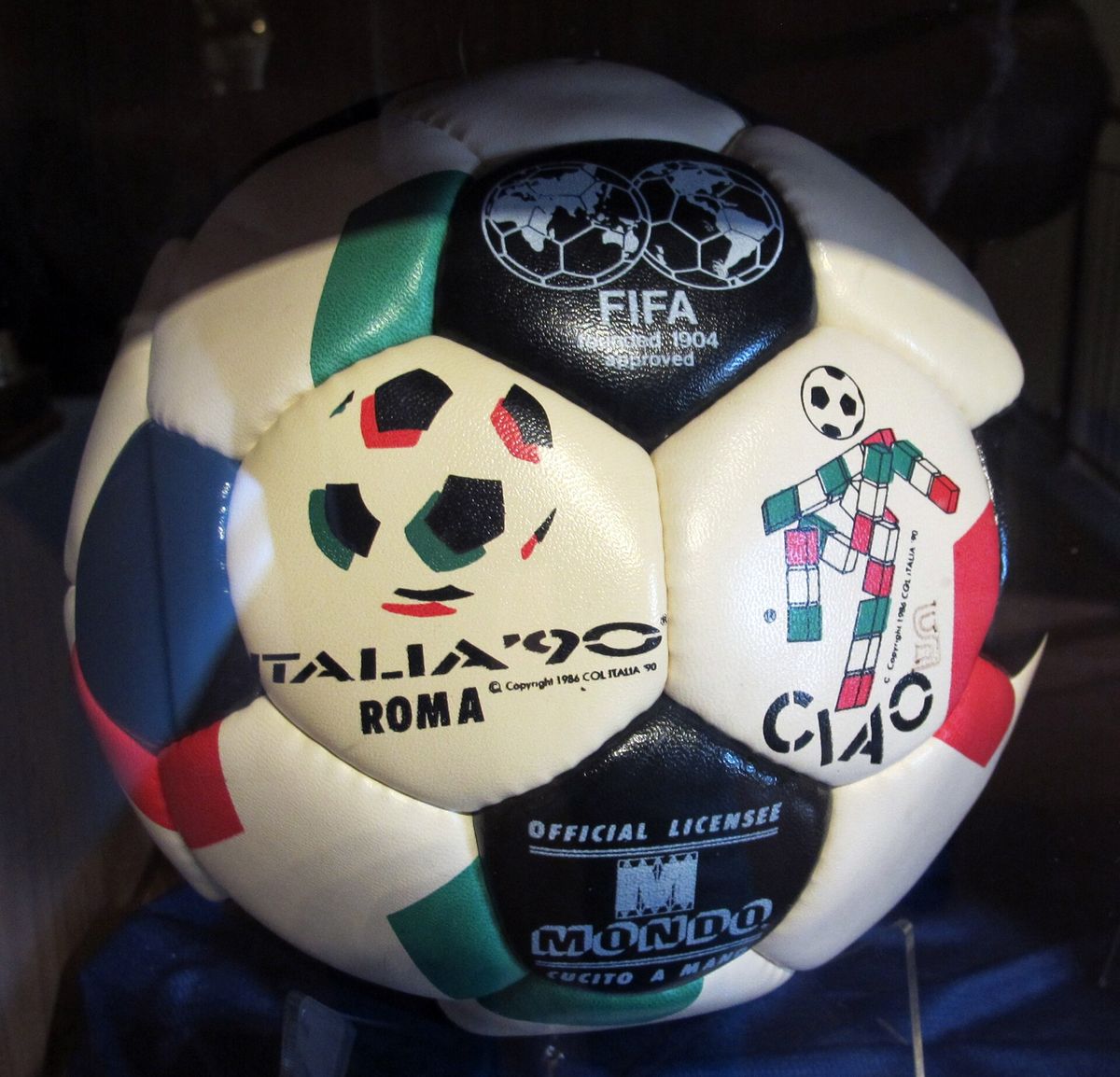
A ball commemorating Italia '90, in the Museo del Calcio, Florence.
The tournament generally cited as the trigger for the 1992 back-pass rule.
Sailko · CC BY 3.0 · Wikimedia Commons
Newcastle's offside trap. Sixty-five years earlier the Board had done the same thing for the same reason. A defensive method had become reliable enough to suppress scoring across a whole league, and the Board changed Law 11 from three defenders to two. Both changes are legislation against a way of playing that was working too well.
Golden goal, and its withdrawal. Introduced in 1993 to make extra time more attacking; abolished in 2004 on the reading that it had made extra time more cautious, because conceding once ended the match with no chance to reply. A governing body reversing itself and effectively saying so is rare enough to be worth recording as its own entry rather than as a footnote to the first.
Every televised refereeing error since about 1970. VAR has no single trigger, and that is the interesting thing about it. What forced it was cumulative: broadcast technology showed the audience, in slow motion and from eight angles, decisions the referee had one look at in real time. The rule changed because the gap between what the crowd knew and what the official knew had become impossible to defend.
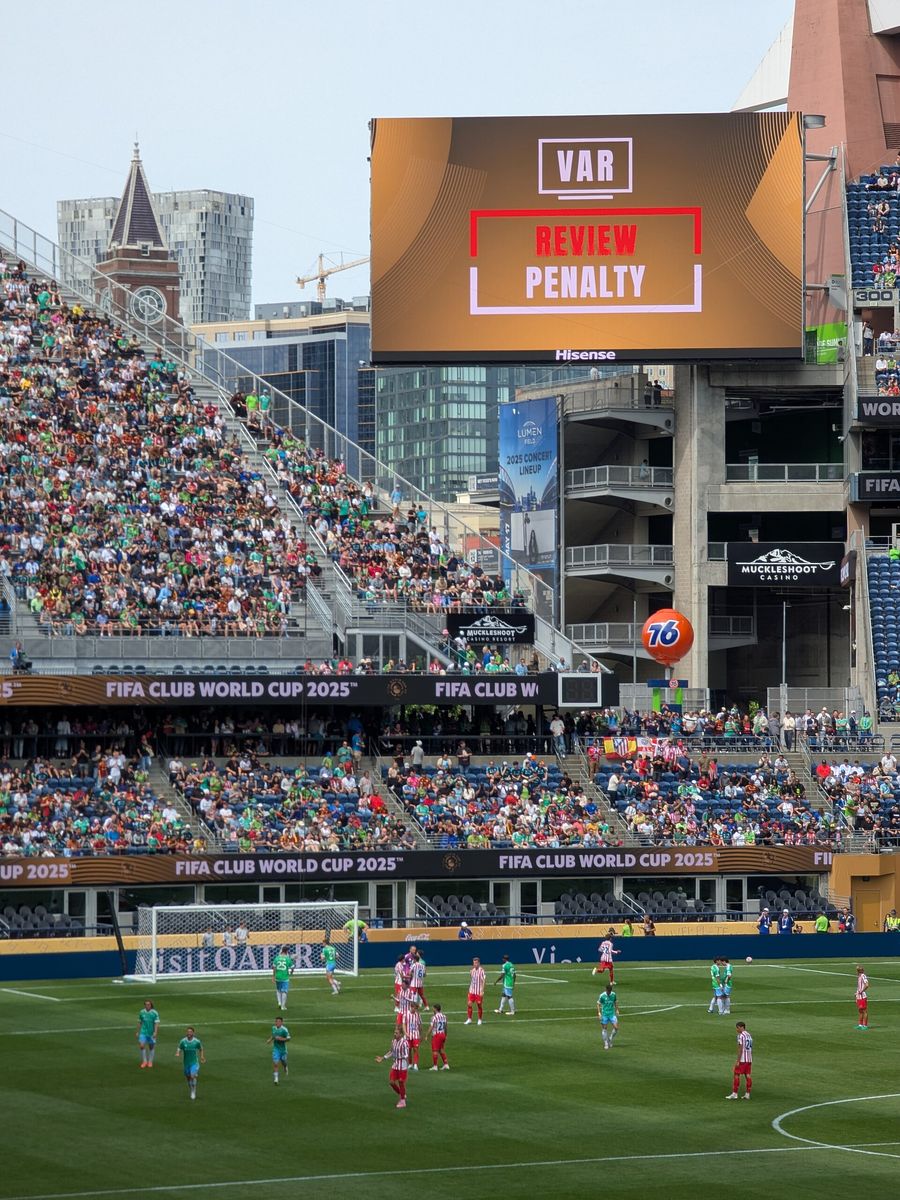
The stadium screen announcing a VAR penalty review at the 2025 FIFA Club World Cup, Lumen Field, Seattle.
The review made visible to the crowd, which is what forced it in the first place.
SounderBruce · CC BY-SA 4.0 · Wikimedia Commons
Where it standsthe record, and what is still open · sections 11 to 12
11Series
No series published
Goals per game — English top flight
There is no such thing as football's goals-per-game figure. Football has no central record book and no body that keeps a continuous quantitative series for the sport, so any rate statistic belongs to one named competition and means nothing outside it. That is why this series is titled with its competition and not with the sport, here and everywhere else it appears. Even scoped, this particular series has a confound that deserves stating rather than smoothing over. The back-pass rule took effect in July 1992. The English top flight was reconstituted as the Premier League in February 1992 and began play the same month the rule did. A change in goals per game across that line is a change across a rule amendment and a competition reorganisation at once, and this site will not present it as measuring the rule. The figures themselves are not entered because they have not been taken from a cited source. When they are, the chart appears here in two segments with the 1992 line between them, and the confound stays in the caption.
1992Scoped to one competitionThe break is real but it is a break in a competition's series, not in the sport's. Football has no series for the sport as a whole to break.
12What is contested now
Recorded as unsettled, and football has more open arguments than any other sport here because IFAB amends the Laws annually and publishes the debate.
Handball. The most rewritten clause in the book and still the least settled. The test has moved between intent, position, whether the arm made the body unnaturally bigger, and whether the deflection came off the player's own body, and each revision has traded one kind of unfairness for another. The underlying problem is that the Law is asking for a judgement about a player's state of mind and then being enforced from a slow-motion camera that cannot see one.
Offside and precision. The Law dates from 1925 and was drafted for a linesman's eye. Enforced to the centimetre by tracking systems, it produces decisions that are correct under the Law and widely felt to be wrong. Proposals to add a tolerance, or to require daylight between attacker and defender, are attempts to rewrite the Law to match the precision now available. None has been adopted.
Concussion substitutes. Temporary concussion substitutions have been trialled, and player unions have pressed for them against a Board that has preferred permanent additional substitutions. This is a safety argument with an integrity objection attached — a temporary substitution is exploitable — which is an unusually clean example of two of this site's causes pulling against each other.
Time-wasting and effective playing time. Proposals to stop the clock, as most other sports do, resurface regularly. Football's added time is the only mechanism of its kind here and the only one left entirely to one official's discretion.