
Golf
The only sport on this site with a formal system for making unequal players comparable.
- Official
- Golf
- Game category
- Target
- Adjudication
- Measured
- Standing
- Removed, restored
- rule changes
- 6
- comparability breaks
- 2
- Olympic editions
- 6
The Olympic golf course at Barra da Tijuca, Rio de Janeiro, built for 2016 · Miriam Jeske / Brasil2016.gov.br · CC BY 3.0 br
- Governing body
- R&A and USGA jointly own the Rules; the IGF runs Olympic golf.
- Founded
- Earliest surviving code of rules, Leith, 1744. The R&A dates from the same decade; the USGA from 1894.
- Olympic status
- 6 editions
- on the 2028 programme
- Also contested at
- Asian Games
Everything else on this site is a record of comparability breaking. Golf is the one sport that built a comparability machine on purpose: the handicap takes players of different abilities on different courses in different conditions and produces a number that can be compared. It is the only systematic answer to this site's problem anywhere in the collection — and it works for amateurs and is switched off entirely at the top.
The gamewhat it is now · sections 1 to 5
01How it is played
Get the ball into the hole in as few strokes as possible. Golf's rules are long because the ball is played wherever it comes to rest, on ground nobody designed to be fair — so most of the book is about what to do when the situation is not a fairway.
These figures were entered from the edition named above but have not been checked against its text line by line. Treat them as this site’s reading of the laws, not as a substitute for them.
The object of the game
Fewest strokes over the round, in stroke play; most holes won, in match play. The ball is played as it lies, which is the governing principle and the source of almost every complication in the rulebook.
Golf is the only sport here where the competitors do not interact at all and the opponent is the course.
The course
Eighteen holes, and no two courses are alike in length, difficulty or conditions. That non-standardisation is more extreme than tennis's surfaces or baseball's outfields: the venue is a different shape at every event and changes with the weather during the round.
Golf handles this not by standardising but by measuring the difficulty. Course and slope ratings quantify how hard a course plays from a given set of tees, which is what makes the handicap work.
- Holes
- 18
- Course length
- Not standardised
- Course rating
- Measures difficulty for a scratch player
- Slope rating
- Measures difficulty for a bogey player
The Olympic golf course at Barra da Tijuca, Rio de Janeiro, built for 2016.
Fairways, greens, bunkers and water across tens of hectares: the land a course needs.
Miriam Jeske / Brasil2016.gov.br · CC BY 3.0 br · Wikimedia Commons
This clause reads this way because of
Clubs and ball
Fourteen clubs maximum, each conforming to specifications on head size, face flexibility and groove geometry. The ball conforms to limits on size, weight, velocity and overall distance under a standard test.
That last one is about to change. From 2028 the test conditions tighten so that conforming balls fly shorter, because driving distance had risen far enough that historic courses could no longer test the best players and lengthening them was running into limits of land and water.
- Clubs
- 14 max
- Ball diameter
- 42.67 mm min
- Ball weight
- 45.93 g max
- Ball rollback
- From 2028
Players and officials
Golf is officiated primarily by the players themselves. A competitor calls penalties on themselves, and doing so is treated as a defining norm of the sport rather than as an unusual burden.
Referees and rules officials exist and are consulted, but they are not watching every player — there are too many, spread over too much ground. Sailing's penalty turn is the nearest relative on this site.
- Primary official
- The player
- Handicap
- Used in amateur play, not in elite competition
Format
Four rounds of eighteen holes over four days in a professional tournament, with a cut after two. Match play, used in some team events, counts holes won rather than strokes.
Pace has been a persistent problem, and the 2019 rewrite addressed it directly: a three-minute limit on searching for a lost ball, dropping from knee height, and a recommendation to play in about forty seconds.
This clause reads this way because of
Scoring
Strokes, counted. In amateur play the handicap converts that raw count into a comparable number by adjusting for the course, the tees and — since 2020 — the conditions on the day.
That system is why golf appears on this site. Everything else here records comparability being lost. Golf built a formal apparatus for creating it, has run it for over a century, and unified it worldwide in 2020 so that a handicap means the same thing in every country.
Elite golf switches it off. Professionals play off scratch, and their scores are not comparable between courses — which is why golf's records are counts of titles rather than numbers of strokes.
- Scoring
- Strokes
- Handicap
- Since 1911
- World Handicap System
- Since 2020
- Elite play
- No handicap
Relief and drops
Most of the rulebook. A ball in a penalty area, in an abnormal course condition, out of bounds, or unplayable each has its own procedure, and each involves taking relief with or without penalty and dropping the ball correctly.
The 2019 rewrite simplified a great deal of this — dropping from knee height rather than shoulder height, and removing several penalties for accidental actions — after decades in which players broke rules by accident and were penalised for it on television.
This clause reads this way because of
Penalties
Playing a wrong ball, grounding the club in a penalty area, improving your lie, taking advice, carrying more than fourteen clubs, and signing an incorrect scorecard.
That last one produced golf's most-criticised enforcement: viewers telephoning broadcasters about breaches a player could not have seen, leading to disqualification days later, and only for players who happened to be on television. It was ended in 2019.
This clause reads this way because of
Deciding the winner
Fewest strokes, or most holes. Ties in major professional competition are resolved by play-off, in formats that differ by championship — which is tennis's deciding-set problem in a different sport, and golf has not harmonised it either.
Everything above is current law. Everything below is how Golf got here.
02Disciplines and events
Two Olympic events, in a sport whose real calendar is elsewhere — the four major championships are independent tournaments run by different bodies, none of which is the IGF. The same shape as tennis, and for the same reason: the sport was fully professionalised long before it returned to the Games.
- Disciplines
- 1
- Olympic medal events
- 2
- Men’s and women’s counted separately.
- Contested elsewhere
- 4
- professional.
- Listed for context
- 2
- Not counted as this sport.
Olympic golf2
72 holes of stroke play. Returned in 2016 after 112 years away.
- Men's individual
- Women's individual
The championships that matter more4
Four independent tournaments, run by four different organisations, each setting its own conditions and its own play-off format.
- The MastersProfessionalPlayed on the same course every year — the only major that is.
- PGA ChampionshipProfessional
- U.S. OpenProfessionalRun by the USGA, one of the two bodies that owns the Rules.
- The Open ChampionshipProfessionalRun by the R&A, the other one.
Where the handicap actually operates2
- Club competitionThe handicap system's purpose: players of any standard competing against each other.
- World Handicap SystemSix regional systems unified in 2020 so a handicap means the same everywhere.
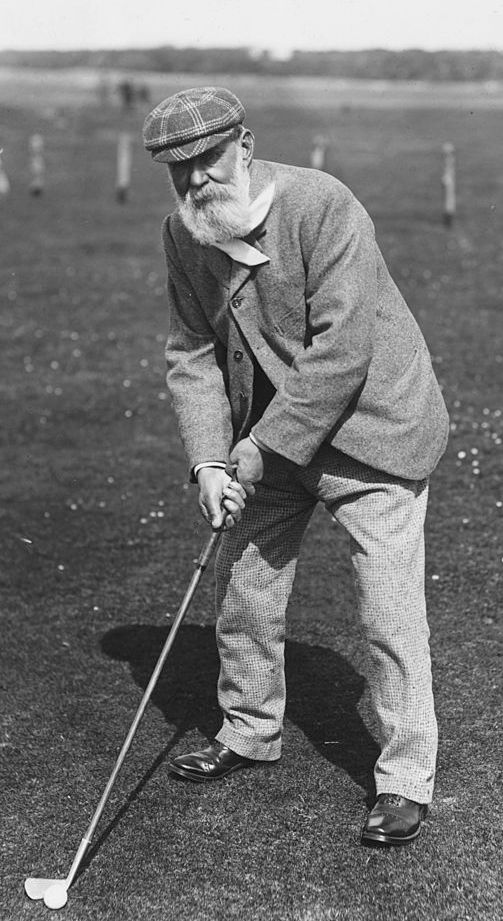
Old Tom Morris on a golf course, 1880.
Four times winner of the Open Championship, the oldest of golf's four majors.
Unknown photographer · Public domain · Wikimedia Commons
03Officiating and technology
Golf is officiated by the people playing it, and takes that seriously enough that it is close to the sport's identity.
A player who breaks a rule is expected to call the penalty on themselves, including when nobody saw and nobody would ever know. Referees and rules officials exist and are consulted for procedure, but they cannot watch everyone: a field is spread across two hundred acres.
The nearest relative on this site is sailing, where a boat that has broken a right-of-way rule takes its own penalty turn on the water without an official intervening. Both sports have strong amateur traditions and both treat self-enforcement as constitutive rather than convenient.
Television broke this for a while, and the way it broke is worth recording. High-definition slow motion could see things no player or official could, viewers telephoned breaches in, and players were penalised for infractions they could not have detected — but only if they had been on camera. A sport that enforces its rules through the honesty of participants ended up with enforcement determined by broadcast schedule.
The 2019 rewrite closed it: call-in penalties ended, and a player is not penalised for a breach that could not reasonably have been seen.
That is a rare direction of travel on this site. Almost everywhere else, technology revealed what officials were missing and the sport adopted it. Golf's technology revealed more than the sport wanted enforced, and the sport declined it.
04Where it is played
Golf's map is drawn by land and money, and it needs an unusual amount of both.
The United States, Great Britain and Ireland, Japan, South Korea, Australia, South Africa, Sweden, Spain and increasingly China produce the elite. What they have is courses, and courses are the constraint: eighteen holes occupies between fifty and eighty hectares, requires continuous maintenance, and in many climates requires a great deal of water.
That last point is now a live political issue rather than a background fact. Golf's land and water use is criticised in exactly the regions where the sport has expanded most aggressively, and it is part of the argument against lengthening courses to keep pace with distance — which is one of the reasons the governing bodies chose to shorten the ball instead.
South Korea is the case worth recording. Its women's programme is the most successful national pipeline in the sport, built on a dense network of practice facilities and a domestic tour, and it produces players in numbers disproportionate to the country's course inventory.

Inbee Park of South Korea on the 16th tee at Royal Lytham & St Annes before the 2009 Women's British Open.
South Korea's women's programme, the most successful national pipeline in the sport.
Wojciech Migda · CC BY-SA 3.0 · Wikimedia Commons
Public access varies enormously and shapes participation more than climate does. Scotland's municipal links and Japan's driving ranges produce golfers; private-club structures elsewhere produce fewer.

A three-tier floodlit driving range in Kobe, Japan, 2016.
The driving ranges that produce Japan's golfers, stacked three storeys high.
zaopharm · CC BY 2.0 · Wikimedia Commons

The roadside entrance to Ranran Club, a driving range in Matsudo, Chiba.
A 250-yard range in a residential street.
Higa4 · CC0 · Wikimedia Commons
The handicap system is what makes any of this a single sport rather than a collection of local ones. Since 2020 a handicap issued anywhere means the same thing everywhere, which is the only global comparability infrastructure on this site.
05Learning curve
The only sport on this site with a built-in mechanism for making a beginner's game meaningful against an expert's. Golf is genuinely hard to learn, and the handicap means that being bad at it does not stop you competing — which is why the entry verdict here is lower than the raw difficulty would suggest.
Editorial — the site’s reading, not a sourced claim
Barrier to entry
How hard is it to get to a real game?
The swing is hard, the cost is real, and the handicap makes a beginner competitive anyway.
Hitting a stationary ball with a long lever, accurately, is much harder than it looks, and a beginner will spend months before the ball goes where intended with any consistency. On difficulty alone the barrier is high.
Two things pull it down. Golf can be practised alone, on a range, with instant feedback and no opponent — one of the few sports here where solo practice is the normal route in. And the handicap means a beginner can enter a club competition in their first season and genuinely win it, because the system converts their bad score into a comparable one.
What keeps the verdict at moderate rather than low is cost and time. Clubs, green fees, membership and four hours a round make golf one of the more expensive and time-consuming sports here to play regularly.
Evidence
- HandicapSince 1911ruleA beginner can compete against an expert and win1911 — the rule this rests on
- Kit to startA partial set of clubsobserved
- FacilityA course or a rangeobserved
- Partner requiredNoobserved
- Round durationAbout 4 hoursestimate
Barrier to the top
How hard is it to be good at?
No handicap, no standard course, and an equipment change coming that shortens the ball.
Elite golf turns the handicap off. A professional plays off scratch, and the comparability apparatus that makes the amateur game work is simply not used — so the top of this sport has the same problem every other sport here has, and no system for it.
The technical demand is extreme and unusually cerebral: the same shot is never repeated, because the lie, the wind, the slope and the pin position differ every time. There is no equivalent of a standard delivery to groove against.
And the object itself is about to change. From 2028 the conforming ball flies shorter, which is the first equipment rollback of its kind on this site — every other equipment rule here has restricted a new advantage rather than withdrawing an established one.
Evidence
- Ball rollbackFrom 2028ruleThe first equipment change here that takes back distance already in the game.2028 — the rule this rests on
- Groove restriction2010ruleRestored a penalty for missing the fairway that technology had removed.2010 — the rule this rests on
- Handicap at elite levelNot usedrule1911 — the rule this rests on
- Typical peak age27–35estimateAmong the longest careers here.
Why the two differ
Golf's gap is wide and its bottom end is artificially lowered by the only deliberate comparability machine on this site. A beginner cannot play well, and can compete — that combination exists nowhere else here.
It is worth setting against rowing and sailing, the two sports on this board that concluded their conditions could not be standardised. Rowing stopped calling its times records. Sailing stopped recording times. Golf did the third thing: it measured the difficulty of the conditions and adjusted the score for them.
Three sports, three coherent answers to the same problem, and golf's is the only one that produces a number you can actually compare.
The historyhow it got here · sections 6 to 10
06Origin and invention
Golf's first surviving written rules date from Leith in 1744 — thirteen articles, drafted for a competition, and short enough to fit on a page. The modern book runs to a small volume, and the growth between the two is the history of a sport discovering how many situations a ball can end up in.
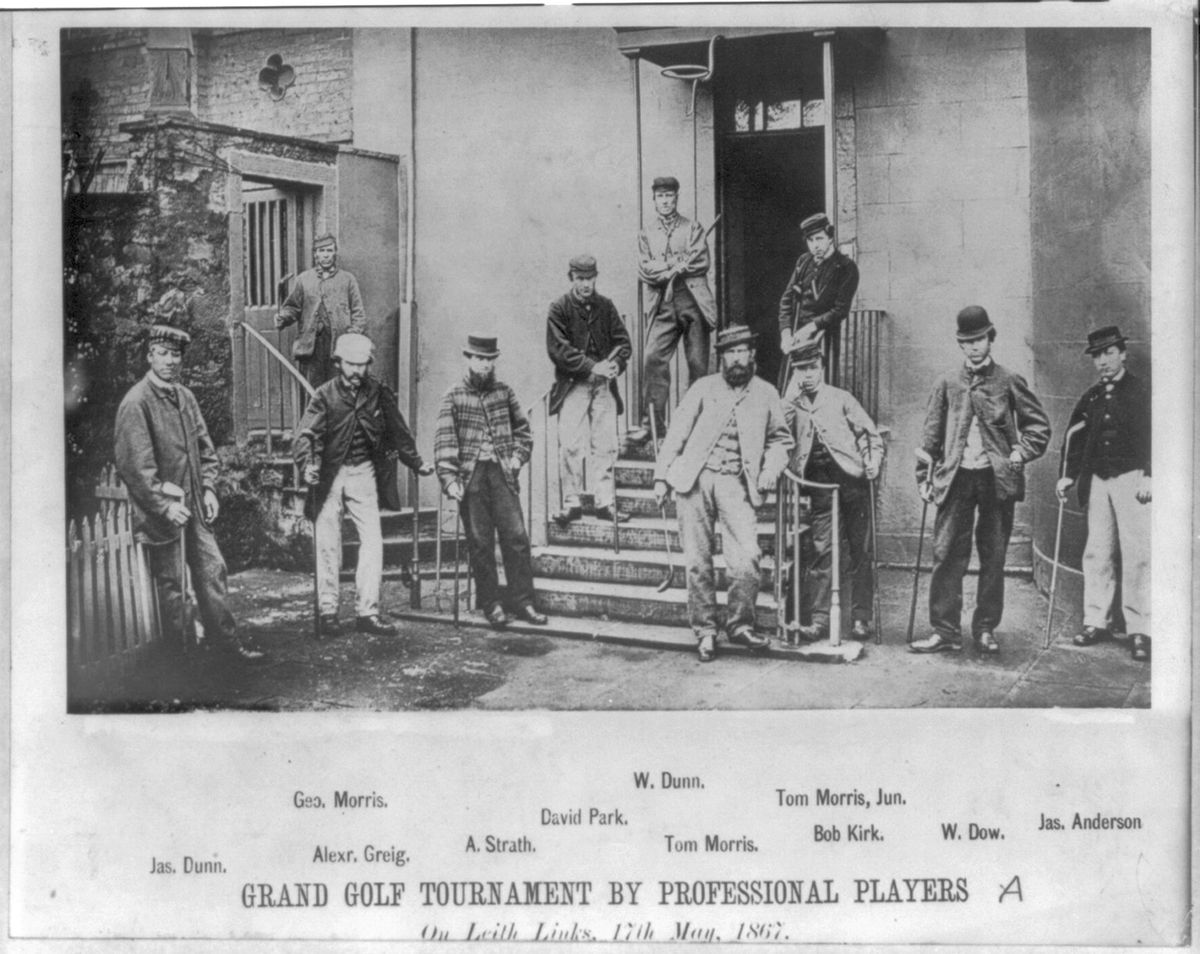
"Grand golf tournament by professional players on Leith Links, 17th May 1867": among the names printed beneath, Tom Morris and Tom Morris Jun.
Leith Links, where the first surviving written rules were drafted for a competition in 1744.
Unknown photographer (Library of Congress) · Public domain · Wikimedia Commons
The founding principle was there in 1744 and has not moved: play the ball as it lies. Everything difficult in the rulebook follows from refusing to move the ball to somewhere fair.
The R&A at St Andrews and the USGA emerged as the two custodians, and they still jointly own the Rules — one book, two bodies, dividing the world between them. That is a third variant of the ownership split this site keeps finding: football has IFAB and FIFA, cricket has MCC and the ICC, golf has two equal partners who must agree.

The clubhouse of the Royal and Ancient Golf Club behind the Swilcan Burn bridge on the Old Course, St Andrews.
The R&A, one of the two bodies that jointly own the Rules. The USGA holds the other half of the world.
Optograph · CC BY-SA 3.0 · Wikimedia Commons
The handicap is golf's real invention and it arrived later, formalised from 1911. It solved a problem the sport had because of what it is: courses differ enormously, players differ enormously, and a raw score carries almost no information without both contexts. Rather than standardise the courses — which was impossible — golf built a system to measure their difficulty and adjust scores accordingly.
Golf was on the Olympic programme in 1900 and 1904 and then absent for 112 years, the longest absence of any returning sport.
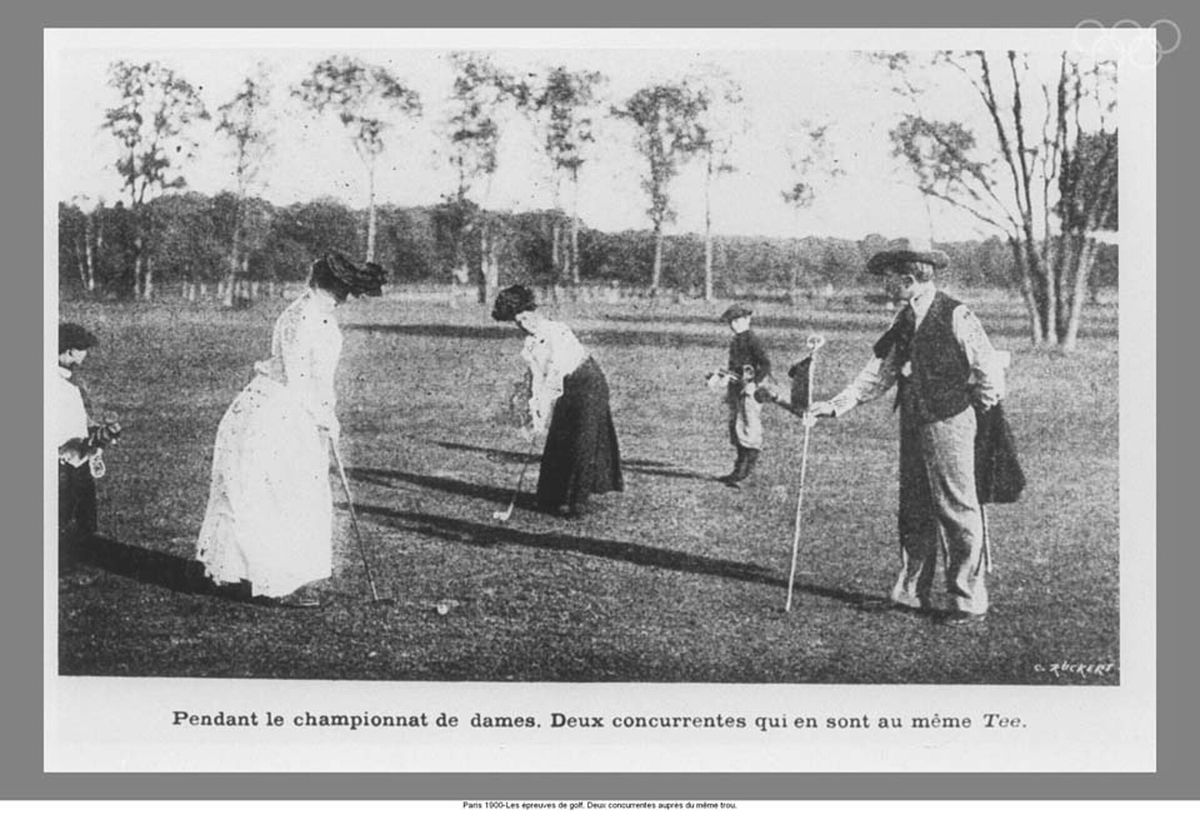
Two competitors on the same tee in the women's championship at the 1900 Paris Olympics.
Golf's first Olympic appearance. After 1904 it was absent for 112 years.
Unknown photographer · Public domain · Wikimedia Commons
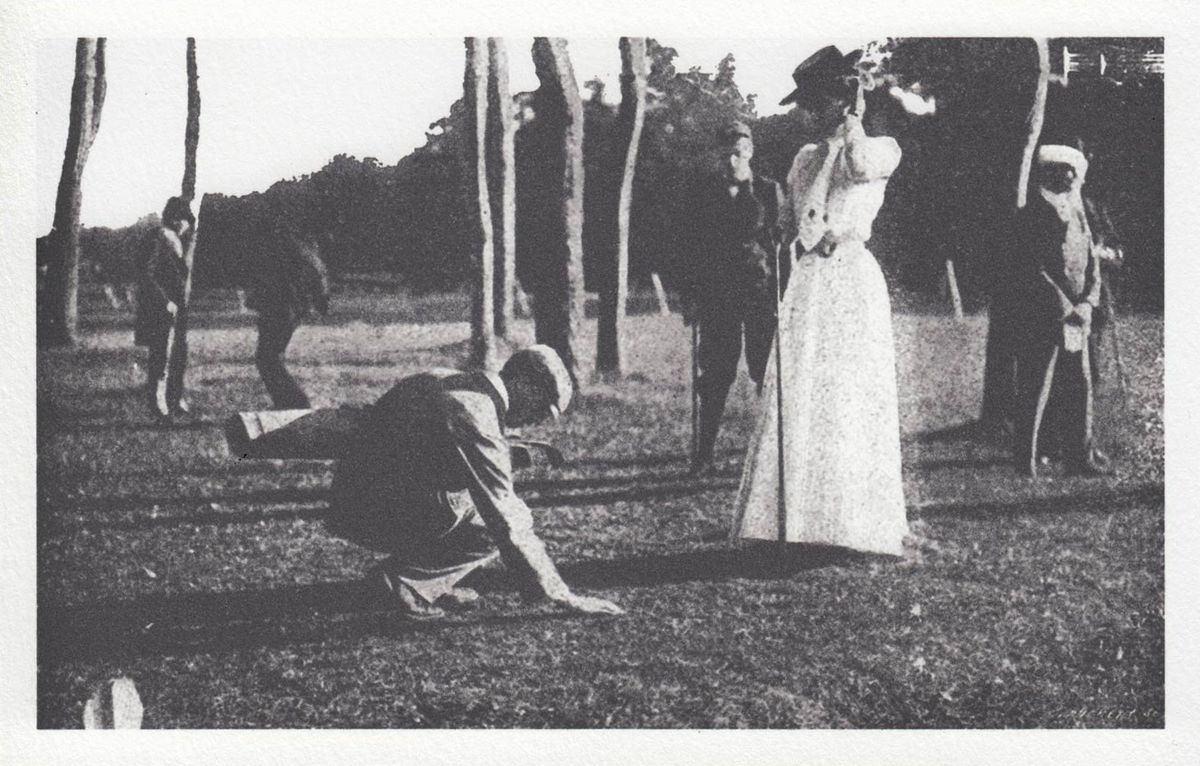
Margaret Abbott playing in the women's golf event at Compiègne during the 1900 Games, from La Vie au Grand Air.
Abbott won it, the first American woman to win an Olympic event.
Unknown photographer (La Vie au Grand Air) · Public domain · Wikimedia Commons
07Rule timeline
The sport’s own lane, expanded. Every entry carries a cause from the closed vocabulary and a citation, and says so where the citation is incomplete.
- 1911Participation and accessalso fairness and eligibilityadopted 1911
A formal handicap system was established, giving each player a number representing their ability so that players of different standards could compete against each other on level terms. It was later extended by course and slope ratings, which adjust for how difficult a particular course is from a particular set of tees. The effect is that a round played by one golfer on one course on one day can be compared with a round played by a different golfer on a different course on a different day. Nothing else on this site attempts this.
Comparability break · No break
Not a break. The opposite: the point at which golf began systematically converting incomparable scores into comparable ones. It is the only entry on this site where a rule change increased comparability rather than destroying it. See the series
Trigger and citationIncomplete — no confirmed article
Trigger
Golf is played on courses that differ enormously in length and difficulty, by players of wildly different standards, and a raw score carries almost no information without knowing both. The handicap exists to supply that context.
The Rules of Golf · Handicapping regulations, from 1911
- 2010Equipment and technologyalso fairness and eligibilityadopted 2008
The permitted dimensions and sharpness of grooves on club faces were restricted, reducing the spin a player can impart from the rough. Square or U-shaped grooves had made it possible to control a ball from bad lies almost as well as from the fairway.
Trigger and citationIncomplete — no confirmed article
Trigger
Driving accuracy had ceased to matter at the top level, because the penalty for missing a fairway had been engineered away. The rule was intended to restore a reason to keep the ball in play.
The Rules of Golf · Rules of Golf, 2010, equipment rules
- 2019Broadcast and pacingalso participation and accessadopted 2017
The Rules were comprehensively rewritten and shortened. Among the changes: the flagstick may be left in while putting, a ball is dropped from knee height rather than shoulder height, a lost-ball search is limited to three minutes, and several penalties for accidental actions were removed.
Trigger and citation
Trigger
Rounds had become slow, the Rules were long and technical enough that players broke them accidentally, and televised penalties for accidents nobody could see were damaging. The stated aim was a simpler book and a faster round.
The Rules of Golf · Rules of Golf, 2019 · article Rules 13 and 14
- 2019Fairness and eligibilityalso integrityadopted 2018
Penalties arising from viewers telephoning a broadcaster about a rules breach were ended, and a player is no longer penalised for a scorecard signed before a breach was known that could not reasonably have been seen.
Trigger and citationIncomplete — no confirmed article
Trigger
Players were being disqualified days after the fact because a member of the public had watched high-definition footage and telephoned in a breach the player could not have detected. Only players shown on television were exposed to it, which made the enforcement arbitrary by broadcast schedule.
The Rules of Golf · Rules of Golf, 2019
- 2020Fairness and eligibilityadopted 2018
Six regional handicap systems were merged into a single World Handicap System, so a handicap issued anywhere is now calculated the same way and means the same thing everywhere. Daily playing conditions are also factored in, adjusting for the weather on the day a score was posted.
Trigger and citationIncomplete — no confirmed article
Trigger
A handicap that meant different things in different countries defeated the purpose of having one. Unifying the calculation made the number genuinely portable.
Recorded here as the only case on this site of a governing body *increasing* the comparability of its numbers. Every other entry in this collection is a record of comparability being lost.
The Rules of Golf · Rules of Handicapping, 2020
- 2028Equipment and technologyadopted 2023-12
The testing conditions for conforming golf balls were changed so that balls must fly shorter under the standard test, reducing distance at the elite end. It applies to all golfers from 2030, having applied to elite competition from 2028.
Comparability break · Record book reset
The conforming ball will fly shorter. Distance and scoring figures from before the change describe a different object, and the governing bodies accepted that when they made it. See the series
Trigger and citationIncomplete — no confirmed article
Trigger
Driving distance had risen for decades to the point that historic courses were becoming too short to test the best players, and lengthening them further was reaching limits of land, cost and water use.
Manufacturers and a substantial part of the professional game opposed it, arguing that distance is not a problem and that bifurcating the rules between elite and everyday play — which the initial proposal would have done — would damage golf's unusual property of everyone playing the same game under the same rules. The governing bodies dropped the bifurcation and applied the change to everyone.
The Rules of Golf · Equipment Rules, 2028
08Equipment evolution
Golf's equipment history is a century of distance increasing and the governing bodies deciding, repeatedly and late, how much of it to allow.
The ball went from feather-stuffed leather to gutta-percha to wound rubber to the modern multi-layer solid core, and each transition added distance. The governing bodies responded with limits on size, weight, initial velocity and finally overall distance under a standard test.
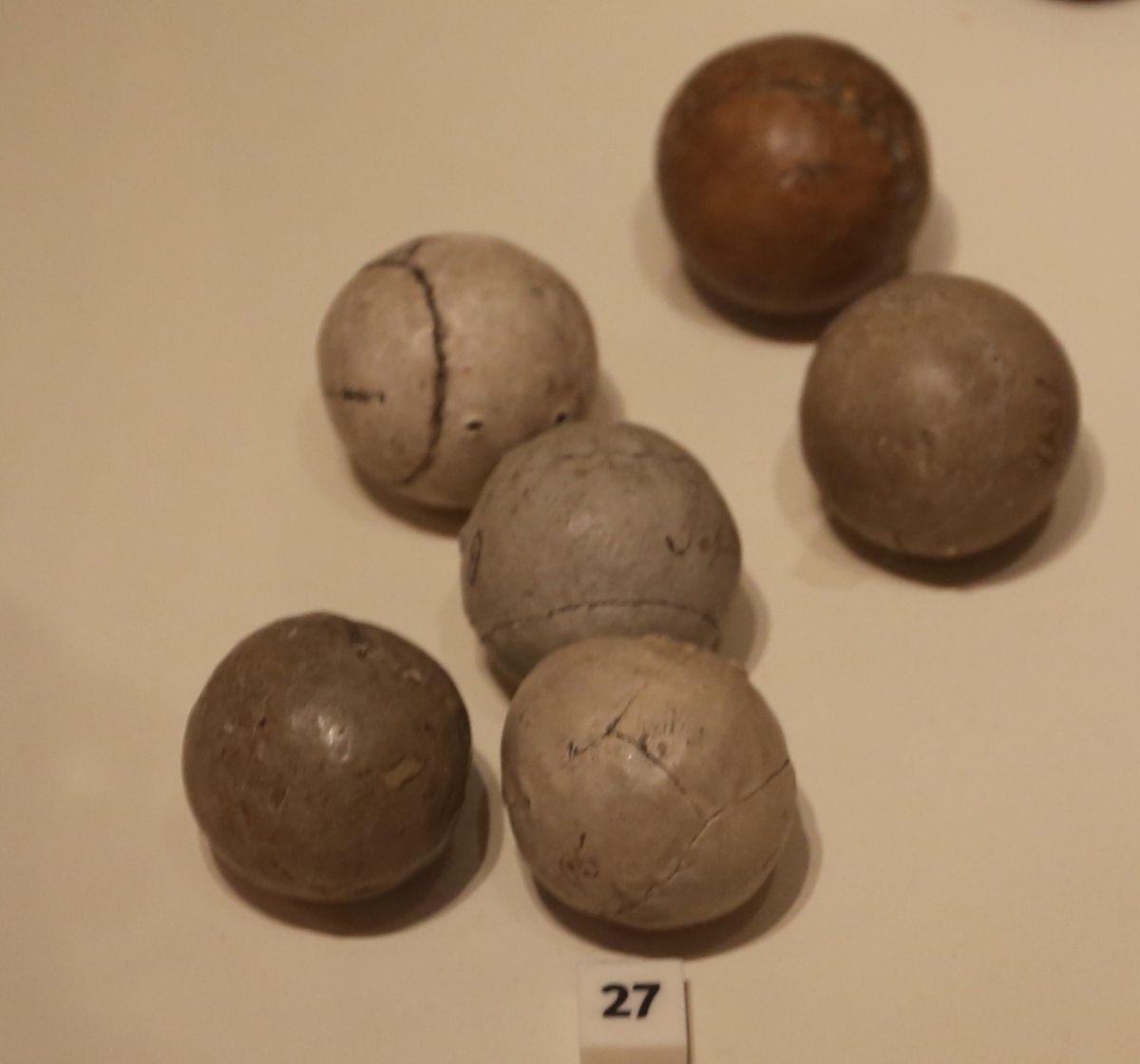
Six featherie golf balls.
Feathers stuffed into stitched leather: the ball before gutta-percha, rubber and the solid core.
Geni · CC BY-SA 4.0 · Wikimedia Commons
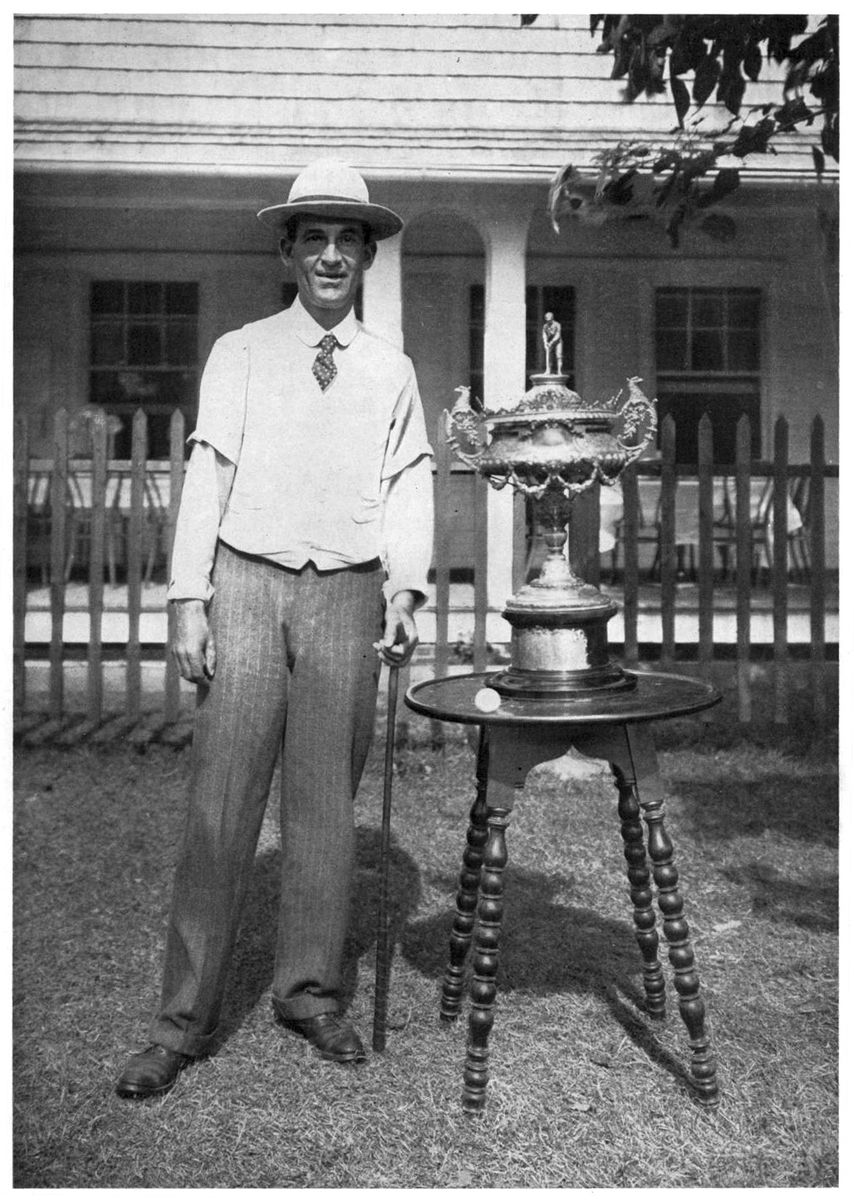
Walter Travis with the Havemeyer Trophy after his second U.S. Amateur title, 1901. On the table is the Haskell rubber-cored ball he won with.
The wound rubber ball, new in 1901, which quickly replaced gutta-percha and added distance.
Stuyvesant Company · Public domain · Wikimedia Commons
The club went from wood to steel to titanium and composite, heads grew enormously, and the face became thin enough to flex and rebound. Limits on head size and on face flexibility followed, each written after the technology arrived.
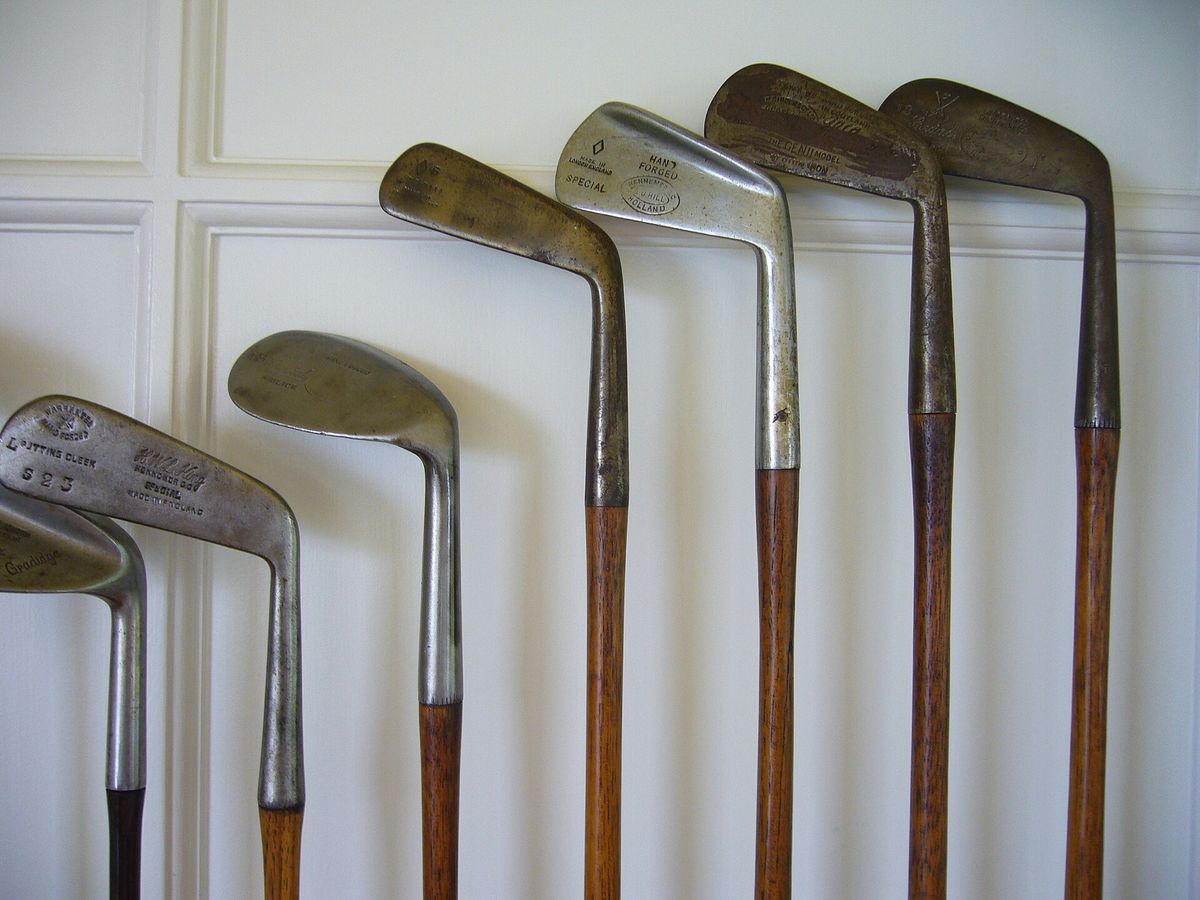
Hickory-shafted irons.
Wood shafts, before steel, titanium and composite.
Pvt pauline · CC BY-SA 3.0 · Wikimedia Commons
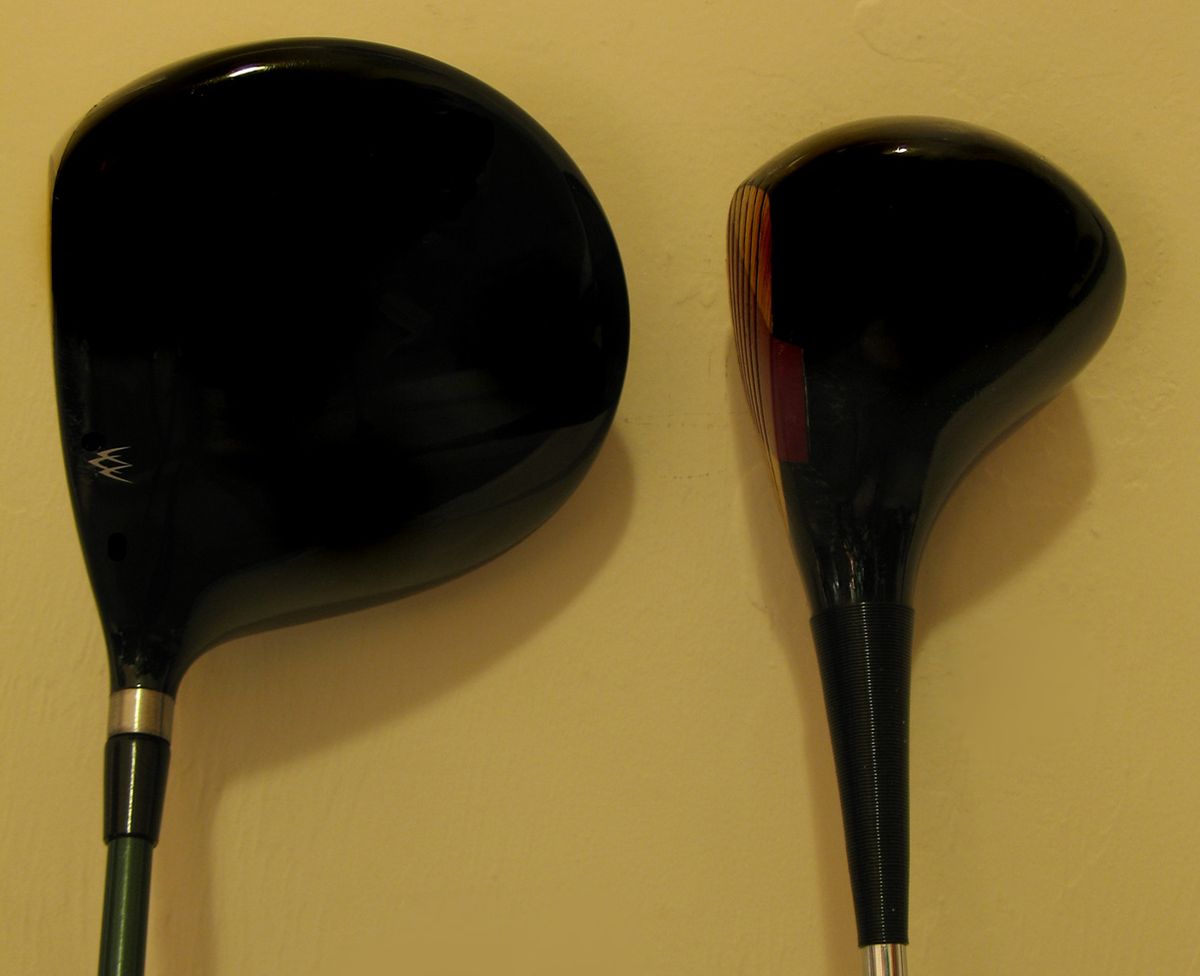
A 460 cc titanium-era driver beside an early-1980s persimmon driver.
Heads grew enormously. The limits on head size and face flex came after the technology.
ReignMan · Public domain · Wikimedia Commons
Grooves are the most instructive one. Square-cut grooves let a player impart heavy spin from the rough, which meant missing the fairway stopped costing anything. Driving accuracy ceased to matter at the top level. The 2010 restriction on groove geometry was written to restore a penalty that technology had engineered away — a rule reinstating a difficulty rather than removing one.
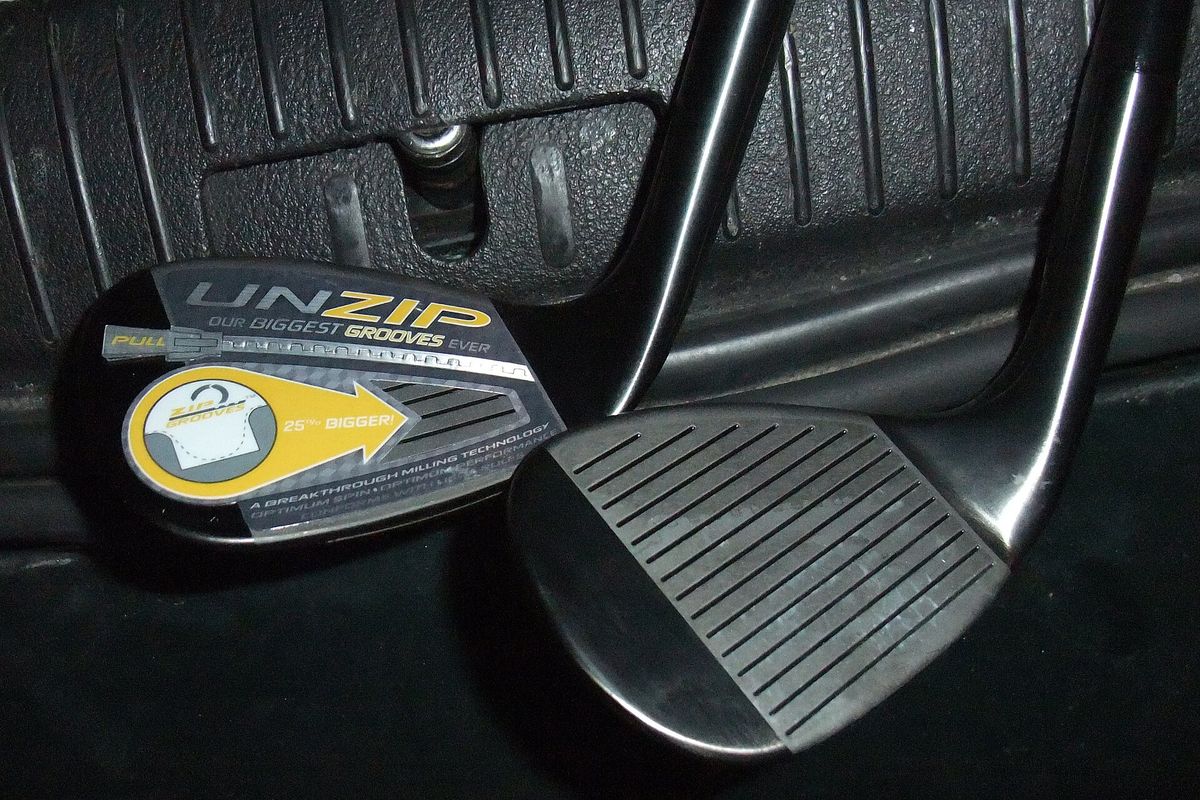
Cleveland CG14 wedges, their packaging advertising the brand's biggest grooves.
Groove geometry was restricted in 2010 so that spin from the rough would stop cancelling the penalty for missing the fairway.
Kevin Ho · CC BY-SA 2.0 · Wikimedia Commons
The 2028 rollback is the entry this site finds most striking. The conforming ball will be required to fly shorter under the standard test. Every other equipment rule in this collection restricts a new advantage before it is established; this one takes back distance that has been in the game for decades.
The governing bodies initially proposed applying it only to elite competition and dropped that, because golf's unusual property is that everyone plays the same game under the same rules, and bifurcating would have ended it.
09Governing body politics
Golf's rules are owned jointly by the R&A and the USGA, who divide the world between them and must agree on any change. It is a partnership of equals with no arbiter, which makes the Rules unusually stable and unusually slow.
The recurring political question is distance, and the argument has run for thirty years. One side holds that increasing driving distance is making historic courses obsolete, forcing lengthening that costs land, money and water, and that the governing bodies have a duty to act. The other holds that distance is not a problem, that manufacturers and players have invested in the current game, and that rolling back equipment punishes everyone for what a few hundred professionals can do.
The 2023 decision to change the ball testing conditions from 2028 is the governing bodies choosing the first position after decades of not choosing. Manufacturers and a substantial part of the professional game opposed it.
Bifurcation is the deeper question underneath. The proposal could have applied only to elite competition, leaving everyday golfers alone — and the governing bodies withdrew that version. Golf's distinctive claim is that everyone plays the same game under the same rules, from a club medal to a major championship, and bifurcation would have ended it. They preferred to change the ball for everybody.
The other institutional feature worth recording is that golf's four major championships are run by four separate organisations, two of which own the Rules. The sport's most important competitions are not governed by any single body, which is why their play-off formats still differ.
10Controversies that forced rule changes
The telephone. For years, viewers watching high-definition coverage could telephone a broadcaster to report a rules breach, and players were penalised — sometimes disqualified days later — for infractions they could not have seen at the time. Because only players on camera were exposed, enforcement depended on the broadcast schedule.
It produced several high-profile disqualifications and was widely regarded as indefensible. Ended in 2019, along with the rule that a scorecard signed before a breach was known was automatically wrong.
Accidental breaches on camera. The same era produced penalties for balls that moved fractionally on a green, visible only in slow motion. The 2019 rewrite removed several of these, on the reasoning that a player should not be penalised for something no human could detect.
Grooves. Not an incident but a measurement. By the 2000s the statistical relationship between driving accuracy and scoring had weakened to the point where missing the fairway barely mattered, because square grooves controlled the ball from the rough. The 2010 restriction was an attempt to make accuracy count again.
Distance. The longest-running argument in the sport, and the one that finally produced the 2028 ball change. Courses have been lengthened for decades; several historic venues can no longer test the best players; and lengthening runs into land, cost and water limits.
The governing bodies' initial proposal would have applied only to elite play. They withdrew it, because golf's claim that everyone plays the same game under the same rules was judged worth more than the convenience of leaving amateurs alone.
Where it standsthe record, and what is still open · sections 11 to 12
11Series
No series can exist
Scoring across courses, conditions and equipment
A golf score is strokes taken on a particular course, on a particular day, in particular weather. Two rounds of 68 are not the same achievement unless the courses and conditions were the same, and they never are. That would make golf the least comparable sport on this site — except that golf noticed first and built a machine for it. The handicap takes a score and adjusts for the difficulty of the course, the tees played, and since 2020 the conditions on the day, and produces a number that genuinely can be compared across players, courses and countries. So this entry is here for the opposite reason to every other absence in this collection. There is no chart of raw scores because raw scores were never comparable and golf has known it for a century. What exists instead is a formal system for making them comparable, which nothing else here has attempted. The elite game, which does not use handicaps, keeps the problem. A winning score at one championship and another are not comparable, which is why golf's records are things like number of titles rather than numbers of strokes. The 2028 ball change adds a further break at the top end: the object itself will fly shorter, so distances and scoring records set before it stand in a different game.
1911No breakNot a break. The opposite: the point at which golf began systematically converting incomparable scores into comparable ones. It is the only entry on this site where a rule change increased comparability rather than destroying it.
2028Record book resetThe conforming ball will fly shorter. Distance and scoring figures from before the change describe a different object, and the governing bodies accepted that when they made it.
12What is contested now
Recorded as unsettled.
The ball rollback. Decided in 2023, effective from 2028, and still argued about. Manufacturers and much of the professional game opposed it; the governing bodies judged that distance had made historic courses unusable and that lengthening was reaching its limits. Whoever is right, this will be the first equipment change on this site to take back distance already established in a sport, and it will sever golf's distance and scoring figures at the elite end.
Bifurcation. The rollback could have applied only to elite competition. The governing bodies withdrew that version because golf's claim is that everyone plays the same game under the same rules. That claim will come under pressure again, and the next equipment question may not be answered the same way.
Land and water. Golf's environmental footprint is contested in most places it has expanded, and course lengthening is the specific pressure point. It is one of the few sports here whose rule changes are shaped by a resource constraint rather than by competition.
Pace of play. The 2019 rewrite addressed it and it has not been solved. A four-hour round is a substantial barrier to participation, and every proposal to shorten it runs into the fact that the sport is eighteen holes because it has always been eighteen holes.
Whether the majors should harmonise. Four championships, four play-off formats, four sets of conditions, and no body with authority over all of them. Tennis harmonised its deciding-set rule in 2022 after fifty-two years. Golf has not tried.