
Dilihat — seen
Colour-shifting ink
The printed colour shifts as the note is viewed from a different angle.
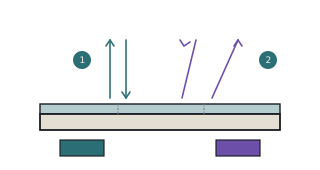
Light reflects twice: from the top surface of a thin layer and from its underside. The two reflections meet again at the eye, and the difference in the distance they travelled decides which colour reinforces.
- Part of the light reflects at the top surface of the layer. The rest enters, reflects underneath, and comes back out.
- The beam that crossed the layer travelled slightly farther. That extra distance changes as the viewing angle changes.
- At each angle some wavelengths reinforce and others cancel. That is why the colour you see moves as the note tilts — the ink has not changed, your angle has.
What to observe
- Tilt the note slowly while watching a single area. The colour shifts hue — it does not merely brighten or darken.
- The change is continuous as the note tilts, and returns to the original hue as it comes back upright.
- The shift follows the viewing angle, not the direction of the lamp. Moving the light source alone does not produce the same shift.
This page explains how to check a feature, not how one is produced. Nor does this site say whether any note is genuine — that authority rests with Bank Indonesia.
Try tilting it
Move the control below to change the viewing angle. The colour shifts because the angle changed, not because the ink did.
Angle: 0° · Head-on
Light path difference: ≈1117 nm
The colour the eye sees is how the brain reads a wavelength of light — red is a long wavelength, blue a short one. This computes thin-film interference for three such wavelengths, so the colour genuinely follows your viewing angle, not a rotated picture. The layer thickness is chosen to make the effect legible on a screen — it is not a copy of any note’s ink.
Sources
- Bank Indonesia — Gambar Uang — Rp100.000 Tahun Emisi 2016, Unsur Pengaman ↗open source: Gambar Uang — Rp100.000 Tahun Emisi 2016
- Artech House — R. L. van Renesse, Optical Document Security, 3rd edition (2005), Ch. 6, Optically variable devices
- Pearson — Eugene Hecht, Optics, 5th edition (2017), §9.7, Thin-film interference