
Diraba — felt
Kode tuna netra — the blind code
Rupiah notes carry marks designed to be read without sight. Almost no sighted person in Indonesia knows they are there.
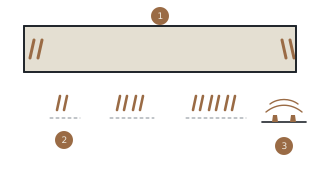
Pairs of raised lines at the left and right edges, letting a denomination be identified by touch.
The code is relief, not image. It sits in the same place on every denomination, so a finger knows where to go before it knows the answer.
- The position is fixed: the left and right edges, near the outer side of the sheet.
- The number of pairs increases as the denomination falls, so counting with a finger is itself the answer.
- The lines are raised rather than merely printed. That places the feature on the diraba channel — and it is why a screen cannot convey it.
What to observe
- Run a fingertip along the left or right edge of the note. The lines are short, slanted, and feel rough.
- The number of pairs marks the denomination: Rp100,000 has one pair, Rp50,000 two, Rp20,000 three, and one pair more with each step down to Rp1,000 with seven.
- The notes also differ in length by 5 mm per denomination, so the size of the sheet helps distinguish them too.
Sweep the light
A screen cannot convey touch, but it can show the other consequence of raised printing: ink standing above the surface catches light from a low angle and shadows the far side. Move the light around.
20°
The surface here is a run of plain ridges, not the engraving on any note. It shows how relief catches light — it is not a substitute for feeling it. For that, still take out a note.
Number of line pairs
| Denomination | Emission | Line pairs | Length |
|---|---|---|---|
| Rp100.000 | TE 2022 | 1 | 151 mm |
| Rp100.000 | TE 2016 | 1 | 151 mm |
| Rp50.000 | TE 2022 | 2 | 146 mm |
| Rp50.000 | TE 2016 | 2 | 149 mm |
| Rp20.000 | TE 2022 | 3 | 141 mm |
| Rp20.000 | TE 2016 | 3 | 147 mm |
| Rp10.000 | TE 2022 | 4 | 136 mm |
| Rp5.000 | TE 2022 | 5 | 131 mm |
| Rp2.000 | TE 2022 | 6 | 126 mm |
| Rp1.000 | TE 2022 | 7 | 121 mm |
See also the 3D steps.
Sources
- Bank Indonesia — Gambar Uang — Rp100.000 TE 2016, Unsur Pengaman — Kode Tuna Netra (Blind Code) ↗open source: Gambar Uang — Rp100.000 TE 2016
- Persatuan Tunanetra Indonesia (Pertuni) — Aksesibilitas untuk Tunanetra pada Uang Baru NKRI (25 Desember 2016) ↗open source: Aksesibilitas untuk Tunanetra pada Uang Baru NKRI (25 Desember 2016)
- Bank Indonesia — Peraturan Bank Indonesia Nomor 24/8/PBI/2022 tentang Pengeluaran dan Pengedaran Uang Rupiah Kertas Pecahan 100.000 (seratus ribu) Tahun Emisi 2022, Pasal 5 ayat (2) — kode tuna netra (blind code) ↗open source: Peraturan Bank Indonesia Nomor 24/8/PBI/2022 tentang Pengeluaran dan Pengedaran Uang Rupiah Kertas Pecahan 100.000 (seratus ribu) Tahun Emisi 2022
- Bank Indonesia — Peraturan Bank Indonesia Nomor 24/9/PBI/2022 tentang Pengeluaran dan Pengedaran Uang Rupiah Kertas Pecahan 50.000 (lima puluh ribu) Tahun Emisi 2022, Pasal 5 ayat (2) — kode tuna netra (blind code) ↗open source: Peraturan Bank Indonesia Nomor 24/9/PBI/2022 tentang Pengeluaran dan Pengedaran Uang Rupiah Kertas Pecahan 50.000 (lima puluh ribu) Tahun Emisi 2022
- Bank Indonesia — Gambar Uang — Rp50.000 TE 2016, Unsur Pengaman — Kode Tuna Netra (Blind Code) ↗open source: Gambar Uang — Rp50.000 TE 2016
- Bank Indonesia — Peraturan Bank Indonesia Nomor 24/10/PBI/2022 tentang Pengeluaran dan Pengedaran Uang Rupiah Kertas Pecahan 20.000 (dua puluh ribu) Tahun Emisi 2022, Pasal 5 ayat (2) — kode tuna netra (blind code) ↗open source: Peraturan Bank Indonesia Nomor 24/10/PBI/2022 tentang Pengeluaran dan Pengedaran Uang Rupiah Kertas Pecahan 20.000 (dua puluh ribu) Tahun Emisi 2022
- Bank Indonesia — Gambar Uang — Rp20.000 TE 2016, Unsur Pengaman — Kode Tuna Netra (Blind Code) ↗open source: Gambar Uang — Rp20.000 TE 2016
- Bank Indonesia — Peraturan Bank Indonesia Nomor 24/11/PBI/2022 tentang Pengeluaran dan Pengedaran Uang Rupiah Kertas Pecahan 10.000 (sepuluh ribu) Tahun Emisi 2022, Pasal 5 ayat (2) — kode tuna netra (blind code) ↗open source: Peraturan Bank Indonesia Nomor 24/11/PBI/2022 tentang Pengeluaran dan Pengedaran Uang Rupiah Kertas Pecahan 10.000 (sepuluh ribu) Tahun Emisi 2022
- Bank Indonesia — Peraturan Bank Indonesia Nomor 24/12/PBI/2022 tentang Pengeluaran dan Pengedaran Uang Rupiah Kertas Pecahan 5.000 (lima ribu) Tahun Emisi 2022, Pasal 5 ayat (2) — kode tuna netra (blind code) ↗open source: Peraturan Bank Indonesia Nomor 24/12/PBI/2022 tentang Pengeluaran dan Pengedaran Uang Rupiah Kertas Pecahan 5.000 (lima ribu) Tahun Emisi 2022
- Bank Indonesia — Peraturan Bank Indonesia Nomor 24/13/PBI/2022 tentang Pengeluaran dan Pengedaran Uang Rupiah Kertas Pecahan 2.000 (dua ribu) Tahun Emisi 2022, Pasal 5 ayat (2) — kode tuna netra (blind code) ↗open source: Peraturan Bank Indonesia Nomor 24/13/PBI/2022 tentang Pengeluaran dan Pengedaran Uang Rupiah Kertas Pecahan 2.000 (dua ribu) Tahun Emisi 2022
- Bank Indonesia — Peraturan Bank Indonesia Nomor 24/14/PBI/2022 tentang Pengeluaran dan Pengedaran Uang Rupiah Kertas Pecahan 1.000 (seribu) Tahun Emisi 2022, Pasal 5 ayat (2) — kode tuna netra (blind code) ↗open source: Peraturan Bank Indonesia Nomor 24/14/PBI/2022 tentang Pengeluaran dan Pengedaran Uang Rupiah Kertas Pecahan 1.000 (seribu) Tahun Emisi 2022