 AFM Studio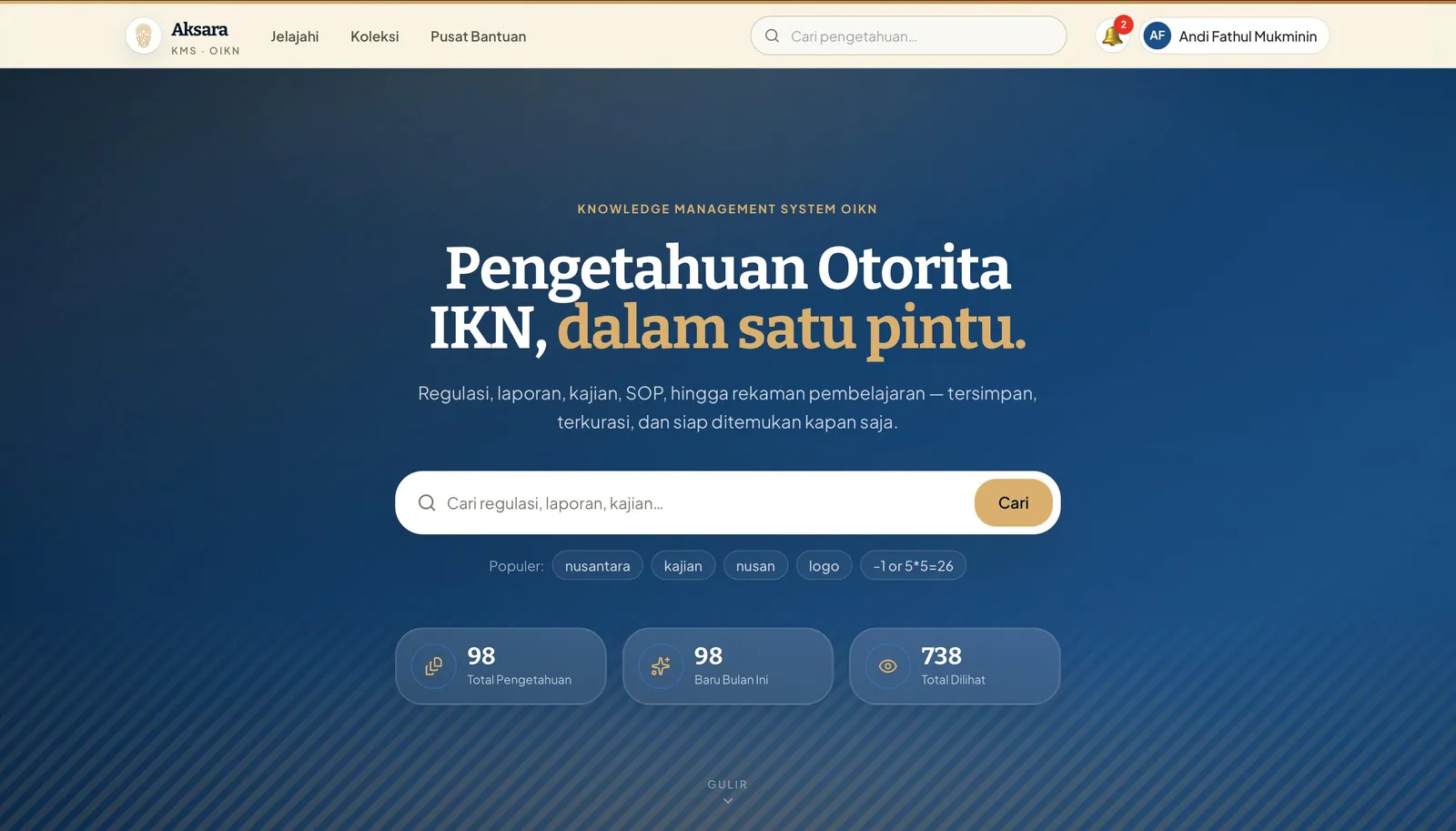

Aksara
Knowledge management platform for Indonesia's new-capital authority — a searchable home for OIKN's regulations, reports, and studies with an internal submit-and-approve workflow behind it
Fullstack Developer
Jul 2026
On this page
The problem
OIKN (Otorita Ibu Kota Nusantara) produces a high volume of institutional knowledge across ten Eselon-1 units — regulations, technical reports, academic studies, field knowledge — but the previous system had it effectively locked away. Nothing was findable: there was no global search, and the listing was a raw DataTable, so staff went back to asking colleagues for files over chat. Contributing was painful: a two-step, overly long form with no draft support, so knowledge simply never got uploaded. And managers were blind — no overview of what existed, what was pending review, or which units were actually contributing.
Three audiences share the same platform: the public (citizens, researchers, press browsing published knowledge without logging in), OIKN staff (uploading and consuming internal material), and knowledge managers (verifiers, curators, and admins who approve, organise, and report on it). The hard constraint that shaped everything: much of this material is not public. Regulations are open; internal evaluations are staff-only; some unit documents are restricted to the owning directorate. Every listing, search result, homepage highlight, and file download had to be access-filtered on the server, per requesting user, without ever leaking a title or a file URL to someone who shouldn't see it.
The approach
A two-ID system for every knowledge product
Internally each product is a UUID from the moment it's a draft. On first publish it also gets a public code — AKS-2026-0042-K7mP — and that code is what appears in the public URL (/pengetahuan/AKS-2026-0042-K7mP). Public URLs must be permanent and citable, but drafts and rejected items must have no guessable public address, and a title-based slug would break the moment someone fixed a typo. The sequential part is allocated under a row lock so two simultaneous publishes can't collide, and codes are reserved forever — never recycled, and reactivated if a product is unpublished then republished.
Access control lives in the queryset, not the UI
Three levels — Publik / Internal OIKN / Terbatas — are resolved server-side against the user's work unit, echelon, roles, and any approved time-boxed access grants. The browser is never sent a restricted document and asked to hide it. Even file downloads go through an access-checked endpoint rather than a raw /media/ path — that was a security fix mid-build, after realising attachment URLs were directly enumerable. Direct-linking a restricted item as a logged-out visitor renders a full block page that leaks nothing.
Workflow status is system-managed
Draft → Menunggu Verifikasi → Menunggu Kurasi → Terpublikasi (plus Dikembalikan / Ditolak) can only change through transition services, never a manual field edit. The two-stage review runs on split-screen verification and curation queues with three decisions each — approve, return with a mandatory note, or reject. Every transition, return note, and admin intervention is appended to an immutable per-document timeline ("Riwayat Alur"), alongside a global audit log. Edit-after-publish keeps the live version public until the revision is re-curated.
Search behind an interface
Postgres full-text search (GIN indexes, ranked, highlighted) is the shipped backend, but call sites talk to a SearchBackend abstraction so Elasticsearch can be dropped in later without touching views. A pg_trgm trigram fallback handles typos and powers a "did you mean" recovery built from previously-successful queries. Every filter, page, and sort lives in the URL as a query param, so a filtered result set is bookmarkable, shareable, and survives a refresh — important for a discovery-first product where people send each other links.
Portal-per-role, and a federated JDIH feed
The PRD offered a role-switcher navigation model; two days in it was replaced with portal-per-role — Kontributor, Verifikator, Kurator, and Administrator each get their own named portal and sidebar — because "Ganti Peran" read as a mode toggle rather than a place, and multi-role users kept losing track of which hat they were wearing. National legal-documentation (JDIH) records are indexed as light metadata via a daily Celery sync and live-fetched server-side with an hour cache and graceful-degradation fallback; regulations are merged inline into the main discovery listing rather than sitting in a separate silo. The integration is read-only and one-way — the API key never leaves the server.
Outcome
Deployed and running for OIKN, with the public portal serving open knowledge to any visitor. Built solo from an empty repo — 109 commits over roughly two and a half weeks — spanning 14 Django apps, ~30 data models, 66 API endpoints documented via OpenAPI, and a 36-page React SPA (~12,800 lines of TypeScript) across the public portal and backoffice, backed by 156 backend tests concentrated on the two genuinely dangerous surfaces: the access-control rules and the AKS-ID generation logic. The stack is deliberately boring — no ML, no vector search, no second datastore. "Recommended knowledge" is rule-based by design, because for a government client, being able to explain exactly why a system produced an output matters more than squeezing out marginal accuracy.
- ~2.5 wks
- 66
- 156
- 43
Have a project like this?
If you need a system built with the same care — clear scope, solid execution — let's talk.
Start a project