 AFM Studio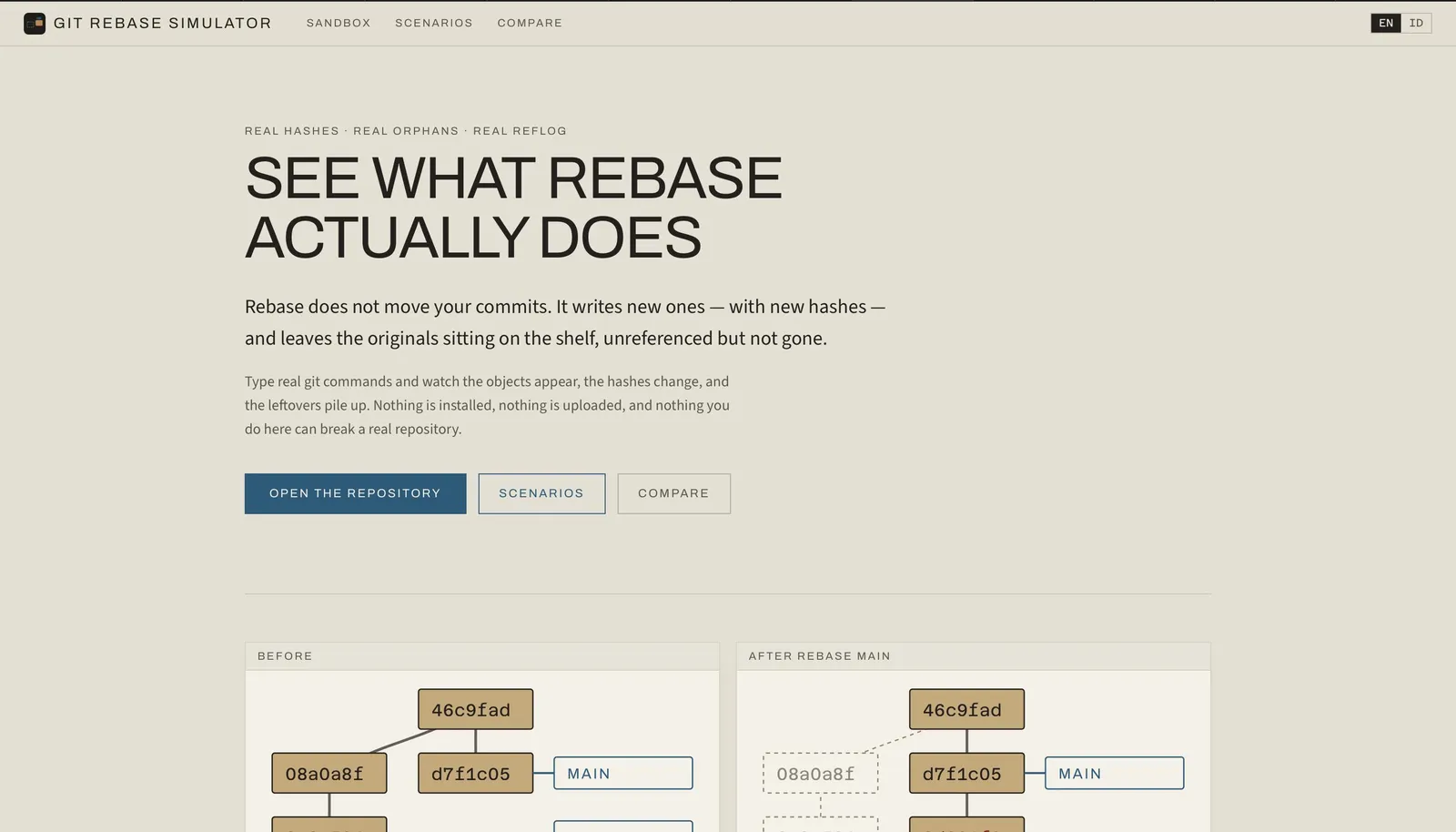

Git Rebase Simulator
A safe sandbox to practise the scariest parts of Git — rebase, hard reset, force-push — and watch what actually happens to your commits, with real content-addressed hashes
Solo Developer
Aug 2026
On this page
The problem
Rebase is the Git operation developers fear most, and the fear is earned: it's routinely misexplained as "moving commits onto a new base". It doesn't move anything. It writes new commits with new ids and leaves the originals sitting in the repository, unreferenced. Almost every "I lost my work" panic — and its cure, the reflog — follows from that one misunderstanding.
Existing visualisers are genuinely good (Learn Git Branching is linked prominently, not competed with), but they share three omissions: fake commit ids (C1, C2 — a rebased C3 still looks like C3, so the notation erases the lesson); nothing shows what was left behind (orphaned commits go invisible, so the recovery move never gets taught); and no file content, therefore no real conflicts — which is exactly where rebase hurts.
The approach
Model the object store honestly, and the lessons emerge for free
Rather than animating a diagram and narrating what Git "would" do, the app implements Git's data model and lets the visualisation read off it. Four decisions carry the whole thing:
- The object store is append-only. Objects are created, never mutated, never deleted except by explicit
gc. Every operation is "create objects, move refs". A shared assertion runs after every command in every test: each object present before must still be present and byte-identical after. Code that mutates a commit here doesn't just have a bug — it teaches the opposite of the truth. - Hashes are computed, never assigned. A hash is always the hash of the object's canonical serialization. Because a commit's hash covers its parent, changing the parent changes the hash — so rebase produces visibly different ids automatically, with no special-casing. SHA-1 is hand-written (99 lines, checked against the RFC 3174 vectors) rather than using the async, browser-only
SubtleCrypto, which would have made the engine impure and untestable in Node. - The engine is pure:
(state, command) → { state, events }, with timestamps from a virtual clock in state. Fully testable in Node, and deterministic. - A session is a list of command lines, not a snapshot. Replaying the lines rebuilds the repository byte-for-byte, so a shared URL encodes the script — and can never disagree with what the commands actually do.
Tested against the real thing
The riskiest failure mode for a teaching tool is being plausibly wrong. So a development script shells out to the actual git binary across nine scenarios (two against a real bare repo, so push is checked against Git's own fast-forward rule) and records the structure. The suite asserts structure — parent relationships, ref positions, which objects are new versus reused, tree equality — never literal hash equality, which would be dishonest, since real Git also folds in timestamps and author identity (the UI states this plainly rather than claiming parity).
Unsupported commands fail loudly, by name
pull is refused on purpose — it hides the half of its job that rewrites history — with an error naming fetch plus merge/rebase. Same for --rebase-merges and reverting a merge without -m. A confident wrong answer is the worst output this project could give.
Outcome
Live and public, MIT-licensed, offline after first load. Type rebase main and the seven-character ids change in front of you — because the parent changed, not because a label was swapped. Orphaned commits stay visible on the board, greyed and unstrung; the reflog panel lists every ref movement with its cause and recovers an orphan in one click. Real file content produces real three-way conflicts with Git's own markers and --continue/--abort/--skip. A comparison view shows merge vs. rebase side by side — different history shapes, identical final trees — which is both the teaching payoff and a test assertion. Plus interactive rebase, a simulated origin remote, and six curated scenarios.
Built solo — ~11,700 lines of source, 17 Git commands, 186 tests, three runtime dependencies and no Git, hashing, or graph-layout library. The unusual data point: a complete Git object-model implementation with a real-binary test oracle, built in a single ~5-hour sitting against a spec written first.
- 17
- 9
- 186
- ~5 hrs
Have a project like this?
If you need a system built with the same care — clear scope, solid execution — let's talk.
Start a project