Artistic swimming
A sport performed mostly upside down and underwater, judged from above it, and renamed by a vote most of its own experts did not cast.
- Official
- Aquatics
- Game category
- Performance
- Adjudication
- Judged
- Standing
- Added and kept
- rule changes
- 3
- comparability breaks
- 0
- Olympic editions
- 12
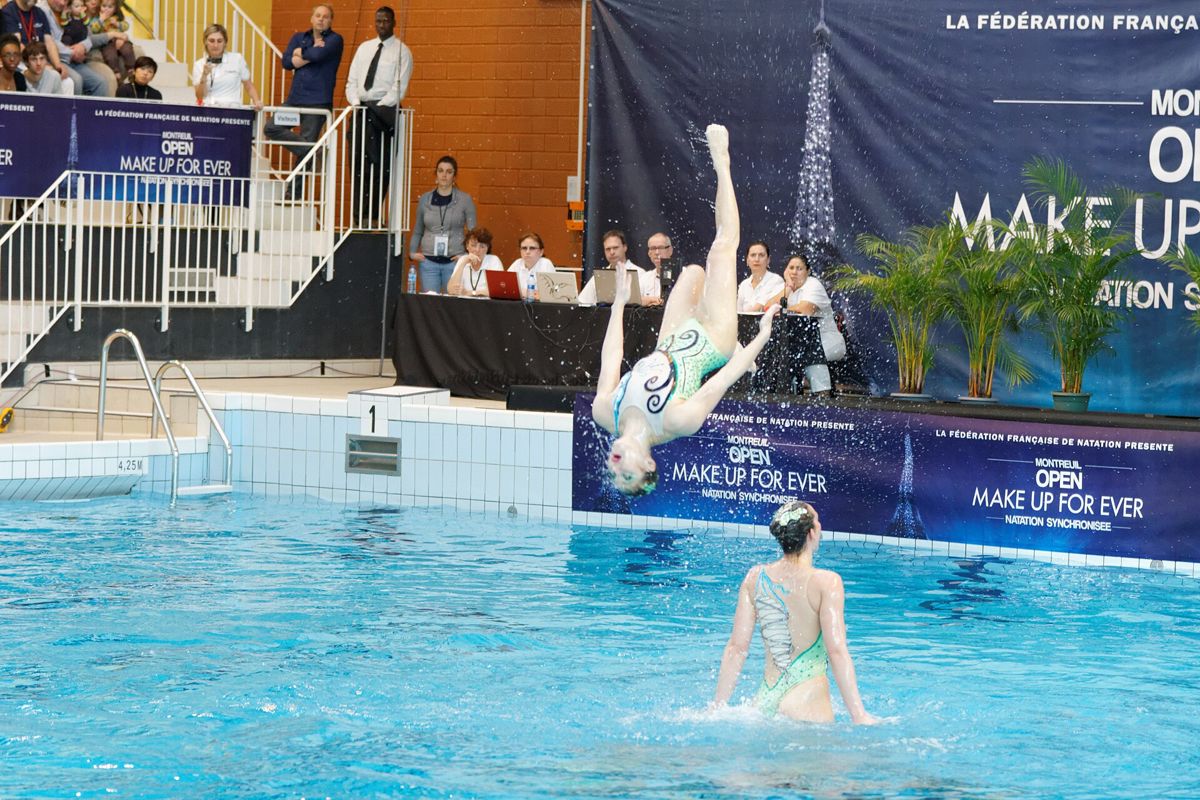
Team swimmers in an indoor pool, one inverted above the surface and another rising beside her · Pierre-Yves Beaudouin · CC BY-SA 3.0
- Governing body
- World Aquatics
- Founded
- Grew out of water ballet and aquatic shows in the 1920s and 1930s; on the world championship programme since 1973 and the Olympic one since 1984. Called synchronised swimming until 2017.
- Olympic status
- 12 editions
- on the 2028 programme
- Also contested at
- No other programme here
Routines set to music, in solo, duet or team, scored by two panels of judges and checked by six technical controllers. Since 2023 a team declares the difficulty of every element in advance, as divers do, and a controller who sees something different applies a base mark. The sport has long argued that it is athletic rather than theatrical, and changed its name in 2017 to one that says artistic.
The gamewhat it is now · sections 1 to 5
01How it is played
Perform a routine to music, in the water, without touching the bottom. Since 2023 the difficulty of every element is declared in advance and checked by technical controllers; the judges mark how well it was done and how it looked.
The object of the competition
Score the highest total across the routines of an event. At the Games the team swims a technical routine, a free routine and an acrobatic routine, and the duet a technical and a free; the scores of each are added.
- Olympic team
- Technical, free, acrobatic
- Olympic duet
- Technical, free
World Aquatics Competition Regulations, Part Seven — Artistic Swimming Rules (February 2026) · Part Seven, 1.2, 7.2
The pool
A pool at least thirty metres by twenty and three metres deep at the Games and world championships, with underwater speakers so the swimmers hear the music below the surface and water clear enough to see the bottom.
- Olympic pool
- 30 × 20 m minimum
- Depth
- 3.0 m minimum
- Underwater speakers
- 4
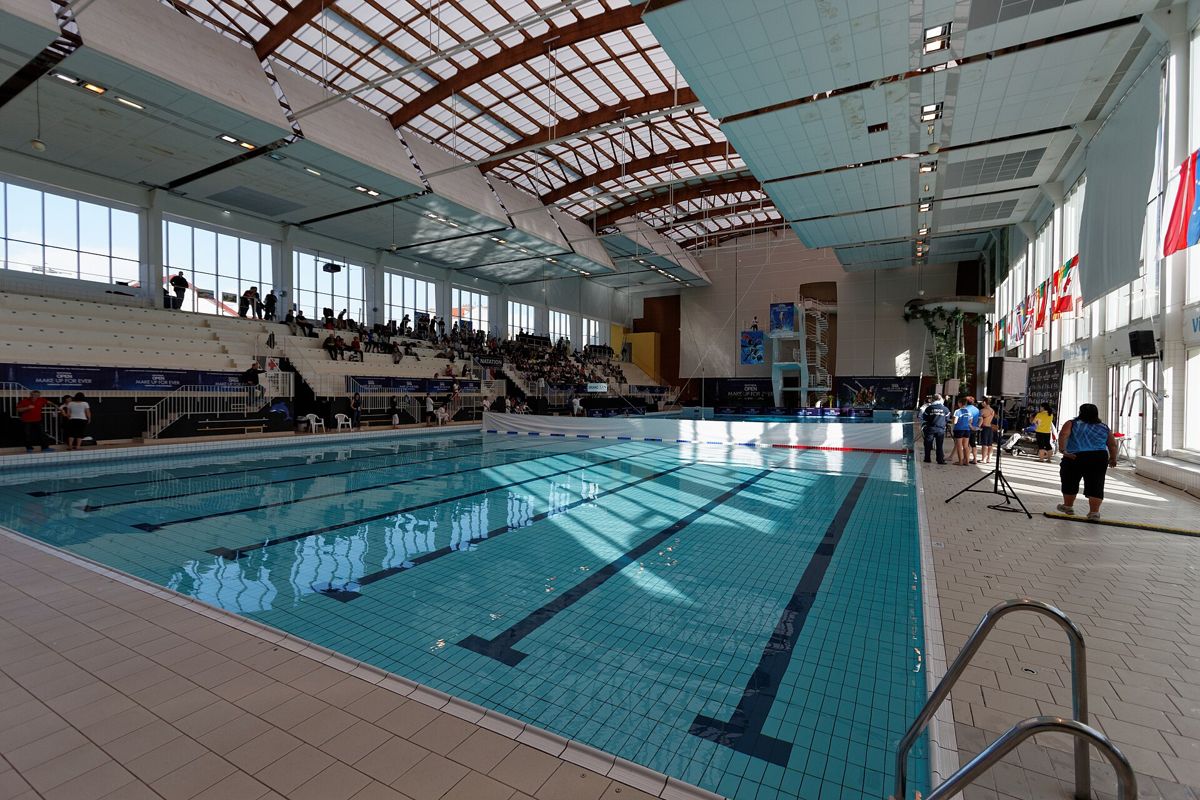
An empty indoor pool with lane markings and a timing board
The Maurice Thorez pool in Montreuil, host of the French Open. Routines at the Games need water at least three metres deep across thirty metres by twenty.
Pierre-Yves Beaudouin · CC BY-SA 3.0 · Wikimedia Commons
World Aquatics Competition Regulations, Part Seven — Artistic Swimming Rules (February 2026) · Part Seven, 9.1.3, 12.1.4, 12.2.2
What may be worn
A swimsuit, a nose clip and natural make-up. Goggles are not allowed in routines unless approved for medical reasons, nor theatrical make-up, nor any device that aids speed, buoyancy or endurance.
- Nose clip
- Allowed
- Goggles
- Not in routines
- Theatrical make-up
- Not allowed
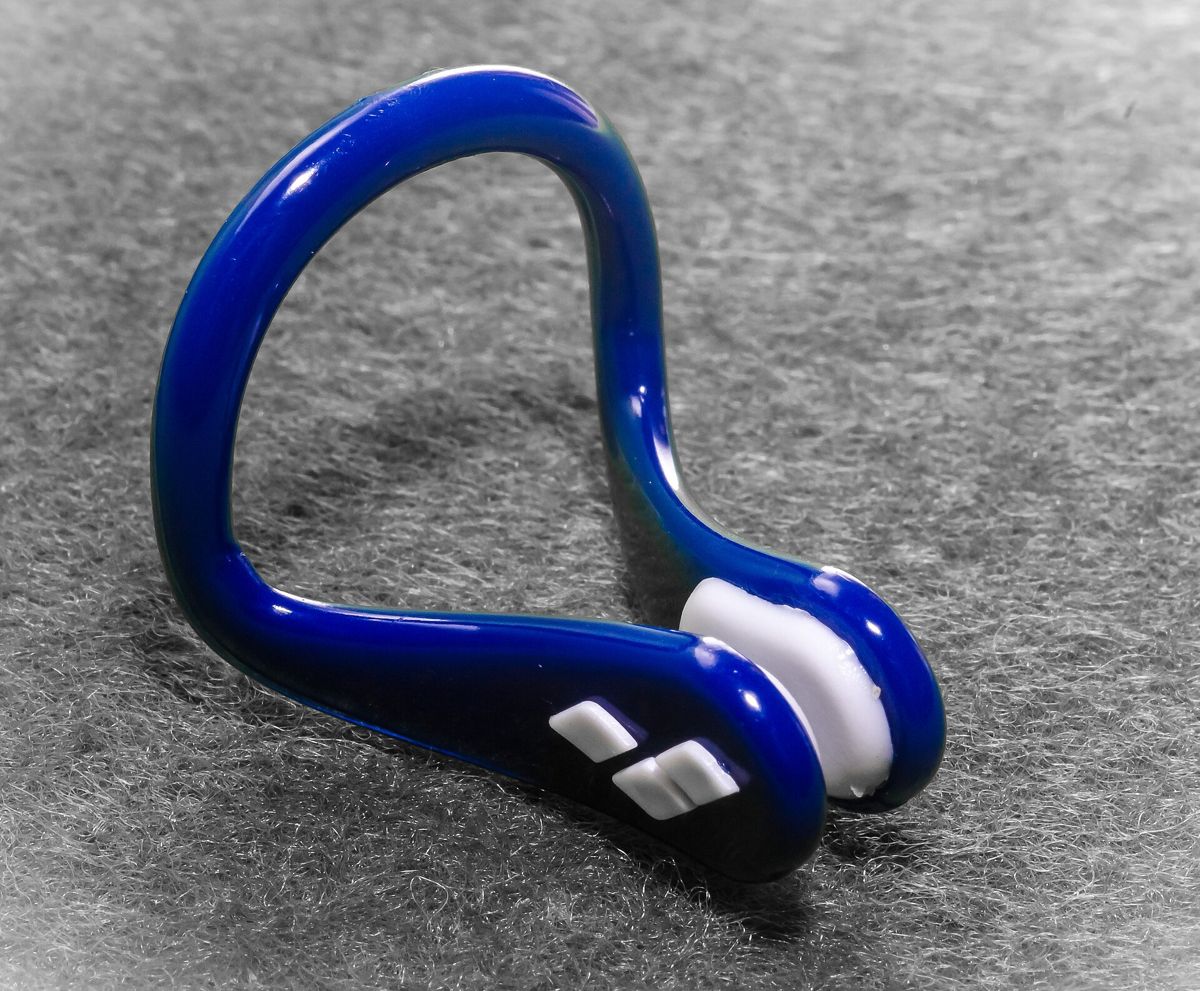
A blue plastic nose clip on a grey surface
A nose clip, the one piece of equipment the rules allow beyond the swimsuit.
BastienM · CC BY-SA 3.0 · Wikimedia Commons
World Aquatics Competition Regulations, Part Seven — Artistic Swimming Rules (February 2026) · Part Seven, 11.1.4–11.2
Swimmers
Solo, duet or team. An Olympic team is eight swimmers and a reserve, and may include up to two men. The Olympic duet is a women's event; the world championships also hold men's solos and a mixed duet of one woman and one man.
- Olympic team
- 8 and a reserve
- Men in a team
- Up to 2
- Mixed duet
- 1 woman, 1 man
This clause reads this way because of
World Aquatics Competition Regulations, Part Seven — Artistic Swimming Rules (February 2026) · Part Seven, 1.2–1.3, 4.2, 6.1.1
Routine times
Each routine has a fixed length, with five seconds' allowance either way, and the walk-on along the deck is timed too. Missing the time limit costs eight points.
- Solo technical
- 2:00
- Duet free
- 2:45
- Team technical
- 2:50
- Team free
- 3:30
- Acrobatic routine
- 3:00
- Allowance
- ±5 seconds
World Aquatics Competition Regulations, Part Seven — Artistic Swimming Rules (February 2026) · Part Seven, 6.3, 6.7.4
Scoring a routine
Five Elements judges mark the execution of each element, and five Artistic Impression judges give three marks each — choreography and musicality, performance, and transitions — from 0 to 10 in quarter points. Difficulty is not judged: it is declared on a coach card and verified by three technical controllers, who can apply a base mark to an element performed differently from its declaration.
- Judges
- 2 panels of 5
- Technical controllers
- 3 difficulty, 3 synchronisation
- Scale
- 0–10 in quarters
This clause reads this way because of
World Aquatics Competition Regulations, Part Seven — Artistic Swimming Rules (February 2026) · Part Seven, 6.5–6.6
A new start
If a routine is interrupted during the deck movements and a new start is allowed, it costs two points. A swimmer who stops swimming or makes clear use of the pool wall before the end is disqualified, unless the referee finds the cause was beyond their control.
- New start
- −2 points
- Stopping
- Disqualification
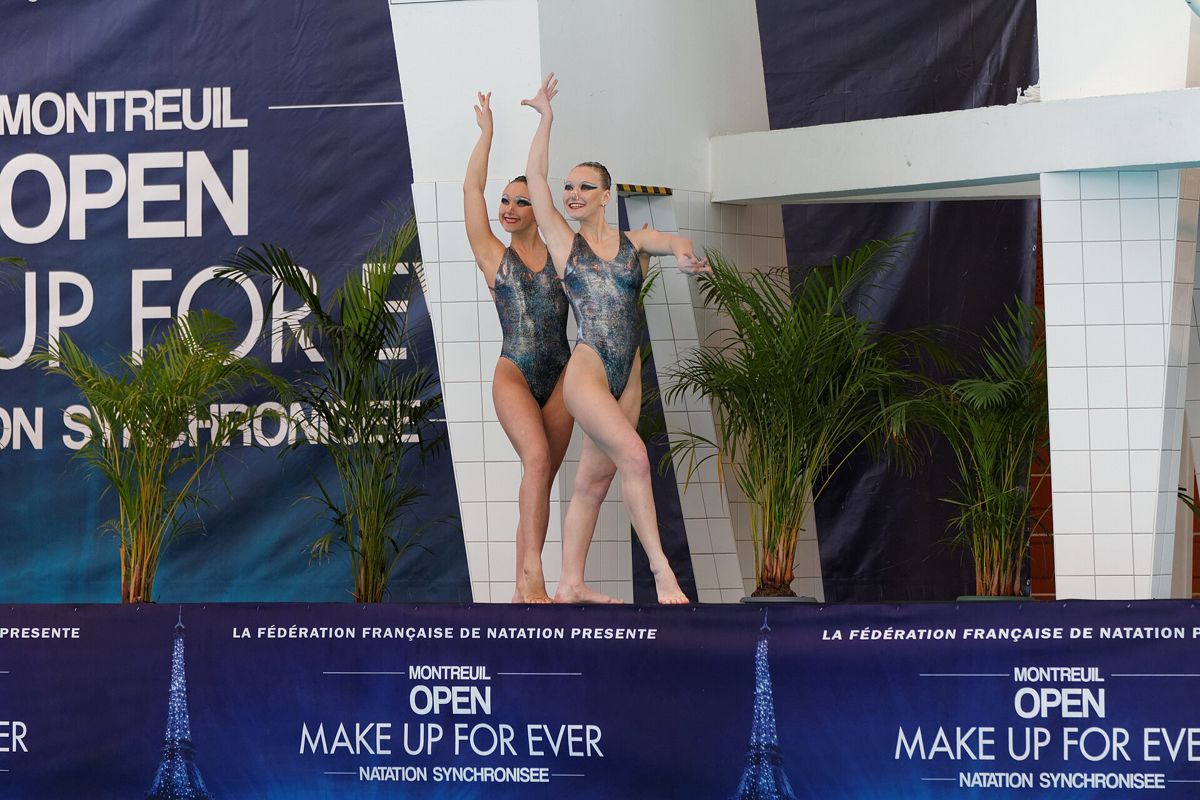
Two swimmers posed on the deck before entering the water
Alla Vaskovich and Alena Zhebeleva on the deck before their duet technical routine, Montreuil, 2013: the walk-on and deck movements are timed.
Pierre-Yves Beaudouin · CC BY-SA 3.0 · Wikimedia Commons
World Aquatics Competition Regulations, Part Seven — Artistic Swimming Rules (February 2026) · Part Seven, 6.7.3, 6.7.5
Penalties
Deliberately using the bottom of the pool to propel a swimmer or to help another costs eight points, though contact to protect against an impact injury is not penalised. Synchronisation errors are counted by the controllers and deducted at 0.1 for small, 0.5 for obvious and 3.0 for major ones.
- Using the bottom
- −8 points
- Synchronisation errors
- 0.1, 0.5 or 3.0 each
World Aquatics Competition Regulations, Part Seven — Artistic Swimming Rules (February 2026) · Part Seven, 6.8.6–6.8.7, 6.8.14
Deciding the winner
The highest combined score of the routines in the event. A tie is broken by the higher Elements score, then by choreography and musicality, then by the higher declared difficulty.
World Aquatics Competition Regulations, Part Seven — Artistic Swimming Rules (February 2026) · Part Seven, 7.2–7.3
Everything above is current law. Everything below is how Artistic swimming got here.
02Disciplines and events
Two Olympic events, a team and a women's duet, each scored on its routines combined. The world championships give each routine its own medal and add solos for women and men and a mixed duet.
- Disciplines
- 3
- Olympic medal events
- 2
- Men’s and women’s counted separately.
- Contested elsewhere
- 5
- asian games, world championship.
Team4
- Team — technical, free and acrobatic combinedUp to two men in the Olympic team from 2024.
- Team technical, free and acrobatic routinesWorld championship
Duet5
- Women's duet — technical and free combined
- Women's duet technical and freeWorld championship
- Mixed duet technical and freeWorld championshipOn the world championship programme since 2015.
Solo4
- Women's solo technical and freeWorld championship
- Men's solo technical and freeWorld championship
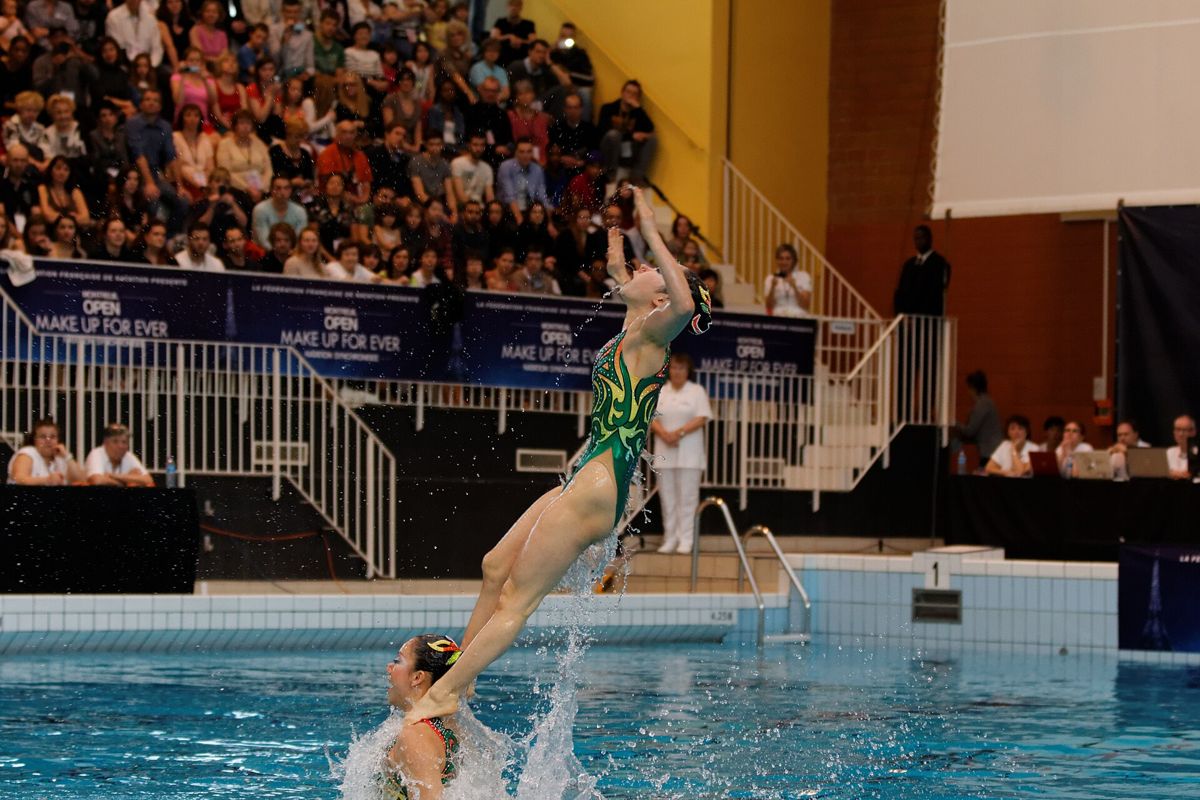
A swimmer launched from the water by teammates in an indoor pool, spectators behind
Japan's team in its free routine at the French Open in Montreuil, 2013. A lift like this is an acrobatic element, and the Olympic team event now includes a whole routine of them.
Pierre-Yves Beaudouin · CC BY-SA 3.0 · Wikimedia Commons
03Officiating
A routine is marked by two panels of five judges and checked by six technical controllers, seated around the pool.
The Elements panel marks the execution of every element. The Artistic Impression panel gives three marks each: for choreography and musicality, for performance, and for transitions. Every mark is from 0 to 10 in quarter points.
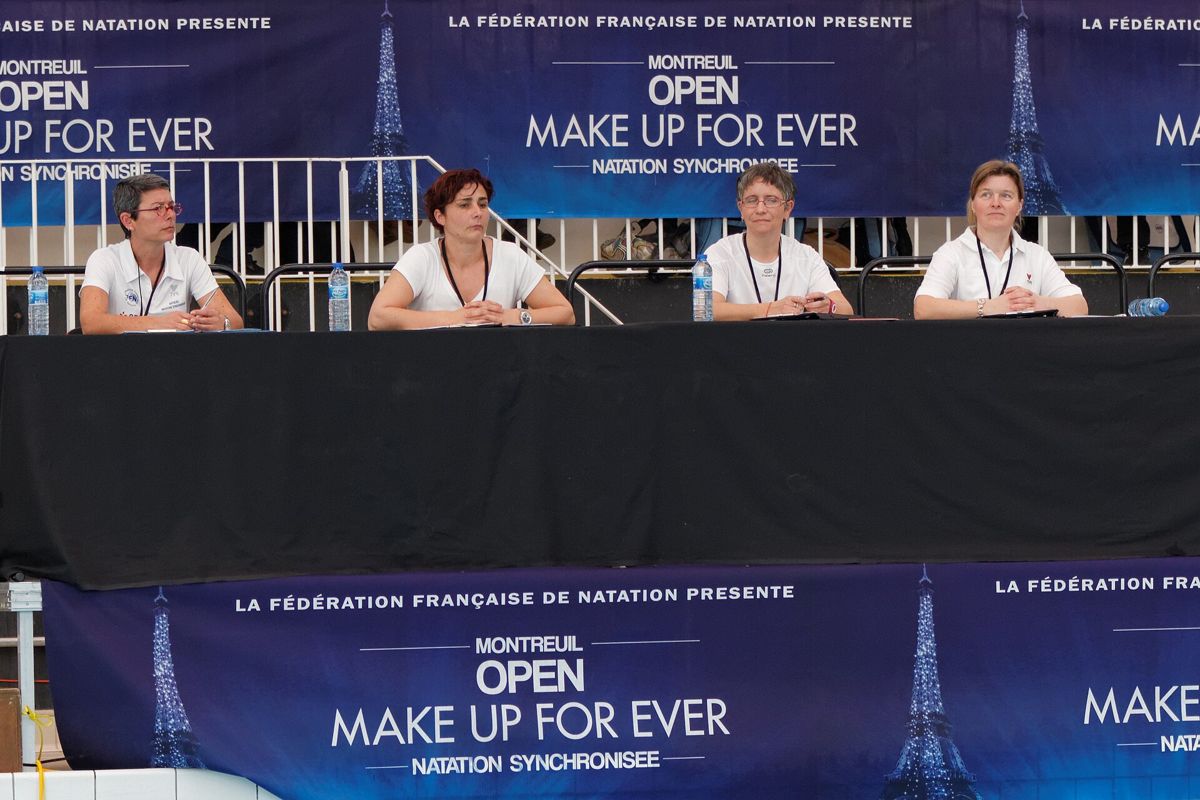
Four officials seated at a table on the poolside
Officials at the French Open in Montreuil, 2013.
Pierre-Yves Beaudouin · CC BY-SA 3.0 · Wikimedia Commons
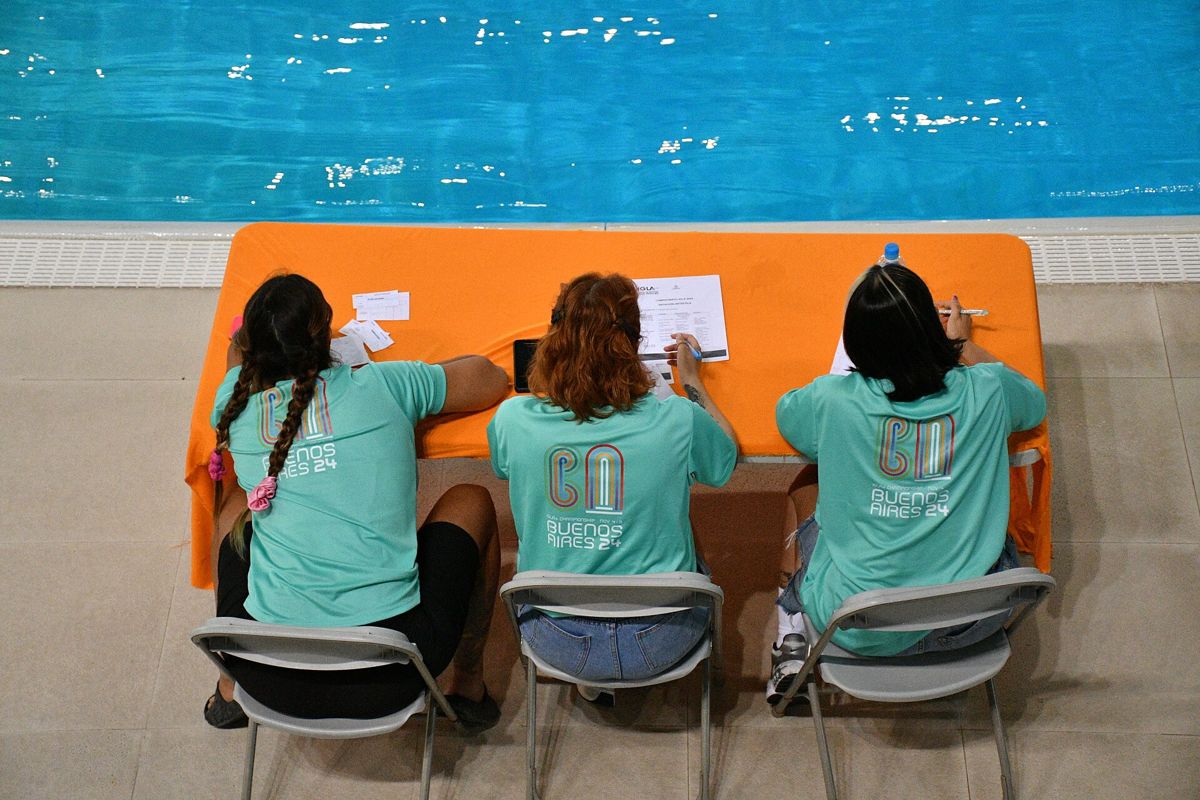
Three judges seen from behind at a poolside table, writing scores
Judges at the IGLA+ championships in Buenos Aires, 2024.
Diegodlh · CC BY 4.0 · Wikimedia Commons
Difficulty is not judged. Each team submits a coach card listing its elements and their declared difficulty, and three difficulty controllers verify each one as it happens. An element that does not match its declaration gets a base mark. Three synchronisation controllers count the unequal actions, at 0.1, 0.5 or 3.0 points each. Two of the three must agree to apply a base mark or a major error, and each can ask for one video review per element.
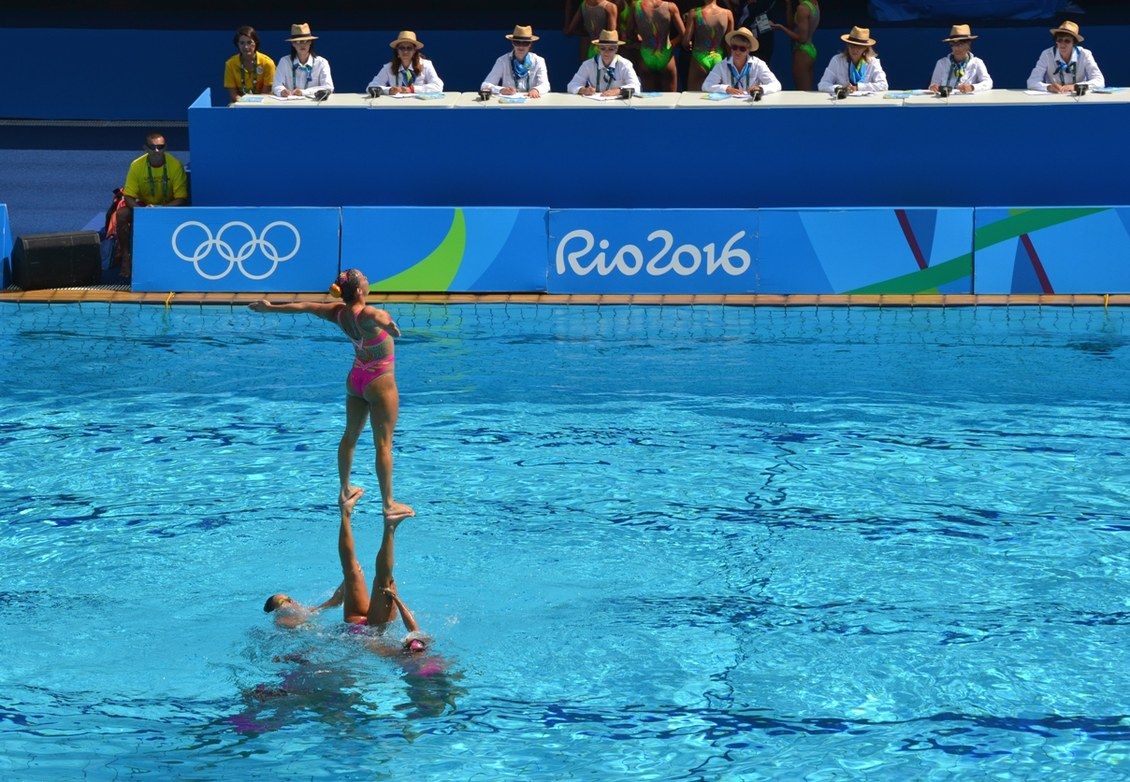
A swimmer standing on teammates' hands above the water, judges seated along the far side
Brazil's team at Rio 2016, a swimmer held above the water with the judges' panel along the far side.
Rafael Brais / brasil2016.gov.br · CC BY 3.0 · Wikimedia Commons
Officials are also appointed to watch the bottom of the pool. Using it to push off costs eight points.
04Where it is played
The sport began in North America and Europe, and the United States and Canada won most of the early Olympic titles.
From 2000 it belonged to Russia. Its swimmers won every Olympic gold for twenty years, and Svetlana Romashina retired with seven, more than anyone else in the sport.
China, Japan, Spain and Ukraine have been the nearest challengers. China was second to Russia for much of the 2010s and won both Olympic events in Paris in 2024, in Russia's absence. Ukraine's team won bronze in Tokyo.
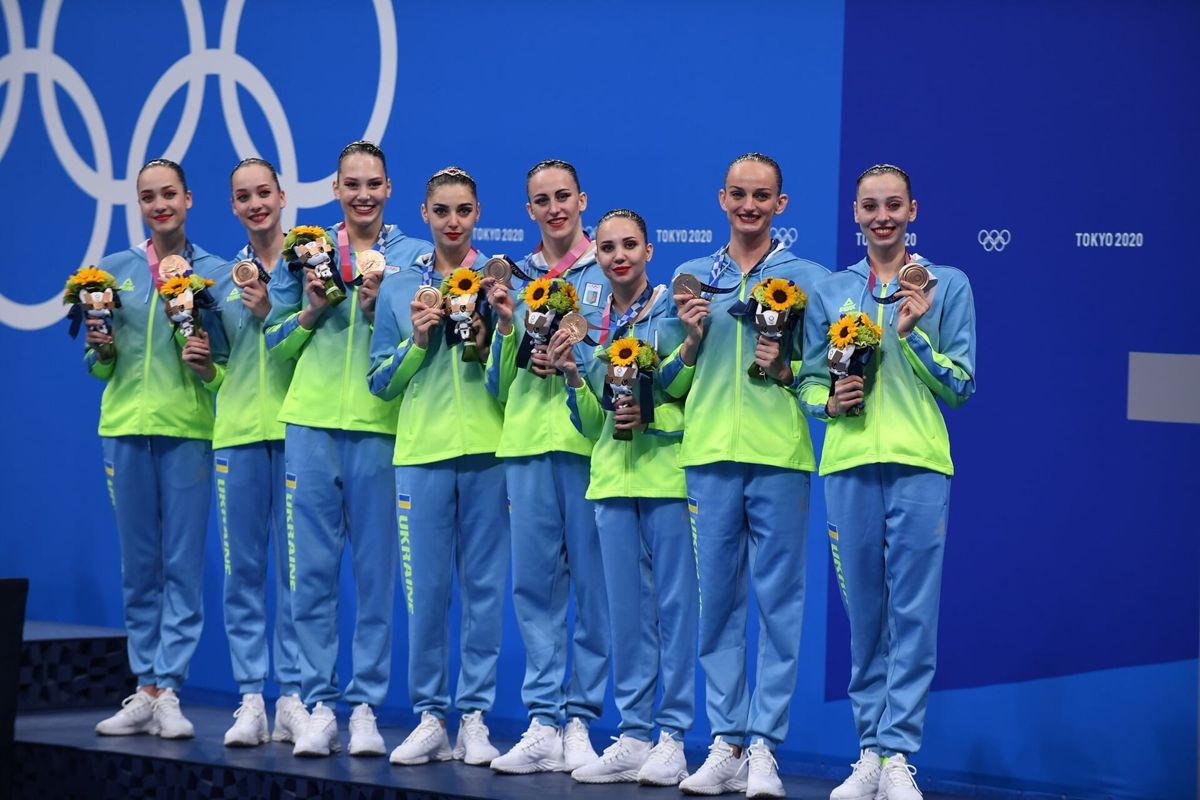
Eight swimmers in tracksuits on a podium holding flowers and medals
Ukraine's team with its bronze medals at Tokyo 2020.
Ministry of Youth and Sports of Ukraine · CC BY 4.0 · Wikimedia Commons
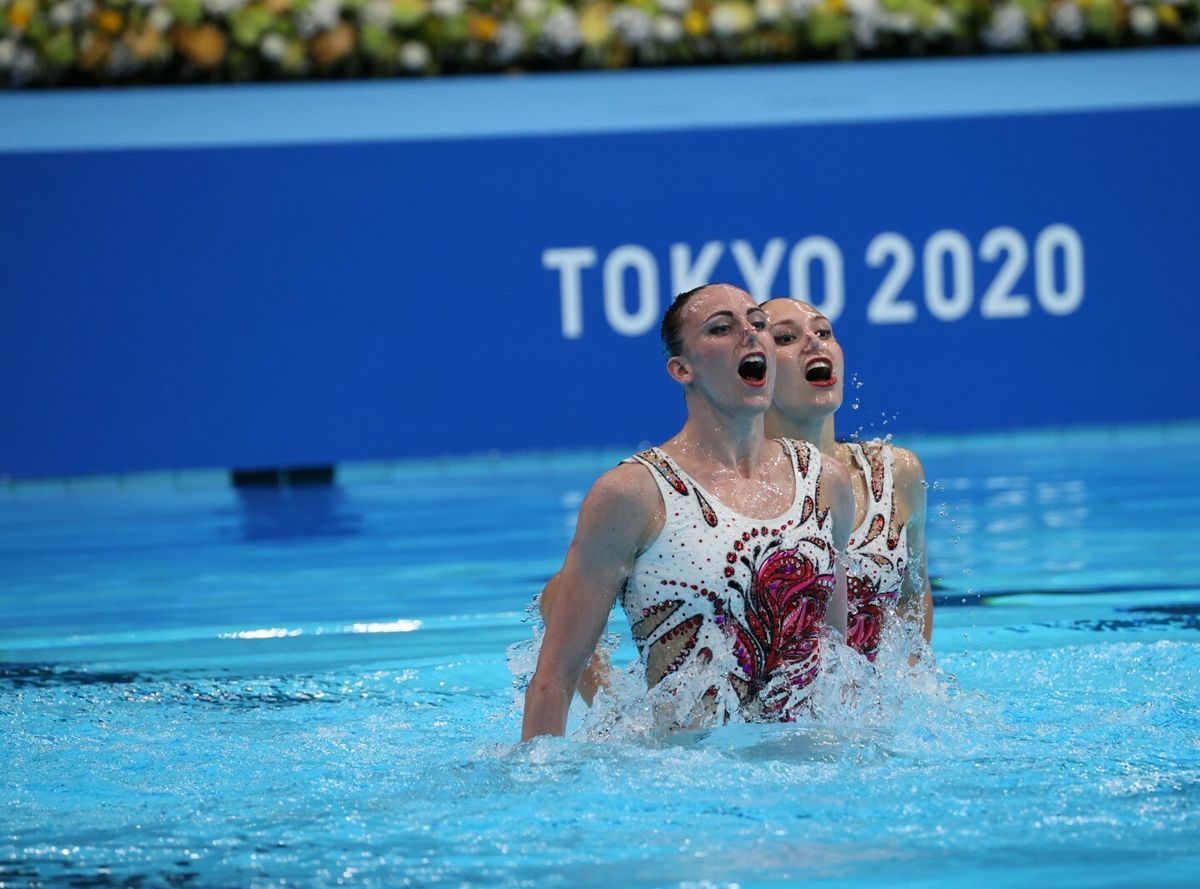
Two swimmers rising from the water side by side with mouths open
Marta Fiedina and Anastasiya Savchuk of Ukraine in the duet free routine at Tokyo 2020.
Ministry of Youth and Sports of Ukraine · CC BY 4.0 · Wikimedia Commons
Men's artistic swimming is small and growing. Italy's Giorgio Minisini has won world titles in the mixed duet, and men's and mixed events are now on the world championship programme, though not on the Olympic one.
05Learning curve
A sport that asks for a swimmer's lungs, a gymnast's flexibility and a dancer's timing at once, performed where the audience cannot see most of the work.
Editorial — the site’s reading, not a sourced claim
Barrier to entry
How hard is it to get to a real game?
Any pool and a club; the first skills are sculling and holding a position.
It needs nothing a swimming pool does not already have, and a beginner's first lessons — sculling with the hands to stay up, holding the body still at the surface — are learnable in weeks. Clubs exist wherever swimming does, though fewer of them.
The barrier is everything after that. The routines are held in deep water, much of them upside down, and the breath-holding is trained, not natural.
Evidence
- EquipmentSwimsuit and nose clipobserved
- First skillScullingestimate
- Usual backgroundSwimming or gymnasticsestimate
Barrier to the top
How hard is it to be good at?
Height out of the water, held still, while synchronised with seven others.
The elite standard is measured in how far out of the water a leg or a body rises, and how still it stays there, with no floor to push from: using the bottom costs eight points. Every element is declared in advance and its difficulty is fixed, so the margin is in execution, and in a team of eight every swimmer's error is the team's.
Russia won every Olympic gold from 2000 to 2020. The standard that set is the one the rest of the world has chased.
Evidence
- Using the bottom−8 pointsrule2023 — the rule this rests on
- Olympic team8 swimmersrule2024 — the rule this rests on
- Russian Olympic golds, 2000–202012 of 12observed
Why the two differ
The gap is hidden. Most of what makes an elite routine — the eggbeater kick that holds a swimmer up, the breath held through a long underwater sequence — happens below the surface, so a beginner watching from the side sees the result and not the work.
The historyhow it got here · sections 6 to 10
06Origin and invention
Artistic swimming began as a show. In the early twentieth century the Australian swimmer Annette Kellerman performed in glass tanks on the vaudeville stage and in films, and made swimming to music into something people paid to watch.
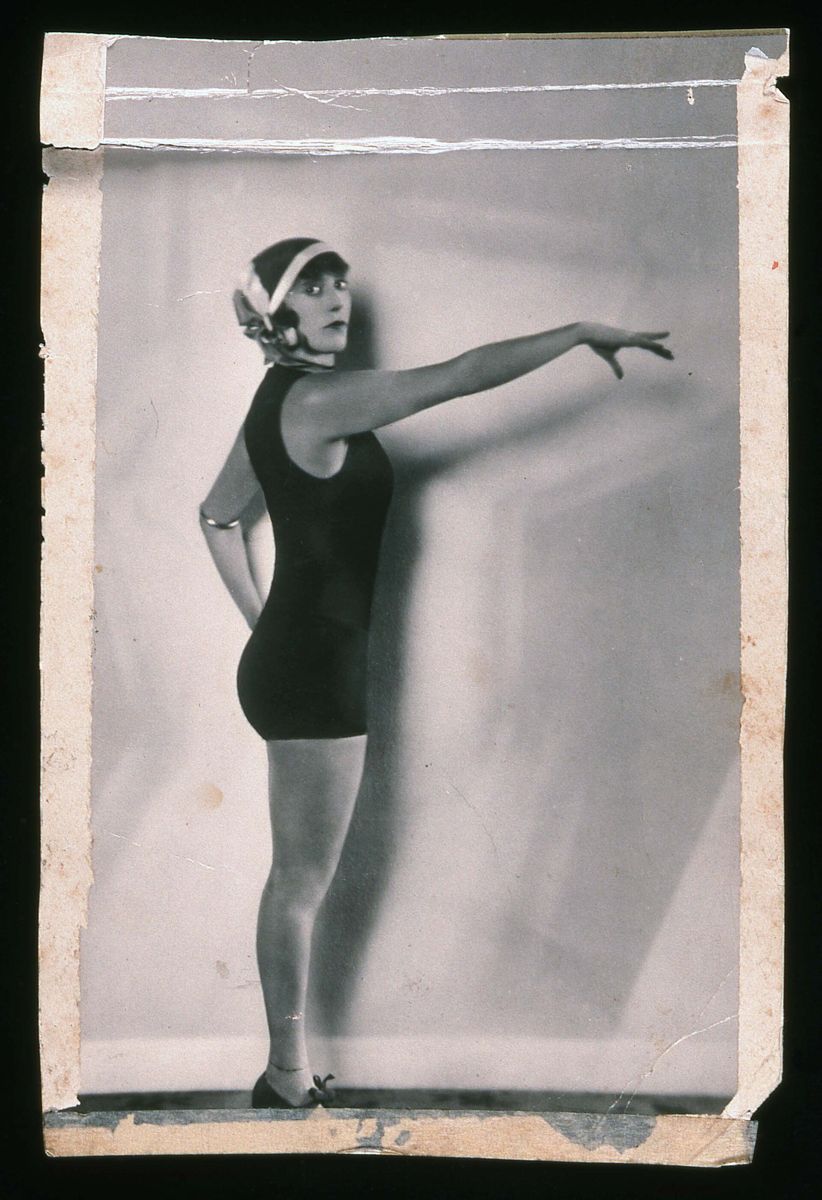
A studio photograph of a woman in a one-piece swimsuit, one arm outstretched
Annette Kellerman in a studio portrait of 1907: the Australian swimmer whose stage and film performances made swimming to music a show.
Australian National Maritime Museum · No restrictions · Wikimedia Commons

A woman in a one-piece swimsuit lying on her front, smiling
A postcard of Annette Kellerman, “Champion Lady Swimmer and Diver of the World”.
Australian National Maritime Museum · No restrictions · Wikimedia Commons
Clubs took it up as figure swimming. In Berlin in 1932 a women's club was photographed from above forming a wheel in a wave pool, the kind of pattern the sport still builds today.
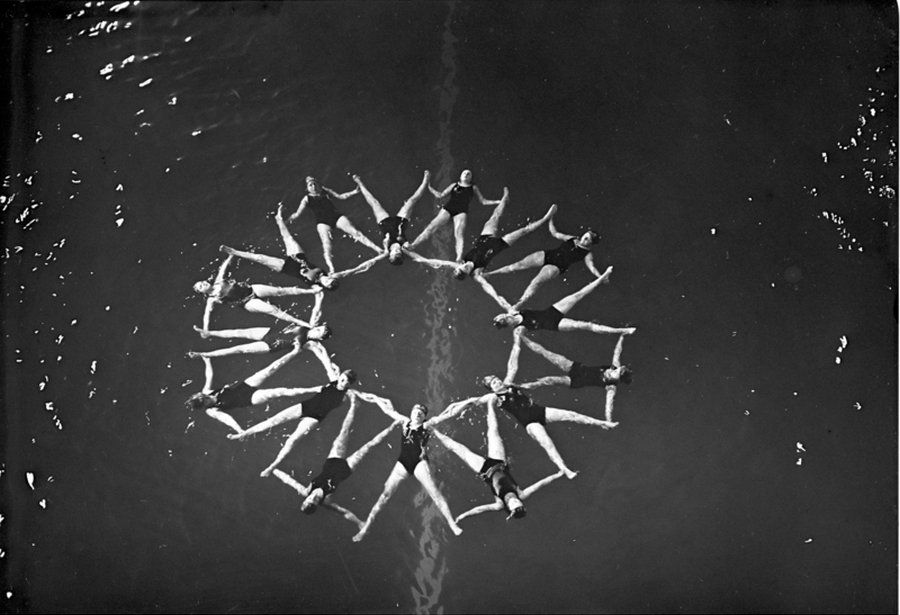
Swimmers seen from above forming a wheel pattern on dark water
Figure swimming by the Berlin women's club Nixe in the wave pool at Lunapark, November 1932.
Georg Pahl · CC BY-SA 3.0 de · Wikimedia Commons
The name came from Chicago. Katherine Curtis coached women's water shows there in the 1930s, and a show she staged at the Century of Progress fair of 1933–34 is credited with the term synchronised swimming. Billy Rose's Aquacades of the late 1930s and Esther Williams's films of the 1940s and 1950s made it famous, and fixed in the public mind an image the sport has argued with ever since.
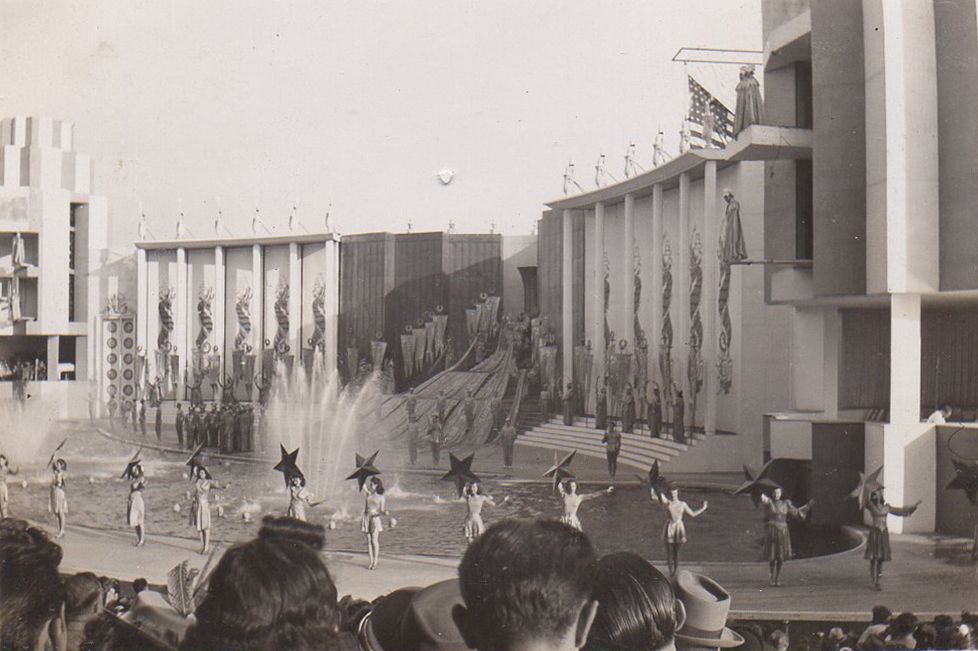
An audience watching performers on a stage beside fountains, with modern buildings behind
The Billy Rose Aquacade at the 1939 New York World's Fair.
Waeltkm · CC BY-SA 4.0 · Wikimedia Commons
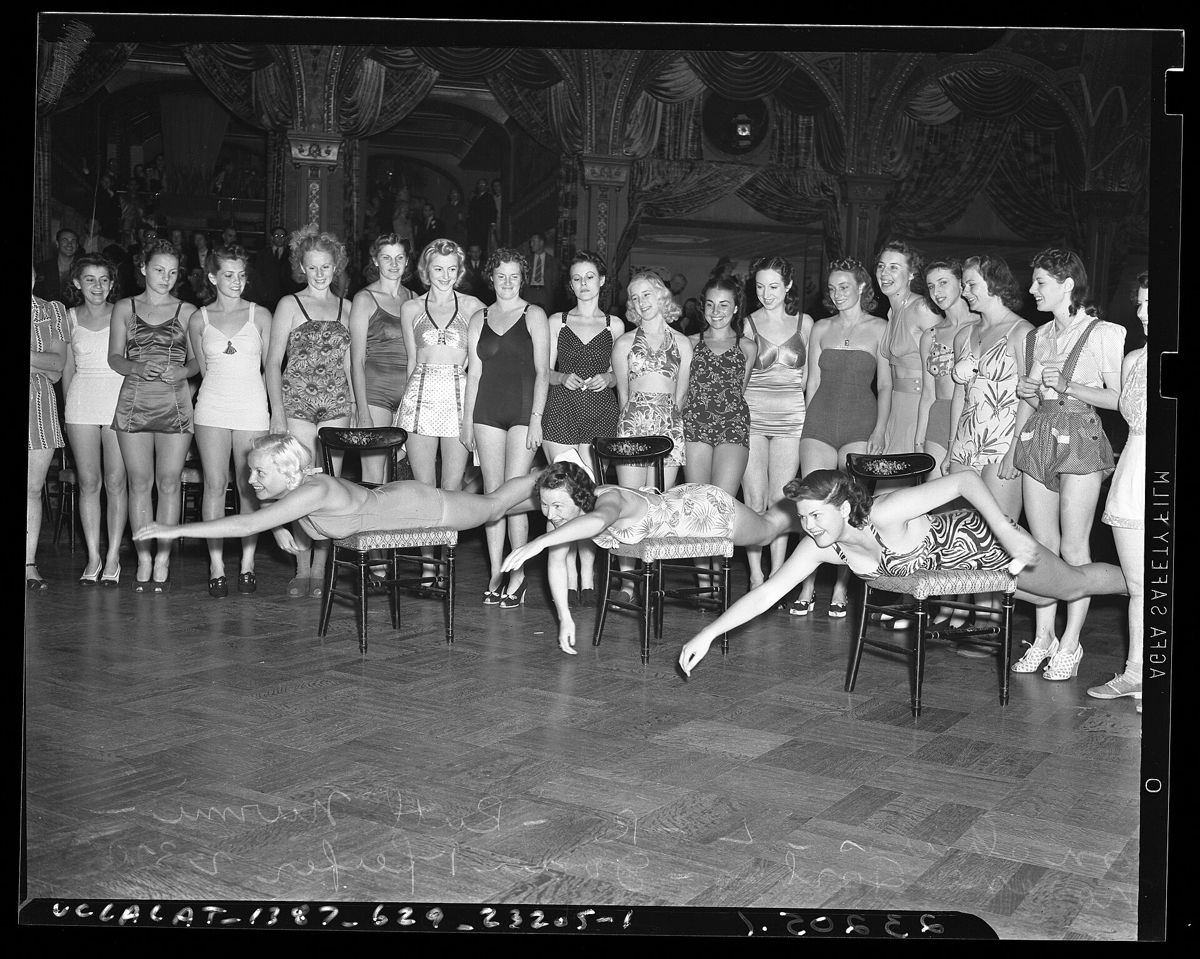
A row of women in swimsuits, three lying across chairs demonstrating a stroke
Auditions in Los Angeles in April 1940 for Billy Rose's Aquacade at the Golden Gate International Exposition in San Francisco.
Los Angeles Daily News · CC BY 4.0 · Wikimedia Commons
It became a competition. Synchronised swimming joined the first world aquatics championships in 1973 and the Olympic Games in 1984, with a solo and a duet. The Olympic events changed three times before they settled: a team event alone in 1996, then duet and team from 2000, and from 2024 a team that may include men.

A red and blue programme cover with a diver, a swimmer and a ring of swimmers seen from above
The programme for Seattle's Aqua Follies of 1952, billed as the “World's Greatest Water Show”.
Seattle Municipal Archives · CC BY 2.0 · Wikimedia Commons

Two women in formal clothes talking on a staircase
Esther Williams, whose films made the sport famous, in Amsterdam in May 1955 with the Dutch swimmer Geertje Wielema.
Ben van Meerendonk / AHF, IISG · CC BY-SA 2.0 · Wikimedia Commons
07Rule timeline
The sport’s own lane, expanded. Every entry carries a cause from the closed vocabulary and a citation, and says so where the citation is incomplete.
- 2017-07Disputedalso commercialadopted 2017-07
Synchronised swimming renamed artistic swimming by vote of the FINA General Congress in Budapest. The rules, events and scoring were not changed by the vote; the sport has competed under the new name since.
Trigger and citationIncomplete — no confirmed article
Trigger
FINA's stated reason, from its vice-president Sam Ramsamy, was that the name "brings it into line with artistic gymnastics and will be better understood by the public and the media. This should help us rebrand and enhance its popularity." Its executive director Cornel Marculescu said the issue had come "from the media … and also from the (International Olympic Committee)".
Mental Floss, reporting The Atlantic, gives the idea as the IOC's, with the sport's own technical committee resisting before it relented. Inside Synchro records that the vote was taken by the general congress, two delegates per country from any aquatic sport, not by the synchronised swimming experts, and that a protest petition drew nearly 11,000 signatures. Whether the change was FINA's rebrand or the IOC's condition is the dispute; both accounts are recorded.
Artistic Swimming: Now What? (Inside Synchro, 30 October 2017) · FINA General Congress, Budapest, July 2017
- 2023-01-01Integrityadopted 2022-10
Routines declared in advance on a coach card, with every hybrid and acrobatic element given a degree of difficulty calculated by formula. Routines are marked by two panels of five judges, Elements and Artistic Impression, with three difficulty and three synchronisation technical controllers using video review, on a scale of 0 to 10 in quarter points. An element performed differently from its declaration is given a base mark, its minimum value.
Trigger and citation
Trigger
The federation's stated aims were to "calculate the difficulty using mathematical values and formulas" and "obtain objective and detailed measurement using technology", dividing the roles of the officials and giving athletes and coaches "more specific feedback".
Competition Regulations, Part Seven — Artistic Swimming Rules (in force from February 2026) · Competition Regulations Part Seven, February 2026 (current text) · article Part Seven, 6.5–6.6
- 2024Participation and accessadopted 2022-12-22
Men allowed in the Olympic team event for the first time, up to two in a team of eight. Men had competed at the world championships since the mixed duet was introduced in 2015. The Olympic duet remains a women's event.
Trigger and citation
Trigger
World Aquatics announced the IOC's approval as the outcome of a campaign for men's inclusion led by athletes including Bill May, the first male world champion in 2015, and quoted Giorgio Minisini on "our sport's evolution towards inclusivity".
Competition Regulations, Part Seven — Artistic Swimming Rules (in force from February 2026) · Competition Regulations Part Seven, February 2026 (current text) · article Part Seven, 1.2, 4.2
08Equipment evolution
There is almost no equipment, and the rules keep it that way. A swimmer wears a swimsuit and a nose clip. Goggles are banned from routines unless approved for medical reasons, and so is anything that might aid speed, buoyancy or endurance.
The nose clip is the sport's one piece of gear and its signature: it lets a swimmer stay upside down without water forcing its way in, and so makes the long inverted sequences possible.
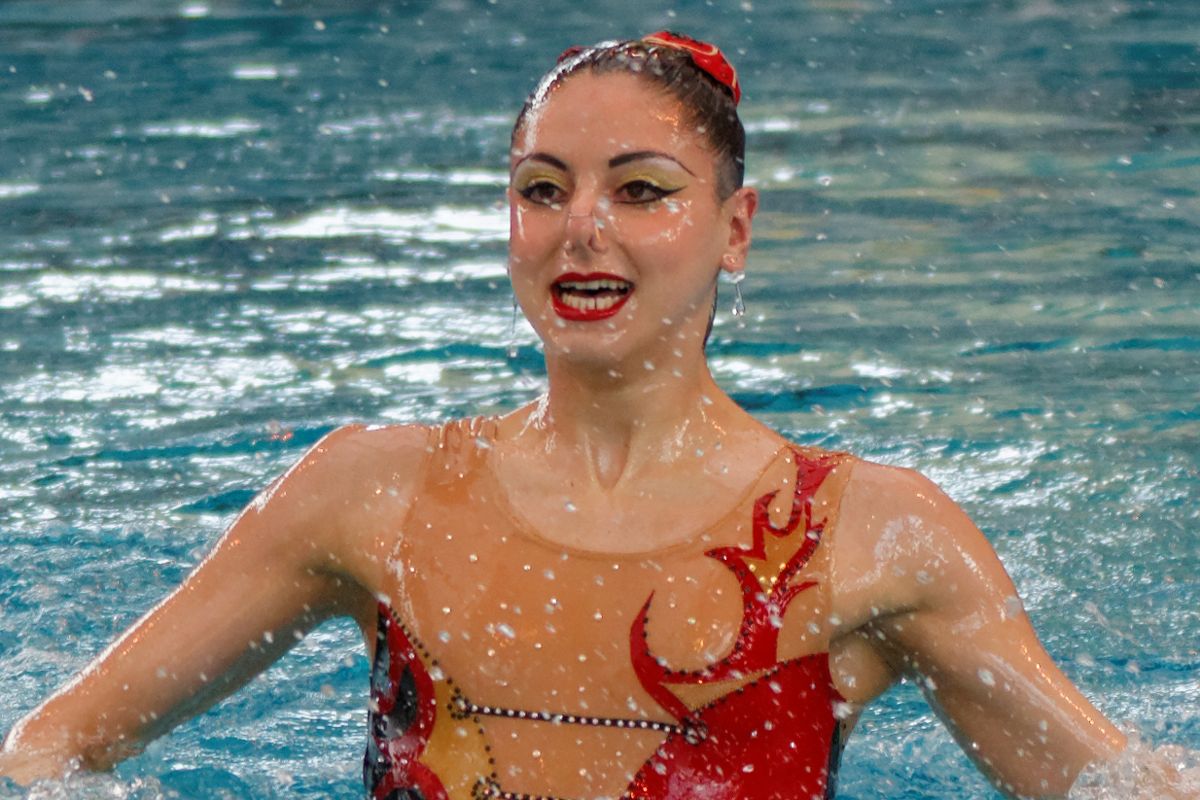
A swimmer at the surface in a red costume and bold make-up, smiling
Linda Cerruti of Italy in the duet technical routine at Montreuil, 2013.
Pierre-Yves Beaudouin · CC BY-SA 3.0 · Wikimedia Commons
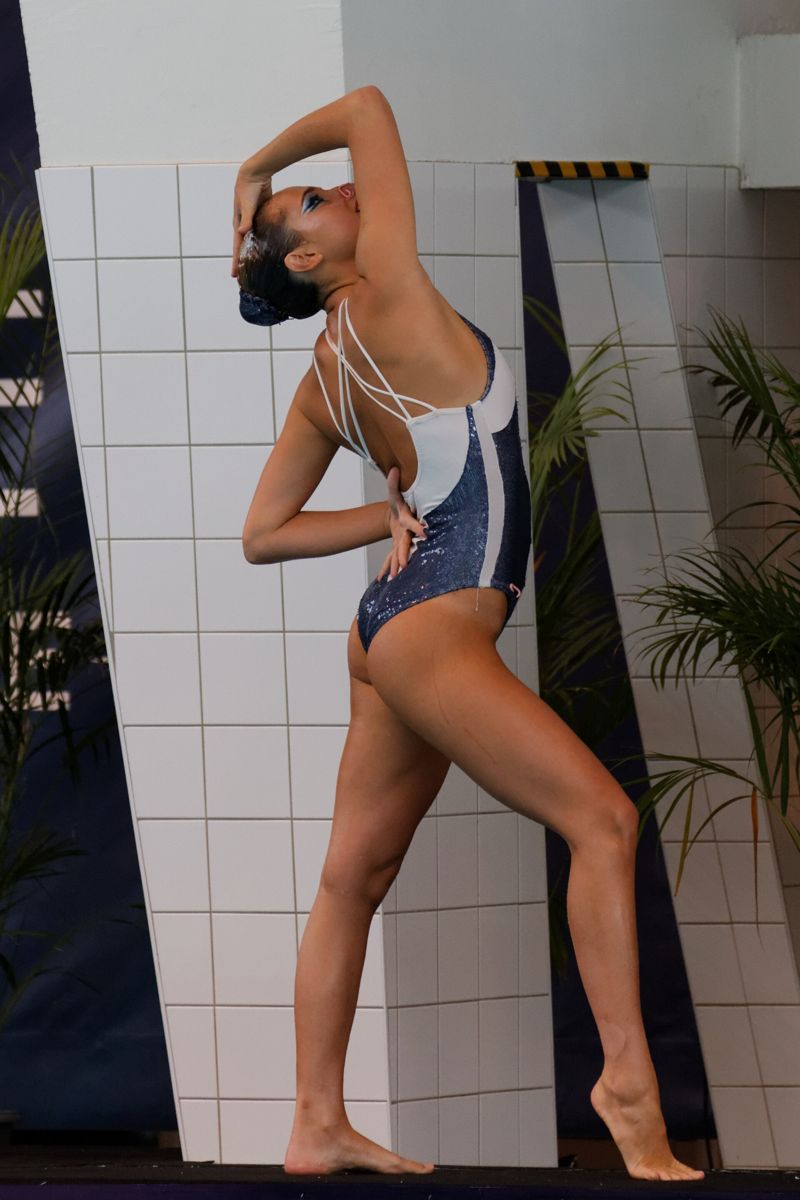
A swimmer posing on the deck in a dark costume before her routine
Etel Sánchez of Argentina on the deck before her free solo, Montreuil, 2013.
Pierre-Yves Beaudouin · CC BY-SA 3.0 · Wikimedia Commons
The pool is the rest of it. Routines at the Games are swum in water at least three metres deep, deep enough that no one can stand, and the organisers must provide underwater speakers so the music can be heard below the surface, where most of the counting is done.
The costume rules reach as far as the face. Natural make-up is allowed and theatrical make-up is not, and swimwear must be "dignified and appropriate for athletic competition" — the rules' own phrase, and a fair summary of the argument the sport has been having with itself since the Aquacades.
09Governing body politics
The sport is governed with swimming by World Aquatics, formerly FINA, and the two largest decisions about it in the last decade were taken by bodies above its own technical committee.
The name came from the general congress. In July 2017 FINA's congress, in which every member federation votes regardless of whether it has a single synchronised swimmer, renamed the sport artistic swimming. FINA's stated reason was to align it with artistic gymnastics and widen its appeal; its executive director said the idea had also come from the IOC. Swimmers protested, and a petition gathered nearly 11,000 signatures, but the vote stood.
Team swimmers in an indoor pool, one inverted above the surface and another rising beside her
France's team free routine at the French Open in Montreuil, March 2013.
Pierre-Yves Beaudouin · CC BY-SA 3.0 · Wikimedia Commons
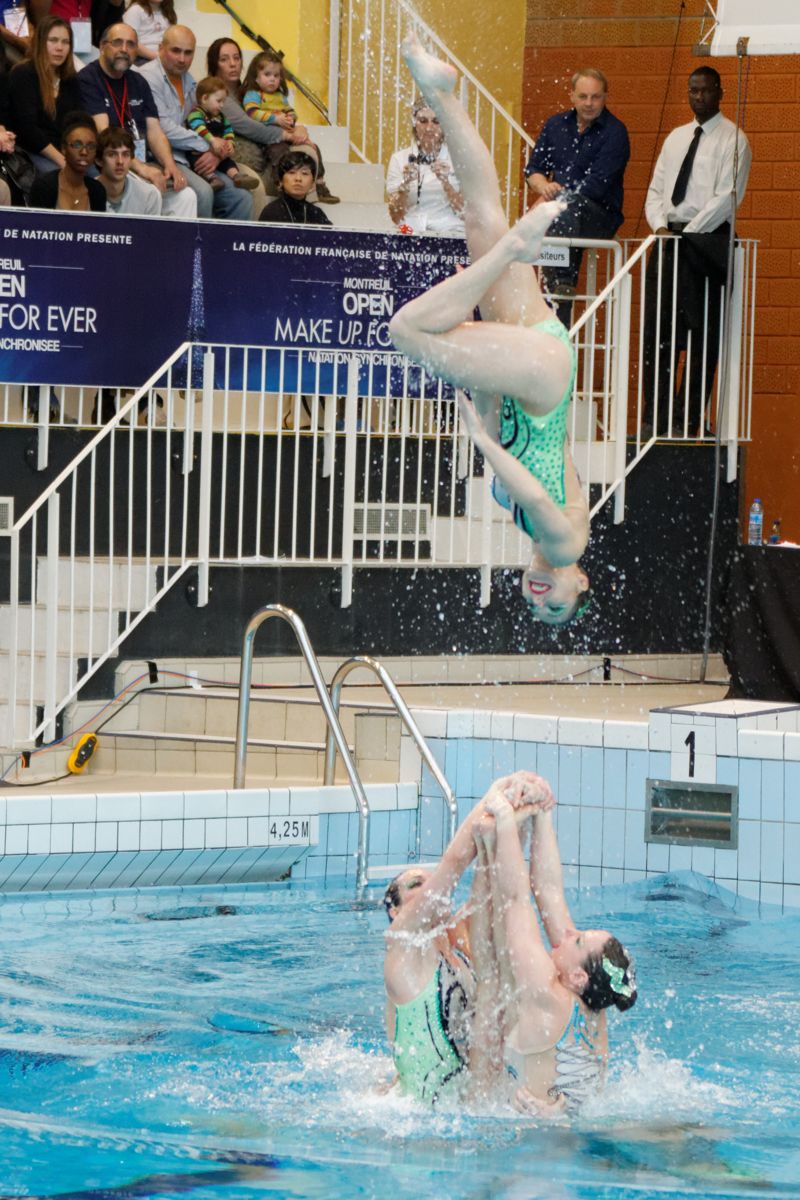
A swimmer flipped upside down above the water by teammates beneath her
France's team in its free routine at the French Open in Montreuil, March 2013.
Pierre-Yves Beaudouin · CC BY-SA 3.0 · Wikimedia Commons
The men came from the IOC. On 22 December 2022 it approved men in the Olympic team, up to two in eight, after a campaign led by athletes such as Bill May, who had won the first mixed duet world title in 2015. No man was selected for Paris in 2024.

A smiling man giving a thumbs up, medals round his neck
Giorgio Minisini of Italy at the 2022 European Championships in Rome, where he won four golds in the men's and mixed events.
Giorgiominisini · CC BY-SA 4.0 · Wikimedia Commons
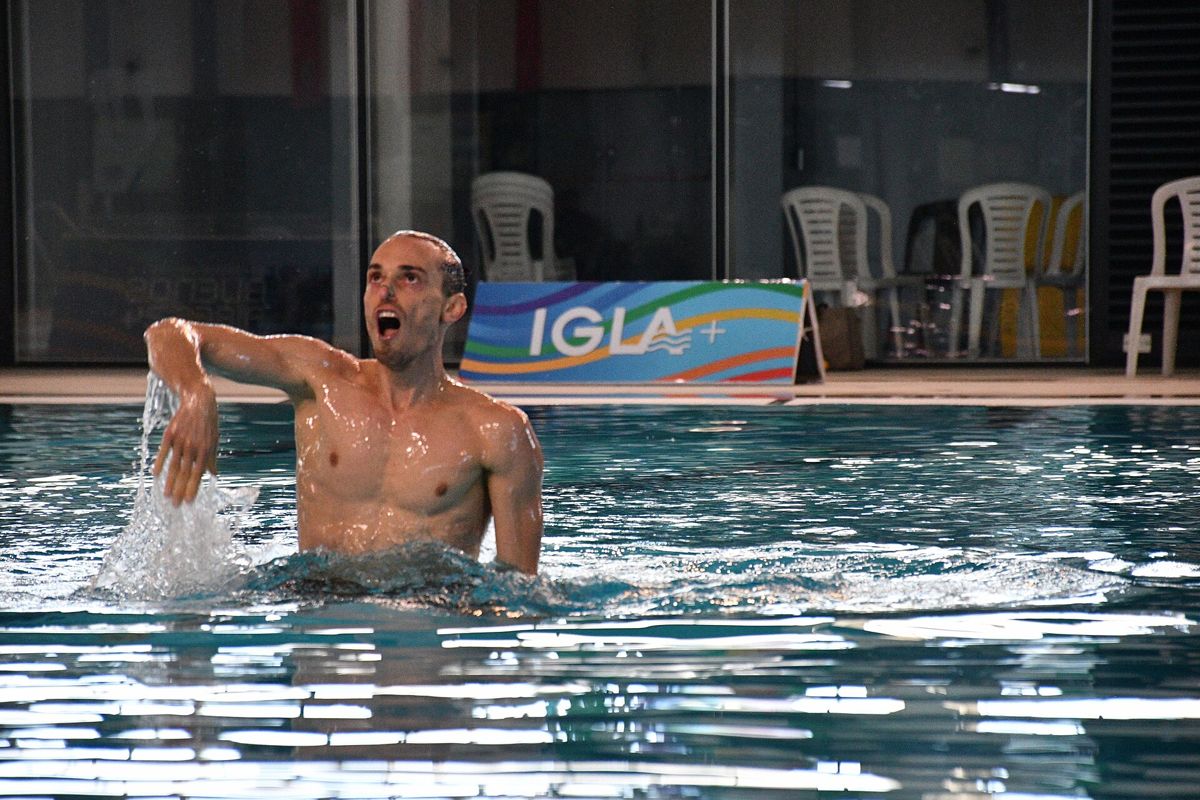
A man in the water mid-routine, one arm raised and splashing
Bruno Lázzaro competing at the IGLA+ championships in Buenos Aires, 2024.
Diegodlh · CC BY 4.0 · Wikimedia Commons
10Controversies that forced rule changes
The judging. Until 2023 difficulty was itself one of the judges' marks, and a mark given on impression is hard to check. The scoring system of 2023 was built to make it checkable: every element's difficulty is declared on a coach card and verified by controllers with video review, and the federation's stated aim was "objective and detailed measurement". It is the move diving made with its difficulty tables.
The name. The rename of 2017 was decided by a congress of delegates from every aquatic sport, and its critics within the sport said it reduced their event to a show. FINA said it would not revert.
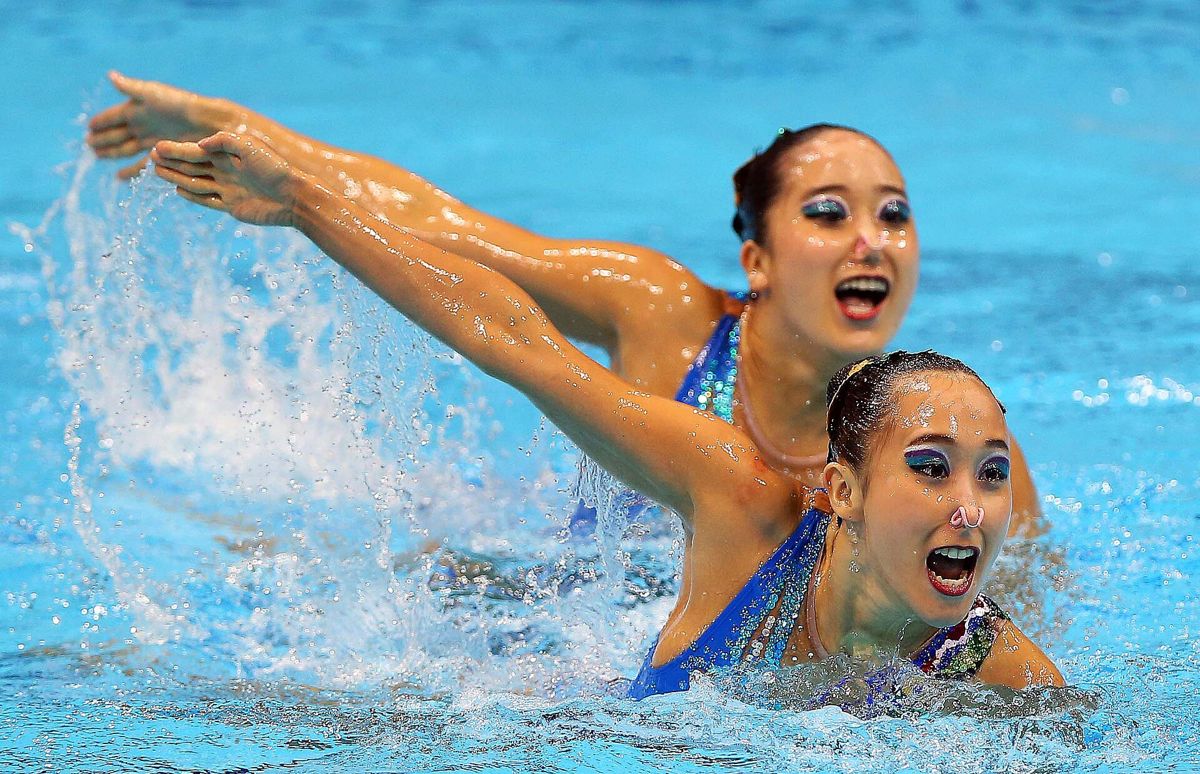
Two swimmers at the surface with arms extended in unison
Park Hyun-ha and Park Hyun-sun of South Korea in the duet at London 2012.
Korean Olympic Committee / Korea.net · CC BY-SA 2.0 · Wikimedia Commons
The men. Men could swim at world championships from 2015 and could not at the Games until 2024. The change was made, but in its narrowest form: two places in a team of eight, and no Olympic men's or mixed event.
Russia. Russia won every Olympic gold from 2000 to 2020, twelve in all, the last two under the name of the Russian Olympic Committee. It was absent from Paris 2024, and China won both events.
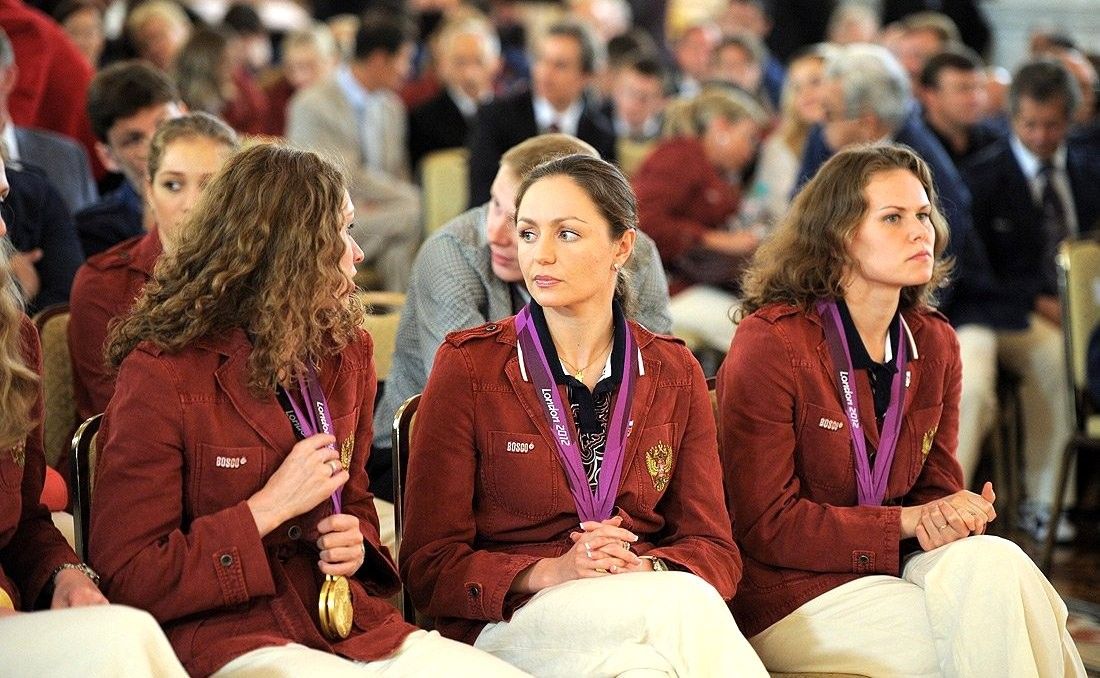
Three women in red jackets with medals seated in an audience
Natalia Ishchenko, Anastasia Davydova and Maria Gromova of Russia's 2012 Olympic champion team at a Kremlin reception in August 2012.
kremlin.ru · CC BY 4.0 · Wikimedia Commons
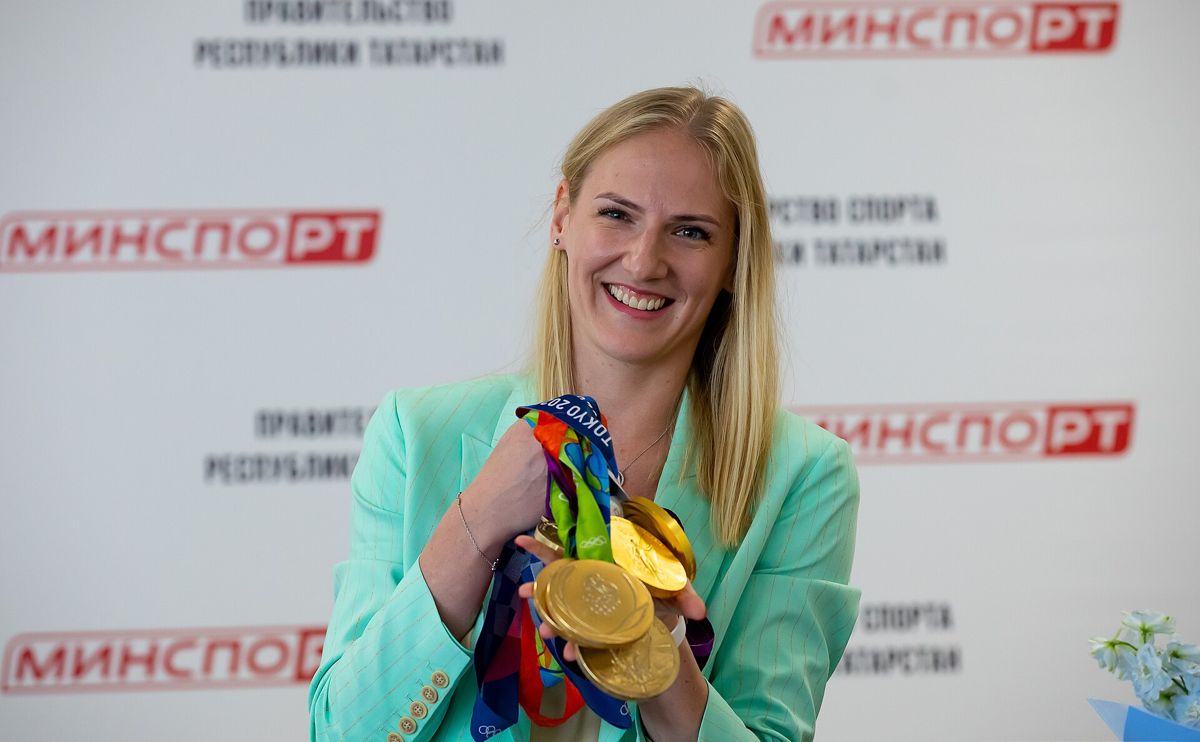
A smiling woman holding up several gold medals
Svetlana Romashina in 2021 with her Olympic gold medals. She won seven, more than anyone in the sport.
Ministry of Sport of the Republic of Tatarstan · CC BY 4.0 · Wikimedia Commons
Where it standsthe record, and what is still open · sections 11 to 12
11Series
No series has been assembled for this sport.
12What is contested now
The base mark. Under the 2023 system an element that does not match its declaration gets its minimum value. In an open letter in 2024 a world championship athlete called the system "disrespectful to the athletes' work", arguing that a single missed movement in a hybrid of twenty is punished as heavily as missing all of them.
Execution against difficulty. The same letter argued that judges use too little of the scale — marks "mostly float between 6.75 and 8.5" — so that declared difficulty decides results. Whether the reform has made the sport more objective or only more predictable is the argument now.
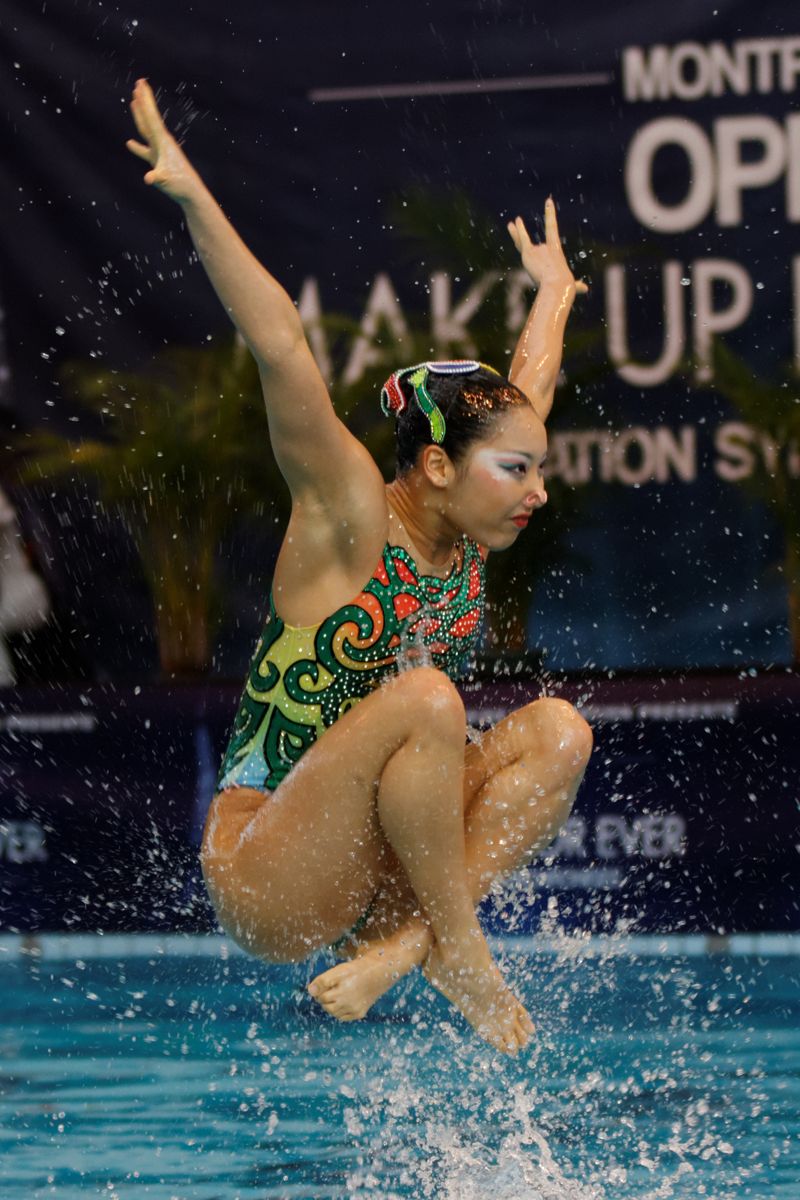
A swimmer thrown into the air in a tucked position, arms raised
A member of Japan's team thrown clear of the water in its free routine, Montreuil, 2013.
Pierre-Yves Beaudouin · CC BY-SA 3.0 · Wikimedia Commons
Men at the Games. Two places in a team of eight, and no man selected in 2024. Whether a men's or mixed Olympic event follows is open.
The name. It has stuck. Whether it has changed how the sport is seen is harder to say.