Billiards sports
Three sports that cannot be played on each other's tables — and one of them has no pockets at all.
- Official
- Billiards sports
- Game category
- Target
- Adjudication
- Decided by score
- Standing
- Never Olympic
- rule changes
- 4
- comparability breaks
- 2
- Olympic editions
- 0
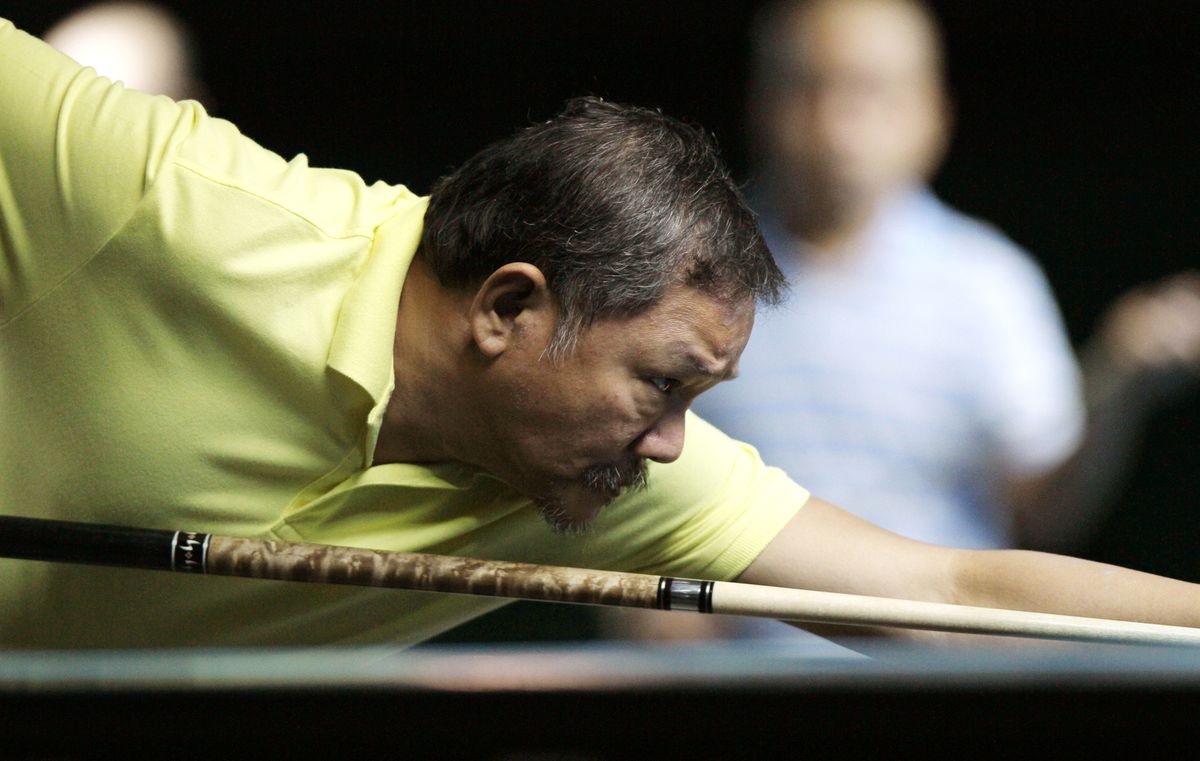
Efren Reyes of the Philippines at the World 9-Ball Championship, Doha, 2012 · Vinod Divakaran, for Doha Stadium Plus · CC BY 2.0
- Governing body
- World Confederation of Billiards Sports
- Founded
- Cue games descend from lawn games moved indoors in the fifteenth century; carom's international federation dates from 1959, snooker's professional body from 1968, and the confederation uniting the codes from 1992.
- Olympic status
- Not on the Olympic programme
- Also contested at
- World Games
Carom, pool and snooker share a cue, a cloth and an ancestry, and are otherwise three different sports. The carom table has no pockets — a point is scored by making the cue ball touch both object balls — while pool and snooker have six each, on tables of different sizes with different balls. An umbrella confederation was built above them in 1992 to pursue Olympic inclusion, obtained recognition in 1998, and has never been selected.
The gamewhat it is now · sections 1 to 5
01How it is played
Three codes. Carom is played on a pocketless table and scores by making the cue ball touch both object balls. Pool pockets numbered balls on a nine-foot table. Snooker pockets reds and colours on a twelve-foot one.
These figures were entered from the edition named above but have not been checked against its text line by line. Treat them as this site’s reading of the laws, not as a substitute for them.
The object of the game
Carom: make the cue ball contact both object balls in one stroke. In three-cushion, it must also touch the cushions three times first.
Pool: pot the balls of your group and then the black, or run the numbered balls in order, depending on the game.
Snooker: pot a red, then a colour, then another red, alternating, until the reds are gone and the colours are cleared in order. A frame is won on points; a match is won on frames.
- Carom
- No pockets — score by contact
- Snooker
- A maximum break of 147
This clause reads this way because of
The tables
Three tables that cannot substitute for each other.
Carom: about ten feet by five, heated, with no pockets at all and a cloth chosen for speed.
Pool: nine feet by four and a half in competition, six pockets, wide and generously cut.
Snooker: twelve feet by six, six pockets, cut much tighter relative to the ball, which is why snooker's potting is harder over distance than pool's.
A player from one code cannot walk to another's table and compete. That is the confederation's central problem stated physically.
- Carom table
- About 10 × 5 ft, no pockets
- Pool table
- 9 × 4.5 ft, six pockets
- Snooker table
- 12 × 6 ft, tight pockets
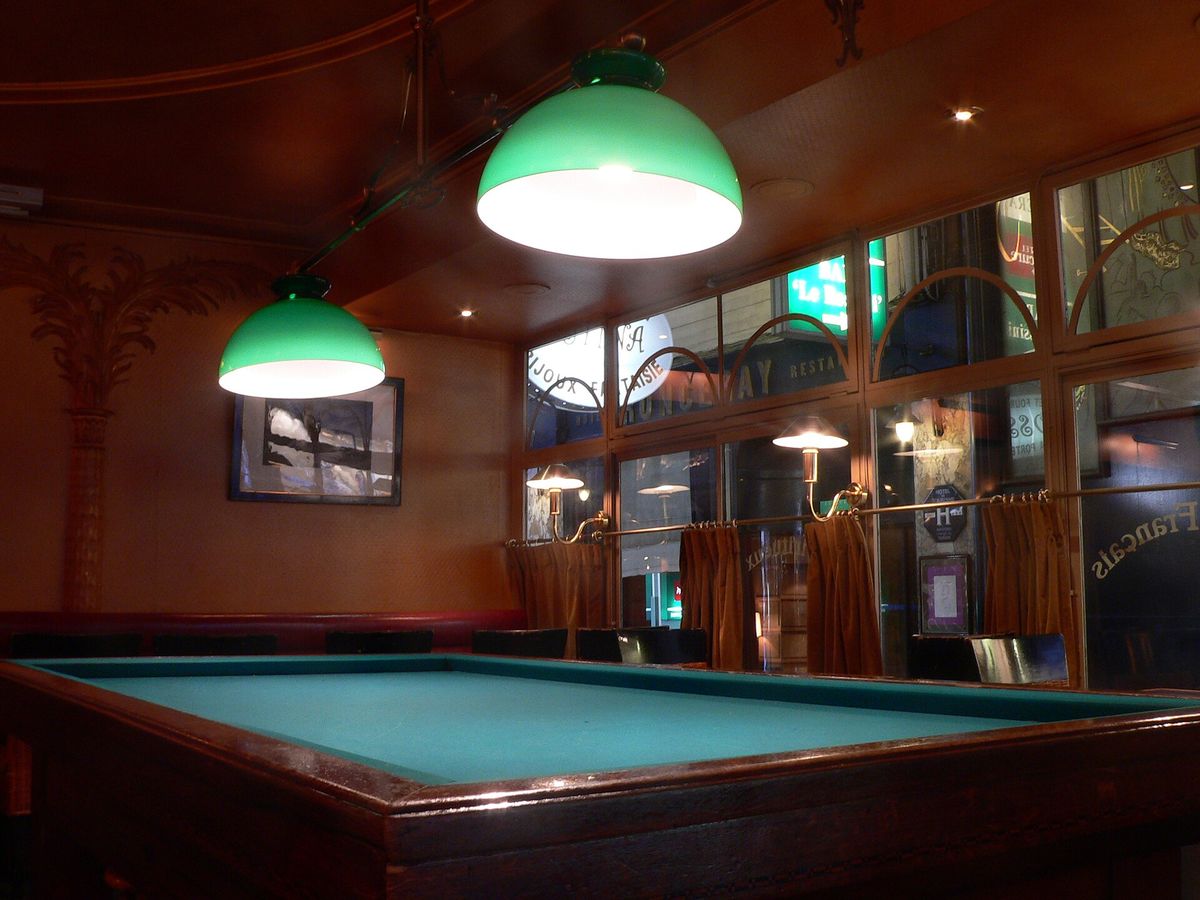
A carom table in the Café Zéphyr, Paris, 2007.
No pockets. Nothing is ever removed from this table: a point is scored by making the cue ball touch both object balls.
David Monniaux · CC BY-SA 3.0 · Wikimedia Commons
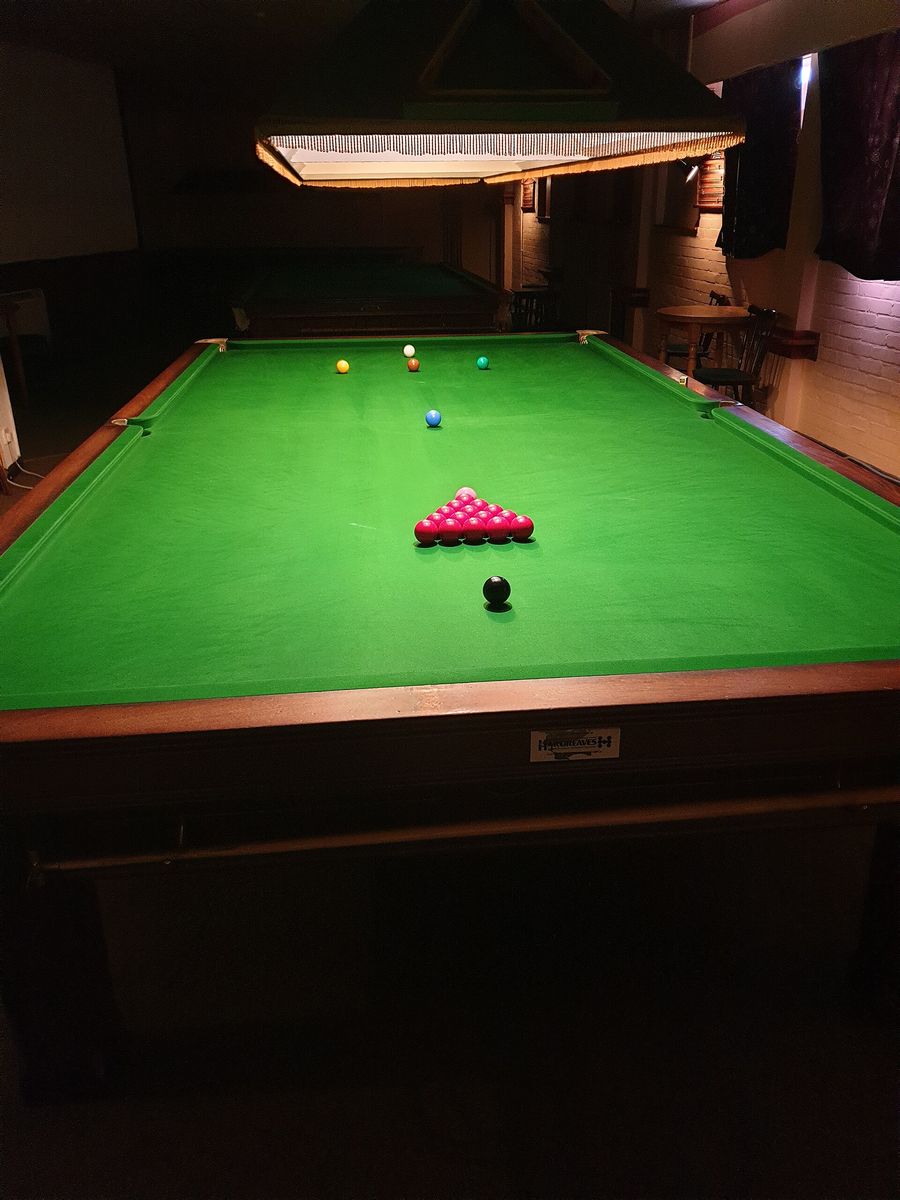
A snooker table set for the break, seen from the baulk end.
Twelve feet by six, fifteen reds racked in the triangle and six colours on their spots. The pockets are cut tight to the ball, which is what makes potting over this distance harder than on a pool table.
Lee Vilenski · CC BY-SA 4.0 · Wikimedia Commons
Cues and balls
A cue, chalk, and balls that differ by code — three balls in carom, fifteen numbered plus a cue ball in pool, twenty-one plus a cue ball in snooker.
Cues differ too: carom cues are shorter and stiffer with a smaller tip for the fine control the game's spin demands, snooker cues are longer with a narrow tip, pool cues sit between. Many players use a separate break cue and, in snooker, an extension or rest to reach across a twelve-foot table.
- Carom
- 3 balls
- Pool
- 15 numbered balls and a cue ball
- Snooker
- 15 reds, 6 colours and a cue ball
Players and officials
One against one, in frames or to a points target, with a referee who places balls, calls fouls and — distinctively in snooker — cleans the balls and hands the player a rest without being asked.
Doubles and team formats exist in all three codes and are secondary everywhere.
- Format
- One against one
- Referee
- In the arena, handling the balls
Time
No clock in the traditional forms, and this is snooker's long-standing problem: a frame can take an hour and a world championship final runs over two days.
Shot clocks exist in some professional pool and in shortened snooker formats, adopted for scheduling — the same pressure this site records pushing five other sports into rewriting their scoring.
- Traditional
- Untimed
- Shortened formats
- Shot clocks, for broadcast
Scoring
Carom counts points, one per successful carom, with matches to a target.
Pool counts racks or games won.
Snooker counts points within a frame — reds one, colours two to seven — and frames within a match. Its bounded maximum, 147, is one of very few perfect scores on this site that a competitor can actually reach, and it is reached rarely enough to remain a genuine achievement. Bowling's 300 is the direct comparison, and the reason snooker's number still means what it meant is that nothing changed the equipment underneath it.
- Snooker maximum break
- 147
- Carom
- One point per carom
The break and the visit
A frame begins with a break shot. From there a player continues while they keep scoring — a visit — and the turn passes on a miss or a foul.
That structure is what makes these games unlike almost everything else here: a player can win a frame without their opponent striking a ball, and in snooker the highest expression of the sport is exactly that.
Fouls
Failing to hit the correct ball first, potting the cue ball, failing to hit a cushion after contact, touching a ball with anything but the cue tip, and playing out of turn.
Snooker adds the offence the sport is named for. A player who cannot strike the required ball because another is in the way has been snookered, and if the referee judges no genuine attempt was made, a miss is called and the shot replayed — a rule that regulates intent rather than outcome, which very few rules on this site do.
Deciding the winner
Frames, racks or points, by code. Because a visit can run indefinitely while a player keeps scoring, a match's competitive balance can be entirely one-sided while remaining formally close.
Everything above is current law. Everything below is how Billiards sports got here.
02Disciplines and events
No Olympic events. The confederation has held IOC recognition since 1998, billiards sports are contested at the World Games, and the sport's largest professional competition is run by a body outside the confederation altogether.
- Disciplines
- 3
- Olympic medal events
- 0
- Men’s and women’s counted separately.
- Contested elsewhere
- 10
- world games, world championship, federation only.
- Listed for context
- 2
- Not counted as this sport.
Carom5
A pocketless table. Score by making the cue ball contact both object balls.
- Three-cushionWorld GamesWorld championshipThe premier carom discipline. Three cushions before completing the carom.
- One-cushion, straight rail and artisticWorld championshipArtistic billiards sets prescribed shots of declared difficulty — a judged-adjacent format inside a scored sport.
Pool7
Six pockets on a nine-foot table, with several games under one code.
- Nine-ballWorld GamesWorld championship
- Ten-ball and eight-ballWorld championship
- Straight poolWorld championship
Snooker2
A twelve-foot table with tight pockets; fifteen reds and six colours.
- Amateur world championshipsWorld GamesWorld championship
The professional tour2
Snooker's world championship, ranking tour and money are run by the professional body formed in 1968, outside the confederation that holds Olympic recognition on the sport's behalf.
- Professional snookerFederation onlyWhere the sport's elite competition and broadcast presence are.
- Professional pool eventsFederation onlyA thinner but real commercial circuit, largely in the United States and East Asia.
Cue games governed elsewhere2
- English billiardsWorld championshipPlayed on a snooker table with three balls; scores by cannons, pots and in-offs. An older game than snooker and now much smaller.
- Russian pyramidFederation onlyA large table with tight pockets and near-pocket-sized balls, governed separately.
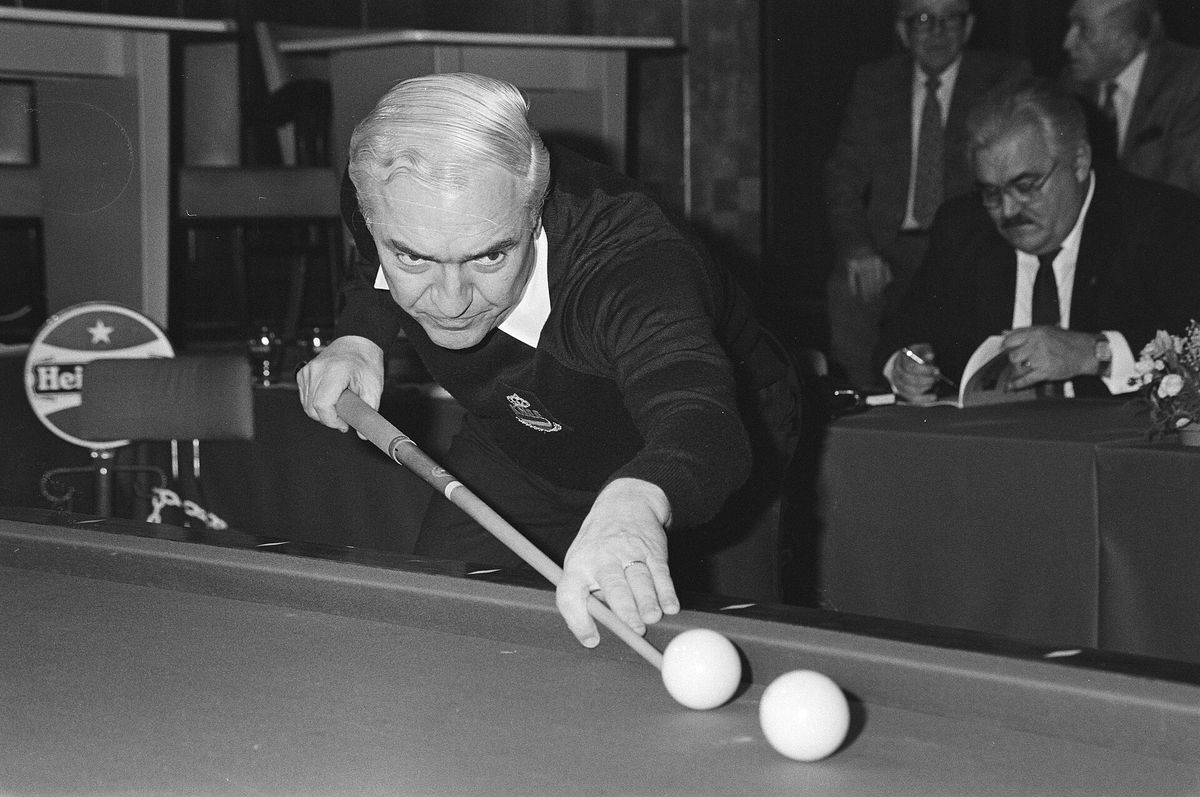
The Dutch artistic billiards championship, Haarlem, January 1982.
Artistic billiards sets prescribed shots, each with a declared difficulty: a judged-adjacent format inside a scored sport.
Hans van Dijk, for Anefo · CC0 · Wikimedia Commons
03Officiating
A referee who handles the equipment more than the players do, and one call that judges what somebody meant.
The routine work is unusually hands-on. A snooker referee places balls, cleans them, retrieves the cue ball, hands a player the rest, and announces the score — an official participating in the mechanics of the game continuously, which almost nothing else on this site does.
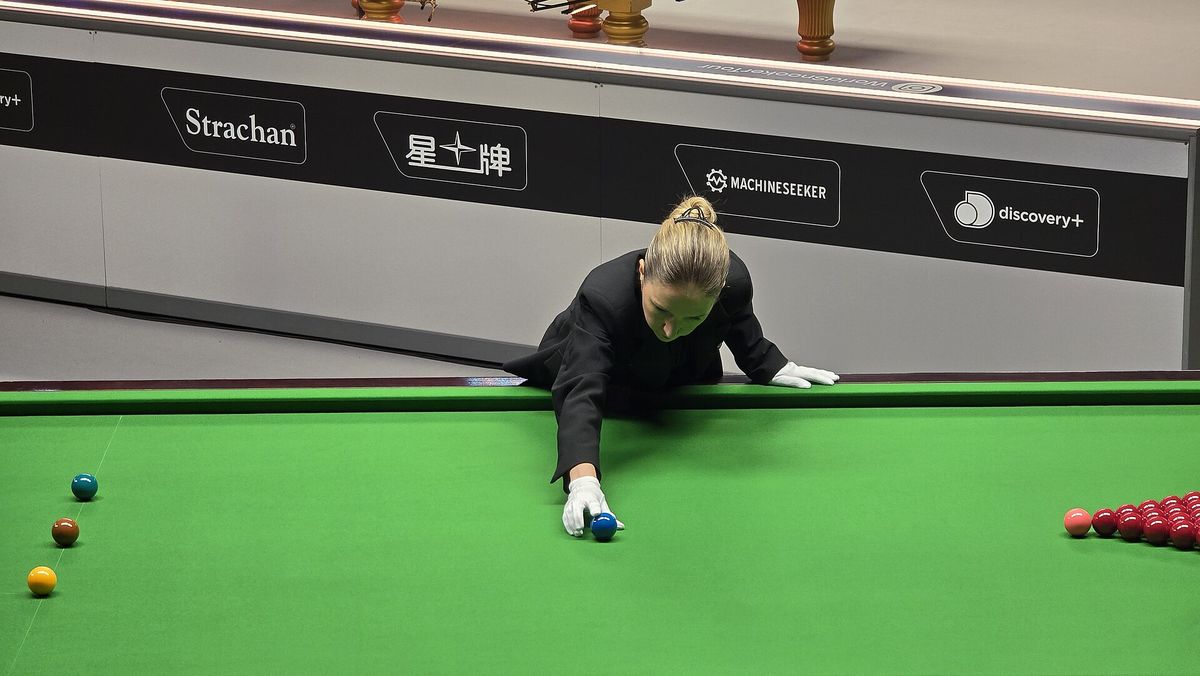
Referee Tatiana Woollaston at the table, German Masters, 2025.
Gloved, handling the balls: a snooker referee re-spots, cleans and retrieves throughout the match, which almost no other official on this site does.
Andrej146 · CC0 · Wikimedia Commons
Fouls are largely factual: hitting the wrong ball first, potting the cue ball, failing to reach a cushion, touching a ball with anything but the tip. These are observed rather than judged.
The miss is the exception and the sport's hardest call. In snooker, a player who is snookered and fails to hit the required ball may have a miss called, and the shot replayed — but only if the referee decides no genuine attempt was made. That is an assessment of intent, made from the referee's reading of the shot's difficulty and the player's likely capability, and it is the most disputed decision in the professional game. Very few rules anywhere ask an official to rule on what a competitor was trying to do.
Carom is comparatively simple to officiate: did the cue ball touch both object balls, and did it reach three cushions first. The difficulty is observational rather than interpretive, and at speed.
Professional snooker uses video review for touching balls and for close contacts. Neither carom nor most pool competition is instrumented.
04Where it is played
Three codes, three maps, and almost no overlap.
Carom belongs to continental Europe, East Asia and Latin America. Belgium, the Netherlands, Spain, Turkey, Sweden, South Korea, Japan, Vietnam, Colombia and Mexico are the powers, and three-cushion is a substantial spectator sport in South Korea and Vietnam in particular — which surprises people who have only met billiards in English-speaking countries, where carom is essentially unknown.
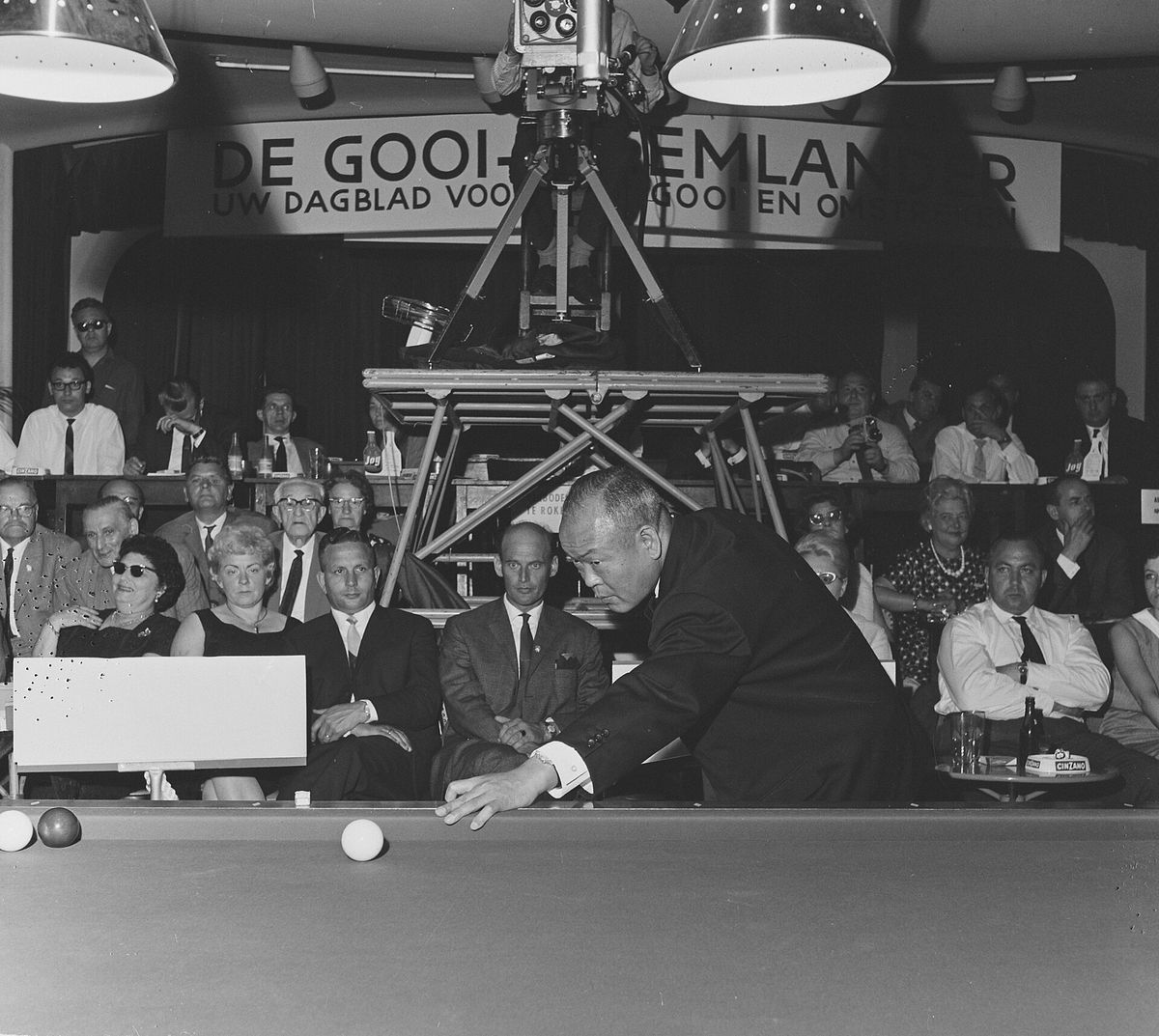
Koya Ogata of Japan at the table in the 1965 world three-cushion championship.
A Japanese player at a championship won by Raymond Ceulemans of Belgium: carom's two strongholds, continental Europe and East Asia, at the same table.
Jan Voets, for Anefo · CC0 · Wikimedia Commons
Snooker is British in origin and increasingly Chinese in gravity. England produced the professional structure and most of its history; China now produces a very large share of the sport's growth, its audience and, increasingly, its players. Northern Ireland, Scotland, Wales, Australia, Thailand, India, Iran and Belgium all contribute.

Ding Junhui at the Masters, London, 2025.
The player most associated with snooker's growth in China, where much of the sport's audience and, increasingly, its players now come from.
Kroome111 · CC BY 4.0 · Wikimedia Commons
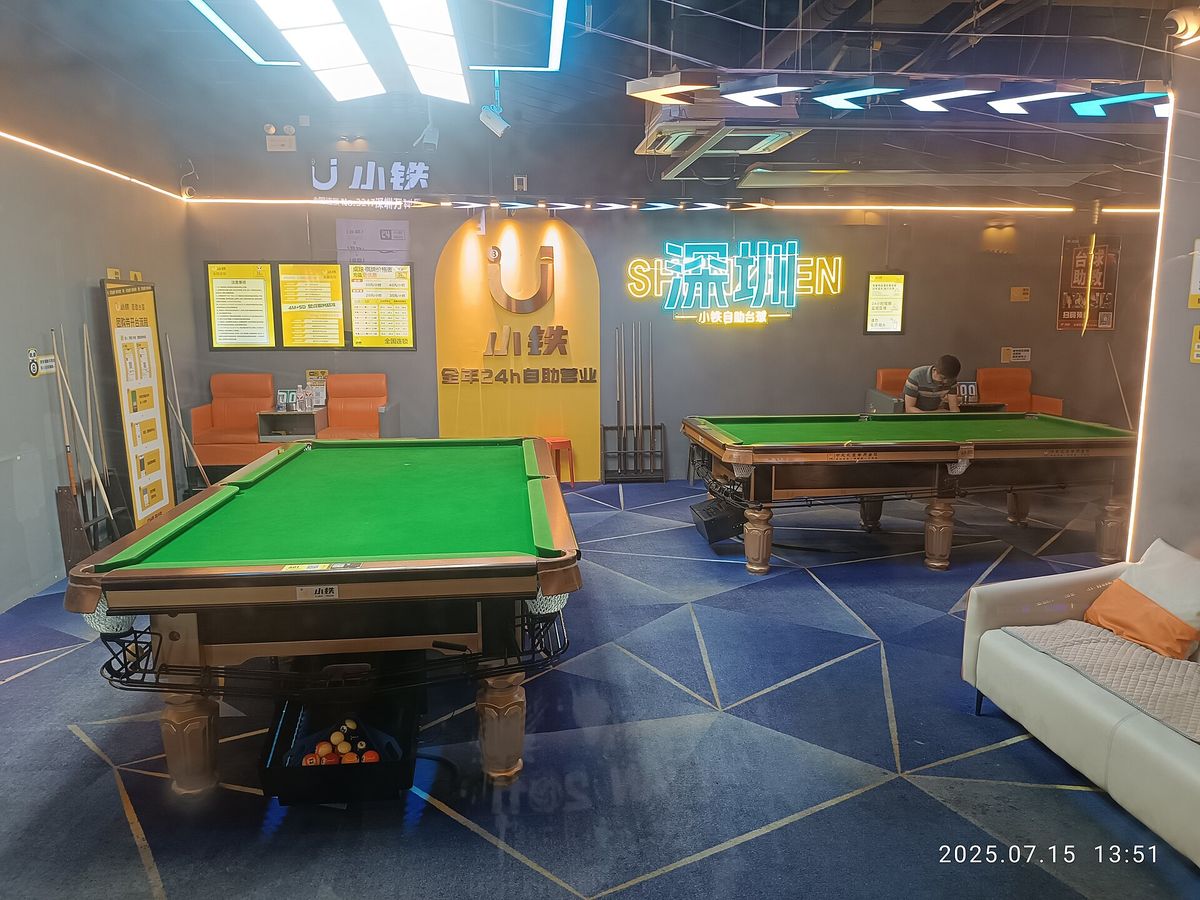
A cue-sports room in a Shenzhen shopping mall, 2025.
Tables in a mall, open to anyone: the kind of everyday access behind the growth the section describes in China.
PDD Ping Done OK · CC0 · Wikimedia Commons
Pool is strongest in the United States, the Philippines, Chinese Taipei, China, Germany, Poland and the United Kingdom, and the Philippines in particular has produced world champions far out of proportion to its size.
Efren Reyes of the Philippines at the World 9-Ball Championship, Doha, 2012.
The Philippines has produced world pool champions far out of proportion to its size, and Reyes is one of the most celebrated players the sport has had.
Vinod Divakaran, for Doha Stadium Plus · CC BY 2.0 · Wikimedia Commons
The pattern is that each code took root where its table went. Carom tables travelled with continental European trade and administration; snooker tables followed the British Army and the Commonwealth; pool tables followed American commercial culture into bars everywhere.
That is why the confederation's problem is geographic as well as technical. It represents three sports whose strongholds barely overlap, and no country is prominent in all three.
05Learning curve
Everybody has played on a pub table and nobody has played the sport. The gap between a pool table in a bar and a twelve-foot snooker table with tight pockets is one of the widest misperceptions on this site.
Editorial — the site’s reading, not a sourced claim
Barrier to entry
How hard is it to get to a real game?
A table in a pub or a hall, a cue off the wall, and an hour.
Pool in particular is among the most widely tried games in the world. Tables are in bars, clubs, universities and community halls almost everywhere, the equipment is provided, the rules take a minute, and two people can play immediately.
There is no physical prerequisite of any kind — no fitness, no age limit at either end, no strength requirement — which puts billiards alongside boules as one of the few sports here playable across an entire adult lifespan.
The barrier to the *sport* rather than the game is a table of the right kind. Carom tables and full-size snooker tables are rare outside clubs, and that scarcity is the real entry constraint on both codes.
Evidence
- Kit to startProvided with the tableobserved
- Physical demandNoneestimate
- FacilityA pub table; a club for snooker or caromobserved
- TablesThree kindsrule1959 — the rule this rests on
- Time to a real gameMinutesestimate
Barrier to the top
How hard is it to be good at?
Controlling where the cue ball stops, shot after shot, on a table that punishes a millimetre.
The skill nobody sees is position. Potting a ball is the visible part and the easy part; the hard part is leaving the cue ball where the next shot is available, and then the one after that. An elite snooker break of a hundred is a hundred points of potting and ninety-nine acts of cue ball control, and the control is what separates professionals from very good amateurs.
Carom is the purest version, because there is nowhere for a ball to go. Three-cushion asks a player to send the cue ball off three cushions and into two object balls, repeatedly, and the world's best average somewhere above one point per turn — a number that sounds low until you have tried it.
Snooker adds the tactical layer the sport is named for: playing safe, leaving an opponent snookered, and forcing errors. A frame between good players can be won without a single long pot.
The ceiling is also institutional. Professional snooker is a real career for perhaps a hundred people; professional pool and carom are much thinner; and the three codes' athletes do not compete with each other.
Evidence
- No pockets in caromScore by contactruleThree-cushion's best players average a little over one point per turn.1959 — the rule this rests on
- Snooker's maximum147observedA bounded perfect score that is still genuinely rare, unlike bowling's 300.
- Professional structureOutside the recognised confederationruleSnooker's tour and money sit with a body formed in 1968.1968 — the rule this rests on
- Typical peak age25–45estimateOne of the longest competitive spans covered here.
Why the two differ
Very low to very high, and the perception gap is the point.
A pub pool table has wide pockets, a short bed and a heavy ball, and it flatters everyone. A competition snooker table is twelve feet long with pockets cut tight enough that a ball struck a millimetre off line rattles out from distance. They are not the same activity, and almost nobody who has played the first has seen the second in person.
This site records the same structure in bowling, where a recreational oil pattern funnels the ball towards the pocket and a competition pattern does not — and in both cases the sport's enormous popular base is playing a version engineered to be forgiving, which recruits people and teaches them the sport is easy.
The other half of the gap has nothing to do with skill: three codes, three tables, no crossover, and a professional structure that sits outside the body holding the recognition.
The historyhow it got here · sections 6 to 10
06Origin and invention
All of these games are a lawn game that was brought indoors and then diverged for five hundred years.
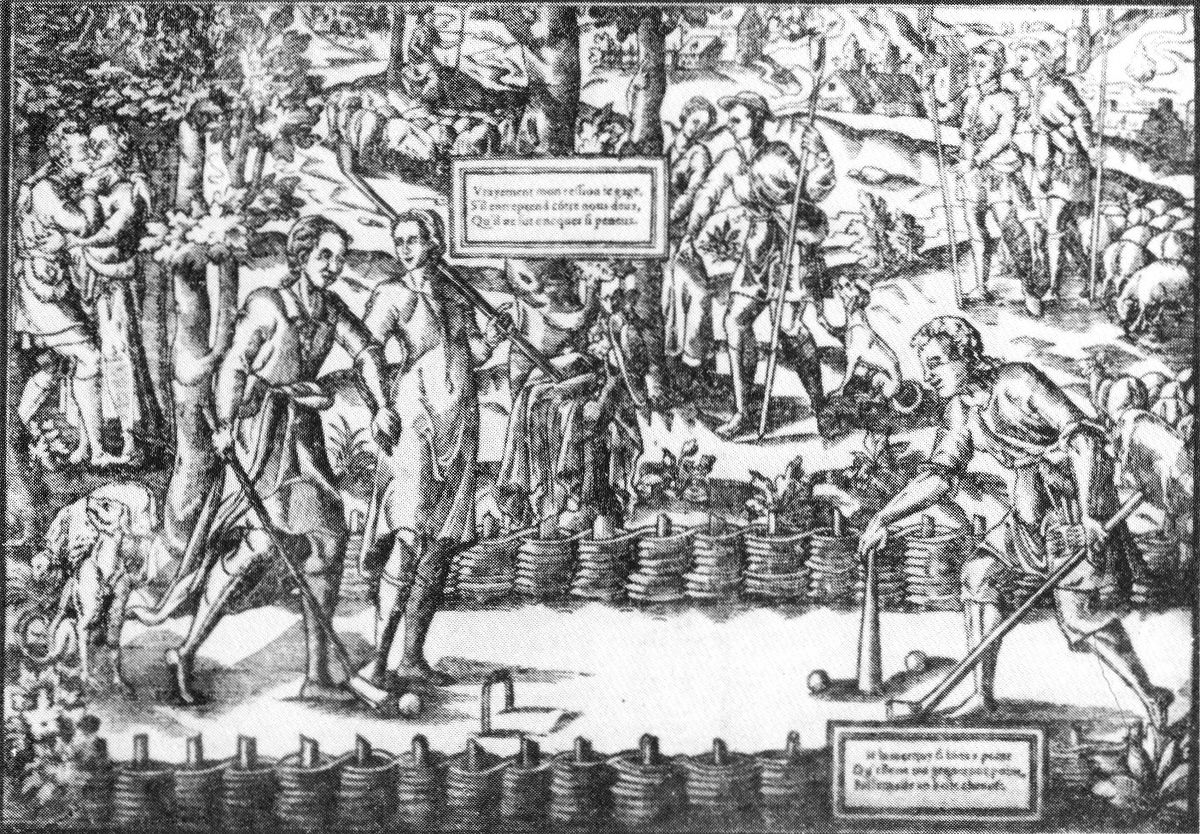
French ground billiards, from a woodcut of 1480.
The outdoor game: balls driven along the ground with maces towards a hoop. Everything the table kept, it kept from this, starting with the green of the grass.
Artist unknown · Public domain · Wikimedia Commons
Ground billiards was played outdoors in medieval Europe with balls pushed by maces towards a hoop and a target peg. Moving it onto a table in the fifteenth century kept the green cloth — the lawn — and the raised edges that became cushions, and over time the mace gave way to the cue, the hoop and peg disappeared, and the game split.
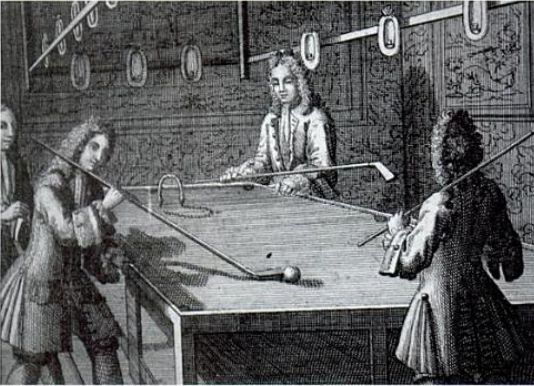
Three men playing billiards with maces, about 1730.
The game has moved onto a table and still carries the lawn with it: the hoop stands on the cloth, and the players push the ball with the flat head of a mace rather than strike it with a cue.
Artist unknown · Public domain · Wikimedia Commons
Carom kept the table without pockets. Its scoring is pure geometry: make the cue ball touch both object balls in one stroke, and in three-cushion, touch the cushions three times first. Nothing is ever removed from the table, which makes it the only cue game where the arrangement of balls only ever becomes more difficult.
Pool and snooker put pockets in and made removal the object. Snooker was devised by British Army officers in India in the 1870s, adding coloured balls to the existing game of pyramids, and it acquired the twelve-foot table and the tight pockets that make it what it is.
The institutional history is much later and it fragmented in the other direction. Carom's international federation dates from 1959. Snooker's professional players formed their own body in 1968, separate from the amateur structures, and it has run the sport's world championship ever since.
The World Confederation of Billiards Sports was built above all three in 1992 for a single purpose: to hold recognition and pursue the Olympic programme. It obtained recognition in 1998 and has never been selected.
07Rule timeline
The sport’s own lane, expanded. Every entry carries a cause from the closed vocabulary and a citation, and says so where the citation is incomplete.
- 1959Fairness and eligibilityadopted 1959
Carom billiards was internationally codified: a table with no pockets, three balls, and a point scored when the cue ball is made to contact both object balls in a single stroke. In three-cushion, the discipline's premier form, the cue ball must also touch the cushions at least three times before completing the carom. A run of a dozen is a very good one; the game's best players average somewhere above one point per turn. A pocketless table is the sport's defining fact. Every other cue game on this site is about removing balls from the table. Carom is about geometry, and nothing ever leaves.
Trigger and citationIncomplete — no confirmed article
Trigger
Carom had been played across continental Europe, Japan and Latin America with national variants of the disciplines and the table, and required a common international code.
WCBS member federation rules for carom, pool and snooker · UMB rules of carom billiards
- 1968Commercialalso disputedadopted 1968
Snooker's professional players organised into their own body, separate from the amateur federation structure, and it is the professional body that has run the sport's world championship and its tour ever since. That split has never healed and it shapes everything about snooker's institutional position: the sport's elite competition, its money, its ranking system and its broadcast presence all sit outside the confederation that represents billiards sports to the Olympic movement.
Comparability break · Scoped to one competition
Snooker's professional record sits with a body outside the recognised confederation, and has since 1968. See the series
Trigger and citationIncomplete — no confirmed article
Trigger
Professional snooker needed a body to run a tour and negotiate broadcast arrangements, which an amateur federation structure was not built to do.
WCBS member federation rules for carom, pool and snooker · WPBSA constitution
- 1992Commercialalso participation and accessadopted 1992
An umbrella confederation was formed above the three codes — carom, pool and snooker — each of which keeps its own federation, its own rules, its own tables and its own championships. Its purpose was explicitly institutional: a single body could hold recognition and pursue Olympic inclusion on behalf of games that are not played across. This site records the same construction in boules, formed for the same reason seven years earlier.
Comparability break · Scoped to one competition
The umbrella unites three codes played on three incompatible tables. Results belong to a code, never to billiards. See the series
Trigger and citationIncomplete — no confirmed article
Trigger
None of the three codes was large enough alone to make an Olympic case, and the international system recognises one federation per sport.
WCBS member federation rules for carom, pool and snooker · WCBS statutes
- 1998Participation and accessadopted 1998
The confederation received IOC recognition. Billiards sports have been on no Olympic programme since, having been considered and passed over for several editions. Recognition has now been held for nearly three decades by a body that does not run the sport's largest professional competition, on behalf of three codes whose players cannot compete against each other.
Trigger and citationIncomplete — no confirmed article
Trigger
The confederation completed the requirements recognition sets, six years after being formed to do exactly that.
WCBS member federation rules for carom, pool and snooker · IOC recognition, 1998
08Equipment evolution
Three tables that cannot substitute for each other, and a cue that has been refined for four centuries.
The tables are the sport's whole argument about itself. A carom table is about ten feet by five and has no pockets; it is often heated, to keep the cloth fast and consistent. A pool table is nine by four and a half with six generously cut pockets. A snooker table is twelve by six with pockets cut tight relative to the ball, which is why potting over distance is far harder there than on a pool table and why the two games reward different things.
The cue replaced the mace in the seventeenth century, and the decisive addition was the leather tip in the early nineteenth, which allowed a player to strike the cue ball off centre without miscuing. That is the invention the modern game rests on: side, screw and topspin all became available, and cue ball control — the thing that actually separates players — became possible.
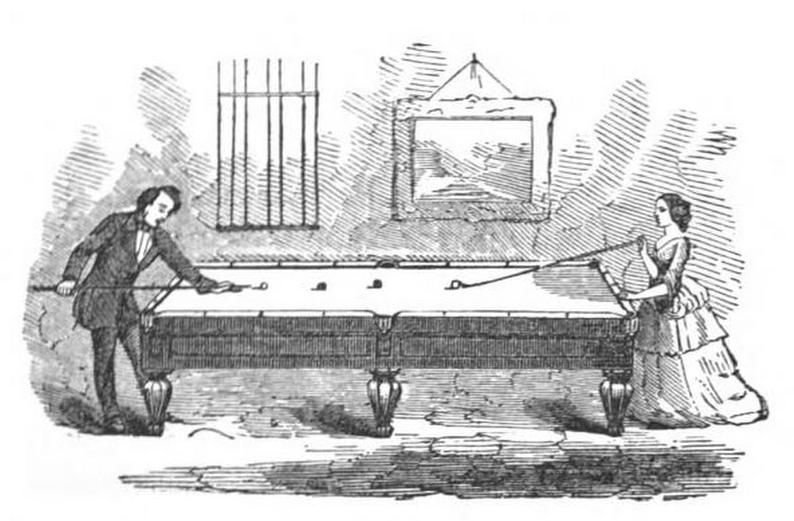
A man with a cue and a woman with a mace at the same table, from Michael Phelan's The Game of Billiards, 1859.
The transition in one drawing: the cue had taken over the serious game, and the mace was still in use at the same table.
Michael Phelan · Public domain · Wikimedia Commons
Chalk followed for the same reason, and the two together are the most consequential equipment change in the sport's history.
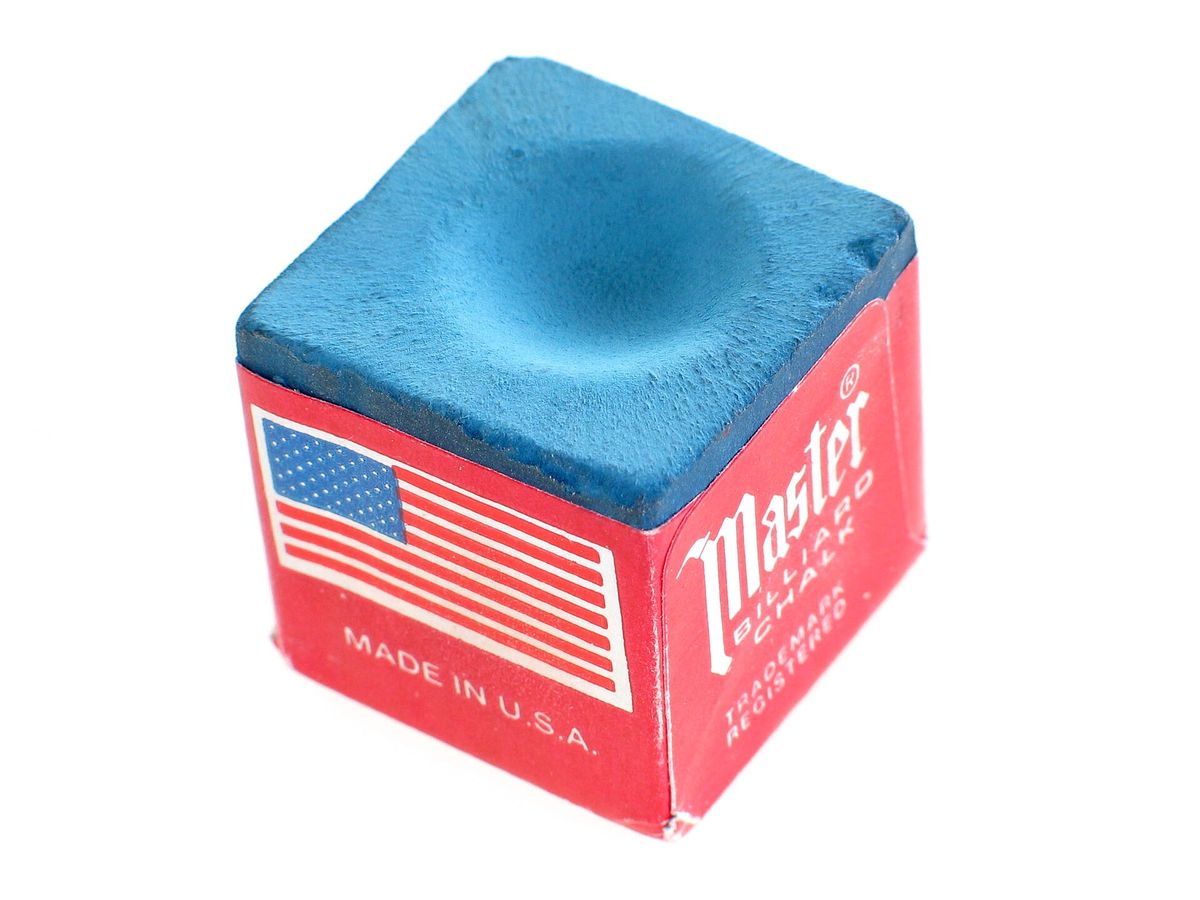
A cube of billiard chalk, worn by use.
Chalk and the leather tip together made it possible to strike the cue ball off centre without miscuing, and so made side, screw and cue-ball control possible.
Jonas Bergsten · Public domain · Wikimedia Commons
Balls moved from ivory to composites, which standardised weight and elasticity and removed both the variability and the elephants.
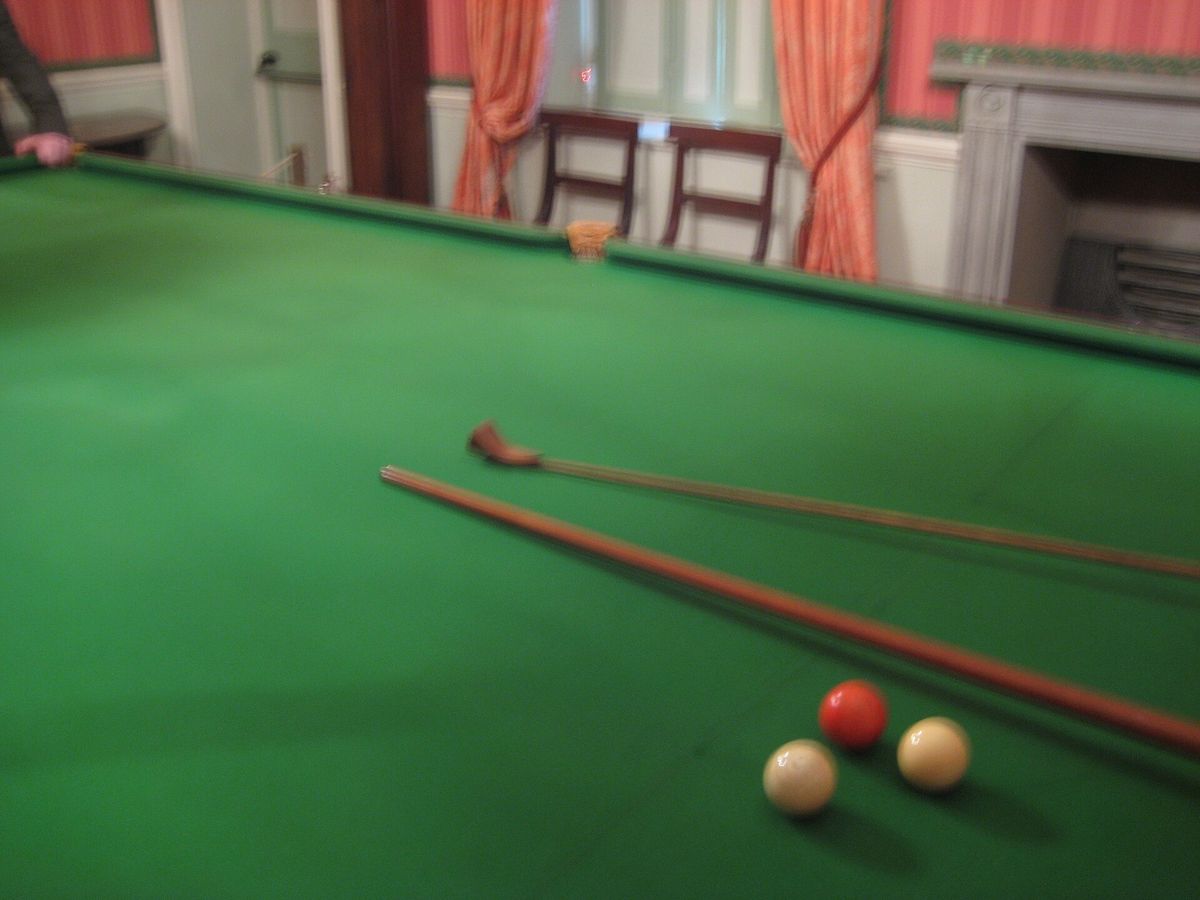
Cues and ivory billiard balls at the Judges' Lodgings, Lancaster.
The material the balls were made from until composites replaced it. Ivory varied in weight and elasticity from ball to ball, and it came from elephants.
Hazel Maher · CC BY-SA 4.0 · Wikimedia Commons
Cloth and cushion rubber have improved steadily, making tables faster and more predictable. That matters for one comparison this site cares about: snooker's maximum break of 147 has become somewhat more attainable as conditions improved, but nothing like the way bowling's 300 was devalued by reactive resin. The number still means close to what it meant.
09Governing body politics
The confederation holding billiards' Olympic recognition does not run its biggest competition, and the codes it represents cannot play each other.
The World Confederation of Billiards Sports was formed in 1992 above the three codes for an explicitly institutional purpose: the international system recognises one federation per sport, and none of carom, pool or snooker was large enough alone to make an Olympic case. Recognition duly arrived in 1998.
Since then, nothing. Billiards has been considered for several editions and selected for none.
Two structural problems stand in the way, and neither is about the games.
The codes are not one sport. A carom player and a snooker player have different tables, different balls, different cues and no common competition. Presenting them as a single entry is a legal fiction the confederation maintains because the alternative is three federations that are each too small.
The largest code's professional structure is elsewhere. Snooker's world championship, its ranking tour, its money and its broadcast presence belong to a professional body formed in 1968. This site has recorded the same shape in sumo, where a national professional association governs the best wrestlers, and in muaythai — but here the professional body governs the sport's global elite competition outright, not a national tradition.
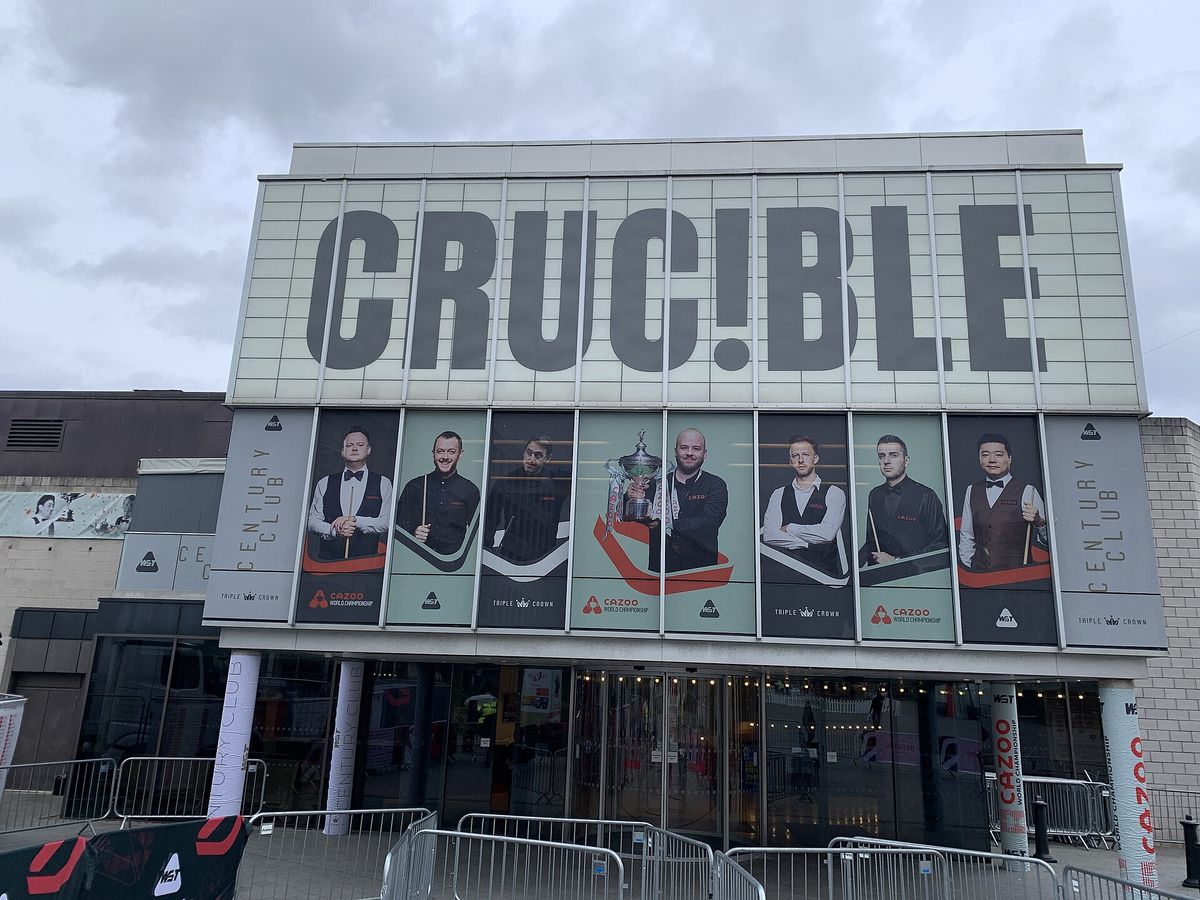
The Crucible Theatre, Sheffield, during the 2024 World Snooker Championship.
The sport's summit, run by the professional body formed in 1968, not by the confederation that holds billiards' Olympic recognition.
BennyOnTheLoose · CC0 · Wikimedia Commons
So the recognised federation represents a sport whose summit it does not administer, on behalf of three games that are not interchangeable, and has done so for nearly thirty years.
10Controversies that forced rule changes
The miss rule. Snooker's most argued regulation and one of very few rules on this site that adjudicates intent. A player who fails to hit the required ball may have a miss called against them, and the shot replayed from the original position, if the referee judges that a genuine attempt was not made. That is a judgement about what somebody was trying to do, made live, and it has been rewritten repeatedly because it decides frames.
Time. A snooker frame can run an hour and a world final over two days, which is a scheduling problem no broadcaster loves. The sport's answer has been shortened formats with shot clocks rather than changing the main event, which is a gentler version of the rewrites this site records in badminton, volleyball, table tennis and fistball.
Ivory. Balls were made from it until composites arrived in the nineteenth century — one of the earliest material substitutions on this site driven by supply rather than performance.
Integrity. Cue sports have had match-fixing cases, and professional snooker in particular has suspended and banned players. A one-against-one sport with heavy betting markets and long matches has the conditions for it, and the professional body's disciplinary apparatus exists largely because of it.
Whether the umbrella is real. Not a rule change and the confederation's permanent question: three codes, three tables, no crossover, and one entity representing them for the purpose of an Olympic application that has not succeeded in nearly thirty years.
Where it standsthe record, and what is still open · sections 11 to 12
11Series
No series can exist
A comparable score
Billiards sports cannot produce one series because they are not one sport. A carom average, a pool rack count and a snooker break are three different quantities produced on three tables of different sizes with different balls and different numbers of pockets — none of which a player of another code could compete on. The confederation that unites them was formed in 1992 for institutional reasons and has never claimed otherwise. Inside snooker, one number does hold. The maximum break of 147 is fixed by the rules and has not changed, and unlike bowling's 300 it has not been devalued by equipment: cloth and balls have improved, and a maximum remains rare enough that each one is still counted. That makes snooker's perfect score one of the very few bounded maxima on this site that still means what it meant. What prevents even that becoming a series is where the record lives. Snooker's elite competition, its rankings and its statistics belong to a professional body formed in 1968, separate from the confederation representing billiards to the Olympic movement. The numbers are excellent and they are not the recognised federation's.
1968Scoped to one competitionSnooker's professional record sits with a body outside the recognised confederation, and has since 1968.
1992Scoped to one competitionThe umbrella unites three codes played on three incompatible tables. Results belong to a code, never to billiards.
12What is contested now
Recorded as unsettled.
Whether the umbrella should exist. Three codes with three tables, no crossover between them, and one confederation formed in 1992 to hold recognition on their behalf. It has produced recognition and no programme place in nearly thirty years, and whether the construction is worth maintaining is a fair question inside the sport.
Snooker's professional structure. The sport's elite competition, ranking system and money belong to a body outside the recognised confederation. Any Olympic proposition would have to reconcile that, and nobody has proposed how.
The miss rule. Snooker's most disputed regulation asks a referee to judge intent. It has been rewritten repeatedly and continues to decide matches.
Time. Long formats are the sport at its best and are difficult to schedule. Shortened events with shot clocks have grown, and whether they are the future or a sideshow is argued in both snooker and pool.
Integrity. Heavy betting markets on one-against-one matches produce match-fixing risk, and professional cue sports have had cases and bans.
Where snooker's centre of gravity should be. The sport's growth, audience and increasingly its players are in China while its institutions remain British. That is a live question about power rather than about rules, and it is being answered gradually by where the events are held.