Bowling
The lane is dressed with oil in a pattern you cannot see, and it changes as you play on it.
- Official
- Bowling
- Game category
- Target
- Adjudication
- Measured
- Standing
- Never Olympic
- rule changes
- 4
- comparability breaks
- 2
- Olympic editions
- 0
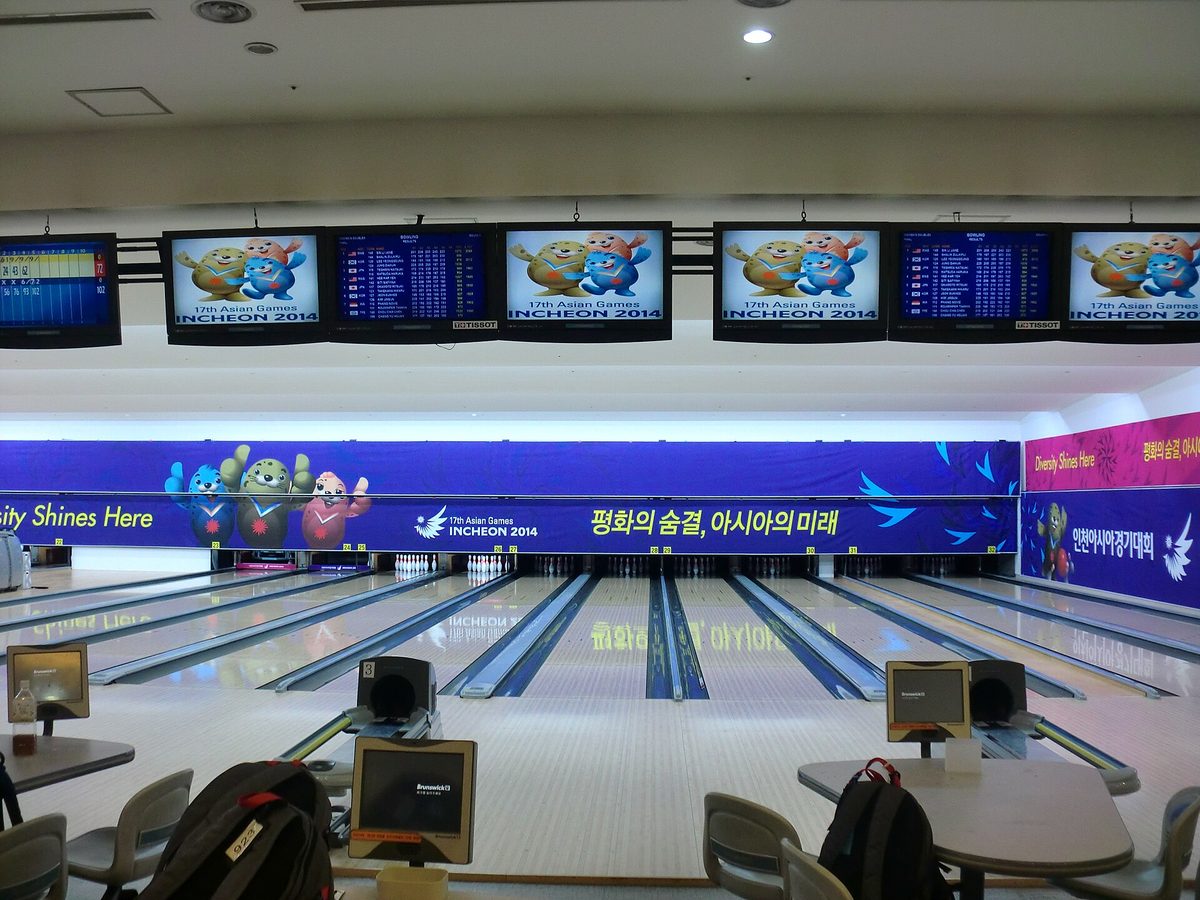
Bowling at the 2014 Asian Games, Anyang, South Korea · hyolee2 · CC BY-SA 3.0
- Governing body
- International Bowling Federation
- Founded
- Pin games are ancient and ten-pin bowling was codified in the United States in the nineteenth century; the international federation was founded in 1952 as the Fédération Internationale des Quilleurs.
- Olympic status
- Not on the Olympic programme
- Also contested at
- World Games
Ten pins, two deliveries a frame, ten frames, and a maximum score of 300 that has not changed since the scoring system was written. What has changed is how hard it is to reach, because the lane is coated with an invisible oil pattern that steers the ball and that degrades as balls carry oil down it. The field of play cannot be seen and is different in the tenth frame from the first.
The gamewhat it is now · sections 1 to 5
01How it is played
Ten frames, two deliveries each, ten pins, maximum 300. The lane is dressed with an oil pattern the bowler cannot see, which steers the ball and breaks down as the game goes on.
These figures were entered from the edition named above but have not been checked against its text line by line. Treat them as this site’s reading of the laws, not as a substitute for them.
The object of the game
Knock down all ten pins. A strike — all ten with the first ball — carries the next two deliveries as a bonus; a spare carries the next one. Twelve consecutive strikes is 300, and the number cannot be exceeded.
A bounded maximum score is rare on this site. Gymnastics had one until 2006 and abolished it precisely because athletes were reaching it. Bowling kept its cap and let the difficulty of reaching it change underneath.
- Frames
- 10
- Maximum score
- 300
- Strike
- Carries the next two deliveries
The lane
Sixty feet from the foul line to the headpin, about 41 inches wide, with a gutter each side — and coated with oil in a pattern that is invisible to the bowler.
The oil is what makes the ball behave. Where there is oil the ball slides; where the lane is dry it grips and hooks. The pattern's shape decides where a ball can be thrown from and how much it will turn, and it is applied by machine before play.
Then it changes. Every ball carries oil down the lane and moves it about, so the pattern in the tenth frame is not the pattern in the first, and it breaks down differently depending on where the bowlers in that pair have been throwing. Reading the transition is the sport.
- Lane
- 60 ft to the headpin
- Oil pattern
- Invisible, applied by machine
- During play
- Carries down and breaks down
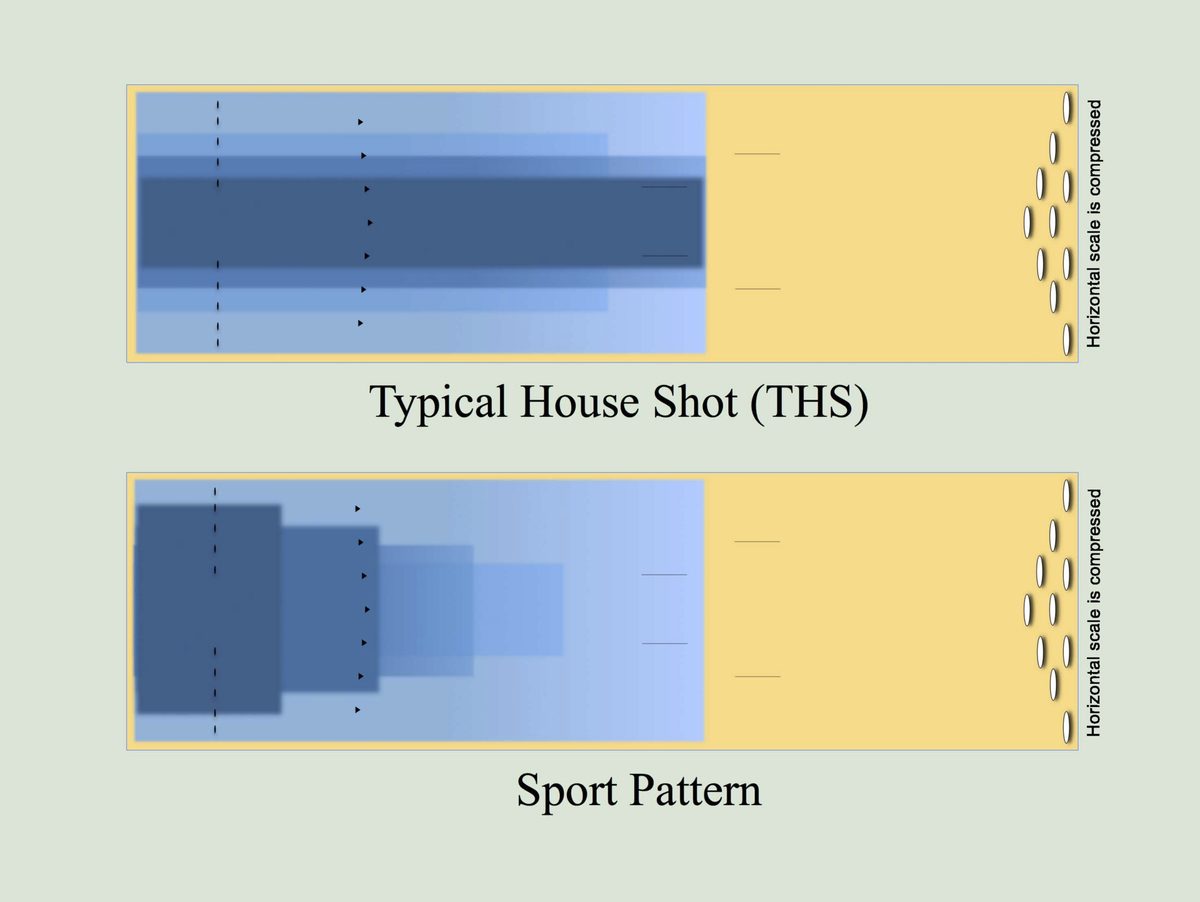
Diagrams of a typical house oil pattern and a sport pattern, with darker blue for heavier oil.
The house shot puts the oil in the middle and little on the outside, so a ball that drifts wide grips and comes back: a margin for error built into the lane. The sport pattern is flatter across the lane and takes that margin away. The diagrams are schematic, and the lane's length is compressed.
RCraig09 · CC BY-SA 4.0 · Wikimedia Commons
This clause reads this way because of
Equipment
A ball of up to 16 pounds, drilled to fit the bowler's hand, with a coverstock and an internal weight block chosen to produce a particular reaction. Competitive bowlers carry several — different coverstocks and layouts for different oil conditions — and changing ball mid-game is a standard tactical response to the lane breaking down.
Reactive resin coverstocks, from the early 1990s, are the equipment change that reshaped the sport: they grip the dry lane far harder than polyester or urethane, hook more aggressively, and carry pins that older equipment left standing.
Shoes are asymmetric — one slides, one grips — with interchangeable soles.
- Ball
- Up to 16 lb, drilled to the hand
- Coverstock
- Reactive resin, since the early 1990s
- Balls carried
- Several, for different lane conditions
This clause reads this way because of
Competitors and officials
One bowler at a time, with pairs sharing a pair of lanes and alternating — which matters, because each bowler's deliveries change the oil for the other.
Officials verify equipment and lane dressing rather than adjudicate play. Almost nothing that happens during a game requires a judgement.
- Competing
- One at a time, alternating on a pair of lanes
- Officials
- Verify equipment and lane conditions
Time
A game is ten frames and takes about ten minutes; championships are contested over blocks of many games, with the total or the average deciding qualification.
- Game
- 10 frames
- Championship
- Decided over many games
Scoring
Pins, with bonuses. The system is more than a century old and has not changed: a strike scores ten plus the next two deliveries, a spare ten plus the next one, an open frame just the pins knocked down.
That stability is the reason this sport's scores are so difficult to compare across time. The arithmetic is identical; what the arithmetic is applied to is not.
This clause reads this way because of
Frames and deliveries
Two deliveries per frame, except the tenth, which allows a third if the bowler strikes or spares — which is why a perfect game is twelve strikes rather than ten.
Infringements
Crossing the foul line, which voids the pins knocked down by that delivery and is detected automatically. Using a ball outside the specifications for weight, dimension or surface preparation. Altering the ball surface during a block outside the permitted process.
Notably, there is no rule against a bowler being helped by the lane condition, because every bowler on that pair is subject to the same condition — even though it changes between them.
Deciding the winner
Highest total, or the winner of a match-play ladder, depending on the format. Because the lane transitions during a block, a large part of winning is deciding when to move, when to change ball, and when the pattern has stopped being the one you started on.
Everything above is current law. Everything below is how Bowling got here.
02Disciplines and events
No Olympic events. Bowling was a demonstration sport at Seoul in 1988, has bid repeatedly since, and is contested at the World Games with its own world championships.
- Disciplines
- 1
- Olympic medal events
- 0
- Men’s and women’s counted separately.
- Contested elsewhere
- 9
- world games, world championship, federation only, lapsed.
- Listed for context
- 3
- Not counted as this sport.
Ten-pin12
The international competitive form, on a 60-foot oiled lane.
- SinglesWorld GamesWorld championship
- DoublesWorld GamesWorld championship
- TriosWorld championship
- TeamWorld championship
- All events and mastersWorld championshipDecided on aggregate across the other formats, then a match-play ladder.
Nine-pin1
The European pin games — schere, bohle and classic — governed under the same international umbrella and played almost entirely in Central Europe. They are a different sport from ten-pin and are not played across.
- Nine-pin classicWorld championshipStrong in Germany, Austria, Croatia, Serbia and Slovenia.
Its Olympic record1
- Seoul 1988 demonstrationLapsedContested as a demonstration sport; the IOC discontinued the category after 1992.
Where the sport actually lives2
Bowling's participation base is overwhelmingly recreational and commercial, on lane conditions that are not competition conditions.
- Commercial centre bowlingFederation onlyHouse oil patterns, deliberately forgiving; the version nearly everyone has played.
- Professional toursFederation onlyModest professional structures, principally in the United States and East Asia.
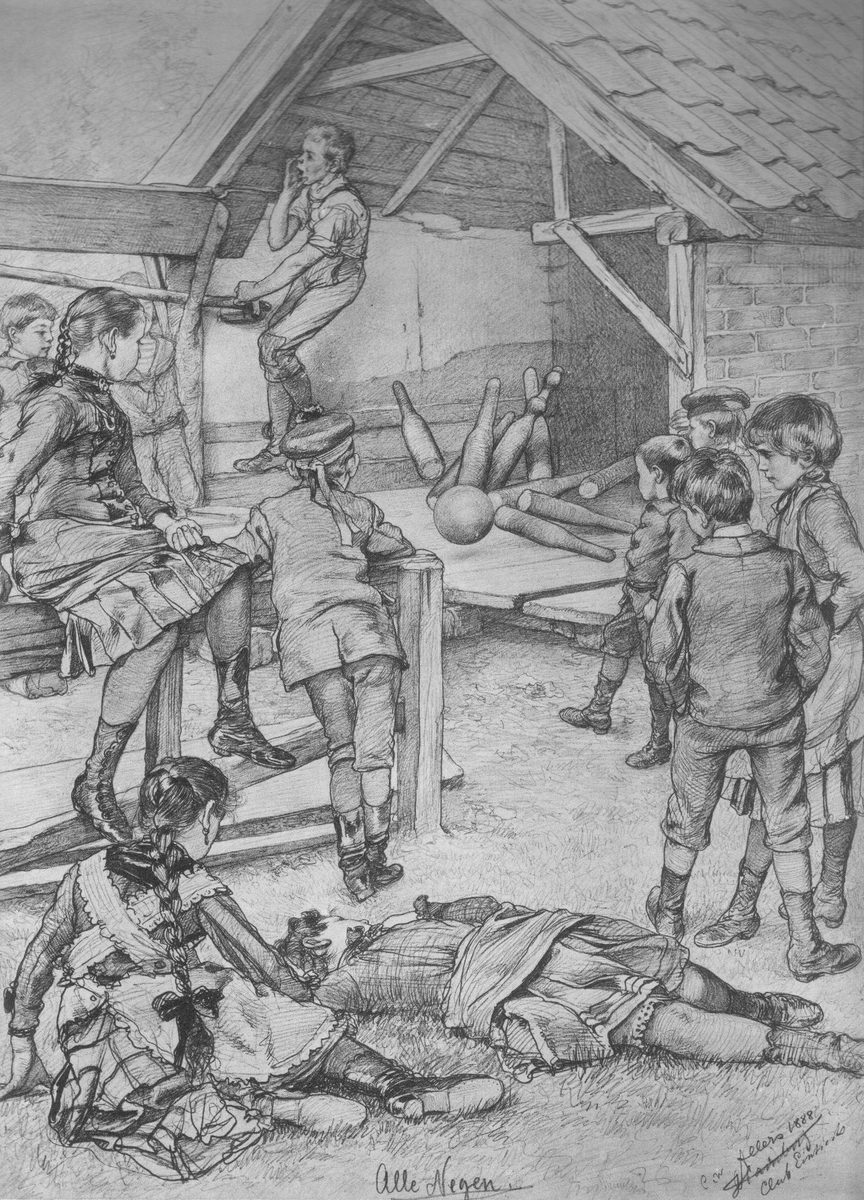
Christian Wilhelm Allers, "Alle Neune", from his Club series, 1888.
A German skittle alley and its players. "Alle neune" — all nine — is the nine-pin strike.
Christian Wilhelm Allers · Public domain · Wikimedia Commons
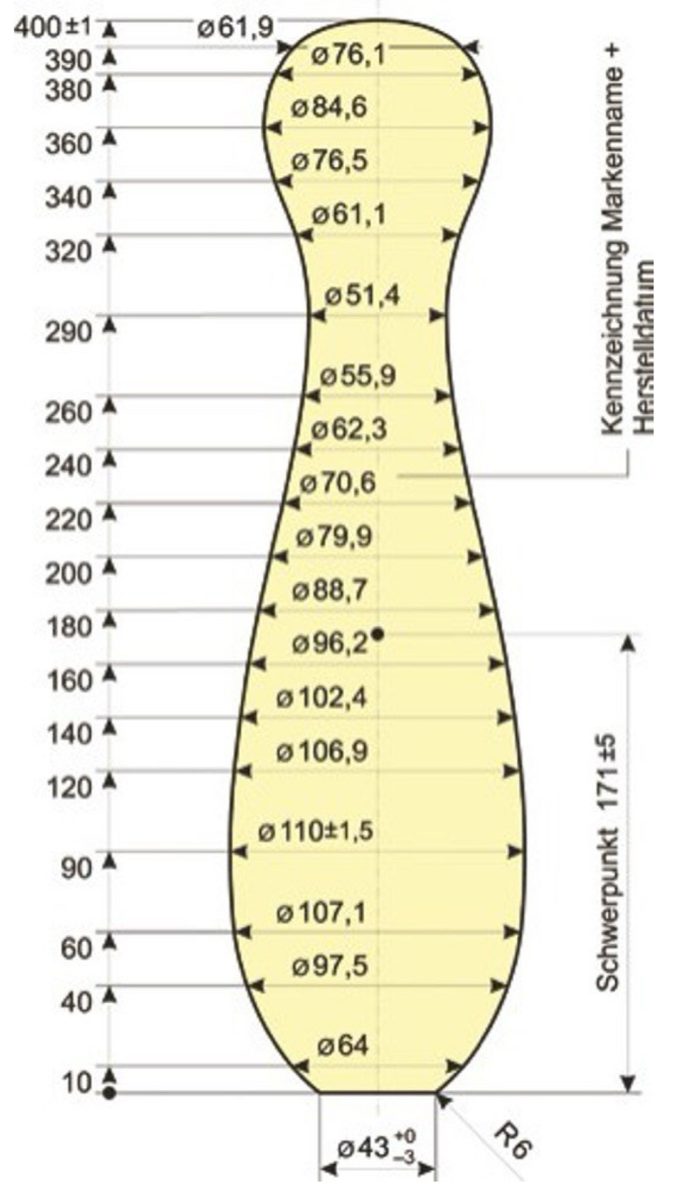
The dimensions of a nine-pin pin, from the World Ninepin Bowling Association.
Specified to the millimetre, like the ten-pin pin, and a different object: the two games share a federation and not their equipment.
World Ninepin Bowling Association · Public domain · Wikimedia Commons
03Officiating
Bowling barely needs officials during play, and needs them badly before it.
During a game almost nothing requires judgement. Pins fell or they did not. The count is objective and, in modern centres, automated. The one in-play offence — crossing the foul line — is detected electronically and voids that delivery's pins.
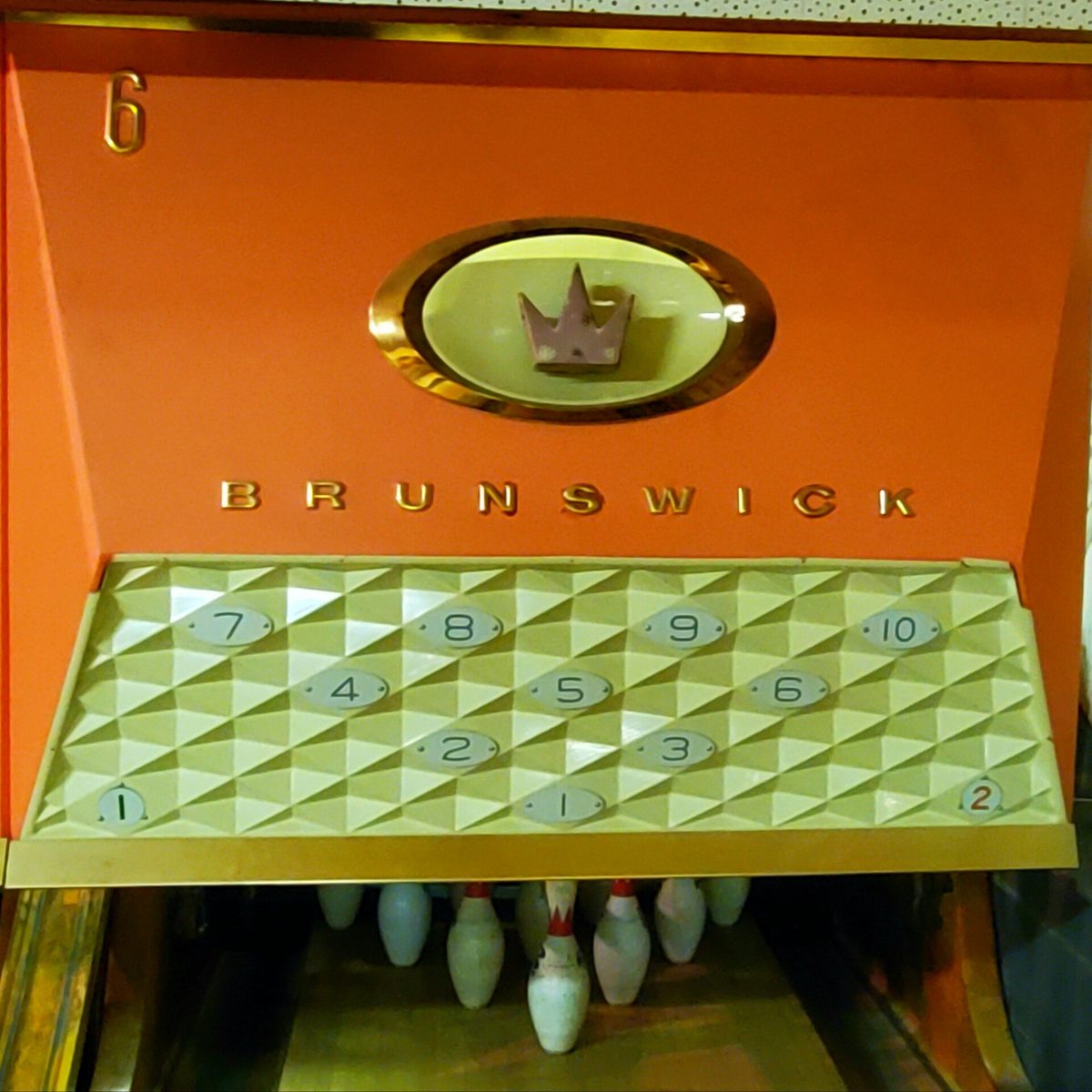
A Brunswick automatic pinsetter, its panel showing which pins are standing.
The machine that replaced the pin boys, and that makes the count objective: pins fell or they did not, and the lane reports it.
Yuccavalerie · CC BY-SA 4.0 · Wikimedia Commons
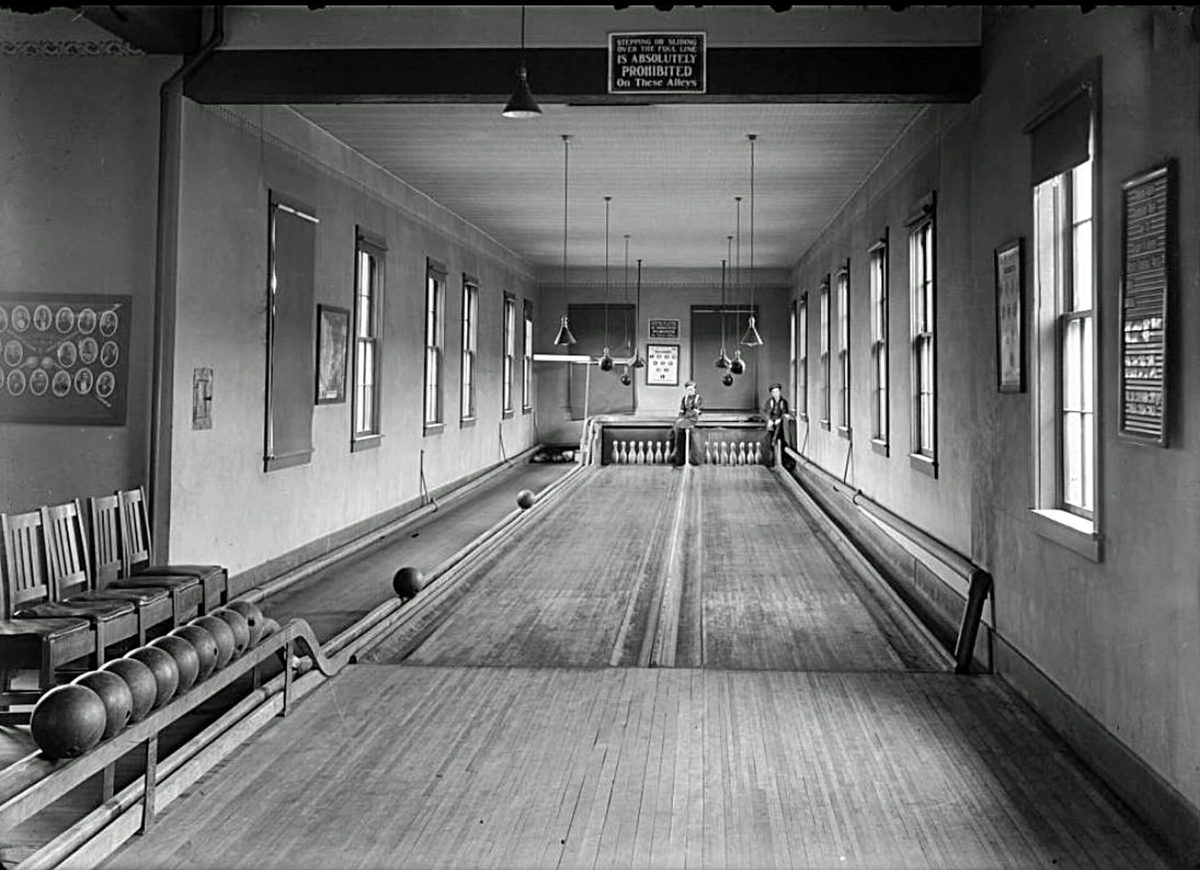
Two lanes and their pin boys, between 1890 and 1910, with the sign: "Stepping or sliding over the foul line is absolutely prohibited on these alleys."
The one in-play offence, already posted on the wall more than a century ago. It is detected electronically now.
Photographer unknown · Public domain · Wikimedia Commons
That makes bowling one of the least-adjudicated sports covered here, alongside orienteering, whose result is an electronic record, and boules, where the players measure.
Before and around a game, officiating is entirely about conditions and equipment, and it is where the sport's integrity lives:
Lane dressing. Verifying that the oil pattern applied matches the specification for the competition, and that re-oiling happens on schedule. The pattern decides how hard scoring is, so an error here changes the event.
Ball inspection. Weight, dimensions, balance, hardness and surface preparation are all specified, and a coverstock can be altered by sanding or polishing — so what a ball's surface is, and when it was changed, is checked.
Pair rotation. Because bowlers' deliveries change the oil for the person they share lanes with, and because a pattern breaks down unevenly, who bowls where and in what order is administered rather than left to chance.
The result is a sport whose officials spend their attention on the field of play rather than on the competitors — the opposite of almost everything else on this site.
04Where it is played
Bowling's map is drawn by commercial property rather than by sporting tradition.
The United States is where ten-pin was standardised, where the industry that built the lanes grew, and where the professional structure remains. It has by far the largest number of centres and bowlers.
East and Southeast Asia is the sport's other stronghold and in competitive terms often its strongest: South Korea, Japan, Chinese Taipei, Singapore, Malaysia and Hong Kong all produce world-class bowlers, and Singapore and Malaysia in particular have won at world level far out of proportion to their size. The sport arrived commercially and was then taken up seriously.
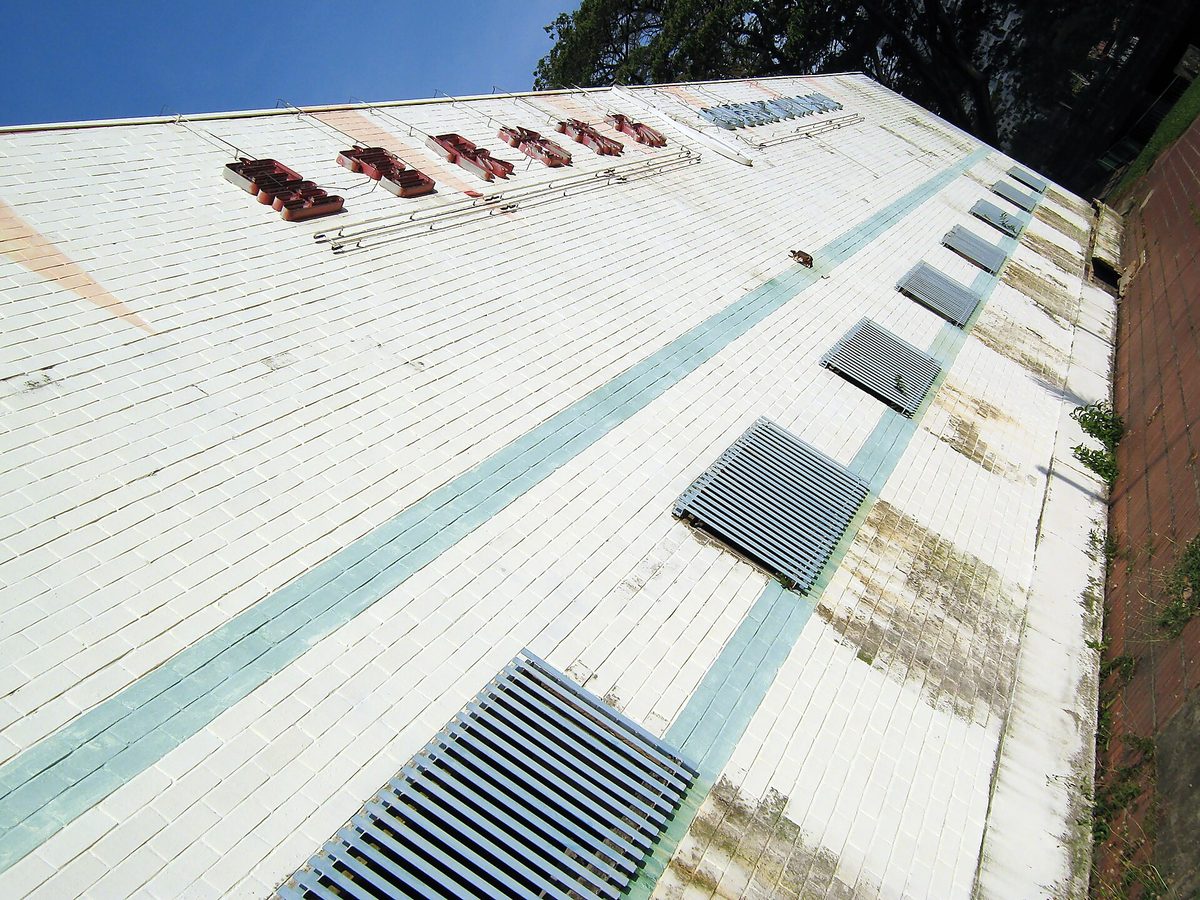
A disused bowling alley in Queenstown, Singapore, 2009.
Singapore wins at world level far out of proportion to its size. Its alleys, like everyone's, are private businesses, and this one has closed.
yeowatzup · CC BY 2.0 · Wikimedia Commons
Europe has ten-pin in Sweden, Finland, Denmark, England, Germany and the Netherlands — and a completely separate pin-game culture in the centre of the continent, where nine-pin in its several forms is a substantial club sport in Germany, Austria, Croatia, Serbia and Slovenia, governed under the same international umbrella and played by different people.
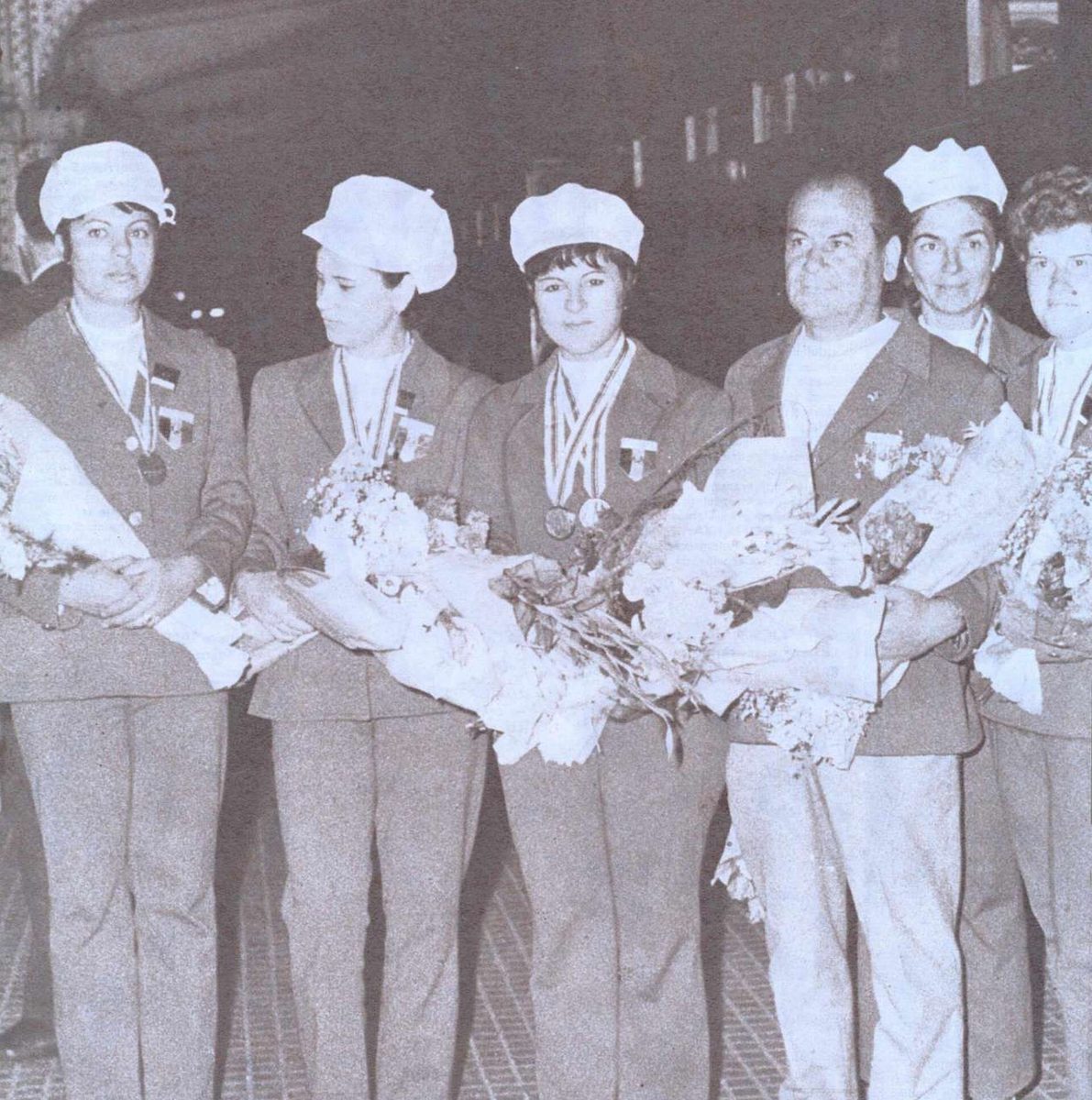
Romania's women's nine-pin team after winning their fourth consecutive world title, 1972.
Nine-pin is the other sport the federation governs: a Central and Eastern European club game, played by different people from ten-pin.
Dragoș Neagu · Public domain · Wikimedia Commons
The distinctive feature of bowling's geography is that the facilities are private businesses. A country gets bowling when someone decides there is money in building centres, and it loses it when the property becomes worth more as something else. This site records the same mechanism destroying racquetball in the United States, where clubs converted courts to gym floor.

The former Amherst Bowling Center, Buffalo, New York, in 2020.
Built in 1946 and closed: the same commercial calculation that brings bowling to a place, running the other way.
Andre Carrotflower · CC BY-SA 4.0 · Wikimedia Commons
Bowling has been luckier, because a bowling centre cannot easily become anything else — but the sport's presence in any country still depends on a commercial calculation rather than on a federation.
05Learning curve
Almost everyone has bowled, and almost nobody has bowled on a competition lane. The gap between the two is the widest on this site between what a sport feels like to a beginner and what it is.
Editorial — the site’s reading, not a sourced claim
Barrier to entry
How hard is it to get to a real game?
A commercial bowling centre will rent you shoes and a ball. Nothing else is required.
Bowling is one of the most widely tried sports in the world. Commercial centres exist in most cities, they rent everything a beginner needs, the rules take a minute, and the recreational lane condition is deliberately forgiving — a house oil pattern funnels the ball towards the pocket and hides a great deal of error.
That forgiveness is a commercial decision rather than a sporting one: people who knock pins down come back. It is also why bowling's entry experience misrepresents the sport so completely.
Nothing about starting requires strength, fitness, youth or a team, and it is played socially by people who would never call it sport.
Evidence
- Kit to startRented shoes and a house ballobserved
- FacilityA commercial centreobserved
- House oil patternForgiving by designruleIt funnels the ball towards the pocket.2005 — the rule this rests on
- Physical demandLowestimate
- Time to a first gameMinutesestimate
Barrier to the top
How hard is it to be good at?
Reading an invisible surface that changes under you, with the right ball, for sixty frames.
A competitive bowler is solving a problem the recreational player never encounters. The oil pattern is invisible, it is far less forgiving than a house condition, and it transitions continuously as balls carry oil down the lane — so the line that worked in the second game is wrong by the fifth.
Elite bowlers respond by moving their feet and their target, by changing the ball's surface, and by carrying several balls with different coverstocks and layouts. Deciding *when* to change is the sport's central skill and it is made on evidence — where the ball is reacting — rather than on anything visible.
The physical skill is a repeatable delivery of a 16-pound ball with substantial rotation, held together over blocks of many games. Consistency is worth more here than in almost anything else covered here, because the condition is already varying and the bowler must not.
The ceiling is capped institutionally: no Olympic place, a modest professional structure, and a sport whose public image is a recreational activity.
Evidence
- The lane is invisibleOil pattern, applied by machineruleCompetition patterns are far less forgiving than recreational ones.2005 — the rule this rests on
- It changes during playOil carries down and breaks downobservedThe line that worked earlier in a block is wrong later in it.
- Reactive equipmentSince the early 1990sruleBall selection and surface adjustment became a core competitive skill.1991 — the rule this rests on
- Typical peak age25–40estimate
Why the two differ
Very low to very high, and it is the largest perception gap on this site.
Nearly everybody has bowled, and what they bowled on was a surface engineered to make them succeed. Move the same person to a competition oil pattern with the same ball and their score collapses, without anything visible having changed. No other sport covered here hides its difficulty inside a condition the participant cannot see.
The sport also has the strangest relationship to its own scale of anything on this site. Gymnastics abolished the Perfect 10 in 2006 because athletes had reached the ceiling and the scale could no longer separate them. Bowling has the same problem — a fixed maximum of 300, reached far more often since reactive equipment arrived — and solved it the other way: it kept the scale and changed the surface underneath, so the number means less and the arithmetic is untouched.
The historyhow it got here · sections 6 to 10
06Origin and invention
Knocking down pins is one of the oldest games there is, and ten-pin bowling is a nineteenth-century American standardisation of it.
Pin games are attested across Europe for centuries in many forms — nine pins arranged in a diamond, in a square, in a line — and they crossed to North America with German and Dutch settlers. The move to ten pins in a triangle, on a lane of fixed length, with a fixed ball specification, happened in the United States through the nineteenth century, driven by the commercial bowling industry that was building the lanes.
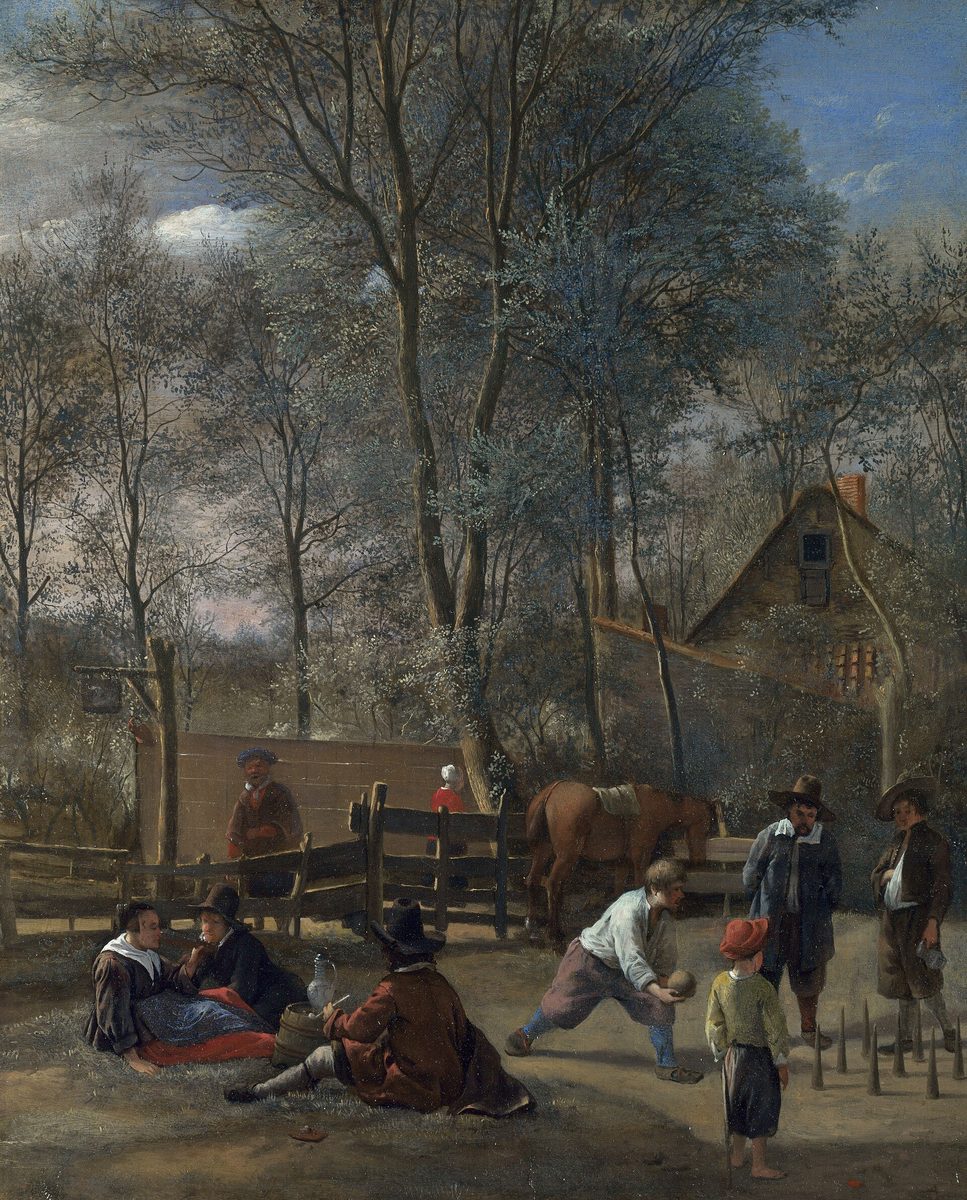
Jan Steen, Skittles Players outside an Inn, about 1660–63.
A pin game in the Dutch countryside two centuries before ten-pin was standardised: a handful of pins, a ball, and a stretch of open ground.
Jan Steen · Public domain · Wikimedia Commons
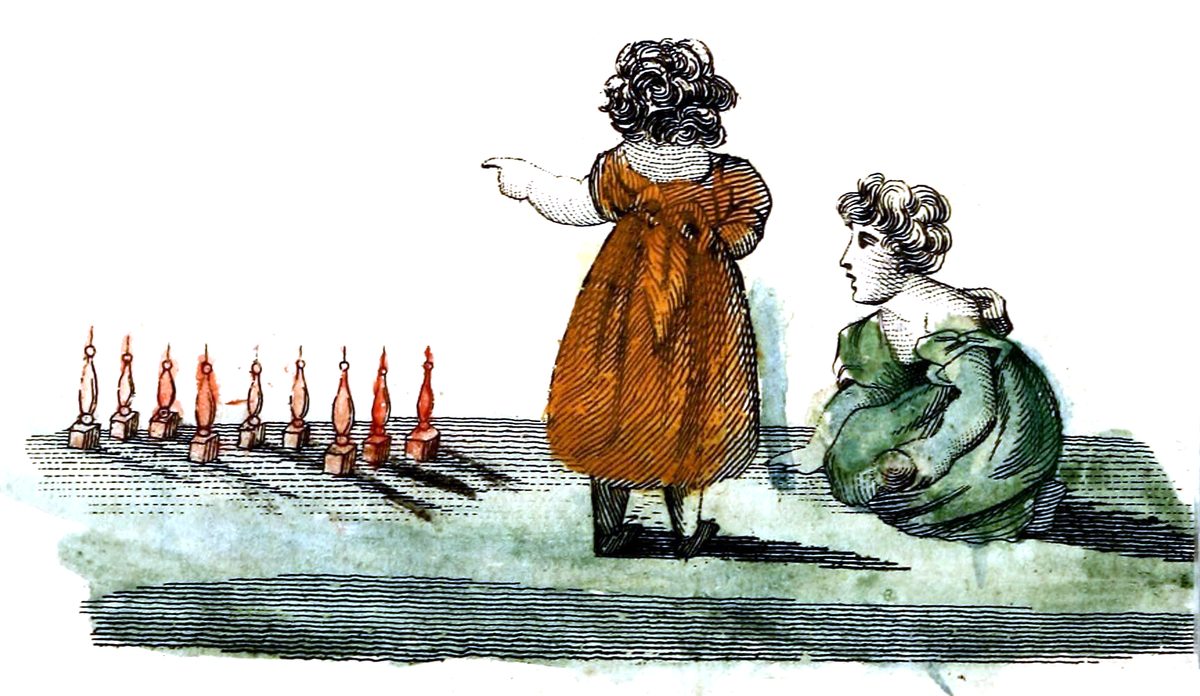
Children playing nine-pins, a hand-coloured engraving of 1818.
Nine pins in a line: one of the many arrangements the European games used before the United States settled on ten in a triangle.
Illustrator unknown · Public domain · Wikimedia Commons
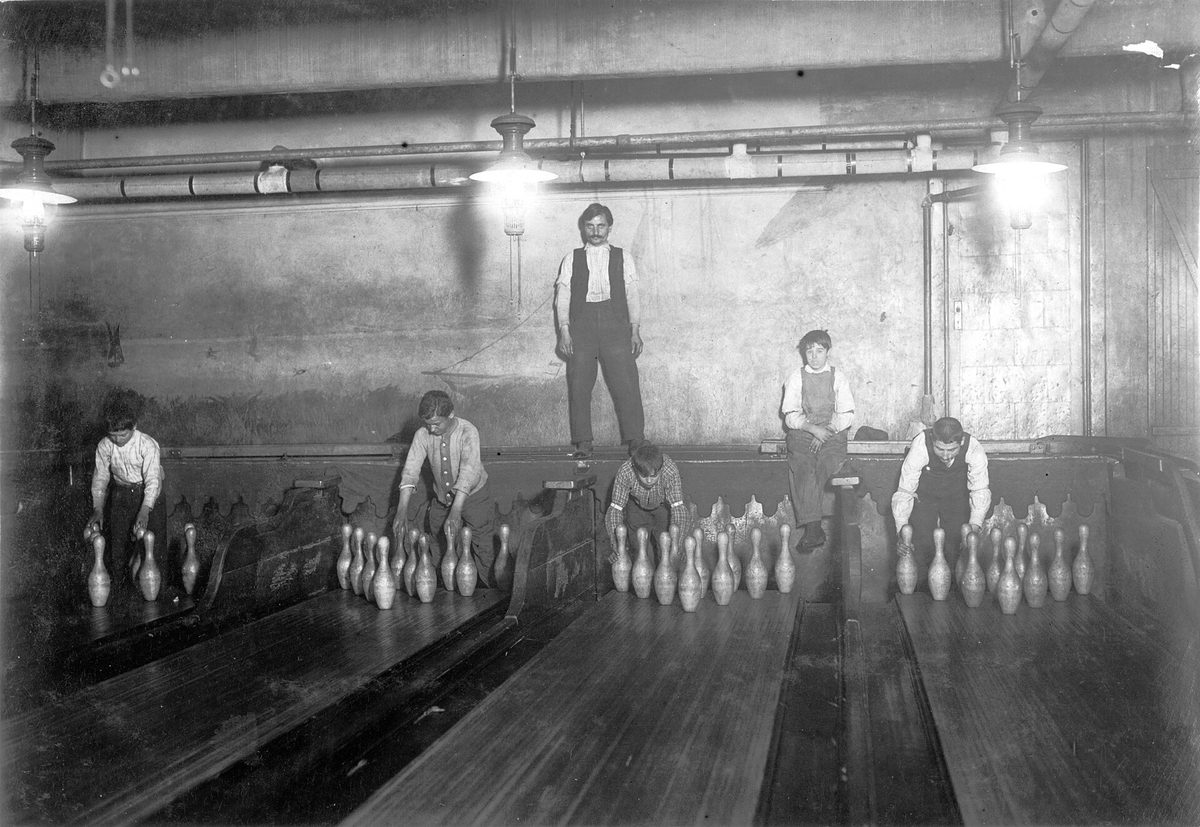
Pin boys at the Subway Bowling Alleys, Brooklyn, at one in the morning, April 1910.
Photographed by Lewis Hine for the National Child Labor Committee, whose caption notes that three smaller boys were kept out of the picture by the boss. Before automatic pinsetters, every pin was reset by hand.
Lewis Wickes Hine · Public domain · Wikimedia Commons
The scoring system dates from that period and has not changed since. Ten frames, two deliveries each, a strike carrying the next two deliveries and a spare the next one, with a maximum of exactly 300. It is a bounded perfect score in a sport where a competitor can actually reach it — a distinction worth holding on to, because gymnastics had a bounded perfect score too and abolished it in 2006 for precisely that reason.
The international federation was founded in 1952 as the Fédération Internationale des Quilleurs, bringing ten-pin and the European nine-pin games under one body. It has since been World Bowling and is now the International Bowling Federation.
Bowling was a demonstration sport at Seoul in 1988. The IOC discontinued the demonstration category after 1992, bowling has bid for the programme repeatedly since, and it has never been selected.
The sport's decisive modern event was neither institutional nor athletic. In the early 1990s the ball changed, and everything the numbers meant changed with it.
07Rule timeline
The sport’s own lane, expanded. Every entry carries a cause from the closed vocabulary and a citation, and says so where the citation is incomplete.
- 1952Fairness and eligibilityadopted 1952
An international federation was formed, bringing ten-pin bowling and the European nine-pin games under one body and standardising ten-pin competition internationally: lane and pin dimensions, ball specifications, and the scoring system that caps a game at 300. The cap is the interesting part. Ten frames, two deliveries each, with strikes and spares carrying bonus pins forward, produce a maximum of exactly 300 — a bounded perfect score, like gymnastics' old Perfect 10, and unlike it in that a competitor can actually reach it.
Trigger and citationIncomplete — no confirmed article
Trigger
Ten-pin had been codified in the United States and the European pin games were governed nationally, with no international body to hold championships between them.
IBF Playing Rules and equipment specifications · IBF Playing Rules
- 1988Participation and accessAdopted, then rescinded before it was ever enforcedadopted 1988
Bowling was contested at the 1988 Seoul Olympics as a demonstration sport. The IOC discontinued the demonstration category after 1992, and bowling has bid for inclusion repeatedly since without being selected. It is one of very few sports covered here to have been at a Games in any capacity and never on the programme.
Trigger and citationIncomplete — no confirmed article
Trigger
Bowling had a very large participation base, particularly in the United States and East Asia, and the demonstration mechanism existed to showcase exactly that kind of sport.
IBF Playing Rules and equipment specifications · Seoul 1988 demonstration sports
- 1991Equipment and technologyalso commercialadopted 1991
Reactive resin ball coverstocks came into use, replacing polyester and urethane. A reactive ball grips the dry part of the lane far more aggressively, hooks harder into the pocket, and carries pins that earlier equipment left standing. Scores rose sharply and permanently. Perfect games, once rare enough to be news, became common — and the maximum did not move, because 300 is defined by the scoring system rather than by the difficulty of achieving it. This is the inverse of every equipment case recorded elsewhere on this site. The javelin's redesign reset the record book; the supersuits were banned and the records kept. Here the number stayed exactly where it was while what it took to reach it collapsed.
Comparability break · Rule changed, marks retained
Reactive coverstocks raised scoring permanently. The scale was not changed and the records were kept, so averages across this line describe different sports under one number. See the series
Trigger and citationIncomplete — no confirmed article
Trigger
Manufacturers developed coverstocks with far greater friction on dry lane surfaces, within the existing ball specifications, which regulated weight, dimensions and balance rather than surface behaviour.
IBF Playing Rules and equipment specifications · IBF equipment specifications
- 2005Fairness and eligibilityalso integrityadopted 2005
Rather than restrict the balls, the sport changed the lane. Competition oil patterns — longer, flatter and with far less margin between the dry outside and the oiled centre than a recreational house pattern — were adopted to make scoring difficult again. A house pattern funnels a ball towards the pocket and forgives error. A sport pattern does not, and the same bowler will score dramatically lower on one than the other with identical equipment. So the sport's answer to an equipment problem was to modify the invisible surface the equipment acts on, which is an option no other sport on this site has had available.
Comparability break · Scoped to one competition
Competition oil patterns diverge from recreational ones. A score belongs to a lane condition, not to the sport. See the series
Trigger and citationIncomplete — no confirmed article
Trigger
Reactive equipment had made high scores routine on recreational lane conditions, and averages ceased to distinguish between competitors.
IBF Playing Rules and equipment specifications · IBF lane dressing specifications
08Equipment evolution
Bowling's equipment history has two halves, and the second one is a surface nobody can see.
The ball. Hard rubber gave way to polyester, polyester to urethane, and urethane — around 1991 — to reactive resin. A reactive coverstock grips the dry part of the lane far more aggressively than anything before it, hooks harder into the pocket, and carries pins that older equipment left standing. Scores rose immediately and permanently.
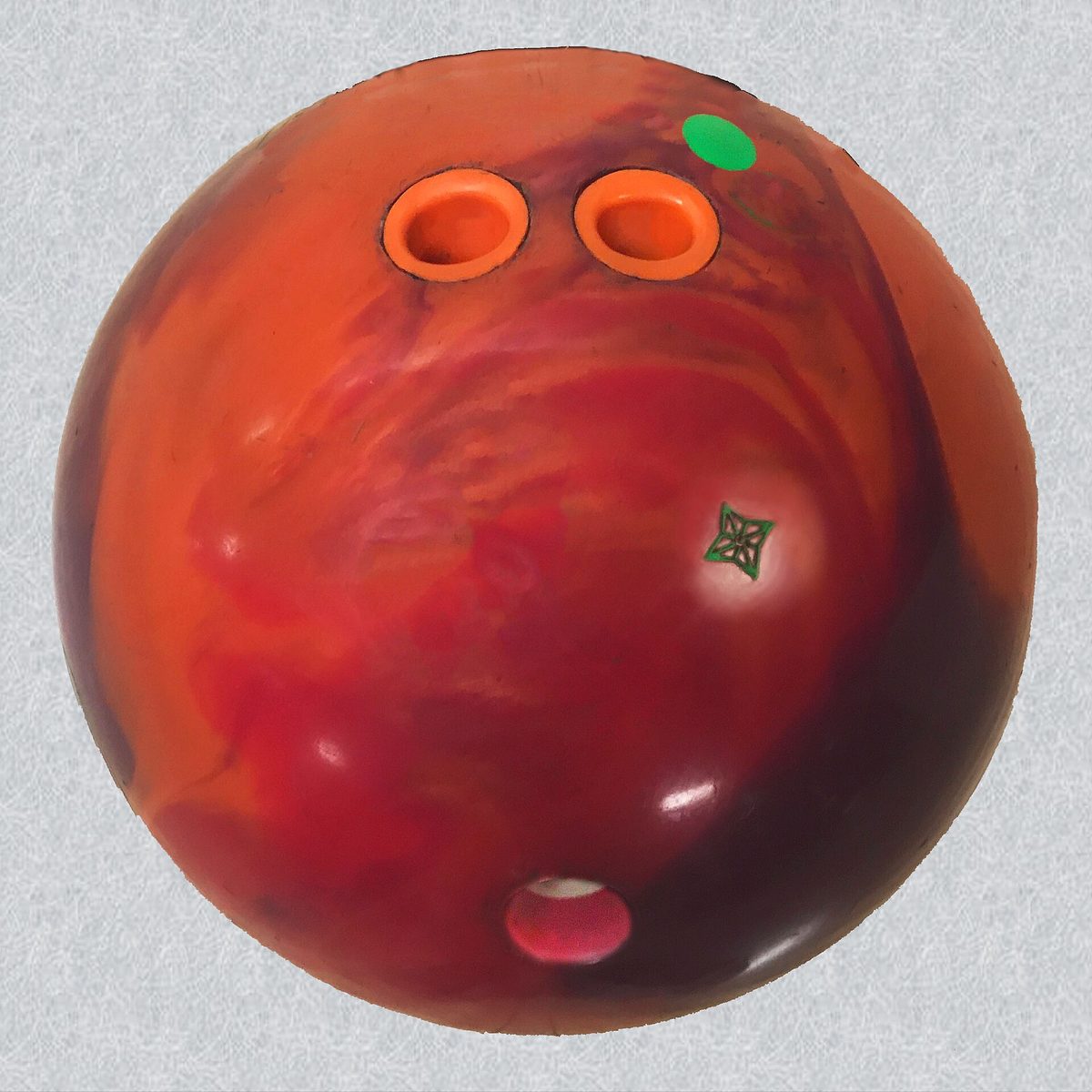
A reactive resin ball, drilled for a fingertip grip.
The coverstock that arrived around 1991: it grips the dry part of the lane far harder than anything before it, and scores rose permanently.
RCraig09 · CC BY-SA 4.0 · Wikimedia Commons
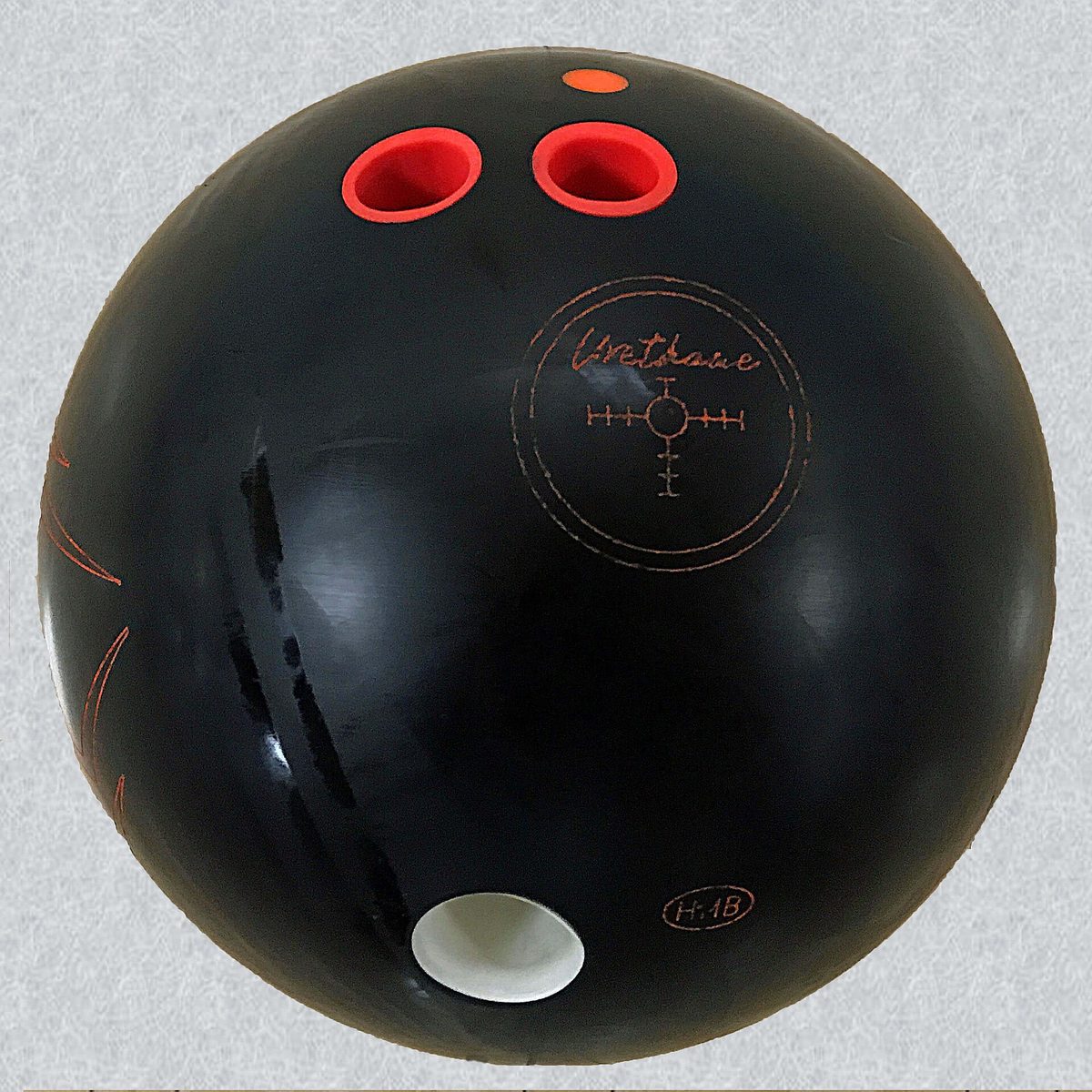
A urethane ball, drilled the same way.
The generation before. Weight, size, balance and hardness were all specified; how the surface gripped the lane was not, which is how the reactive ball got through the rules.
RCraig09 · CC BY-SA 4.0 · Wikimedia Commons
The regulations did not stop it, because they were written for a different threat: weight, dimensions, hardness and balance were all specified, and a coverstock's friction behaviour was not. Manufacturers innovated inside the rules, which is the same story this site records for the composite softball bat and the polyurethane swimsuit.
Modern competitive equipment goes further. A ball has an internal weight block of a designed shape, drilled at a chosen angle relative to it, and a coverstock that can be sanded or polished to alter friction. Bowlers carry several and change during a block.
The lane. This is where bowling diverges from every other sport covered here. The lane is dressed with oil in a pattern, applied by machine, invisible to the bowler, which determines where the ball slides and where it grips.
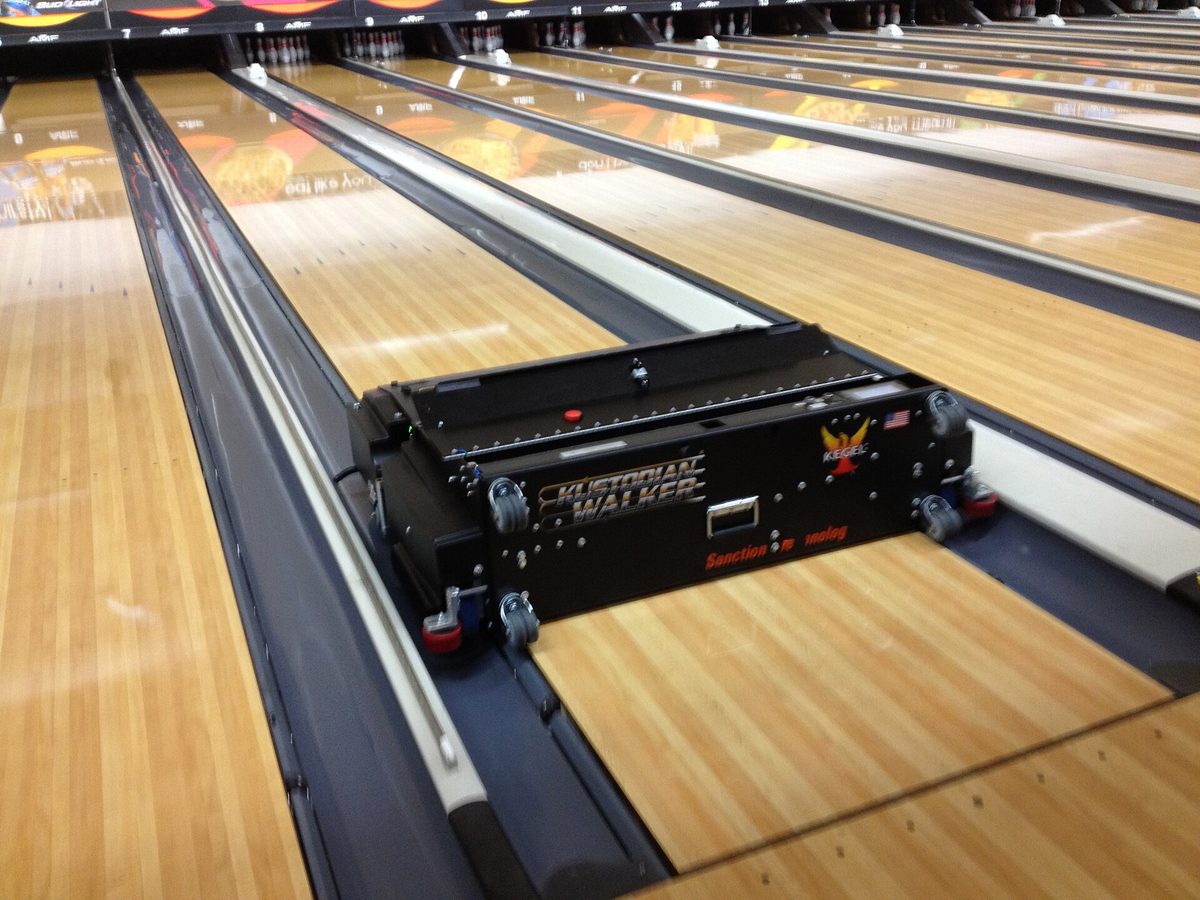
An automatic lane-dressing machine at work.
It lays down the oil pattern before a session, to a specification the bowlers cannot see on the lane. The field of play is reapplied every time and consumed by the play on it.
TH1RT3EN · CC BY-SA 3.0 · Wikimedia Commons
When reactive equipment made scoring easy, the sport did not restrict the balls. It changed the oil — adopting longer, flatter competition patterns with far less margin for error than the forgiving house conditions recreational bowling is played on.
That option existed because bowling is the only sport here whose field of play is reapplied before every session and consumed during it.
09Governing body politics
Bowling has the participation numbers every federation dreams of and none of the standing that usually follows them.
Tens of millions of people bowl. Commercial centres exist in most cities on earth. The sport was a demonstration event at Seoul in 1988, has bid for the Olympic programme repeatedly, and has never been chosen — which puts it in an unusual category: a genuinely global, genuinely popular sport that the Olympic movement has consistently declined.
Bowling at the 2014 Asian Games, Anyang, South Korea.
A multi-sport games that has bowling on its programme. The Olympic Games, despite repeated bids, never has.
hyolee2 · CC BY-SA 3.0 · Wikimedia Commons
The reasons offered are identifiable and unflattering. Bowling is played overwhelmingly as a commercial leisure activity rather than in clubs; its professional structures are modest and concentrated in the United States and East Asia; and it presents poorly as a spectacle, because the decisive variable — the oil pattern — is invisible to a camera and to an audience.
That last point is worth dwelling on. A viewer watching elite bowling sees people knocking down all the pins repeatedly and cannot see why it is hard. Every other sport on this site can show a spectator its difficulty. This one hides it in a coating.
The federation has also had a naming problem that reflects an identity one: the Fédération Internationale des Quilleurs became World Bowling and then the International Bowling Federation, while continuing to govern both ten-pin and the European nine-pin games, which are a different sport played almost entirely in Central Europe.
The most consequential decisions in bowling's recent history were not made by the federation at all. They were made by ball manufacturers in the early 1990s, and the sport has been responding to them ever since.
10Controversies that forced rule changes
Reactive resin. The defining controversy. Ball coverstocks developed in the early 1990s hooked far harder than anything before them, and scoring rose permanently — perfect games went from rare to routine — without a single change to the scoring system. Averages from before and after are not comparable, and the sport has never annulled or separated them.
Compare the three answers this site has already recorded. Athletics redesigned the javelin and reset the record book. Swimming banned the supersuits and let the marks stand. Finswimming could ban nothing and split the book by fin type. Bowling did something none of them could: it left the equipment alone and changed the surface.
Sport patterns. Competition oil patterns — longer, flatter, far less forgiving than recreational house conditions — were adopted so that scores would again separate competitors. It worked, and it created a sport in which the same bowler scores dramatically differently on two lanes that look identical.
Whether 300 still means anything. A perfect game was once a career achievement. It is now common enough that the sport's own recognition of it has had to change. The number is fixed; what it certifies is not.
Lane maintenance. Because the oil breaks down during play, and breaks down differently depending on where bowlers have been throwing, the fairness of a block depends on the sequence of who bowled where. Pattern design and re-oiling schedules are governed and argued.
Ninepin and tenpin. One federation, two sports, no overlap in athletes.
Where it standsthe record, and what is still open · sections 11 to 12
11Series
No series published
Scoring average
Bowling has the strangest comparability problem on this site, because nothing about its scoring system ever changed. A strike has scored ten plus the next two deliveries for more than a century. The maximum is 300 and always has been. The arithmetic is identical in 1960 and today, which is exactly why the numbers cannot be compared. What changed is underneath. Reactive resin coverstocks from the early 1990s grip the dry lane far harder than the polyester and urethane balls before them, hook into the pocket more aggressively, and carry pins that older equipment left standing. Averages rose and perfect games went from rare to routine — with no change whatsoever to the scale they were measured on. Then the sport responded by changing the surface rather than the equipment. Competition oil patterns are longer, flatter and far less forgiving than the recreational house conditions most bowling is done on, so the same bowler with the same ball scores dramatically differently depending on a coating they cannot see. So a score requires three pieces of context that are almost never recorded together: the era's equipment, the oil pattern, and how far into the block it was applied. Without them the number is arithmetic without a measurement. Nothing is entered here because no series carrying that context has been taken from a cited source.
1991Rule changed, marks retainedReactive coverstocks raised scoring permanently. The scale was not changed and the records were kept, so averages across this line describe different sports under one number.
2005Scoped to one competitionCompetition oil patterns diverge from recreational ones. A score belongs to a lane condition, not to the sport.
12What is contested now
Recorded as unsettled.
What a score means. Reactive equipment raised scoring permanently in the early 1990s and nothing was annulled, separated or reset. Averages and perfect games from before and after sit in the same records under the same number. No proposal to address it has gained ground, and the sport is unusual in having apparently decided it does not need to.
Equipment regulation. Specifications govern weight, dimensions, balance and hardness. Coverstock friction — the property that actually changed the sport — is regulated far more loosely, and manufacturers continue to develop inside the rules.
Oil patterns as the fairness mechanism. Making competition hard by changing an invisible surface works, and it means the sport's difficulty is set by a specification most participants have never heard of, on a variable no spectator can see.
Olympic prospects. Enormous participation, a 1988 demonstration appearance, repeated bids, no place. The obstacles — a commercial rather than club base, modest professional structures, and a spectacle that hides its own difficulty — have not changed.
Ten-pin and nine-pin. One international body governing two sports with different equipment, different lanes and no shared athletes.
Whether the recreational game helps or hurts. Bowling's vast popular base is played on conditions engineered to flatter, which recruits people and teaches them that the sport is easy. Whether that is the federation's greatest asset or its central misrepresentation is a genuine strategic question.