Boxing
Removed its headguards on safety grounds, and lost its governing body altogether.
- Official
- Boxing
- Game category
- Outside this taxonomy
- Adjudication
- Combat
- Standing
- Removed, restored
- rule changes
- 6
- comparability breaks
- 2
- Olympic editions
- 28
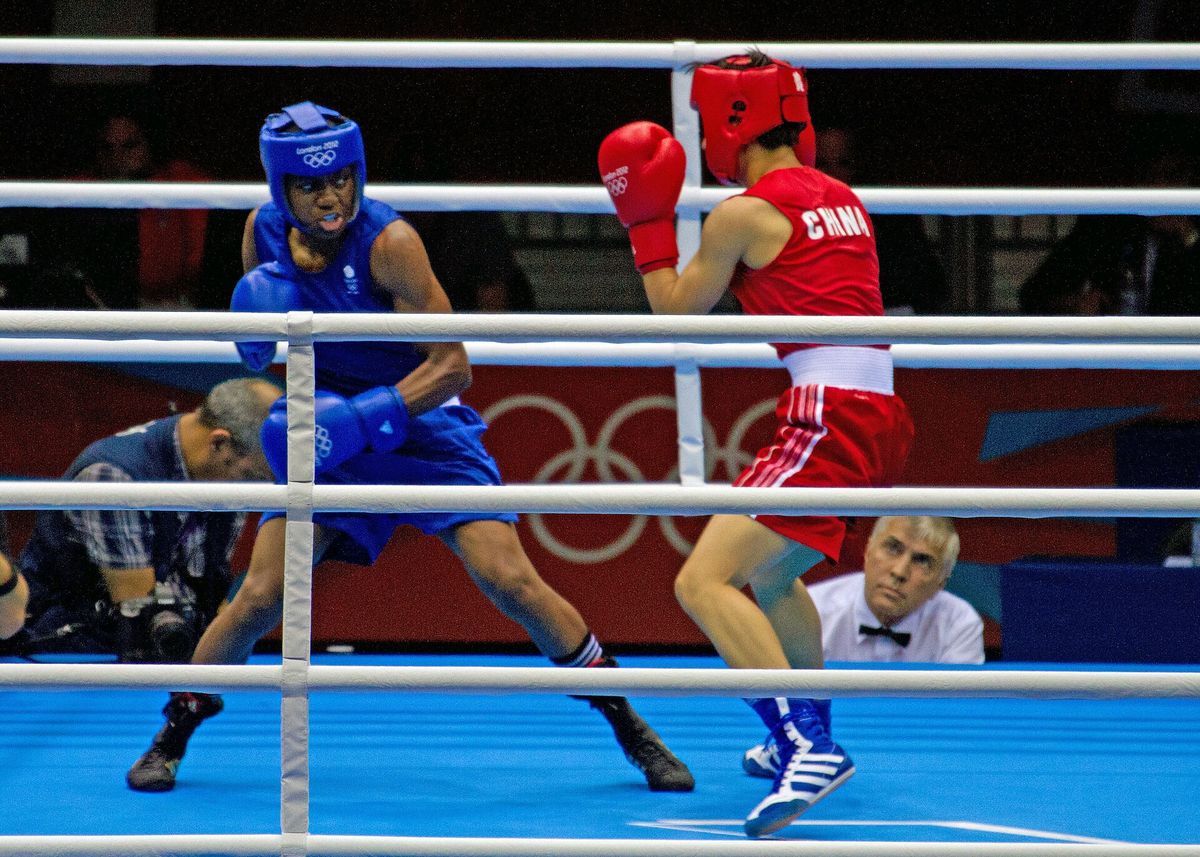
Nicola Adams against Ren Cancan in the women's flyweight final, London 2012 · Kent Capture · CC BY 2.0
- Governing body
- World Boxing, recognised by the IOC in 2025. The previous body, AIBA and later IBA, was suspended in 2019 and expelled in 2023.
- Founded
- Queensberry Rules published 1867; the Fédération Internationale de Boxe Amateur founded 1920, becoming AIBA in 1946.
- Olympic status
- 28 editions
- on the 2028 programme
- Also contested at
- Asian Games
Boxing is the only sport on this site whose governing body was expelled from the Olympic movement, and the only one where the IOC ran the competition itself because there was nobody it trusted to. It is also the sport with the most counter-intuitive safety rule in the collection: headguards were removed from elite men's competition in 2013, on the argument that they were making concussion more likely rather than less.
The gamewhat it is now · sections 1 to 5
01How it is played
Hit the opponent above the belt with the knuckle part of a closed glove, more cleanly and more often than they hit you, across three rounds. Boxing's rules of play are among the simplest here and its rules about who governs, who scores and what protective equipment is worn have been the most unstable of any sport on this site.
These figures were entered from the edition named above but have not been checked against its text line by line. Treat them as this site’s reading of the laws, not as a substitute for them.
The object of the bout
Win more rounds than the opponent in the judges' assessment, or end the bout early by knockout, referee stoppage or the opponent's disqualification. Only blows landed with the knuckle part of the glove, above the belt, count.
The ring
A square ring, roped, with a canvas over padding. There is nothing much to say about it, which makes boxing one of the few sports here where the venue specification carries no consequence at all.
- Ring
- 6.1 m square
- Inside the ropes, at international level.
- Ropes
- 4
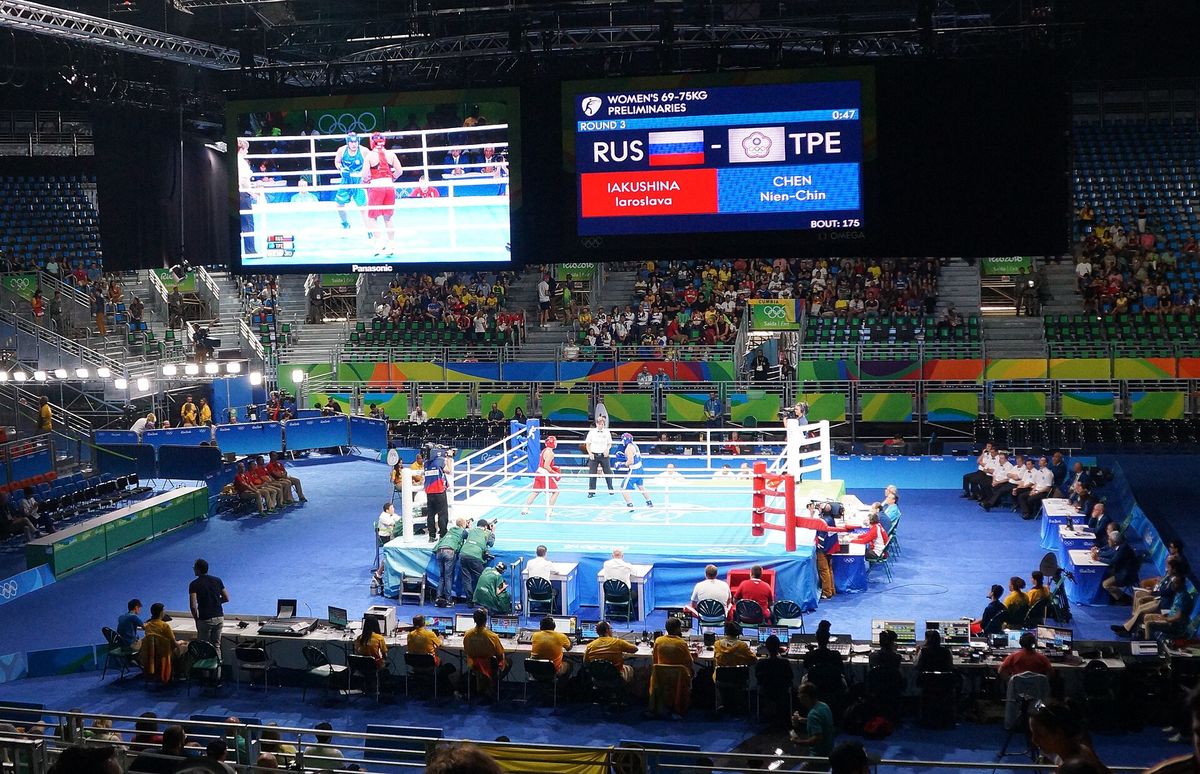
The boxing ring at Riocentro, Rio de Janeiro, 2016.
Four ropes around a square of about six metres, judges ringside, and the scoreboard above. The Games where the ten-point must system returned, and the judging controversies that followed.
Jonas de Carvalho · CC BY-SA 2.0 · Wikimedia Commons
Gloves and protection
Gloves specified by weight, hand wraps by length, a mouthguard and a groin protector required. The headguard is the contested item and the one the sport has changed its mind about: compulsory from 1984, removed from elite men's competition in 2013 on the argument that it made concussion more likely, and retained for women and juniors throughout.
That a piece of protective equipment was removed on safety grounds is the most counter-intuitive rule on this site, and the entry records the dispute about whether that was really the reason.
- Headguard, elite men
- Removed 2013
- Headguard, women and juniors
- Retained
- Glove weight
- 10 oz or 12 oz, by category
- Mouthguard
- Compulsory
Boxers and officials
Two boxers in a weight category. One referee in the ring, five judges at ringside, and — since 2019 and until World Boxing took over — a competition structure written by the IOC because there was no federation it recognised.
Professionals have been eligible since 2016, which ended the amateur distinction that had defined Olympic boxing for a century.
Format
Three rounds of three minutes for elite men, three of three for elite women, with a minute between. Elimination tournament, no repechage, and bronze medals awarded to both losing semi-finalists — a convention boxing shares with judo and taekwondo and almost nothing else.
- Rounds
- 3 × 3 min
- Bronze medals
- 2
Scoring
The ten-point must system, taken from professional boxing: judges award the winner of each round ten points and the loser nine or fewer, and the totals decide the bout.
Between 1992 and 2016 it worked entirely differently. A point existed only when at least three of five judges pressed a button for the same blow within about a second, which was an arithmetic designed to remove the judges' discretion after the 1988 scandal. It changed how boxers fought — single visible shots scored, combinations did not — and it was abandoned in 2016.
So the sport went from opinion to arithmetic and back to opinion inside twenty-four years.
- System
- Ten-point must
- Judges
- 5
- Computerised counting
- 1992 to 2016
Breaks and counts
The referee breaks a clinch, administers a count after a knockdown, and may issue a standing count. The count is the sport's central safety instrument and the one place where a single official's judgement can end a contest immediately.
Fouls
Below the belt, holding, hitting with the open glove or the inside of the wrist, using the head, hitting an opponent who is down, and turning the back. Fouls are penalised by warning and then by point deduction or disqualification.
Deciding the winner
More rounds on the judges' cards, or a stoppage. There is no draw at the Games, and where the cards are level the bout is resolved on criteria rather than replayed.
This clause reads this way because of
Everything above is current law. Everything below is how Boxing got here.
02Disciplines and events
Weight categories, and the number and boundaries of them have been rewritten repeatedly — most recently by the IOC rather than by a federation, because from 2019 to 2025 there was no recognised federation to do it. Women's boxing entered the programme only in 2012, the last sport on the Olympic programme to admit women.
- Disciplines
- 2
- Olympic medal events
- 13
- Men’s and women’s counted separately.
- Listed for context
- 1
- Not counted as this sport.
Men's categories7
- Men's weight categories
Women's categories6
On the programme since 2012, and expanding towards parity since.
- Women's weight categories
Who has set these categories3
Recorded because for two Games the answer was not a federation.
- AIBA, to 2019
- The IOC task force, 2020 and 2024The IOC wrote the competition and qualification rules itself.
- World Boxing, from 2025Recognised for the 2028 Games.
03Officiating and technology
Boxing has done less with officiating technology than any sport on this site, and it is the sport with the worst documented officiating record. Those two facts are related, and the relationship is not the obvious one.
The sport did try. The 1992 computerised system was a serious attempt to mechanise scoring, and it failed on its own terms twice over. It changed how boxing was fought, because it only counted blows the judges could individually separate and register. And it did not remove corruption, because the buttons were still pressed by people.
That is the crucial difference between boxing and taekwondo, which faced an almost identical judging crisis and solved it. Taekwondo put the sensor on the athlete: a kick registers because it landed hard enough, and no official is involved. Boxing put the button in the judge's hand, so the instrument recorded opinions faster without making them more honest.
There is no technical reason boxing could not be scored the way taekwondo is. Impact sensors in gloves and body protectors have been trialled. The sport has not adopted them, and the reasons offered are that boxing scores quality — cleanness, effect, ring generalship — rather than mere contact, and that a sensor cannot tell a jab that lands from a jab that lands well.
That objection is real and it is also the objection every sport makes before it automates. Whether boxing's central judgement is genuinely unmeasurable, or whether the sport has simply preferred not to find out, is the open question of its officiating.
The referee's count, meanwhile, remains one of the best-designed safety instruments in sport: a judgement converted into ten seconds.
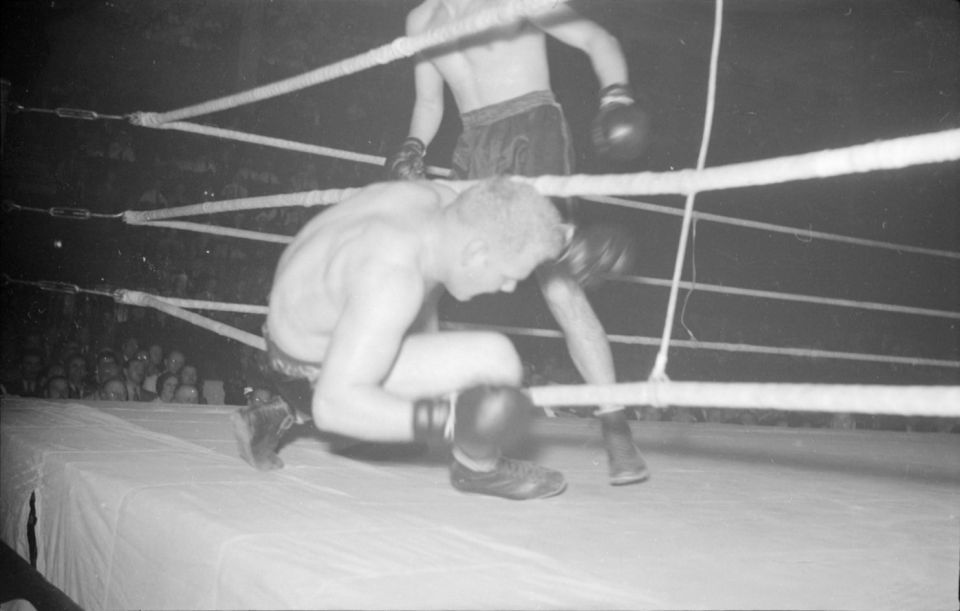
A boxer going down against the ropes, Montreal, July 1937.
The moment the ten count exists for: whether a man can continue, turned from a judgement into ten seconds.
Conrad Poirier · Public domain · Wikimedia Commons
04Where it is played
Boxing has the least wealth-correlated geography of any sport on this site. Its facilities are cheap, its equipment is minimal, and it has been concentrated for a century in exactly the communities that other Olympic sports do not reach — which is the reason it has survived repeated pressure to remove it from the programme.
Cuba is the outstanding case, with a state amateur system that has produced more Olympic champions per head than any programme in any sport, sustained across decades in which its boxers could not turn professional. Kazakhstan, Uzbekistan, Great Britain, the United States, Russia, Ukraine, Ireland, Mexico and Thailand all produce international boxers from very different structures.
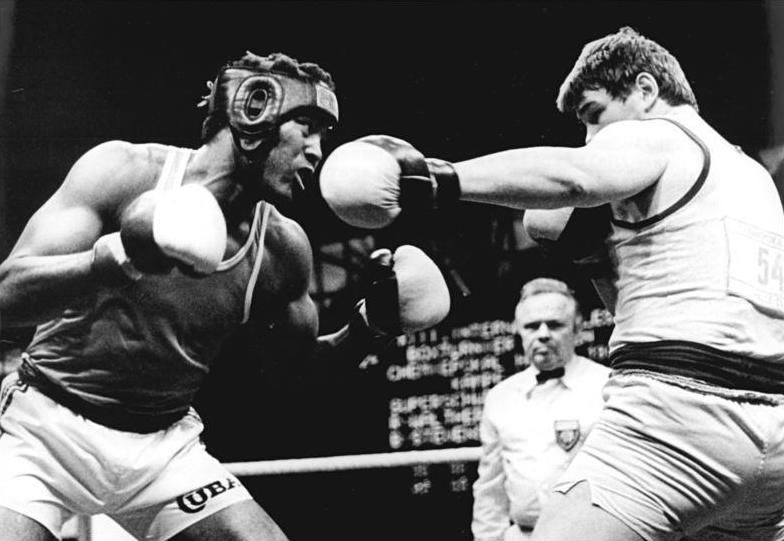
Teófilo Stevenson of Cuba against Olaf Walther, 1984.
Olympic heavyweight champion three times over, and never a professional: the product of the state amateur system the section describes.
Thomas Lehmann, Bundesarchiv Bild 183-1984-0331-021 · CC BY-SA 3.0 de · Wikimedia Commons
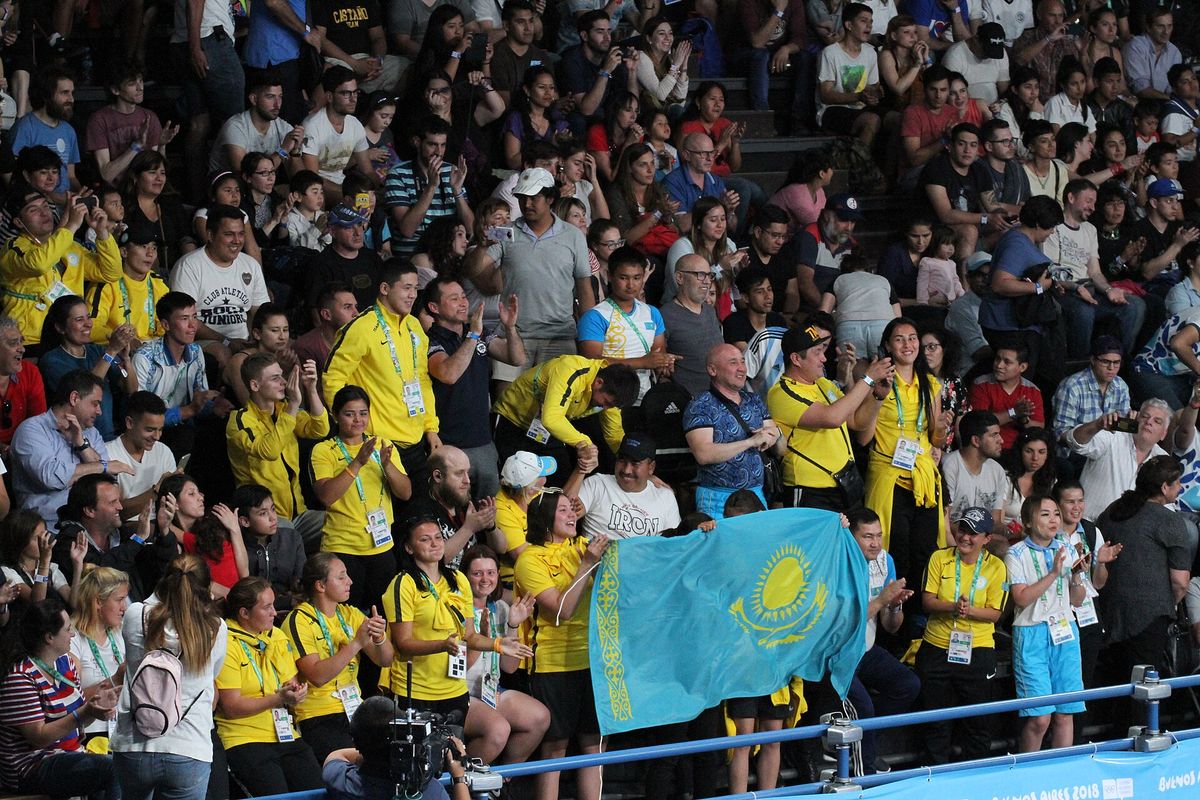
Kazakhstan's supporters at the boxing tournament of the 2018 Youth Olympics, Buenos Aires.
One of the countries that produce international boxers from very different structures, and follow them.
BugWarp · CC BY-SA 4.0 · Wikimedia Commons
Ireland's is the small-country version worth recording: a club network in a population of five million producing sustained Olympic success, mostly from urban clubs with almost no funding.
Katie Taylor of Ireland at the London 2012 Olympics.
She won the lightweight title there: the small-country, club-built version of Olympic boxing success the section records.
cormac70 · CC BY 2.0 · Wikimedia Commons
The governance collapse fell across this map unevenly. When the IOC ran the 2020 and 2024 tournaments itself, it also wrote the qualification system, and countries whose pathway depended on federation-run continental events had to adapt to a structure designed elsewhere at short notice.
The sport's Olympic future has been in doubt for a decade, and the argument made most often in its defence is a geographic one: boxing reaches people no other sport on the programme reaches, and removing it would remove the only Olympic pathway available in a large number of places.
05Learning curve
The lowest entry barrier of any combat sport here and one of the highest tops, and unlike every other sport on this board its ceiling includes a well-documented risk of permanent neurological harm. That has to be stated in a section about how hard a sport is to master, because for this one it is part of the answer.
Editorial — the site’s reading, not a sourced claim
Barrier to entry
How hard is it to get to a real game?
A gym, wraps and a bag. You can train for months before anyone hits you.
Boxing is unusually easy to begin and unusually easy to begin safely, because most of the training is not sparring. Bag work, pads, footwork and conditioning are the bulk of it, they can be done alone or with a coach, and a beginner can train for months without taking a punch.
Gyms are cheap, widely distributed and historically concentrated in exactly the places other sports are not. Boxing has the lowest correlation with wealth of any sport on this site.
Amateur competition has weight categories, headguards for women and juniors, short rounds and a referee empowered to stop a bout early, which makes entering a controlled step rather than a leap.
Evidence
- Kit to startWraps and glovesobserved
- FacilityA gymobserved
- Partner requiredNot initiallyobservedMost training is solo or on pads.
- Headguards, women and juniorsRetainedrule2013 — the rule this rests on
- Time to a first boutMonthsestimate
Barrier to the top
How hard is it to be good at?
A sport whose scoring, protective equipment and governing body have all been replaced mid-career.
The athletic demand is severe and conventional. What is not conventional is the instability around it. A boxer who came through the amateur system in the 2010s trained under computerised scoring, competed under the ten-point must system, started with a headguard and finished without one, and did all of it under a federation that was subsequently expelled from the Olympic movement for manipulating results.
An independent investigation found that bouts at the 2016 Games had been fixed. That is not a rule change, and it belongs in an assessment of what mastery meant in this sport in that period, because for some competitors it did not determine the outcome.
And the ceiling carries a cost no other sport here carries in the same way. Repeated head impact is the sport's mechanism, not an accident of it, and the long-term neurological consequences are documented.
Evidence
- Scoring system replaced1992 and again 2016ruleArithmetic replaced judgement, then judgement replaced the arithmetic.2016 — the rule this rests on
- Headguards removed2013ruleFor elite men only, on contested safety grounds.2013 — the rule this rests on
- Governing body expelled2019 suspended, 2023 expelledruleThe IOC ran two Olympic tournaments itself.2020 — the rule this rests on
- Typical peak age23–30estimate
Why the two differ
Boxing has the widest gap of any combat sport here, and the shape of it is the opposite of judo's. Judo's entry is moderate because you must learn to fall before you can start; boxing's is low because you can train for months without being hit. Judo's elite version is recognisably the club version; boxing's is the same activity performed against someone trying to concuss you.
What sets this sport apart on the board is that its ceiling is partly a governance problem rather than an athletic one. In no other sport here did the people running the competition manipulate its results — that is a finding of an independent investigation, not an allegation — and no other sport has had its Olympic tournament run by the IOC because there was nobody else to run it.
The historyhow it got here · sections 6 to 10
06Origin and invention
Boxing is old and its rules are not. Prize fighting existed in eighteenth- century England as a bare-knuckle activity with wrestling throws allowed and rounds that ended only when a man went down, and it was governed by conventions rather than by anything written.
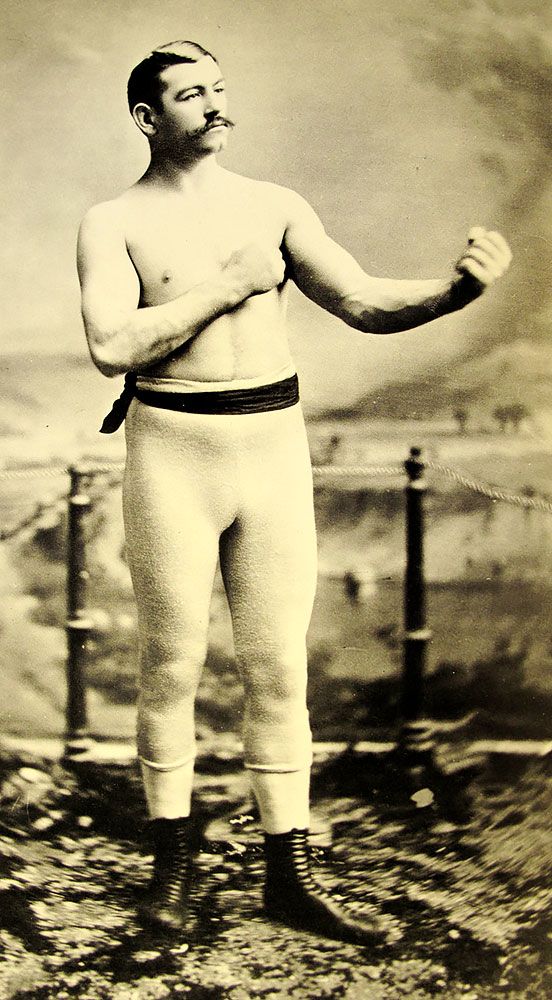
John L. Sullivan, photographed by José María Mora in 1882.
The last bare-knuckle heavyweight champion. He lost the title in 1892 in one of the first championship fights under the Queensberry Rules, wearing gloves.
José María Mora · Public domain · Wikimedia Commons
The document that made it a sport is the Queensberry Rules, published in 1867 and drafted by John Graham Chambers under the patronage of the Marquess of Queensberry. Three of its provisions built modern boxing: gloves became compulsory, rounds were fixed at three minutes with a minute's rest, and a downed fighter had ten seconds to rise.
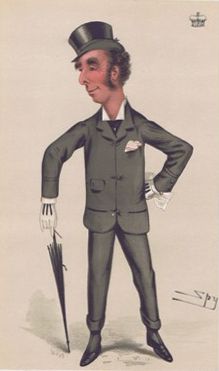
The Marquess of Queensberry, caricatured by Leslie Ward ("Spy") in Vanity Fair, 1877.
The patron whose name the rules carry. The rules themselves were drafted by John Graham Chambers; the caption to this caricature called the marquess "a good light weight".
Leslie Ward · Public domain · Wikimedia Commons
The ten count is the interesting one for this site. It is the first safety-motivated stopping rule in any sport here, and it works by converting a judgement — is this man able to continue — into a countable interval. That is the same move badminton made with its service height in 2018 and athletics makes wherever it can.
Amateur boxing organised separately from the professional sport almost from the start, with the Fédération Internationale de Boxe Amateur founded in 1920 and becoming AIBA in 1946. Boxing has been on every Olympic programme since 1904 except 1912, when Swedish law prohibited it.
Women's boxing was admitted to the Games only in 2012, the last sport on the programme to include women.
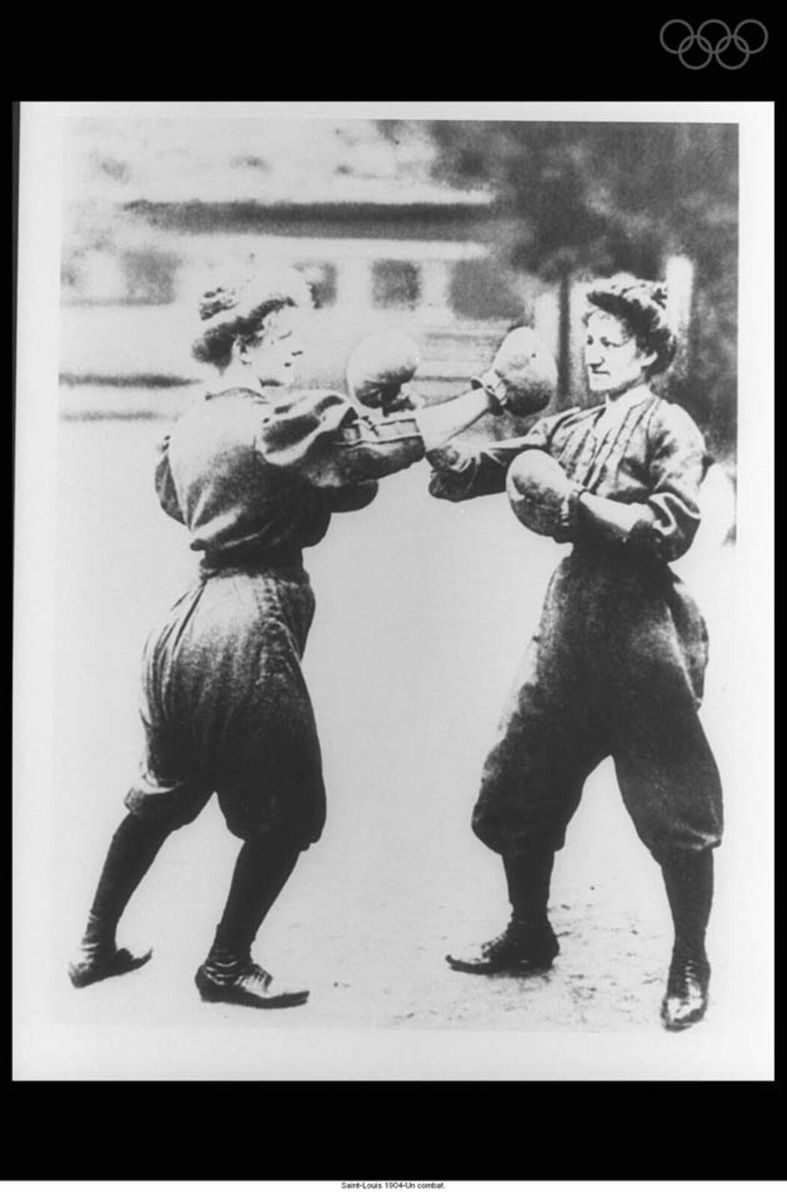
A women's bout, captioned as taking place at the St. Louis Games of 1904.
Whatever this was, it was not a medal event. Women's boxing reached the Olympic programme in 2012, the last sport on it to include women.
Photographer unknown · Public domain · Wikimedia Commons
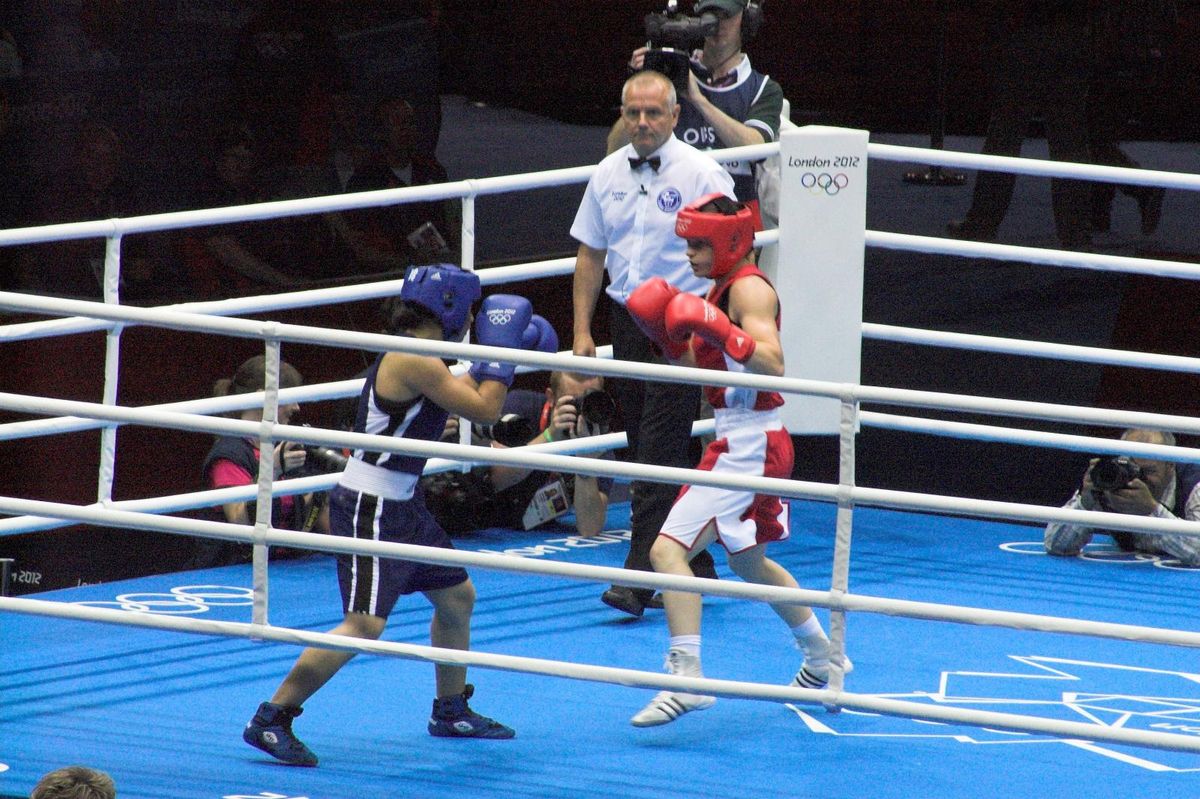
Nicola Adams against Ren Cancan in the women's flyweight final, London 2012.
The final that made Adams the first woman to win an Olympic boxing title. Both boxers wear headguards, as women still do.
Kent Capture · CC BY 2.0 · Wikimedia Commons
07Rule timeline
The sport’s own lane, expanded. Every entry carries a cause from the closed vocabulary and a citation, and says so where the citation is incomplete.
- 1984Safetyadopted 1983
Headguards were made compulsory in amateur competition, including at the Olympic Games. Amateur boxing thereby diverged visibly from the professional sport, and the headguard became the thing that distinguished them.
Trigger and citationIncomplete — no confirmed article
Trigger
Concern about cumulative head injury in a sport where a knockout is a legitimate objective, and pressure from medical bodies on whether amateur boxing should exist at all.
AIBA and IBA Technical and Competition Rules · AIBA Technical Rules, 1984
- 1992Integrityadopted 1989
Scoring moved to a computerised system in which five judges pressed a button for each scoring blow, and a point was recorded only when at least three registered it within about a second of each other. The winner was whoever accumulated more such points.
Comparability break · Measurement scale changed
A judged score became a count of blows registered by a majority of judges within a fixed interval. Different quantity, same name. See the series
Trigger and citationIncomplete — no confirmed article
Trigger
At the 1988 Games, Roy Jones Jr dominated the light-middleweight final and was awarded the loss on a 3–2 decision, in a competition where several results were disputed and an investigation followed. The federation replaced the discretion of judges with an arithmetic they hoped could not be corrupted.
The system had an immediate and widely criticised effect on how boxing was fought: because only clearly separated, individually registered blows counted, combination punching and body work scored poorly, and boxers adapted by throwing single, visible shots.
AIBA and IBA Technical and Competition Rules · AIBA Technical Rules, 1992
- 2013Disputedalso safetyadopted 2013-03
Headguards were removed from elite men's competition, twenty-nine years after being made compulsory. Women's competition and junior categories kept them.
Trigger and citationIncomplete — no confirmed article
Trigger
The federation cited its own analysis indicating that headguards were associated with a higher rate of concussion, on the reasoning that they enlarge the head as a target, obscure peripheral vision, and encourage boxers to take shots they would otherwise avoid.
Independent commentary has questioned both the analysis and the federation's motives, noting that removing headguards made amateur boxing look more like the professional sport at exactly the time the federation was moving to admit professionals. That the change applied to elite men and not to women or juniors is difficult to explain on purely medical grounds. Both readings are recorded; the sources do not settle it.
AIBA and IBA Technical and Competition Rules · AIBA Technical and Competition Rules, 2013
- 2016Broadcast and pacingalso disputedadopted 2015
Computerised point-counting was abandoned and replaced by the ten-point must system used in professional boxing: judges score each round, the winner of a round receives ten points and the loser nine or fewer. Twenty-four years after replacing judgement with arithmetic, the sport returned to judgement.
Comparability break · Measurement scale changed
Back to round-by-round judging on the professional system. The arithmetic introduced to remove discretion was removed, and the discretion returned. See the series
Trigger and citationIncomplete — no confirmed article
Trigger
The point-counting system had produced a style of boxing widely regarded as unwatchable, in which single scoring blows were preferred to combinations. Aligning with the professional system also removed a difference at the moment professionals were being admitted.
Returning to round-by-round judging restored exactly the discretion the 1992 system had been introduced to eliminate, and the judging controversies at the 2016 Games followed almost immediately.
AIBA and IBA Technical and Competition Rules · AIBA Technical and Competition Rules, 2016
- 2016Commercialalso fairness and eligibilityadopted 2016-06
Professional boxers were made eligible for the Olympic tournament, ending the amateur distinction that had defined Olympic boxing since its beginning.
Trigger and citationIncomplete — no confirmed article
Trigger
The federation had been pursuing commercial ventures that blurred the amateur boundary for several years, and the change formalised a distinction that had already stopped meaning much.
AIBA and IBA Technical and Competition Rules · AIBA Technical and Competition Rules, 2016
- 2020Integrityadopted 2019-06
The IOC suspended AIBA's recognition and ran the Olympic boxing tournaments at the 2020 and 2024 Games itself, through a task force, writing the competition and qualification rules directly. The federation, by then renamed IBA, was expelled outright in 2023, and World Boxing was recognised in 2025 for the 2028 Games.
Trigger and citationIncomplete — no confirmed article
Trigger
Findings on judging manipulation at the 2016 Games, together with governance and financial concerns, led the IOC to conclude that the sport had no body it could recognise. An independent investigation subsequently documented that bouts at 2016 had been manipulated.
World Boxing Technical and Competition Rules · IOC Executive Board decisions, 2019 and 2023
08Equipment evolution
Boxing's equipment history is one item, and the sport has changed its mind about it in a way no other sport here has.
Gloves themselves are the founding equipment change and the founding paradox. The Queensberry Rules made them compulsory in 1867 on humanitarian grounds, and the long-run consequence is contested: gloves protect the hands, which allows harder and more frequent punches to the head than bare knuckles permitted. Whether padded gloves reduced harm or redistributed it from the hands to the brain is a genuine argument, and it is more than a century old.
The headguard is the modern version of exactly the same question.
Made compulsory in amateur boxing in 1984, on straightforward safety grounds. Removed from elite men's competition in 2013, also on safety grounds — the federation's argument being that a headguard enlarges the target, restricts peripheral vision, and gives a boxer the confidence to take shots they would otherwise slip, and that its own data showed more concussions with them than without.
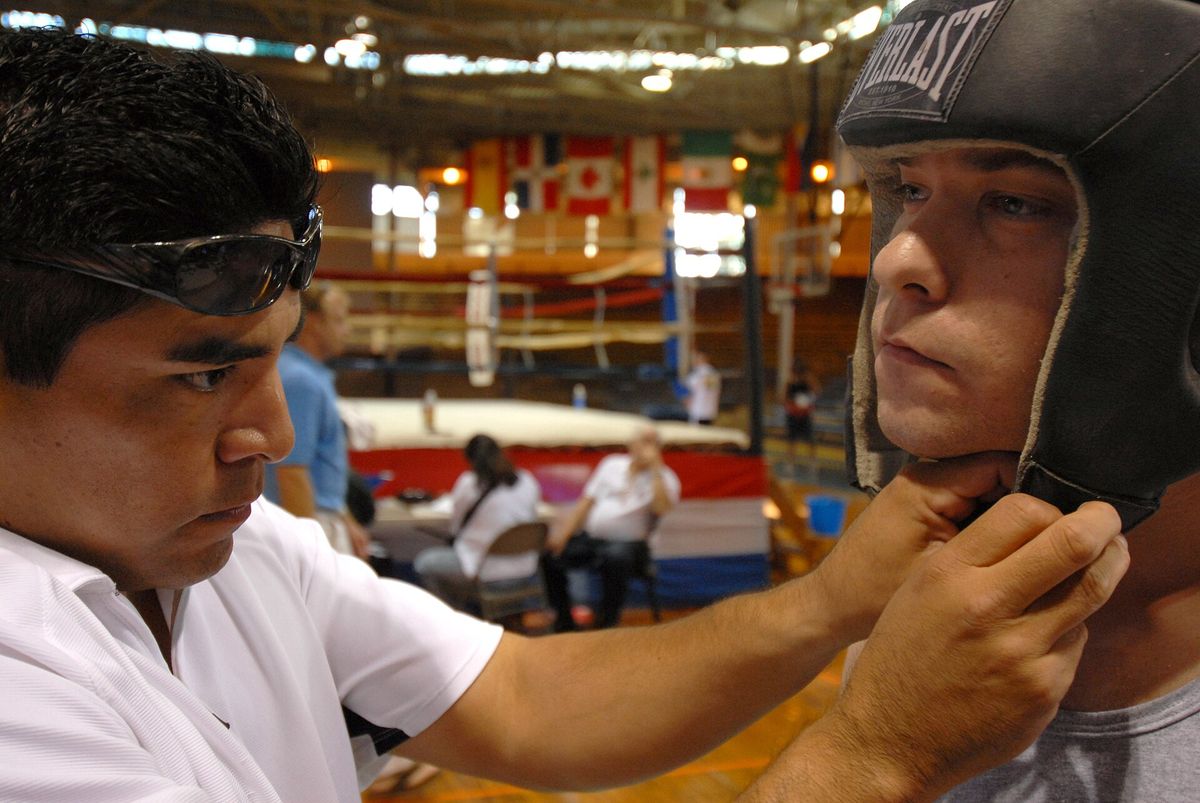
A trainer adjusting a boxer's headguard, Pearl Harbor, 2007.
Compulsory in amateur boxing from 1984, on safety grounds; removed from elite men's competition in 2013, also on safety grounds.
US Navy · Public domain · Wikimedia Commons
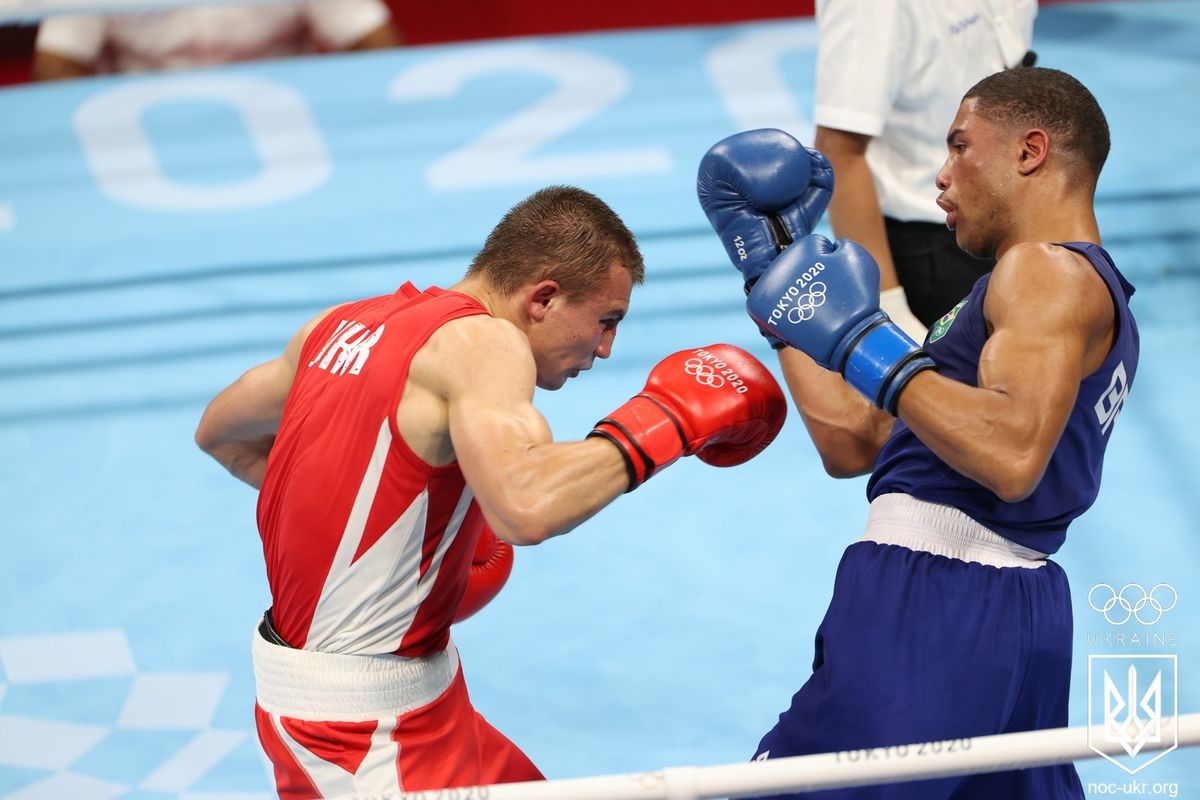
Oleksandr Khyzhniak against Hebert Conceição in the men's middleweight final, Tokyo 2020.
Elite men, bare-headed. The federation argued that the headguard enlarged the target and made concussion more likely; the same rule was not applied to women or juniors.
Ministry of Youth and Sports of Ukraine · CC BY 4.0 · Wikimedia Commons
This is the only rule on this site where protective equipment was removed to
protect people. The entry records it as disputed, for two reasons the
federation has never adequately answered: independent analysts have questioned
the data, and the change applied to elite men only while women and juniors kept
their headguards. A medical finding that applies to one group and not to others
in the same sport requires an explanation, and none was given.
Gloves are specified by weight, wraps by length, and mouthguards are compulsory. Nothing else in the sport is regulated equipment.
09Governing body politics
Boxing is the only sport on this site whose governing body was expelled from the Olympic movement, and the only one whose Olympic tournament has been run by the IOC itself.
The sequence is worth setting out plainly. AIBA governed amateur boxing for decades. Judging controversies recurred across multiple Games. In 2016 the federation withdrew a large number of officials mid-tournament after disputed decisions. In 2019 the IOC suspended AIBA's recognition and established a task force to run the boxing competition at the 2020 Games, writing the rules and the qualification system directly. It did the same again in 2024.
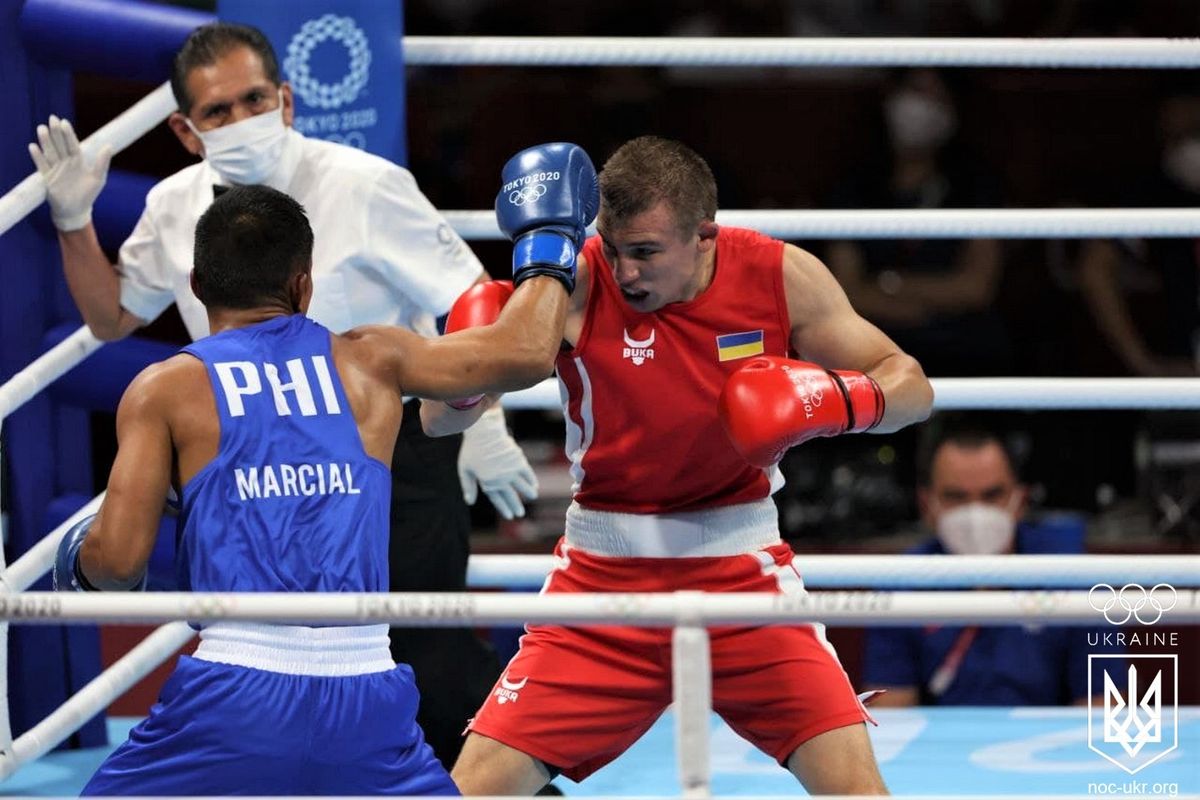
Khyzhniak against Eumir Marcial in the middleweight quarter-final, Tokyo 2020.
A bout in the tournament the IOC ran itself, with its own rules and qualification system, because the sport had no federation it trusted to.
Ministry of Youth and Sports of Ukraine · CC BY 4.0 · Wikimedia Commons
In 2023 the federation, by then renamed IBA, was expelled outright. An independent investigation commissioned by the IOC found that bouts at the 2016 Games had been manipulated — a finding, not an allegation. World Boxing, a new federation, was recognised in 2025 for the 2028 Games.
For two Olympic cycles, therefore, boxing's rules of competition were written by the Olympic movement because the sport did not have a body it could be trusted to. Nothing comparable has happened to any other sport here.
That context matters for reading the rest of this page. The 2013 headguard removal, the 2016 return to professional-style scoring, and the 2016 admission of professionals were all decisions of a federation that was found, within a few years, to have manipulated its own competition. This site does not treat that as evidence about any particular rule's merits, and it does record that the body giving the stated reasons subsequently lost the presumption of good faith.
10Controversies that forced rule changes
Seoul, 1988. Roy Jones Jr dominated the light-middleweight final by any visible measure and was awarded the loss 3–2. It was the most conspicuous of several disputed results at those Games, and it produced the most drastic response to a judging problem in this collection: from 1992, a point existed only when at least three of five judges pressed a button for the same blow within about a second.
The federation replaced judgement with arithmetic. It is exactly what taekwondo would do twenty years later, except that taekwondo used sensors on the athlete and boxing used the judges' fingers — so the arithmetic still depended on the people it was meant to constrain.
What the arithmetic did to boxing. Because only cleanly separated, individually registered blows counted, combinations scored poorly and body work scored barely at all. Boxers adapted by throwing single visible shots and holding. The sport spent twenty-four years being fought in a style its own scoring system had created.
2016, and the reversal. The point-counting system was abandoned for the professional ten-point must system. That restored precisely the discretion the 1992 system existed to remove — and judging controversies followed at the 2016 Games immediately, then the mid-tournament withdrawal of officials, then the suspension of the federation, then an independent finding that bouts had in fact been manipulated.
The headguards, 2013. Removed from elite men's competition on the argument that they increased concussion risk. It remains the most counter-intuitive safety rule on this site and the least satisfactorily explained, because it applied to men and not to women or juniors.
Where it standsthe record, and what is still open · sections 11 to 12
11Series
No series can exist
Bout scores across the scoring systems
Amateur boxing has changed what a score is twice, in opposite directions, and neither change was a rescaling. Until 1992 judges scored a bout on their overall assessment. From 1992 a point existed only when at least three of five judges registered the same blow within about a second — an arithmetic, deliberately built to remove discretion after the 1988 judging scandal. From 2016 the sport reverted to the professional ten-point must system, in which judges score each round on their assessment of it. A bout won 12–7 in 2004 and one won 29–28 in 2018 are not two values of one quantity. The first counts registered blows; the second counts rounds awarded on judgement. The sport went from opinion to arithmetic and back to opinion inside twenty-four years. What makes this the strangest entry in this collection is the direction of travel. Every other sport here that automated a judgement kept it automated — taekwondo, archery, tennis, swimming. Boxing automated, disliked what automation did to the sport, and reversed. And then, three years later, an independent investigation found that bouts under the restored human system had been manipulated.
1992Measurement scale changedA judged score became a count of blows registered by a majority of judges within a fixed interval. Different quantity, same name.
2016Measurement scale changedBack to round-by-round judging on the professional system. The arithmetic introduced to remove discretion was removed, and the discretion returned.
12What is contested now
Recorded as unsettled.
The headguards. Still the most disputed safety rule on this site. The federation's data has been questioned, the change applied to elite men and not to women or juniors without a stated medical reason, and the body that made the decision has since been expelled from the Olympic movement. Whether headguards increase or reduce harm is a genuinely open scientific question, and boxing is currently running both policies simultaneously in different categories.
Whether the sport should be on the programme. Medical bodies have argued for decades that a sport whose objective includes concussing an opponent has no place at the Games. The counter-argument is geographic and social: boxing reaches communities nothing else on the programme reaches. Neither side has moved.
Scoring. The ten-point must system restored the discretion that the 1992 arithmetic was built to remove, and the manipulation finding followed. Sensor scoring of the taekwondo kind has been trialled and not adopted, on the ground that boxing scores quality rather than contact. Whether that is true or convenient is the open question.
Governance. World Boxing was recognised in 2025 and has to rebuild a qualification structure, a judging corps and a set of competition rules that the sport can trust. It is starting from a position no other federation here has ever been in.
Long-term neurological harm. Documented, mechanistic rather than accidental, and not addressed by any rule currently in force.