Contract bridge
A partnership game in which telling your partner anything is an offence, and telling your opponents everything is compulsory.
- Official
- Contract bridge
- Game category
- Outside this taxonomy
- Adjudication
- Decided by score
- Standing
- Never Olympic
- rule changes
- 4
- comparability break
- 1
- Olympic editions
- 0
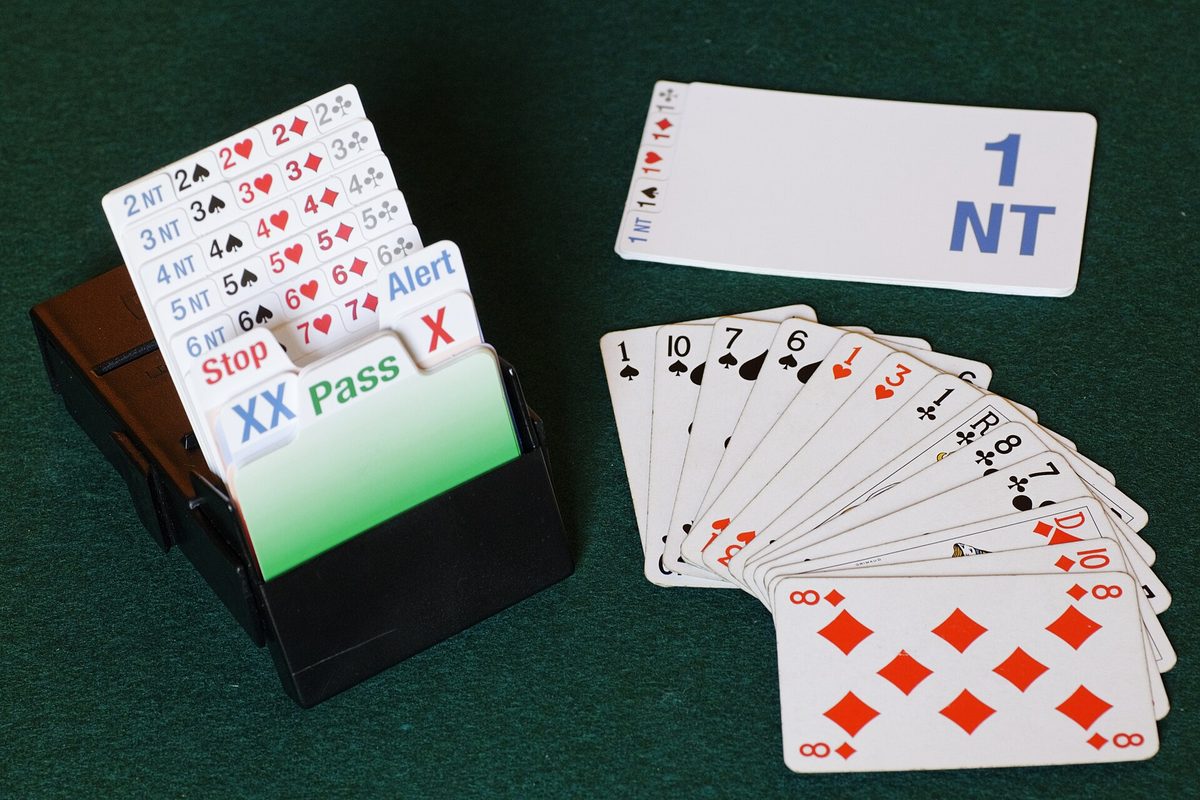
A bidding box, a hand of thirteen cards, and a call of one no-trump · Marie-Lan Nguyen · CC BY 3.0
- Governing body
- World Bridge Federation
- Founded
- Contract bridge was devised in 1925 from earlier whist and auction bridge games; the World Bridge Federation was formed in 1958, and bridge was contested at the Asian Games from 2018.
- Olympic status
- Not on the Olympic programme
- Also contested at
- Asian Games
Four players in two partnerships, bidding for a contract and then playing it out. Two rules make it unlike anything else here. You may not communicate with your partner except through the bids and cards themselves — a hesitation or a tone of voice is an ethical violation. And your partnership's private agreements must be fully disclosed to your opponents on request. The secret is kept from the person you are playing with.
The gamewhat it is now · sections 1 to 5
01How it is played
Four players in two partnerships, thirteen cards each. An auction determines the contract; the side that wins it then tries to make it. In competition the same deals are played at every table and results are scored by comparison.
These figures were entered from the edition named above but have not been checked against its text line by line. Treat them as this site’s reading of the laws, not as a substitute for them.
The object of the game
Win the auction with a contract you can make, then make it — or push the opponents into a contract they cannot.
The auction is a bidding conversation in which each bid is a coded but fully disclosed statement about your hand. The partnership that describes two hands to each other most accurately reaches the right contract, and the play then tests whether the description was true.
- Players
- 4, in two partnerships
- Cards
- 13 each
- Phases
- An auction, then the play
The table
A table for four, with the deal held in a board so the same cards can be passed to the next table and played again.
At the highest level the table carries a screen: a diagonal barrier across it so that partners cannot see each other. Bids are passed under it on a tray. The screen exists to make signalling by expression or gesture physically impossible.
- Boards
- Hold the deal for replay at other tables
- Screens
- At top level, blocking partners' view of each other
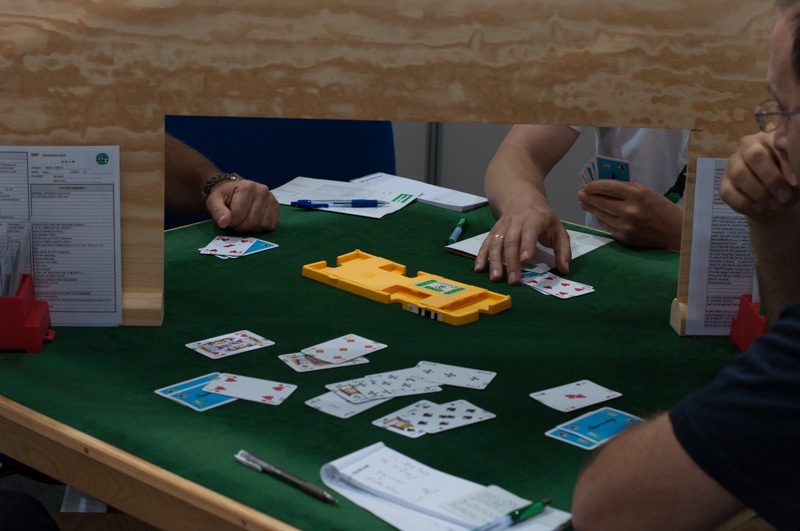
The screen up and the play under way, European Bridge Team Championships, 2014.
Once the auction is over the screen stays: dummy's cards are on the table, and the partners still cannot see each other.
European Bridge League · CC BY-SA 2.0 · Wikimedia Commons
Cards, boxes and cards about cards
A standard 52-card pack, and three items that exist to control information.
Duplicate boards hold each player's thirteen cards in a slot so the deal survives being played and can be passed to the next table.
Bidding boxes replace spoken bids with printed cards laid on the table. This removes tone of voice from the auction — a bid made hesitantly and one made briskly look identical on a card, and the information a voice would leak is not available to leak.
The convention card is a written summary of a partnership's agreements, kept on the table and available to the opponents.
- Bidding boxes
- Remove tone of voice from a bid
- Convention card
- Your agreements, for your opponents to read
- Duplicate boards
- The same deal, played at every table
A bidding box, a hand of thirteen cards, and a call of one no-trump.
Everything a player uses at the table, laid out: the cards, and the box that turns a bid into a printed card.
Marie-Lan Nguyen · CC BY 3.0 · Wikimedia Commons
Players and officials
Four at a table. After the auction, the partner of the player who won the contract becomes dummy: their thirteen cards are laid face up and played by their partner, and dummy takes no further part.
So one player plays twenty-six cards and their partner plays none — a distribution of participation nothing else on this site produces.
A tournament director rules on irregularities and may adjust a score after the fact.
- Declarer
- Plays 26 cards
- Dummy
- Plays none, and may not participate
This clause reads this way because of
Time
Boards are played to a schedule — a set number per round, with a time allowance — and a championship runs over days. There is no clock on an individual decision, though slow play is penalised.
- Session
- A set number of boards per round
Scoring
A contract made scores according to its level, its denomination and whether the side is vulnerable, with bonuses for game and slam; a contract defeated scores to the defenders.
Then the duplicate comparison. In pairs play, matchpoints: you score against every other pair that held your cards. In teams, IMPs: the difference between your table's result and your team-mates' at the other table, converted on a scale.
That comparison is the sport's fairness mechanism. A modest result on a poor hand can be a top if everybody else did worse with it.
- Pairs
- Matchpoints, against everyone who held your cards
- Teams
- IMPs, against your team-mates' table
This clause reads this way because of
Between boards
Boards move between tables and players move between boards, on a published movement, so that over a session every pair meets a defined set of opponents and deals.
There is no restart within a board. A revoke or an irregularity is handled by the director with a rectification or an adjusted score rather than by replaying the hand.
Infringements
Unauthorised information is the sport's characteristic offence, and it is unusual in that the offender may be entirely innocent. If a partner hesitates, or fidgets, or asks a question, they have transmitted something — and the rule falls on the *other* partner, who must then choose among the actions available to them the one least suggested by what they were not supposed to know.
Also: failing to alert a conventional bid, misexplaining an agreement, having undisclosed agreements, revoking, playing out of turn, and slow play.
A director may adjust the score to what would probably have happened without the infraction — an unusual remedy, and one that requires judging a counterfactual.
This clause reads this way because of
Deciding the winner
The highest comparison score over the session, or the team with more IMPs over a match. Because every result is relative to what others did with identical cards, a bridge score says how well you played the hand rather than how good the hand was.
Everything above is current law. Everything below is how Contract bridge got here.
02Disciplines and events
No Olympic events. Bridge was contested at the Asian Games in 2018, holds IOC recognition, and its major competition is a world championship cycle run by the World Bridge Federation.
- Disciplines
- 2
- Olympic medal events
- 0
- Men’s and women’s counted separately.
- Contested elsewhere
- 10
- asian games, world championship, federation only.
- Listed for context
- 1
- Not counted as this sport.
Teams4
Scored in IMPs against a team-mate pair holding the same cards at another table.
- Open teamsAsian GamesWorld championship
- Women's teamsAsian GamesWorld championship
- Mixed teamsAsian GamesWorld championship
- Seniors teamsWorld championshipA full championship category — bridge is one of very few sports where a seniors title is a serious competitive event rather than a veterans' one.
Pairs3
Scored in matchpoints against every other pair that held your cards.
- Open pairsAsian GamesWorld championship
- Women's pairsWorld championship
- Mixed pairsAsian GamesWorld championship
Where bridge actually lives3
The overwhelming majority of duplicate bridge is club play, and a large and growing share is online.
- Club duplicateFederation onlyWeekly sessions run by local clubs, which is where nearly all the sport happens.
- Online bridgeFederation onlyLarge commercial platforms, which grew sharply during the pandemic and brought their own cheating problems — screens cannot be built into a website.
- Rubber bridgeFederation onlyThe social, non-duplicate form; decided substantially by the cards, and not a competitive sport.
03Officiating
A tournament director rules on things that already happened, and often on what would have happened instead.
Irregularities are the routine work: a revoke, a lead out of turn, a bid out of turn, an insufficient bid. The Laws prescribe rectifications for each, and applying them correctly is technical rather than judgemental.
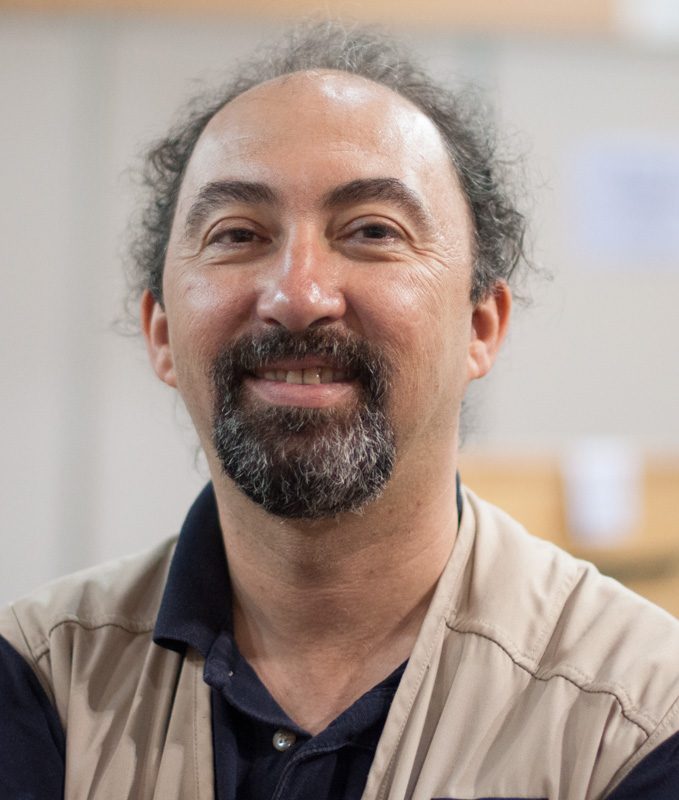
Rahmi Iyilikci, tournament director, European Bridge Team Championships, 2014.
The official who rules on what happened at a table, and when a partner has had information they were not entitled to, on what would probably have happened instead.
European Bridge League · CC BY-SA 2.0 · Wikimedia Commons
Unauthorised information is where the difficulty is, and it has no counterpart on this site. When a player hesitates, or asks a question, or fidgets, their partner has received information they were not entitled to. The director must then decide whether the partner's subsequent action was one that a player without that information could reasonably have chosen. If it was not, the score is adjusted.
That involves ruling on a counterfactual — what would probably have happened at this table had the infraction not occurred — and directors consult expert opinion on what actions were "logical alternatives" for a player of that standard. It is the only officiating decision covered here that requires reconstructing an alternative history of the contest.
Adjusted scores follow from that, and they are unusual as a remedy: rather than penalising, the director substitutes the result that probably would have occurred.
Screens shift the officiating burden into the equipment. With partners unable to see each other, a whole class of infraction becomes physically impossible and does not need to be judged at all.
Appeals committees hear disputes on the ruling, which makes bridge one of very few sports here with a routine appellate process on individual decisions.
04Where it is played
Old money, old clubs, and one country where it is genuinely a mass sport.
Europe is bridge's heartland: Italy, the Netherlands, Norway, Sweden, Denmark, Poland, France, England and Germany all have deep club structures and strong national teams, and Italian and Dutch partnerships have dominated long stretches of the sport's history.
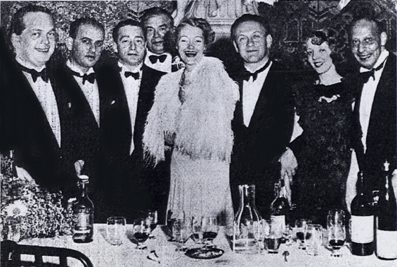
Austria's winning team in 1937, with two American players.
European teams dominated long stretches of the sport's history; Austria won the world title that year.
Photographer unknown · Public domain · Wikimedia Commons
The United States has the largest single national organisation and a dense tournament circuit.
China has invested seriously and is now a leading nation, and bridge has significant participation there in a way it does not elsewhere in Asia — though India, Indonesia, Japan, Chinese Taipei and Singapore all compete, and it was Indonesia's hosting that brought bridge to the Asian Games in 2018.
The distinctive geographic fact is age. In most of bridge's strongholds the playing population is markedly older than in any other sport covered on this site, and shrinking. Clubs that ran full sessions for decades are closing, and the pipeline of new players is thin because the game's entry requirement — four people, two partnerships, a shared learned system — is difficult to satisfy casually.
Where bridge is growing it is generally because a national body has put it into schools deliberately, which China and several European federations have done. Online platforms have added players and have not replaced the club structure that teaches them.
05Learning curve
A pack of cards and three other people, and one of the longest learning curves of anything on this site — because you are not learning a game so much as a language you must speak with a partner and translate for your opponents.
Editorial — the site’s reading, not a sourced claim
Barrier to entry
How hard is it to get to a real game?
A pack of cards, three other people, and a bidding system you both have to learn.
The materials cost nothing and the play of the cards is learnable quickly — follow suit, win tricks, count.
The barrier is the auction. A bid is a coded statement, and the code is a partnership agreement that both players must know identically. So a beginner is not learning rules; they are learning a system, with a partner, and neither of them can use it until both do. That is a much steeper start than any other game covered here.
The other barrier is the fourth person. Bridge needs four, in two committed partnerships, at the same time, repeatedly — an organisational demand that chess and go do not have and that has done bridge real demographic damage.
Clubs teach it well, and the teaching structures are among the best of any sport here. They are also mostly full of people who started decades ago.
Evidence
- Kit to startA pack of cardsobserved
- Players needed4observedIn two committed partnerships.
- The auctionA learned systemrule1958 — the rule this rests on
- Physical demandNoneestimate
- Time to a real gameWeeks to monthsestimate
Barrier to the top
How hard is it to be good at?
Describing a hand precisely to a partner who may be told nothing, while your opponents read your notes.
The information structure is the difficulty, and it is unlike anything else on this site.
You must convey your hand to your partner using only bids and cards. You may not convey it any other way, and if your partner accidentally conveys something to you — a pause, a question — you are then obliged to act as though you did not notice, and choosing the action least suggested by information you were not supposed to have is one of the hardest ethical and technical judgements in any sport.
Meanwhile your opponents may read your convention card and ask what your bids mean. So a partnership's system must be sophisticated enough to describe hands precisely and robust enough to survive the opposition knowing exactly how it works.
The card play adds a second discipline: counting the hand, inferring the unseen distribution from the bidding and the cards played, and deceiving opponents within the rules.
And a partnership is a long-term unit. Top pairs play together for decades, because the system is only as good as the shared understanding of it — the same constraint this site records for dancesport.
Evidence
- No communication with partnerBeyond bids and cardsruleAn unintended hesitation constrains the innocent partner, not the leaker.1958 — the rule this rests on
- Full disclosure to opponentsCompulsoryruleYour system must work while the opposition knows it.1958 — the rule this rests on
- Duplicate comparisonThe same deals everywhereruleLuck of the deal is removed, so every result is a judgement on you.1958 — the rule this rests on
- Typical peak age35–60estimateThe latest peak of any sport covered here.
Why the two differ
Moderate to very high, and bridge holds a distinction on this site that nothing else comes close to: it is the sport where competitors are at their best latest in life.
Nothing decays. There is no physical component to lose, and the game rewards accumulated pattern recognition, systemic knowledge and partnership understanding built over decades. World-class players competing into their sixties and seventies are ordinary rather than remarkable.
The gap's shape is also inverted relative to most sports here. Usually the entrance is easy and the ceiling is physical. Here the entrance is the hard part — you must learn a system with a partner before you can play properly at all — and the ceiling is reached by people who never stopped.
What that has not produced is a healthy demographic. Bridge's participation is old and shrinking in most countries, because a game requiring four committed people and a shared learned language is a difficult thing to start in a world of instantly available alternatives.
The historyhow it got here · sections 6 to 10
06Origin and invention
Contract bridge was devised in 1925 and the change that created it was a scoring rule.
The game descends from whist, through bridge whist and auction bridge, and by the early 1920s auction bridge was the dominant form. It had an auction, and the auction did not matter much: tricks made above the contracted level still counted towards game, so bidding aggressively cost nothing and the bidding conveyed little.
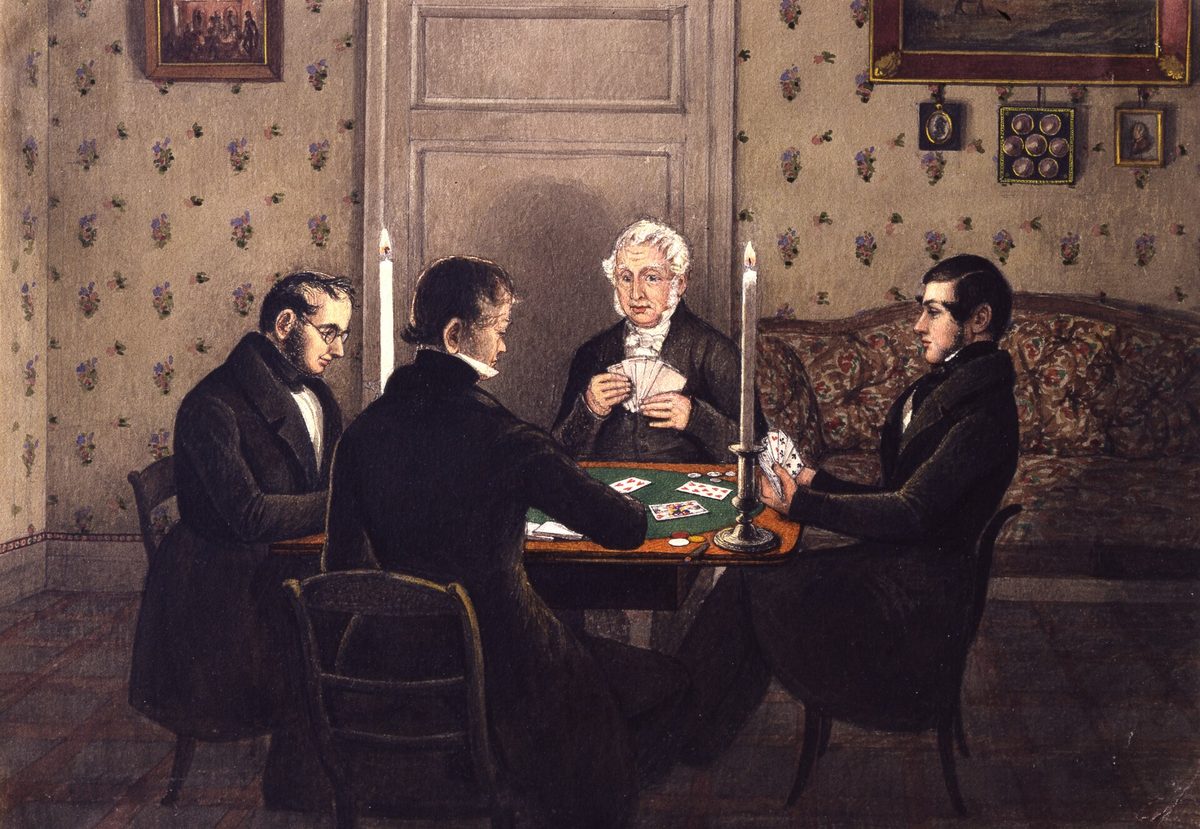
Johann Anton Sarg and three friends playing whist.
A painting in York Art Gallery of the ancestor game: four players, two partnerships, tricks. Whist had no auction at all, which is the part contract bridge was built around.
Artist unknown (York Art Gallery) · Public domain · Wikimedia Commons
Harold Vanderbilt's revision — worked out, in the well-known account, on a cruise through the Panama Canal in 1925 — was to credit towards game only the tricks a partnership had actually contracted to make, and to penalise failure according to vulnerability. Overbid and you are punished; underbid and you have wasted the hand.
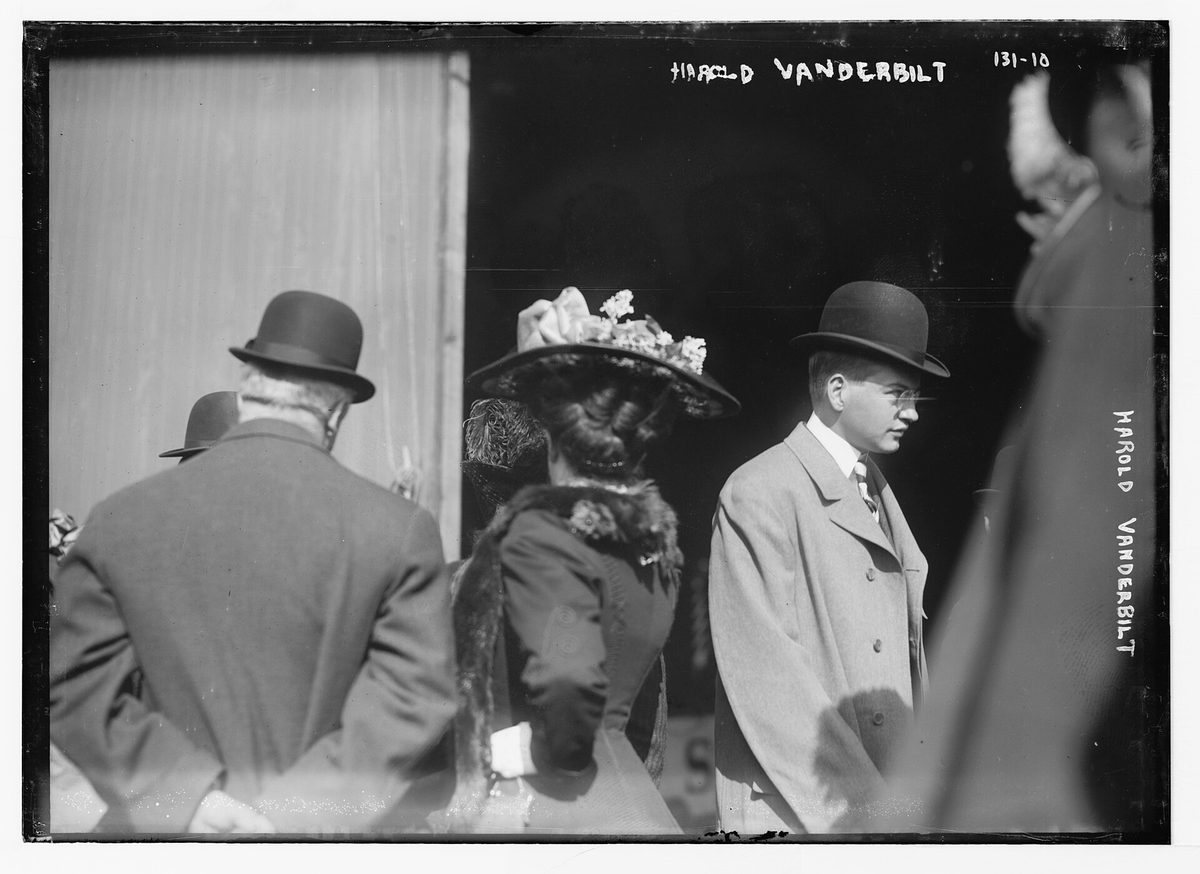
Harold Vanderbilt, photographed for the Bain News Service.
The man whose 1925 scoring revision created contract bridge: only the tricks a partnership contracted for counted towards game, and the auction became the game.
Bain News Service · Public domain · Wikimedia Commons
That turned the auction into the game. A bid became a precise statement about a hand, and the partnership that describes two hands to each other most accurately reaches the right contract. Everything distinctive about bridge follows from that one scoring change.
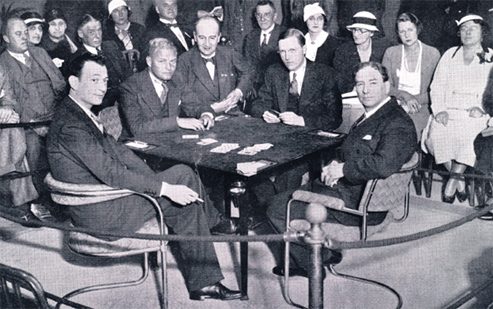
Players and spectators at the Culbertson–Beasley match, 1933.
Eight years after the revision, contract bridge was a public event, played in front of an audience by the people who were writing its bidding systems.
Photographer unknown · Public domain · Wikimedia Commons
The competitive form followed. Duplicate play — the same deals at every table, scored by comparison — removed the luck of the deal, which is what made bridge a sport rather than a card game. The World Bridge Federation was formed in 1958.
Bridge was contested at the Asian Games in 2018. It holds IOC recognition and has never been on an Olympic programme — and in 2017 a European court ruled that it is not a sport at all, for the purposes of a tax exemption, on the ground that it lacks a significant physical element.
07Rule timeline
The sport’s own lane, expanded. Every entry carries a cause from the closed vocabulary and a citation, and says so where the citation is incomplete.
- 1925Fairness and eligibilityadopted 1925
Contract bridge replaced auction bridge by changing one thing about scoring: a partnership only receives credit towards game for the tricks it contracted to make. Bidding more than you can make is punished, and bidding less than you can make wastes the hand. That single change turned the auction from an opening formality into the substance of the game. A bid is no longer a claim on the right to play; it is a precise statement about your hand, and the partnership that describes two hands most accurately to each other reaches the right contract.
Trigger and citationIncomplete — no confirmed article
Trigger
Auction bridge rewarded overbidding, because tricks made above the contract still counted towards game, so the auction carried little risk and less information.
Laws of Duplicate Bridge · Laws of Duplicate Bridge, scoring
- 1958Fairness and eligibilityadopted 1958
Competitive bridge is played duplicate: the same deals are played at every table, and a result is scored by comparison with what everybody else achieved holding those identical cards. This removes the luck of the deal almost entirely, which no other card or dice game has managed. A player dealt a poor hand is not disadvantaged — every other pair sitting their direction was dealt the same poor hand, and the question is what you did with it relative to them. It is the most effective randomness-control mechanism on this site. Golf invented the handicap to make unequal players comparable; bridge made the deal itself constant.
Comparability break · Scoped to one competition
A duplicate result is relative to the field that played the same deals. It has no meaning outside that session. See the series
Trigger and citationIncomplete — no confirmed article
Trigger
Rubber bridge, played with freshly dealt hands, is decided substantially by the cards, which makes it unusable as a competitive sport.
Laws of Duplicate Bridge · Laws of Duplicate Bridge
- 1958Integrityalso fairness and eligibilityadopted 1958
Two obligations that pull in opposite directions and together define the sport. Full disclosure: a partnership's bidding agreements are not secret from the opponents. They are written on a convention card the opponents may consult, unusual bids must be alerted, and an opponent may ask what any bid means and must be told accurately. No communication: a player may convey information to their partner only through the bids and cards they actually make. A hesitation, an inflection, a mannerism or a gesture that conveys anything is an offence — and using information a partner leaked, even unintentionally, is itself an offence. So the information is public to the people trying to beat you and closed to the person helping you.
Trigger and citationIncomplete — no confirmed article
Trigger
A partnership with private agreements has an advantage that has nothing to do with skill, and a partnership able to signal outside the bidding has an unbeatable one. Both were dealt with by the same body of law.
Laws of Duplicate Bridge · Laws of Duplicate Bridge, disclosure and unauthorised information
- 2017Disputedadopted 2017
A European court ruled in 2017 that duplicate contract bridge is not a sport for the purposes of a tax exemption, on the ground that it does not involve a significant physical element. The ruling changed no rule of bridge and is recorded here because it is one of very few occasions on which the question this site's learning layer asks informally — is this a sport — has been answered by a court with consequences attached. Cheerleading has faced the same question in American litigation about educational funding. Bridge lost its version of it.
Trigger and citationIncomplete — no confirmed article
Trigger
The English Bridge Union sought treatment as a sport for a tax exemption, and the question was referred upward for a ruling on what "sport" means in that legislation.
The federation's position is that bridge is recognised as a sport by the IOC and by numerous national bodies, and that a tax definition is not a general verdict. The court's reasoning turned specifically on physical activity. Both are recorded.
Laws of Duplicate Bridge · European Court of Justice ruling, 2017
08Equipment evolution
A pack of cards, and then three inventions whose entire purpose is to stop information leaking.
Duplicate boards hold each player's thirteen cards in a numbered slot so that the deal survives being played and can be passed to the next table intact. Without them there is no duplicate bridge, and without duplicate bridge there is no competitive bridge — the cards would decide too much.
Bidding boxes replaced spoken bids with printed cards laid on the table. The stated reason is noise and clarity; the real one is tone. A bid made after a pause, or briskly, or reluctantly, tells a partner something the rules forbid them to be told, and a card laid on a table has no tone. It is a piece of equipment designed to remove a channel of communication from the game.
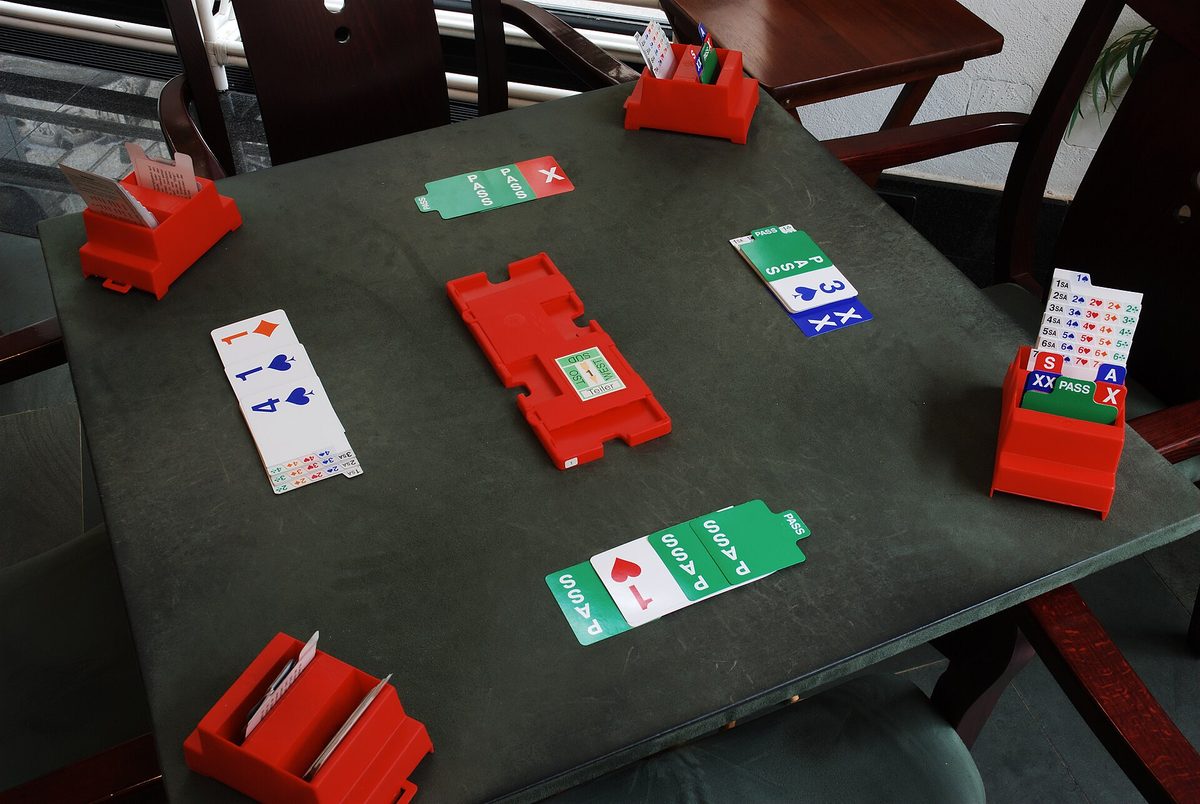
An auction made with bidding boxes: each call is a printed card laid on the table.
The stated reason is clarity. The effect is that a bid has no tone of voice, no pause and no emphasis for a partner to read.
KoeppiK · CC BY-SA 3.0 · Wikimedia Commons
Screens go further. At the highest level a diagonal barrier crosses the table so that partners cannot see each other at all, with bids passed underneath on a sliding tray. A player can therefore see one opponent and their partner is invisible to them. Screens were adopted after cheating scandals in which partnerships were accused of signalling by gesture, expression and card placement, and they are the most direct physical anti-cheating apparatus on this site.
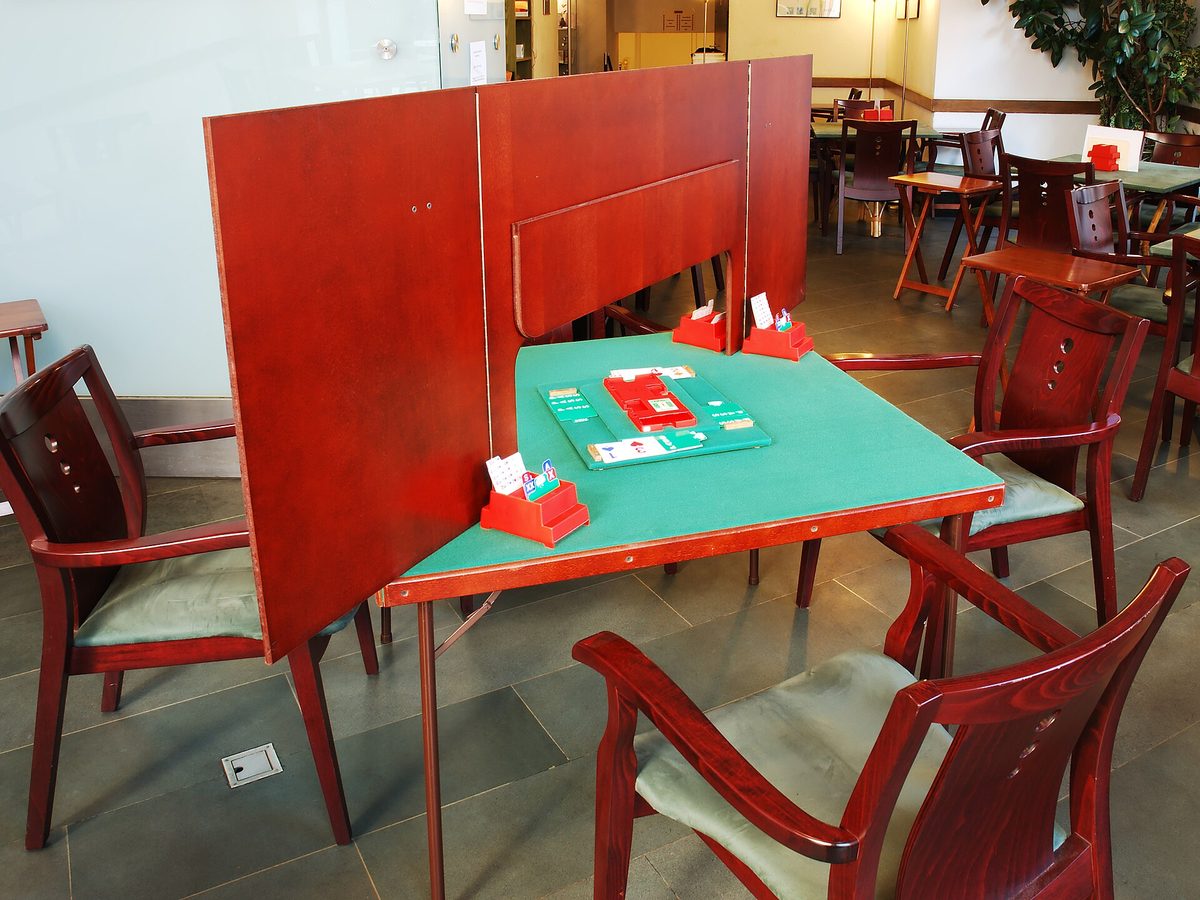
A bridge table with a screen, the tray and board in the middle.
A diagonal barrier across the table, with a door under which the tray is passed. Each player can see one opponent and cannot see their partner.
KoeppiK · CC BY-SA 3.0 · Wikimedia Commons
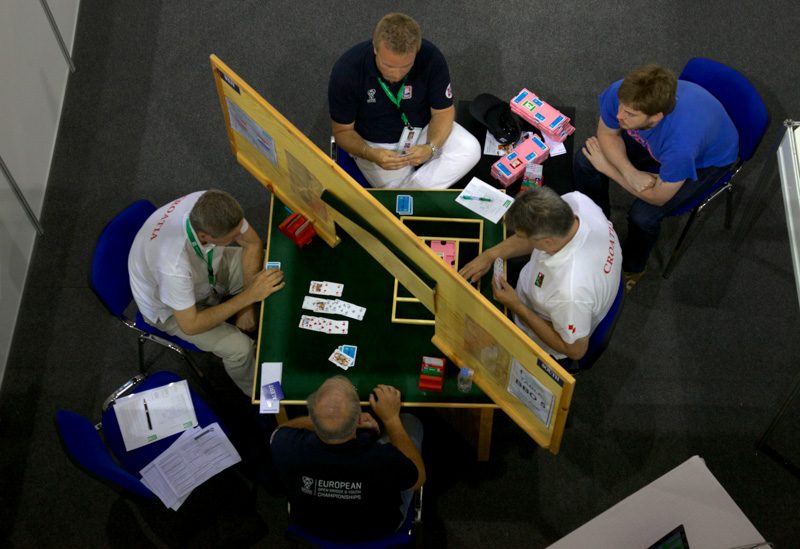
A screened table at the European Bridge Team Championships, Opatija, 2014, seen from above.
The screen as it works in play: two partnerships, each split down the middle, with the bids passed on the tray.
European Bridge League · CC BY-SA 2.0 · Wikimedia Commons
The convention card is the opposite kind of object: a written summary of a partnership's private agreements, kept on the table for the opponents to read.
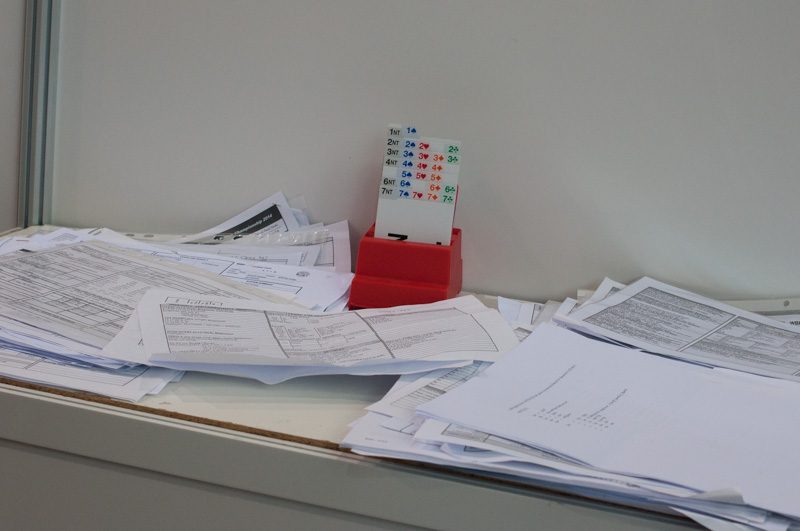
Discarded convention cards and a bidding box, European Bridge Team Championships, 2014.
The opposite kind of equipment: a written account of a partnership's private agreements, kept for the opponents to read.
European Bridge League · CC BY-SA 2.0 · Wikimedia Commons
So bridge's equipment list divides neatly. Some of it exists to keep your partner from learning things. The rest exists to make sure your opponents do.
09Governing body politics
Bridge is well governed, internationally recognised, demographically in trouble, and was told by a court that it is not a sport.
The World Bridge Federation, formed in 1958, runs a serious world championship cycle and holds IOC recognition. Bridge reached the Asian Games in 2018. On paper that is a strong institutional position for a game with no physical component.
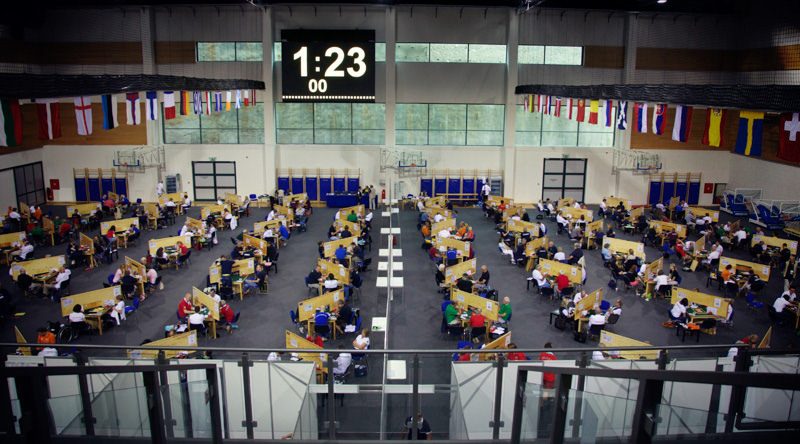
The playing area of the European Bridge Team Championships, Opatija, 2014.
A serious championship, well run: rows of screened tables in a sports hall, and a clock over them. What it does not have is anything for a spectator to watch.
European Bridge League · CC BY-SA 2.0 · Wikimedia Commons
The 2017 European court ruling is the sharpest thing in its politics. Asked whether duplicate bridge qualified as a sport for a tax exemption, the court said no, on the ground that it does not involve a significant physical element. The federation's answer — that bridge is recognised as a sport by the IOC and by many national bodies, and that a tax definition is not a general verdict — is reasonable and did not prevail. This site records the same question being litigated for cheerleading in the United States, with the same lack of a settled answer.
The federation's real problem is not definitional. Bridge's playing population is old and shrinking across most of the countries where it is strong, and the reason is structural: the game needs four committed people at the same time, in two partnerships, each of which must learn a shared bidding system before either can play properly. That is a difficult product to sell against alternatives available instantly and alone.
Online play grew sharply and brought its own crisis: screens and bidding boxes cannot be built into a website, and a partnership communicating by any other channel is undetectable in a way it is not across a table. Several high-profile cheating cases followed, and the sport has had to build detection systems it did not previously need.
10Controversies that forced rule changes
Signalling between partners. Bridge's defining controversy and the source of most of its apparatus. Because a partnership legitimately communicates through bids and cards, illegitimate communication through anything else is both devastating and hard to prove. Major championships have been disrupted by accusations of coded coughs, finger positions, card placement and the angle at which a board was held.
The responses were physical. Bidding boxes removed tone of voice. Screens removed sight of a partner entirely. Both are equipment introduced to make a category of cheating impossible rather than merely illegal.
Unauthorised information. The subtler and more common problem, and the one that produces bridge's strangest rule. A hesitation transmits something even when nobody intended it — and the law falls on the innocent partner, who must then choose among their available actions the one least suggested by what they were not supposed to know. A player can be penalised for doing the right thing for a reason they were not entitled to have.
Online play. Screens cannot be built into a website, and a pair on a video call is undetectable across a server. The move online produced cheating cases and forced the sport to develop statistical detection it had never needed.
Whether it is a sport. Settled against bridge in a 2017 tax ruling, unsettled everywhere else, and consequential for funding in several countries.
System complexity. Highly artificial bidding systems are powerful and opaque, and regulation limits which conventions may be used at which level — a rule limiting how sophisticated a partnership's private language may be.
Where it standsthe record, and what is still open · sections 11 to 12
11Series
No series can exist
A comparable score
Bridge scores are relative by construction and cannot be placed on any axis that runs between events. A duplicate result is a comparison. In pairs, a matchpoint score says how you did against everybody else holding those cards on that day, in that field. In teams, an IMP margin says how you did against one other pair at one other table. Neither number means anything outside the session that produced it, and both are bounded by the field's size rather than by performance. A top on a board is a top whether you beat the field by one trick or five. Two identical percentage scores in different events describe different achievements against different opposition. This is not a defect. It is the mechanism that makes bridge fair: comparing results across identical deals removes the luck that would otherwise decide the game, and the price of that comparison is that the number only exists inside the comparison. What the sport does have is masterpoint and ranking systems that accumulate across events, but those measure participation and placing over a career rather than strength on a common scale — they are not the instrument chess has, and the federation does not present them as one.
1958Scoped to one competitionA duplicate result is relative to the field that played the same deals. It has no meaning outside that session.
12What is contested now
Recorded as unsettled.
Whether it is a sport. Answered no by a European court in 2017 for tax purposes, answered yes by the IOC's recognition and by the Asian Games. The question has funding consequences in several countries and no settled answer.
Online cheating. Screens and bidding boxes cannot exist on a website, and a partnership communicating by any outside channel is very difficult to detect. The sport has built statistical detection and high-profile cases have divided it, because the evidence is probabilistic and the accusations are career-ending.
Unauthorised information. The rule that penalises the innocent partner is correct in principle and produces rulings that feel unjust to the person penalised. Every serious event generates disputes about it, and the appellate process exists because of it.
System regulation. How artificial a partnership's bidding system may be is capped, and the caps are argued between those who see complex systems as the sport's intellectual frontier and those who see them as a barrier to entry.
The demographic. Bridge's population is old and shrinking across most of its strongholds. Federations know it, school programmes are the main response, and nothing has yet reversed it.
Whether the Asian Games place survives. Bridge appeared in 2018. Its presence on any programme depends on hosts willing to stage a sport that requires quiet rooms and produces no spectacle, and there is no reliable argument the federation can make about that.